Showing posts with label Svetovid. Show all posts

Friday, 27 September 2024

Utu

 Utu, Sun: 𒀭𒌓

According to this table, this means god, heaven + day = sun...

But, did the god sign originally mean shiny thing (sun, star)? And did the day sign originally mean "eye"? 

Because if the did, then we would get: shiny thing + eye = to see = sun? 

Makes a lot of sense...At least to me...Cause I am a Slav...Cause Slavs have Svetovid...

svet (world)

svetlo (light)

vid (sight)

Svetovid (sun god) = world, light + to see = sun  

I talked about this in my post "Svetovid"...

Thanks to @selineith for the original sun pic...

Saturday, 13 July 2024

St George of the Sprouting Crown

St George of the Sprouting Crown. Ethiopia, 19th c

What does this mean? Let me try to explain...

I'll start with the excerpt from my post "Letnitsa treasure":

Snakes are solar animals. They are in our world when sun is in our world (hot part of the year) and they are in the underworld when sun is in the underworld (cold part of the year)...I talked about this in my post "The chthonic animal"

Snakes are symbol of the sun and the sun's heat. They are also symbols of the beginning of summer, as vipers, the most common Eurasian snakes, start mating in Apr/May, beginning of summer...

And dragons, old snakes, are symbol of the old sun, destructive summer sun which burns the land and causes drought. Steals and guards water...Which is why in Slavic mythology, dragon, always breathes fire...

And which is why in the past, during spring droughts, Serbs used to go to mountain lakes, on St George's day, and pray for rain on lake shores "to the dragons living in the lake who swallowed the rain"...

I talked about this in my post "Dragon who stole rain"...

There is actually a Serbian belief that "a snake got wings when it lived over 100 years, after which it flew away to live in lakes and waters"...Just like a Dragon...

This is in addition to the belief from Ukraine and Poland that snakes once had wings and flew in the sky. But the sun burned their wings and they fell on the ground. I wrote about this in my article about Slavic belief in the link between snakes and sun...

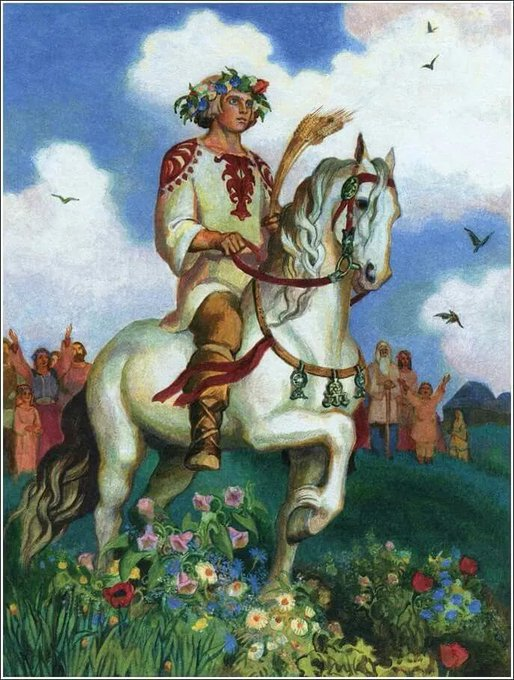
Now, there is an interesting Slavic word "jar" which means young, green, spring...It is the root of the name of the Slavic sun god, Jarilo (pronounced Yahreeloh)...He is the life giving spring and early summer sun that brings back life to the frozen earth...Here is a depiction of Jarilo painted by Russian artist Andrey Shishkin...

Jarilo is the original Green Man...This is Zeleni Jura (Green Jarilo) walking the earth. Part of Jurjevanje, celebration of the spring return of Jarilo, Sun god, from the land of the dead...Bela Krajina, area inhabited by descendants of Serbians who migrated here during Turkish invasions of the Balkans. Today split between Croatia/Slovenia...

But the root "jar" can also mean "brightly burning" and "raging, furious"...

This means that Jarilo can also mean "The Scorcher", the life destroying burning sun of the late summer and early autumn...

Two suns, young and old, the life creator and life destroyer...In one...

Jurjevo, the celebration of the return of Jarilo, is today known as St George's day. St George is basically Christianised Jarilo...

Jurjevo is the celebration of the beginning of the summer, the domain of the sun...And dragons...Because as the summer goes on, and the sun gets hotter and hotter, snake, the symbol of sun's heat, grows older and older and eventually turns into dragon, the symbol of destructive sun's heat...

Jarilo, The Scorcher, The Dragon...To whom Serbs, sacrificed rams during droughts, on St George's day, with blood poured into the lake, for the dragon who stole rain...

Funny...

St George = Jarilo = Dragon...

By the way, Serbs believed that the Snake King, who is "An Old Male snake", The Dragon, also had a "green branch in his mouth"...

Interesting right? 

Snake King = Dragon = Jarilo = Green man...

By the way, the dragons who steal princesses in the Balkan fairytales usually live in palaces...They are kings...Snake kings...

Jurjevo, Jarilo's day, the day when spring ends, summer begins (what Beltane, Mayday marks too) is at the same time the celebration of good spring sun and bad summer sun. The day of thanks for the spring and prayers for the summer...

And every year, on The Day of Jarilo, the Spring Earth, Vesna, The Maiden, is "sacrificed" to the The Dragon, Jarilo (Bad Summer Sun). Except every year, St George, Christianised Jarilo (Good Summer Sun) arrives and kills the Dragon (Bad Summer Sun) and saves the Princess (Earth) from being killed (burned) by the Dragon, Jarilo (Bad Summer Sun)...

The best way to control Jarilo, The Dragon, is to Christianise him and to turn the Dragon into it's opposite...The Dragon Killer...

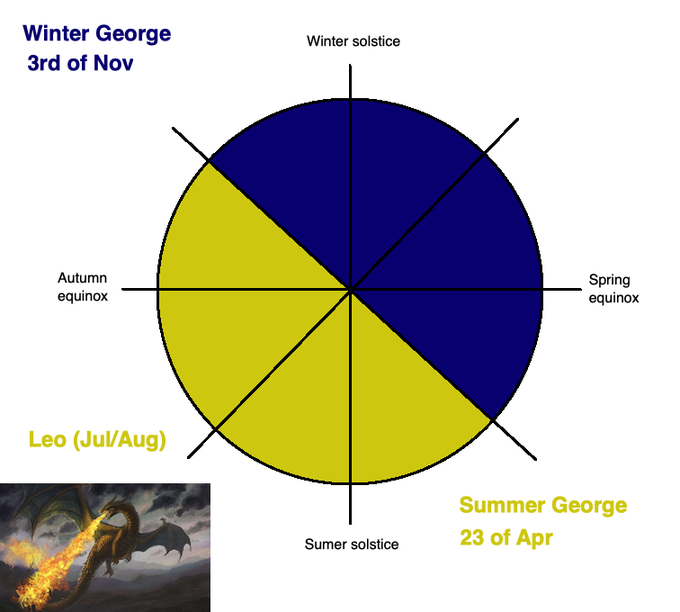
In Serbian Orthodox church tradition, the beginning and the end of the "Time of Dragons", the hot sunny half of the year, is marked (guarded) by Two Georges, Summer and Winter St Georg (e's day)...I talked about this in my post "Two Georges"...


One very interesting thing. St George is mostly depicted riding a white horse when he is doing his dragon killing...

(White) Horse is one of the most widespread solar symbols. For instance, Slavic Sun god Svetovid, also rode on a white horse, and white horses were kept in his temples...I wrote about that in my post "Svetovid"...

Celtic solar horse coin. 

Articles about solar horse (equid)

Iran "Water carrier equid", "Dioscuri plate from Iran"

Mesopotamia "Shamash playing with the solar horse", "Sun god from Tell Brak"

India "Hayagriva"

China "Longma", "Three legged crow", "Mythical beast from Xian"

Levant "Alexamenos graffito", "Goddess on a horse", "Unicorn"

Europe "Archaic rider", "Beotian solar pyxis", "Pegasus and chimera", "King John", "The horseman"

We find white horse as a solar symbol even in Jarilo (pronounced Yareeloh) folklore (mythology) where Jarilo "arrives on a white horse"...

What is very interesting is that Radoslav Katičić and Vitomir Belaj, who attempted to reconstruct the mythology surrounding Jarilo, came to the conclusion that he had "equine characteristics", basically that he is both the (solar) rider and the (solar) horse...

From the Animal Calendar Markers point of view, this is pretty clear. The "solarness" 🙂 of equids and their link with Sun gods stems from the fact that horse fertility is governed by sunlight...It starts in Apr/May (start of summer, St George's day) and peaks on Summer Solstice. I talked about this in my post 

This is why...

Horse zodiac symbol is disguised as Dioskuri, divine twin horsemen. The guys who wanted to marry "the daughters of the white horse". They mark Summer Solstice, the peak of the horse mating season, characterised by wild stallion fights for mares...

I talked about this in my posts "Hayagriva", "Dioscuri plate from Iran"...

Anyway, this is also why in Slavic folklore, horse is a symbol for a "young groom"...Which is another disguise for Jarilo, in his "Young Spring Sun" phase, when he marries Vesna, Young Spring Earth....

To read more about ancient animal and plant calendar markers, which were the key to deciphering all this, check my blog posts related to animal calendar markers, and then check my twitter threads I still didn't convert to blog post...I am way behind now...

Friday, 2 July 2021

Lords of divination

In Serbian the expression "On vedri i oblači" means "he rules", "he has absolute control, absolute power". Literally this expression means "he makes the sky clear and cloudy"...


I talked about this in my post "The power of the Thunder Giant"...

This expression was obviously originally applied to the sky god, The God, The Lord of the early agricultural societies and the peasants, particularly the wheat farmers, whose lives depend on the climate being just right...

The sky god, the sky father, was over time split into Sun god (Svetovid) and Storm god (Perun)...

But the fact that these were just two faces of the old Sky god was preserved in Serbian folklore in Dabog (Giving God, The Sky Father)...

You know that you are dealing with someone powerful when his name is "Giving god"...This means that he can also not give if you piss him off..

Dabog was seen as both the sun god, and as the rain god...

Serbs also preserved the notion of the Sun and Thunder god being one and the same in their "thundering saint" Elijah the Thunderer...

He is seen as the burning sun of the late summer and as the cooling rainstorm of the early autumn...

Elijah the Thunderer is celebrated at the end of summer and start of autumn, on the old day of Perun's victory over Veles...But Elijah is both Veles, The Dragon (Drought) who steals Perun's "heavenly cows" (clouds), and Perun, The Dragon Killer...

I talked about this in my post "Dragon that stole rain"...

The other day I thought that I guess you could say that there is only one God in the sky, and that is The Sun...It is The Sun that both takes away the heavenly cows (causes drought) and mercifully returns them...If you pray enough...

I think that the Ancient Sumerians had the same view of heaven and who's the boss up there...

This is "dingir" symbol, which means "god" and is placed in front of every god's name to indicate that we are dealing with a deity...Originally though, it was an ideogram for the Sumerian word an ("sky" or "heaven")...People say it looks like a star. To me it looks like The Sun.


It is An, The Sky Father and Ki, The Earth Mother, who gave, and continue to give birth to everything...Including all the "gods" and all life. 

Father (sky) + Mother (earth) = Life...It is their union, their interplay, their intercourse, that creates that life...Interestingly, when you put the names of the Sumerian father sky and mother earth together you get AnKi...

Strangely similar to ankh...

I talked about this in my posts "Etemenanki", "Square and compasses" and "An Ki - Ankh"...

Anyway eventually The Sky god, The Sky Father, was split into Sun god and Storm god... In Akkad, Sun god Shamash and Storm god Adad...And interestingly, Shamash and Adad became in combination the gods of oracles and of divination in general...

Of course, because if you are a farmer, it is the will of these two, that determines whether you eat or starve, live or die...Which is why you turn to the sky in your prayers...

And so the main duty of diviners was to figure out what Shamash and Adad were up to. Basically what is Sky God, Sky Father up to...

In the annals and votive inscriptions of the kings, when oracles are referred to, Shamash and Adad are always named as the gods addressed as "lords of divination".

And it was the main duty of the priests to figure out what were Shamash and Adad pleased with and what were they pissed off with...What The Sky God, The Sky Father wanted...In return for "Giving" life and not "Taking" life...

And to put that into religious laws and make everyone obey these laws...And make everyone practice what pleases the Sun god and Storm god (Sky God or just God who are in...) and abstain from what might piss "The Lord" off...

Cause "On vedri i oblači" (he makes the sky clear and cloudy) and you don't mess with someone so powerful...

Friday, 15 December 2017

Bowls from Los Millares

Los Millares is a Chalcolithic occupation site 17 km north of Almería, in the municipality of Santa Fe de Mondújar, Andalucía, Spain. The complex was in use from the end of the fourth millennium to the end of the second millennium BC and probably supported somewhere around 1000 people.

The site covers 2 hectares (4.9 acres) and comprises three concentric lines of stone walls, the outer ring the largest, running more than 650 feet with nineteen 'bastions' and a gate guarded by foreworks. A cluster of simple dwellings lay inside the wall. The road to the site is guarded by four smaller outlying stone forts. There is an extensive cemetery of eighty passage grave tombs. The site was occupied between around 3200 BC and 1800 BC, when the Los Millares culture was replaced by El Argar civilisation.


Although primarily farmers, the inhabitants of Los Millares had crucially also learned metal working, especially the smelting and forming of copper. A large building containing evidence of copper smelting. Because of this, the site is considered highly important in understanding the transition from the Neolithic to the Bronze Age. The Los Millares culture eventually came to dominate the Iberian peninsula.

Pottery excavated from the site included plain and decorated wares including engraved bowls bearing oculus (a round or eye-like opening or design) motifs. Similar designs appear on various carved stone idols found at the site.

This is these ceramic bowls decorated with the "ocular" motif. It was dated to the period 3200–2300 BC. The bowl is currently displayed in Ashmolean museum.


Here is another example from the Museum of Almeria.


So what about the meaning of this "occular" decoration. The Ashmolean has this to say about it: "The meaning of the eye motif is unknown, but it must have had significance for Los Millares people. Some researchers believe that it may be related to the sun. Another interpretation is that it may represent an owl..."

That this motif indeed represents eyes can be seen from the fact that it is framed with what looks very much like eyebrows. Also the same motif is found on idols exactly where eyes are supposed to be.


But the motif also represents the sun, which can be seen from the fact that it is found on plates where it is not framed by eyebrows and where it is found in different numbers (1,2,3..)


So how can the same symbol represent the eyes and the sun? Well eyes are the organs of sight. But the sight is only possible if there is light. And the light is given by the sun. So without the sun there would be no light and no sight...

This link between the light and the sight is beautifuly depicted on Los Millares artefacts where the eyes are depicted using sun symbols.

The same symbolic link between the light and the sight is also preserved in Slavic language and tradition.

Svetovid is the Slavic sun god whose name comes from Svet + Vid = Light + Sight. Interestingly the word "svet" also means world, which does't exist until it is lit up by the light (svet) of the sun. At the same time the sun sees (vid) all the world (svet) from the sky. So Svetovid can mean both "the one who sees the world" and "the one who allows us to see the world".

You can read more about Svetovid symbolism in my post "Svetovid".

This makes the "occular motifs" from the Los Millares bowls really cool, right? 

But they are not half as cool as the motifs found on the other sides of the same bowls. Here is the back of the bowl from the Ashmolean museum:


And here is the back of another bowl, for which I am not sure where it is kept.


Here is the enlarged scene from the first bowl:


The scene on both bowls depicts a single male deer with large antlers and several animals which look like female deers, does (hinds). And this strange thing:


So what is the meaning of this scene? Well the Ashmolean says that the meaning of this scene is unknown. So let me see if I can offer a plausible interpretation.

This is Orion, a prominent constellation located on the celestial equator and visible throughout the world. It is one of the most conspicuous and recognizable constellations in the night sky.


The distinctive pattern of Orion, which looks like an X or like an hourglass, has been recognized in numerous cultures around the world, and many myths have been associated with it.


Now have a look again at the strange object that you can see on the above scene with deer. 


It looks exactly like the shape of the Orion constellation. And what is interesting, while the deer are engraved using straight lines, this strange object is gouged using poke marks. Why? Is it because the artists wanted to indicate that these are stars and the the object is a collection of stars forming a constellation, the Orion constellation?

But why would anyone put Orion constellation in the same scene with a single male deer and several female deers?

Autumn is the time when one of nature's great spectacles, deer rutting (mating), takes place. The deer will mate from September to November, with the main breeding time occurring in October. 


The timing of the rut is controlled by the length of the day and it never changes. So it is an event which is fixed on the solar circle. By mid September, aggression is more marked. Mature stags are increasingly intolerant of each other, and there are short chases as they attain peak condition. These animals are first to rut. Traditionally, the first roars (loud deep low-pitched call) are heard in the last week of September, signalling the commencement of the rut. Each stag is seeking to gather hinds to herd together for his harem (on average 5 hinds), he will then endeavour to possess exclusively, by marking and defending the territory over which the hinds roam. 


He will mate with the fittest hinds, which normally come on heat by the second and third week in October. During the rut, while the stag waits for each hind in his harem to come in season, he will wallow in peat, thresh the vegetation with his antlers, as well as roar and clash in contest with competing males. As October draws to a close, the, majority of stags have finished the rut. 

In Slavic calendar the month of September, when the rut starts, is known as "Rujan", which means "the month of deer mating" (from archaic verb for deer roar "rjuti").

Now here is something amazing:

Around 3000 BC, Orion was visible from August to October.
Around 1000 BC, Orion was visible from September to November.

So the beginning of the rut, the deer mating season falls right in the middle of the period when Orion was visible during the period when Los Millares people made their misterious bowls...

It gets even better. The Persian fallow deer, which is the predominant deer type in North Western Indian subcontinent, starts its matins season in August. At the EXACT same time when Orion became visible around 3000 BC... 

Now compare the above picture of a single male deer with his harem of does (hinds) with the scene from the Los Millares bowls:


Deer rut, single male deer surrounded with a harem of does (hinds) ,taking place during the period when Orion is visible in the sky...

What did I tell you, super cool. And it gets cooler :)

The Rigveda refers to the Orion Constellation as Mriga (The Deer). 

In Sanskrit mṛgaśiraṣa, the 5th nakṣatra or lunar mansion as used in Hindu astronomy and astrology is the constellation Orion. Symbol is Antelope or Deer.


The term Mṛgaśira (मृगशिर) a composite of two Sanskrit words, mṛga (मृग) meaning deer/animal/beast and śira (शिर) meaning head or precisely, the top of the head.


What is also interesting is that in Serbian the word "orijaš" means giant and the word "mrga" also means giant. Both of these are very close to Orion and Mrga (Mriga) probably coming from the same ancient root.

Is the reason why Rigveda use deer as symbol for Orion the same as the reason why we find Orion depicted on the deer rut scene on Los Millares bowls? If this is so, and I believe that it is, then this has significant implications on the origin of Rigveda.

Accepted opinion, based on philological and linguistic evidence, is the Rigveda was composed in the north-western region of the Indian subcontinent, most likely between c. 1500 and 1200 BC. 


But is it possible that the association between deer and Orion is older? Like 1500 years older?

So to conclude:

Is this what the meaning of this "mysterious" scene is? And if so, what implications does it have on the origin of Rigveda? Did the same people make Los Millares bowls and write Rigveda? Or did two different people, one in Europe and one in North India, who both lived at the time when Orion marked the period of the deer rut, independently marked this in their own way: the Los Millares people by drawing Orion constellation as part of the deer rutting scene, and the creators of Rigveda by naming Orion Mriga - Deer? 

What do you think?

Saturday, 9 May 2015

The horseman


This is a medieval standing stone "Stećak" from Boljuni, Near Stolac, Bosnia. The stone has an engraving of a "man" sitting on a white horse. He is sitting between two sets of two clovers or shamrocks. What does this image represent?

His head is a disc with 12 rays. I believe that this disc represents a solar year with each ray representing one of the 12 months of the solar year. The clovers or shamrocks are often found on the top border of the stećak stone monuments. I wander if in this case, because of their arrangement, they have a special meaning. I believe that in this case, each clover or shamrock represents one season of three months. This means that this picture represents  the day in the middle of the solar year:

6 months (2 clovers, shamrocks X 3 leaves) after the previous winter solstice morning (the birth of the new sun god, the beginning of the new solar year) 

and 

6 months (2 clovers, shamrocks X 3 leaves) before the next winter solstice eve (the death of the old sun god, the end of the old solar year). 

This means that this engraving represents the summer solstice day. In Serbian tradition the Summer solstice the day is called Vidovdan, the day of Sveti Vid, Svetovid.

Well at least it was once. And not just among Serbs. In "Ta Slovenski Kolendar" published in 1557 by Slovenian Protestant cleric Primož Trubar, we can read that "Sveti Vid has the longest day and shortest night"...Sveti Vid here is Summer Solstice, the day of Svetovid (Sventevith), Slavic Sun God...  

Svetovid is the Slavic sun god whose name comes from Svet + Vid = Light + Sight. Interestingly the word "svet" also means world, which does't exist until it is lit up by the light ("svet") of the sun. 

Also the word "cvet", pronounced "tsvet" means flower but also color. 


Sun's light (svet) is white (bel). But that white light contains inside of itself all the other colors (cvet). A color (cvet) is just a part of the frequency specter contained within the light (svet) of the sun. Material things which make up the world (svet) absorb most of the sun's light (svet). The frequencies which are not absorbed are reflected back to our eyes and we see (vid) them as color (cvet). 


Color ("cvet") also does not exist until the world ("svet") is lit up by the light ("svet") of the Sun. 

Interestingly in Sanskrit, the word "श्वेत" zveta means white, and white is the color that contains all other colors (cvet)...

Have you ever been outside in the late evening watching the sun go down? The west is bursting with color and then the sun disappears. What happens when the sun goes behind the horizon? The color disappears too. The world becomes gray and then black. 


And when does the color return to the world? In the morning, when the sun reappears. I don't think that it took our ancestors too long to link the sun light (svet) with color cvet (pronounced tsvet and probably coming from to + svet = that + light, world) and to derive the word for color from the word for light? 

We can't see ("vid") the world ("svet") and colors ("cvet") until the light ("svet") of the Sun falls on them. This is why the Slavic Sun god is called Svetovid. The  holy animal of Svetovid was a white horse. A white horse was kept in Svetovid temples and was used for divination. 

So does the engraving on this standing stone represent Vidovdan, the day of Svetovid, Summer solstice, the middle of the solar year???

Svetovid is also known as Beli Vid, Belbog.

Beli, Bel, Belenos, was the Celtic sun god. 

Is the horseman from the standing stone the same horseman which was depicted on the reverse of so many Celtic coins, like this one?


In Sanskrit the word "राग" (rAga) means "sun, color, beauty, prince..."

In Serbian the word for a very old, almost dead horse is raga. 

Is this why the sun rides on a horse in Serbian and Celtic mythology? 

Maybe the word "raga" once meant solar horse. And maybe it acquired its negative meaning through the influence of Christianity? Who knows, but it is definitely and interesting "coincidence"...

PS: When I originally wrote this article, I didn't know about animal calendar markers...Basically using animals, whose mating or birthing season always happens at the same time during the solar year, as symbol for that part of the solar year...Now I know...

What does this have to do with solar horses? Well, wild horse mating season starts in April and ends in September, peaking on summer solstice, because mare fertility is directly driven by the day length...

I wrote about this in my posts "Trojan horse" and "Unicorn"...

Tuesday, 12 August 2014

Bogovo gumno - God's threshing floor

In several of my previous posts I have been talking about sun circles. I talked about their origin in my post about Henges - rondel enclosures. I talked about how they were used as solar observatories for determining the beginning of the lunisolar calendar in my post about Calendars. In my post about Stone circles on mountain Devica, I talked about the solar observatory called Bogovo Gumno from Serbia. In my post about Ognjena Marija I explained how the sun circles on Bogovo Gumno are linked to the week which starts on the 30th of July and ends on the 4th of August. This week is in Serbia called Kresovi (Fires, Lightnings). In Ireland this week is called Domhnach Crom Dubh, the week of Crom Dubh. This week centers around the 2nd of August, the last day of summer and the first day of Autumn, which is in Serbia known as the day of Thunder god Perun or the day of Triglav, Thundering Sun Ilios, and which is in Ireland known as the day of Triglav, Crom Dubh, but also as Lughnasadh, the day of Thunder god Lugh.

Bogovo Gumno sun circles are extremely important for several reasons:

  1. Bogovo Gumno sun circles could be part of an extremely old and complex astronomic and religious complex.
  2. Bogovo Gumno sun circles give us a proof that prehistoric astronomic solar observatories continued to be used millenniums after they were built by the local population for calendar calculation and religious practices related to solar cycles.
  3. Bogovo Gumno sun circles can help us understand the stone circle complex known as Grange circles from Ireland and the meaning and significance of the term Grange itself.
  4. Bogovo Gumno sun circles can help us understand the origin of Jewish and therefore Christian religion.

Being the solar observatory designed to determine and mark the summer solstice, the big stone circle in Bogovo Gumno was also dedicated to the Sun, also known in Serbia as Višnji bog (the high god), Vid. In Serbian tradition, Sun, the "Višnji Bog", the High God, is perceived as a living being, which is born every year in the winter on New Year's day, winter solstice. He then grows into a young man Jarilo on the 6th of May the day of the strongest vegetative, reproductive power of the sun. This day marks the beginning of the heating of the world, the beginning of summer. Then he becomes the powerful ruler Vid at the summer solstice, 21st of June the longest day of the year. He then becomes the terrible warrior Perun on the 2nd of August the hottest day of the year. This day marks the beginning of the cooling of the world. 

Summer solstice, the day of Svetovid, Vishnji bog is exactly in the middle of the summer period marked by the day of Jarilo and the day of Perun. Jarilo (heat, fire), Svetovid (light, sun) and Perun (lightning, electricity, energy) are together forming Triglav, Dabog, Hromi Daba, Perun the main god of the Serbs which is in Ireland known as Triglav, Dagda, Crom Dubh, Lugh. This is the Thundering Burning Sun Ilios, Grom Div, the Three in one, Trinity, Trimurti, Agni. He is the sun at its most powerful and terrifying, the sun that contains the cumulative power of the whole summer. 


In my post about Triglav i quoted this riddle from the book of Veles:
Jer tajna je velika, kako to Svarog biva u isto vreme i Perun i Svetovid.
 Translated into English it means: 
Because it is a great secret how come Svarog (hevenly and earthly fire) is at the same time Perun (thunder) and Svetovid (Sun).
The answer to this riddle is Triglav (three headed), trojan (triple), Hromi daba, Crom Dubh - Lugh, Grom Div, Agni.

This riddle hides in itself the same sacred knowledge contained in Vedas.

The above religious system is related to vegetative agricultural cycle. It is extremely important to farmers in continental Europe, but it is almost irrelevant to the steppe nomads, and it is completely wrong in Indian climate which is governed by a monsoon. The hottest month for the western and southern regions of India is April; for most of North India, it is May. So where did this religious system originate? I would suggest Europe. I believe that Vedic Solar Religion was brought to India by farmers from Europe, not by Steppe nomads from central Asia.


So on mountain Devica we have a Sun circle used for determining the day of the summer solstice. So what? We have these types of circles all over Europe. Why is this one so significant? The answer to this quesiton is: because of its name and what its name means. The meaning of the name "Bogovo Gumno" means God's Threshing floor.There is a local legend which says that the Circle is called God's Threshing floor because in the ancient times god came from heaven with his horses and he threshed grain there.


Threshing floor is a flat, smooth and hard surface used for threshing, a process of separating the grain from the straw and husks


The process of threshing is performed generally by spreading the sheaves on the threshing floor and causing oxen, cattle or horses to tread repeatedly over them. If you look at the picture above you can see that that the animals are made to walk in a circle. In order to make the animals walk in circles, a man needs to stand in the center of the pile of grain which is being threshed and restrict and direct the movement of the oxen, cattle or horses using reins or rope. You can see this technique being used on the above picture. Alternatively a central pole can be erected, to which the animals are tied and then they are urged to walk in circles by a man walking behind them. You can see this technique being used on the below picture.


This process loosens the edible part of cereal grain from the scaly, inedible chaff that surrounds it. 


On occasions flails or sticks were used for threshing on their own or in combination with treading by oxen, cattle or horses


The stalks of hay are separated from the mixture of grains and scaly husks. Hay is put into haystacks and the grain and chaff mixture is ready for winnowing. 


The winnowing consist of throwing the mixture into the air so the wind could blow away the chaff, leaving only the good grain on the floor. 

Winnowing can be done in two ways.

By throwing the grain chaff mixture into the air using winnowing forks


By pouring the grain chaff mixture from the winnowing basket.


This is why threshing floors are usually built on wind swept places. You need good steady wind for the process of winnowing. So you build your threshing floor on the top of the hill, like this one:


Or on an open plane, like this one:


Both locations also have excellent view of the sky and are ideal for solar observation.

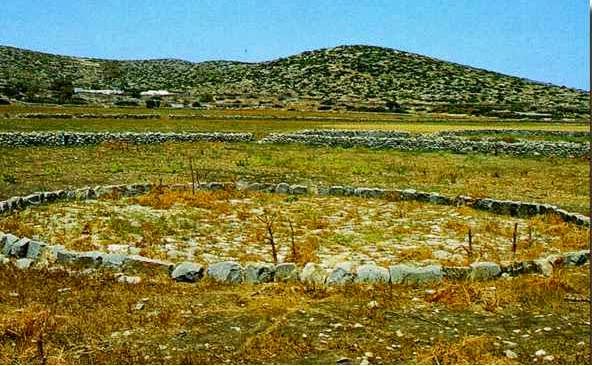
You can see that the above threshing floors have a wall built around it. This is done to mark the edge of the threshing circle and to prevent the grain being blown away. This creates a flat shallow pan like circular enclosure. Does this remind you of anything? A sun circle? The design and constriction is exactly the same. You erect a central pole, you tie a rope to it and then you walk around the pole while holding the end of the rope or animals walk around the pole while being tied to the rope. The produced movement describes perfect circle, the sun circle the threshing circle. Here are two depictions of this circular movement of bulls around the threshing floor from ancient Ilios (Troy). They are from an excellent book called The Swastika, by Thomas Wilson.


What does this remind you of? Swastika, the symbol of the sun, fire, lightning? The spinning of our galaxy? Swastika was the symbol of Ilios, the thundering sun god. Was Ilios the city named after Ilios the god? It is very interesting that Bull and swastika are often found together. And that both Crom Dubh in Ireland and Ilios, Perun in Serbia have a bull as their sacrificial animal.

Once the threshing floor is constructed it can be used for both threshing and as a solar observatory. What you are actually observing is the shadow made by the central stake or a standing stone. At the sunrise and sunset the shadow will be long enough to cut the circle at the oposite end. This is extremely precise way of marking the sunrise point. This stake is in Serbian known as "stožer". This is a very interesting word which means pivot, central standing pole. The sun literally pivots around it both daily and yearly in the same way bulls or horses pivot around the stožer pole during threshing

Here are some examples of threshing floors from Croatia. Some of them are still used today in exactly the same way they were used thousands of years ago.


Please note the central stake, pole "stožer" in the middle of the threshing floors.

This film is from 1989 from Croatia, when people still used gumno to thresh the wheat:

Have a look at these pictures from Croatia, showing people in traditional clothing reenacting the harvest procedure on gumno, threshing floor:


There are thousands of these stone circles all over the Balkans. Every village and sometimes every house had one. Sometimes they are made of stone, where stone was plentiful, but sometimes they were just a flat piece of land with a stick stack into the middle of it.

In 1950, Serbian ethnographer Nenad Janković published a book on folk astronomy called "Astronomija u predanjima, obicajima i umotvorinama Srba" (Astronomy in legends, customs and oral and written tradition of the Serbs). In it he expressed his great surprise at the ability of ordinary illiterate peasants to tell exact date and time without calendars and clocks. Professor Jankovic states that one of the main instruments used for these calendar and time calculations was the threshing floor. By looking at the shadow cast by the stožer, the central pole at sunrise, they were able to tell the date. And by looking at the shadow cast by the stožer, the central pole during the day they were able to tell the time. Threshing floor is a universal solar observatory, which at the same time can tell the date and the time. The main parts of this solar observatory were solar circle and its center, solar pole, stožer. Or if viewed from above, from heaven, the way Sun God would see it, a circle and a dot representing its center, solar pole, stožer. This is the symbol found all over the world and in Egypt it was the symbol of the sun, Ra. The below symbol is usually interpreted to mean sun disc, but I believe that it actually means sun circle, threshing floor and sun cycle observed from the threshing floor.


Greeks called the central solar pole, stožer of the sundial "gnomon" meaning the one which knows. This was because the central stake "new" the time and date.

In Serbian we have these words:

O - the shape of our mouth when it makes sound O. Letter O. The sound of surprise when we see something new, unknown, circle, surrounding.
K - towards (pointing, direction of movement and observation)
L - line
KO = K + O = towards, pointing + surrounding = who, what
OKO = circle + direction + circle = around
OKO = O + KO = circle + who, what = what we use to look around, what we use to determine who is it, eye


According to ethnographic research from the Balkan mountains conducted in the 19th century, threshing floor was the place where all the village meetings, celebrations and ceremonies took place.The ethnographers say that this is because threshing floors were the only flat smooth surfaces big enough to accommodate many people. But was this the only reason? Were threshing floors places where village meetings, celebrations and ceremonies took place because they were considered to be the sacred ground, the place where god lived on earth? I believe so. 

In Montenegro young people, wearing flower wreaths on their heads,  would gather on "Vilino Gumno", Fairy threshing floor, on the Feast of Ascension to sing songs about fairies and dance a circular dance kolo, oro. This is probably a remnant of an ancient fertility right, which was originally probably held at the beginning of summer, on the day of the young Sun, Jarilo which falls on the 6th of May.

At the same time Serbian tradition says that threshing floors are a favorite meeting place of demons and witches and one of the main places that should be avoided during the night. Witches come to threshing floors to dance. This is typical reversal of positives into negative which was a favorite method of brain washing used by Christians during forced conversions. Old gods become devils and demons, and places where old gods lived on earth become gathering places of demons and witches. What is interesting is that people believe that witches only live on unused threshing floors. Once people stop visiting god's house on earth, the god leaves as well, and demons move in....

Western Serbs have also preserved this custom related to the birth of the young Sun god, the beginning of the new solar year, new year. On Christmas day, the hay that was used to decorate the houses on Christmas eve is brought out and strewn on the threshing floor. On the first of January, which is in Serbia called "mladi Božić" meaning young God, a magic ritual threshing is performed. A special votive bread is made in a shape of a circle with a hole in the middle (torus, wheel) decorated with cuts on the outer edge. The bread is called "kovrtanj", "kovrtač" meaning the one that spins, and is used for magical ceremonies linked to fertility. 


First one is performed in the cow shed where the bread is put on a bull's horn. The way it rolls off it is interpreted as an indication whether the next harvest will be good or bad. The second one is performed on the threshing floor. A father gets up before the dawn and takes all the children out onto the threshing floor. He sticks the votive solar bread onto the stožer, central pole of the threshing floor. The father holds onto the bread and all the children hold on to him and they all walk around the stožer pole performing a ritual threshing. Then they all break the votive bread, turn towards the rising sun and cross themselves greeting the young God, Sun on his birthday, the beginning of the new Solar Year. Then they pick up the hay from the threshing floor and decorate fruit trees with it performing fertility rituals. The hay is also added to chicken nests to ensure fertility. No hay is supposed be left on the threshing floor because it contains magical properties. 

In central Serbia, and other parts of the Balkans, on the first day of threshing, the first sheaf of grain is stuck on top of the stožer, the central pole of the threshing floor, as an offering. This picture is from Poreč region of Makedonija:


Then the village or family leader walks across the threshing floor, east to west, north to south, creating the image of the solar cross. The same solar cross that we find on česnica (Cyrillic: чесница, Serbian pronunciation: [tʃeːsnitsa]; derived from the noun čest, meaning "share") which is the ceremonial, round loaf of bread that is an indispensable part of Christmas dinner in Serbian tradition.


So here we have a direct link between the Sun, the Threshing floor, the Solar cross and Bread.

ORO - Slavic circular solar dance. Same dance if found in other parts of the Balkans and was probably originally a ritual solar dance.


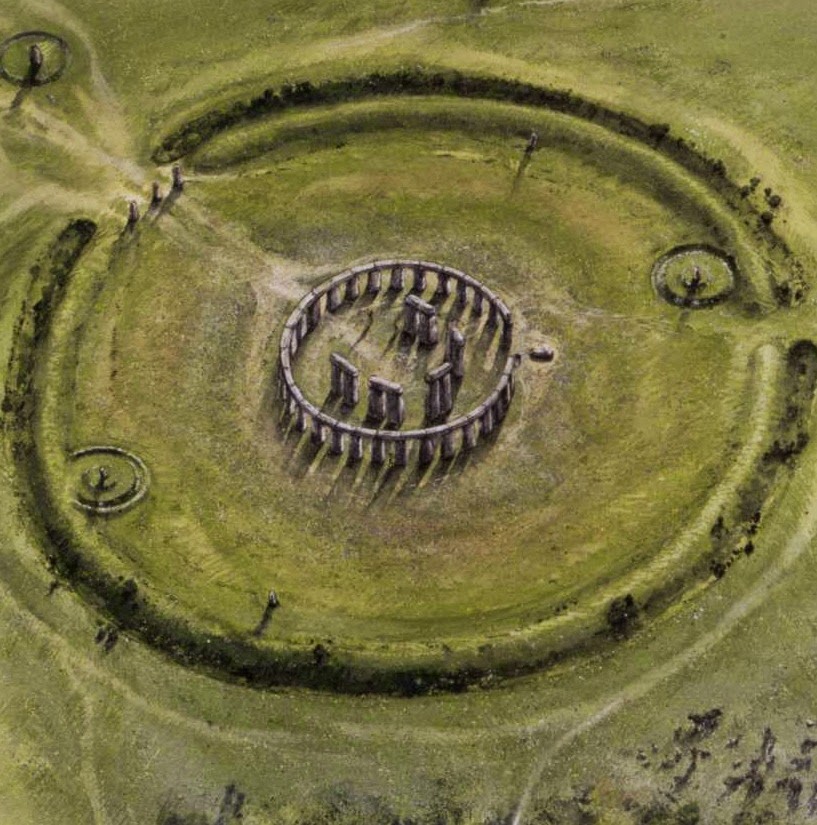
Is symbolism of ORO the same as symbolism of Stonehenge? Were the original henges threshing floors as well as a sun circles, solar observatories? 


And is the outer stone circle just a stone representation of ORO, sun dance, sun cycle, sun circle, danced as part of some Solar ceremony representing the never ending turning of the sun wheel?


Serbian peasants have preserved this link between the God (Vid), Sun, Time and Harvest expressed through the threshing floor for thousands of years. Threshing floor is the place where God (Vid), Sun shows himself to people as time and as grain.

But I don't think that it is only the threshing floor which has an astronomical symbolism. I believe that all the items involved in the process of harvest have astronomical symbolism. If threshing floor is symbolically linked to the sun, is sickle symbolically linked to the moon?

These are two neolithic sickles and one modern sickles:


Compare them with the moon calendar from Serbia. They have the same shape, the shape of a young moon.


Sickle is today called Srp in Serbian, but I believe that it was original called something like Latin sekula meaning sickle. Sekula is actually a South Slavic personal name. South Slavic languages have the largest cluster of cutting words based on the root "sec" with only Irish having a similar world cluster. 

If threshing floor is linked to the sun, if sickle is linked to the moon are grain seeds linked to the stars? This is quite possible.
In western culture the name "Milky Way" is derived from its appearance as a dim un-resolved "milky" glowing band arching across the night sky. The term is a translation of the Classical Latin via lactea, in turn derived from the Hellenistic Greekγαλαξίας, short for γαλαξίας κύκλος (pr. galaktikos kyklos, "milky circle"). The Ancient Greek γαλαξίας (galaxias), from root γαλακτ-, γάλα (milk) + -ίας (forming adjectives), is also the root of "galaxy", the name for our, and later all such, collections of stars. 
You can find an extensive list of names for milky from different languages around the world on  this page and this page (two different lists).
What is interesting is that we can see that by far most Evroasian people use Milk or cow, sheep way metaphor to describe our galaxy. All of these names for our galaxy which are linked to milk have root in nomadic herding people. The second most common metaphor used in Evroasia to describe our galaxy is birds way. This is again linked to migration. 

But in Serbo Croatian, Persian, Arabic, Turkish, Armenian, Kirgiz, Uighur, Uzbek, Chechen tradition, the metaphor for our galaxy is linked to straw, hay. What is connection between these people? 

Maybe Serbian tradition can help us understand this straw link. In Serbian tradition that our galaxy is known as "Kumova Slama" meaning "The Godfather's hay". But what if the original expression was "Gumnova Slama" meaning "Threshing floor hay"? Gumno is Serbo Croatian word. And it is only in Serbo Croatian tradition that we have the link between our galaxy, hay and threshing floor. That "Gumnova Slama" meaning "Threshing floor hay" is probably the original name for our galaxy in Serbo Croatian tradition can be seen from the name Serbs have for the constellation of Orion. In Serbian tradition he is known as Orač, meaning the plowman. In Serbian Orion = Ore + on = Plows + he = Plowman. In Serbian tradition, Kumova Slama (Gumnova Slama), threshing floor hay, is what a soul needs to cross to reach God. What do we reach when we cross threshing floor hay? We reach stožer, the central pole of the threshing floor. Is this the representation of the center of our galaxy? Is this where or what god is? Is the stožer earthly representation of the galactic pole around which galaxy rotates?

I said many times that Serbs are a mixed population of many different peoples. Each of them brought into the mix part of their own culture and language. Looking at the Serbo Croatian metaphors used to describe our galaxy, we see that we can find both "Mlečni put" meaning milky way, which comes from the Slavic tradition and "Gumnova Slama" meaning "Threshing floor hay". Whose is this second culture that we are unraveling here? Why is it that we find such a strong solar - agricultural belief system in Serbian tradition? Is this tradition found in Serbian Croatian, Persian, Arabic, Turkish, Armenian, Kirgiz, Uighur, Uzbek, Chechen people coming to us from the time of the first farmers? Did you notice that Hebrew tradition also uses Milk way metaphor characteristic of nomad herders to describe our galaxy, which is in keeping with their nomadic history? So who were the first farmers then? 

So we have gumno (threshing floor, circle, sun, bread), stožer (threshing floor pole, galactic axis), srp (crescent, moon), slama (hay, galaxy), zrno (grain, stars), all linked to a harvest, the culmination of the agricultural year.

The threshing process is the final part of the harvest. It is the moment when the months of hard work finally turn into food. This is the moment when the people will find out whether they will feast or whether they will starve through the winter. But it is not just the months of hard work that were put into producing the grain that is being threshed at the threshing floor. These months were also months of prayers to the Sun, the god of Grain.

First there were spring prayers to the young god of Grain Jarilo. These prayers were performed during plowing, sawing and sprouting season. The prayers were asking the young god of fertility to help insure that the land gets impregnated with the wheat seeds and that the wheat sprouts.

Second there were prayers to the mature god of Grain Vid. These prayers were performed during the growing of the grain, when sun is needed to grow the wheat seeds and fill them with goodness.

Third there were prayers to the old god of Thunder and Rain, Perun, Ilios. These prayers were performed during the ripening of the grain just before the harvest, when light rain is needed to ensure that the wheat is not destroyed by the drought.

But all these three gods are just three faces, three ages of one god, the god of grain, Dabog, the God that gives also known as Hromi Daba, Triglav, Thundering sun Ilios.

Just before the harvest, the final, most important prayer to the Sun, the god of weather and the good of Grain is uttered: "Please god give us enough grain so that we can survive through the winter". Then the grain is harvested and threshing starts. The threshing is the moment when the months of hard work finally turn into food. The threshing time is the time of truth. The threshing floor becomes the place where every year the relationship between the people and their god is being tested. If the harvest was bountiful, the god heard our prayers and has delivered. If the harvest was poor, the god did not hear our prayers or heard them and decided to ignore them. Why? What did we do wrong? What if we didn't do anything wrong, what if we were praying to the wrong god? 

Were threshing floors, sun circles, the first temples dedicated to the Sun, the god of grain farmers?