Showing posts with label Summer Solstice. Show all posts

Saturday, 21 February 2026

Little horses

The žirgeliai (little horses), are common motifs on Lithuanian rooftops, placed there for protection of the house...

They are a symbolic depiction of the Ašvieniai, Baltic counterparts of Vedic Ashvins, who are said to pull the chariot of Saulė (the Sun Goddess) through the sky. As depicted on this rooftop of a house in Nida...

Both names, Lithuanian ašva and Sanskrit ashva, mean "horse" and are derive from the same Proto-Indo-European root for the horse – *ek'w-...

And in India, we also find (horse headed) twins...

Surya's wife Saranyu transforms into a mare and runs away from her husband. Surya eventually finds her, turns himself into a white stallion and...

After which Saranyu delivers horse head twins called Ashvins...

I talked about this in my post "Hayagriva" about the Indian solar horse mythology...

BTW, these guys were hidden in our zodiac as Dioskuri, divine twin horsemen... 

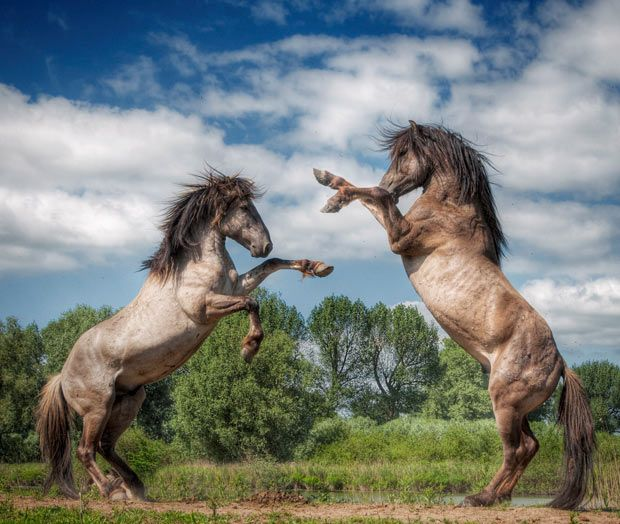
The guys who wanted to marry "the daughters of the white horse". They mark Summer Solstice, the peak of the horse mating season, characterised by wild stallion fights for mares...

I talked about solar horse (more precisely equid) in many of my posts...

We find the same horse twins in Etruria. I talked about this in my post "Ponte Sodo fibula" about this Etruscan gold disc fibula, from the Necropolis of Ponte Sodo, Vulci, Etruria, Italy. 650 BC, from the "Orientalizing period". Currently in the Antikensammlungen, Munich, Bavaria, Germany. 


We find them in Sasanian Iran, on this plate with youths and winged horses drinking water from a jar ca. 5th–6th century AD. I talked about this in my post "Dioskuri plate from Iran"...

And in Gotland. Together with horses. And pile of soar symbols...I talked about this in my post "Gotland sun stone with Dioscuri"...


But this link between (horse) twins and Summer Solstice is not just an Indo-European thing. 

In Mesopotamia, we find them "guarding the gates of hell". In my post "White raven" about Apollo-Nergal, I talk about the Sumerian twin gods, identified as Gemini constellation, and associated with Nergal, which "guard the gates of hell"...Are they holding torches? Or keys?

And in Egypt, we find god Hapi, the god of the annual flooding of the Nile, who was "often depicted as twins, tying papyrus and lotus flowers together". Papyrus flowers in Apr/May, and lotus in Jul/Aug...I talked about him/them 🙂 in my post "Lotus and papyrus"...


Twins marking summer solstice, Nubia. I talked about this in my post "Meroitic language"...


In Central America the Hero Twins pour the water of heaven (rains there arrive in Jun/Jul). I talked about this in my post "Resurrection of the maize god"...

To read more about ancient animal and plant calendar markers, which are at the root of all our mythologies, start here…Then check my twitter threads I still didn't convert to blog post...I am way way behind...

Saturday, 8 June 2024

Gotland sun stone with horses and ibexes

 Sun-wheel stone, Gotland, 6th century AD, Fornsal Museum, Visby


It is one of several so called "sun stones". 

I already talked about this one here 


And I talked about this one here

And I talked about this one here

Anyway, the horses are depicted facing each other, fighting for the right to mate...

The horse fertility is governed by the sunlight and peaks on summer solstice. Hence solar horses all over Eurasia...

Articles about solar horse (equid):

Iran "Water carrier equid", "Dioscuri plate from Iran"

Mesopotamia "Shamash playing with the solar horse", "Sun god from Tell Brak"

India "Hayagriva"

China "Longma", "Three legged crow", "Mythical beast from Xian"

Levant "Alexamenos graffito", "Goddess on a horse", "Unicorn"

Europe "Archaic rider", "Beotian solar pyxis", "Pegasus and chimera", "King John", "The horseman"

Which is why horses are an animal calendar marker for summer, and summer solstice. Horse is hidden among zodiac symbols as The Devine Horse Twins...Dioscuri...


I talked about this in my posts "Hayagriva", "Dioscuri plate from Iran"...

So that's horses. What about ibex goats? 

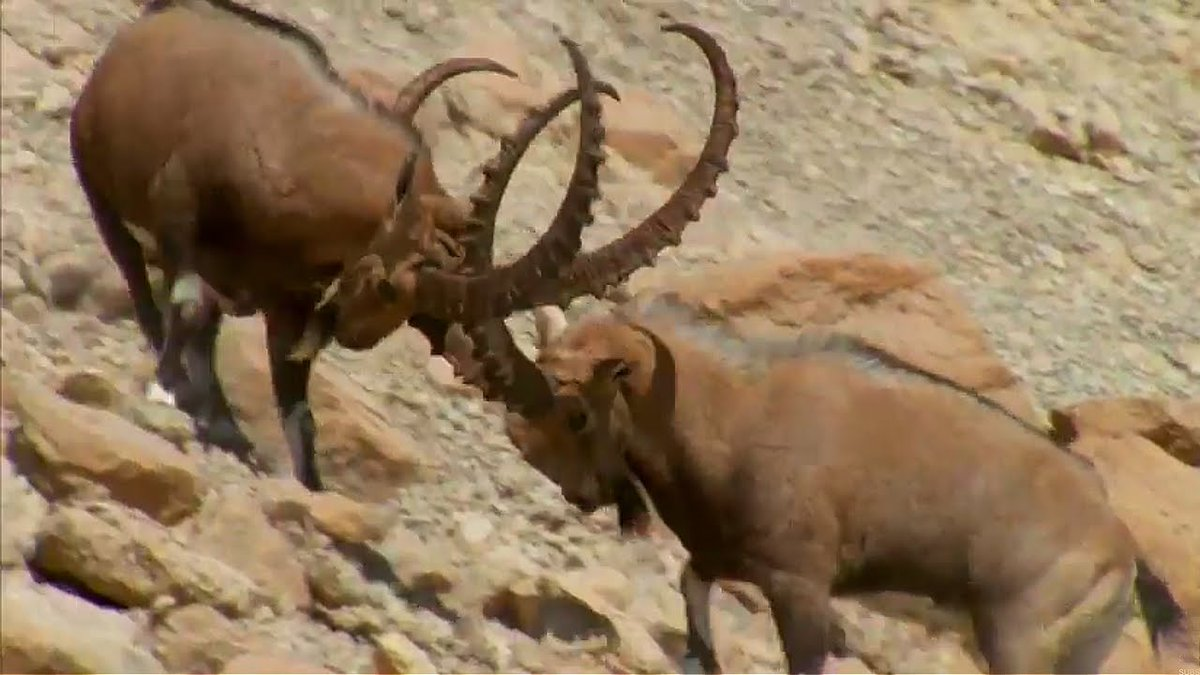
Across their range, ibex goats start mating in Oct/Nov...At the beginning of winter...And they announce that to the world by loudly banging their heads...Not something you can easily miss...


I talked about symbolism of ibex goats in many of my posts, like 

Europe:

"Pitys", "Goat in European culture", "Patera of Rennes"... 

Levant:

"The tree of life/light", "Lachish animal calendar"...

Mesopotamia:

"Feast plaque from Louvre", "Green pastures", "Problems with Abzu", "Relief from Dur Sharrukin", "Goatfish"...

Iran: 

"Flamingos from Susa", "Goat carrier", "Iranian goat of rain", "Strider", "A vessel from Tepe Hissar"...

Their mating season peaks around winter solstice. Which is why ibex goat became animal calendar marker for winter, and winter solstice. Which is why in zodiac we find Capricorn marking the winter solstice...

So on this sun stone we have opposite animal calendar markers marking opposite times of the year, goat marking winter solstice and horse marking summer solstice...I think this is quite cool...


To read more about ancient animal and plant calendar markers, which were the key to deciphering all this, start here…then check the rest of the blog posts related to animal calendar markers I still didn't add to this page, and finally check my twitter threads I still didn't convert to blog post...I am 9 months behind now...

Wednesday, 6 March 2024

Meroitic language

This article was originally an X thread. So are most of my articles actually, as I publish all my stuff on X first. But this thread is different, as in it I wanted to show how I do my research and how fast you can find things if you know what you are looking for...

Before I saw this post 6 hours ago, I had never heard of "Meroitic language" and have never seen one of these objects before. But I had a funny feeling that I knew what was depicted on it...So I did some googling, and it turns out I was right. 

Check this out:

So my hunch was that the relief depicted some kind of connection between water (obvious, as the wavy lines are water bing poured out of the two jars) and summer solstice (not so obvious, but these two jars, for some reason, reminded me of the "twins symbol")...


Twins which mark summer solstice...I talked about these twins in several of my articles. First in my post "Hayagriva". 

Surya's wife Saranyu transforms into a mare and runs away from her husband. Surya eventually finds her, turns himself into a white stallion and...

After which Saranyu delivers horse head twins called Ashvins...

Horse zodiac symbol is disguised as Dioskuri, divine twin horsemen. The guys who wanted to marry "the daughters of the white horse". 

They mark Summer Solstice, the peak of the horse mating season, characterised by wild stallion fights for mares...


We find them in Sasanian Iran, on this plate with youths and winged horses drinking water from a jar ca. 5th–6th century AD. I talked about this in my post "Dioskuri plate from Iran"...


In Mesopotamia (no horses in site), they appear as these two charming gentlemen: Lugal-irra and Meslamta-ea, "who were both closely associated with Nergal, and could be either regarded as members of his court or equated with him"...


These two dudes "typically appear together in cuneiform texts and could be described as the "divine twins", and were linked to Gemini constellation. They were regarded as protectors of doors, "possibly due to their role as the gatekeepers of the underworld"...

Hmmm...Twins guarding doors (of the underworld)? This looks like a door to you?


Very interesting, knowing that right after the summer solstice, we enter the hottest time of the year, Jul/Aug, the domain of Nergal, the god of the underworld...

In Central America we find Hero Twins who pour the water of heaven (rains there arrive in Jun/Jul). I talked about this in my post "Resurrection of the maize god"...


And finally, and most importantly for our current thread, we find them in Egypt, where god Hapi, the god of the annual flooding of the Nile, was "often depicted as twins, tying papyrus and lotus flowers together". Papyrus flowers in Apr/May (beginning of summer), and lotus in Jul/Aug (end of summer) and the knot the twins tie is...Summer solstice...I talked about him/them 🙂 in my post "Lotus and papyrus"...


Anyway, now that you know why I thought twins were important, 

So, I first went on the museum website and I found the official description of the object here:

"Offering table, from Ballana, dates to Meroitic phase IIIB-IV, decorated in relief with two kohl jars and four loaves and has a Meroitic inscription"...

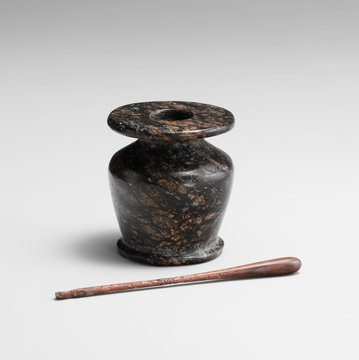
So I then went to find out what the hell were "kohl jars". Well, they were jars, like this one from New Kingdom, dated to 1492–1473 BC and currently in Met Museum. 

Used for storing kohl, an ancient eye cosmetic, made by grinding stibnite.  

The Ancient Egyptians (both men and women) wore kohl on their eyelids as protection against the glare of the sun. Outlining the eyes could also have been a way of drawing a protective amulet, such as the Wadjet Eye, right onto the skin.

Anyway, I couldn't find any link between kohl and kohl jars and water, so I was about to give up and write this off as a false hunch, but I decided to just do one last thing and check where exactly was the Meroitic language spoken. 

It was spoken here. In the area between today's Aswan in Egypt and Khartoum in Sudan...


And so, in the spirit of "if all you have is a hammer (animal calendar markers), everything looks (actually is) like a nail (deified calendar)", I went to check the local climate...

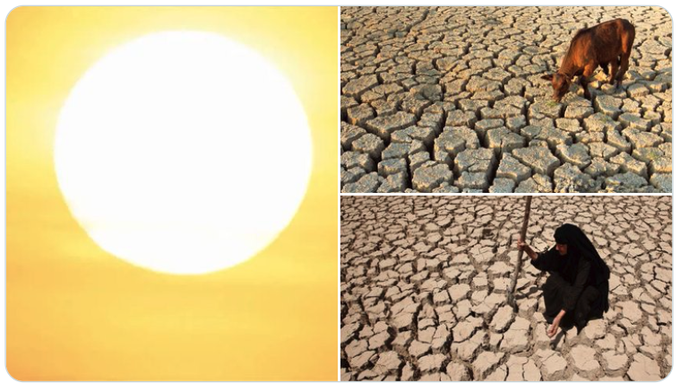
And what is very interesting about this part of the world is that it has a very long dry season and very short wet season, and that the rains arrive right around...summer solstice...

So my hunch that the two jars with water pouring out of them somehow links water and summer solstice (and the start of the rain season) was right...

Which would then explain what is depicted on this very interesting offering table (altar), Ptolemaic Period, 306–30 BC. Northern Upper Egypt, Dendera, currently in the Met Museum, New York...

The flowers depicted on this altar are Sacred (blue) lotuses...

Which bloom during the annual Nile flood. 

I wrote about the calendar marker meaning of these flowers in many of my posts...

Now look at the above rain chart and the above water flow chart. They overlap...Which means that the two jars are also linked to the start of the flood season...

But what does this have to do with kohl jars? Nothing. University of Chicago was wrong. These were not kohl jars at all. They are hes-vases...

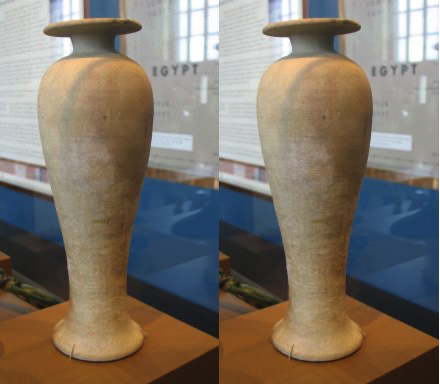
Here is one, currently in the Brooklin museum, from the Old Kingdom to 18th Dynasty. I have no idea how I came across this page. AI decided to help me I guess...I doubled it so you can see how they resemble the vases from the offering table...

The hes-vases were special vessels used to hold ritually purified water. These containers were frequently left as tomb offerings so the deceased could drink the water...

Thirsty dead? Again? I talked about the "thirsty" dead first in my posts "Drought" and "White feast" about South Slavic beliefs that the dead are linked to rain and grain fertility...And that thirsty ancestors will "drink rain from the clouds and will cause drought".

I then talked about "thirsty dead" in my post "Lapis Manalis" about Roman belief that the dead are linked to rain and grain fertility...BTW, do you see the similarity between cup and ring marked stones and rain caused ripples on water? Or is it just me?

I finally talked about "thirsty dead" in my post "Care of the dead" about Hittite and Sumerian belief that the dead are linked to rain and grain fertility...And if you forget to respect the sacred bond with the dead...


Hmmm ritually purified water...Was this purification intended to turn water back to rain? The pure water that falls from the sky that can be drank without fear of diseases?


So we have water pouring out of hes-vases, which normally contain water for the dead and loaves of bread...Again we see the link between water, the dead, rain and bread...

(This was not in the original thread, but I just remembered this thread

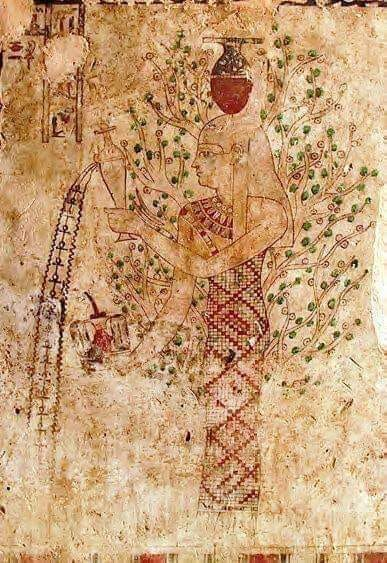
Sycamore tree goddess, originally Hathor, and later Isis, both goddess of flood, pouring water which is depicted with ankh (life) symbols inside it...Tomb, Siwa Oasis, 400-600 BC. Egypt...Is she pouring water of life from a "Hes-Vase"?

Now I was wondering why would water from the twin vases be pouring on the two loaves of bread. Maybe there is some kind of cereal that directly depends on the rain that starts falling around summer solstice...

And It turns out I was right again...Sorghum is a staple crop in Sudan. Sorghum grows during the rainy season (Jun-Sep). Once harvested, it is ground and stored for the dry season...and is used to make kisra flat breads...


And just when I decided I had found enough info to write this thread, while I was looking for a nice pic of traditional sorghum kisra flat breads, I stumbled across "Sky and Earth – A Nuba Mountains Folktale"...

Nuba Mountains lie just below Khartoum, and this story proves conclusively that my hunch about the twin(s) jars was 100% right. Here it goes:

“At the beginning of time,  the sky and the earth lived together as one..."

 "...The Nuba people remember a day when a young woman from the Nuba was grinding sorghum on the grindstone.  As she worked, she unintentionally struck the sky with her elbow.  The sky was insulted and decided to leave the place and take up residence far away from the earth..."

"...The people were unhappy about this and did not know how to continue their lives which had become gloomy and miserable without the sky, its rainy clouds and its shining sun..."

 "...They held a meeting and agreed to send an envoy to the sky to persuade it to come back. The envoy somehow managed to convince the sky to come back. It agreed on one condition: that it would return only once a year and would be invited to return each time..." 

"...This is how the seasons were created and how the Nuba Mountains received their first Kujur, the rainmaker, who since that time has continued to mediate between the earth and sky. The kujur has passed on his ability to make rain to his children and the children of his children..."

The end...

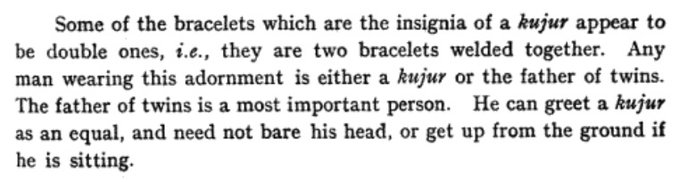
Now here is the best bit (from "Sudan Notes and Records Volume 23"): 

The only person equal to the Kujur is "a man who fathered twins" as "father of twins is the most important person"...Why? The only explanation is that the ancient Sudanese associated rain season with twins...Gemini...

Neat...Oh and in September, right after the rains stopped and the first harvest started, Nuba people hold Kambala festival, which celebrates the harvesting of grain and is associated with initiation rites for young Nuba men.

And we know that rain is linked with grain, semen and male fertility...

PS: Dear @ISAC_UChicago I would really like to know what is written on this offering table, if you know yourself. But I find it interesting that in Meroitic language

at(a) means "bread" and ato means "water"...

PS: please correct the object's description...

That's it. It took about half an hour to find all this info...

To read more about ancient animal and plant calendar markers, start here…then check the rest of the blog posts related to animal calendar markers I still didn't add to this page, and finally check my twitter threads I still didn't convert to blog post...I am 9 months behind now...

Thursday, 12 October 2017

Burning rolling wheel

"At Lower Konz, a village situated on a hillside overlooking the Moselle, the midsummer festival used to be celebrated as follows. A quantity of straw was collected on the top of the steep Stromberg Hill. Every inhabitant, or at least every householder, had to contribute his share of straw to the pile. At nightfall the whole male population, men and boys, mustered on the top of the hill; the women and girls were not allowed to join them, but had to take up their position at a certain spring half-way down the slope. On the summit stood a huge wheel completely encased in some of the straw which had been jointly contributed by the villagers; the rest of the straw was made into torches. From each side of the wheel the axletree projected about three feet, thus furnishing handles to the lads who were to guide it in its descent. The mayor of the neighboring town of Sierck, who always received a basket of cherries for his services, gave the signal; a lighted torch was applied to the wheel, and as it burst into flame, two young fellows, strong-limbed and swift of foot, seized the handles and began running with it down the slope. A great shout went up. Every man and boy waved a blazing torch in the air, and took care to keep it alight so long as the wheel was trundling down the hill. The great object of the young men who guided the wheel was to plunge it blazing into the water of the Moselle; but they rarely succeeded in their efforts, for the vineyards which cover the greater part of the declivity impeded their progress, and the wheel was often burned out before it reached the river. As it rolled past the women and girls at the spring, they raised cries of joy which were answered by the men on the top of the mountain; and the shouts were echoed by the inhabitants of neighbouring villages who watched the spectacle from their hills on the opposite bank of the Moselle. If the fiery wheel was successfully conveyed to the bank of the river and extinguished in the water, the people looked for an abundant vintage that year."


This is a passage from the book "The Golden Bough" by James George Frazer.

The book then goes to say that similar custom of rolling a burning wheel down a hill side existed in many other places in Europe:


At Eisenach on the fourth Sunday in Lent young people used to fasten a straw-man, representing Death, to a wheel, which they trundled to the top of a hill. Then setting fire to the figure they allowed it and the wheel to roll down the slope.

In Germany, Austria, and Switzerland at the same season similar customs have prevailed. Thus in the Eifel Mountains, Rhenish Prussia, on the first Sunday in Lent, a great wheel was made of straw and dragged by three horses to the top of the hill. Thither the village boys marched at nightfall, set fire to the wheel, and sent it rolling down the slope.

In the Rhön Mountains, situated on the borders of Hesse and Bavaria, the people used to march to the top of a hill or eminence on the first Sunday in Lent. Children and lads carried torches, brooms daubed with tar, and poles swathed in straw. A wheel, wrapped in combustibles, was kindled and rolled down the hill;

In neighboring villages of Hesse, between the Rhön and the Vogel Mountains, it is thought that wherever the burning wheels roll, the fields will be safe from hail and storm.

Bonfires were lit in almost all the hamlets of Poitou on the Eve of St. John. People marched round them thrice, carrying a branch of walnut in their hand. Shepherdesses and children passed sprigs of mullein (verbascum) and nuts across the flames; the nuts were supposed to cure toothache, and the mullein to protect the cattle from sickness and sorcery. When the fire died down people took some of the ashes home with them, either to keep them in the house as a preservative against thunder or to scatter them on the fields for the purpose of destroying corn-cockles and darnel. In Poitou also it used to be customary on the Eve of St. John to trundle a blazing wheel wrapt in straw over the fields to fertilise them.

In Wales three or nine different kinds of wood and charred faggots carefully preserved from the last midsummer were deemed necessary to build the bonfire, which was generally done on rising ground. In the Vale of Glamorgan a cart-wheel swathed in straw used to be ignited and sent rolling down the hill. If it kept alight all the way down and blazed for a long time, an abundant harvest was expected.

In Switzerland, also, it is or used to be customary to kindle bonfires on high places on the evening of the first Sunday in Lent, and the day is therefore popularly known as Spark Sunday. In some parts of the canton also they used to wrap old wheels in straw and thorns, put a light to them, and send them rolling and blazing down hill.

All over Northern and Central Germany, from Altmark and Anhalt on the east, through Brunswick, Hanover, Oldenburg, the Harz district, and Hesse to Westphalia the Easter bonfires still blaze simultaneously on the hill-tops. In some places tar-barrels or wheels wrapped in straw used to be set on fire, and then sent rolling down the hillside.

In Swabia, lads and lasses, hand in hand, leap over the midsummer bonfire, praying that the hemp may grow three ells high, and they set fire to wheels of straw and send them rolling down the hill. At Obermedlingen, the “fire of heaven,” as it was called, was made on St. Vitus’s Day, the day of Svetovid. On the summit of a mountain, a cart-wheel, smeared with pitch and plaited with straw, was fastened on a pole twelve feet high, the top of the pole being inserted in the nave of the wheel. The wheel was then set on fire.

In Lower Austria bonfires are kindled on the heights, and the boys caper round them, brandishing lighted torches drenched in pitch. Whoever jumps thrice across the fire will not suffer from fever within the year. Cart-wheels are often smeared with pitch, ignited, and sent rolling and blazing down the hillsides.

All over Bohemia bonfires still burn on Midsummer Eve.  Sometimes an old cart-wheel is smeared with resin, ignited, and sent rolling down the hill.

The Golden Bough does not mention it, but similar customs are also known from other Central and Eastern European Slavic lands:

In Slovakia, the Midsummer Night is called "Vajana". The root of this word is verb "váľať" meaning "to roll". Basically Midsummer Night is the night when fiery wheels are rolled down the slopes of hills.


In Belarus, Ukraine and Russia one of the solar-fire rituals performed during the Kupala Night (Midsummer Night) was to roll a flaming wheel down a hill and into a river or lake at the bottom, if there was one. The wheel symbolized the wheel (circle) of the seasons, as well as the sun-disk. In this ritual, the wheel was stuffed with straw or hay (the yellowish color of which resembled the sun) so that the wheel itself was barely visible, and in many cases an axle protruded a meter or so on each side, which people used to guide it down the hill. The idea was for it to roll all the way to the bottom, into the water if any; if it did not roll all the way down, the harvest would be bad. A wheel was also burned on a long pole. Wheels were also put on high poles and then burned either alone or a bonfire was piled around the pole with the wheel and then then whole thing was set on fire.


In "THE LITHUANIANS, an ethnic portrait" by Juozas Kudirka we read that "The Midsummer Day is a festival of simple people, connected with the veneration of fire. Young girls adorn their heads with flower wreaths. A tall pole with a wooden wheel soaked in tar or filled with birch bark is hoisted at the top of the highest hill in the vicinity. Men whose names are Jonas (John) set the wheels on fire and make bonfires around it. In some places a second pole is hoisted with flowers and herbs. Young people dance round the fire, sing songs about rye, play games, men try to jump over the fire. The burning wheels on the poles are rolled down the hill into a river or a lake at its foot, men jumping over it all along."


I would like to talk about this interesting ritual. 

First I would like to say that I believe that this was originally a ritual performed only on the summer solstice night. In most parts of Europe it was still performed on that day or on the Christian saint day which replaced Summer solstice day as a holy day. The reason why this ritual was recorded to have been performed in some parts of Europe during Lent, is because Christian clergy tried to remove the original meaning from this ritual by moving it to another part of the year. 

But what was the original meaning of this ritual? 

We know that wheel is a symbol directly linked with sun. But why is the burning wheel rolled down the mountain? 

The most popular proposed explanation is that the burning wheel was rolled down the mountain on the eve of summer solstice to symbolize the decrease of the sun's declination angle which begins on that night. 


The variation of the declination angle over the year is represented by a sinusoidal line. We can see how the decrease of the declination angle can indeed be represented by the image of the sun rolling down the slope of the hill.   


The effect of the Declination variation is the variation of the height of the point the sun reaches in the sky at noon. The sun reaches the highest point in the sky at noon on the day of the summer solstice. From that day, the height of the point the sun reaches at noon gets smaller and smaller, until at the winter solstice, the sun reaches the lowest point in the sky at noon. Then the process reverses. 

So maybe this is what our ancestors wanted to symbolically represent by rolling the burning wheel down the slope of a hill. The decrease of the height of the point the sun reaches in the sky at noon. 

But there is another possibility. 

In my post "The thundering sun god" I talked about St Ilija the Thunderer. Serbian folk tradition says that every year St Ilija the Thunderer gets so angry, that he wants to  "burn the whole world down". As I already explained in my post "Two crosses", the earth climatic, vegetative cycle lags behind the solar cycle. Becauese of this, the 21st of June, the mid summer, is the day of the maximum sun light. But it is the 2nd of August the day that marks the end of summer, that is the day of maximum sun heat. And this is the day when Serbs celebrate St Ilia the Thunderer. The period three days before and the three days after the 2nd of August, is in South Slavic tradition called Kresovi meaning Fires. These are the days of wild fires and droughts. These days are also known as the dog days, because these are the days when the dog star Sirius is in the sky with the sun.


But thankfully "Ilia the thunderer" does not burn the earth. Every year, on his day, the 2nd of August, the day of St Ilija the Thunderer, he gets persuaded by his wife, Ognjena Marija (Fiary Mary) to calm down. In Serbia there is a saying: "Od svetog Ilije sunce sve milije" which means "From St Ilija the sun starts getting kinder, milder, gentler". The first part of the 2nd of August is considered summer and the second is considered to be Autumn. And thus every year on the 2nd of August the summer ends and the autumn begins.

The 2nd of August is also the day of Perun, Slavic storm god. 

As I said already, we know that wheel is a symbol directly linked with sun. But it is also linked with thunder and fire. We can see this through the symbols of Svetovid and Perun: their wheels. The wheel of Perun is "like" the wheel of Svetovid. It is actually the fiery version of the wheel of Svetovid. 


During the second part of Summer, between mid summer, the day of Svetovid, and the end of summer, the day of Perun, the sun wheel, turns into the fiery wheel. This is symbolic representation of the effect of the ever increasing heat and drought of the second part of the summer. 

But just when the world is about to be burned to cinder by the fiery sun of the late summer, Perun arrives and kills Veles. Veles, the dragon who stole Perun's celestial cows (rain clouds), is the late summer's heat that causes drought. Perun represents the first autumn storms which finally end the drought and ensure that the crops will survive and that the harvest will be successful. The rain water extinguishes sun's fire. Autumn begins. 

Now let's have a look at the ritual again. 

The wheel is lit up on top of the hill. This is Summer solstice sun just starting to get really hot. The wheel is rolled down the hill. As the wheel rolls down the wheel's fire gets stronger and stronger because of the increased air circulation around the wheel. The people handling the wheel aim to plunge the now madly burning wheel into the river which flows below the hill and extinguish the fire. 

I believe that this was actually a magic ritual. 

The rolling of a burning wheel down the hill represents the fact that the sun's temperature increases in the second part of summer even though the days are getting shorter. 
The fact that the wheel is often rolled down the side of the hill which ends in a river or a lake and that it is seen as a good luck if the burning wheel reaches the water is very significant. It shows that the ritual is actually a magic ritual performed in order to insure the "extinguishing of the sun's fire" of the late summer by the water of the autumn rains.

I think this is very very interesting. What do you think?

By the way if you know of any other place in Europe when the same ritual was performed which I didn't list, please let me know so I can update my post.