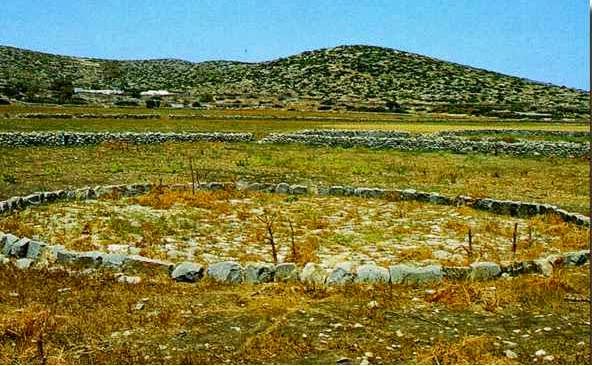
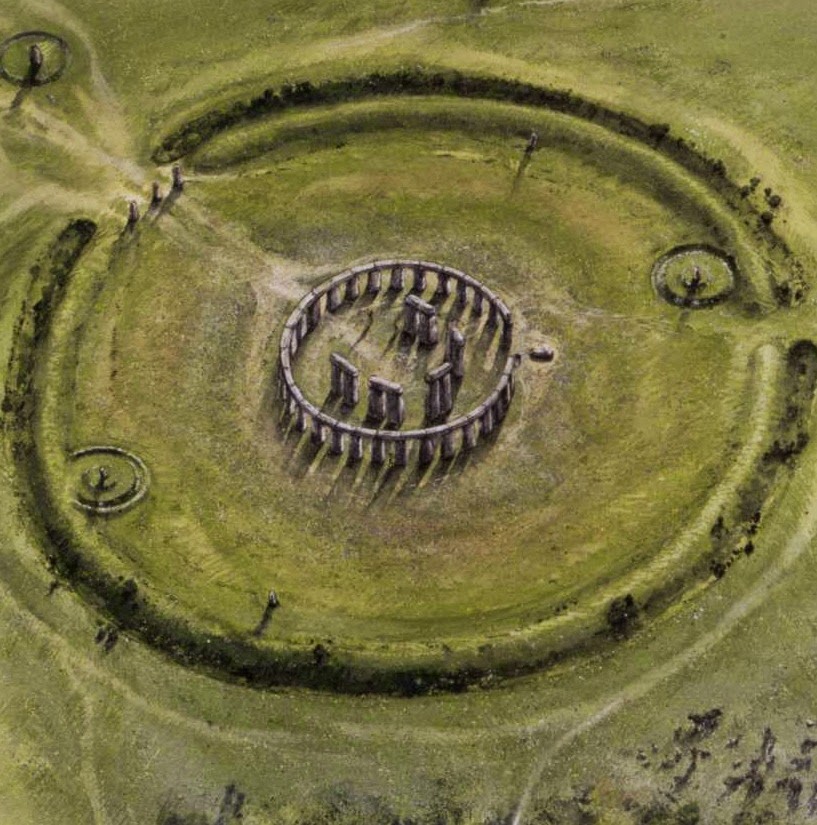
Showing posts with label Henge. Show all posts

Tuesday, 16 February 2016

Dún Ailinne

In my post about the etymology of the word Alps I talked about the Gaelic word "ail" meaning stone, rock, cliff. This post is about a place whose name is derived from the word "ail": Dun Ailinne.

Dún Ailinne is an ancient ceremonial site on the hill of Cnoc Ailinne in County Kildare, Ireland. It is southwest of Kilcullen, near the N78 road to Athy. 


The site is circular, about 13 ha (32 ac) in area, ringed by an earth bank and ditch (or "henge"). As with most henges, the ditch is on the inside, meaning that it was likely to have been symbolic rather than defensive. It is believed that Dún Ailinne was a royal centre and inaugural or ceremonial site for the Kings of Leinster. In terms of its ritual use, the internal structures and layout, and its location and association, is similar to the other royal sites of Tara, Navan Fort and Rathcroghan. Indications of earliest use are from the Neolithic period, but the main activity there was during the Iron Age. It does not seem to have been dwelt in year-round, but was instead mostly used for short-term activity, including ritual. It seems to have been occupied during the Spring/Summer months and there is evidence of cooking, which include a great deal of bone from cows, sheep, pigs, deer and horses. In 1968 a caesium magnetometer survey and a resistivity survey was undertaken that highlighted an area in the low mound, later revealed as areas of intense burning. A La Tène style sword and Roman bronze fibulae have also been found at the site. The artefacts suggested intense activity in the Iron Age and/or Early Medieval period that disturbed a Neolithic occupation phase. While it figures in some early historical references, Dún Ailinne was mostly abandoned about the time the nearby early Christian settlement at Old Kilcullen was established in the 6th century.

This is a drawing showing the results of the geophisical survey of the site. You can see various overlapping features dating to different time periods. 


The images below show a time-lapse sequence of the summer solstice sunset as observed from Dún Ailinne. You can see that the sun touches the top of the Dunmurry hill, and it then proceeds to slide down the side of it, until it finally disappears behind the hill.


What is interesting is that right in front of the Dunmurry hill lies the Long hill, an elongated hill aligned roughly East-West and orientated on a slight E-SE to W-NW axis. On top of that hill lies the Long hill cursus.


Cursus was a name given by early British archaeologists such as William Stukeley to the large parallel lengths of banks with external ditches which they thought were early Roman athletic courses, hence the Latin name cursus, meaning "course". Cursus monuments are now understood to be Neolithic structures and represent some of the oldest prehistoric monumental structures of the British Isles. Long hill Cursos is by some believed to be approximately 1.5km. long and almost 100m. wide, but it is more likely for it to have been just over a kilometre long and approximately 50 metres wide. The OSI map also records clusters of barrows at each end of the Cursus - Cluster 'E' at the W-NW end and Cluster 'F' at the E-SE end (Ref. Pádraig Clancy's study of the ancient monuments of the Curragh).

If we extend the side of the Dunmurry hill along which the sun slides on the eve of the Summer solstice, it touches the east - south east end of the Long hill cursus, while the vertical going through the top of the Dunmurry hill touches the west - north west end of the Long hill cursus.


It seems that the Long hill cursus was deliberately built to create the sacred triangle visible from the Dún Ailinne. In which case Dún Ailinne was not just any ceremonial site but a solar observatory and solar temple. I already wrote about ancient henge solar observatories and solar temples in my post about Henges - Rondel enclosures. The henge was dug to mark the solar observation circle and there was probably a tall stake or a tall standing stone standing somewhere inside the henge circle working as a gnomon. The shaddow cast by the gnomon stone at sunrise was used to determine the exact date. The fact the sun also performed the gliding, or rolling down the Dunmurry hill on the eve of the summer solstice, just made the Dún Ailinne more special. Is there a proof that there was once such a standing stone in Dún Ailinne? There is.

A verse in the Dindsenchas mentions how Dún Ailinne/Alend acquired its name:

Three mighty men made essays of trenchings,
Burech, Fiach, and Aururas:
it is they who without flagging (clear fact!)
dug the rampart of Alend.

Buirech cast from him straightway
across the rampart(no weakling he!) -
a stone he cast from his spear-arm;
and that is the ail in Alend.

This seems to suggest that Buirech placed the Ail (Stone) standing upright on a mound, inside the henge (trenching) that sat at the summit of the Cnoc Ailinne.

Today you will see three very large boulders on the summit, two look like limestone boulders (although it's possible they're both very weathered granite) and an elongated white granite boulder. John O'Donovan's survey of Dún Ailinne in 1837 records only "two rough mountain boulders of considerable size. One of these might be the Ail mentioned in the Dindseanchus as placed in the mound by the hero Buirech......". O'Donovan also records a scattering of stone debris on the summit which he interpreted as a "fort.......much effaced", but Estyn Evans suggests this scatter of stone and the large boulders may have been the remnants of a Neolithic/Early Bronze Age cairn. I would say that the scattering of stones and the remaining boulders are all parts of the original gigantic standing stone after which the Dún Ailinne got its name, and which was deliberately destroyed, possibly during the early Christianization of Ireland and maybe even later.

The images below show the large boulders that now sit on the summit of Dún Ailinne.There'sisible line of drill holes in the large elongated white granite boulder. You can clearly see weathering on one side,but the opposite side shows areas which look significantly fresher,which could suggest it was deliberately broken in recent times. Was this boulder part of a much larger monolith?


Is this what Dún Ailinne might have looked like once?


In Gaelic the word "dún" doesn't only mean military fortification. It means to shut, to close, to enclose, enclosure, fort, fortress, place of refuge, haven, haven for ships, residence, house, promontory fort, bluff...So any enclosed place probably including henge.

In Gaelic the word "ail" means stone, rock.

And in Gaelic the word "linn" means time, period, generation, course.

If there is a possibility that Dún Ailinne was once used as a solar observatory, solar calendar, with the central rock pillar (ail) inside of a henge (dún) and which was used to determine the day of the Summer solstice, the beginning of the solar year, the beginning of a new solar cycle, the new "time period" (linn) is it possible that the name Dún Ailinne actually means "The enclosure of the time stone", the solar calendar?

I would like to thank "bonedigger" for all his great work in exploring Irish megalithic sites and drawing public attention to their possible astronomical features. 

1. Dún Ailinne's Role in Folklore, Myth, and the Sacred Landscape
2. Dún Ailinne, Knockaulin Td and 2. Glebe North Td, Co. Kildare E79 - Unpublished excavations

Tuesday, 12 August 2014

Bogovo gumno - God's threshing floor

In several of my previous posts I have been talking about sun circles. I talked about their origin in my post about Henges - rondel enclosures. I talked about how they were used as solar observatories for determining the beginning of the lunisolar calendar in my post about Calendars. In my post about Stone circles on mountain Devica, I talked about the solar observatory called Bogovo Gumno from Serbia. In my post about Ognjena Marija I explained how the sun circles on Bogovo Gumno are linked to the week which starts on the 30th of July and ends on the 4th of August. This week is in Serbia called Kresovi (Fires, Lightnings). In Ireland this week is called Domhnach Crom Dubh, the week of Crom Dubh. This week centers around the 2nd of August, the last day of summer and the first day of Autumn, which is in Serbia known as the day of Thunder god Perun or the day of Triglav, Thundering Sun Ilios, and which is in Ireland known as the day of Triglav, Crom Dubh, but also as Lughnasadh, the day of Thunder god Lugh.

Bogovo Gumno sun circles are extremely important for several reasons:

  1. Bogovo Gumno sun circles could be part of an extremely old and complex astronomic and religious complex.
  2. Bogovo Gumno sun circles give us a proof that prehistoric astronomic solar observatories continued to be used millenniums after they were built by the local population for calendar calculation and religious practices related to solar cycles.
  3. Bogovo Gumno sun circles can help us understand the stone circle complex known as Grange circles from Ireland and the meaning and significance of the term Grange itself.
  4. Bogovo Gumno sun circles can help us understand the origin of Jewish and therefore Christian religion.

Being the solar observatory designed to determine and mark the summer solstice, the big stone circle in Bogovo Gumno was also dedicated to the Sun, also known in Serbia as Višnji bog (the high god), Vid. In Serbian tradition, Sun, the "Višnji Bog", the High God, is perceived as a living being, which is born every year in the winter on New Year's day, winter solstice. He then grows into a young man Jarilo on the 6th of May the day of the strongest vegetative, reproductive power of the sun. This day marks the beginning of the heating of the world, the beginning of summer. Then he becomes the powerful ruler Vid at the summer solstice, 21st of June the longest day of the year. He then becomes the terrible warrior Perun on the 2nd of August the hottest day of the year. This day marks the beginning of the cooling of the world. 

Summer solstice, the day of Svetovid, Vishnji bog is exactly in the middle of the summer period marked by the day of Jarilo and the day of Perun. Jarilo (heat, fire), Svetovid (light, sun) and Perun (lightning, electricity, energy) are together forming Triglav, Dabog, Hromi Daba, Perun the main god of the Serbs which is in Ireland known as Triglav, Dagda, Crom Dubh, Lugh. This is the Thundering Burning Sun Ilios, Grom Div, the Three in one, Trinity, Trimurti, Agni. He is the sun at its most powerful and terrifying, the sun that contains the cumulative power of the whole summer. 


In my post about Triglav i quoted this riddle from the book of Veles:
Jer tajna je velika, kako to Svarog biva u isto vreme i Perun i Svetovid.
 Translated into English it means: 
Because it is a great secret how come Svarog (hevenly and earthly fire) is at the same time Perun (thunder) and Svetovid (Sun).
The answer to this riddle is Triglav (three headed), trojan (triple), Hromi daba, Crom Dubh - Lugh, Grom Div, Agni.

This riddle hides in itself the same sacred knowledge contained in Vedas.

The above religious system is related to vegetative agricultural cycle. It is extremely important to farmers in continental Europe, but it is almost irrelevant to the steppe nomads, and it is completely wrong in Indian climate which is governed by a monsoon. The hottest month for the western and southern regions of India is April; for most of North India, it is May. So where did this religious system originate? I would suggest Europe. I believe that Vedic Solar Religion was brought to India by farmers from Europe, not by Steppe nomads from central Asia.


So on mountain Devica we have a Sun circle used for determining the day of the summer solstice. So what? We have these types of circles all over Europe. Why is this one so significant? The answer to this quesiton is: because of its name and what its name means. The meaning of the name "Bogovo Gumno" means God's Threshing floor.There is a local legend which says that the Circle is called God's Threshing floor because in the ancient times god came from heaven with his horses and he threshed grain there.


Threshing floor is a flat, smooth and hard surface used for threshing, a process of separating the grain from the straw and husks


The process of threshing is performed generally by spreading the sheaves on the threshing floor and causing oxen, cattle or horses to tread repeatedly over them. If you look at the picture above you can see that that the animals are made to walk in a circle. In order to make the animals walk in circles, a man needs to stand in the center of the pile of grain which is being threshed and restrict and direct the movement of the oxen, cattle or horses using reins or rope. You can see this technique being used on the above picture. Alternatively a central pole can be erected, to which the animals are tied and then they are urged to walk in circles by a man walking behind them. You can see this technique being used on the below picture.


This process loosens the edible part of cereal grain from the scaly, inedible chaff that surrounds it. 


On occasions flails or sticks were used for threshing on their own or in combination with treading by oxen, cattle or horses


The stalks of hay are separated from the mixture of grains and scaly husks. Hay is put into haystacks and the grain and chaff mixture is ready for winnowing. 


The winnowing consist of throwing the mixture into the air so the wind could blow away the chaff, leaving only the good grain on the floor. 

Winnowing can be done in two ways.

By throwing the grain chaff mixture into the air using winnowing forks


By pouring the grain chaff mixture from the winnowing basket.


This is why threshing floors are usually built on wind swept places. You need good steady wind for the process of winnowing. So you build your threshing floor on the top of the hill, like this one:


Or on an open plane, like this one:


Both locations also have excellent view of the sky and are ideal for solar observation.

You can see that the above threshing floors have a wall built around it. This is done to mark the edge of the threshing circle and to prevent the grain being blown away. This creates a flat shallow pan like circular enclosure. Does this remind you of anything? A sun circle? The design and constriction is exactly the same. You erect a central pole, you tie a rope to it and then you walk around the pole while holding the end of the rope or animals walk around the pole while being tied to the rope. The produced movement describes perfect circle, the sun circle the threshing circle. Here are two depictions of this circular movement of bulls around the threshing floor from ancient Ilios (Troy). They are from an excellent book called The Swastika, by Thomas Wilson.


What does this remind you of? Swastika, the symbol of the sun, fire, lightning? The spinning of our galaxy? Swastika was the symbol of Ilios, the thundering sun god. Was Ilios the city named after Ilios the god? It is very interesting that Bull and swastika are often found together. And that both Crom Dubh in Ireland and Ilios, Perun in Serbia have a bull as their sacrificial animal.

Once the threshing floor is constructed it can be used for both threshing and as a solar observatory. What you are actually observing is the shadow made by the central stake or a standing stone. At the sunrise and sunset the shadow will be long enough to cut the circle at the oposite end. This is extremely precise way of marking the sunrise point. This stake is in Serbian known as "stožer". This is a very interesting word which means pivot, central standing pole. The sun literally pivots around it both daily and yearly in the same way bulls or horses pivot around the stožer pole during threshing

Here are some examples of threshing floors from Croatia. Some of them are still used today in exactly the same way they were used thousands of years ago.


Please note the central stake, pole "stožer" in the middle of the threshing floors.

This film is from 1989 from Croatia, when people still used gumno to thresh the wheat:

Have a look at these pictures from Croatia, showing people in traditional clothing reenacting the harvest procedure on gumno, threshing floor:


There are thousands of these stone circles all over the Balkans. Every village and sometimes every house had one. Sometimes they are made of stone, where stone was plentiful, but sometimes they were just a flat piece of land with a stick stack into the middle of it.

In 1950, Serbian ethnographer Nenad Janković published a book on folk astronomy called "Astronomija u predanjima, obicajima i umotvorinama Srba" (Astronomy in legends, customs and oral and written tradition of the Serbs). In it he expressed his great surprise at the ability of ordinary illiterate peasants to tell exact date and time without calendars and clocks. Professor Jankovic states that one of the main instruments used for these calendar and time calculations was the threshing floor. By looking at the shadow cast by the stožer, the central pole at sunrise, they were able to tell the date. And by looking at the shadow cast by the stožer, the central pole during the day they were able to tell the time. Threshing floor is a universal solar observatory, which at the same time can tell the date and the time. The main parts of this solar observatory were solar circle and its center, solar pole, stožer. Or if viewed from above, from heaven, the way Sun God would see it, a circle and a dot representing its center, solar pole, stožer. This is the symbol found all over the world and in Egypt it was the symbol of the sun, Ra. The below symbol is usually interpreted to mean sun disc, but I believe that it actually means sun circle, threshing floor and sun cycle observed from the threshing floor.


Greeks called the central solar pole, stožer of the sundial "gnomon" meaning the one which knows. This was because the central stake "new" the time and date.

In Serbian we have these words:

O - the shape of our mouth when it makes sound O. Letter O. The sound of surprise when we see something new, unknown, circle, surrounding.
K - towards (pointing, direction of movement and observation)
L - line
KO = K + O = towards, pointing + surrounding = who, what
OKO = circle + direction + circle = around
OKO = O + KO = circle + who, what = what we use to look around, what we use to determine who is it, eye


According to ethnographic research from the Balkan mountains conducted in the 19th century, threshing floor was the place where all the village meetings, celebrations and ceremonies took place.The ethnographers say that this is because threshing floors were the only flat smooth surfaces big enough to accommodate many people. But was this the only reason? Were threshing floors places where village meetings, celebrations and ceremonies took place because they were considered to be the sacred ground, the place where god lived on earth? I believe so. 

In Montenegro young people, wearing flower wreaths on their heads,  would gather on "Vilino Gumno", Fairy threshing floor, on the Feast of Ascension to sing songs about fairies and dance a circular dance kolo, oro. This is probably a remnant of an ancient fertility right, which was originally probably held at the beginning of summer, on the day of the young Sun, Jarilo which falls on the 6th of May.

At the same time Serbian tradition says that threshing floors are a favorite meeting place of demons and witches and one of the main places that should be avoided during the night. Witches come to threshing floors to dance. This is typical reversal of positives into negative which was a favorite method of brain washing used by Christians during forced conversions. Old gods become devils and demons, and places where old gods lived on earth become gathering places of demons and witches. What is interesting is that people believe that witches only live on unused threshing floors. Once people stop visiting god's house on earth, the god leaves as well, and demons move in....

Western Serbs have also preserved this custom related to the birth of the young Sun god, the beginning of the new solar year, new year. On Christmas day, the hay that was used to decorate the houses on Christmas eve is brought out and strewn on the threshing floor. On the first of January, which is in Serbia called "mladi Božić" meaning young God, a magic ritual threshing is performed. A special votive bread is made in a shape of a circle with a hole in the middle (torus, wheel) decorated with cuts on the outer edge. The bread is called "kovrtanj", "kovrtač" meaning the one that spins, and is used for magical ceremonies linked to fertility. 


First one is performed in the cow shed where the bread is put on a bull's horn. The way it rolls off it is interpreted as an indication whether the next harvest will be good or bad. The second one is performed on the threshing floor. A father gets up before the dawn and takes all the children out onto the threshing floor. He sticks the votive solar bread onto the stožer, central pole of the threshing floor. The father holds onto the bread and all the children hold on to him and they all walk around the stožer pole performing a ritual threshing. Then they all break the votive bread, turn towards the rising sun and cross themselves greeting the young God, Sun on his birthday, the beginning of the new Solar Year. Then they pick up the hay from the threshing floor and decorate fruit trees with it performing fertility rituals. The hay is also added to chicken nests to ensure fertility. No hay is supposed be left on the threshing floor because it contains magical properties. 

In central Serbia, and other parts of the Balkans, on the first day of threshing, the first sheaf of grain is stuck on top of the stožer, the central pole of the threshing floor, as an offering. This picture is from Poreč region of Makedonija:


Then the village or family leader walks across the threshing floor, east to west, north to south, creating the image of the solar cross. The same solar cross that we find on česnica (Cyrillic: чесница, Serbian pronunciation: [tʃeːsnitsa]; derived from the noun čest, meaning "share") which is the ceremonial, round loaf of bread that is an indispensable part of Christmas dinner in Serbian tradition.


So here we have a direct link between the Sun, the Threshing floor, the Solar cross and Bread.

ORO - Slavic circular solar dance. Same dance if found in other parts of the Balkans and was probably originally a ritual solar dance.


Is symbolism of ORO the same as symbolism of Stonehenge? Were the original henges threshing floors as well as a sun circles, solar observatories? 


And is the outer stone circle just a stone representation of ORO, sun dance, sun cycle, sun circle, danced as part of some Solar ceremony representing the never ending turning of the sun wheel?


Serbian peasants have preserved this link between the God (Vid), Sun, Time and Harvest expressed through the threshing floor for thousands of years. Threshing floor is the place where God (Vid), Sun shows himself to people as time and as grain.

But I don't think that it is only the threshing floor which has an astronomical symbolism. I believe that all the items involved in the process of harvest have astronomical symbolism. If threshing floor is symbolically linked to the sun, is sickle symbolically linked to the moon?

These are two neolithic sickles and one modern sickles:


Compare them with the moon calendar from Serbia. They have the same shape, the shape of a young moon.


Sickle is today called Srp in Serbian, but I believe that it was original called something like Latin sekula meaning sickle. Sekula is actually a South Slavic personal name. South Slavic languages have the largest cluster of cutting words based on the root "sec" with only Irish having a similar world cluster. 

If threshing floor is linked to the sun, if sickle is linked to the moon are grain seeds linked to the stars? This is quite possible.
In western culture the name "Milky Way" is derived from its appearance as a dim un-resolved "milky" glowing band arching across the night sky. The term is a translation of the Classical Latin via lactea, in turn derived from the Hellenistic Greekγαλαξίας, short for γαλαξίας κύκλος (pr. galaktikos kyklos, "milky circle"). The Ancient Greek γαλαξίας (galaxias), from root γαλακτ-, γάλα (milk) + -ίας (forming adjectives), is also the root of "galaxy", the name for our, and later all such, collections of stars. 
You can find an extensive list of names for milky from different languages around the world on  this page and this page (two different lists).
What is interesting is that we can see that by far most Evroasian people use Milk or cow, sheep way metaphor to describe our galaxy. All of these names for our galaxy which are linked to milk have root in nomadic herding people. The second most common metaphor used in Evroasia to describe our galaxy is birds way. This is again linked to migration. 

But in Serbo Croatian, Persian, Arabic, Turkish, Armenian, Kirgiz, Uighur, Uzbek, Chechen tradition, the metaphor for our galaxy is linked to straw, hay. What is connection between these people? 

Maybe Serbian tradition can help us understand this straw link. In Serbian tradition that our galaxy is known as "Kumova Slama" meaning "The Godfather's hay". But what if the original expression was "Gumnova Slama" meaning "Threshing floor hay"? Gumno is Serbo Croatian word. And it is only in Serbo Croatian tradition that we have the link between our galaxy, hay and threshing floor. That "Gumnova Slama" meaning "Threshing floor hay" is probably the original name for our galaxy in Serbo Croatian tradition can be seen from the name Serbs have for the constellation of Orion. In Serbian tradition he is known as Orač, meaning the plowman. In Serbian Orion = Ore + on = Plows + he = Plowman. In Serbian tradition, Kumova Slama (Gumnova Slama), threshing floor hay, is what a soul needs to cross to reach God. What do we reach when we cross threshing floor hay? We reach stožer, the central pole of the threshing floor. Is this the representation of the center of our galaxy? Is this where or what god is? Is the stožer earthly representation of the galactic pole around which galaxy rotates?

I said many times that Serbs are a mixed population of many different peoples. Each of them brought into the mix part of their own culture and language. Looking at the Serbo Croatian metaphors used to describe our galaxy, we see that we can find both "Mlečni put" meaning milky way, which comes from the Slavic tradition and "Gumnova Slama" meaning "Threshing floor hay". Whose is this second culture that we are unraveling here? Why is it that we find such a strong solar - agricultural belief system in Serbian tradition? Is this tradition found in Serbian Croatian, Persian, Arabic, Turkish, Armenian, Kirgiz, Uighur, Uzbek, Chechen people coming to us from the time of the first farmers? Did you notice that Hebrew tradition also uses Milk way metaphor characteristic of nomad herders to describe our galaxy, which is in keeping with their nomadic history? So who were the first farmers then? 

So we have gumno (threshing floor, circle, sun, bread), stožer (threshing floor pole, galactic axis), srp (crescent, moon), slama (hay, galaxy), zrno (grain, stars), all linked to a harvest, the culmination of the agricultural year.

The threshing process is the final part of the harvest. It is the moment when the months of hard work finally turn into food. This is the moment when the people will find out whether they will feast or whether they will starve through the winter. But it is not just the months of hard work that were put into producing the grain that is being threshed at the threshing floor. These months were also months of prayers to the Sun, the god of Grain.

First there were spring prayers to the young god of Grain Jarilo. These prayers were performed during plowing, sawing and sprouting season. The prayers were asking the young god of fertility to help insure that the land gets impregnated with the wheat seeds and that the wheat sprouts.

Second there were prayers to the mature god of Grain Vid. These prayers were performed during the growing of the grain, when sun is needed to grow the wheat seeds and fill them with goodness.

Third there were prayers to the old god of Thunder and Rain, Perun, Ilios. These prayers were performed during the ripening of the grain just before the harvest, when light rain is needed to ensure that the wheat is not destroyed by the drought.

But all these three gods are just three faces, three ages of one god, the god of grain, Dabog, the God that gives also known as Hromi Daba, Triglav, Thundering sun Ilios.

Just before the harvest, the final, most important prayer to the Sun, the god of weather and the good of Grain is uttered: "Please god give us enough grain so that we can survive through the winter". Then the grain is harvested and threshing starts. The threshing is the moment when the months of hard work finally turn into food. The threshing time is the time of truth. The threshing floor becomes the place where every year the relationship between the people and their god is being tested. If the harvest was bountiful, the god heard our prayers and has delivered. If the harvest was poor, the god did not hear our prayers or heard them and decided to ignore them. Why? What did we do wrong? What if we didn't do anything wrong, what if we were praying to the wrong god? 

Were threshing floors, sun circles, the first temples dedicated to the Sun, the god of grain farmers?

Saturday, 21 June 2014

Calendar

In the mountains of the Balkans, up until the end of the 20th century, shepherds carried with them a calendar stick. It was a stick with a notch cut into it for every day of the year and a cross or some other symbol for major holy days, which in Serbia are all linked to major agricultural events and major solar cycle events. At the end of every day a piece of the stick up to the first notch, representing the previous day, was cut off from the stick. When the last piece was cut, the year was over. This was a very effective way to track the passage of time. It was simple and could have been used easily by uneducated shepherds in the mountains where they were often cut off from the rest of the population for up to nine months. By looking at the stick they would know when it is time to praise god and their protector saint. But also the would know when the cheese needs to be ready and packed so that it can be sent from the mountain stations down to the valleys. And when to gather the flocks for sheering and when to start migrating down to the valleys before the winter descends. 

Two shepherds minding flocks on the mountain would be able to coordinate their actions with each other and with the people from the valleys by using identical calendar sticks. 

But in order to make these calendar sticks, you need to know:

1. When does the solar year start?
2. How many full moons there are in a year?
3. How many days there are in a moon?
4. How many full moons are in a solar year?
5. How many full extra days there are after the end of the last full moon before the beginning of the new solar year?

Once you know this, you can make a stick calendar, give it to people and they will be able to coordinate their actions. Here is an example of the stick calendar from Bulgaria.


How do you determine all the above? By a very long period of observation of the sun and the moon and their changes, and by realizing that they follow cyclical patterns. Then you need to determine what these cycles are and how they relate to each other. 

Easy. 

You realize that there is a day and a night. Day always fallows night and night always fallows day. So you can use a border moment between night and day, sunset or sunrise as delimiting point which determines the beginning or the end of a day and night period. Then you can count days by counting the number of sunrises or sunsets. You have your time unit that you can use for measuring and expressing time. So you find a level place from where you can observe the sunrise and sunset all year round and start observing and counting. You want to mark the place from which you are observing the sky, so you use a stick, a post and stick it into the ground. So every morning you go to the post and observe the sun rising and every evening you go to the post and observe sun setting. 

You also realize that there is this body in the sky, moon and that as night after night passes, moon changes from a thin crescent to the full circle and back again. 


Then one night during the full moon you start wandering after how many nights the moon will become full again. You take a stick (štap in Serbian) and you cut a notch into it for every night between the two full moons. Now you have a full moon cycle cut "into stick",  or cut "u štap" in Serbian. The archaic word for full moon in Serbian is still "uštap", meaning "into stick".  You then repeat your marking of nights into another stick "štap" for the next moon cycle and the next. You compare your moon sticks "uštaps" and you realize that the full moon always comes after the same number of notches. 
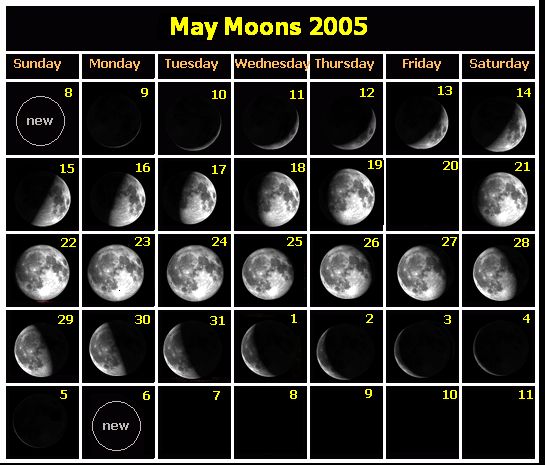

The Moon has phases because it orbits Earth, which causes the portion we see illuminated to change. The Moon takes 27.3 days to orbit Earth, but the lunar phase cycle (from new moon to new moon or from full moon to full moon) is 29.5 days. The Moon spends the extra 2.2 days "catching up" because Earth travels about 45 million miles around the Sun during the time the Moon completes one orbit around Earth.

You count notches on your moon stick, your "uštap". You realize that the there are about 29 to 30 nights in a moon cycle. You start calling this period moon (mesec in Serbian). And you have a lunar calendar. 

Because the first day counting was associated with moon cycle calculation, the start of the day was counted from the sunset. This tradition was preserved in both Ireland and Serbia until very recently. 

Because the tracking the change of the moon is easy, the first calendars were moon based. You could say to people: "we will meet at the next full moon" or "we will meet three full moons from today" or "we need to meet on the third day after the third full moon". All people needed to do to keep their appointment was to use stick "štap" and mark the passing of full moons into the stick "uštap". 

Alexander Marshack, in a controversial reading, believed that marks on a bone baton (c. 25,000 BC) represented a lunar calendar. Other marked bones may also represent lunar calendars. This is the Blanchard bone. 


Thee engraved marks found on this bone were interpreted by Alexander Marshack as lunar calendar with different shaped notched marking lunar change. 


Similarly, Michael Rappenglueck believes that marks on a 15,000-year old cave painting represent a lunar calendar. The below picture is from the Lascaux cave in France. The dots in the picture are supposed to be representations of days in the 29 days moon cycle. 


This is a very good article arguing that the cave paintings in Lascaux represent a complex lunisolar calendar. I have my doubts mostly because the described system is too complicated. There is a much easier way to use sun and moon to calculate time. 

This is the 8000 years old lunar calendar found in Serbia. It is made from the tusk of a wild boar and is marked with engravings thought to denote a lunar cycle of 28 days, as well as the four phases of the moon. There is an empty space just before the last notch. Is this the 29th day, when the new moon vanishes from the sky and is not visible? The calendar fits into a pouch or a small bag so it can be said that this is probably the world's first pocket calculator, calendar. 


The area where the tusk was discovered represents one of Europe's most interesting archaeological sites from the Neolithic period and was a religious center 8,000 years ago.


This was probably a ceremonial calendar, which probably belonged to the priest and was maybe even held in a temple. The ordinary people probably had "uštap" the full moon cycle cut into a stick. For time synchronization required for work planning simple  "uštap" is perfectly sufficient. There is no need for time adjustment 

The problem is that this system is good enough for short term planning which is not related to the vegetative cycle. But if you try to use moon calendar to plan your activities related to vegetative cycle you will realize that the moon calendar is not the right tool for the job, because the Earth vegetative cycle is governed not by the moon but by the Sun. If a specific solar governed event, like the beginning of spring fell on the 3rd full moon this year, it will not fall on the 3rd full moon next year. Because the lunar year, the sum of full moons in one year, is shorter than the solar year, the new lunar year will start earlier than the solar year and the solar event will occur later than previous year. And this lagging of the solar events will be bigger and bigger as years pass.  

So how do you solve this problem? 

You realize that you need to start using the sun cycle in order to determine the exact timing of vegetative events during the solar year. You start with what you know about the sun. You know that the sun is changing in a longer cycle. It gets higher over the horizon and hotter and then lower and colder over many moons. The trick is to determine exactly when the solar cycle starts and how many moons does it last.  

Remember the level place from where you were observing the sunrise and sunset all year round in order to determine the number of days in a moon? The observatory? You are standing next to the observation pole and observing sunrises and sunsets. As you are observing the sunrises and sunsets, you notice that the point where sun rises is not the same as the point where sun sets. The sun rises on the left side of the horizon, travels across the sky from left to right and sets at the opposite right side of the horizon. As days pass you realize that the point where the sun rises moves along the horizon. So does the point where the sun sets. You notice that the sunrise point moves during the spring further and further to the left and the sunset point further and further to the right. So the sun needs to travel longer across the sky and the day is longer and longer and hotter and hotter. Then at some point during the summer the sunrise and sunset points start moving in the opposite direction. The sunrise point starts moving to the right and sunset point starts moving to the left. They get closer and closer to each other, so the sun has to travel shorter distance between the sunrise and sunset and the day is shorter and shorter and colder and colder. 


This is extremely important observation if you depend on solar vegetative cycle for your survival. If the length and heat of the day depends on the position of the sunrise and sunset points, then determining how they move becomes imperative. You know that the days when the sunrise and sunset points change the direction of their movements, fall in the middle of the coldest and hottest part of the year. You are of course more interested in the turning point which falls in the middle of the cold dark part of the year. You want to know if, and this was for our ancestors very real IF, and when the sunrise and sunset points will start moving further and further away from each other, because that will mean that the days will start getting longer and hotter again. So you start observing the the horizon and you try to remember where the sun rose and set yesterday in order to compare it with the sunrise and sunset position today. But that is difficult and imprecise. It would be much better if you could mark the points of sunrise and sunset every day in some way and then observe the relative position of the sunrise and sunset points to the marks. So you decide to use two stakes, poles as markers. But it is difficult to mark the exact point of sunrise and sunset if the horizon is uneven. It would be much easier if the horizon is horizontal, smooth and elevated all around you so that the observation and marking of the sunrise and sunset points becomes more precise. So you decide to create an artificial horizontal smooth horizon which will mask the real horizon. You take a long enough rope, tie it to the observation pole and then walk around the observation pole. As you walk you mark a circle with the center in the observation pole.


You then dig a circular trench along the circle and pile up the the dug out earth on the edge of the circle to form the bank. You build a henge like this original earthen henge in Stonehenge. You can read my article about henges here.


Now when the sun rises or sets it will be easy to mark the exact spot of sunrise and sunset  with a stake stuck into the elevated earthen bank. Every morning and evening you observe the new position of the sunrise and sunset points. If the sun does not rise and set at the points marked with the yesterday's stakes, you stick new stakes into the earthen bank to mark the new position of the sunrise and sunset points, and you remove the yesterday's stakes. As the days get colder and colder, the sunrise and sunset stakes will get closer and closer to each other. Then one day in the middle of the winter, the movement of the sunrise and sunset points will stop. The sun will rise at the same position behind the yesterday's sunrise stake and will set at the same position behind the yesterday's sunset stake. That day is the winter turning point, the winter solstice, the shortest day of the year. You mark these two points with the permanent taller stakes. So when the sun again rises and sets behind these two sunrise and sunset stakes you will know that the winter turning point, the winter solstice, the shortest day has arrived again. You can now build a high wall, a fence, a palisade made of wooden stakes, around the central observation stake, within the earthen henge, in order to create artificial smooth horizontal elevated horizon to completely mask the real horizon. You then make two gates, both in the earthen bank and in the wooden palisade within it, at the exact places where the winter solstice turning point stakes were. So in the future, on the day of the winter turning point, the winter solstice, the people standing in the center of the sun circle will see the sun rise and set through the "sun gates". 

This is exactly what people did in Goseck circle one of the oldest henge solar observatories in the world.


At the winter solstice, observers at the center would have seen the sun rise and set through the southeast and southwest gates.


You can do exactly the same with the boundary turning points in the middle of the summer. You can make gates at these two points or just at the summer solstice sunrise point and watch the sun rise through the sun gate every summer solstice like in so many henges in England. 

Now you have a ceremonial sun circle, which can be used year after year to determine the the beginning of the solar year but also for worshiping of the high god, the Sun. 

Then from the starting point of the winter solstice, you count number of days and number of full moons until the next starting point. You get a long stick and you cut a notch for every day and a cross for a full moon day. You are basically determining the number of days in a solar year and the number of "moons" in a solar year and you record them  "u štap" in a stick. Next time the winter solstice arrives, you will know exactly how many full moons there are in a solar year and how many "extra" days are you need to reach the end of the solar year. Then when the sun rises through the sun gate, and the new solar year begins, a celebration is held to celebrate the rebirth of the sun and the new year calendar stick is cut. 

How was this year calendar stick cut?

The year stick was cut in such a way that it first counted the days of full moons from the day of the winter solstice, regardless whether there was actually a full moon or not. A notch was made for every day and every time the number of days in a full was reached, the full moon mark was made in the calendar stick. At the end of the last full moon period, people were left with the extra days, the days which they needed to add to reach the number of days in the solar year. These days were added to the end of the calendar stick. These extra days were called "dead days". They were outside the calendar, outside the time, between the sun circle and the moon circle. These were the days when no work was done, the taboo days, when everyone was at the sun circle, waiting for the sun to be "reborn" and for another solar year to start. People originally probably used the 29 days full moons. This calendar had 12 full moons and 17 extra dead days. At some point one day was added to each full moon and moons ended up having 30 days each. This calendar had 12 full moons and 5 extra dead days. 

In Serbian tradition the name of these 5 extra "dead days" is preserved as (Mratinci, Mrt + den, literally dead day) which in Serbian Orthodox church calendar fall between the 9. do 14. of November. These dead days are also called "vučji dani" or  wolf days. 

The calendar stick with all the days of the solar year divided into the days of the full moons and the dead days, allowed everyone to count time in the same way, and to coordinate their actions without the need to observe the sky and know anything about the movements of the sun and moon. Now vegetative events of the solar year were fixed in the lunar calendar. Also this system made sure that every year was a true solar year, starting at the exactly the right time and lasting exactly the same number of lunar calendar days. It was the dead days at the end of the solar year that allowed year length adjustment. 

So after the celebration at the sun circle is finished, everyone goes away to their villages, bringing with them their year stick calendars. Every day, they cut away a piece of the year stick up to the first notch, marking the passing of the previous day. Then one day, when the last full moon mark is reached on the stick, at the beginning of the dead days, everyone comes back to the sun circle to witness the rebirth of the sun, and to get the new calendar stick carved for them. I love the way these calendars are not made to record the past, but to fix the present moment in time and to allow planning for the future. 

It seems that at some stage the order of "dead days" and full moons was reversed and the dead days were counted as the first days after the winter solstice.   

In Serbian tradition, Sun, the "Višnji Bog", the High God, is perceived as a living being, which is born every year in the winter. He then grows into a young man Jarilo on the 6th of May the day of the strongest vegetative, reproductive power of the sun. Then he becomes the powerful ruler Vid at the summer solstice, 21st of June the longest day of the year. He then becomes the terrible warrior Perun on the 2nd of August the hottest day of the year. Then the Sun God dies on the day of the winter solstice, the 21st of December the shortest day of the year. The Sun God then goes into the underworld, where it spends 5 days and emerges, reborn on the 25th of December. These 5 days that the sun spends in the underworld, are the extra days, the dead days, the days which are outside of the calendar. 

This is why Christ the Son God, was born on the 25th of December, the same day when Mithra the Sun God was born before him. 

Epiphany which traditionally falls on January 6, is a Christian feast day that celebrates the revelation of God the Son as a human being in Jesus Christ. The earliest reference to Epiphany as a Christian feast was in A.D. 361, by Ammianus Marcellinus St. Epiphanius says that January 6 is hemera genethlion toutestin epiphanion (Christ's "Birthday; that is, His Epiphany"). Alternative names for the feast in Greek include η Ημέρα των Φώτων, i Imera ton Foton (modern Greek pronunciation), hē hēmera tōn phōtōn (restored classic pronunciation), "The Day of the Lights", and τα Φώτα, ta Fota, "The Lights".

Was the night between the 6th and the 7th of January, the old end of the 17 dead days, when the month had 29 days? The day when the sun reappeared from the underworld and revealed itself to the people as the beginning of a first day of the first moon of the new year? Is this why this day is still a holy day of the revelation, birthday of the Son the God who replaced Sun God?  Is this why this day is called the Day of the Lights? 

But in Serbian tradition we also find the 5 dead days at the end of the solar year. When the beginning of the year was moved to the spring Equinox in March, the dead days became the Baba's days, the days of the Baba Mara, Mora, Morana, Marzana, the goddess of winter and death. They are the last 5 days of winter, the dead days after the end of the last 30 days full moon and just before the beginning of the spring. In Serbia these days are often in legends called jarići meaning billy goats. Now vanished stone circle from the south of Serbia was recorded as being called Baba i jarići. Baba was the central stone pillar and jarići were the circle stones. Were there five of them? Is this why so many stone circles from Ireland have exactly 5 stones? Maybe these were days during which Jarilo, the young sun, the god of spring is going through the underworld before being born to start new vegetative cycle. There is an expression in Serbia, which probably dates to the time of the forced Christianization of the Serbs in 13th Century: "Ja ga krstim a on jariće broji" meaning "I am baptizing him and he is still counting billy goats". The expression means wasting time on someone and shows how strong the old faith was among the Serbs. Are the billy goats from this expression the same 5 dead days of the old calendar? Are all these beliefs and customs echos from the days when first henges were built 7000 years ago in order to create the first lunisolar calendar?