While reading about the sudden collapse of the Balkan Neolithic cultures, like Vinča culture (pic) at the end of the 5th mill BC, I came across a proposition that maybe it was an epidemic of some sort which could have caused it...
This is a distinct possibility...New, previously not encountered diseases could have wiped out the population with no immunity.
But we don't have data that proves that something like that happened in the Balkans at the end of the 5th millennium BC.
We however do have proof that epidemics and even pandemics occurred during Neolithic, but not that they were the cause of the collapse of the Neolithic cultures in which they occurred...
Between 1999 and 2001, archaeologists excavated the Frälsegården passage grave in Gökhem parish, Falbygden, western Sweden, which was built between 3300 and 3000 cal. BC.

In it they discovered remains of up to 78 individuals. Which caught attention of the authors of this study: "Emergence and Spread of Basal Lineages of Yersinia pestis during the Neolithic Decline".

And in it, the authors state that:
"Because of a large number of bodies which were buried in the same grave during very short period, 3100–2900 BP, based on carbon dating of 34 individuals...a possible explanation for the magnitude and short duration of this grave was an epidemic event"...
Completely wrong conclusion. We know, based on Early Neolithic data, the the total life expectancy at 15 would have been 28–33 years.
So even if we assume that these guys lived until 40, and that they had children when they were 20, that would mean 5 generations per 100 years, which would mean 15 generations in 300 years...
78 individuals buried in this grave could have been 5 members of a tribe, clan, extended family, which were buried every generation...Not too many...Nothing really to indicate that anything weird went on...
Thankfully the authors of the "Emergence and Spread of Basal Lineages of Yersinia pestis during the Neolithic Decline" paper did think (wrongly) something weird was going on, so:
They analyzed the ancient DNA datasets from individuals of this grave and screened for the presence of known human pathogens.
Unexpectedly, they found the unambiguous presence of Yersinia pestis, the etiological agent of plague, in two different individuals, dated to 2,900 BP
So again a confirmation that all these people weren't buried in a mass grave because they all died from some disease. Only the people buried last were in fact infected by the plague...
The discovery of Neolithic farmers in Scandinavia infected by plague, not only pre-dates all known cases of plague. The people were infected by the the strain from which all known modern and ancient strains of Y. pestis are derived...
Wow this is amazing...It turns out that plague didn't come from "Dirty" Asians...It came from "Dirty" Europeans...The authors of the study continue to say that:
There is a remarkable overlap between the estimated radiation times of early lineages of Y. pestis, toward Europe and the Eurasian Steppe, and the collapse of Cucuteni/Trypillia (Tripolye) mega-settlements in the Balkans/Eastern Europe.
Now Cucuteni/Trypillia (Tripolye) culture, was a Neolithic–Eneolithic archaeological culture (c. 5500 to 2750 BCE) of Eastern Europe which covered huge territory (350,000 km2) in today's Romania, Moldova and Ukraine..

This culture is famous for its amazing pottery and figurines

But what it should be famous for are their settlements. Not the small villages, like this reconstructed one, which indeed constituted the majority of Cucuteni–Trypillia settlements...

But their "mega cities". During the Middle Trypillia phase (c. 4000 to 3500 BCE), Cucuteni/Trypillia culture built the largest settlements in the Neolithic, some of which had as many as 3000 structures and were possibly inhabited by 20,000 to 46,000 people!!!
The plan of the magnetic survey of the settlement Maidanetske 1. From the article "Governing Tripolye: Integrative architecture in Tripolye settlements"...

Here are reconstruction drawings of the two Cucuteni/Trypillia settlements:
Talianki, Ukraine – up to 21,000 inhabitants, up to 2,700 houses
Maydanets, Ukraine – up to 29,000 inhabitants, up to 3,000 houses
So far 3000 settlements have been discovered, ranging from small villages to "vast fortified settlements consisting of hundreds and thousands of dwellings surrounded by multiple ditches".
The typical Trypillia hierarchy was one dominant "capital" of more than 100 hectares, surrounded by satellite towns typically in the size range 10–40 hectares and villages in the range of 2–7 hectares. The Capital controlled territories in about 20 km radius
These were basically city states...And these city states of the Cucuteni/Trypillia culture predate Mesopotamian city states, by half a millennium at least...
But very few people know about this...
Anyway, Cucuteni/Trypillia civilisation, because that's what it was really, was a society of subsistence farmers. Cultivating the soil (using an ard or scratch plough), harvesting crops and tending livestock was probably the main occupation for most people.
Typically for a Neolithic culture, the vast majority of their diet consisted of cereal grains. They cultivated club wheat, oats, rye, proso millet, barley and hemp, which were probably ground and baked as unleavened bread in clay ovens or on heated stones in the home...
Now. The article about the origin of the plague, identifies Trypillia Culture mega settlements, built towards the end of the 5th millennium BC, as the initial source of the Y. pestis infection...
Why? Well have you ever thought where did 30,000 people who lived in one of these mega cities go to the toilet? Huge number of people lived in these cities in cramped conditions with degrading sanitation...At least this is what the authors of the plague paper are hinting at...
But I don't think that was the reason...Cucuteni/Trypillia people grew grain in, for that time, huge amounts. And had to store it inside their homes, or communal storage building inside their settlements...And where there is lots of grain, there are mice and rats...

And it is mice and rats that can devastate grain stores and cause famine...Which is probably why Cucuteni/Trypillia people kept cats...Black cats depicted on a ceramic vessel from Cucuteni/Trypillian culture. 4500-4000BC...
This is also the reason why another civilisation which depended heavily on grain, Egyptian civilisation, deified cats...And held cat goddess festival around the time of the grain harvest.
I talked about it in my post "Bastet"....
But rats also spread plague. The infected rat that carries the disease will infect fleas that live on it. These fleas then transmit the disease on humans...

The authors of the plague study, say that the ever increasing Cucuteni/Trypillian population living under highly dense conglomerations was "likely under nutritional stress and weakened due to resource overexploitation". Ideal conditions favored epidemics and pandemics...
But the population didn't have to be weakened to catch plague. All you need is one infected rat, which enters the settlement and then dies...In a flea infested cramped neolithic settlement, by the time you know what hit you, you have dead bodies piling up...
Anyway, the paper on Y. pestis concludes that: it is most likely that it was the Trypillia mega-settlements where the ancestor(s) of the plague emerged...
They then says that it then rapidly branched and migrated in all directions, including into the steppe...spreading mainly through early trade networks, rather than massive human migrations. This allowed for a rapid and large-scale expansion of the pathogen...
The authors blame the emergence of the animal traction complex, involving cattle traction, wagons, and ard ploughs, on creating the favorable and unprecedented conditions for a rapid expansion of infectious diseases over large geographic regions...
This same pathogen lineages persisted through the Bronze Age but got eventually extinct. The authors of the plague paper propose that plague may have contributed to the Neolithic decline, which paved the way for the later steppe migrations into Europe...
I agree that this is from where the plague spread east into Asian steppe...But I would like here to propose that paper authors are wrong, and that plague didn't originate in 4th millennium BC Trypillia mega-settlements...
I believe it probably originated in the 7th c. BC in "The First Temperate Neolithic" cultures of the Balkans, the first cultures to practice agriculture in temperate Europe...
This required significant innovations in farming technology previously adapted to a mediterranean climate. Leading temperate agriculture revolution was the Starčevo culture which built Blagotin settlement in Serbia around a temple dedicated to grain.
I talked about this in my post "Blagotin"...
Why do I think this is where plague emerged? Because of something called "The burned house horizon", which is the geographical extent of the Neolithic phenomenon of people presumably intentionally burning their settlements.

This was a widespread and long-lasting tradition in what is now Neolithic (grain farming) Southeastern and Eastern Europe, which ended when Neolithic ended...With the end of the Cucuteni-Trypillian culture, the last culture to practice the house burning...
Cucuteni-Trypillian culture brought it to its extreme...There is evidence that every single settlement in the Cucuteni-Trypillian culture practiced house burning. And that not just single houses, but whole settlements were burned regularly...
Why? No one knows actually 🙂
Proposed explanations so far:
Accidental fire and deliberate burning of houses by invaders:
Some of the burned sites contained large quantities of stored food that was partially destroyed by the fires that burned the houses. Some burned houses also contained human remains...
This "supports the theory that the buildings were burned accidentally or due to enemy attack, as it could be argued that nobody would intentionally burn their food supplies along with their homes and their families"
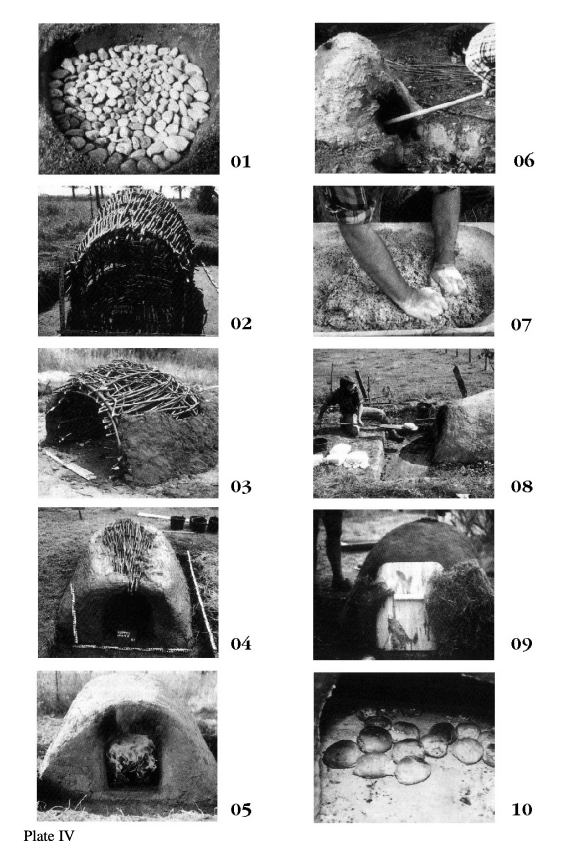
However...Experiments have shown that unaided, both accidental or deliberate fires, can't produce temperatures that can cause vitrification of the clay from the walls (turn it into ceramic)...Which is found in these burned houses...
This can only happen if you deliberately pile huge amount of combustable material around the house and then light it up. Experimental house burning. Note the amount of extra fuel added to the outside of the clay walls to increase the temperature needed for ceramic vitrification

Additionally, the experimental burning with unaided fires, left the walls almost entirely intact. It would have been relatively easy for the roof to have been repaired quickly, the ash cleared away, and the house reoccupied. Which is not what archaeologists found...
The opposite opinion is that people deliberately burned their own homes. Proposed reasons :
1. weatherproofing (🙂 laughable sorry)
2. recycling of building materials (some of the burned clay from the house walls was reused, but this is an exception not a rule)
3. demolition to create space (no new space created. houses built on top of burned remains)
4. fumigation (!!! discarded as an overkill (!!!) as the damage to the settlement was almost total)
None of this really works as an explanation either...
So what's left is ritual 🙂 Symbolic end of house: the buildings were burned ritually, regularly and deliberately in order to mark the end of the "life" of the house which was seen as a living being...
Weeeeell...Here is what I think happened...
French scientist Paul-Louis Simond (who came to China to battle the Third Pandemic of plague in the late 19th c. and who there discovered how plague spreads through rats and fleas) had noted that:
In Yunnan, China, inhabitants would flee from their homes as soon as they saw dead rats, and on the island of Formosa (Taiwan), residents considered the handling of dead rats heightened the risks of developing plague...
And in "The Epidemic of Pneumonic Plague in Manchuria 1910-1911" we read that "In Harbin itself a large-scale burning took place: of houses which had lodged plague victims or whose inhabitants had been removed"!!!!!
Is this how it all started? An infected rodent would come into the village looking for grains. And die. Someone in the village would get bitten by an infected flea...And would get infected by the plague...
Now people from all early the Neolithic Balkan farming cultures lived in separate single family households which were self sufficient...They didn't have to mix a lot with other people from the settlement...
So in most cases, the infection would first spread to the other members of the household and would most likely be initially localised. But then people would start getting really sick and dying...
In the beginning it is possible that whole settlements were wiped out...Their bodies discovered by their kin from another settlement. Who then burned the whole place down to kill the evil disease (spirits, ghosts...whatever)...
But maybe the disease was spotted early and the other people from the village did run away from the "accursed sick possessed by the evil spirits" and came back when they were dead to burn them and their house and everything in it...
And burn it properly, making sure everything is completely destroyed and burned to cinder...Or burn the whole village properly, cause "the evil spirits of the disease could be lurking in any of the houses waiting to kill the rest of us"...
It is interesting that "Early Neolithic houses have more artifacts deposited in them, and it is in these early Neolithic phases that burned human remains are most likely to occur"
Something crazy just occurred to me. Why were Vinča culture figurines depicted with masks? What kind of "ritual" were they involved in? http://oldeuropeanculture.blogspot.com/2017/12/mask-from-belo-brdo.html
By the way the Vinča culture majorly culturally and genetically influenced Cucuteni/Trypillia culture

Did people eventually start paying attention to rats entering their settlement and fleeing as soon as they saw a dead rat? Just like the Chinese and Indian peasants still did in the 20th century...
Coming back after a while to burn their houses in giant pyres to incinerate all the rodents and all the fleas?
Once the agriculture developed, and population increased, and settlements became larger and more crowded, and number of rats increased and trade increased, the chances of plague appearing and spreading became bigger...
Are regular burnings of the Cucuteni-Trypillian settlements really "regular ritual killings of houses" or "frequent killing of rats and fleas in plague infested houses"?
It is actually possible that in the Cucuteni-Trypillian culture this eventually became a ritual. Ritual cleansing of the place. A preventative burning of rats and fleas.
What do you think? I think that this actually explains pretty much every piece of archaeological evidence we have about Neolithic house burning.
It gives us a real reason why someone would resort to such ultimate destruction of his home and everything in it, why sometimes there are bodies burned with the house, why this is done often and why people then just rebuild their houses in the same place...
So is it possible that the Neolithic farmers in the South Eastern Europe would have survived and multiplied, if I was right? Well yes. People do survive epidemics of plague...And continue on...Well, after burning their houses and their dead...
So was the plague the reason for the collapse of the Cucuteni/Trypillia culture? I don't think so...Was the plague the reason for the Neolithic collapse in the 5th millennium BC Balkans? I don't think so...Something else was. And I will talk about this soon...Sorry...