Prior to that, she was "really a personification of the winter and the darkness and the snow getting closer and taking over the land again. Not only did she represent winter, she was seen as actually controlling the landscape"...
This is very interesting. In Slavic languages, the word Baba today primarily means grandmother. But it also used to mean mother, midwife, and Mother Earth. I talked about this in my post about "Baba's day" which is the celebration of midwives from Bulgaria...

As Mother Earth, Baba primarily meant winter earth, the time of complete domination of Earth over Sun in the Earth (Yin) - Sun (Yang) system which produces life. The time of the year dominated by Yin aspects (Dark, Cold, Wet). More about it in my post "Yin and Yang"...
What is interesting about this Icelandic legend is that it directly states that "Baba" (Grandmother) Grýla not only "brings cold and winter" but that she "shapes the landscape". She is Earth...Mother Earth...The same beliefs are found in the Balkans...
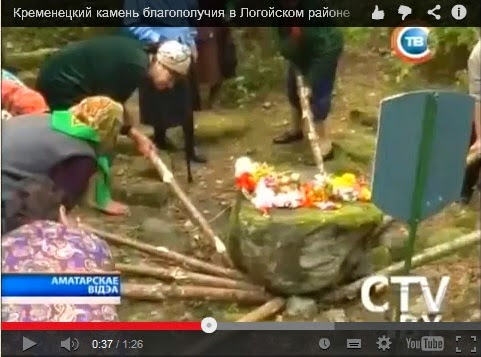
In the Balkans shepherds used to pray to stones and particularly rocky crags for good weather. These stones were known as Baba (Mother Earth) stones. Interestingly a lot of these stones are now incorporated into chapels dedicated to Mother Mary. I talked about this in my post "Shepherds chapels from Velebit"...

In Slavic countries people performed megalithic (stone raising) rituals intended to manipulate weather. These were accompanied with prayers to Dabog, Sky Father, but the medium used was rock, body of Dajbaba, Earth Mother. I talked about these rituals in my post "Weather stones"...

The direct link between Mother Earth, Stone (rock), cold is particularly strong in the Balkans. In Serbia the word baba used to also mean stone, rock. Rocky mountain tops are often called Baba as are exposed outcrops of bedrock...Like this one from Slovenia...

In Croatian and Serbian folklore "baba" (Grandmother) is directly linked to winter, cold, damp:
baba (grandmother) - late snow which falls in spring
babura (grandmother) - hail, ice that falls from the sky
babura (grandmother) - dark sky with drizzle
baba (grandmother) - changeable weather at the beginning of March when snow is likely to fall
bаbini dni (grandmother's days) babini jаrci, kozlići (grandmother's goats) pozаjmenci (borrowed days), ukovi (noise, storm, wind) - cold stormy snowy days in March or April
baba Marta (grandmother Marta, March) - Month of March which can have very changeable weather with snow
babina nedelja (grandmother's week) - the last week in March
baba Korizma - lent, seven weeks of great spring fasting
baba Korizma - a man dressed as a woman representing winter during the Bele Poklade (lent) carnival
bаbin kut, budžаk (grandmother's corner) - the north west part of the sky from which storms and cold weather come
babje, bablje, bа̏bаčko leto (grandmother's summer) - late hot days in the autumn, indian summer
In Polish folklore we find
babinmróz (grandmother's frost) - October frost
In Bulgarian folklore we find
"baba chłóduna (grandmother cold) is sitting somewhere on an oak tree, incubating eggs, and until they hatch, the drought will continue" - when drought lasts too long
In the Polish Carpathians we find
"the baba (grandmother) is already frozen" - the mountain tops are covered with frost or the first snow
babin proso (grandmother's millet) - hailstone
baba Marta (grandmother Marta, March) - a mythical figure who brings with her the end of the cold winter and the beginning of the spring. Celebrated on the March the 1st.
In Romania, where Serbs once lived in huge numbers, we find
babe (grandmothers) - first 9 days of March when snow can fall again
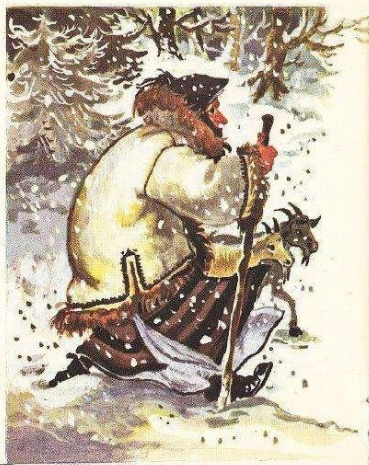
baba Dochia (grandmother Dochia) - an old woman who insults (teases) the month of March either by badmouthing Him or by going up to the mountain with a herd of sheep or goats (way before she should, in May). March then steals frosty days from February to punish her. See "babini jarci" (grandmother's goats) and "pozаjmenci" (borrowed days), both meaning "cold stormy snowy days in March or April" from Serbian folklore...
Among Kashubians in the Carpathian mountians we find
old baba (grandmother) - rain
"the old baba (grandmother) went to dance" - when the weather suddenly changes and it starts to snow
The reason why Baba (Mother Earth) was identified with rocks is because everything above rocks, everything alive, plants, animals, humans... was seen as "what Mother Earth gave birth to"...
This is Babno polje (Grandmother's field), a valley in Slovenia. This is the coldest place in Slovenia...

Babinjača (Grandmother's place), Pešter (Sjenica). Pester is the largest plateau (1150m on 63km²) in the Balkan Peninsula and one of the largest in Europe. The area of Sjenica (Babinjača) is the place where the lowest temperatures in Serbia are recorded every winter...

Bjelašnica, Babin do (Grandmother's valley). The area experiences some of the lowest winter temperatures in Bosnia, down to -41 °C. Also known as Mokra gora (Wet mountain, forest)...

All of these places were called Baba's place deliberately because they were the coldest spots...
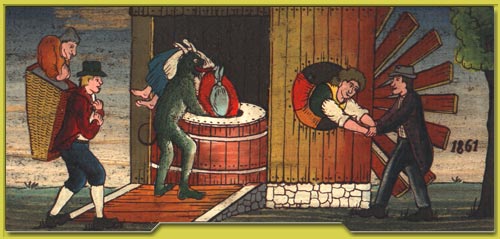
The Cold old hag, Winter Earth, gets transformed into Hot young maiden, Spring Earth, with the arrival of her future husband, young Sun. Just in time, as all the last year's wheat was used up. Milling grandmother into maiden, Slovenia...I talked about this in my post "Babji mlin"...

Baba (Old Hag, Winter Earth) is found all over Europe under different guises.
In Gaelic lands of Ireland and Scotland she is Cailleach...
In Italy she is Befana...
In the mountains of Central Europe she is Perchta to Germans or Peruehty to Slavs...
In the North of Germany and in Scandinavia she is "Mother Holle (Hulda) or "Old Mother Frost"
Mother Holle is very interesting indeed. Marija Gimbutas thought that Holle was originally an ancient Germanic supreme goddess who predated most of the Germanic pantheon. She was right about Holle being old Mother Goddess. Not right about her being in any way exclusively Germanic
Officially, the name is thought to originate from German "huld" (gracious, friendly, sympathetic, grateful), Middle High German "hulde", Old High German "huldī" (friendliness). Weird root for the name of the Old Hag, right?
Then we read this: The name "Hludana" is found in five Latin inscriptions: three from lower Rhine, one from Münstereifel, one from Beetgum, Frisia, all dating from 197 AD-235 AD. Many attempts have been made to interpret this name...How about "hladna" Slavic for she who is cold?
That would be the perfect root for The Old Hag Winter, right? But who would be speaking Slavic languages in parts of Germany occupied by Romans in the 2nd and 3rd century AD??? Well Slavs of course, but that completely contradicts the official history of Europe...
In Slavic countries she is Baba Marta. Normally this is believed to mean Grandmother March, as in month of March. But why would Slavs name the Old Hag Winter Earth using Roman month name, which by the way was in many Slavic lands the first month of Spring?
The original Slavic name for the Old Hag Winter Earth was Baba Mora, Baba Morana. Name Mora, Morana is based on the root "mor". This root is found in most Serbian words with diminishing, reducing, negative meaning...Morana was also Slavic goddess of death...
The word "mori" means "kills", so Morana is literally "She who kills". The word "mraz" (moroz) means "frost" so Marzanna is literally the frosty, the cold one. They both come from the same root "mor"...
And it is Morana (Morena, Marzanna) whose effigies are made at the beginning of every Spring, and
are then burned or drowned (or both, to be sure to be sure 🙂). This is done to make sure winter doesn't return. Burning - warming of Mother Earth, Drowning - showing of Mother Earth

Gaels also used to ceremonially burn the Old Winter, Cailleach.

That Morana and Baba are one and the same can be seen from rituals preserved in South of Serbia and Bulgaria, performed during "Babinden" (Grandmother's day), the annual celebrations of "birth givers"...
In Bulgaria, the climactic moment of the day is the ritual bathing of the midwife in the river or a well. Actually ritual drowning.

This custom was until the 1980s preserved in the village of Dikanci, in Gora region in South of Serbia.

I will finish this post with this Roman mosaic depicting The Spirit of winter...