Showing posts sorted by date for query radegast. Sort by relevance Show all posts

Thursday, 23 December 2021

Inviting spring

There are special kind of bird shaped buns baked by Eastern Slavs as part of the "inviting spring" rituals which were traditionally performed in March every year.  They are called "жаворонки, zhavoronki" (larks) or "кулики/kuliki" (sandpipers) ...

These cookies were baked in March for the first (1st of March), second (9th of March) and third (March 22 or 25th) calling (inviting) of spring...I guess one can get pretty impatient waiting for spring to arrive...🙂

People believed that larks and sandpipers arrived “carrying spring on their wings” and “leading other migratory birds behind them”. And the arrival of migratory birds was a sure sign of coming spring. And an extremely important event in Slavic tradition...I talked about this in my post "Leto"...
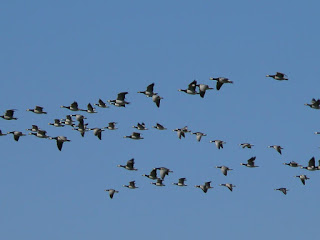
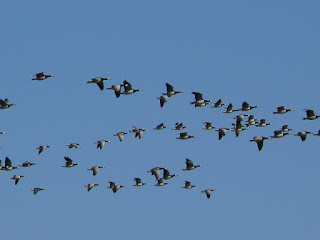
Remember, Slavs believed that every autumn, migratory birds took away the sun to Iriy, Slavic Otherworld, World of the Dead, where he spent winter. And that every spring, migratory birds brought the sun back into our world...

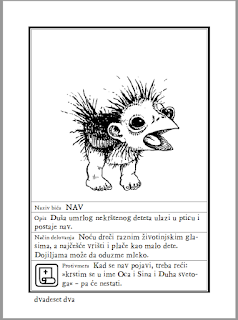
But Slavs also believed that migratory birds also brought souls from Iriy. Souls which were ready to be reborn...I talked about this in my post "Nav"...
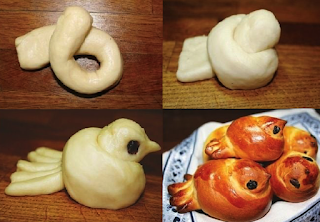
Here is how you can make two main types of bird buns, the flying one and the sitting one...



Anyway, once made, the "larks" and "sandpipers" buns were placed on the windowsill, but most were given to children who ran around with them pretending that the birds were flying, all along shouting and calling spring to come...

Some children stuck their "bird" bun on long rods and waved them high in the air pretending that the birds were flying. Some other children threw the "bird" buns in the air trying to make them “fly” as high as possible. Some carried the "bird" buns on their heads...

The kids tried to bring their "bird" buns to "the high places": tops of hills, trees, rooftops, haystacks, fences...Children played with their "larks" all day and ate them in the evening, but some bird buns were left on the high places as offerings...

In some areas the kids would eat the bodies of their bird buns, but the heads were fed to the cattle "before they were taken out to graze in the fields for the first time"...This again seems to have been a ritual offering, a sacrifice of sorts "for good weather"...

Some bird buns were left on a patch where all snow melted. And some were thrown into a river...Remember snow melt is another sure sign of the departing winter (Morana/Marzana, the Old Hag Earth) and arriving spring (Vesna, the Young Maiden Earth)...

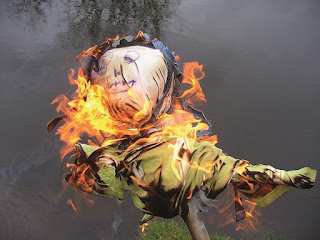
Which is why Slavs burn the effigies of winter or drown them or both...To be sure to be sure...But also heating of the earth causes snow to melt and the rivers to swell with the snowmelt...I talked about this in my posts "Gryla", "Baba's day"...
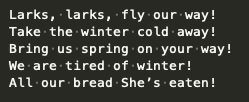
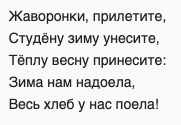
Apart from children, young unmarried women also played a major role in "calling of spring" rituals. They were the ones who sang "Веснянки / Vesnyanki" (Spring songs)...
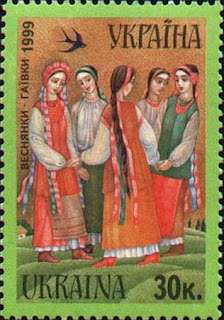
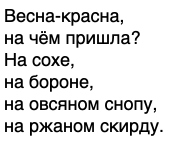
Like this one. And do you see how the end of bread (flour) is linked with the departure of winter and the arrival of spring?

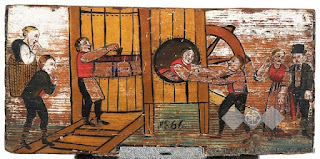
That's interesting...Because it explains the "magical transformation of an old woman into a young maiden through milling" images from Slovenia...

I talked about this in my post "Grandmother's mill"

And in my post "Old woman of the mill dust" about a very similar folk tradition from Ireland...

Here is another Vesnyanka (Spring song). This one directly linked with grain agriculture too...


I don't get this Red Spring thing though...Was this once Весна Красивая (beautiful spring)??? Or is red = hot?

Anyway, in some areas, women baked rye bread and then went out of the village, to the fields, orchards, meadows... There they bowed to earth, threw the bread on the ground and exclaimed: "Here is, Mother Spring, some rye bread for you"...

Again, this is a ritual sacrifice of bread to the mother of bread...And it is performed by a woman...In Slavic tradition (and not just Slavic) Earth fertility and female fertility was directly linked...I talked about this in my post "Walking sheafs of wheat", "Wheat wreath", "Corn dolly"...

This pre Christian Slavic celebration of the end of winter and the beginning of spring was later incorporated into Christianity and is now seen as part of "Сороки / Soroki" (Forty Martyrs of Sebaste)  for some weird reason... 

Here you can find the recipe and the instructional video for these beautiful bird buns (with English subtitle)... 

More about spring and birds in Slavic folklore can be found in these posts: "Partridge",  "Tetjorki", "Swallows", "Bird wedding", "Leto", "Radegast", "Cock bashing"...

Wednesday, 26 August 2020

Babe(le)

Ok this is going to be fun. This amazing rock formation covered in snow is known as Babele. The name means "Grandmothers" and it's derived from Slavic (Serbian) "baba" meaning grandmother but also rock. 


Here is the same rock formation just without snow.

It is located in Romania, on the Bucegi plateau which itself is located on Bucegi Mountains, part of the Southern Carpathian mountain chain...The name "Bucegi" is derived from the Slavic (Serbian) "buk" meaning beech tree. So the mountain name means "Beech mountains"...

The Babele rock formation is located near the mountain peak called "Baba Mare". The name is again derived from Slavic (Serbian) "baba" meaning "grandmother" or "rock" and Romanian mare meaning great, big...

Baba (Grandmother, Rock) is a common root for mountain peaks and rock outcrops in Balkan Slavic countries. I have collected quite a few of them in my article "Baba mountains and crags" 

For instance Velika Baba (Big Grandmother, Big Rock) peak, Jezersko, Slovenia

If you thought that Babele rock formation is wow, how about this one, also located on the same Bucegi plateau...It is just like the sphinx in Egypt. Just organic...

Here is the same rock formation just without snow but with some sheep...

Bucegi plateau is located on the borders of three counties in Romania, all three with Slavic names:

Brașov-from "baras", fortress

Prahova-from "prag", doorstep, water cataract or "prah" dust

Dâmbovița-from "dămb" (dub), oak

List of Romanian counties and the etymologies of their names

The main pass through the Bucegi mountain range Bran pass, once marked by border crossings between Wallachia and Transylvania, and was defended by the Bran Castle, named after Bran village situates nearby. Bran is a Slavic (Serbian) word means "to defend"... 


The castle is linked to Vlad III Dracula, better known as Vlad the Impaler, who was ruler of Wallachia on and off from 1448 to 1476. And an inspiration for the Bram Stoker's Count Dracula. Whether Vlad ever set foot to the Bran Castle is disputed and not really relevant to the theme of this article. What is relevant is that the name Vlad is Slavic and means Ruler. 

Oh and there is a letter written by Vlad III's father Vlad II to the citizens of Brașov (Slavic name) in written in medieval Serbian, and a letter written by his uncle Aleksander to the citizens of Sibiu (Slavic name) in also written in medieval Serbian, and containing a very juicy Serbian curse still used today...I wrote about this this post "And those who lie"

Now...Back to the Babele rock formation. There is a legend linked to it. It goes like this: 

This is interesting, considering that Baba is a Slavic word. And that Baba Dochia is basically Romanian version of South Slavic Baba Marta (Grandmother March), The Hag, Winter Earth, the spiteful old witch...Originally Baba Morana, the goddess of death...I wrote about this in my post "Gryla"...

In Romania there are three main legends related to Baba Dochia as Baba Marta, the Old Hag Winter Earth...

First legend says that Baba Dochia was a proud old woman who insulted the month of March either by badmouthing Him or by going up to the mountain with a herd of goats (way before she should, in May). March then borrows frosty days from February to punish her...

Interestingly in Serbian folklore, "babini jarci" (grandmother's goats) and "pozаjmenci" (borrowed days), both mean "cold stormy snowy days in March or April"...I wrote about this in my post "Gryla"...

Second legend goes like this:

The whole story is an allegory about the animosity between the old hag winter and the young maiden spring. Just like in these Irish and Slavic legends. I talked about this in my posts "The old woman of the mill dust" and "The Snow White" 

Now in this legend, Baba Dochia's son's name is Dragomir, Slavic name meaning "The one who is very dear" . I wonder if this is euphemism for the sun, which is "very dear" as it is the sun that turns old hag winter earth into young maiden spring earth...

We have parallel to Dragomir (very dear)=Sun, Summer in Radegast (dear guest)=Sun, Summer 

The wild strawberries are a summer fruit, ripening at the earliest at the end of May, beginning of June. May is the time when in the Balkans the flocks are moved to the highland pastures.

Which is why Baba Dochia, The Old Hag, Winter goes into the mountains with her flock of Goats when she sees that her daughter in law, Young Maiden, Spring brought the strawberries from the forest...

In the third legend Baba Dochia's son's name is partially Romanised to Dragobete. The legend goes like this:


In Serbia, traditionally, sheep were sheared twice. First time in February, when dirty wool between the legs and around the udder was sheared in preparation for lambing and suckling. This is the black dirty wool which was usually thrown away. The main shearing season is in May, after the lambing is over, and before the sheep are taken up to the mountain pastures. This is the clean white wool...

The sheared wool was washed in rivers before being dried and further processed. The washing of wool is the signal to take the flocks to the highland pastures...Which is why Baba Dochia, The Old Hag, Winter, sets off with her flocks up the mountain when she sees that her daughter in law, Young Maiden, Spring, have brought back home freshly washed white wool...

The reason why in one legend Baba Dochia goes up the mountain wearing 9 coats and in the other 12 coats, is this. There is a belief in Carpathian region of Romania, that the first 9 (in some parts 12) days of March are the "Baba days". This is the time when Baba Dochia can bring snowstorms and cold weather before the spring fully sets in. 

There was also once a custom in the same region, for women to pick a day out of these Baba days, on the first of March. And if the day turns out to be fair, they'll be fair in their old days (when you are a baba yourself), and if the day turns out to be cold, they'll turn bitter when you get old (when you are a baba yourself). 

Very interesting considering that Baba is a Slavic word meaning Grandmother. And that in Serbian folklore, "baba" (grandmother) also means changeable weather at the beginning of March when snow is likely to fall. And that in Serbian folklore, "bаbini dni" (grandmother's days) means cold stormy snowy days in March or April...I wrote about this in my post "Gryla"...

By the way, why is Baba Dochia called Baba Dochia? Apparently, the name originates from the Byzantine calendar, which celebrates the 2nd-century martyr-saint Eudokia of Heliopolis (Evdokia) on 1st of March...

I love this. 

The name Eudokia comes from Greek Eudoxia (Ancient Greek: Εὐδοξία, Eudoxía), originally meaning "good fame or judgement" or "she whose fame or judgement is good". And on her day the judgement ritual is performed by women...Eudokia is from Heliopolis (the Sun City) and the Baba Dochia celebration is about the defeat of winter by the sun. St Eudocia was celebrated on the 1st of March, "because she was beheaded on that day" and the Slavic mythological equivalent of Baba Dochia, Baba Marta, is celebrated by the Balkan Slavs on the 1st of March...Well people celebrate the killing of winter...

How can such an importan Romanian folk character be basically Slavic, Serbian in origin? Well even the Romanian national hero, Iovan Iorgovan was, according to Romanian legends, of Serbian origin...

How come? Well someone had to give names to all the Slavic toponyms and Hydronyms in Romania...Huge number of Serbs once lived in the southern areas of Romania...They are, almost all, Romanised now, through a process organised and "encouraged" by Austor-Hungarian state...

All that's left are toponyms, hydronyms and legends...

Thursday, 2 July 2020

Year Without a Summer

The year 1816 is known as the Year Without a Summer (also the Poverty Year and Eighteen Hundred and Froze To Death) because of severe climate abnormalities that caused average global temperatures to decrease by 0.4–0.7 °C (0.72–1.26 °F). This resulted in major food shortages across the Northern Hemisphere.

Evidence suggests that the anomaly was predominantly a volcanic winter event caused by the massive 1815 eruption of Mount Tambora in April in the Dutch East Indies (now Indonesia). This eruption was the largest eruption in at least 1,300 years (after the hypothesized eruption causing the extreme weather events of 535–536), and perhaps exacerbated by the 1814 eruption of Mayon in the Philippines.


Medieval records tell us that Slavs had a god called Radegast without other details. Interestingly, a lion headed idol with the duck on his head, found in 18th c. in the lake Tollensesee near Prillwitz, Mecklenburg, Germany, has inscription that says "Radegast"...


Finding of these idols was a big event in Europe at the time and initially researchers accepted their authenticity. But this was challenged in the mid-nineteenth century. The idols were alleged to be "clumsy bronze replicas of other idols unrelated to Slavs"...

Considering that there is no Perun or Veles in sight, no wonder that these idols were dismissed as non Slavic...But knowing what we know about the symbolism of Bull and Lion and how this two animals are related to Slavic, especially Serbian, mythology, I would beg to disagree...

Summer, the growing season, starts in Bull (Taurus) and ends in Lion (Leo). The Lion headed figure has bull on his chest because the Leo sun, the old sun contains bull Taurus sun, the young sun. The old Sun is the young sun in its heart...

Also it is the lion that kills the bull. The Leo is the end of summer, the death of summer. Also it is the beginning of autumn, the harvesting season, and this is when the bull gets slaughtered, killed, as a sacrifice for the good harvest...

In my post "Radegast", I identified the lion headed deity as Beli, Belen, Belenos, Belbog (Bel + Bog = White + God)...The god of the white part of the year...  

The white part of the year which starts on Bealtine in Gaelic calendar (Djurdjevdan in Serbian calendar) and ends on Samhain in Gaelic calendar (Djurdjic in Serbian calendar). You can read more about this in my post "Two Georges"...

This deity is opposed by Chernunos, Chernbog (Chern + Bog = Darkness + God), the god of the other, dark half of the year Samhain (Djurdjic) to Bealtaine (Djurdjevdan)...


I remembered seeing this idol for the first time and immediately asking: what the hell was a duck doing on its head? Knowing what I know now, I am certain that he has a duck on his head because ducks, which are migratory birds announce the beginning of the white part of the year...

They return to Europe and have ducklings at the end of April, just before the beginning of summer, which starts on the 6th of May. Duck is the Radegost,Radegast (Rad Gost = Welcome Guest). This is an euphemism for the herald of the return of summer...

Slavs believed that at the end of autumn, migratory birds fly to Irij, the "otherworld", the land of the dead. The sun went there with them, which is why winters are cold and dark... 

Slavs counted the beginning of summer from the day when the migratory birds returned from Irij. They even called summer "leto" which probably comes from "let" (flight). Basically the time between the arrival and departure of migratory birds. You can read more about Slavic migratory bird worship in my post "Leto"...

For Slavs, the most imprtant of all migratory birds was swallow. Swallow is considered to be "the herald of spring" by many peoples, like Ancient Greeks for instance. You can read more about this in my post "Herald of spring"

Bur for Slavs, swallow was also the bringer of luck and abundance. And protector of mankind. One South Slavic legend says that swallow "saved human race during the great flood" when it fought and defeated "the great snake". You can read more about the Slavic swallow folklore in my post "Swallows"...

Another Serbian legend says that once there were three suns, but dragon ate two. It would have eaten all three, if it wasn't for a swallow who managed to hide the last, third one, under her wing. This is why today we only have one sun...


There is also a version in which a snake devours the other two suns...In Slavic mythology dragon was considered to be "a very old snake". I wrote about "snake (dragon) vs Sun" Slavic folklore in my post "The enemy of the sun" 

In my post "Three suns" I postulated that "three suns" are description of perihelium, an atmospheric phenomenon that consists of two bright spots on each side of the Sun, mostly at sunrise or sunset, which are most prominent and striking during the winter. 

I then proposed that the swallow saving only one sun from a dragon is a description of the disappearance of the perihelion phenomenon in the spring...

It gets warmer and snakes come out right at the time when the "other two suns disappear". Fortunately, swallows come back from the south at the same time, right on time to save the last, third sun from the snake (dragon)...

In the same article I also asked a question: why does the legend says that "once there were thee suns"? Does it mean that once there were always three suns in the sky? How could that be possible?

I suggested that maybe this is the memory of the last ice age, when because of the freezing cold, the three suns rose and set every day, year round. When Europe warmed again, the perihelion stoped being every day event, two extra suns disappeared, leaving behind only one, our sun

Now here is the question that I didn't ask at that time: What happened with snakes and migratory birds during the ice age?

Depending how sudden the onset of the last ice age was (apparently very sudden), snakes either slithered down south or died from cold. When the land thowed and warmed, they probably slithered back up north...Eating the two suns in process. 🙂

But what about the migratory birds, like swallows? European swallows spend the winter in Africa south of the Sahara, in Arabia and in the Indian sub-continent. But they don't mate there during the winter. They only mate in Europe, during the summer...

So if one day summer never came, what happened with swallows? I alsways presumed that migratory patterns of birds are ancient and unchanging. But imagine you are a swallow, flying back from Africa, Arabia, India to Europe and finding it covered in ice. What do you do?

Go on and die from freezing and starvation? Are these migratory patterns so strongly encoded into birds that they would have indeed continued on into frozen Europe and all died?

If so who are today's European swallows? Did some African, Arabian and Indian swallows just decide one day to go up north to Europe toe check it out, because they heard it was neat?

Or did swallows turn back when they saw the frozen wasteland that was once their home? And if so did they find themselves flying back south wandering: now what? And what if the same thing happened year after year again and again?

How long before they stopped trying to go back to Europe? And if they did stop, why did they start flying up north to Europe again? Tourism? I woneder if anyone thought about this? What do you think? But boy were Slavs happy to see them again...

Friday, 27 January 2017

Leto

Serbian word "leto" means both "summer" and "year". The word comes from Proto-Slavic *lěto, which comes from Proto-Indo-European *leh₁tom. Cognate with Ukrainian "літо" ‎(lito) meaning "summer", Belarusian "слецiць" ‎(sljecicʹ) meaning "to warm" and "слетный" ‎(sljetnyj) meaning "warmish", Bulgarian "лято" ‎(ljato) meaning "summer", Russian "лето" (leto) meaning "summer, year", Slovene "poletje" meaning "summer", Czech "léto" meaning "summer", Slovak "leto" meaning "summer", Polish "lato" meaning "summer", and Upper and Lower Sorbian "lěto" meaning "year".

Possibly also cognate with Old Gutnish "ladigh" meaning "spring" and dialectal Swedish "låding, låing" meaning "spring", and with Irish "lá" ‎meaning "day".

The etymology of this word is unknown. So let me propose one. Is it possible that the word "leto" comes from the word "let" meaning "flight"? The word "let" comes from Proto Slavic verb "letěti" meaning "to fly".  So why would you derive the word meaning "summer, year" from the verb "to fly"? Because of the migratory birds. Every year, starting from the second half of February, right after the climatic start of the spring, 4th of February,  migratory birds start arriving from their wintering sites. The bulk of the migratory birds return by the end of April, just before the climatic start of the summer, 6th of May.

So every year, during spring, which is in Serbian called "proleće", which can mean both "before summer" and "flying by, migrating", migratory birds arrive back home, signalling the end of the cold part of the year and the beginning of the warm part of the year. 


Equally the end of the warm period of the year, which normally coincides with the end of October, the end of the climatic end of autumn, is signaled by the flight of the migratory birds, this time in the opposite direction, flying away to their wintering sites.


In the old Celtic and Serbian calendar, year only had two parts: the warm, white part, summer (6th of May to 5th of November), and cold, dark part, winter (6th of November, 5th of May).

So the period between these two "let" (flights) of migratory birds, between their arrival and their departure, is "leto" (summer). This beginning of the new "summer" is the beginning of the new period of vegetative growth and abundance, the "important" part of the year. I believe that this is why Serbian word for "summer" and "year" is the same: "leto"...

I was just made aware of the existence of a Macedonian folk festival called Letnik. The following is excerpt translated from Makedonians in Albania by Dragoslav Budimovski. Original title: "Будимовски К, Драгослав. „Македонците во Албанија“. Студентски збор, Скопје, 1983. стр. 151":

"Letnik, which is celebrated every year on March 1 in the old calendar and is associated with the return of migratory birds from southern regions to Macedonia. The return of the migratory birds is celebrated as the beginning of spring or summer, the period of growth and the beginning of agricultural work. Therefore this feast is often considered to be a celebration of the beginning of the year in terms of the active period of the year. 

Holiday is mostly celebrated in Western Macedonia, in Galichnik, Golo Brdo, Pustec, Debar, Prespa, Ohrid and Struga. That this celebration has ancient pagan roots can be seen by the fact that in the areas where we have mixed population Orthodox and Muslim, like in Golo Brdo and Reka area, Letnik is celebrated by both Orthodox Christians and Muslims. However in mixed Macedonian Albanian areas only Macedonians celebrate Letnik. 

According to the testimonies of the local people, Letnik celebrations start in the early morning of the 1st of March. The first thing everyone does in the morning when they wake up is to look for a chicken (bird) so that you can be as light as a bird all year round. My comment: Originally people probably looked for return of migratory birds in flight. Then people look into their pockets so that they will have money and success (prosperity) all year round. People then go out in the forests and mountains and from there they bring home boughs made from blossoming cornel branches and they would put them over the fireplace. Alternately they would bring a cornel branch with which they would touch verige (the chain holding the cauldron over the fireplace), and then they would eat cornel blossom, so that they are healthy as cornel and as solid and strong as iron. My comment: Cornel is probably chosen because it has bright yellow flowers, like the summer sun everyone is awaiting...


Young children would pick dry branches and would go from house to house throwing them into house fires saying: How many sparks so many children (similar to Christmas Eve ceremony my comment: ceremony which is related to rekindling of the sun's fire). During Letnik day it was mandatory to bring a branch of cornel if you visited anyone's house, and in return the hosts would give the guests nuts, boiled grain and sweet. If the year turns out to be good for the host, the person who entered the house on first on Letnik morning is asked to do the same next year as he is believed to have brought luck to the family. my comment: Similar to the Christmas Položajnik (first footer) ceremony. 

This pretty much confirms my theory that the word leto comes from let. But there is more. 

In Slavic mythology, Jarilo was the son of the supreme Slavic god of thunder, Perun, his lost, missing, tenth son, born during Velja Noć (Great Night), the pagan Slavic celebration of the New Year. We don't really know what the "Great Night" means, but I believe that this Great Night was originally the night before the beginning of winter which in the Irish calendar is marked by Samhain, the 31st of October, and in the Serbian calendar by St Mitar day (Mitrovdan) the 8th of November. I believe that this night was originally the night of the 5th of November, the mid point between the autumn equinox and winter solstice. 

I also believe that the expression Great Night was also an euphemism for Winter, the time of cold and death. Right in the middle of the winter is the night of the winter solstice, the longest night of the year, which is also the middle of the winter, the middle of the darkest part of the year. This is the night when new fires are rekindled, to symbolize rekindling of sun's fire, the birth of the new sun, new solar year. This new sun is Jarilo, whose name means the young one, but also the hot one.

However, on the same night when he was born, according to the Slavic tradition, Jarilo was stolen from his father and taken to the world of the dead, where he was adopted and raised by Veles, Perun's enemy, Slavic god of the underworld and cattle. The Slavs believed the underworld to be an ever-green world of eternal spring and wet, grassy plains, where Jarilo grew up guarding the cattle of his stepfather. In the mythical geography of ancient Slavs, the land of the dead was assumed to lie across the sea, where migrating birds would fly every winter. This land of the dead was by Slavs known as Iriy, Irij or Vyriy (Russian: ирий, ирей, вырий). And when do the migrating birds leave the land of the living? By the beginning of the winter, which is marked by Samhain (Mitrovdan).

With the advent of spring, Jarilo returned from the underworld, that is, bringing spring and fertility to the land. Spring festivals, actually more precisely summer festivals of Jurjevo/Jarilo, St Georges day,  that survived in the Slavic folklore celebrate Jarilo's return, the return of the summer heat. This is also the time when in Irish folklore we find Beltane, the day of bonfires...

And when does Jarilo return from the land of the dead? When the migratory birds return from Irij, the land of the dead where they spend winter, the period between Samhain (Mitrovdan) and Beltane (Djurdjevdan)...So again we have the link between the migrating birds and the beginning and the end of the year...

And there is more:

Remember my post about Radegast - Welcome guest?

In it I talked about a group of bronze idols which was discovered in mid 18th century in the lake Tollensesee near Prillwitz in Mecklenburg, South Baltic. Many of them bear Slavic inscriptions in runic letters. A significant number of the figures shows the characters with lion heads and lush manes. 


Baltic Slavs who lived in Pomerania, Pomorje, Fomorie and other Western Slavs had a god called Radegast of which we have many medieval records but of which we know very little. What is interesting is that the lion headed idol with the duck on his head from the Prillwickie idols group has inscription on identifying it as Radegast. 

Radegast, who has a lion's head, has bull's head on his chest. Why? Summer, starts in Bull (Taurus) and ends in Lion (Leo). The Lion headed figure has bull on his chest because the Leo sun, the old sun at the end of the summer contains Taurus sun, the young sun at the beginning of the summer. The old Sun is the young sun at heart :) 

Slavs also had god Belbog of whom we know even less. I would like to propose that Radegast and Belbog are one and the same deity and they were represented as the man with the lion's head. 

Belbog means white god. This god is the equivalent of the Celtic god Belenos and Welsh god Beli. This is the god of day, summer, light. The white part of the year and the white part of the day. The name of the Celtic god Belenos comes form the root bel. In Slavic languages bel, beli, beo means white. 

Why is this god represented as a man with the lion's head? This is a representation of an anthropomorphic sun. Sun is the strongest in the middle of Leo. And the middle of Leo is also the middle of the white part of the year, which as I said, in Serbian and Celtic calendar starts on the 6th of May Beltane (Djurdjevdan, St Georges day) and ends on the 5th of November Samhain (Mitrovdan, St Martin's day). This is the day of Thundering sun, Grom Div, Crom Dubh, Hromi Daba.

You can read more about this calendar in my post "Two crosses".

And what is the duck doing on Belbog's head. He has a duck on his head, as ducks, and other migratory birds return by the end of April just before Beltane (Djurdjevdan, St Georges day), announcing the beginning of the summer, the white (bel) part of the year. It is the duck who is the "welcome guest" = Rad Gost, Radegos. Radegast. This is basically an euphemism for the long awaited beginning of the new summer...The beginning of the new Leto.

I wish it was summer now...I hope the welcome guests start arriving soon :)

Friday, 28 August 2015

Krkava Triglav stone


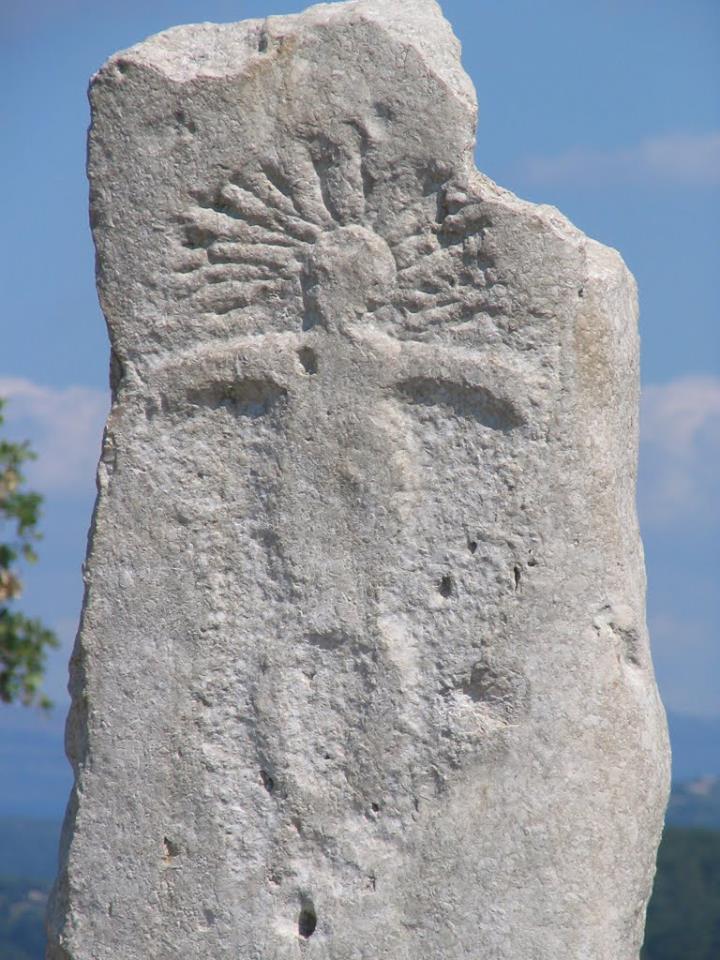
This is Krkavški Kamen (Krkava stone) also known as Triglav stone from Istria. Dating of the stone is uncertain but it is proposed that it was not built later than the 12 century and that it could be much older. It stands 400 metres southeast of the Krkavče cemetery, north of the path leading past the Gradišče field towards the Škrljevec hamlet.

The monolith is approximately 2.5 metres high and roughly hewed. Only 1.6 m still stand above ground and the upper part of the monolith is partially damaged. There is a stylised human image carved on both sides. 


It is an anthropomorphic image with widely spread arms, erect penis and with a crown of sun rays. 


In this the image from the Krkava stone resembles the "Lion man" stone from Armagh in Ireland. 


I wrote about this stone and its link with the Slavic Triglav worship in my post about Radegast.

The surface of the two images shows different treatment and the reliefs were probably made in two if not even three phases. 

The locals say that the stone once had three heads carved on its top which are now missing. Some say that it was only one head with three faces. Maybe like this one from Ireland:


This is why the stone is called Troglav, Triglav, the Three headed one. This Triglav is the the old European Trinity, Sun, Fire, Thunder, the three in one, the one which is three, the Trinity known in India as Trimurti. I wrote about Triglav worship in Serbian tradition in my post about Triglav.  

There are local legends that claim that in the field called Gradišče, which means "Fortified city" once stood a stone city and that the Triglav stone was erected by the people who built the city. Other legends say that the stone is older than the city. People say that the city was built by the king who had a golden calf...Other legends say the it was the Devil himself who lived in the old stone city and who had the golden calf. They say that the Devil went under ground to protect his gold. This is very interesting as in Serbia we also have legends of the evil king Trojan (Triglav) who lived in the old stone city on top of the mountain. Trojan, Triglav was in Serbia identified with Dabog, who later became Christian Devil.. Archaeologists have found Roman villa in the field, but there is an Illyrian fortress nearby. 

Locals say that the stone was once worshiped as holy. They say that according to the local lore, the stone is dedicated to the sun god. On the day of St. Vid people used to come to the stone to lay hands on the stone. St Vid is Christianized Slavic sun god Svetovid, who was originally celebrated on the day of the Summer Solstice. On Christmas eve, which is Christianized Winter Solstice celebration, people used to spend all night burning oak logs around the stone. This is the ceremony of rekindling of the fire of the Sun which is still performed in the Balkans for Orthodox Christmas. At the dawn the whole village would gather around the stone and celebrate the rising of the first sun of the new solar year. This is the rebirth of the young Sun god which Christians turned into the birth of Christ. In Serbian the word for god is "bog" and the word for young god is "božić", which is what Serbians call Christmas. The whole Winter Solstice ceremony around the stone was linked to fertility. I already wrote about similar ceremonies from Serbian territories in the Balkans in my post about threshing floors. These pagan ceremonies were condemned by the Christian clergy and were performed in secret and eventually abandoned. They were replaced by church processions following the same routes that the old pagan processions probably followed.  


There were many Christian processions which either started or ended at the stone or passed by the stone. The main one started from the stone and and ended in front of  the Church of St. Michael the Archangel. These processions took place on Rogation Days preceding Accession Day. The Accenssion Day is the old Beginning of the Summer ceremony, Beltane, the day of Jarilo, the Fire part of the Triglav. I wrote about Beltane, the Day of Jarilo in my post about the Beltane circle. It is very interesting that the procession ends at the church dedicated to the Archangel Michael. In Serbian tradition, Triglav was replaced by Archangel Michael who represents the lightning part of the Triglav trinity.

According to the local tradition the stone used to be used as a punishment, shaming stone. People who committed a crime were tied to the stone. They were then spat on and had insults and curses hurled at them. In recent times children were threatened with being tied to the stone when they did something wrong. Was this an ingenious way devised by Christians to replace the veneration of the holy Triglav Sun Stone with loathing of the Punishment and Humiliation stone? Or was the stone used as a shame stone even before the arrival of Christianity? In Serbian we still have an expression "to put someone on the pillar of shame" when you want to expose and shame someone for the bad deeds that he had committed. Is this somehow linked with the "prokletija" stoning ceremony about which I wrote in my last post? Were people who were tied to the Triglav stone originally stoned? Was spitting and hurling of abuse originally spitting and hurling of stones and abuse?

Archaeologists Pleterski and Puhar have proposed that the stone is part of a large spatial alignment. The stone and the four surrounding churches form perfect Latin Cross. 


The churches are all linked to the stone with well trodden paths once used for annual processions.  Local legends say that the churches were deliberately build like this around the stone so that they would "destroy the devil's power residing in the stone". But they were probably built on top of the old holy places which with the Triglav stone once formed the larger holy landscape dedicated to the celebration of Triglav, the old Trinity. 

You can read detailed study of the stone written by Jana Puhar and Andrej Pleterski in Slovenian here.

Wednesday, 25 February 2015

Odin the wandering deity


Odin is a prominently mentioned god throughout the recorded history of the Germanic peoples, from the Roman occupation of regions of Germania, through the tribal expansions of the Migration Period and the Viking Age. Odin continued into the modern period to be acknowledged in rural folklore in all Germanic regions. References to Odin appear in place names throughout regions historically inhabited by the ancient Germanic peoples, and the day of the week Wednesday bears his name in many Germanic languages.

The official etymology of the name of the old Norse theonym Óðinn (popularly anglicized as Odin) and its cognates, including Old English Wóden, Old Saxon Wōden, and Old High German Wuotan, says that it derives from the reconstructed Proto-Germanic theonym *wōđanaz. The masculine noun *wōđanaz developed from the Proto-Germanic adjective *wōđaz, related to Latin vātēs and Old Irish fáith, both meaning 'seer, prophet'. Adjectives stemming from *wōđaz include Gothic woþs 'possessed', Old Norse óðr, 'mad, frantic, furious', and Old English wód 'mad'.

The adjective *wōđaz (or *wōđō) was further substantivized, leading to Old Norse óðr 'mind, wit, soul, sense', Old English ellen-wód 'zeal', Middle Dutch woet 'madness', and Old High German wuot 'thrill, violent agitation'. Additionally the Old Norse noun æði 'rage, fury' and Old High German wuotī 'madness' derive from the feminine noun *wōđīn, from *wōđaz. The weak verb *wōđjanan, also derived from *wōđaz, gave rise to Old Norse æða 'to rage', Old English wédan 'to be mad, furious', Old Saxon wōdian 'to rage', and Old High German wuoten 'to be insane, to rage'.

But this etymology does not correspond to the role that Odin or Vodan seem to have originally had.

The earliest records of the Germanic peoples were recorded by the Romans, and in these works Odin is frequently referred to as the Roman god Mercury. The first clear example of this occurs in the Roman historian Tacitus's late 1st-century work Germania, where, writing about the religion of the Suebi (a confederation of Germanic peoples), he comments that "among the gods Mercury is the one they principally worship. In this instance, Tacitus refers to the god Odin as "Mercury"...

Mercury is a major Roman god, being one of the Dii Consentes within the ancient Roman pantheon. He is the patron god of financial gain, commerce, eloquence (and thus poetry), messages/communication (including divination), travellers, boundaries, luck, trickery and thieves; he is also the guide of souls to the underworld.

You could see how Mercury would be perfect deity for Vikings, the traders, the travellers and the thieves...

While I was discussing Radegast (Welcome guest) with one of my friends, he reminded me that one of Odins names was "far travelled guest"...

This is very interesting. 

In some dialects of South Slavic languages word "od" or "hod" means walk. "odi" or "hodi" means walks and "oditi" or "hoditi" means you walk, walking. "odi on" or "hodi on" means he walks, he who walks. Is odin = odi on = the one that walks, travels? It is Interesting that in Greek we have word ὁδός (hodós) which means threshold, road, path, way, journey, trip, expedition...The official etymology is that the Greek word comes form Proto-Indo-European *sodos. Cognates include Old Church Slavonic ходъ (xodŭ) and Sanskrit आसद् (āsad). I wander if the Greek word actually comes from South Slavic word "od, hod" meaning to walk...The word "odos" (path) would then be something you "od" walk on..."odaš, odiš" means you are walking, "oda si, odi si" means he is walking and "odao si" means you walked, both meaning travel, trip, expedition, journey...

Vodan is another name for Odin. In South Slavic languages word "vodi, voda" means leads, "vodi nas, voda nas" means he leads us and "vodi on, voda on" means he leads, leader...The word "vodja" means leader, "vodja naš" means our leader....Is Vodan = vodi + on = leads he = leader? 

This fits perfectly with the the Roman description of Odin, Vodan as the equivalent of Mercury, the traveller, messenger, guide...

But if this is true, why does Norse god have name whose etymology comes from Slavic languages? Is this just a coincidence? 

Serbian Historian from the 19th century, Miloš Milojević, claimed that Serbs and Danes were one and the same people. This is very interesting because the latest genetic evidence is showing us that Serbs and Croats have majority I2a1 and the Danes have majority I2a2 Y haplogroup. Basically they are the closest genetic cousins. You can see this clearly from these maps published on Eupedia:

I2a1


I2a2


We know that there was a lot of mixing between the western Slavs and Danes and that the most prominent Danish Viking dynasties descending from Harlad the blue tooth were of mixed Danish Slavic descent. Both Danes and western Slavs were renowned traders and pirates. The Book of Veles talks about western Slavs having the same customs as Germans. So it is entirely possible that Odin's name did come from the Slavic language. 

Another possibility is that Tacitus relied on a Slavic speaking informants who completely misinterpreted the word Vodan and Odin and understood them as the one who leads and the one who wanders. This could have lead to the erroneous linking of Odin, Vodan with Mercury...But this would put Slavic speaking people in Germania in the the first century AD...

A can of worm has been opened. Or more precisely reopened.

“Origin of the Anglo – Saxon race” is a book published in 1906 by Thomas William Shore, author of 'a history of Hampshire,' etc, Honorary secretary London and Middlesex archaeological society; honorary Organizing secretary of the Hampshire field club and Archaeological society. In it the author gives detailed analysis of the “Anglo Saxons”, and shows us that both Angles and Saxons were just terms used for complex federations of south Baltic Germanic, Norse and West Slavic tribes. He describes the late Iron Age and early medieval northern central Europe as a melting pot where future great nations of Franks, Angles, Saxons, Danes, Norse, Slavs, were being created from tribal federations of mixed Germanic and Slavic ethnic, linguistic and cultural origin.

This is what he thought about conflict of the Æsir and Vanir. This is just the excerpt, you can find the rest on my blog post "The origin of the Anglo Saxon race".

...The conflict of the Æsir and Vanir is a Northern myth, which, considered ethnologically, may be regarded as founded on the wars carried on between the Teutonic and Slavonic races. That between the Goths and Vandals was a war of this kind, and it resulted in peace and a lasting alliance. The myth of the conflict of the Æsir and Vanir also terminated in a lasting peace and the exchange of hostages between the contending races....

And this is where we need to look for the origin of Odin and his name....

And this is why I believe that Odin's name reopens a can of worms which was shut after the first world war, when the Slavs became the bad guys of Europe...


So what do you think?