One of the versions of the Scandinavian Yule Goat has long sharp teeth...

Meet Tanngnjostr and Tanngrisnir, the magic goats of Thor...They are the guys that pull his chariot...

Have you ever thought why a thunder god would travel in a chariot pulled by goats? I did...I puzzled and puzzled until my puzzler was sore...Then I presented the result of my puzzling :) in my post "Goat riding thunder gods"...
Now as you can imagine, Thor's goat were not ordinary goats...No god would ride on a chariot pulled by ordinary goats...
First, they have teeth like carnivores which eat raw flesh, based on their names Tanngrisnir (Old Norse "teeth-barer, snarler") and Tanngnjóstr (Old Norse "teeth grinder")...
Also they are immortal. As described in this story:
Once Thor travelled together with Loki. When evening came, they sought cover in a farmhouse. Thor then killed his goats with his hammer, Mjolnir, and skinned them, roasted them and everyone ate the meat...
But, he said, nobody must break any of the bones to suck the delicious marrow.
But Thialfi, the farmer's son, broke one of the bones, because the marrow inside the bones tastes by far the best.
Next morning Thor spread the two skins on the ground and laid all the bones on them. Then he swung his hammer, Mjolnir, and the skins and bones moved around until suddenly the two goats stood whole and completely alive again, ready to drive on...
But one of them had a bad leg! Thor got really angry, and Thialfi had to admit what he had done. As punishment Thialfi had to come with Thor as a servant...
And this is why one of Thor's goats is lame...
Sounds familiar? The goat that gets killed and then resurrects? I talked about the goats that get killed and then get resurrected during European winter rituals in my article "Krampus"...
The goats whose death and resurrection symbolizes the end of winter and the beginning of spring...The death of winter earth and birth of spring earth. Otherwise known as resurrection of nature...
But what about the goats with teeth? What's that about? Well there is a very strange fairy tale found in Serbia, Germany and Italy...It's about a goat...A very annoying goat.

Goat which is constantly complaining that it doesn't have enough to eat...Until its owner has enough...
In the German version of the story, the annoyed owner "shaves the goat off" and then whips it until it runs away...
In the Serbian version of the story, which is probably the oldest which survived, the owner kills the goat, skins it, salts it, puts it on the spit over the fire to roast it, when the goat jumps off the spit and runs away shouting:
"Ja sam jarac živodarac (živoderac), živ drt neodrt, živ klat nezaklat, živ pečen neispečen, živ jeden neizeden. Zubi su mi kao kolac, pregrišću te kao konac."
In some versions of this story the goat calls himself (živoderac) which means "skinned alive"...In some versions he calls himself "živodarac" (from život darac), which means "life giver" and which actually rimes with "jarac" (goat): jarac živodarac...
Knowing the symbolic meaning of the resurrecting goat (the bringer, giver of spring, life) I think that what the resurrected goat says is:
"I am the life-giving goat, skinned yet not skinned, slaughtered yet not slaughtered, roasted yet not roasted, eaten yet not eaten. My teeth are like stakes, I will bite you in two like a thread..."
Wow...Just like in the story about Thor's goats...Resurrecting goat...With deadly sharp teeth...Wow indeed...
Now...What the goat does next, in both Serbian and German version of the story, is that it decides to hide in an empty fox's lair...

In the main Italian version of the story "Grandmother Goat decides to move into the Grandmother Fox's house"...
Anyway, the fox asks the fox to get out of its lair, but fox refuses and instead:
In the Italian version of the story, the goat shouts: "I am Godmother Goat. I have a sword at my side, and with my horns I will tear you in pieces"
We don't know if the German goat shouted anything or not...
In the Serbian version, the goat shouts again: "I am the life-giving goat, skinned yet not skinned, slaughtered yet not slaughtered, roasted yet not roasted, eaten yet not eaten. My teeth are like stakes, I will bite you in two like a thread..."
In all the versions of this story, the poor fox enlists the help of different animals, who one after the other come to try to get the goat out of the fox's lair...They all fail, until finally:
In the Serbian version a hedgehog kicks the goat out...
In the German version a bee kicks the goat out...
In one Italian version a mouse in another a little bird and in yet another a cricket kicks the goat out...
WTF...I mean this is a bonkers story. Did all these people smoke the same shit when they came up with the same crazy story? Or did they all preserve the same ancient story slightly changed over time?
Well I think that the only way to understand this part of the story is to turn to real animals that feature in it: Goat, Fox, Hedgehog, Bee, Field Mouse, Little Bird, Cricket...And check if maybe they are here as calendar markers...
Spoiler: they are...
I have already talked about the mating habits of Wild Ibex Goats and how because their mating season in Eurasia spans winter months (Nov-Jan), they became calendar markers for winter...

Winter which in continental Europe is cold and dark time of hunger, when trees are bare, grass is covered with snow, no food grows...Is this why the goat is constantly complaining it's hungry? Because it represents the hungry part of the year? And is this why the death of the goat (symbol of winter) and its resurrection (symbol of spring) is the part of the winter goat rituals across Europe? I talked about these rituals in my article "Krampus"...
That's cool. But why evil toothed goats?
There is a Romanian legend about a grandmother who insulted the month of March. She did so either by badmouthing Him or by going up to the mountain with a herd of goats too early. March then borrowed frosty days from February and froze her to death...

Interestingly in Serbian folklore, "babini jarci" (grandmother's goats) and "pozаjmenci" (borrowed days), both mean "cold stormy snowy days in March or April"...Which can turn green spring full of life into this...

I talked about this link between goats and winter cold in my posts "Babele" and "Gryla"...
What's this all about? What's with goats and grandmothers?
Well:
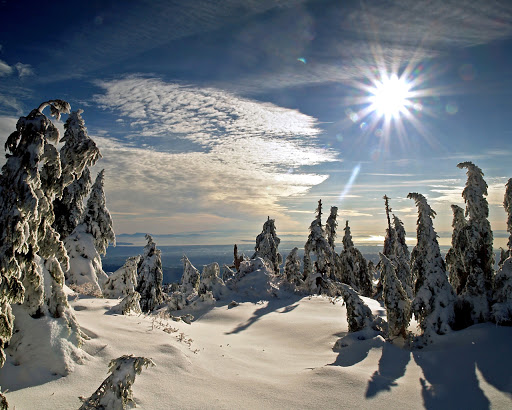
The pale winter sun which doesn't bring warmth but instead brings freezing cold (cloudy winter days are warmer than bright winter days)...In Serbia this sun is called "Zubato sunce" (Toothed Sun, Sun with teeth)...The same expression translatable to "Sun with teeth" is also found in Greece, just below Serbia and in Romania, just above Serbia...
What is the "sun with teeth"? This is the sun that causes the "frostbite", a burn like wounds which cause parts of your body to fall of...Or have to be amputated...Hence "toothed" sun which literally bites the part of your body off...

Now, in Serbian folklore, the word Baba (Grandmother) was used for Earth, Mother (Grandmother) Earth...But the word also means "Hag" and was used as the name for Frozen Winter Earth...The goddess of death...I talked about this in my posts "Babele" and "Gryla"
Across the Balkans, Baba was also "the one that controls the bad, wet, cold weather".
Which is why shepherd's in Slovenia believed that "baba" stones (exposed bedrock) like this on, were linked to weather. And which is why they sacrificed to them during their spring ascent to the mountain pastures...And why stones are used by slavs in weather manipulation magic...I talked about this in my post "Weather stones"

Because if you were a shepherd on your way up the mountain pastures and you got caught in one of the late spring snow storms, the chances of your survival were very slim...So you had to make sure that Baba (Mother Earth as Winter Hag) doesn't get angry...
By the way
Yin = Earth, dark, cold, wet, down...Winter
Yang=Sun, bright, warm, dry, up...Summer
Both absolute Yin (freezing dark wet cold winter) and absolute Yang (roasting bright dry hot summer) are time of death...Life only flourishes between these two absolutes, Yin and Yang, Mother and Father, Earth and Sun...I talked about this in my post "Yin and Yang"....
So I think this is why we have Baba's (Grandmother's) goats. Both Baba and Goat are symbols of winter. So Baba's goats are cold winter days (brrrrrr)...The same cold winter like days which can "bite your fingers, toes, nose, ears..." off...Hence scary toothed killer goats from Serbian and Norse folklore (mythology)...
So we know now why the goat from the Serbian fairy tale has teeth. I think that this is also the reason why Thor's goats have teeth like carnivores which eat raw flesh. But does this mean then that Thor is not god of rain storms, but the god of snow storms???
As I explained in my post "Goat riding thunder god", the fact that Norse, Baltic and Slavic thunder gods ride goats, is one of the biggest mysteries of the European folklore. One which opens (for some an uncomfortable) question about the origins of these goat riding gods...But Thor and his flesh eating goats are a great example how mythology gets changed by climate. How life bringing rain storm god who rides on a good goats from Eastern Mediterranean became death bringing snow storm god who rides on evil goats...
Finally let's get back to our fairytale. The goat is lounging in the fox's hole and the poor fox is trying to get it out. What is all this about?
I think to figure this out, we have a look at mating seasons of Wild goats and Foxes. Why? To see if these seasonal activities, which occur every year at the same time, are so easily observable and impossible to ignore, that they make good calendar markers...
Throughout the Ibex range, their mating season starts from Oct/Nov and lasts until Jan. Which is why eventually goat became a calendar marker which means: when Ibexes mate, Oct/Nov, beginning of winter, and winter itself.
Foxes mating season is Jan/Feb...Mating takes place during the night...Foxes make really loud mating calls which can easily wake you up and are basically impossible to miss...Hence I think fox could be a calendar marker which means: when foxes mate = Jan/Feb, the end of winter, winter itself.Is this the reason why the Italian version of the weird Goat and Fox fairytale, Goat and Fox are actually called Grandmother Goat and Grandmother fox? To point to the fact that both Goat and Fox are animal calendar markers for winter...They both mate in winter, the time of Baba (grandmother, hag), one at the beginning the other at the end...
Remember the annoying always hungry goat was annoying for a while, before it was thrown out, killed and ran away...So I think that the time when the goat enters the fox's hole is towards the end of the winter, beginning of spring, Jan/Feb. Right at the time when foxes are out partying...So the goat finds empty fox's lair and takes over...
The fox has finished with her looooove (Feb/Mar) and is pregnant and needs her lair because the litter arrives in late March, and the cubs remain exclusively inside the lair for about six to eight weeks...
As calendar markers then, "when goats mate" would be succeeded by "when foxes mate" and then by "when fox cubs are born"...
So that would I think explain the fighting over the fox hole...
But are the animals that finally manage to get the evil undead big toothed goat (winter) out of the fox's lair picked randomly or are they also calendar markers?
Spoiler: they are not picked randomly.
In the two oldest versions of the story (according to ethnographers), Serbian and German:
Serbian: Hedgehogs - Hibernate in holes from October to April

German: Bees - Hide in hives from November to April

Let's not forget the Italians. The animals that manage to throw the goat out of the fox's hole (hose) in Italian versions of the story are:
Field mice, hide during winter, appear after the snow has melted and start mating in March - April

Birds, here probably migratory birds, appear in March - April

And for crickets...Well European field cricket turn into adults and appear in April

So in all cases, the animals that finally get rid of the scary goat, which is the symbol of winter, cold, are animals that reappear in nature in April...Once winter is finally finally finally over. And any possibility that the winter hag (Baba Marta - Grandmother March in the Balkans) can return is gone. In April...
How interesting....
So, crazy story full of random rubbish, or a complex animal calendar markers filled allegory?


