Showing posts with label bird symbolism. Show all posts

Sunday, 12 November 2023

Tuna boats

This is the amazing fortified Bronze Age settlement of Kastri, located on the Greek island of Syros and dated to the Early Cycladic II period (Keros-Syros culture, 2600–2300 BC)... 

Near this settlement, archaeologists have discovered a cemetery, with more than 700 graves excavated to date. The graves are of the subterranean corbelled type, which is exclusive to Syros...

This is the grave XI with some of the grave goods found in it...You can read more about it in "Figurines in context at the Chalandriani cemetery on Syros".

For this article, the most interesting thing found in this grave is the so called "frying pan"...

Curious objects, which do resemble frying pans, but no one really knows what they are or what they were used for... 


Here is what these objects look like from both sides...

One proposal is that they were used as liquid mirrors. You fill the vessel with a liquid and...Pics of the reflection in four liquid mirrors with: (a) water, (b) olive oil, (c) ‘black’ water (d) ‘black’ olive oil...

You can read more about it in "The ‘frying pans’ of the Early Bronze Age Aegean: an experimental approach to their possible use as liquid mirrors"...

Another proposal is that these were vessels used for salt extraction through natural solar evaporation...Structures, which until recently were used for solar brine evaporation in Greece...

You can read more about it in "Neolithic flat-based pots from the Carnac Mounds in the light of Cycladic ‘frying pans’". Those interested in ancient salt extraction techniques might like this post "Fulacht fiadh salt extraction facility"...

Now quite a lot of these Cycladic frying pens have depictions of boats as part of the decoration...Like this one...A boat depicted among the swirling spirals representing waves, or moving, running water...And right above the bow of the boat there is always a depiction of a fish...Which would suggest that Cycladic boatsmen were fishermen...

Here are some examples of the the boat-fish designs from the Cycladic frying pans...

The fish depicted has a very big dorsal and tail fins...To me the look the most like tunas...

Which would suggest that Cycladic boatsmen were not just fishermen, but tuna fishermen...

Now in my post about the "Tuna coin from Akanthos" I talked about different native types of tuna fish that live in Mediterranean, their mating seasons and their fishing season...

Basically, the tuna fishing season in Mediterranean, including Cycladic islands is from Apr to Nov...With the peak in Jul/Aug...Basically when summer (which starts in Taurus) ends (gets killed) by autumn (which starts in Leo)...


Ram, marks lambing of Eurasian wild sheep

Bull, marks calving of Eurasian wild cattle

Lion, marks mating of Eurasian lions

Goat, marks mating of Eurasian wild goats

You can read more about it in my post "Symbols of the seasons"...

This time when lion kills bull (Jul/Aug) is also "the best time to go to the sea" according to Hesiod... 

I talked about this in my post "Tetradrachm from Byblos"...

So after this lengthy intro 🙂 let me get to the interesting bit: This is a silver belt found in one of the Cycladic graves on Syros. This is an amazing object...Which no one knows how to interpret...

I would propose that this is a calendar...No surprises there, if you have been following me for a while🙂 

But why calendar? 

And calendar depicting what?

The answer to the second question, "calendar depicting what?" is "calendar depicting tuna fishing season"...

The answer to the first question "why calendar?" is "because birds and dogs are well known animal calendar markers which when depicted the way they are depicted on the diadem, mark the beginning the end and the peak of the tuna fishing season in the Cyclades area"...

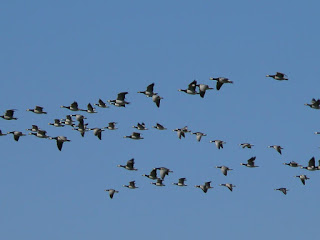
Let me explain what I mean: The Cyclades are on the major bird migration route between Europe and Africa. 

The spring migration from Africa to Europe suddenly peaks in Apr/May...

Sudden appearance of millions of migrating birds above the Cycladic islands coincides with the onset of the sailing (and tuna fishing) season in the Eastern Mediterranean...

Birds announcing the time to go to the sea...Interesting...I talked about the sailing season in the Eastern Mediterranean and how birds were used as animal calendar markers for the beginning of the sailing season in my post "Three sacrifices" made for "good winds" by the Greeks at the beginning and the end of the Trojan war...

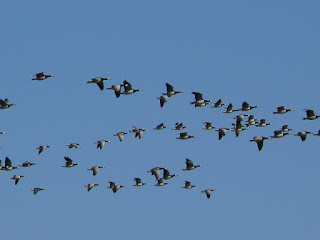
The birds migrate from Europe to Africa between Sep and Oct...

When the last migrating flock disappears in the southern skies, it is time to pull the boats on the beach, as this marks the end of the seafaring (and tuna fishing) season in Eastern Mediterranean...

So that could explain the birds depicted on the Cycladic silver belt...What about the dogs?

Remember this? 

When our mythologies were made out of animal calendar markers, Sirius, the Dog Star rose with the sun in Jul/Aug, when mating season of the old primitive dog breeds began...


I talked about this in my posts "Dog days" Egypt, "TishtryaMesopotamia, "The bitch of the godsIndia...

The middle point between the beginning of the spring bird migration and the end of the autumn bird migration...

And "the best time to go to the sea in Cyclades in search of tuna"...

Apr/May - Jul/Aug - Oct/Nov

Oh, and these "discs" between the animal calendar markers are suns...Apr/May - Jul/Aug - Oct/Nov is the sunny, hot, dry half of the year in Syros...

So to recapitulate, I believe that this belt is a kind of calendar, which using animal calendar markers depicts the sunny, dry half of the year, which is also the time when you can go to the sea in search of tuna fish...
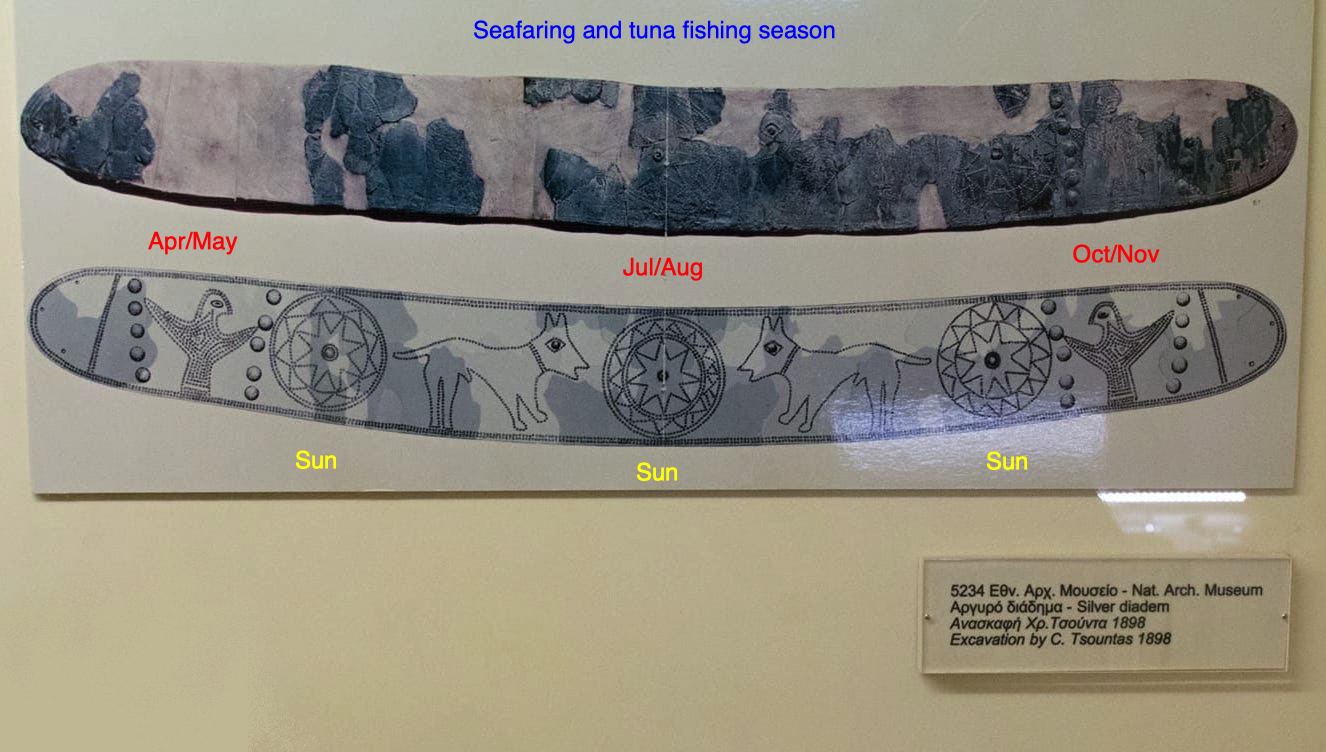
I could be wrong, but I can't see any other reason why someone would depict birds, suns and dogs on such a precious object...And I refuse to accept that the choice of the depicted symbols was random...

To read more about ancient animal and plant calendar markers, start here…then check the rest of the blog posts related to animal calendar markers I still didn't add to this page, and finally check my twitter threads I still didn't convert to blog post...I am 9 months behind now...

Sunday, 27 November 2022

Pavoncella

"Two of the most recurring symbols in Sardinian weaving are the pavoncella (top) and people dancing ballu tundu (bottom). While the second has always been referenced as an apotropaic ritual, the first has uncertain origins, maybe bringer of luck or fertility"...

I want to thank @DrWatson_writer for posting this very interesting info 

This is very interesting indeed. The top symbol consists of two birds facing yellow flowers growing on a tree. This is a common tree of life symbol and usually the animals facing the tree of life are animal calendar markers for the fertile period of the year....

Soooo:

The birds look like peacocks, which are "birds of rebirth". But the word "pavoncella" doesn't mean peacock. It means Lapwing. One of these cute fellows...

And in Sardinia depictions of lapwings are everywhere...

And in Sardinia lapwings are regarded as the symbol of "fertility, abundant rains and health of the flocks"...Why?

On the page "Checklist of the birds of Sardinia" we find that Lapwing is a migratory bird which spends winters in Sardinia...

And it is the rain that falls in Sardinia, between the arrival and the departure of the Northern Lapwings (Autumn, Winter, Spring) that makes Sardinia green, creates and supports (the tree of) life in Sardinia...And supports the flocks...

And so pavoncella, the fertility symbol, the symbol of rebirth (of nature)...

The guys at the bottom dancing ballu tundu are probably just celebrating the arrival of rains...

I guess...🙂

To read more about ancient animal and plant calendar markers, start here…then check the rest of the blog posts related to animal calendar markers I still didn't add to this page, and finally check my twitter threads I still didn't convert to blog post...I am 9 months behind now...

Thursday, 23 December 2021

Inviting spring

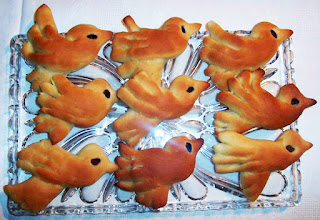
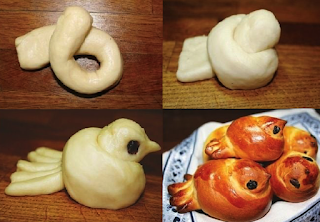
There are special kind of bird shaped buns baked by Eastern Slavs as part of the "inviting spring" rituals which were traditionally performed in March every year.  They are called "жаворонки, zhavoronki" (larks) or "кулики/kuliki" (sandpipers) ...

These cookies were baked in March for the first (1st of March), second (9th of March) and third (March 22 or 25th) calling (inviting) of spring...I guess one can get pretty impatient waiting for spring to arrive...🙂

People believed that larks and sandpipers arrived “carrying spring on their wings” and “leading other migratory birds behind them”. And the arrival of migratory birds was a sure sign of coming spring. And an extremely important event in Slavic tradition...I talked about this in my post "Leto"...


Remember, Slavs believed that every autumn, migratory birds took away the sun to Iriy, Slavic Otherworld, World of the Dead, where he spent winter. And that every spring, migratory birds brought the sun back into our world...

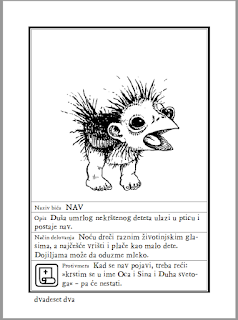
But Slavs also believed that migratory birds also brought souls from Iriy. Souls which were ready to be reborn...I talked about this in my post "Nav"...

Here is how you can make two main types of bird buns, the flying one and the sitting one...


Anyway, once made, the "larks" and "sandpipers" buns were placed on the windowsill, but most were given to children who ran around with them pretending that the birds were flying, all along shouting and calling spring to come...

Some children stuck their "bird" bun on long rods and waved them high in the air pretending that the birds were flying. Some other children threw the "bird" buns in the air trying to make them “fly” as high as possible. Some carried the "bird" buns on their heads...

The kids tried to bring their "bird" buns to "the high places": tops of hills, trees, rooftops, haystacks, fences...Children played with their "larks" all day and ate them in the evening, but some bird buns were left on the high places as offerings...

In some areas the kids would eat the bodies of their bird buns, but the heads were fed to the cattle "before they were taken out to graze in the fields for the first time"...This again seems to have been a ritual offering, a sacrifice of sorts "for good weather"...

Some bird buns were left on a patch where all snow melted. And some were thrown into a river...Remember snow melt is another sure sign of the departing winter (Morana/Marzana, the Old Hag Earth) and arriving spring (Vesna, the Young Maiden Earth)...

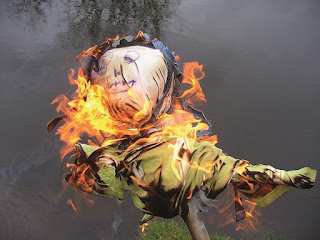
Which is why Slavs burn the effigies of winter or drown them or both...To be sure to be sure...But also heating of the earth causes snow to melt and the rivers to swell with the snowmelt...I talked about this in my posts "Gryla", "Baba's day"...

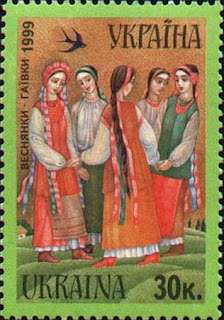
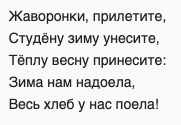
Apart from children, young unmarried women also played a major role in "calling of spring" rituals. They were the ones who sang "Веснянки / Vesnyanki" (Spring songs)...

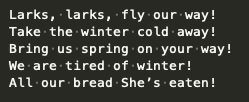
Like this one. And do you see how the end of bread (flour) is linked with the departure of winter and the arrival of spring?


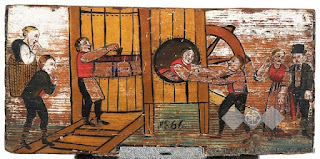
That's interesting...Because it explains the "magical transformation of an old woman into a young maiden through milling" images from Slovenia...

I talked about this in my post "Grandmother's mill"


And in my post "Old woman of the mill dust" about a very similar folk tradition from Ireland...

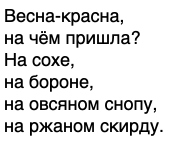
Here is another Vesnyanka (Spring song). This one directly linked with grain agriculture too...


I don't get this Red Spring thing though...Was this once Весна Красивая (beautiful spring)??? Or is red = hot?

Anyway, in some areas, women baked rye bread and then went out of the village, to the fields, orchards, meadows... There they bowed to earth, threw the bread on the ground and exclaimed: "Here is, Mother Spring, some rye bread for you"...

Again, this is a ritual sacrifice of bread to the mother of bread...And it is performed by a woman...In Slavic tradition (and not just Slavic) Earth fertility and female fertility was directly linked...I talked about this in my post "Walking sheafs of wheat", "Wheat wreath", "Corn dolly"...

This pre Christian Slavic celebration of the end of winter and the beginning of spring was later incorporated into Christianity and is now seen as part of "Сороки / Soroki" (Forty Martyrs of Sebaste)  for some weird reason... 

Here you can find the recipe and the instructional video for these beautiful bird buns (with English subtitle)... 

More about spring and birds in Slavic folklore can be found in these posts: "Partridge",  "Tetjorki", "Swallows", "Bird wedding", "Leto", "Radegast", "Cock bashing"...

Sunday, 28 May 2017

Bull and bird

Recently I came across these two interesting vases:

The Sub-Minoan (1150-1100 BC) vase from Crete decorated with a bull and a bird. 


The Mycenaean (1300 BC) vase from Enkomi, Cyprus, decorated with a bull and a bird


Apparently similar vases were also found in Jordan, but I couldn't find any pictures of them.

Now what do these images symbolize? Well it could be just bulls and a birds. They are often seen together. 


But Minoans considered both bulls and birds sacred and clearly attributed a symbolical meaning to both animals. This is a Minoan symbol, Larnax, 1300 bc. A bird (duck) sitting on labris which is positioned between the bull horns. 


So is there a deeper meaning to these images?

In my post entitled "Leto" I talked about the link between Slavic words "let" meaning "flight" and "leto" meaning "summer, year".

In short, the period between these two "let" (flights) of migratory birds, between their arrival and their departure, is "leto" (summer). This beginning of the new "summer" is the beginning of the new period of vegetative growth and abundance, the "important" part of the year. Which is why Serbian word for "summer" and "year" is the same: "leto"...

In Slavic mythology, Jarilo was the son of the supreme Slavic god of thunder, Perun, his lost, missing, tenth son, born during Velja Noć (Great Night), the pagan Slavic celebration of the New Year. We don't really know what the "Great Night" means, but I believe that this Great Night was originally the night before the beginning of winter which in the Irish calendar is marked by Samhain, the 31st of October, and in the Serbian calendar by St Mitar day (Mitrovdan) the 8th of November. I believe that this night was originally the night of the 5th of November, the mid point between the autumn equinox and winter solstice. 

I also believe that the expression Great Night was also an euphemism for Winter, the time of cold and death. Right in the middle of the winter is the night of the winter solstice, the longest night of the year, which is also the middle of the winter, the middle of the darkest part of the year. This is the night when new fires are rekindled, to symbolize rekindling of sun's fire, the birth of the new sun, new solar year. This new sun is Jarilo, whose name means the young one, but also the hot one.

However, on the same night when he was born, according to the Slavic tradition, Jarilo was stolen from his father and taken to the world of the dead, where he was adopted and raised by Veles, Perun's enemy, Slavic god of the underworld and cattle. The Slavs believed the underworld to be an ever-green world of eternal spring and wet, grassy plains, where Jarilo grew up guarding the cattle of his stepfather. In the mythical geography of ancient Slavs, the land of the dead was assumed to lie across the sea, where migrating birds would fly every winter. This land of the dead was by Slavs known as Iriy, Irij or Vyriy (Russian: ирий, ирей, вырий). And when do the migrating birds leave the land of the living? By the beginning of the winter, which is marked by Samhain (Mitrovdan).

With the advent of spring, Jarilo returned from the underworld, bringing spring and fertility to the land. Spring festivals, actually more precisely summer festivals of Jurjevo/Jarilo, St Georges day,  that survived in the Slavic folklore celebrate Jarilo's return, the return of the summer heat. This is also the time when in Irish folklore we find Beltane, the day of bonfires, which also celebrates the return of the summer heat...

And when does Jarilo return from the land of the dead? When the migratory birds return from Irij, the land of the dead, where they spend winter, the period between Samhain (Mitrovdan) and Beltane (Jarilo day, Djurdjevdan)...

You can read more about the old Celtic and Serbian calendar in my post "Two crosses". 

Now Beltane (Jarilo day, Djurdjevdan), the day when Jarilo returns from the land of the dead, the beginning of Summer, is celebrated on the 6th of May. This date, falls in the middle of the Taurus (Bull) zodiac sign (21 April – 21 May), which marks the beginning of the calving period of the Eurasian wild cattle

So the arrival of migratory birds is immediately followed by the beginning of summer, which falls in the middle of Taurus (Bull) zodiac sign...

Is this what is symbolically depicted on the above two vases? 6th of May, Beltane, (Jarilo day, Djurdjevdan), the beginning of summer? I think so. 

What do you think?