Showing posts with label Roman mythology. Show all posts

Wednesday, 9 September 2026

Pillar of the Boatmen

Strap in. This is going to be fun. In this article I am going to talk about the first raw of panel from the 1st c. AD Roman monument known as the "Pillar of the Boatmen" found in Paris, France...

I was prompted to look into it by the posts by this great account @Michssspp82096 about this panel which depicts a bull standing under a willow tree, with 3 cranes perched on his back. The inscription reads "TARVOS TRIGARANOS" or  "Bull and Three Cranes" in Gaulish...

This is a coloured version of this image. 

It looks cool, but the colours are wrong...The only cranes native to France are Common Cranes and their feathers are grey not white and their legs are black not orange...

Common Cranes are highly migratory and follow extremely precise migratory routines, always mating/nesting and wintering in the same locations...

In Northern Europe (Including France, Britain and Ireland), cranes arrive from their wintering sites to their mating/nesting sites in the spring in Mar/Apr/May and they leave their mating/nesting sites for their wintering sites in Oct/Nov...

Which means that their arrival and departure was definitely used as animal calendar marker for the beginning of spring (arrival) and end of autumn (departure)...

Now look at this: In (Celtic) Europe, willow flowers in Feb/Mar/Apr, basically announcing the arrival of spring...


Spring which starts in Jan/Feb, and is marked by Celtic Imbolc festival...

So, spring starts (Jan/Feb), willow starts flowering (Feb/Mar)...Then the cranes arrived (Mar/Apr)...

And started their mating dances followed by mating and nesting...

And then in Apr/May the wild Eurasian cattle (now extinct) calving and lactating season started...This is what the original, Old Taurus marked...I talk about the old Taurus which we find all over Eurasia in many of my posts...

Spring starts (Jan/Feb), Willow (Feb/Mar), Cranes (Mar/Apr), Bull/Calf (Apr/May) Spring ends...

Cool, right? It gets a lot cooler...

Cranes are linked to cattle as animal calendar markers all over Eurasia. I talk about it in several of my posts...

What I found only today is that cranes love hanging around large ruminators, domesticated and wild. They love open spaces created by these animals...

You can read more about this in

"Interactions and impacts of domesticated animals on cranes in agriculture"

"Eurasian crane (Grus grus) as ecosystem engineer in grasslands ‒ conservation values, ecosystem services and disservices related to a large iconic bird species"

Which is why cattle and cranes together are a very common sight...

And why why we see things like these

Crane animal calendar marker:

A Terracotta Bowl, Mehrgarh, Balochistan, Indus Valley, 3500–3000 BC...

Decorated with zebu bulls, each with a water bird perched on its back and a leaf motif between the horns...

I talk about this artefact in my post "Mehrgarh crane bowl"...

Cool, right? It gets A LOT cooler...

Interestingly, next to the panel depicting "Tarvos Trigaranos" (arrival of spring) is the panel depicting a young man cutting willow branches. The inscription reads "ESVS"...

There are several prominent spring rituals in Europe involving the cutting and usage of willow branches, particularly in Central and Eastern European Slavic (ex Celtic) lands...

These traditions, now linked to Easter (Mar/Apr), are generally rooted in pre-Christian fertility rites, marking the arrival of spring and symbolising health, growth, renewal...

And there is a very good reason for it: Spring willow is full of growth hormones...Which is why I put the spring branch cuttings into water for watering my flowers...I talked about this in my post "Willow in Slavic folklore": 

I also talked about the use of willow trumpets in May day/Beltain/St George's day rituals in

In the past in the Balkans, during the night before St George's day, processions of men and boys roamed the villages blowing willow bark trumpets "to scare the witch (winter) away"...The same ritual was performed in Cornwall too on May Day. I talk about this in my post "May horns"...


May day/Beltain/St George's day is the day which in South Slavic and Celtic calendar marks the end of cold, dark half of the year, and the beginning of the hot, light half of the year...

I also talked about the use of willow in spring fertility (sexual) rituals among the Etruscans in my post "Whipping fresco", where I give full symbolic analysis of this 5th c. BC Etruscan fresco, Tarquinia, Tomb of the whipping...Depicting...Well you can all see the obvious bit that it is depicting...Right? 🙂

BTW, the now tame Slavic spring willow rituals could once have been equally as explicit as the Etruscan ones...Considering the beliefs like this:

In Serbia people believed that women become very horny and very fertile in spring, when willows started putting out new green shoots ...So this was the best time to make babies...🙂 

And rituals like this:

Willow, the tree which grows next to water, is associated with rain, water and female fertility, female sexuality...Hence ritual whipping of teenage girls by teenage boys using willow whips, performed in the Czech Republic, Slovakia on Easter Sunday...

I talk about this in my post "Willow in Slavic folklore" about willow and fertility in Slavic folklore. 

Anyway...

Esus was Gallic god whose Romans equated with either Mercury or Mars...Which is it? It doesn't mater...

In Roman times, Mar/Apr-Oct/Nov was the "war season", which was opened and closed with the appropriate religious festivities presided by the Salii priests...

As I asked in the comments to this post, but didn't get any answer, I wonder if Celts also had "War Season"?

The Gallic chieftain Dumnorix, literally "king of the world" in Gaulish, of the Aedui tribe, is depicted holding a severed head on a silver coin (first half 1st century BCE)


I would say yes, they did. I think that the Celts, like many societies in antiquity, had their "war season" aligned with the agricultural and weather cycles...

Warfare was most common during the warmer months, roughly from after spring agricultural work, planting, ended until before autumn agricultural work, harvest, began...

So Esus could have been a war god, Mars, announcing (by cutting the willow branches with cranes in Mar/Apr) the start of the war season, starting (most likely) in Apr/May...

Here he is depicted on another panel from a four sided column dedicated to Mercury, dated to the early Roman imperial period, and found in Trier, France. He is depicts as a young man chopping a willow tree, which holds a bull and three birds...

Also, according to the Irish tradition, before the Tuatha De Danan went to war against Fomori, Lugh, the leader of the Tuatha De Danan danced the "Corrghuineacht" (crane dance) around his warriors on one leg, with one eye closed and one arm outstretched, while cursing their enemies...

So the arrival of cranes and their mating dance was also an announcement of the beginning of the war season...

But ESUS could have also been Mercury/Hermes...

Hermes himself was a deified calendar marker for Apr/May...Every single plant and animal that features prominently in his mythology is a calendar marker for Apr/May...I talk about this in these articles:

Happy birthday Hermes! According to the "Homeric hymn to Hermes", Hermes was born "on the fourth day of the month" but the name of the month was never mentioned...So a mystery...Solved using animal and plant calendar markers: it's 4th of May. I talk about this in my post "When grapes flower"...

What did Hermes do first after he was born? 

He stole Apollo's cows. 

He then invented fire drill, made fire, and sacrificed one of the cows to the gods...

I talked about this in my post "12 Olympians" about (apparently inexplicable 🙂) link between Hermes and Hestia (fire)

What did Hermes do after that? He invented a lyre which he gifted to Apollo...A very special lyre...In exchange, Apollo gave him Caduceus topped with two snakes...

I talk about this in my post "Lyre of Apollo", in which I present the analysis of the animal and plant calendar markers embedded into the story about the birth of Hermes, particularly the part related to him making the first lyre, which he later swapped with Apollo for the caduceus...Bull, Tortoise, Snake are all animal calendar markers for Apr/May, the time of Hermes...

Finally, are the wings on the hat worn by Hermes/Mercury actually cockerel wings? Cockerel is also an animal calendar marker for Apr/May, the time of Hermes...I talk about this in my post "Cock fight mosaic", where I talk about the link between Hermes/Mercury, cockerels and (god of rain) thunder storms...

Remember, Mercury/Hermes was Herald of the Thunder God Jupiter/Zeus...Guess when the thunderstorm season starts in Europe? In Apr/May, the months of Mercury/Hermes...And peaks in Jul/Aug...


So Esus could have been Mercury, the herald of Jupiter...Which is interesting, cause the next panel in the same row on the Pillar of the Boatmen, next to the one with Esus, depicts Juptier, standing, holding a spear and a thunderbolt. The inscription reads "IOVIS"...

How cool is this? It get EVEN EVEN cooler...

Mercury/Hermes was the protector of trade and traders. During Celtic/Roman/Greek times, long distance trade in Europe started in Apr/May. After the snow melted, making roads passable, after ice melted, making rivers passable, after winter storms passed, making seas passable...

Which is quite interesting, considering that all of this is depicted on a Roman column erected in Lutetia (modern Paris) in honour of Jupiter by the guild of boatmen...

How cool is this? It gets EVEN EVEN EVEN cooler...

In Irish myths, Lugh, Thunder God, carried his most precious magical relics in a crane skin bag, the corr bolg, as did Manannan mac Lir, the Sea and Warrior God!

As I said, Trading, War and Thunderstorms all stared in Apr/May, right after the arrival of cranes...

How cool is this? Well, here is the coolest part...

The last panel in this same row depicts Vulcan/Hephaestus, standing, with hammer and tongs. The inscription reads "VOLCANVS"...

Why Vulcan/Hephaestus? 

Cause he was a Holy Craftsman...

So?

When were boats repaired during Roman times? Well of course, during the "non sailing season", Oct/Nov - Mar/Apr...

Which makes me wonder if the first row of panels on the Pillar of the Boatmen is actually a calendar:

TARVOS TRIGARANOS: Spring (Jan/Feb-Apr/May)

ESUS: Summer (Apr/May-Jul/Aug)

IOVIS: Autumn (Jul/Aug-Oct/Nov)

VOLCANVS: Winter (Oct/Nov-Jan/Feb)


I told you...I think we just managed to decipher the meaning of the first row of panels form Pillar of the Boatmen. What do you think? I will leave deciphering the rest of this pillar for some other time. I think this is quite enough for today...

To read more about ancient animal and plant calendar markers, start here…Then check my twitter threads I still didn't convert to blog post...I am way way behind...



Thursday, 24 April 2025

Pretas

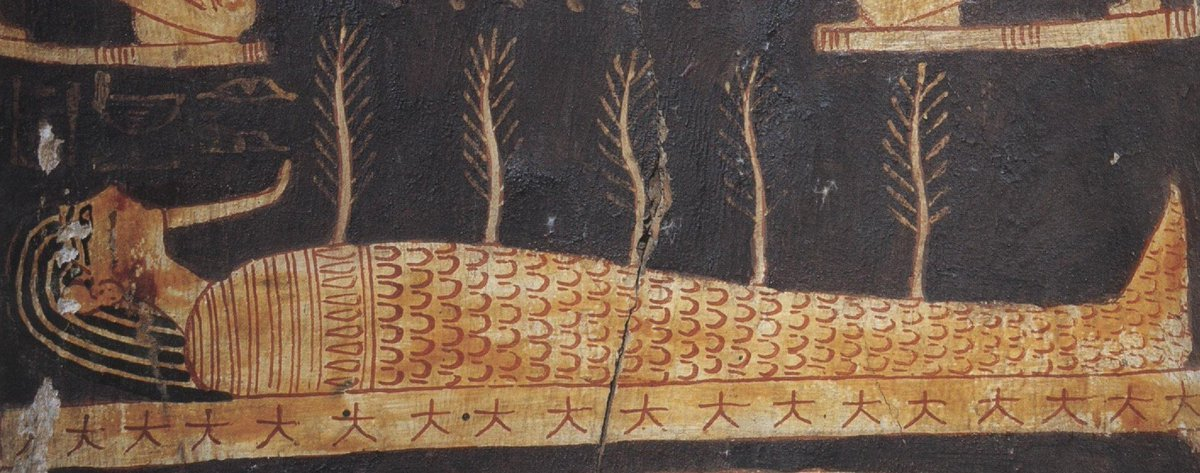
In Buddhism, Pretas, the "Hungry ghosts" are pitiable creatures with huge, empty stomachs which suffer constant hunger...

Buddhists believe that beings are reborn as hungry ghosts because of their greed, envy, addiction, obsession, and compulsion and jealousy...

And yet, in the summer there are hungry ghost festivals throughout Asia that feature food and entertainment for the hungry ghosts...

The origin of Buddhist "hungry ghosts" is in Hinduism, where originally Preta was understood as the ghost of any deceased individual. The Sanskrit word "preta" (प्रेत) literally means "departed, deceased, a dead person" derived from "pra-ita" meaning "gone forth, departed"...

Today, the dead are burned and the food is given to them "for a year, until they reincarnate"...But I wonder if this belief about the hungry dead originates from the time before Hindus started to be burn their dead and before Hindus started believing in reincarnation?

Here is why.  Today the Hindu families ritually feed the deceased "whose spirit is often symbolised by a clay mound somewhere in the house"...Why? Is this a remnant of the memory of the the time when the dead were buried under the mounds of clay (earth), under tumuli?

Is it possible that this belief and ritual came to India from the steppe with the Indo-Europeans? Who did bury their dead under the tumuli. And is it possible that these are actually remnants of the ancient Ancestor Cult?

The same ancestral cult featuring ever hungry and thirsty ancestors found among the Slavs for instance? I talked about this in many of my posts, like "Soul breads", "Dead man loaf" and , in which I talked about the breads made for the hungry dead...

It is interesting that Hindus feed their "hungry dead" rice balls, "which are said to symbolise the body of the deceased"...Just like in the Slavic ancestor cult where ancestors are believed to be the source of grain. 

I talked about this in my post "Diduch", about Diduch (grandfather), symbolic representation of the the dead ancestors who govern the lives of the living... 

Romans too saw direct link between the dead and the grain. I talked about this in my article "Lapis Manalis", about the sacred water stone which covered the entrance into the underworld/grain storage pit...

BTW, while I was looking for a suitable illustration for "lapis manalis" (we don't know what it actually looked like), the sacred stone used as part of a Roman "aquaelicium" (calling of the waters), rain making ceremony performed during droughts, I suddenly realised what cup and ring marks look like...

We find the same link between the dead, the god of the dead, Osiris and grain in Egyptian religion too. I talked about this in these articles where I talk about why Egyptians believed that grain grows from the body of Osiris...I talked about this in my post "The beard of Osiris" and "Braided beard"...


It is this life giving power of the dead, which Pluto (Hades), the giver of wealth, appropriated for himself. And this is why Hades and Persephone are depicted sitting on their throne in the land of the dead, with sheafs of wheat and flowers...I talked about this in my post "Pluto"...

In the Mesopotamian and Hittite ancestor cult, we also find hangry and thirsty ancestors who are also linked to rain and grain. Talked about this in my article "Care of the dead" about the care of the dead in Mesopotamia and Anatolia...

"...humiliation of the Hittite kingdom is the result of the fact that the Hittites have forgotten to respect the sacred bond with their dead..." - Last Hittite king Suppiluliuma II.

Statue of Suppiluliuma II, Hatay Archeology Museum

The last thing that I will say about the "hungry ghosts" is that in China the hungry ghost festival is held on the 15th day of the 7th lunar month which corresponds to Jul/Aug in Gregorian calendar...

During the festivals, people give food to the hungry ghosts and hope for blessings from their ancestors in return...This is the old contract between the dead and the living. The living feed the dead so that the dead will feed the living...The contract the Hittites broke...

The Chinese seventh lunar month, is actually known as the "Ghost Month" or "Hungry Ghost Month," and is believed to be a time of the year when the gates of the underworld open, allowing spirits to roam the earth...

Very interesting, considering that in Mesopotamia, July, or month of Ab, was dedicated to the dead and the dead god, Tammuz, who died and went to the underworld...You can read more about this here...

The rituals of this month, consisted in eating bread in the funeral feasts for the dead god of life, who now reposed in hell, and in carrying torches by night for the souls of the dead who during this month ascended from the underworld to the world of the living...

Interesting, right?


Sunday, 2 February 2025

Dewy head

"Greetings to the hair of your head, spun like silk,

and to your head with its curly locks,

O George, star brighter than (other) stars!

May the ointment of his dewy head refresh me every morning,

like the rain of grace a thirsty field!"

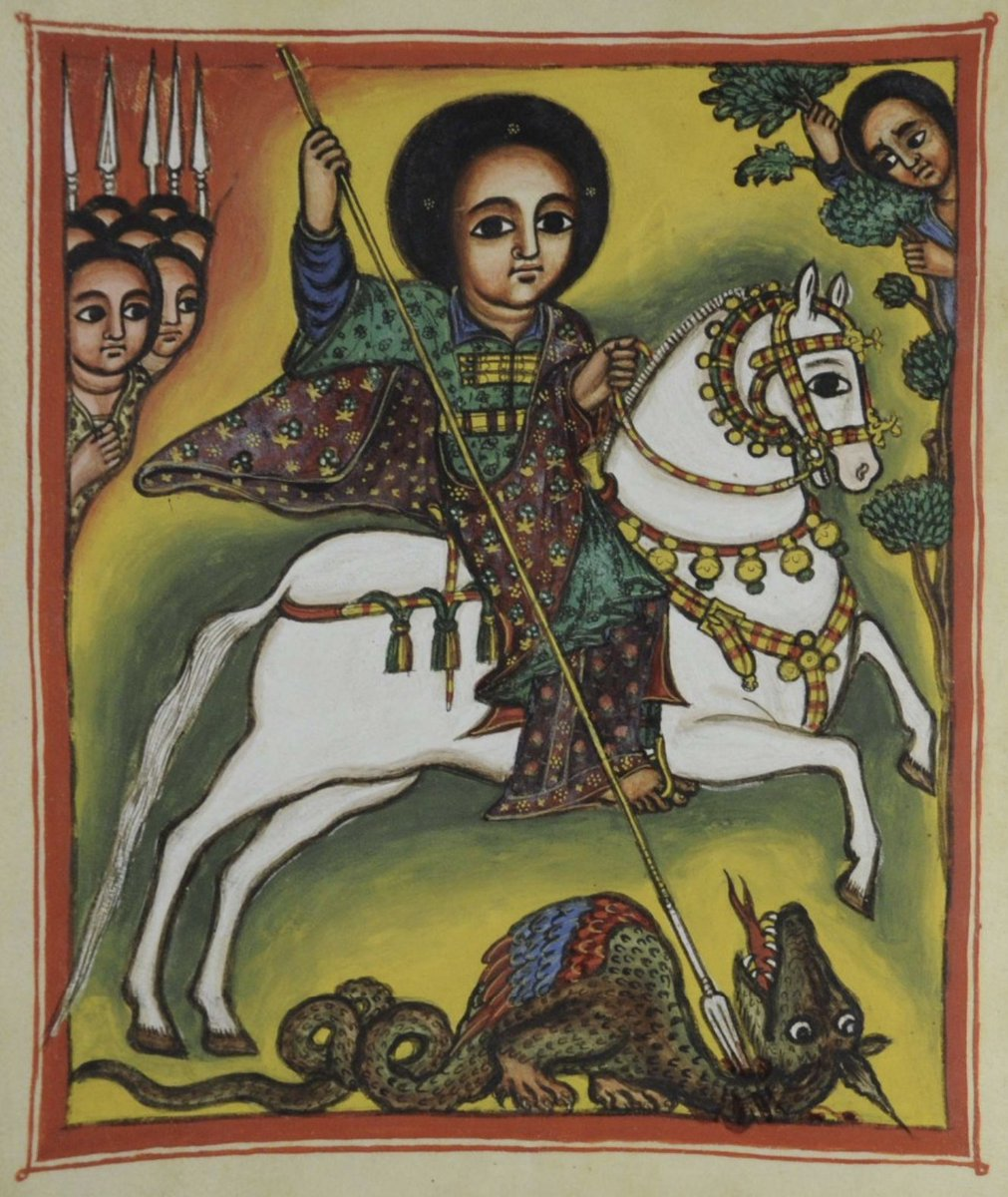
This is one stanza of the liturgical poem መልክአ፡ ጊዮርጊስ፡, "The Image of George". This genre of poems praises the body parts of a saint from the head and down to the feet...


Ethiopia, 18th c.

I want to thank @ArtEthiopic for all his hard work promoting amazing Ethiopian religious art...

And I want to add few comments that might explain the last two verses:

"May the ointment of his dewy head refresh me every morning, like the rain of grace a thirsty field..."

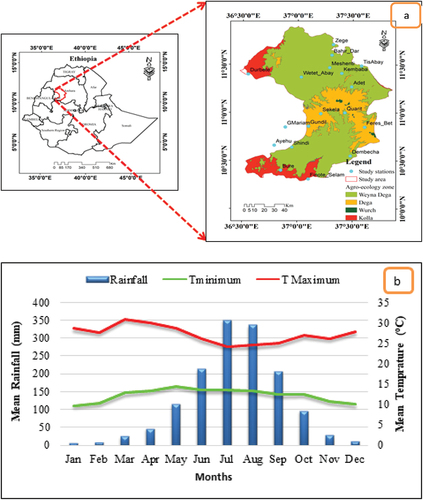
Rains arrive to Ethiopia in Mar/Apr...Right on time for St Georges day...Full blown monsoon starts in Jun...You can read about Ethiopian climate here...

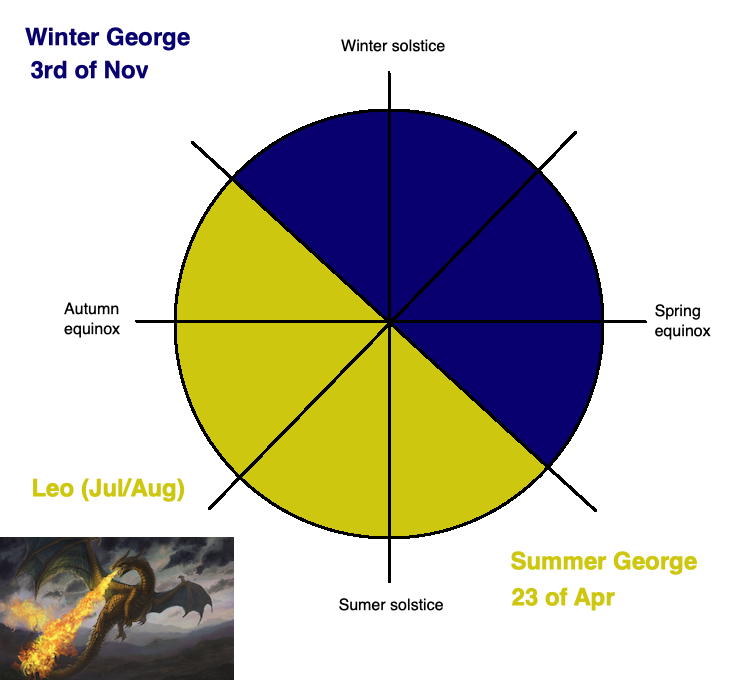
Interestingly, in Serbian Orthodox calendar, the beginning and the end of the "Time of Dragons", the hot sunny half of the year, is marked (guarded) by Two Georges, Summer and Winter St George('s day)...In Ethiopia, the climate is the opposite to the one in Serbia...I wrote about this in my post "Two Georges"...


Speaking of dew, this also might be of interest:

Irish riddle

Q: I wash my face in water that has never rained nor run, and dry it in a towel that was never wove on spun   
A: A face washed in Mayday dew and dried in the open air.  

The same tradition is in the Balkans linked to St George's day, Jurjevo. 

On the morning of St George's day, girls would go to fields to wash their faces in dew, so that they are beautiful all year round. Recorded in Skopska Crna Gora region of Macedonia.


This ritual was widespread among Serbs too, where dew bathing was done on the so called "herb Friday", the last Friday before St George's day, when medicinal herbs were also collected because people believed that they were the most potent on that day. This would explain why washing your face with the morning dew collected from these the plants on that morning was also the most beneficial...I talked about this in my posts "Morning dew" and "Jani", "Parilia"...


Many other traditions which are in Celtic parts of Europe linked to Beltane, 1st of May, are in the Balkans linked to St George's day, indicating that these two calendar markers are one and the same...

Saturday, 4 March 2023

Parilia

Happy Parilia (or Palilia) - This Roman festival, held on 21st April, cleansed shepherds & sheep, honouring the god of shepherds & sheep, Pales. A bonfire was built, with the shepherd and sheep jumping through the flames to be cleansed. The painting by Joseph-Benoît Suvée reimagines the festival

I find it interesting that the Romans didn't know who or what Pales was...But, considering that Ovid says that Parilia predates the founding of Rome, Pales and related rituals are of Pre Roman and most likely of Non Roman origin...

I don't know who or what Pales was either. But I would like here to add few bits of information that might help someone, some day, solve this mystery 🙂 First let's have a look at the Parilia ceremony:

"...After the sheep pen had been decorated with green branches and a wreath draped on the gate, the remainder of the ceremony took place in this sequence..."

"...At the first sign of daylight, the shepherd would purify the sheep: by sweeping the pen and then constructing a bonfire...the shepherd would jump through this flame, dragging his sheep along with him...Offerings of bread and milk were then presented to Pales..."

"...After these offerings, the shepherd would wet his hands with dew, face the east, and repeat a prayer four times...requesting Pales’s protection of the shepherd and the flock..."

"...The final portion of the rural festival made use of the beverage burranica, a combination of milk and sapa (boiled wine). After consumption of this beverage, the shepherd would leap through the fire three times, bringing an end to the ceremony..."

So...21st of April is very close to the 1st of May...Which was in some parts of the world known as Beltane (Bealtaine)...The day that marked the beginning of the Celtic summer (May-Oct), half of the year dominated by the sun...


On Beltane, in Scotland, they purified the sheep and cattle by walking them between two fires derived from single ritually kindled fire...I talked about this in my post "Beltane purification ceremony"...

And they did the same thing in Ireland on the same day...I talked about this in my post "The City"...

21st of April is very close to the 23rd of April, St George's day...And in the past in the Balkans, at the dawn of the St George's day, two fires were lit between which people and domestic animals (sheep and cattle) walked "for protection from diseases and snakes"...

St George being Christianised old Slavic sun god Jarilo (The Brightly Burning one), and snake being the solar animal which follows sun everywhere, it is obvious why people performed snake protection rituals on the day of the sun...

But there is something really interesting about when we celebrate St George and St Michael...The dragon killers...They mark the beginning and the end of the "Old Summer", the domain of the sun, the domain of the dragon...I talked about that in my post "Dragon always gets killed"...


BTW, in the old Serbian calendar, solar year is also divided into summer and autumn...Where summer starts with summer St Georges day, and winter starts with Winter St Georges day...

Summer George icon. 

Winter George icon.

So the fire purification on the day (around) the beginning of the summer...The season ruled by the Jarilo, the "Brightly Burning One"...The one who "pali" (lights up fires)...

It is interesting that in the past, in the Balkans, on the morning of St George's day kids were woken up by being swished with nettles, "to be healthy"...

Nettle sting feels like burning, and the expression in Serbian for being stung by nettles is "ožariti se" (to be burned)...

In the past, in Skopska Crna Gora region of Macedonia, women swept their houses with nettles early in the morning on St George's day, "to sweep all bad things out of the house, because everything runs away from nettles"...From: Ѓурѓовденски обичаи (1956) which sadly isn't available on Youtube any more...

There is an expression in Serbian "on žari i pali" which means "he burns and lights up fires"...Jarilo, Žarilo, Palilo...The Burning Sun of summer...

Shepherd kids making flower wreaths in the spring, most likely for Djurdjevdan (St George's day)...


From the description of the Parilia ritual:

"...After the sheep pen had been decorated with green branches and a wreath draped on the gate..."

In Serbia, on the St George's day people put wild flower and medicinal herbs wreaths on house gates for good luck and health...

I talked about St George (Jarilo) as the sheep and shepherds god in my posts "April" and "Aries must die"...

From the description of the Parilia ritual: "...Offerings of bread and milk were then presented to Pales..."

St George's day rituals involving bread and milk from Serbia: 

This is "kravaj" (pronounced kravay), a ritual bread made in Serbia. It was in the past used during "premlaz", the ritual first milking of the year which is always done the day before St George's day and which marks the beginning of the milking season...I talked about this in my post "Aries must die"...

From the description of the Parilia ritual: "...After these offerings, the shepherd would wet his hands with dew, face the east...pray..."

Just in case you wondered who the shepherd was praying to facing east at dawn...The sun...god..who "pali" (burns)...

Oh, and why would he "wet his hands with dew" before praying?

Well in places where people believed in purification by fire at the beginning of summer, they also believed in purification by dew at the beginning of summer...

This is one custom that I only read about before. On the morning of St George's day, girls would go to fields to wash their faces in dew, so that they are beautiful all year round. Recorded in Skopska Crna Gora region of Macedonia. From: Ѓурѓовденски обичаи (1956) which sadly isn't available on Youtube any more...


But this ritual was widespread among Serbs too, where dew bathing was done on the so called "herb Friday", the last Friday before St George's day. And the Irish did it too, on Beltane morning...Just another indication what St George's day is...I talked about this in my post "Morning dew"...

Interestingly, the same ritual is performed in Latvia on Jāņi day (summer solstice). Girls wash their faces with the morning dew, so their face will always be white and beautiful"...Great example how ritual dates change because of climate...I talked about this in my post "Jani"...

And that's it from me for today...After all this, I still don't know who Pales was...But I could guess...🙂 Especially after I recently found out that one of the names of the Mesopotamian god of death, Nergal, the personification of the destructive, burning sun of the late summer, was "Palil"...I talked about this in my post "Palil"...

To read more about ancient animal and plant calendar markers, start here…then check the rest of the blog posts related to animal calendar markers I still didn't add to this page, and finally check my twitter threads I still didn't convert to blog post...I am 9 months behind now...