A while back, @chapps posted this on X: This cockfight mosaic may have a religious meaning, as two of Mercury’s symbols - the caduceus and a bag of money (purse) - are on the mensa agonistica (winnings table), along with a palm of victory. Cockerels are associated with Mercury...

The mosaic, part of the Santangelo Collection, is currently kept in the Naples National Archaeological Museum...
In Greek and Roman mythology, the cockerel (rooster) is a sacred animal directly associated with Hermes (or his Roman equivalent, Mercury). Why? No one really knows...
The first reason is this:
Cockerel standing on top of the sun gate, on the border between the darkness and light, between the land of the dead (where sun spends night, winter) and the land of the living (where sun spends day, summer). Medieval (?) standing stone Bosnia...

This links cockerel with both day (the living) and night (the dead)...I talked about this link in Irish and Serbian folklore in my post "Bleeding for Martin"...

In this post I talk about ritual killing of cockerels at the beginning of the dark half of the year, and the ritual blooding of the doorstep and four house corners, both believed to be the hanging places of the souls of the dead ancestors...
Serbs had an interesting ritual from the cult of the dead which involved cockerels. When two members of the family die close together, Serbs then bury "a live cockerel" with the dead "to fool Death" or more precisely "as a replacement for the third death"...I talked about this in my post "Third death"...


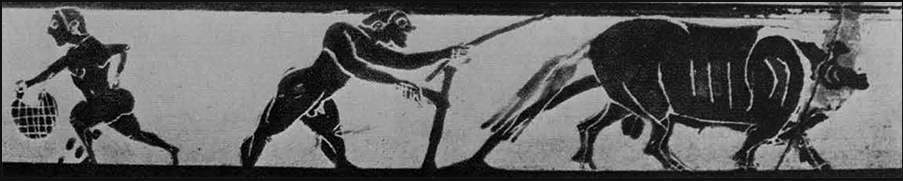
This "thrice-ploughed" (triple-furrowed) thingy is very interesting. Apparently, "the cutting of three furrows was part of fertility rites performed to inaugurate the new agricultural year"...Anyone knows where I can find reference to this in Greek texts???
Interestingly, in "Bulletin of the ethnographic museum of Serbia, Volume 10" from 1935 we can read that in some parts of Serbia, cutting of three furrows in the field was also a ritual marking the beginning of the agricultural year...

Once the three furrows were cut, an egg was buried in and then the ploughing of the field continued...At the end of harvest, people slaughtered a cockerel in the field. Ploughing-sowing-harvesting...Egg-Cockerel...


Hermes was the herald of the thunder god, the voice of the thunder god...The thunder...

I talked about this in my post "Iris". Goddess Iris, who was later replaced by Hermes, was originally "the one who speaks for Zeus"...Considering that thunder is the voice of the thunder god, who (or what) was she? This article asks this question and few more...

Did you know that "fiery cockerel" is the sacred bird of the Slavic Thuder/Rain god Perun?
19th c. embroidery from Russia depicting cockerels standing between two lions.

The 2nd of August, the end of summer and beginning of autumn, the day of Perun (Slavic thunder god) falls in the middle of Leo. Perun's sacred bird is cockerel...I talked about this first in my post "Cockerel and lion"...
Cockerel, the sacred bird of Perun, Slavic thunder god, was used in magic rituals for protection agains lightning, like the ritual of "throwing cockerel over the roof of the house", symbolically placing cockerel between the thunder (god) and the house...
Like cockerel weathervane?
Great pic by @another_barbara of the old St. George's chapel, topped with a cockerel weather-vane. Holy mountains, Slovenia.


Why this connection between cockerels and thunder (gods)? Maybe cause chicken main mating season is during the period of 14+ daylight hours...

Mating season marked by vicious cock fights...

The main chicken mating season overlaps with the main thunderstorm season in Europe...

I talked about this in my post "Pero"...
Cockerel was the thunder bird not just in Europe, but in India and China too...
China: A man was preparing a chicken as a meal for his mother. Suddenly he was slain by a thunder strike, whereupon he transformed into a divine cock, that was no one else than the Master (Lord) of Thunder, Lei Kung...

Lei Kung was "sometimes depicted with a cock’s head, wings and claws"...

Why? Because the start of the wild chicken mating season marks the start of the rain and thunderstorm season in China...

I wrote about this in my posts "The son of thunder" and "Lei kung"...
India:
In India, peacocks are heralds of the summer monsoon rain season which is the source of (eternal) life...
This is climate chart from India. You can see that the rains season starts in Jun and ends in Sep...


Peacocks are directly linked with Indra, the thunder and rain god. And Indra's main general, Kartikeya, rides on a peacock...


Cockerel behaviour often changes significantly before a thunderstorm or severe weather. Due to their extreme sensitivity to drops in atmospheric pressure, shifts in humidity, and low-frequency vibrations, cockerels can sense an approaching storm hours in advance...
Feeling the atmospheric pressure drop, cockerels may become restless and break their usual schedule to crow, crowing instead even in the middle of the night or in the middle of the day....
Hence sayings like:
"If a rooster crows on going to bed, you may rise with a watery head (rain)"...
"If a rooster crows at night, there will be rain by morning"...
So cockerels are real heralds of thunder gods, which I think makes me even more sure that Hermes wore hat with cockerel wings...
In the immediate moments before a severe storm (like a cyclone or heavy thunderstorm), the entire flock may go completely silent and freeze, stopping all foraging, clucking, or scratching...
Before the weather turns bad, chickens often engage in a feeding frenzy, eating as much as possible to fuel up to survive the duration of the storm. After that they will often rush to their coop or huddle together under shelter well before the first raindrops fall...
Some observers note that chickens might lower their tails as a sign of stress or anticipation of the approaching low-pressure system...
How cool is this?

If we look at cockerel as an animal calendar marker, we can see that because its natural mating season starts in Apr/May, it is an animal calendar marker for Apr/May...Now look at this: All the animals linked to Hermes are animal and plant calendar markers for Apr/May...
Happy birthday Hermes! According to the "Homeric hymn to Hermes", Hermes was born "on the fourth day of the month" but the name of the month was never mentioned...So a mystery...But we are actually told that it is a month when grapes flower...

Solved using animal and plant calendar markers: it's 4th of May...
I talked about this in my post "When grapes flower"...
What did Hermes do first after he was born? He stole Apollo's cows.

Why? Cause Apr/May is marked by Taurus, ancient animal calendar marker for the beginning of the calving season of wild Eurasian cattle...

I talked about this in many of my posts...
He then invented fire drill, made fire, and sacrificed one of the cows to the gods...

A very strange thing to be attributed to a messenger of Zeus...
Or is it?
Remember the article about this excerpt from the Homeric Hymn To Hestia: "Hestia, you who tend the holy house of the lord Apollo...come now into this house...having one mind with Zeus the all-wise..."?
In it I talked about how strange it was that Classical cultures still talked about the invention of fire making as if it was a really really big deal?
And I also talked about the fact that before people learned to make fire themselves, Fire (Hestia) descended to earth from the Sun (Apollo, Helios) through Thunder/Lightning (Zeus)...
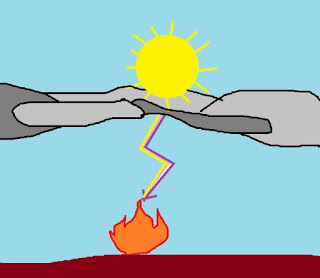
So if fire (Hestia) was made (Fathered) by the thunder/lightning (Zeus) then Hermes, "the messenger of Zeus", is the perfect inventor of the fire stick and fire making...
I talked about this in my post "12 Olympians" about (apparently inexplicable 🙂) link between Hermes and Hestia (fire)...
What did Hermes do after that? He invented a lyre which he gifted to Apollo...

I talked about why this lyre (tortoise body, bull horns, sheep intestines) is actually a complex animal calendar marker for Apr/May in my post "Lyre of Apollo"...

The most ancient depiction of Archaic Greek Hermes is this bronze from the 6th century BC. Hermes Kriophoros is wearing a tunic with belt and zig-zag pattern, has wings on his legs, and is bearing a ram...Why would god born in Apr/May cary a ram?

Cause Apr/May is when Lambing season finishes and milking season starts...I talked about this in my post "April"...
In exchange, Apollo gave him Caduceus topped with two snakes...

Snake is an animal calendar marker for Apr/May, beginning of summer, domain of the sun. Cause the most common Eurasian snakes mating season starts in Apr/May...

Add to this cockerel as another animal calendar marker for Apr/May and...
Oh! Almost forgot. What about the money and trade? Why was Hermes god of trade? The trading was at the time of Hermes mostly done by boat. And the sailing season in Eastern Mediterranean starts in...Apr/May...

The sailing season starts in Apr/May, because this is when the "good sailing winds", Etesian winds, start blowing from the north...

And so Hermes, basically deified Apr/May, announces the beginning of the sailing (trading) season and becomes the patron of trade...
I think this is all very very cool...What do you think?
To read more about ancient animal and plant calendar markers, which are at the root of all our mythologies, start here…Then check my twitter threads I still didn't convert to blog post...I am way way behind...

not about hermes, but i found this interesting channel https://youtu.be/7xIpElNg3Pc?si=_t5RTQV7l9y6UFDe that talks about the symbol of snakes and dragons in relation to cosmic events that could have been seen by ancient humans, and i thought it could be interesting for this blog
ReplyDeleteIn Christianity, a Cockerel rooster is a Passion symbol (Arma Christi), hinting at St. Peter’s denial of knowing Jesus, f.i. Mark 14:68-
ReplyDeleteThe "fiery cockerel" is a symbol of the Slavic Thunder/Rain deity Perun. Wasn't Perun perceived as the High God? I wonder because the cockerel often appears on the top of church steeples and weathervanes. The Khasi people of northeastern India sacrifice a rooster as a substitute for a human because they believe that the cockerel when sacrificed "bears the sins of the man." There seems to be a similar idea among conservative Jews.
ReplyDelete