Showing posts with label Beltane. Show all posts

Saturday, 4 March 2023

Parilia

Happy Parilia (or Palilia) - This Roman festival, held on 21st April, cleansed shepherds & sheep, honouring the god of shepherds & sheep, Pales. A bonfire was built, with the shepherd and sheep jumping through the flames to be cleansed. The painting by Joseph-Benoît Suvée reimagines the festival

I find it interesting that the Romans didn't know who or what Pales was...But, considering that Ovid says that Parilia predates the founding of Rome, Pales and related rituals are of Pre Roman and most likely of Non Roman origin...

I don't know who or what Pales was either. But I would like here to add few bits of information that might help someone, some day, solve this mystery 🙂 First let's have a look at the Parilia ceremony:

"...After the sheep pen had been decorated with green branches and a wreath draped on the gate, the remainder of the ceremony took place in this sequence..."

"...At the first sign of daylight, the shepherd would purify the sheep: by sweeping the pen and then constructing a bonfire...the shepherd would jump through this flame, dragging his sheep along with him...Offerings of bread and milk were then presented to Pales..."

"...After these offerings, the shepherd would wet his hands with dew, face the east, and repeat a prayer four times...requesting Pales’s protection of the shepherd and the flock..."

"...The final portion of the rural festival made use of the beverage burranica, a combination of milk and sapa (boiled wine). After consumption of this beverage, the shepherd would leap through the fire three times, bringing an end to the ceremony..."

So...21st of April is very close to the 1st of May...Which was in some parts of the world known as Beltane (Bealtaine)...The day that marked the beginning of the Celtic summer (May-Oct), half of the year dominated by the sun...


On Beltane, in Scotland, they purified the sheep and cattle by walking them between two fires derived from single ritually kindled fire...I talked about this in my post "Beltane purification ceremony"...

And they did the same thing in Ireland on the same day...I talked about this in my post "The City"...

21st of April is very close to the 23rd of April, St George's day...And in the past in the Balkans, at the dawn of the St George's day, two fires were lit between which people and domestic animals (sheep and cattle) walked "for protection from diseases and snakes"...

St George being Christianised old Slavic sun god Jarilo (The Brightly Burning one), and snake being the solar animal which follows sun everywhere, it is obvious why people performed snake protection rituals on the day of the sun...

But there is something really interesting about when we celebrate St George and St Michael...The dragon killers...They mark the beginning and the end of the "Old Summer", the domain of the sun, the domain of the dragon...I talked about that in my post "Dragon always gets killed"...


BTW, in the old Serbian calendar, solar year is also divided into summer and autumn...Where summer starts with summer St Georges day, and winter starts with Winter St Georges day...

Summer George icon. 

Winter George icon.

So the fire purification on the day (around) the beginning of the summer...The season ruled by the Jarilo, the "Brightly Burning One"...The one who "pali" (lights up fires)...

It is interesting that in the past, in the Balkans, on the morning of St George's day kids were woken up by being swished with nettles, "to be healthy"...

Nettle sting feels like burning, and the expression in Serbian for being stung by nettles is "ožariti se" (to be burned)...

In the past, in Skopska Crna Gora region of Macedonia, women swept their houses with nettles early in the morning on St George's day, "to sweep all bad things out of the house, because everything runs away from nettles"...From: Ѓурѓовденски обичаи (1956) which sadly isn't available on Youtube any more...
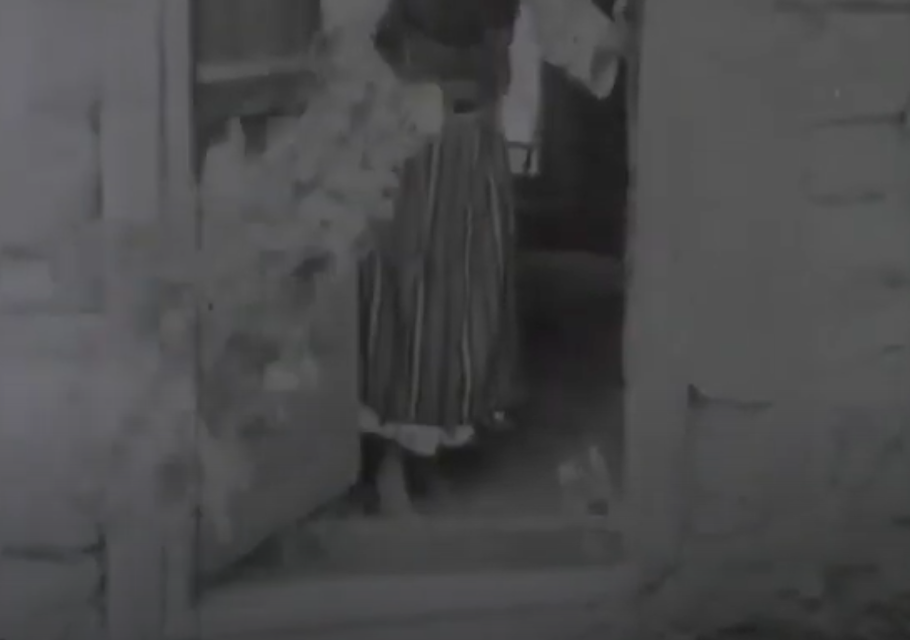
There is an expression in Serbian "on žari i pali" which means "he burns and lights up fires"...Jarilo, Žarilo, Palilo...The Burning Sun of summer...

Shepherd kids making flower wreaths in the spring, most likely for Djurdjevdan (St George's day)...


From the description of the Parilia ritual:

"...After the sheep pen had been decorated with green branches and a wreath draped on the gate..."

In Serbia, on the St George's day people put wild flower and medicinal herbs wreaths on house gates for good luck and health...

I talked about St George (Jarilo) as the sheep and shepherds god in my posts "April" and "Aries must die"...

From the description of the Parilia ritual: "...Offerings of bread and milk were then presented to Pales..."

St George's day rituals involving bread and milk from Serbia: 

This is "kravaj" (pronounced kravay), a ritual bread made in Serbia. It was in the past used during "premlaz", the ritual first milking of the year which is always done the day before St George's day and which marks the beginning of the milking season...I talked about this in my post "Aries must die"...

From the description of the Parilia ritual: "...After these offerings, the shepherd would wet his hands with dew, face the east...pray..."

Just in case you wondered who the shepherd was praying to facing east at dawn...The sun...god..who "pali" (burns)...

Oh, and why would he "wet his hands with dew" before praying?

Well in places where people believed in purification by fire at the beginning of summer, they also believed in purification by dew at the beginning of summer...

This is one custom that I only read about before. On the morning of St George's day, girls would go to fields to wash their faces in dew, so that they are beautiful all year round. Recorded in Skopska Crna Gora region of Macedonia. From: Ѓурѓовденски обичаи (1956) which sadly isn't available on Youtube any more...


But this ritual was widespread among Serbs too, where dew bathing was done on the so called "herb Friday", the last Friday before St George's day. And the Irish did it too, on Beltane morning...Just another indication what St George's day is...I talked about this in my post "Morning dew"...

Interestingly, the same ritual is performed in Latvia on Jāņi day (summer solstice). Girls wash their faces with the morning dew, so their face will always be white and beautiful"...Great example how ritual dates change because of climate...I talked about this in my post "Jani"...

And that's it from me for today...After all this, I still don't know who Pales was...But I could guess...🙂 Especially after I recently found out that one of the names of the Mesopotamian god of death, Nergal, the personification of the destructive, burning sun of the late summer, was "Palil"...I talked about this in my post "Palil"...

To read more about ancient animal and plant calendar markers, start here…then check the rest of the blog posts related to animal calendar markers I still didn't add to this page, and finally check my twitter threads I still didn't convert to blog post...I am 9 months behind now...

Beltane purification ceremony

Walter Gregor’s "Folklore of the North-East of Scotland" published in 1881 gives this description of the sacrifice herdsmen performed during Beltane fire ceremony...

The first written reference to Beltane dates from the year 900 CE and can be found in the Sanus Chormaic (Cormac's glossary codex)...


Description of Beltane rituals from "Carmina Gadelica - Hymns and Incantations, Ortha Nan Gaidheal, Volume I" by Alexander Carmichael [1900]... 

Beltane blessing. From "Carmina Gadelica - Hymns and Incantations, Ortha Nan Gaidheal, Volume I" by Alexander Carmichael [1900] 


Saturday, 5 May 2018

Morning dew


Irish riddle

Q: I wash my face in water that has never rained nor run, and dry it in a towel that was never wove on spun

A: A face washed in May dew and dried in the open air. 

This ritual performed on the May Day (1st of May, Beltane) morning was believed to bring beauty and health.

In Serbia in the past the dew bathing was done on the so called "herb Friday", the last Friday before St George's day. Older women lead younger women and girls out of their villages and towns and into wild, uncultivated meadows and fields, their voices collectively ringing out in song. They went there to wash themselves in morning dew. This they did by literally rolling about in the morning dew, as well as dabbing some dew on their faces. This was considered to be an extremely important magical ritual, one that brought beaty and health. It also helped ensure that women of child-bearing age will conceive without difficulty and have safe, uncomplicated births. 

As I already wrote in my post "Beltany stone circle" there is an indication that originally Beltane was celebrated on the 6th of May, the mid point between the spring equinox and the summer solstice, the true beginning of summer. This is the day when people in Serbia still celebrate St George's day. Many customs and rituals which are in Ireland associated with Beltane, like this one, are in Serbia associated with St George's day. 


Friday, 27 January 2017

Leto

Serbian word "leto" means both "summer" and "year". The word comes from Proto-Slavic *lěto, which comes from Proto-Indo-European *leh₁tom. Cognate with Ukrainian "літо" ‎(lito) meaning "summer", Belarusian "слецiць" ‎(sljecicʹ) meaning "to warm" and "слетный" ‎(sljetnyj) meaning "warmish", Bulgarian "лято" ‎(ljato) meaning "summer", Russian "лето" (leto) meaning "summer, year", Slovene "poletje" meaning "summer", Czech "léto" meaning "summer", Slovak "leto" meaning "summer", Polish "lato" meaning "summer", and Upper and Lower Sorbian "lěto" meaning "year".

Possibly also cognate with Old Gutnish "ladigh" meaning "spring" and dialectal Swedish "låding, låing" meaning "spring", and with Irish "lá" ‎meaning "day".

The etymology of this word is unknown. So let me propose one. Is it possible that the word "leto" comes from the word "let" meaning "flight"? The word "let" comes from Proto Slavic verb "letěti" meaning "to fly".  So why would you derive the word meaning "summer, year" from the verb "to fly"? Because of the migratory birds. Every year, starting from the second half of February, right after the climatic start of the spring, 4th of February,  migratory birds start arriving from their wintering sites. The bulk of the migratory birds return by the end of April, just before the climatic start of the summer, 6th of May.

So every year, during spring, which is in Serbian called "proleće", which can mean both "before summer" and "flying by, migrating", migratory birds arrive back home, signalling the end of the cold part of the year and the beginning of the warm part of the year. 


Equally the end of the warm period of the year, which normally coincides with the end of October, the end of the climatic end of autumn, is signaled by the flight of the migratory birds, this time in the opposite direction, flying away to their wintering sites.


In the old Celtic and Serbian calendar, year only had two parts: the warm, white part, summer (6th of May to 5th of November), and cold, dark part, winter (6th of November, 5th of May).

So the period between these two "let" (flights) of migratory birds, between their arrival and their departure, is "leto" (summer). This beginning of the new "summer" is the beginning of the new period of vegetative growth and abundance, the "important" part of the year. I believe that this is why Serbian word for "summer" and "year" is the same: "leto"...

I was just made aware of the existence of a Macedonian folk festival called Letnik. The following is excerpt translated from Makedonians in Albania by Dragoslav Budimovski. Original title: "Будимовски К, Драгослав. „Македонците во Албанија“. Студентски збор, Скопје, 1983. стр. 151":

"Letnik, which is celebrated every year on March 1 in the old calendar and is associated with the return of migratory birds from southern regions to Macedonia. The return of the migratory birds is celebrated as the beginning of spring or summer, the period of growth and the beginning of agricultural work. Therefore this feast is often considered to be a celebration of the beginning of the year in terms of the active period of the year. 

Holiday is mostly celebrated in Western Macedonia, in Galichnik, Golo Brdo, Pustec, Debar, Prespa, Ohrid and Struga. That this celebration has ancient pagan roots can be seen by the fact that in the areas where we have mixed population Orthodox and Muslim, like in Golo Brdo and Reka area, Letnik is celebrated by both Orthodox Christians and Muslims. However in mixed Macedonian Albanian areas only Macedonians celebrate Letnik. 

According to the testimonies of the local people, Letnik celebrations start in the early morning of the 1st of March. The first thing everyone does in the morning when they wake up is to look for a chicken (bird) so that you can be as light as a bird all year round. My comment: Originally people probably looked for return of migratory birds in flight. Then people look into their pockets so that they will have money and success (prosperity) all year round. People then go out in the forests and mountains and from there they bring home boughs made from blossoming cornel branches and they would put them over the fireplace. Alternately they would bring a cornel branch with which they would touch verige (the chain holding the cauldron over the fireplace), and then they would eat cornel blossom, so that they are healthy as cornel and as solid and strong as iron. My comment: Cornel is probably chosen because it has bright yellow flowers, like the summer sun everyone is awaiting...


Young children would pick dry branches and would go from house to house throwing them into house fires saying: How many sparks so many children (similar to Christmas Eve ceremony my comment: ceremony which is related to rekindling of the sun's fire). During Letnik day it was mandatory to bring a branch of cornel if you visited anyone's house, and in return the hosts would give the guests nuts, boiled grain and sweet. If the year turns out to be good for the host, the person who entered the house on first on Letnik morning is asked to do the same next year as he is believed to have brought luck to the family. my comment: Similar to the Christmas Položajnik (first footer) ceremony

This pretty much confirms my theory that the word leto comes from let. But there is more. 

In Slavic mythology, Jarilo was the son of the supreme Slavic god of thunder, Perun, his lost, missing, tenth son, born during Velja Noć (Great Night), the pagan Slavic celebration of the New Year. We don't really know what the "Great Night" means, but I believe that this Great Night was originally the night before the beginning of winter which in the Irish calendar is marked by Samhain, the 31st of October, and in the Serbian calendar by St Mitar day (Mitrovdan) the 8th of November. I believe that this night was originally the night of the 5th of November, the mid point between the autumn equinox and winter solstice. 

I also believe that the expression Great Night was also an euphemism for Winter, the time of cold and death. Right in the middle of the winter is the night of the winter solstice, the longest night of the year, which is also the middle of the winter, the middle of the darkest part of the year. This is the night when new fires are rekindled, to symbolize rekindling of sun's fire, the birth of the new sun, new solar year. This new sun is Jarilo, whose name means the young one, but also the hot one.

However, on the same night when he was born, according to the Slavic tradition, Jarilo was stolen from his father and taken to the world of the dead, where he was adopted and raised by Veles, Perun's enemy, Slavic god of the underworld and cattle. The Slavs believed the underworld to be an ever-green world of eternal spring and wet, grassy plains, where Jarilo grew up guarding the cattle of his stepfather. In the mythical geography of ancient Slavs, the land of the dead was assumed to lie across the sea, where migrating birds would fly every winter. This land of the dead was by Slavs known as Iriy, Irij or Vyriy (Russian: ирий, ирей, вырий). And when do the migrating birds leave the land of the living? By the beginning of the winter, which is marked by Samhain (Mitrovdan).

With the advent of spring, Jarilo returned from the underworld, that is, bringing spring and fertility to the land. Spring festivals, actually more precisely summer festivals of Jurjevo/Jarilo, St Georges day,  that survived in the Slavic folklore celebrate Jarilo's return, the return of the summer heat. This is also the time when in Irish folklore we find Beltane, the day of bonfires...

And when does Jarilo return from the land of the dead? When the migratory birds return from Irij, the land of the dead where they spend winter, the period between Samhain (Mitrovdan) and Beltane (Djurdjevdan)...So again we have the link between the migrating birds and the beginning and the end of the year...

And there is more:

Remember my post about Radegast - Welcome guest?

In it I talked about a group of bronze idols which was discovered in mid 18th century in the lake Tollensesee near Prillwitz in Mecklenburg, South Baltic. Many of them bear Slavic inscriptions in runic letters. A significant number of the figures shows the characters with lion heads and lush manes. 


Baltic Slavs who lived in Pomerania, Pomorje, Fomorie and other Western Slavs had a god called Radegast of which we have many medieval records but of which we know very little. What is interesting is that the lion headed idol with the duck on his head from the Prillwickie idols group has inscription on identifying it as Radegast. 

Radegast, who has a lion's head, has bull's head on his chest. Why? Summer, starts in Bull (Taurus) and ends in Lion (Leo). The Lion headed figure has bull on his chest because the Leo sun, the old sun at the end of the summer contains Taurus sun, the young sun at the beginning of the summer. The old Sun is the young sun at heart :) 

Slavs also had god Belbog of whom we know even less. I would like to propose that Radegast and Belbog are one and the same deity and they were represented as the man with the lion's head. 

Belbog means white god. This god is the equivalent of the Celtic god Belenos and Welsh god Beli. This is the god of day, summer, light. The white part of the year and the white part of the day. The name of the Celtic god Belenos comes form the root bel. In Slavic languages bel, beli, beo means white. 

Why is this god represented as a man with the lion's head? This is a representation of an anthropomorphic sun. Sun is the strongest in the middle of Leo. And the middle of Leo is also the middle of the white part of the year, which as I said, in Serbian and Celtic calendar starts on the 6th of May Beltane (Djurdjevdan, St Georges day) and ends on the 5th of November Samhain (Mitrovdan, St Martin's day). This is the day of Thundering sun, Grom Div, Crom Dubh, Hromi Daba.

You can read more about this calendar in my post "Two crosses".

And what is the duck doing on Belbog's head. He has a duck on his head, as ducks, and other migratory birds return by the end of April just before Beltane (Djurdjevdan, St Georges day), announcing the beginning of the summer, the white (bel) part of the year. It is the duck who is the "welcome guest" = Rad Gost, Radegos. Radegast. This is basically an euphemism for the long awaited beginning of the new summer...The beginning of the new Leto.

I wish it was summer now...I hope the welcome guests start arriving soon :)

Tuesday, 5 May 2015

Beltany Stone Circle

Happy Beltane the 6th of May!

I know what you will say.

"You are 5 days late, mate. Beltane is celebrated on the 1st of May, and today is the 6th of May."

And you are right. Beltane is today celebrated and was in the historical times celebrated on the 1st of May and sometimes even on the 30th of April. But I believe that this is a relatively recent development. I believe that Beltane was originally celebrated on the 6th of May.

If we read what Wikipedia has to say about Beltane we read that: "Beltane or Beltain is the Gaelic May Day festival. Most commonly it is held on 1 May, or about halfway between the spring equinox and the summer solstice." And the day which is half way between the spring equinox and the summer solstice is the 6th of May. Do I have any proof that Beltane was originally celebrated on the 6th of May? Actually I believe I do.

In both Serbian and Celtic calendar the year was divided into two parts, the dark, black part (winter and spring) and white part (summer and autumn). Beltane (Djurdjevdan, St Georges day) and Samhain (Mitrovdan, St Martin's day) marked the borders between these two parts of the year. Beltane is the day of Bel, Beli, Belenos, Belbog, the white god, the bringer of light and warmth. Beltane is the beginning of the white, bright, hot part of the year. Samhain is the day of Bran, Vran, Chernunos, Černbog, Crnbog, the Black god, the bringer of darkness and cold. Samhain is the beginning of the black, dark, cold part of the year.

In Slavic languages "bel", "beli", "beo" means white, "čern", "črn", "crn", "v(b)ran" means black,  "bog" means god.

Belbog = bel + bog = white + god, the god of the white part of the year.
Belenos = belen + os = white, light, the god of the white part of the year.
Beli = white, light

Slavic sun god Svetovid = Svet + vid = Light + sight was also called Beli Vid = White + sight. His name literally means bringer of light and sight. In Slavic languages the word "svet" can mean both the world, the visible world and light which makes the world visible...

In the comments in the translation of the annals of the four masters by Owen Connellan we reed that in Ireland the sun was worshiped under the names of Bel, Beal, and Baal. .According to 17th century historian Geoffrey Keating, there was a great gathering at the hill of Uisneach each Beltane in medieval Ireland, where a sacrifice was made to a god named Beil.

Černbog = čern + bog = black + god, the god of the black part of the year.
Chernunos = černun + os = black, dark, the god of the black part of the year.
Bran = black, darkness

Belbog - Črnbog, Bel - Bran, Vran, Belenos - Chernunos are two faces of Janus, two halves of the solar year, the white and dark part of the year from the Celtic and Serbian calendar.

Beltane is the first day of the white part of the year, the part of the year which belongs to Belbog, Belenos, Beli, Summer Sun. Historically, it was widely observed throughout Ireland, Scotland and the Isle of Man....The name for Beltane in Irish it is Bealtaine, in Scottish Gaelic Bealltainn and in Manx Gaelic Boaltinn or Boaldyn.

In Irish the word "tine" means fire. In Serbian word "tinja" is a verb meaning "to smolder, start, kindle fire". The word "bel" means white. Beltine means white fire but also smoldering kindling, starting of the sun's fire, the beginning of summer, of the white, bright, hot part of the year. This is why bonfires are lit for Beltine, to help the sun to rekindle. To start the white, bright, hot part of the year...

Keating wrote that two bonfires would be lit in every district of Ireland, and cattle would be driven between them to protect them from disease. This is the so called "need fire" ceremony which was also practiced among the Germanic and Slavic people. Medieval Dindsenchas includes a tale of a hero lighting a holy fire on Uisneach that blazed for seven years. Excavations at Uisneach in the 20th century found evidence of large fires and charred bones, showing it to have been ritually significant.Interestingly,

As I said already, in Irish literature Beltaine has been primarily associated with Hill of Uisneach, the mythological centre or naval of Ireland, where there is known to be a prehistoric ceremonial enclosure. Medieval Dindsenchas includes a tale of a hero lighting a holy fire on Uisneach that blazed for seven years (or six years in another version). The thing is that neither version of Dindsenchas actually says that the fires were lit on the hill of Uisneach.

The version found on the UCC site says:

Mide it was, the ardent son of Brath
the host-leading son of Deaith;
for he kindled a mystic fire
above the race of Nemed, seizer of hostages.
Seven years good ablaze
was the fire, it was a sure truce:
so that he shed the fierceness of the fire for a time
over the four quarters of Erin.
So that it is in return for this fire in truth
(it is not a rash saying, it is not a falsehood)
that he (Mide and his descendants) has a right by a perpetual bargain
over every chief hearth of Erin.

And they said (no small grief it was),
the druids of Erin all together,
"It is an ill smoke was brought to us eastward:
it has brought an ill mood to our mind."
Then Mide the untiring assembled
the druids of Erin into one house,
and cut their tongues (a harsh presage)
out of the heads of the strong and noble druids.
And he buried them under the earth
of Uisnech in mighty Mide,
and sat him down over their tongues,
he, the chief seer and his chief shanachie.

The version found on UCD site says:

Mide son of Brath, son of Deoth, was the first to light a fire
in Erin for the clans of Nemed, and it was six years a-blaze,
and from that fire was kindled every chief fire in Erin. Wherefore
Mide’s successor is entitled to a sack (of corn) with a
pig from every house-top in Ireland. And the wizards of Ireland
said: ‘’Tis an evil smoke (mí-dé) for us, this fire that
hath been lit in the land’. So the wizards of Ireland were collected
into one house, and, by Mide’s advice, their tongues
were cut out of their heads, and he buried them in the ground
of Uisnech, and Mide, chief wizard and chief historian of Ireland,
sat above them.

Neither of the two stories actually states that the fires were lit on the hill of Uisnech. But the excavations at Uisneach in the 20th century found evidence of large fires and charred bones, showing it to have been ritually significant and the fires were regularly lit on this hill. So there is a possibility that Uisnech is the place where Beltane could have been celebrated in the past, but the evidence is circumstantial.

But there is another Irish ceremonial site which is also associated with Beltaine. And for this place there is no doubt that it was a ritual place directly linked with the celebration of Beltane. This is  is the great stone circle at Beltany, Co. Donegal. The name Beltany is an anglicised version of the Irish Beltaine, Beltane. The stone circle dates from around 1400-800 BC. Some reports are even saying that the actual building date is 2000 BC. The complex comprises a stone circle of 64 stones around a low earth platform or tumulus, situated at the summit of Beltany Hill.


In "Instances of Orientation in Prehistoric Monuments of the British Isles" published in 1923 we can find this detailed information concerning the Beltany circle and particularly its astronomical alignments:

This is the plan of the great Circle crowning Beltany Hill, 1½ miles due south from the small but ancient town of Raphoe, county Donegal, in Ireland.


The somewhat rounded summit of the hill is made up (artificially) into a flat circular space, 145 ft. in diameter. The platform thus constructed is edged and defined by a circle of megaliths, of which sixty-four remain out of, possibly, an original number of eighty. The greater number are about 4 ft. high, as measured down their outer sides to the natural ground-level; while on the inner side, the tops of the stones are about level with the platform surface in the south-western part of the Circle, but stand up 1 ft. or 2 ft. clear of the platform elsewhere. There are, however, at certain points of the Circle, marked exceptions to this general height of the stones. The most noticeable of these is to the WSW., where there is a great slab, 2 ft. to 3 ft. in thickness, standing 9 ft. high, and about 8 ft. in width, in conjunction with a second considerable megalith, 6 ft. high.

Standing with one’s back to the greater of these two (which is by far the greatest stone in the Circle), and looking across the diameter on which it stands, to the ENE., one sees a large and prominent stone of the Circle, triangular in shape, with its sharp apex 4 ft. 6 in. above the Circle platform. Besides its conspicuous shape, this stone is individualized by having its whole inner surface (that facing the observer) covered with cup-markings. 


Continuing the line of the diameter on which it stands, there is seen beyond it against the sky, at a distance of about four hundred yards, a small but conspicuous hill-summit. This is now the site of an old windmill tower; but probably had in ancient times some sufficient indication of its purpose as a point of sight—a cairn, perhaps, or a pillar stone. The azimuth of this line, in any case, is precisely that of sunrise on Bealltaine (6th May); and it is important to note that the present name, ‘Beltany Hill’, gives the almost exact pronunciation of the Gaelic name of this ‘May Day’ celebration. This seems a very convincing proof of the connexion of the Circle with the date found by orientation.

Another orientation discoverable in this Circle is as follows. In the northwestern part of its perimeter there is another stone conspicuously greater and higher than its neighbours, though not so great as the Bealltaine-observing stone just described. It is 5 ft. 10 in. high, and about 8 ft. in width. Looking across the diameter on which it stands, the eye passes over a stone at the other {213} {Fig. 11} end (close, to which there is growing an ancient thorn-tree) to an outlying slab, or pillar stone, 6 ft. 3 in. high, which is ‘planted’ in the ground with its longer {214} sides parallel to the line of sight, at a distance of 67 ft. outside the boundary of the Circle. Beyond this pillar-stone, on the same line, there is a hill-summit seen against the sky, at some little distance. The azimuth of this line is (exactly) that of sunrise on the day of the Winter Solstice.

There is also an orientation across the centre of Beltany Circle to a conspicuous hill-summit named Croaghan, 3½ miles distant, crowned with an ancient earthwork, clearly seen against the sky. This line is that of sunrise at Samhuin (’All Hallows’), marking the November ‘half-quarter-day’; at six months’ distance in time, therefore, from that of Bealltaine, in May. It is unfortunate that the stones at both ends of the diameter of the Circle on this line have disappeared. The orientation should not, however, for that reason be rejected. It is not only inherently probable, but is exact in azimuth.

Yet another orientation is found in this interesting, and no doubt important, Circle by looking across a diameter from the westward over a great slab 7 ft. 3 in. high, flanked on either side by tall pillars, each about 6 ft. high, standing on the eastern edge—the three stones standing out conspicuously among their lesser neighbours. This line directs to the sharp summit of Argery Hill, two miles distant, and marks sunrise on the day of the Equinoxes (21st March and 21st September).

As we can see the Beltany stone circle is aligned to the sunrise of the beginning of the white part of the year and the sunset of the end of the white part of the year. I believe that this is deliberate. The daylight, the white part of the day starts with sunrise and ends with sunset. I believe that the builders of the Beltany stone circle deliberately mapped the beginning of the white part of the year to the sunrise at Beltane and the end of the white part of the year to the sunset at Samhain. 

But interestingly the builders of the Beltany stone circle didn't take 1st of May as the beginning of the white part of the year. Instead they took the 6th of May, the day which lies exactly at the mid point between the spring equinox and the summer solstice, which is the real Beltane day. The author of the "Instances of Orientation in Prehistoric Monuments of the British Isles", Rear-Admiral Boyle Somerville, a man who certainly new his azimut calculation and orientaton by the sun, clearly states that the alignment with the sunrise on the 6th of May which he calls the day of Beltane. This real Beltane day is still celebrated in Serbia as Djurdjevdan, the day of St George, the day of Jarilo, Jurjevo, the day when the young, sun becomes a young man, the fertile sun, the sun burning with life giving fire and warmth, the sun beaming with life force, the day which marks the beginning of the white part of the year.

The builders of the Beltany stone circle also marked the sunrise at Winter solstice, which means that they were able to use Lunisolar calendar as I already explained in my post about Calendars. The winter solstice is the day one of the solar cycle. If we know how to determine the winter solstice day, we know how to re calibrate the lunar year to coincide with the solar year and so avoid the calendar slipping. The Builders of the Beltany stone circle also marked the sunrise of the day of the spring and autumn equinox. This is the same point, right between the points marking the points of the summer and winter solstice, the true East, the direction of the house of Sun god. This point can only be marked if you have already marked the points of both summer and winter solstice. All of this is pointing to Beltany circle as being a sophisticated solar observatory.

However, all this said, I heard recent reports that this triangular pokemarked stone is aligned with the sunrise on the 1st of May. This is a bit confusing considering that the solar orientation of stone monuments does not change in time. Also people who were able to construct such a complex solar observatory, who were able to determine and mark the exact points of the winter and summer solstice and the equinoxes were certainly able to precisely determine and mark the exact day of Beltane. But maybe the day of Beltane was at that time already moved from the 6th of May to the 1st of may. The stone circle is aligned with the Samhain day, which is according to the Wikipedia "It is celebrated from sunset on 31 October to sunset on 1 November, or about halfway between the autumn equinox and the winter solstice. " The real Samhain is the 5th of November. The author of the "Instances of Orientation in Prehistoric Monuments of the British Isles" says that the Samhain point marks the "November ‘half-quarter-day’; at six months’ distance in time, therefore, from that of Bealltaine, in May." This then has to be the the 5th of November if the Beltane point is the point marking the 6th of May. But if the Samhain point is marking the 1st of November then the exact 6 month distant point is indeed the point marking the 1st of May. So I would really appreciate if anyone can confirm the following:

1. Which one of the above two reports about the Beltane point orientation is correct? Is Beltany circle aligned with the sunrise on the 1st or 6th of May?
2. Is the Beltany circle aligned with the sunset on the 31 of October or 5th of November?
3. Is the Beltany circle aligned with the sunrise on the 1st or 2nd of August, the Crom Dubh day? 

This would greatly enhance our understanding of the development of the Beltane, Samhain calendar. 

As I said the Beltany stone circle was a complex solar observatory. But as I already talked about in my post "Bogovo gumno - god's threshing floor" the solar observatories were also solar temples. This is why I believe that the Beltany circle was also not just an observatory but a temple dedicated to the Sun. The sun is also known in Serbia as Višnji bog (the high god), Vid, Bel bod (the white god). In Serbian tradition, Sun, the "Višnji Bog", the High God, is perceived as a living being, which is born every year in the winter on New Year's day, winter solstice. He then grows into a young man Jarilo on the 6th of May the day of the strongest vegetative, reproductive power of the sun. This day marks the beginning of the heating of the world, the beginning of summer. Then he becomes the powerful ruler Vid at the summer solstice, 21st of June the longest day of the year. He then becomes the terrible warrior Perun on the 2nd of August the hottest day of the year. This day marks the beginning of autumn, the beginning of the cooling of the world but also the beginning of the harvest which ends with Samhain, the day of gathering, the fair.

Summer solstice, the day of Svetovid, Vishnji bog is exactly in the middle of the summer period marked by the day of Jarilo and the day of Perun. Jarilo (heat, fire), Svetovid (light, sun) and Perun (lightning, electricity, energy) are together forming Triglav, Dabog, Hromi Daba, Perun the main god of the Serbs which is in Ireland known as Triglav, Dagda, Crom Dubh, Lugh. This is the Thundering Burning Sun Ilios, Grom Div, the Three in one, Trinity, Trimurti, Agni. He is the sun at its most powerful and terrifying, the sun that contains the cumulative power of the whole summer. As the day of Vid is right in the middle of the summer, the Crom Dubh day is right in the middle of the white part of the year of the vegetative part of the year. But it all starts with Jarilo, young sun, whose day, Beltane is today.

And so, again, Happy Beltane, the day of Bel, Beli, Belenos, Belbog, the god of the white part of the year. Happy first day of the summer. Happy Djurdjevdan. Happy Jurjevo, the day of Jarilo.