Showing posts with label Germanic mythology. Show all posts

Friday, 6 February 2026

The wheel of fire


In "The Golden Bough" by James George Frazer we can read that:

"Among the Slavs from Masuria the new fire for the village was made on the Midsummer day by making a wheel to revolve rapidly around the axle of oak until the axle took fire..."

"Also among the Magyars in Hungary on the Midsummer Eve in many places it is customary to kindle bonfires on heights by rotating a wheel round a wooden axle wrapped in hemp."

In the "Balder the beautiful : the fire-festivals of Europe and the doctrine of the external soul" by Sir James George Frazer we read that:  "In the Island of Mull in the Hebrides, the need-fire was as late as 1767 kindled like this..."

"People would carry a wheel and nine spindles of oak wood to the top of the Carnmoor hill. Every fire in the vicinity of the hill was extinguished. The wheel was then turned rightward, over the nine spindles...to produce fire by friction. The fire had to be produced by noon..."

We know that wheel is a symbol directly linked with sun. But it is also linked with thunder and fire. We can see this through the symbols of Svetovid (sun) and Perun (thunder): their wheels. The wheel of Perun is "like" the wheel of Svetovid, a fiery version of it...

Sun creating fire through lightning...

Q: "It is a great secret how Svarog (heavenly and earthly fire) is at the same time Perun (thunder and lightning) and Svetovid (Sun)."

Science: easy...Solar fire creates solar winds which trigger lightning which creates earthly fire...I talked about this in my post "Sun, Thunder, Fire"...

Also don't forget St Elijah, who was in Balkan Slavic countries known as St Elijah the Thunderer...And was depicted blazing and thundering over the tops of the clouds...

When I was a kid, I spent my summers with my grandparents. One year, around the 2nd of August, the day of the St Ilija the Thunderer, a late summer storm was rumbling over the village. My grandmother turned to me and said: "It's St Ilija the Thunderer driving his chariot over the clouds. The rolling thunder and flashing in the clouds are made by the fiery wheels of St Ilia's chariots bouncing off the bumpy tops of the clouds".

I talked about this in my post "Thundering sun god"...

In North Germany too, the peasants say, when they hear the low rumbling of distant thunder, "Use Herr Gott mangelt" meaning 'The Lord is mangling, or rolling the thunder...

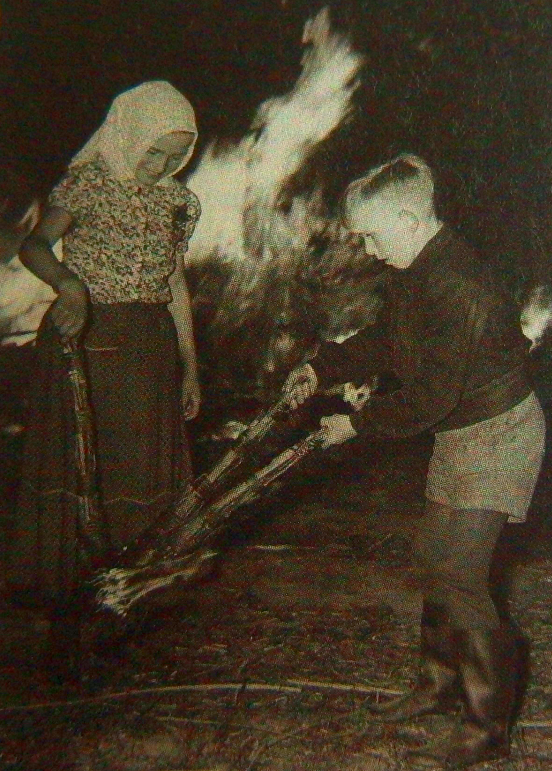
Rolling the burning wheel down the hill was part of the celebrations usually linked with summer solstice across Germanic and Slavic world. I talked about it in my post "Burning rolling wheel". Pic from Belarus.,.

Hence Taranos


In the "Curiosities of Indo-European tradition and folk-lore" by Kelly, Walter Keating, we can read that:

"It appears from the preceding accounts that, both by Celts and Germans, a wheel was often used for kindling the needfire..."

"Jacob Grimm was the first to make it evident that, for the Germans at least the wheel was an emblem of the sun, and numerous facts which have come to light since he wrote, abundantly verify his conclusion..."

"He mentions...that in the Edda the sun is called fagrahvel " fair or bright wheel," and that the same sign ☉ which in the calendar represents the sun stands also for the Gothic double consonant 'hw,' the initial of the Gothic word 'hvil,' Anglo-Saxon 'hveol,' English wheel..."

"In the needfire on the island of Mull the wheel was turned, according to Celtic usage, from east to west, like the sun..."

Digression: Talked about the importance of the "sunwise" movement in

Q: "Which way to turn myself I know not?" 

A: "If you worship the gods, right-hand wise, I apprehend."

Ever wondered why "clockwise" means "circle to the right" and "anti clockwise" means "circle to the left"? 

Cause the original clocks were sundials...


I talked about this in my post "Sunwise"...

"There was a twofold reason for this use of the emblem of the sun, for that body was regarded not only as a mass of heavenly fire, but also as the immediate source of the lightning..."

"When black clouds concealed the sun, the early Aryans believed that its light was actually extinguished, and needed to be rekindled. Then the pramantha [firedril] was worked by some god in the cold wheel until it glowed again..."  

Digression:

Thread: "Hestia, you who tends the holy house of the lord Apollo...come now into this house...having one mind with Zeus the all-wise..." From "Homeric Hymn To Hestia"

What does this mean?

It means that the lightning which was the source (essence) of fire...

I talked about this in my post "Having one mind with Zeus"... 

Apparently, Hestia was for some "inexplicable" reason linked to Hermes...

"...but before this was finally accomplished the pramantha often shot out as a thunderbolt from the wheel, or was carried off by some fire robbers..."

"The word 'thunderbolt' itself like its German equivalents expresses the cylindrical or conical form of the pramantha. When the bolts had ceased to fly from the nave, and the wheel was once more ablaze, the storm was over."

Interestingly, it is Hermes, the younger brother of Apollo (Sun god) who invented fire (!!!) drill...

That's the same Hermes who later became Messenger (Thunder) of Zeus (Thunder god)...

What did Hermes do on the day he was born? He stole Apollo's cows. He then invented fire drill, made fire, and sacrificed one of the cows to the gods...I talked about this in my post about (apparently inexplicable 🙂) link between Hermes and Hestia (fire)...

I talked about this in my post "12 Olympians"...

Also interestingly, the term pramantha is closely associated with the, sacred, ancient symbol of the swastika, particularly in Vedic and metaphysical contexts, acting as a metaphor for the creation of fire and, by extension, cosmic creation... 

In Sanskrit, pramantha is an instrument used for kindling fire through rotary motion (a fire drill)...

The swastika (卍 or 卐) is traditionally seen as a symbol representing the pramantha (drill) and the arani (the baseboard) used in Vedic rituals to produce sacred fire (Agni)...

The rotary action of the fire drill—symbolized by the bent arms of the swastika—represents the creation of life and energy. It is considered a "summary in a few lines of the whole work of creation or evolution"...

Swastika is also a solar symbol, a symbolic depiction of ever turning solar wheel, solar year...


I talked about this in my post "Kolo-Vrt"...

And considering that it is sun that powers lightning that creates fire...

Sunday, 27 July 2025

Walpurgis Night

Illustration by Bernard Zuber for Maurice Garçon’s La Vie Execrable de Guillemette Babin, Sorciere, 1926. 

May Day Eve (April 30) is across Northern and Central Europe known as Walpurgis Night, the night when everyone is trying to "ward off, scare, witches"...

Why?

Maybe this has something to do with the old Celtic calendar which divided the year into two halves:


Winter (Samhain, 1st of Nov - Beltane, 1st of May)

Summer (Beltane, 1st of May - Samhain, 1st of Nov)

I talked about this in my post "Two crosses"...

This division of the year, is btw based on the old transhumance shepherd calendar:

Lowland grazing and lambing Oct/Nov - Apr/May

Highland grazing and milking Apr/May - Oct/Nov

I talked about this in my post "April"...

In Serbian Orthodox calendar, the beginning and the end of the "Time of Dragons", the hot sunny half of the year, is marked (guarded) by Two Georges, Summer and Winter St George('s day)...I talked about this in my post "Two Georges"...

This is important to know as a lot of old traditions linked to Beltane were migrated to the Summer St George day...

Where do witches come into the picture here?

Remember this: Hey, you Halloween witches, dressing up in black on the first day of winter...You know that The Witch here is The Hag, Winter Earth, Baba, Cailleach, The Dark, Veiled One...Here she is, all in black, with bare branch, on the four seasons Roman mosaic from the Bignor

The witch here is the Old (Winter) Mother Earth. 

In the Polish Carpathians we find this saying:

"Baba (Grandmother) is already frozen" meaning "The mountain tops are covered with frost or the first snow". 

I talked about this in my post "Gryla" about Winter Hag, Winter Earth...

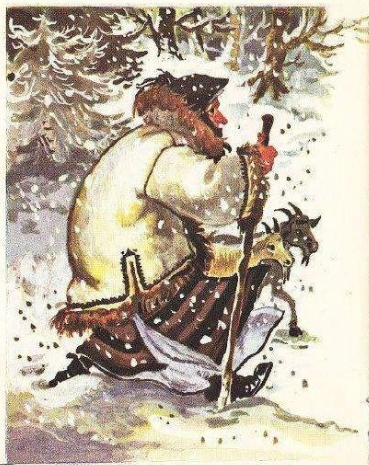
Baba Dochia was an old woman who insulted the month of March. So, while she was going up the mountain with a herd of goats (symbols of winter), March borrowed frosty days from February and froze her to death...

I talked about this legend from Romania in my post "Baba, cold, winter"...

Slovenian folk play called "Baba (grandmother) and Ded (grandfather)": "As they get older he gets weaker and she gets stronger. At one point she takes over him and rules until spring".  

This makes a lot of sense if Baba (Earth, Yin, Cold) and Ded (Sun, Yang, Heat)...


Ever changing Yin-Yang symbol is most likely description of the ever changing daily amount of light and darkness and the effect this change has on Earth's temperature...

More about it in my post "Yin and Yang"...

The winter earth is actually depicted as a witch in the Snow White. 

Crab apples are the last fruit to stay on the branches in Continental Europe, well into winter. 

Winter, which was imagined by our ancestors as "an old hag, and old witch" veiled in black, the bringer of death...

The one Slavs called Morana (the goddess of death) and Marzana (the goddess of cold). From my post "Snow-White"...

Some Slavs performed burning of the witch of winter/goddess of death at the beginning of spring (Jan/Feb)...

"Maslenitsa" by Simon Kozhin. 

As I said, Slavs equated The Goddess of Death, Morana (mor=death) with The Winter Earth, Marzana (marz=frost). She is ceremonially burned (warmed) or drowned (thawed) or both (to de sure to be sure 🙂) during Slavic spring festivals...

Here are some posts in which I talk about this ritual and related customs: "Gryla", "Party" "Bannock", "To kill a witch", "Baba's day", "Living stone"...

And some Slavs performed burning of the witch of winter/goddess of death at the beginning of summer (Apr/May)...

Like Sorbs (Slavs) from Germany, who at the end of April perform "Chodojtypalenje" (the witch burning). A large stack of branches is piled and a straw witch effigy is placed on top. The whole thing is then set ablaze symbolically "killing winter" (witch=hag=winter) 

As I said above, in Serbian and Celtic calendar, year had two seasons: winter Samhain (start of November) to Bealtaine (start of May), and summer Bealtaine to Samhain. Hence Sorbian witch burning at the end of April, just before the start of summer...  

Here is a picture of one of these "witches" (hags) being burned. 

Christianised version of this custom is Walpurgis Night. "As a result of Saint Walpurga's evangelism in Germany, the people there converted to Christianity from heathenism. Saint Walpurga was also known to repel the effects of witchcraft..." 😉

I think that by now you can all see that what was burned on these bonfires was not a witch but the Hag, Ugly, Evil, Winter earth, The Goddess of Death. Who is transformed, every spring, by the fire of the sun into Beautiful, Good, Summer Earth, The Goddess of Life...This "burning" is not destruction but transformation by fire...

The fire lit at these ceremonies is supposed to ignite the reproductive fire of the mother earth. We don't want frigid winter hag, we want hot spring maiden 🙂 burning with desire for her young sun lover. Without this fire there is no life...

In the Balkans they also performed the scaring of the witch of winter

As part of end of winter, beginning of summer rituals, men and boys in Bosnia blew willow horns to scare the witch (winter) away...As I said, the old Serbian year, just like the old Celtic year, was divided into summer (Apr/May-Oct/Nov) and winter (Oct/Nov-Apr/May)...

I talked about this in my post "May horns"...

This link between Mother earth and Yin, dark, wet, cold weather, resulted in the women being the ones who in Slavic tradition performed Yin, dark, wet, cold magic. 

I talked about this in two posts, "Weather stones", about the use of "weather stones" among Slavs and "The last megalithic ritual in Europe", which talks about a ritual from Belarus, where women (Yin, dark, wet, cold) raise Dabog's (sun and rain god) stone during drought to get cool and wet weather...

And in the post "Thunder book" where we read about the prosecution of female witches in medieval Serbia for performing weather magic...

The association between (Yin, dark, wet, cold) magic and women seems to have been common in the past in the rest of Europe too. 

Two witches conjuring a hailstorm, an illustration from the 1489 book "De Lamiis et Pythonicis Mulieribus" by Ulrich Molitor which talks about weather altering magic (witchcraft) performed by women...


Did you know that the sudden climate change which resulted in the medieval mini ice age was blamed on the weather controlling witches and was the excuse for the subsequent witch-hunt? I talked about this in my post "De Lamiis et Pythonicis Mulieribus"...

Now that we know who witches were, I think it is interesting that witches seem to have liked riding on two things which are both associated with storms and winter: brooms and goats...

Broom...Remeber my post "Donderbezem" about Donderbezem (thunder broom), a protective symbol used in Holland and northern Germany as a protection from lightning strikes and evil spirits.

Goat...Goat is universally associated with dark, cold, wet half of the year (Oct/Nov - Apr/May) in Europe, Eastern Mediterranean, Western Asia, Mesopotamia, Central Asia, Iran...This is because ibex goat mating season starts in Oct/Nov and the ibex goat birthing season finishes in Apr/May...


I talked about symbolism of ibex goats in many of my posts, like 

Europe:

"Pitys", "Goat in European culture", "Patera of Rennes", "Gotland sun stone with horses and ibexes"... 

Levant:

"The tree of life/light", "Lachish animal calendar"...

Mesopotamia:

"Feast plaque from Louvre", "Green pastures", "Problems with Abzu", "Relief from Dur Sharrukin", "Goatfish"...

Iran: 

"Flamingos from Susa", "Goat carrier", "Iranian goat of rain", "Strider", "A vessel from Tepe Hissar", "Rhubarb and ibex"...

Interesting, right?

Anyway, don't just sit there. Go burn a witch. We all had enough of winter...

To read more about ancient animal and plant calendar markers, which were the key to deciphering all this, start here…then check the rest of the blog posts related to animal calendar markers I still didn't add to this page, and finally check my twitter threads I still didn't convert to blog post...I am 9 months behind now...

Tuesday, 31 December 2019

Nav


"On Christmas morning in Scandinavia every gable, gateway, or barn-door, is decorated with a sheaf of grain fixed on the top of a tall pole, wherefrom it is intended that the birds should make their Christmas dinner"

Quote from 1902 book "Christmas: Its Origin and Associations", by William Francis Dawson

"In pre-Christian times, Slavs believed that souls of their dead entered birds and through birds entered heaven, Iriy. So feeding birds with grain during  winter was basically a form of sacrificing grain to the ancestors."

Quote from my post "Bird wedding

Are these customs linked? 

This is the page about a strange creature from Serbian folklore called "Nav". 


The page is from the beautiful illustrated children's book on Serbian mythology called "Ale i Bauci" by Rastko Ćirić.

According to the Serbian mythology, soul of a dead unbaptised child enters a bird and becomes a "nav". It screeches during the night most commonly making crying sounds. It can make breastfeeding mothers go dry. Crossing yourself and saying "I baptise myself" makes it disappear.

This is very interesting. Slavic word Nav denote the souls of the dead in Slavic mythology. The singular form (Nav or Nawia) is also used as a name for the "otherworld". 

In Slavic mythology, souls of the dead entered birds who brought them to irij, paradise. Birds then brought the souls back when they were ready to be reborn. It is interesting that only the souls of unbaptised (still pagan) children become "nav" 🙂

What is even more interesting is that in Irish the word for saint is "naomh" which is pronounced like "n(i)ev" and which comes from Old Irish noíb (noeb) meaning sacred, holy. 

And that in Irish the word for heaven (where saints (naomh) go) is "neamh" which is pronounced like "nav" 🙂and which comes from PIE "*nébʰos." meaning sky which is in Slavic "nebo" 🙂

So in Slavic languages the dead, (navi) go to underworld, old pagan heaven probably, (nav) and in Irish language saints (niev) go to haven (nav)...


Thursday, 12 October 2017

Burning rolling wheel

"At Lower Konz, a village situated on a hillside overlooking the Moselle, the midsummer festival used to be celebrated as follows. A quantity of straw was collected on the top of the steep Stromberg Hill. Every inhabitant, or at least every householder, had to contribute his share of straw to the pile. At nightfall the whole male population, men and boys, mustered on the top of the hill; the women and girls were not allowed to join them, but had to take up their position at a certain spring half-way down the slope. On the summit stood a huge wheel completely encased in some of the straw which had been jointly contributed by the villagers; the rest of the straw was made into torches. From each side of the wheel the axletree projected about three feet, thus furnishing handles to the lads who were to guide it in its descent. The mayor of the neighboring town of Sierck, who always received a basket of cherries for his services, gave the signal; a lighted torch was applied to the wheel, and as it burst into flame, two young fellows, strong-limbed and swift of foot, seized the handles and began running with it down the slope. A great shout went up. Every man and boy waved a blazing torch in the air, and took care to keep it alight so long as the wheel was trundling down the hill. The great object of the young men who guided the wheel was to plunge it blazing into the water of the Moselle; but they rarely succeeded in their efforts, for the vineyards which cover the greater part of the declivity impeded their progress, and the wheel was often burned out before it reached the river. As it rolled past the women and girls at the spring, they raised cries of joy which were answered by the men on the top of the mountain; and the shouts were echoed by the inhabitants of neighbouring villages who watched the spectacle from their hills on the opposite bank of the Moselle. If the fiery wheel was successfully conveyed to the bank of the river and extinguished in the water, the people looked for an abundant vintage that year."


This is a passage from the book "The Golden Bough" by James George Frazer.

The book then goes to say that similar custom of rolling a burning wheel down a hill side existed in many other places in Europe:


At Eisenach on the fourth Sunday in Lent young people used to fasten a straw-man, representing Death, to a wheel, which they trundled to the top of a hill. Then setting fire to the figure they allowed it and the wheel to roll down the slope.

In Germany, Austria, and Switzerland at the same season similar customs have prevailed. Thus in the Eifel Mountains, Rhenish Prussia, on the first Sunday in Lent, a great wheel was made of straw and dragged by three horses to the top of the hill. Thither the village boys marched at nightfall, set fire to the wheel, and sent it rolling down the slope.

In the Rhön Mountains, situated on the borders of Hesse and Bavaria, the people used to march to the top of a hill or eminence on the first Sunday in Lent. Children and lads carried torches, brooms daubed with tar, and poles swathed in straw. A wheel, wrapped in combustibles, was kindled and rolled down the hill;

In neighboring villages of Hesse, between the Rhön and the Vogel Mountains, it is thought that wherever the burning wheels roll, the fields will be safe from hail and storm.

Bonfires were lit in almost all the hamlets of Poitou on the Eve of St. John. People marched round them thrice, carrying a branch of walnut in their hand. Shepherdesses and children passed sprigs of mullein (verbascum) and nuts across the flames; the nuts were supposed to cure toothache, and the mullein to protect the cattle from sickness and sorcery. When the fire died down people took some of the ashes home with them, either to keep them in the house as a preservative against thunder or to scatter them on the fields for the purpose of destroying corn-cockles and darnel. In Poitou also it used to be customary on the Eve of St. John to trundle a blazing wheel wrapt in straw over the fields to fertilise them.

In Wales three or nine different kinds of wood and charred faggots carefully preserved from the last midsummer were deemed necessary to build the bonfire, which was generally done on rising ground. In the Vale of Glamorgan a cart-wheel swathed in straw used to be ignited and sent rolling down the hill. If it kept alight all the way down and blazed for a long time, an abundant harvest was expected.

In Switzerland, also, it is or used to be customary to kindle bonfires on high places on the evening of the first Sunday in Lent, and the day is therefore popularly known as Spark Sunday. In some parts of the canton also they used to wrap old wheels in straw and thorns, put a light to them, and send them rolling and blazing down hill.

All over Northern and Central Germany, from Altmark and Anhalt on the east, through Brunswick, Hanover, Oldenburg, the Harz district, and Hesse to Westphalia the Easter bonfires still blaze simultaneously on the hill-tops. In some places tar-barrels or wheels wrapped in straw used to be set on fire, and then sent rolling down the hillside.

In Swabia, lads and lasses, hand in hand, leap over the midsummer bonfire, praying that the hemp may grow three ells high, and they set fire to wheels of straw and send them rolling down the hill. At Obermedlingen, the “fire of heaven,” as it was called, was made on St. Vitus’s Day, the day of Svetovid. On the summit of a mountain, a cart-wheel, smeared with pitch and plaited with straw, was fastened on a pole twelve feet high, the top of the pole being inserted in the nave of the wheel. The wheel was then set on fire.

In Lower Austria bonfires are kindled on the heights, and the boys caper round them, brandishing lighted torches drenched in pitch. Whoever jumps thrice across the fire will not suffer from fever within the year. Cart-wheels are often smeared with pitch, ignited, and sent rolling and blazing down the hillsides.

All over Bohemia bonfires still burn on Midsummer Eve.  Sometimes an old cart-wheel is smeared with resin, ignited, and sent rolling down the hill.

The Golden Bough does not mention it, but similar customs are also known from other Central and Eastern European Slavic lands:

In Slovakia, the Midsummer Night is called "Vajana". The root of this word is verb "váľať" meaning "to roll". Basically Midsummer Night is the night when fiery wheels are rolled down the slopes of hills.


In Belarus, Ukraine and Russia one of the solar-fire rituals performed during the Kupala Night (Midsummer Night) was to roll a flaming wheel down a hill and into a river or lake at the bottom, if there was one. The wheel symbolized the wheel (circle) of the seasons, as well as the sun-disk. In this ritual, the wheel was stuffed with straw or hay (the yellowish color of which resembled the sun) so that the wheel itself was barely visible, and in many cases an axle protruded a meter or so on each side, which people used to guide it down the hill. The idea was for it to roll all the way to the bottom, into the water if any; if it did not roll all the way down, the harvest would be bad. A wheel was also burned on a long pole. Wheels were also put on high poles and then burned either alone or a bonfire was piled around the pole with the wheel and then then whole thing was set on fire.


In "THE LITHUANIANS, an ethnic portrait" by Juozas Kudirka we read that "The Midsummer Day is a festival of simple people, connected with the veneration of fire. Young girls adorn their heads with flower wreaths. A tall pole with a wooden wheel soaked in tar or filled with birch bark is hoisted at the top of the highest hill in the vicinity. Men whose names are Jonas (John) set the wheels on fire and make bonfires around it. In some places a second pole is hoisted with flowers and herbs. Young people dance round the fire, sing songs about rye, play games, men try to jump over the fire. The burning wheels on the poles are rolled down the hill into a river or a lake at its foot, men jumping over it all along."


I would like to talk about this interesting ritual. 

First I would like to say that I believe that this was originally a ritual performed only on the summer solstice night. In most parts of Europe it was still performed on that day or on the Christian saint day which replaced Summer solstice day as a holy day. The reason why this ritual was recorded to have been performed in some parts of Europe during Lent, is because Christian clergy tried to remove the original meaning from this ritual by moving it to another part of the year. 

But what was the original meaning of this ritual? 

We know that wheel is a symbol directly linked with sun. But why is the burning wheel rolled down the mountain? 

The most popular proposed explanation is that the burning wheel was rolled down the mountain on the eve of summer solstice to symbolize the decrease of the sun's declination angle which begins on that night. 


The variation of the declination angle over the year is represented by a sinusoidal line. We can see how the decrease of the declination angle can indeed be represented by the image of the sun rolling down the slope of the hill.   


The effect of the Declination variation is the variation of the height of the point the sun reaches in the sky at noon. The sun reaches the highest point in the sky at noon on the day of the summer solstice. From that day, the height of the point the sun reaches at noon gets smaller and smaller, until at the winter solstice, the sun reaches the lowest point in the sky at noon. Then the process reverses. 

So maybe this is what our ancestors wanted to symbolically represent by rolling the burning wheel down the slope of a hill. The decrease of the height of the point the sun reaches in the sky at noon. 

But there is another possibility. 

In my post "The thundering sun god" I talked about St Ilija the Thunderer. Serbian folk tradition says that every year St Ilija the Thunderer gets so angry, that he wants to  "burn the whole world down". As I already explained in my post "Two crosses", the earth climatic, vegetative cycle lags behind the solar cycle. Becauese of this, the 21st of June, the mid summer, is the day of the maximum sun light. But it is the 2nd of August the day that marks the end of summer, that is the day of maximum sun heat. And this is the day when Serbs celebrate St Ilia the Thunderer. The period three days before and the three days after the 2nd of August, is in South Slavic tradition called Kresovi meaning Fires. These are the days of wild fires and droughts. These days are also known as the dog days, because these are the days when the dog star Sirius is in the sky with the sun.


But thankfully "Ilia the thunderer" does not burn the earth. Every year, on his day, the 2nd of August, the day of St Ilija the Thunderer, he gets persuaded by his wife, Ognjena Marija (Fiary Mary) to calm down. In Serbia there is a saying: "Od svetog Ilije sunce sve milije" which means "From St Ilija the sun starts getting kinder, milder, gentler". The first part of the 2nd of August is considered summer and the second is considered to be Autumn. And thus every year on the 2nd of August the summer ends and the autumn begins.

The 2nd of August is also the day of Perun, Slavic storm god. 

As I said already, we know that wheel is a symbol directly linked with sun. But it is also linked with thunder and fire. We can see this through the symbols of Svetovid and Perun: their wheels. The wheel of Perun is "like" the wheel of Svetovid. It is actually the fiery version of the wheel of Svetovid. 


During the second part of Summer, between mid summer, the day of Svetovid, and the end of summer, the day of Perun, the sun wheel, turns into the fiery wheel. This is symbolic representation of the effect of the ever increasing heat and drought of the second part of the summer. 

But just when the world is about to be burned to cinder by the fiery sun of the late summer, Perun arrives and kills Veles. Veles, the dragon who stole Perun's celestial cows (rain clouds), is the late summer's heat that causes drought. Perun represents the first autumn storms which finally end the drought and ensure that the crops will survive and that the harvest will be successful. The rain water extinguishes sun's fire. Autumn begins. 

Now let's have a look at the ritual again. 

The wheel is lit up on top of the hill. This is Summer solstice sun just starting to get really hot. The wheel is rolled down the hill. As the wheel rolls down the wheel's fire gets stronger and stronger because of the increased air circulation around the wheel. The people handling the wheel aim to plunge the now madly burning wheel into the river which flows below the hill and extinguish the fire. 

I believe that this was actually a magic ritual. 

The rolling of a burning wheel down the hill represents the fact that the sun's temperature increases in the second part of summer even though the days are getting shorter. 
The fact that the wheel is often rolled down the side of the hill which ends in a river or a lake and that it is seen as a good luck if the burning wheel reaches the water is very significant. It shows that the ritual is actually a magic ritual performed in order to insure the "extinguishing of the sun's fire" of the late summer by the water of the autumn rains.

I think this is very very interesting. What do you think?

By the way if you know of any other place in Europe when the same ritual was performed which I didn't list, please let me know so I can update my post.