Showing posts with label Weather magic. Show all posts

Saturday, 25 October 2025

Anavlochos mountain

This is The Anavlochos mountain range, located in the Lasithi, Crete. This naturally defensible ridge controls the major communication axis linking Central and Eastern Crete...

Between 1200-1100 BC, small settlement sites were scattered all along the ridge. At around 1100 BC most of them have been abandoned and a large settlement that remained continuously occupied until around 650 BC started developing in the highest part of the central valley...

oldeuropeanculture

Archaeologists from the University of Cincinnati, are currently involved in the excavation of the site known as Deposit 1, a bedrock outcrop with deep crevices. 3D animated model of Deposit 1 showing some of the teracottas...

There, they have discovered huge number of figurines and moulded plaques embedded deep in the crevices of the bedrock.

All were depictions of women or female sphinxes...

What is interesting, is that Anavlochos was settled between 1200 and 650 BC. The figurines date between 900 BC and 350 BC, which means that many of them were deposited after people left the settlement..

Which means that people considered the actual ridge bedrock sacred...And sacrificed to it. Or should I say to her...Mother Earth...Cause:

Great pic by @another_barbara Bedrock is in the Balkans known as "živi kamen, živa stena" (living stone, living rock) because it is believed to be still part of the living body of the Mother Earth which gives birth to all life...I talk about this in my post "Living stone"...

Again this ritual deposit site from Crete proves that people saw symbolic link between earth and female fertility. 

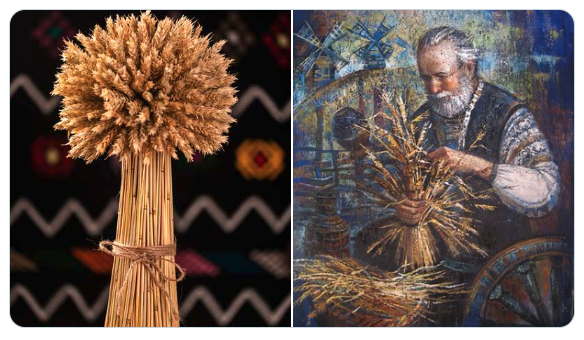
Among Slavs, the last sheaf of wheat was commonly called Baba. 

This word means grandmother, mother, midwife, birth giver...In some places the woman binding the last sheaf the last sheaf of wheat is also called Baba...

I talked about this link in my posts "Baba - the last sheaf of wheat" and "Baubo"...

I talked about the link between the veneration mountain peaks and female and earth fertility in Minoan Crete in my post "Sanctuary rhyton", about this amazing rhyton, discovered in the palace of Zakros, the most isolated of all the Minoan Palaces and was dated to 1550-1500 BC. The decoration on the rhyton depicts a "mountain sanctuary". Were these mountain sanctuaries centres of Ibex "goat of rain" cult? 


As we can see, it seems that this veneration continued after the collapse of the Minoan civilisation...

As we can see from the type of figurines deposited in the bedrock, people saw symbolic link between female lactation and earth producing spring water...

How do I know this? Rain, Water magic was among Slavs always female magic. I talked about this in my post "The last megalithic ritual in Europe", about a ritual which was until recently performed during severe draughts in Belarus to appease the Slavic Sun God Dabog (Giving god) who was also known as Daždbog (Rain giving god). 


And in my post about the "Weather stones", stones used in weather magic...

I talked about women being in charge of weather magic in Europe in my post "De Lamiis et Pythonicis Mulieribus" about this depiction of the two witches conjuring a hailstorm from a medieval manuscript on witchcraft. 

BTW, did you know that the sudden climate change which resulted in the medieval mini ice age was blamed on the weather controlling witches and was the excuse for the subsequent witch-hunt? 

I also talk about this in my post "Pozoj" about male and female dragons from Slavic folklore. In South Slavic folklore, it is a female dragon, ala, that brings hailstorms and unseasonably cold, wet weather during summer months, which destroys crops...In South Slavic folklore, cold, wet weather is "feminine"...

So Mother's milk = symbolically = Mother Earth's spring water...

More about Anavlochos excavation project can be found here.

PS: Just remembered I wrote about this a year ago in my post "Goddess of Myrtos" in which I analysed this 3rd millennium Minoan rhyton in the form of a female deity with pitcher.

Sunday, 27 July 2025

Walpurgis Night

Illustration by Bernard Zuber for Maurice Garçon’s La Vie Execrable de Guillemette Babin, Sorciere, 1926. 

May Day Eve (April 30) is across Northern and Central Europe known as Walpurgis Night, the night when everyone is trying to "ward off, scare, witches"...

Why?

Maybe this has something to do with the old Celtic calendar which divided the year into two halves:


Winter (Samhain, 1st of Nov - Beltane, 1st of May)

Summer (Beltane, 1st of May - Samhain, 1st of Nov)

I talked about this in my post "Two crosses"...

This division of the year, is btw based on the old transhumance shepherd calendar:

Lowland grazing and lambing Oct/Nov - Apr/May

Highland grazing and milking Apr/May - Oct/Nov

I talked about this in my post "April"...

In Serbian Orthodox calendar, the beginning and the end of the "Time of Dragons", the hot sunny half of the year, is marked (guarded) by Two Georges, Summer and Winter St George('s day)...I talked about this in my post "Two Georges"...

This is important to know as a lot of old traditions linked to Beltane were migrated to the Summer St George day...

Where do witches come into the picture here?

Remember this: Hey, you Halloween witches, dressing up in black on the first day of winter...You know that The Witch here is The Hag, Winter Earth, Baba, Cailleach, The Dark, Veiled One...Here she is, all in black, with bare branch, on the four seasons Roman mosaic from the Bignor

The witch here is the Old (Winter) Mother Earth. 

In the Polish Carpathians we find this saying:

"Baba (Grandmother) is already frozen" meaning "The mountain tops are covered with frost or the first snow". 

I talked about this in my post "Gryla" about Winter Hag, Winter Earth...

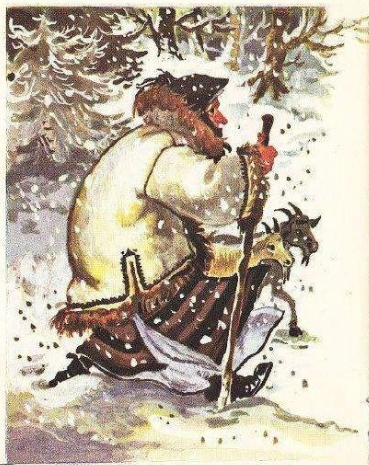
Baba Dochia was an old woman who insulted the month of March. So, while she was going up the mountain with a herd of goats (symbols of winter), March borrowed frosty days from February and froze her to death...

I talked about this legend from Romania in my post "Baba, cold, winter"...

Slovenian folk play called "Baba (grandmother) and Ded (grandfather)": "As they get older he gets weaker and she gets stronger. At one point she takes over him and rules until spring".  

This makes a lot of sense if Baba (Earth, Yin, Cold) and Ded (Sun, Yang, Heat)...


Ever changing Yin-Yang symbol is most likely description of the ever changing daily amount of light and darkness and the effect this change has on Earth's temperature...

More about it in my post "Yin and Yang"...

The winter earth is actually depicted as a witch in the Snow White. 

Crab apples are the last fruit to stay on the branches in Continental Europe, well into winter. 

Winter, which was imagined by our ancestors as "an old hag, and old witch" veiled in black, the bringer of death...

The one Slavs called Morana (the goddess of death) and Marzana (the goddess of cold). From my post "Snow-White"...

Some Slavs performed burning of the witch of winter/goddess of death at the beginning of spring (Jan/Feb)...

"Maslenitsa" by Simon Kozhin. 

As I said, Slavs equated The Goddess of Death, Morana (mor=death) with The Winter Earth, Marzana (marz=frost). She is ceremonially burned (warmed) or drowned (thawed) or both (to de sure to be sure 🙂) during Slavic spring festivals...

Here are some posts in which I talk about this ritual and related customs: "Gryla", "Party" "Bannock", "To kill a witch", "Baba's day", "Living stone"...

And some Slavs performed burning of the witch of winter/goddess of death at the beginning of summer (Apr/May)...

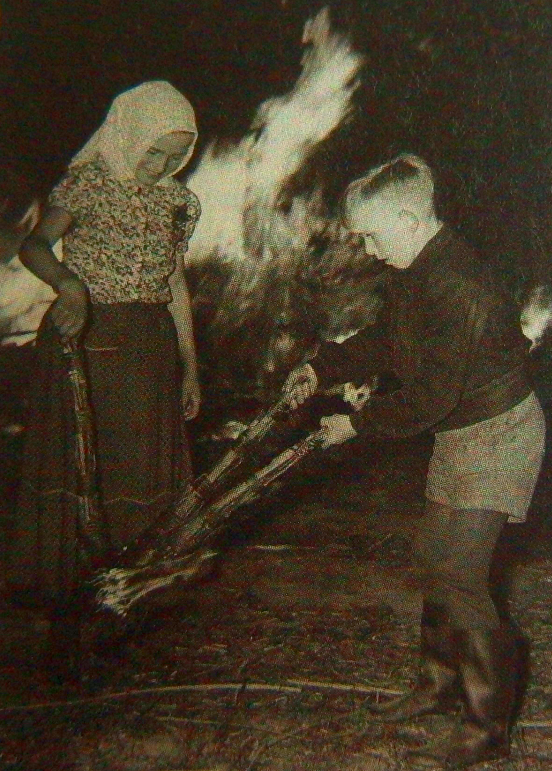
Like Sorbs (Slavs) from Germany, who at the end of April perform "Chodojtypalenje" (the witch burning). A large stack of branches is piled and a straw witch effigy is placed on top. The whole thing is then set ablaze symbolically "killing winter" (witch=hag=winter) 

As I said above, in Serbian and Celtic calendar, year had two seasons: winter Samhain (start of November) to Bealtaine (start of May), and summer Bealtaine to Samhain. Hence Sorbian witch burning at the end of April, just before the start of summer...  

Here is a picture of one of these "witches" (hags) being burned. 

Christianised version of this custom is Walpurgis Night. "As a result of Saint Walpurga's evangelism in Germany, the people there converted to Christianity from heathenism. Saint Walpurga was also known to repel the effects of witchcraft..." 😉

I think that by now you can all see that what was burned on these bonfires was not a witch but the Hag, Ugly, Evil, Winter earth, The Goddess of Death. Who is transformed, every spring, by the fire of the sun into Beautiful, Good, Summer Earth, The Goddess of Life...This "burning" is not destruction but transformation by fire...

The fire lit at these ceremonies is supposed to ignite the reproductive fire of the mother earth. We don't want frigid winter hag, we want hot spring maiden 🙂 burning with desire for her young sun lover. Without this fire there is no life...

In the Balkans they also performed the scaring of the witch of winter

As part of end of winter, beginning of summer rituals, men and boys in Bosnia blew willow horns to scare the witch (winter) away...As I said, the old Serbian year, just like the old Celtic year, was divided into summer (Apr/May-Oct/Nov) and winter (Oct/Nov-Apr/May)...

I talked about this in my post "May horns"...

This link between Mother earth and Yin, dark, wet, cold weather, resulted in the women being the ones who in Slavic tradition performed Yin, dark, wet, cold magic. 

I talked about this in two posts, "Weather stones", about the use of "weather stones" among Slavs and "The last megalithic ritual in Europe", which talks about a ritual from Belarus, where women (Yin, dark, wet, cold) raise Dabog's (sun and rain god) stone during drought to get cool and wet weather...

And in the post "Thunder book" where we read about the prosecution of female witches in medieval Serbia for performing weather magic...

The association between (Yin, dark, wet, cold) magic and women seems to have been common in the past in the rest of Europe too. 

Two witches conjuring a hailstorm, an illustration from the 1489 book "De Lamiis et Pythonicis Mulieribus" by Ulrich Molitor which talks about weather altering magic (witchcraft) performed by women...


Did you know that the sudden climate change which resulted in the medieval mini ice age was blamed on the weather controlling witches and was the excuse for the subsequent witch-hunt? I talked about this in my post "De Lamiis et Pythonicis Mulieribus"...

Now that we know who witches were, I think it is interesting that witches seem to have liked riding on two things which are both associated with storms and winter: brooms and goats...

Broom...Remeber my post "Donderbezem" about Donderbezem (thunder broom), a protective symbol used in Holland and northern Germany as a protection from lightning strikes and evil spirits.

Goat...Goat is universally associated with dark, cold, wet half of the year (Oct/Nov - Apr/May) in Europe, Eastern Mediterranean, Western Asia, Mesopotamia, Central Asia, Iran...This is because ibex goat mating season starts in Oct/Nov and the ibex goat birthing season finishes in Apr/May...


I talked about symbolism of ibex goats in many of my posts, like 

Europe:

"Pitys", "Goat in European culture", "Patera of Rennes", "Gotland sun stone with horses and ibexes"... 

Levant:

"The tree of life/light", "Lachish animal calendar"...

Mesopotamia:

"Feast plaque from Louvre", "Green pastures", "Problems with Abzu", "Relief from Dur Sharrukin", "Goatfish"...

Iran: 

"Flamingos from Susa", "Goat carrier", "Iranian goat of rain", "Strider", "A vessel from Tepe Hissar", "Rhubarb and ibex"...

Interesting, right?

Anyway, don't just sit there. Go burn a witch. We all had enough of winter...

To read more about ancient animal and plant calendar markers, which were the key to deciphering all this, start here…then check the rest of the blog posts related to animal calendar markers I still didn't add to this page, and finally check my twitter threads I still didn't convert to blog post...I am 9 months behind now...

Thunder book

In the Annals from 1605, the Dubrovnik writer Jakov Lukarević says that Serbian kings Stefan Nemanja and Dušan "persecuted witches", whom he calls "evil women from Mount Hemo", and burned their book of magic, which was in Slavic tongue called Grominjak (Thunder book)...

That book probably had spells and rituals for affecting meteorological phenomena. St. Sava, in the "Zakonopravilo", condemns the magical summoning of hail, although he himself summons hail, in the story about the Hungarian king.

St Sava from Serbian folktales basically replaced Dabog, the old Serbian supreme god and took all his magical powers, including weather control...I talk about Dabog as both sun and rain god in two article "The last megalithic ritual in Europe" and "Weather stones" about the use of "weather stones" by Slavs to manipulate weather. Like here, where women raise Dabog's stone during drought to get cool and wet weather...


Another interesting bit here is that it is women who were always associated with rain (hail) storm rituals. 

Did you know that the sudden climate change which resulted in the medieval mini ice age was blamed on the weather controlling witches and was the excuse for the subsequent witch-hunt. I talked about this in my article "De Lamiis et Pythonicis Mulieribus" about the 1489 book "De Lamiis et Pythonicis Mulieribus" by Ulrich Molitor which talks about weather altering magic (witchcraft) performed by women...

This is an illustration from the book depicting "two witches conjuring up a destructive (hail) storm"...


In South Slavic folklore, cold, wet weather is "feminine"...Yin...

Which is why, in South Slavic folklore, it is a female dragon, ala, that brings hailstorms and unseasonably cold, wet weather during summer months, which destroys crops...I talked about this in my article "Pozoj"...

While male dragon, zmaj, brings hot, dry weather which brings drought, which destroys crops...Yang...I talked about this in my articles "Scaring off the dragon" and "Letnitsa treasure"...


Saturday, 14 January 2023

Lapis manalis

While I was looking for a suitable illustration for this post about "lapis manalis", the sacred stone used as part of a Roman "aquaelicium" (calling of the waters), rain making ceremony performed during droughts, I suddenly realised what cup and ring marks look like...


I'll just leave this here...

Anyway, we have no ideas what this magic Roman "weather stone" looked like...What we know is that it was kept inside the Temple of Mars in Clivo near the Porta Capena...

From there, the stone was brought into the Senate, where offerings were made to Jupiter petitioning for rain, and water was ceremonially poured over the stone...

Now, have a look at this: In his 1925 paper "The Ring of Nestor", Sir Arthur Evans, mentions a curious rain-making ritual which was performed in Ibrahimovci, near Skoplje, Macedonia, during droughts. Pic: Altar dedicated to Jupiter, Macedonia


This is 1925 we are talking about. At least 1500 years since Jupiter was officially a god of rain...And yet, uneducated, illiterate SLAVIC villagers in Macedonia still remembered him in times of desperation...

What is very interesting is that this altar "was lying face down normally but was lifted when the rain was needed". 

Compare this with this Slavic rain making ritual from Belarus in which Dabog's stone is ceremonially lifted (and water is poured on it 🙂). I talked about it in my post "Last megalithic ritual in Europe"...


And compare this with other weather controlling Slavic rituals involving stones and rocks. I talked about this in my post "Water stones"...


Have a look at this article too, "White cross", about weather control "temple" from Slovenia...


And now compare all this with the Roman "calling the waters" (Latin: aquaelicium) ritual with the "lapis manalis" sacred stone...Interesting, right? It gets better...

This was not the only sacred "lapis manalis" stone Romans played with...There was one more...This one covered the "mundus Cereris" (The world of Ceres), a pit thought to contain an entrance to the underworld...

This "lapis manalis" was removed on August 24, October 5 and November 8 and the pit was opened with the official announcement "mundus patet" ("the mundus is open")...

Its opening offered the spirits of the dead temporary leave from the underworld, to roam lawfully among the living...This is very interesting...You'll see soon why...

Anyway after the pit was opened, offerings were thrown into it for "the underworld deities" and "the agricultural deities", including Ceres the goddess of grain "and guardian of underworld portals"...This is also very interesting...You'll see soon why...

Roman tradition held that the "mundus Cereris" had been dug and sealed by Romulus as part of Rome's foundation...

There are some suggestions that the "mundus Cereris" was the Rome's first storehouse (penus) for seed-grain, which later become the symbolic penus of the Roman state...Which makes sense cause the pit was called "mundus Cereris" (The world of Ceres)...

However, most cities of Latium and Etruria contained a similar pit or ditch...Plutarch suggests that the custom of the "mundus Cereris" was of Etruscan origin...

He compares it to pits dug by Etruscan colonists, containing soil brought from their parent city, and into which they sacrificed the first fruits of the harvest...

Sooo...Here we have two stones with the same name, one used in rain making ritual, the most important agricultural ritual that there is, and the other one used in a thanksgiving agricultural ritual involving "the dead" and grain...

Apparently, grammarian Festus, who worked  in the later 2nd century AD, "held the cover to the gate of the underworld and the rainmaking stone to be two distinct stones"....

Possibly...But they were functionally and mythologically definitely related...Except, by the time of Festus, Romans probably had forgotten that fact...Well, not everyone forgot the link between the dead, the grain, the stones and the rain...Check this:

In the Balkans people believed that if the dead were not given water, they would drink it from the clouds, and would cause drought. More about the eternal thirst of the dead can be found in my post "Thirst"...

This is why Bosnian Muslim Slavs would during droughts throw stones in the air making sure they fall in a river. The reason why a stone was thrown up in the air was "to bring the thirsty souls down from the clouds"...

Slavs believed that stones can capture the spirits of deceased...

Slavs used to place stones in, on and around graves to prevent the dead from rising. I talked about this in my post "Tombstones"...I this why suspected vampires were buried with stones in their mouths...

Hence why Romans also believed that their "lapis manalis" stone would keep the souls of their "blessed dead" inside the "mundus Cereris"...

This belief in thirsty ancestors most likely originates in Neolithic...In this post, "One for the road", I talk about the possibility that vessels placed in graves since Neolithic were not left there empty, but originally contained drink for the thirsty dead...

We find the same belief among the Hittites, who blamed the effects of the climate change which eventually led to the collapse of the Bronze Age empires around Mediterranean, on themselves. Because they have forgotten to honour their ancestors.  I talked about this in my post "House of bones"...

BTW, Slavs didn't just believe that the ancestors controlled only rain. They firmly believed that it was their ancestors who were the source of all the good and all the bad in their lives. And particularly grain...

Making Diduch or Did from grain, meaning grandfather, ancestor, the most important decoration made in the Carpathian villages in Western Ukraine during the traditional winter holidays...I talked about this in my post "Diduch"...

Greeks believed that too, BTW. It is this life giving power of the dead, which Pluto (Hades), the giver of wealth, appropriated for himself. And this is why Hades and Persephone are depicted sitting on their throne in the land of the dead, with sheafs of wheat and flowers...I talked about this in my post "Pluto"

So...Back to Romans and their sacred "lapis manalis" stones. Were they named the same because they were both linked with the worship of the ancestors? Doesn't "lapis manalis" mean "Manes (blessed dead) stone"?

Was the water poured on the rain making "lapis manalis"  during the rain making ceremony, because it contained "thirsty souls of the ancestors"?

You know,  Manes, the blessed dead, who lived in the pit covered with the other "lapis manalis"...The pit which Romans opened so they can sacrifice to "the underworld deities" and "the agricultural deities"...

The pit which could have originally been the grain seed store...Thankfully, Slavs still remembered who to blame for the drought, and who to thank for rain and grain until recently: the ancestors...So we can now understand these ancient "obscure" Roman rituals a bit better...
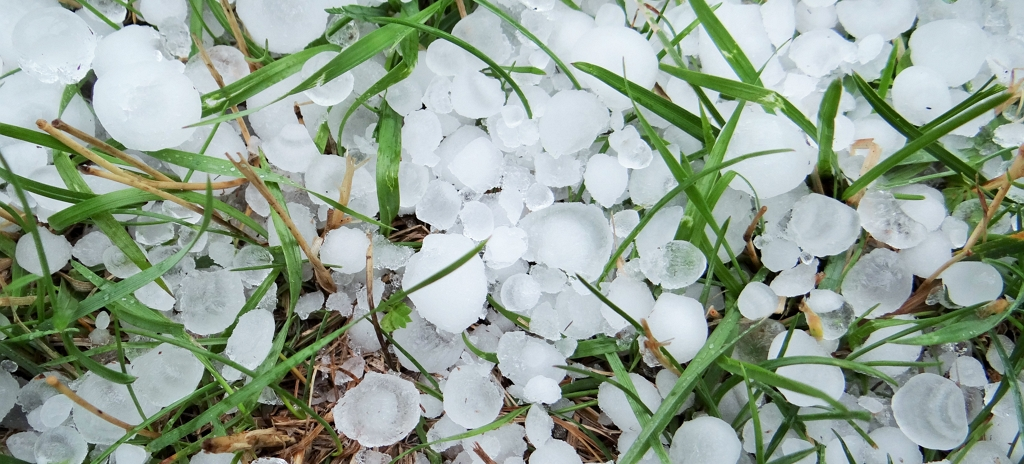
Oh, forgot. Slavs also prayed to and sacrificed to Dabog. Don't forget Dabog, The Giving god. Dabog, The Sky god, Sun and Rain god, to whom Slavs prayed for just enough rain and sunshine, so their grain fields would yield plenty of grain...

Also Dabog, the god of the dead...Whom Serbs considered their ancestral deity, the first, original ancestor...And whom other Slavs knew as "Djed" (Grandfather)...So we are still in the realm of the ancestor cult...

So there you have it...

Finally, have a look at this: 

Food for thought...

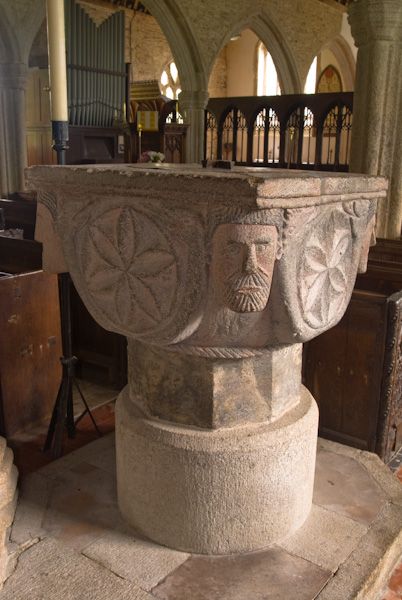
Norman font from St Nonna's Church at Altarnun. Decorated with Perunikas, Perun's flowers,  also known as thunder marks...and water marks...and flowers of life...Because it is rain that makes life possible??? What is the origin of stone fonts? Maybe rain filled ancient stone mortars? I talked about this link between holy water fonts and mortars in my post "Knocking stones"...