Attic red-figure lekythos, c. 500–450 BC, showing Charon welcoming a soul into his boat. Charon was the boatman that took souls across the river Styx that divided the world of the living from the world of the dead... The soul, psyche (ψυχή) was here depicted as a miniature version of the deceased person with wings...
Before the soul became completely anthropomorphised, it was depicted as bird with the head of the deceased person...Like on this Attic red-figure crater, c. 460BC-430BC, depicting the death of Procris...

Well, whether this is indeed the depiction of the soul of Procris leaving his body or not is debated...The description on the British Museum page for this object says " a Harpy (?) waiting for her soul"...
The first depiction of the human headed bird in a funerary contexts are found on Attic funerary plaques from the Archaic period (650-480BC) depicting a prothesis (wake).
Like this one, where we see the "soul bird" standing with its wings outstretched, under the funeral bier on which the body lies in state, as if ready to take flight. Above the body, we see three birds in flight. As I said, some people believe that this is a depiction of a soul...

If, whether these human headed birds are representations of a human soul is debatable, then this next thing is highly controversial...
From "Kerameikos" publication comes this "Black-figure miniature plate with an illegible scene, probably a funeral...A flute-player playing a dirge on a double flute, as the deceased receives his due. The bird is interpreted as the soul of the deceased..." Late 6th c. BC, Greece...

This is very interesting...Did Ancient Greeks really depict the souls of the deceased as birds? Like on these depictions of the prothesis (wake) from a Geometric period (900 to 700BC) amphorae?

We see birds under the funeral bier with the deceased...In the same place where the human headed bird is later found on Archaic period prothesis scenes?

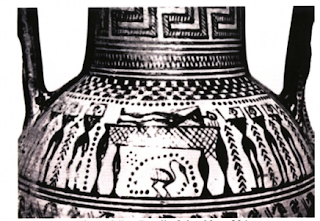
Are these really depictions of the souls? Well, in "Winged representations of the soul in ancient Greek art from the late Bronze Age through the Classical period", we read that this is a possibility...
This is a thesis written by Tina Ross, a student from the University of Victoria. In it Tina lists all the "important" 🙂 people who do think that the depictions of birds in funerary context on Ancient Greek artefacts symbolise human souls. There are handful of them...
Tina actually says that "this is not a mainstream opinion", and that she just wants "to assert and highlight another possible interpretation in order to open up other avenues of interpretation"...
What do you think?
I don't know how Ancient Greeks arrived to the idea of the winged psyche, and whether at some stage in the past they did depict souls as birds. One interesting thing is that none of the people who supported this idea put forward explanation why would Greeks do so?
But I know that Slavs believed that birds carry souls between this and the otherworld. In both directions...I talked about this in my posts "Nav" and "Bird wedding"...
More specifically, Slavs believed that it was migratory birds that acted as the soul carriers. Slavs believed that every autumn, migratory birds took away the sun to Iriy, Slavic Otherworld, World of the Dead, where he spent winter. And that every spring, migratory birds brought the sun back into our world...
"...the souls of our ancestors shine every morning from Iriy (Slavic Paradise)..."
There are two worlds, the world of the living and the world of the dead. The sun spends the day in the world of the living and the night in the world of the dead...
And there are two gates that stand on the border between these two worlds: the eastern gate and the western gate...
Every morning the eastern gate is opened by Danica, the day star, which is in the morning called Zornjača, the morning star, and the sun comes from the world of the dead into the world of the living...
And every evening the sun goes from the world of the living into the world of the dead through the western gate, which is then closed behind him by Danica, the day star, which is in the evening called Večernjača, the evening star...
The souls of the dead follow sun to the western gate, which is where the entrance into the land of the dead is...
And there they enter Iriy, the ever green land of eternal spring, full of cattle...Raj..Paradise. And every morning, when the eastern gate of the world of the dead is opened, they smile on us...
BTW, in Ireland also, there was a belief that the souls of the dead departed westwards over the sea with the setting sun...
Where does the sun come from in the morning and where does it go back in the evening?
The same observation resulted in Dabog, Serbian Sun god, Serbian ancestral deity, having all the characteristics of the god of the dead, and having the cult which is in its essence a cult of the dead...According to Serbian ethnographers...
People are logical...
This is also the reason why the dead play such a huge role in Slavic agricultural cult...
Not only that the life literally grows out of the dead...
But Dabog, The Sun, the father of the living, and the dead, resides among the dead...
And if the dead are not happy with the living, and if they complain to "Their Father", Dabog, about the living...Then the living are basically fucked...
I talked about this in my post "Diduch"...
Hittites forgot about their dead, and look what happened to them
"...humiliation of the Hittite kingdom is the result of the fact that the living Hittite kings and their subjects have forgotten to respect the sacred bond with their dead..." - From the last Hittite king, Suppiluliuma II's letter...
I talked about this in my post "The house of bones"...
By the way this link between the souls, the birds and the sun, found in Slavic mythology is also found in Ancient Egypt and Mesopotamia...
In Ancient Egypt we find the human headed Ba bird which can fly between this world and the otherworld...And we find Ra, the sun god, traveling through the otherworld, which was imagined as green watery paradise, every night...
And in Mesopotamia we also find the sun god Utu/Shamash in the land of the dead. The Sumerian poem "Enki and the World Order" exclaims: Young Utu (the sun), father of the Great City (the realm of the dead, underworld)
But the land of the dead was by Mesopotamians not seen as paradise...It was a place of dread...But souls there were still seen as birds...In a myth called "The Descent of Ishtar to the Underworld" we read that the dead "live in darkness, eat clay, and are clothed like birds with wings"...
It is strange that the otherworld was imagined as dark, horrible place, considering that it was the sun god who was the ruler of the underworld, just like in Slavic (Dabog) and Egyptian (Ra) mythology...
And not just any sun god. Young Utu, the good sun, the sun of life, not death...
This makes me wonder if Mesopotamian mythology was, like all the other mythologies, a compendium of various belief systems which preceded it? Which is why we find these "inconsistencies"...
Knowing all these ancient links between birds, souls, otherworld and sun I would say that the (Very) Ancient Greeks could have once themselves believed in the same things we find in Slavic folklore...
Migratory birds carrying the souls to and from the otherworld...