Showing posts with label Gaelic folklore. Show all posts

Sunday, 28 July 2024

Bride

Bride (the effigy of St Brigit, the "hag" turned "bride", winter turned spring), which is paraded around Ireland on Imbolc, 1st of Feb, the first day of Gaelic spring, was made from the stick or dash from butter churn, which was dressed as a bride...

In the past, at Imbolc, St Bride's "bannock" "pan cake", was baked and given to the young girls as a blessing...I talked about this in my post "Bannock"...
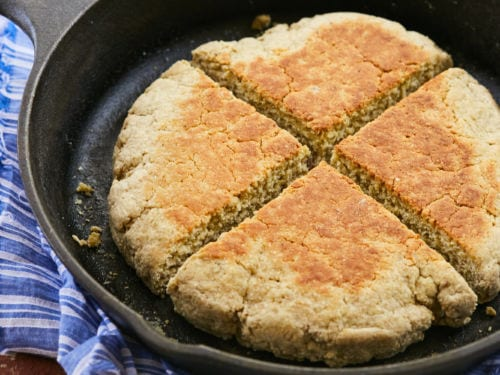
In Scotland they made bannock not on Imbolc, but on Pancake Tuesday....At the same time when Slavs celebrate their ancient beginning of spring festival Maslenitsa (butter day)...When they bake and eat pan cakes. Which symbolise the sun...

Oh, and on Maslenitsa, the festival that celebrates the death (end) of the witch (winter), people also parade the effigies of Marzana (goddess of death and winter) which are dressed in white, like brides...Because Imbolc/Maslenitsa is time of year when winter ends and spring begins and the hag of winter turns into a maiden of spring...I talked about this in my post "Snow-white"... 
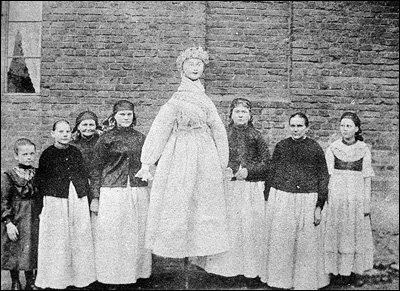
The effigy is then burned (rising temperature) or drowned (snowmelt, flowing water), or both, to be sure to be sure 🙂, to symbolically end (kill) winter (hag) and give birth to spring (maiden). This can give us the clue who Brigid originally was...I talked about this in my post "Gryla"...
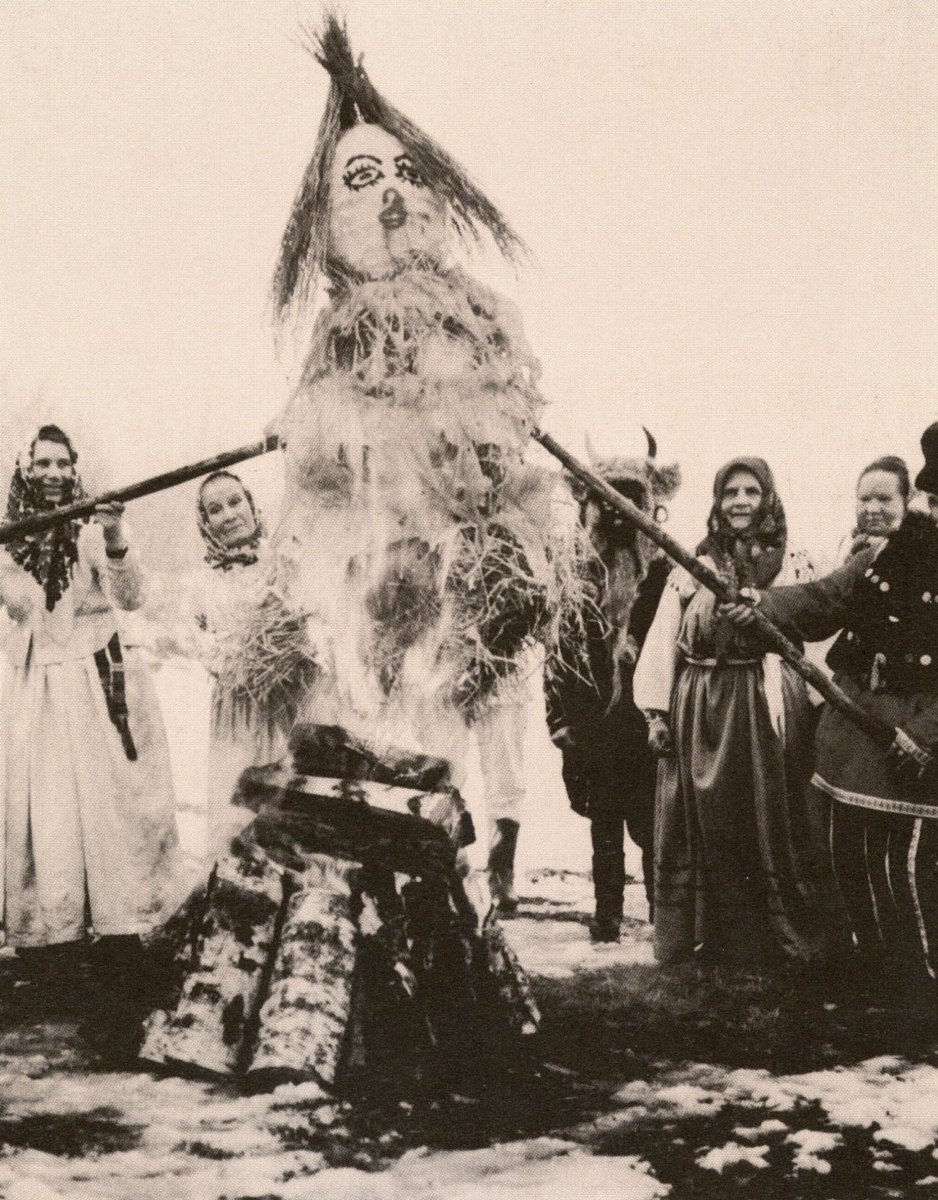
BTW, there are also some who believe that the word Imbolc, could be derived from im = butter...Would make a lot more sense than the official etymology...


Sunday, 5 March 2023

Wheat cross

A ceremonial "wheat cross" from Romania. It was made on the last day of the wheat harvest to carry the "wheat wreath" from the fields to the village. Pic from this great paper about crosses from the Alba county in Romania, "Crucea in patrimoniul spiritual al judetului Alba" (In Romanian)...

The wheat wreath was the most important part of the Romanian end of harvest ceremonies. It was made from the last sheaf of wheat...

It was normally then used to "crown" the "most beautiful unmarried girl" that participated in the harvest, who then carried it back to the village on her head...Love these pics of the reenactment of this ceremony by Vasile Sarb


The same Wheat wreath ceremony was performed by the Slavs. Wheat wreath, worn by the "corn maidens" and made from the last sheaf of wheat, was the first batch of grain to be threshed on the threshing floor. This grain was then set aside for next year's sowing and was the fist grain to be sawn. I talked about this in my post "Wheat wreath"...

BTW, a lot of Slavs once lived in Romania, which is attested by huge number of Slavic toponyms and hydronyms and by the amount of Slavic words still present in Romanian language...

Romanians, like many other Europeans, believed that the last sheaf of wheat, from which the wreath was made, contained the "spirit of grain"...This spirit was preserved in a "Corn dolly" made from the last sheaf instead or together with the wreath. I talked about this in my post "Corn dolly"...


Who corn dolly represents can be seen from the fact that in Gaelic, the word Cailleach means both an old woman and the last sheaf of wheat and the corn dolly made from it. Corn dolly which represents Mother Earth, the life (grain) giving mother...

I talked about this in my post "The old woman of the mill dust"...

And in Slovenia we find this: Men bringing an old woman in a grain basket into the mill, where she gets transformed through milling into a young girl. An old story about the rebirth (sowing/sprouting) of the Mother Earth (Mother of grain) over winter? I talked about this in my post "Bablji mlin"...

What is very interesting about the "wheat wreath" was placed on the head of the most beautiful unmarried (fertile!!!) girl which participated in harvesting, who then carried it to the village "while everyone else sang wedding songs and performed various wedding rituals"...

This seems to be directly linking female fertility and land fertility, again something found also in Slavic and Gaelic folklore (remnants of old religions)...

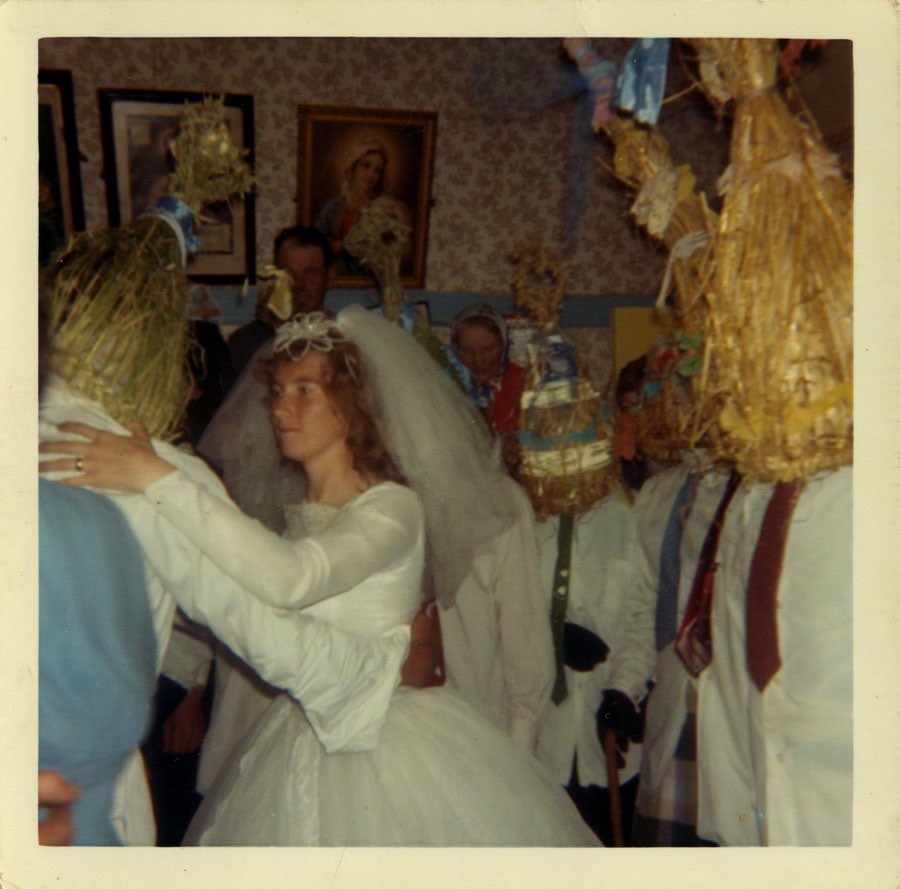
In Ireland "grain sheafs appear at weddings and dance with a bride"...

More about walking sheaves of wheat in European folklore can be found in my post "Walking sheafs of wheat"...

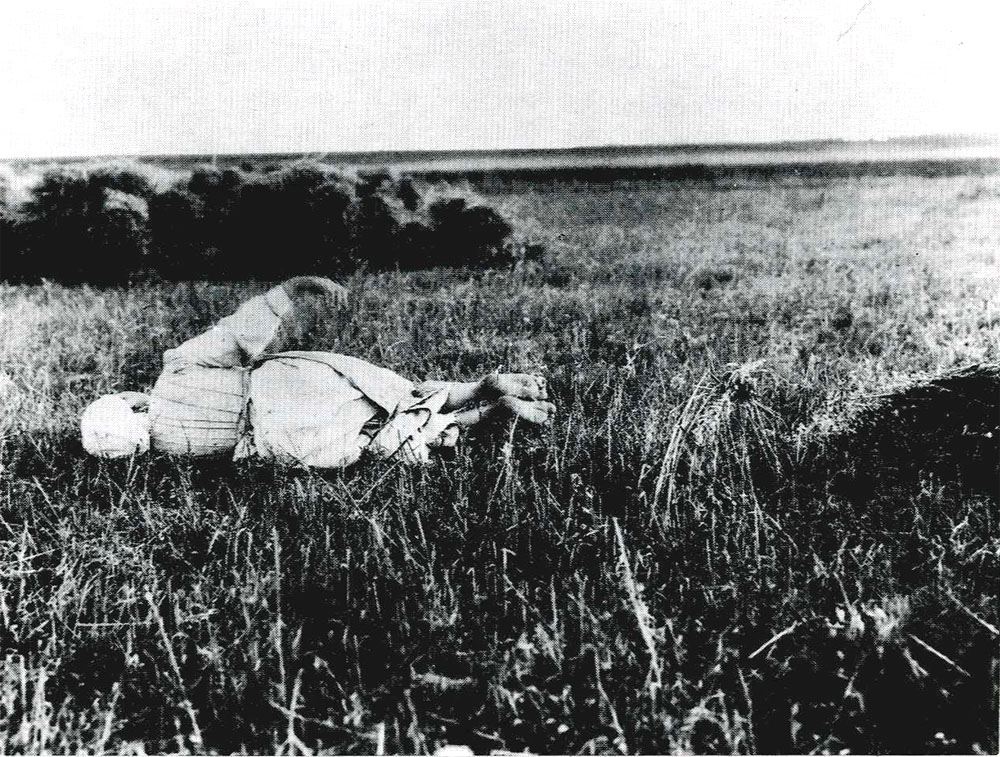
In Russia, in the past, after the last sheaf of grain was cut, women harvesters would lie down on the ground and roll around the field "to return the strength to the earth". 

The Wheat wreath was in Romania always made by women standing in a circle, and originally was made "the way you would plait women's hair"...


Which (thank you @another_barbara) looks like ear of wheat...The girl carrying the wheat wreath was the embodiment of the Corn Maiden...

BTW, this link between female fertility and land, and especially grain field fertility is ancient, and can be traced back to Neolithic Fertile Crescent, from where it spread to Europe...

As I said, all over Europe, The last sheaf of grain represents the living "sprit of grain"...But in Eastern Slavic countries, it also represents The Ancestors...This is Diduch (Grandfather) Christmas sheaf from Ukraine... I talked about this in my post "Diduch"...

And interestingly, the girl carrying the wheat wreath, is sprinkled with water all along her journey from the field to the village...Why? Slavs believed that thirsty ancestors can cause droughts which destroys wheat...I talked about this in my post "White feast"...

Saturday, 4 March 2023

Beltane purification ceremony

Walter Gregor’s "Folklore of the North-East of Scotland" published in 1881 gives this description of the sacrifice herdsmen performed during Beltane fire ceremony...

The first written reference to Beltane dates from the year 900 CE and can be found in the Sanus Chormaic (Cormac's glossary codex)...


Description of Beltane rituals from "Carmina Gadelica - Hymns and Incantations, Ortha Nan Gaidheal, Volume I" by Alexander Carmichael [1900]... 

Beltane blessing. From "Carmina Gadelica - Hymns and Incantations, Ortha Nan Gaidheal, Volume I" by Alexander Carmichael [1900] 


Friday, 28 February 2020

The Old Woman of the Mill-Dust

Carmina Gadelica is a compendium of prayers, hymns, charms, incantations, blessings, folkloric poems and songs, proverbs, lexical items, historical anecdotes, natural history observations, and lore gathered in the Gaelic-speaking regions of Scotland between 1860 and 1909.


In this book, the author Alexander Carmichael recorded a tune, still popular today especially among pipers, called Cailleach an Dùdain (The Old Woman of the Mill-Dust).

You can hear the song here, and here is the note sheet.

Here are the lyrics. I couldn't translate one of the lines


In my post "Gryla" I talked about the Old Hag Winter from European folklore.


I mentioned that in Gaelic lands of Ireland and Scotland her name was Cailleach.

But Cailleach is also a name for a Corn dolly in Irish and Scottish folklore.


At the end of the article about Cailleach corn dollies, I talked about the folk play from Slovenia called "Babji mlin" (Grandmother's mill, or mill for milling grandmothers) in which "an old woman was transformed into a young girl through milling"


In the Slovenian folk play an old woman gets transformed into a young girl through milling.
In the Gaelic folk song "Old woman of mill dust" an old woman is asked to give her daughter away.

How should we understand these two allegorical images?

Like this: In Slavic mythology, there is really only goddess: Mother Earth. But she has three faces. She is young virgin girl, Vesna (Spring), mature fertile woman, Mokosh (Summer, Autumn) and old barren old woman, the hag, Morana (Winter)...

The harvest happens in the summer and autumn and the harvested grains are milled over the winter and spring to make bread. Which is why milling is symbolically used the Slavic ritual play to describe passage of time which turns winter (Grandmother into spring (Maiden).

I believe that "Old woman of mill dust" was a Gaelic ritual song, sang during the reenactment of the transformation of the Old Hag Winter Earth into Young Maiden Spring Earth, probably during Imbolc (beginning of spring) festival...

That this is indeed the case, can be seen from the fact that elsewhere in Carmina Gadelica, Carmichael has a long note about the curious ‘resurrection’ dance which accompanied the playing of this jig:


In this curious dance, the woman playing the Old Hag Winter Earth (Old Lady of the mill dust, flour) dies and is then revived (gives her daughter away), is turned into Young Maiden Spring Earth, by the young man playing the Young Sun...

Remember in Slovenian "Milling of the grandmother" ritual play depictions, it is always young men who bring the Old Hag to the mill and take away the Young Maiden...

This is truly incredible. This is a remnant of the old European religious rituals which were once probably performed throughout Europe, but were to our days only preserved in Scotland and in Slovenia. Again Slavs and Gaels...We find this toooo often to be a coincidence...

I will finish this article with the great picture entitled: "Cailleach aig a bheil cailleach" (An old woman with a last sheaf of wheat) from Carmichael Watson Project page about the Cailleach an Dùdain. Cailleach means both an old woman, and the last sheaf of wheat and the corn dolly made from it. Corn dolly which represents Mother Earth, the life, birth giving mother of all...