Showing posts with label Levantine Archaeology. Show all posts

Saturday, 19 September 2026

Beard pulling

Muiredach's cross is a high cross from the 10th or possibly 9th century, located at the ruined monastic site of Monasterboice, in County Louth, Ireland. On one of the lowest panels of the cross there is a relief depicting two men pulling each other's beards.


Expression "Pulling someone's beard" means "Challenging someone's authority". Does anyone know how old this expression is?

Pulling someone's beard out was an act of insult. In Isaiah 50:6 we read: "I let them beat my back and pull out my beard. I didn't turn aside when they insulted me and spit in my face". This is because beard was a sign of manhood so pulling the beard out was a symbolic castration...

Romanesque sculpted stone capital from the Church of Notre-Dame-de-l'Assomption in Thiviers (Dordogne, France), likely dating from the 12th century.


The link between beard and penis is symbolically represented in this late 15th century polychrome stone stature of Adam from Albi cathedral, showing Adam covering his penis with fig leaf with one hand and touching his beard with the other...


Earlier romanesque depictions of the same symbolic scene are much more explicit :) Like this one from the church of San Martín de Elines (dated to 8th-10th century AD). Basically Beard = Penis = Fertility = Fatherhood 


Serbian expression "He acts like he had pulled god's beard" which means "he acts like god gave him power". 

Apparently, this stems from the fact that in the Ancient Near East, grabbing someone by the beard (to kiss them) was a customary gesture of intense affection, respect, and familial intimacy...

So "He acts like he had pulled god's beard" means "Him and God are best palls"...

But the Serbian expression "He acts like he had pulled god's beard" has another version: "He acts like he had pulled god's penis". 

I talked about the link between penis and sceptre (symbol of power) in my post "Sceptre"...

For instance, in Sumerian:  ñišuš-bar: ruler's staff; sceptre, literally means 'penis' + 'to see, show'...

So are beard stroking penis wielding figures like this one from Mansilla de la Sierra depictions of god?


Like this Ithyphallic Norse statue of the male fertility god Freyr Holding his beard and his penis...


Remember god is god the creator, god the father. Beard = Penis = Procreation = Fatherhood...

I talk about all this in my posts "Beard of Osiris" "Braided beard"...


Tuesday, 15 April 2025

Mother of grain from Mari

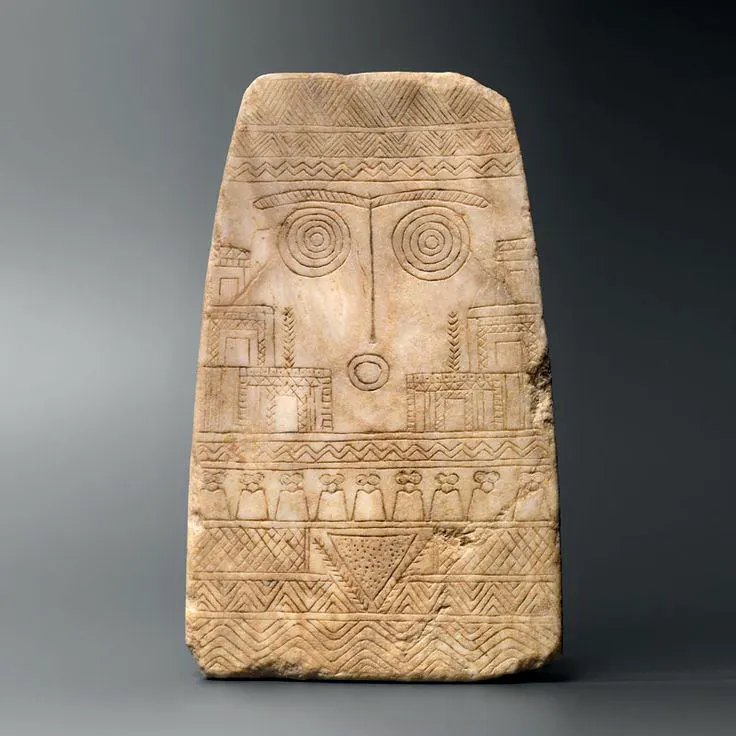
This alabaster stele [my comment: depicting the Mother of Grain, see more further down the thread], was presented in 2012 catalog of the Phoenix Ancient Art, as a cult plaque originating from the Near East and dating from the beginning of the third millennium BC...

According to Professor Michel Al-Maqdissi, an expert in oriental archaeology at the universities of Damascus and Saint-Joseph des Jésuites in Beirut, this stele almost certainly came from the ancient Mesopotamian city of Mari...

Located in Syria, not far from the Iraqi border, Mari was literally devastated by the wild searches and massive looting that took place before and after Daesh/Isis proclaimed its Islamic caliphate...

The offices of the Phoenix Ancient Art were raided by the customs in 2016 and a number of archaeological objects were seized under the suspicion that they were looted in the Middle East and smuggled into Europe...

The owner of the Phoenix Ancient Art was later sentenced in Switzerland for forging documents in order to disguise the true origin of the artefacts he was selling. You can read more about this here...

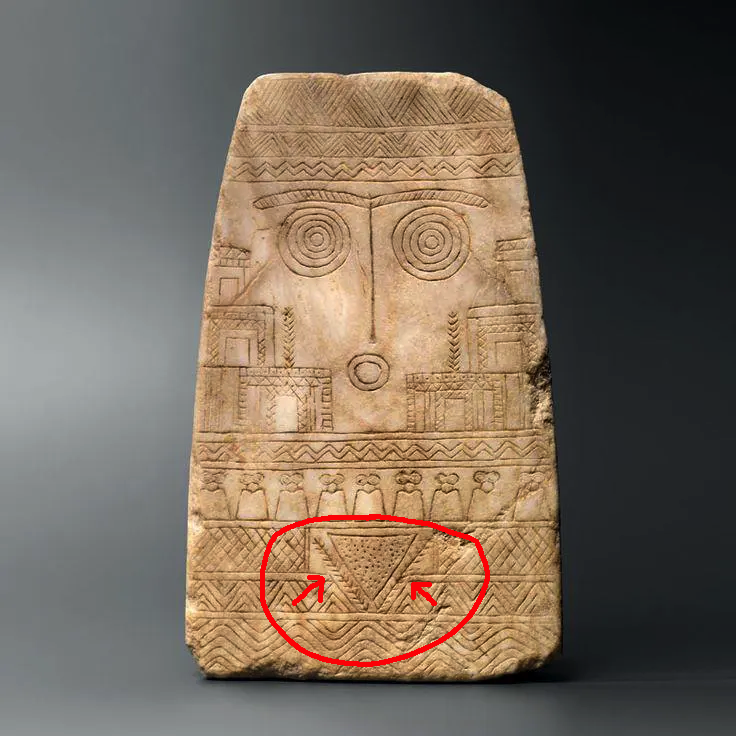
Now the interesting bit. The mother of grain? What the hell is the Mother of Grain? Well she is Mother Earth of course...Our stele from Mari also has eyes and vulva as well as water, plants, buildings and people...

What is the best way to symbolically depict "Mother Earth"? Place moutains, plants and animals between eyes and  a pubic triangle. Decorated bone depicting slightly bewildered "Mother Earth", 6th - 5th millennium BC, Hagoshrim, Southern Levant. From my post "Eyes"...


But Mother of Grain is a special version of Mother Earth. She is the mother earth of the grain farmers...

We know this because the plant depicted on the stele from Mari is grain...

I first talked about Mother of Grain in my post "Mother of grain"...

Mother of grain...Grain seed and vulva symbolism from Vinča, Starčevo and Lepenski vir cultures...Link between female fertility and earth/grain field fertility...

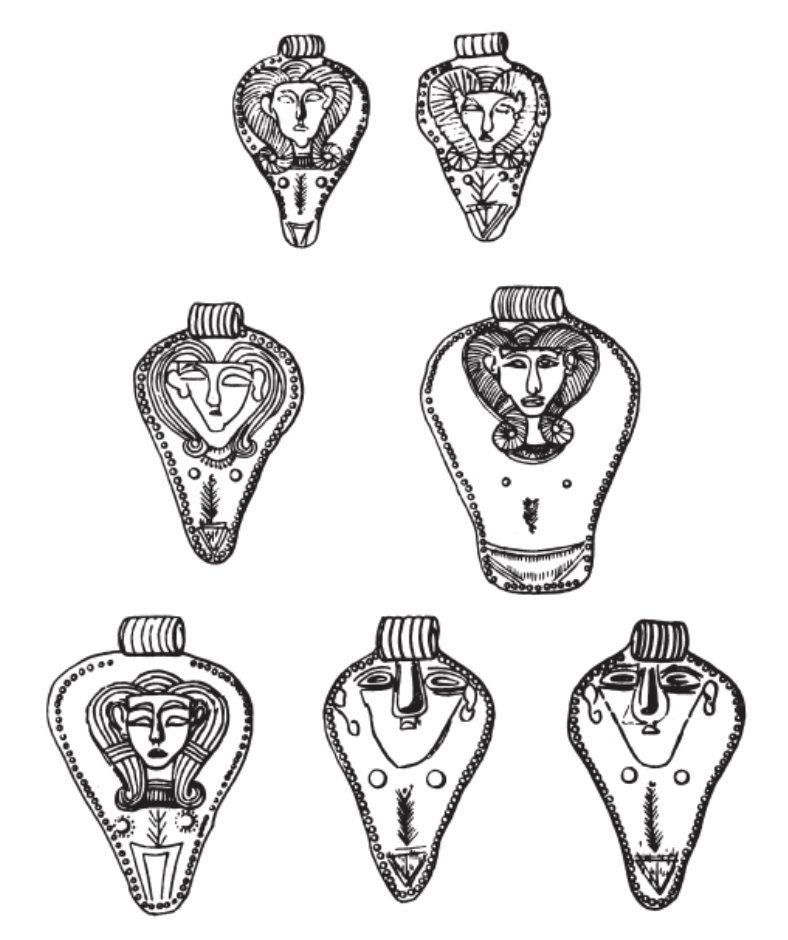
The same symbol, grain growing out of a vulva can be seen on these levantine pendants

Golden pendant with the image of Hathor. From Tel el Adjul. Gaza, middle of the 2nd mill BC. 

Similar pendants with a depiction of grain growing from the vulva. 

I wrote about them in my post "Hathor grain pendants"...

And then I talked about mother of grain in my post "Sabi Abyad venus"...

A figurine from the Late Neolithic and Early Halaf Village at Sabi Abyad, Northern Syria, part of Fertile Crescent. dated to 7th mill BC...Depicting Mother Earth turning into Mother of Grain...

And then in my post "Altyn Tepe mother of grain"...

How to depict "Mother of Grain"? Like a voluptuous woman (Mother) whose vulva (where new life come from) is horizontal (like Earth, Field) with horizontal lines (furrows) with plant (Grain) growing out of them. Altyn Tepe, BMAC,  3200-2000 BC...  

An I talked about the mother of grain in my post "Mother of grain from Yarim Tepe"...

Figurine of a nude "woman"? Or a depiction of the "Mother of grain"? Yarim Tepe, Iraq. Ubaid period, 5000-4000 BCE. Iraq Museum... Interpretation from: 

And finally i talked about the mother of grain in my post "Arjoune venus"...

An early Halaf culture figurine from the Arjoune site in Syria. It is made from a natural pebble, and it depicts a female form, with large eyes and long hair. And a square pubic area...Grain field?...Mother of grain?  

The Mother of Grain had a name in Mesopotamia: Inanna:

As for me, Inanna,

Who will plow my vulva?

Who will plow my high field?

Before my lord, Dumuzi,

...

I poured out grain before him,

I poured out grain before my womb...


From: "The Courtship of Inanna and Dumuzi"

I talked about Inanna and grain in many of my posts...

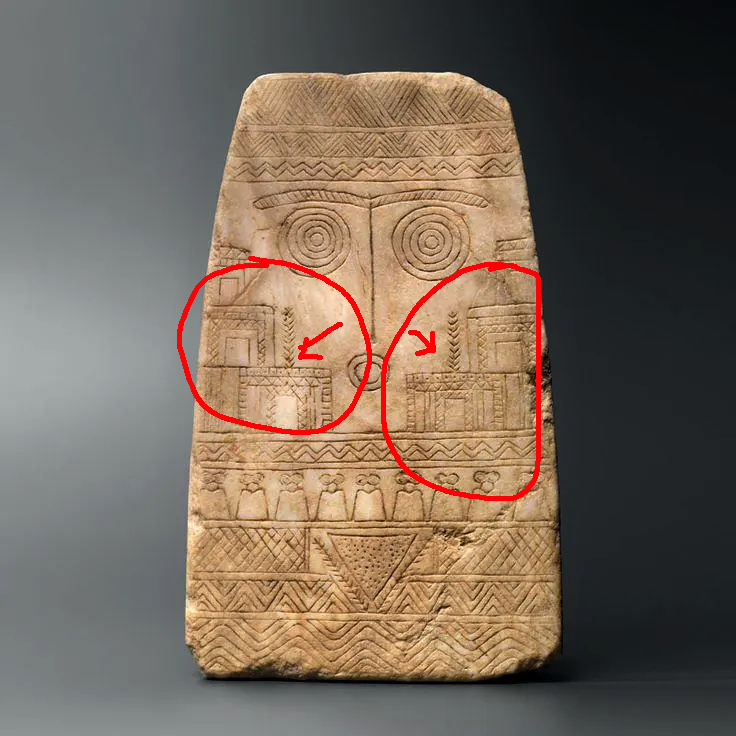
Just as Inanna says herself, we are supposed to see the vulva depicted on the stele from Mari as a grain field. Hence two grain symbols depicted on both sides of it...

We are also supposed to see the buildings as temple granaries, again because of the grain symbols depicted on top of these buildings...

We are also supposed to see this feature as an irrigation canal. People from Mari used canal irrigation extensively...You can read more about it here...

In which case this is feature is supposed to be seen as the Euphrates river...

As for the little minions, they are supposed to be seen as people from Mari...I talked about them in my post "Eye idols from Tell Brak"...

To read more about ancient animal and plant calendar markers, start here…Then check my twitter threads I still didn't convert to blog post...I am way way behind...

Sunday, 27 August 2023

Mystery seal

The other day, I came across this image, while searching for something on the net. The image is an illustration from "Yahweh and the Origins of Ancient Israel, Insights from the Archaeological Record" by Nissim Amzallag...


I don't have 85£ to buy the book (hopefully I will get to read it one day), so I can't tell you where and when this seal was made, or what Nissim Amzallag thinks it means...

My guess is it was made during the Late Bronze Age, most likely in Levant (or upper Mesopotamia)...

13/8/2024 I managed to get the copy of this book. This is a cylinder seal from Ugarit. And here is what Nissim has to say about it: "It represents the struggle between someone with a conical hat and a threatening pose (Baal), and a lion/caprid associated with a serpent (Reshef/Athtar). The posture of the animals (and especially the serpent) is not submissive, a feature challenging the hegemony of Baal (and the Amorites) on the local pantheon".

So...As I expected. No idea what this seal actually depicts. No worries, I can tell you exactly what is depicted on it: The end of the sunny, hot, dry half of the year. Let me explain why I think so:

These are (representative) climate charts for Syria, Israel, Iraq, Iran...


You can see that the climatic year is divided into two halves:

Hot, dry half of the year, Apr/May - Oct/Nov

Cool, wet half of the year, Oct/nov - Apr/May


Sooo??? What does this have to do with what is depicted on the seal we are talking about? 

Grain

On the seal we see a plant symbol for grain. I talked about it in many of my posts, for instance "Sabi Abyad venus"


The symbol for wheat is placed under the bull's head. This is because the grain harvest season in Levant and Mesopotamia starts with the barley harvest in Taurus, Apr/May.

I talked about it in my post "Bull carrying granary"...


Now bull and lion. 

These are most common symbols of the seasons:

Ram (marks lambing of Eurasian wild sheep) - spring

Bull (marks calving of Eurasian wild cattle) - summer

Lion (marks mating of Eurasian lions) - autumn

Goat (marks mating of Eurasian wild goats) - winter

And on the seal, we see lion following (and attacking) bull from behind...

Summer, which starts in Taurus (Apr/May) is followed by autumn, which starts in Leo (Jul/Aug)...

Together, they form the hot, dry half of the year, Apr/May - Oct/Nov


By the way, this is a version of a very common "lion killing bull" scene, which funnily no one before me had any explanation for...

Coin depicting Lion killing Bull sceene. Cilicia, Tarsos Mazaios Satrap 361-334BC...  

Remember, Ram - spring, followed by Bull - summer, followed by Lion - Autumn, followed by Goat - winter...  

So autumn (starts in Leo) ends (kills) summer (starts in Taurus)...


Jul/Aug, the moment when Lion kills Bull is the hottest and driest time of the year in Levant and Syria. The seat of the destructive sun god, the god of death. 

In the deserts of Levant, Middle East and Arabia, it was The Sun who was "The God of Death". It is in climate and nature it produces, that we find the root of all our religions... Pic: Over 2000 years old poem about the god of death Mot. I talked about this in my post "The oldest Arabic poem"...


In Mesopotamia they even depicted this god of death as a lion man...Cause Leo is the time when the sun is most destructive...

Nergal, the deified destructive "burning" sun, was depicted as a lion man, because Jul/Aug, Leo, is the hottest and driest part of the year in Mesopotamia...Talked abut him in my post "Winged superhuman hero"...

Hence on the seal we see the sun disc hovering right above the lion's head, in Leo, Jul/Aug...

So what about the snake? Snake is an animal calendar marker of the beginning of summer, Apr/May, because this is when the most common Eurasian snakes, vipers, begin their mating season...

Which is why

Snake: Apr/May, beginning of the main snake mating season, beginning of summer. 

Lion: Jul/Aug, beginning of the main lion mating season, end of summer.

And in the middle...

I talked about this in my post "You will trample the great lion and serpent"...


And which is why on the seal, snake slithers from right above the grain (start of grain harvest Apr/May) and head of the bull (start of summer, Taurus, Apr/May)...

On the seal, the snake then delineates the space taken by the bull, the lion and the sun, ending at the lion's butt (end of autumn, Oct/Nov). Why? Cause snake is The Solar Symbol...

Snake is a pure solar animal. It is in our world when sun is here (day, hot half of the year) and it is in the underworld when sun is there (night, cold half of the year)...I talked about it in my posts "The chthonic animal" and "Enemy of the sun"...


Hence sun god holding snakes...

This is 3rd millennium BC, Bactrian seal depicting the sun god (see heat rays emanating from his shoulders) holding snakes, symbols of sun's heat...See snakes, Solar animals number one, the symbols of sun's heat... I talked about it in my post "Nude winged hero dominating snakes"...

To understand fully the meaning of the snake animal calendar marker, and its link with bull animal calendar marker, we need to understand snake's relationship with dragon...

The first clue about this relationship I found in Slavic folklore, where Dragon (the symbol of the destructive summer sun's heat which burns everything and brings drought) is just "an old snake" (symbol of sun's heat)...Also Slavic "zmaj" (dragon) is masculine form of "zmija" (snake). I talked about this in my post "Letnitsa treasure"...


This same link between snakes and dragons is found in Mesopotamia...

In Mesopotamia, summer lasted seven (hot) months...Which is why local dragon (dragon = symbol of summer), had seven snake heads (snake = symbols of sun's heat)...Oh, and look, we also have dragon killer(s) and the princess 🙂. I talked about this in my post "Seven headed dragon"...

And so, the dragon killer brings us to the end of autumn, and the end of the sunny, hot dry half of the year. On our seal, this time of the year, Oct/Nov, is symbolised by a lion's butt. Which is being speared by the rain storm god. 

We know it is a rain storm god, cause he is looks like Baal...

I talked Baal (Rain) - Mot (Sun) in my post "Anat"...

And on top of it he is also carrying a (double) axe, another one of the weapons associated with storm gods. Like Adad...I talked about this in my post "Kataibates"...


And this is it. Here is the meaning of the seal depicted on the circular climate year chart...

Interesting, right?

To read more about ancient animal and plant calendar markers, start here…then check the rest of the blog posts related to animal calendar markers I still didn't add to this page, and finally check my twitter threads I still didn't convert to blog post...I am 9 months behind now...