Showing posts with label Blagotin. Show all posts

Sunday, 19 March 2023

Mother of grain

MOTHER Earth...The symbolic link between women and earth depicted on this Early Vinča Culture terracotta figurine from Jela, Iron Gate region of the Danube, Serbia, c. 5200 BC, H. 5.3 cm, which has a branching plant growing out of the womb...Pic from "The Body of Woman as Sacred Metaphor"...

It is interesting that this Neolithic Early Vinča culture depiction of the mother goddess was found in the same region where in Mesolithic we find Lepenski Vir culture, whose people made exactly the same image out of a bone...5000 years earlier...around 10,600 BC. It was found at Cuina Turcului, a rock shelter in the Iron Gates gorges on the Danube river, Romania.


The symbolic depiction of a mother earth as a woman is kind of easy to understand. They both give birth to things...

What is interesting is that Slavs who live in the area today, have preserved this symbolic depiction of the mother earth as a female...

Baba, the word which means Mother, Grandmother, Midwife...Birth Giver...The rock which gives birth to life...Which is why we have so many rocky mountain peaks in the Balkans named Baba. Like this one, "Baba's tooth" from Stara Planina (Old Mountain) You can find many more examples in my post "Baba, mountains and crags"...


That mountain alone has all these toponyms and hydronyms with Baba (mother, grandmother) in them...

But Slavs have also preserved something else: belief that female fertility and earth fertility, particularly agricultural fertility, and even more specifically grain fertility, are directly linked, and that one can affect the other...

Which is why we have Slavic agricultural rituals like these: In the past in Russia, after the last sheaf of grain was cut, women harvesters would lie down on the ground and roll around the field "to return the strength to the earth"...I talked about this in my post "Walking sheafs of wheat"...

Or why we have Slavic beliefs like this: A pregnant woman was forbidden to climb fruit trees or even touch them, because "the tree would dry out" (she would steal the tree's fertile energy for her own pregnancy)...I talked about this in my post "Planting tree when the child is born"... 

Or why bread oven is called "baba" (mother, grandmother, midwife, birth giver, mother earth)...I talked about this in my post "Baba, earthen bread oven"...

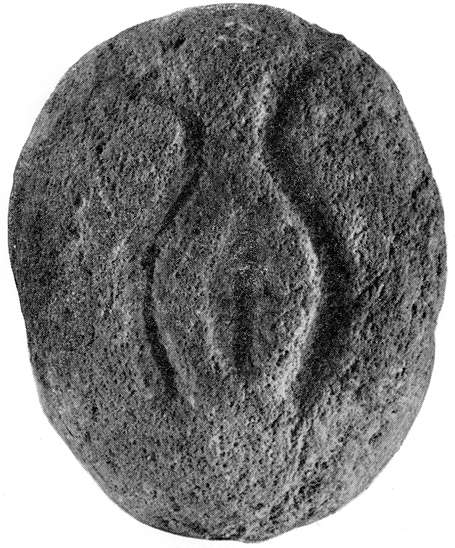
Now back to our mother earth figurines. The people from Lepenski vir who made that figurine depicting plants growing out of the womb of the mother earth, also made these: womb stones. Sculpture from the hearth of house No. 51, Lepenski Vir (9500–6000 BC, Serbia). It shows a vulva in a specific physiological state, just before giving birth, with all its anatomical details...Photo: From "Lepenski Vir" by Dragoslav Srejović 1972...

They also made very strange trapezoidal shaped houses dated to 6300-6000BC. 

They are all shaped like a flat top pyramid they could see from their settlement. Why? Because every summer solstice, the sun rose on top of it...I talked about this in my post "Sun on top of pyramid"...

Interestingly the only other example of a house like this was a Natufian culture "shrine", dated to 12,600-10,000 BC. I talked about this in my post "Natufian house"...

Natufians also made lots of stones like these...The pic is from this paper "The Natural Inspiration for Natufian Art: Cases from Wadi Hammeh 27, Jordan" which says that "They have sometimes been referred to as ‘shaft straighteners’ with the idea being that they were used to straighten bone or wooden shafts, perhaps when heated..."

"This function is unlikely, however, given direct observations of traditional artisans and experimental reconstructions of these objects’ use. Wooden spears or shafts are usually straightened by hand while being held over a fire..."

"Alternatively, the grooved stones were probably used to abrade softer materials such as Phragmites reeds, while drawing shafts back and forth through the cavity formed by binding two stones tied together with the grooves opposed..."


So we don't know what these stones were used for. That they were tools becomes doubtful (at least to me) when we know that they also made decorated, stones of the same type...The pic is from the same above article...


And this is why I don't think these were tools. The same type of objects, just made from clay, were found deposited in a sacrificial pit in the 7th mill BC early grain farming Starčevo culture Blagotin settlement in Serbia. I talked about this in my post "Blagotin"...

These were the guys who brought grain to Europe...The guys who built temple dedicated to grain. 

If we look at the clay objects from Blagotin, we can see that the groves made in them are too wide and shallow to be used for any kind of straightening of anything...

Which is why they were interpreted by Serbian archaeologists as "grain seed models", grain fertility idols...Now if you squint you will see that they don't just look like grain seeds. They also look like vulvas...Vulvas made of stone and clay, made of the body of mother earth...

Starčevo culture was ancestral culture of the Vinča culture...So we have come full circle...Hence plants growing out of the womb of the Vinča culture idol...But also out of the womb of the Lepenski Vir idol. Which predates Starčevo...

I recently came across this: A gynomorphic (woman like) figurine made of "soil mixed with chaff and grain seeds" from Grčac, Serbia. Proto-Starčevo culture, 6200-5500 BC. Direct symbolic link between earth, grain and female fertility. Basically, "Mother of Grain"...

Now that I think about it, the plant is most likely grain...These are symbols for grain from Mesopotamia and Central Asia...


This (widespread) belief that plants (especially grain) grow out of the womb of the mother earth was for the first time spelled out in Mesopotamia, where in "The Courtship of Inanna and Dumuzi" we find these verses:

"...Before my lord, Dumuzi,

I poured out plants from my womb.

I placed plants before him,

I poured out plants before him.

I placed grain before him,

I poured out grain before him,

I poured out grain before my womb..."

BTW, every year during the harvest, a man and a woman performed ritual sexual act on a threshing floor, imitating Inanna (earth, womb) and Enki (sweet water, seed) consummating their holy marriage. I talked about this in my post "Sacred marriage on the threshing floor"...


The result of which was grain grew out of Inanna's womb...

And so on and so forth...I will end this rambling article here. Got to go and make dinner...

PS: Forgot to say that Natufians were some of the first people to eat, gather and maybe even grow grain...I talked about this in my post "How grain came to Sumer"...


Friday, 27 August 2021

Burned house horizon

While reading about the sudden collapse of the Balkan Neolithic cultures, like Vinča culture (pic) at the end of the 5th mill BC, I came across a proposition that maybe it was an epidemic of some sort which could have caused it...

This is a distinct possibility...New, previously not encountered diseases could have wiped out the population with no immunity. 

But we don't have data that proves that something like that happened in the Balkans at the end of the 5th millennium BC.

We however do have proof that epidemics and even pandemics occurred during Neolithic, but not that they were the cause of the collapse of the Neolithic cultures in which they occurred...

Between 1999 and 2001, archaeologists excavated the Frälsegården passage grave in Gökhem parish, Falbygden, western Sweden, which was built between 3300 and 3000 cal. BC. 

In it they discovered remains of up to 78 individuals. Which caught attention of the authors of this study: "Emergence and Spread of Basal Lineages of Yersinia pestis during the Neolithic Decline". 

And in it, the authors state that: 

"Because of a large number of bodies which were buried in the same grave during very short period, 3100–2900 BP, based on carbon dating of 34 individuals...a possible explanation for the magnitude and short duration of this grave was an epidemic event"...

Completely wrong conclusion. We know, based on Early Neolithic data, the the total life expectancy at 15 would have been 28–33 years.

So even if we assume that these guys lived until 40, and that they had children when they were 20, that would mean 5 generations per 100 years, which would mean 15 generations in 300 years...

78 individuals buried in this grave could have been 5 members of a tribe, clan, extended family, which were buried every generation...Not too many...Nothing really to indicate that anything weird went on...

Thankfully the authors of the "Emergence and Spread of Basal Lineages of Yersinia pestis during the Neolithic Decline" paper did think (wrongly) something weird was going on, so:

They analyzed the ancient DNA datasets from individuals of this grave and screened for the presence of known human pathogens. 

Unexpectedly, they found the unambiguous presence of Yersinia pestis, the etiological agent of plague, in two different individuals, dated to 2,900 BP

So again a confirmation that all these people weren't buried in a mass grave because they all died from some disease. Only the people buried last were in fact infected by the plague...

The discovery of Neolithic farmers in Scandinavia infected by plague, not only pre-dates all known cases of plague. The people were infected by the the strain from which all known modern and ancient strains of Y. pestis are derived...

Wow this is amazing...It turns out that plague didn't come from "Dirty" Asians...It came from "Dirty" Europeans...The authors of the study continue to say that:

There is a remarkable overlap between the estimated radiation times of early lineages of Y. pestis, toward Europe and the Eurasian Steppe, and the collapse of Cucuteni/Trypillia (Tripolye) mega-settlements in the Balkans/Eastern Europe.

Now Cucuteni/Trypillia (Tripolye) culture, was a Neolithic–Eneolithic archaeological culture (c. 5500 to 2750 BCE) of Eastern Europe which covered huge territory (350,000 km2) in today's Romania, Moldova and Ukraine..

This culture is famous for its amazing pottery and figurines


But what it should be famous for are their settlements. Not the small villages, like this reconstructed one, which indeed constituted the majority of Cucuteni–Trypillia settlements...

But their "mega cities". During the Middle Trypillia phase (c. 4000 to 3500 BCE), Cucuteni/Trypillia culture built the largest settlements in the Neolithic, some of which had as many as 3000 structures and were possibly inhabited by 20,000 to 46,000 people!!!


The plan of the magnetic survey of the settlement Maidanetske 1. From the article "Governing Tripolye: Integrative architecture in Tripolye settlements"...


Here are reconstruction drawings of the two Cucuteni/Trypillia settlements

Talianki, Ukraine – up to 21,000 inhabitants, up to 2,700 houses

Maydanets, Ukraine – up to 29,000 inhabitants, up to 3,000 houses


So far 3000 settlements have been discovered, ranging from small villages to "vast fortified settlements consisting of hundreds and thousands of dwellings surrounded by multiple ditches".

The typical Trypillia hierarchy was one dominant "capital" of more than 100 hectares, surrounded by satellite towns typically in the size range 10–40 hectares and villages in the range of 2–7 hectares. The Capital controlled territories in about 20 km radius

These were basically city states...And these city states of the Cucuteni/Trypillia culture predate Mesopotamian city states, by half a millennium at least...

But very few people know about this...

Anyway, Cucuteni/Trypillia civilisation, because that's what it was really, was a society of subsistence farmers. Cultivating the soil (using an ard or scratch plough), harvesting crops and tending livestock was probably the main occupation for most people.

Typically for a Neolithic culture, the vast majority of their diet consisted of cereal grains. They cultivated club wheat, oats, rye, proso millet, barley and hemp, which were probably ground and baked as unleavened bread in clay ovens or on heated stones in the home...

Now. The article about the origin of the plague, identifies Trypillia Culture mega settlements, built towards the end of the 5th millennium BC, as the initial source of the Y. pestis infection...

Why? Well have you ever thought where did 30,000 people who lived in one of these mega cities go to the toilet? Huge number of people lived in these cities in cramped conditions with degrading sanitation...At least this is what the authors of the plague paper are hinting at...

But I don't think that was the reason...Cucuteni/Trypillia people grew grain in, for that time, huge amounts. And had to store it inside their homes, or communal storage building inside their settlements...And where there is lots of grain, there are mice and rats...

And it is mice and rats that can devastate grain stores and cause famine...Which is probably why Cucuteni/Trypillia people kept cats...Black cats depicted on a ceramic vessel from Cucuteni/Trypillian culture. 4500-4000BC...

This is also the reason why another civilisation which depended heavily on grain, Egyptian civilisation, deified cats...And held cat goddess festival around the time of the grain harvest. 

I talked about it in my post "Bastet"....

But rats also spread plague. The infected rat that carries the disease will infect fleas that live on it. These fleas then transmit the disease on humans... 

The authors of the plague study, say that the ever increasing Cucuteni/Trypillian population living under highly dense conglomerations was "likely under nutritional stress and weakened due to resource overexploitation". Ideal conditions favored epidemics and pandemics...

But the population didn't have to be weakened to catch plague. All you need is one infected rat, which enters the settlement and then dies...In a flea infested cramped neolithic settlement, by the time you know what hit you, you have dead bodies piling up...

Anyway, the paper on Y. pestis concludes that: it is most likely that it was the Trypillia mega-settlements where the ancestor(s) of the plague emerged...

They then says that it then rapidly branched and migrated in all directions, including into the steppe...spreading mainly through early trade networks, rather than massive human migrations. This allowed for a rapid and large-scale expansion of the pathogen...

The authors blame the emergence of the animal traction complex, involving cattle traction, wagons, and ard ploughs, on creating the favorable and unprecedented conditions for a rapid expansion of infectious diseases over large geographic regions...

This same pathogen lineages persisted through the Bronze Age but got eventually extinct. The authors of the plague paper propose that plague may have contributed to the Neolithic decline, which paved the way for the later steppe migrations into Europe...

I agree that this is from where the plague spread east into Asian steppe...But I would like here to propose that paper authors are wrong, and that plague didn't originate in 4th millennium BC Trypillia mega-settlements...

I believe it probably originated in the 7th c. BC in "The First Temperate Neolithic" cultures of the Balkans, the first cultures to practice agriculture in temperate Europe...

This required significant innovations in farming technology previously adapted to a mediterranean climate. Leading temperate agriculture revolution was the Starčevo culture which built Blagotin settlement in Serbia around a temple dedicated to grain. 

I talked about this in my post "Blagotin"...

Why do I think this is where plague emerged? Because of something called "The burned house horizon", which is the geographical extent of the Neolithic phenomenon of people presumably intentionally burning their settlements. 


This was a widespread and long-lasting tradition in what is now Neolithic (grain farming) Southeastern and Eastern Europe, which ended when Neolithic ended...With the end of the Cucuteni-Trypillian culture, the last culture to practice the house burning...

Cucuteni-Trypillian culture brought it to its extreme...There is evidence that every single settlement in the Cucuteni-Trypillian culture practiced house burning. And that not just single houses, but whole settlements were burned regularly... 

Why? No one knows actually 🙂

Proposed explanations so far:

Accidental fire and deliberate burning of houses by invaders:

Some of the burned sites contained large quantities of stored food that was partially destroyed by the fires that burned the houses. Some burned houses also contained human remains...

This "supports the theory that the buildings were burned accidentally or due to enemy attack, as it could be argued that nobody would intentionally burn their food supplies along with their homes and their families"

However...Experiments have shown that unaided, both accidental or deliberate fires, can't produce temperatures that can cause vitrification of the clay from the walls (turn it into ceramic)...Which is found in these burned houses...

This can only happen if you deliberately pile huge amount of combustable material around the house and then light it up. Experimental house burning. Note the amount of extra fuel added to the outside of the clay walls to increase the temperature needed for ceramic vitrification

Additionally, the experimental burning with unaided fires, left the walls almost entirely intact. It would have been relatively easy for the roof to have been repaired quickly, the ash cleared away, and the house reoccupied. Which is not what archaeologists found...

The opposite opinion is that people deliberately burned their own homes. Proposed reasons :

1. weatherproofing (🙂  laughable sorry)

2. recycling of building materials (some of the burned clay from the house walls was reused, but this is an exception not a rule)

3. demolition to create space (no new space created. houses built on top of burned remains)

4. fumigation (!!! discarded as an overkill (!!!) as the damage to the settlement was almost total)

None of this really works as an explanation either...

So what's left is ritual 🙂 Symbolic end of house: the buildings were burned ritually, regularly and deliberately in order to mark the end of the "life" of the house which was seen as a living being...

Weeeeell...Here is what I think happened...

French scientist Paul-Louis Simond (who came to China to battle the Third Pandemic of plague in the late 19th c. and who there discovered how plague spreads through rats and fleas) had noted that:

In Yunnan, China, inhabitants would flee from their homes as soon as they saw dead rats, and on the island of Formosa (Taiwan), residents considered the handling of dead rats heightened the risks of developing plague...

And in "The Epidemic of Pneumonic Plague in Manchuria 1910-1911" we read that "In Harbin itself a large-scale burning took place: of houses which had lodged plague victims or whose inhabitants had been removed"!!!!!

Is this how it all started? An infected rodent would come into the village looking for grains. And die. Someone in the village would get bitten by an infected flea...And would get infected by the plague...

Now people from all early the Neolithic Balkan farming cultures lived in separate single family households which were self sufficient...They didn't have to mix a lot with other people from the settlement...

So in most cases, the infection would first spread to the other members of the household and would most likely be initially localised.  But then people would start getting really sick and dying...

In the beginning it is possible that whole settlements were wiped out...Their bodies discovered by their kin from another settlement. Who then burned the whole place down to kill the evil disease (spirits, ghosts...whatever)...

But maybe the disease was spotted early and the other people from the village did run away from the "accursed sick possessed by the evil spirits" and came back when they were dead to burn them and their house and everything in it...

And burn it properly, making sure everything is completely destroyed and burned to cinder...Or burn the whole village properly, cause "the evil spirits of the disease could be lurking in any of the houses waiting to kill the rest of us"...

It is interesting that "Early Neolithic houses have more artifacts deposited in them, and it is in these early Neolithic phases that burned human remains are most likely to occur"

Something crazy just occurred to me. Why were Vinča culture figurines depicted with masks? What kind of "ritual" were they involved in? http://oldeuropeanculture.blogspot.com/2017/12/mask-from-belo-brdo.html

By the way the Vinča culture majorly culturally and genetically influenced Cucuteni/Trypillia culture


Did people eventually start paying attention to rats entering their settlement and fleeing as soon as they saw a dead rat? Just like the Chinese and Indian peasants still did in the 20th century...

Coming back after a while to burn their houses in giant pyres to incinerate all the rodents and all the fleas?

Once the agriculture developed, and population increased, and settlements became larger and more crowded, and number of rats increased and trade increased, the chances   of plague appearing and spreading became bigger...

Are regular burnings of the Cucuteni-Trypillian settlements really "regular ritual killings of houses" or "frequent killing of rats and fleas in plague infested houses"?

It is actually possible that in the Cucuteni-Trypillian culture this eventually became a ritual. Ritual cleansing of the place. A preventative burning of rats and fleas.

What do you think? I think that this actually explains pretty much every piece of archaeological evidence we have about Neolithic house burning.

It gives us a real reason why someone would resort to such ultimate destruction of his home and everything in it, why sometimes there are bodies burned with the house, why this is done often and why people then just rebuild their houses in the same place...

So is it possible that the Neolithic farmers in the South Eastern Europe would have survived and multiplied, if I was right? Well yes. People do survive epidemics of plague...And continue on...Well, after burning their houses and their dead...

So was the plague the reason for the collapse of the Cucuteni/Trypillia culture? I don't think so...Was the plague the reason for the Neolithic collapse in the 5th millennium BC Balkans? I don't think so...Something  else was. And I will talk about this soon...Sorry... 

Saturday, 11 April 2020

To kill a witch

"Everyone knows that an ordinary bullet can't kill a witch. If you want to kill a witch, load the rifle with 3 grains of wheat and a bit of Easter beeswax candle"... 


This Serbian folk belief is very very interesting and contains in itself a lot of encoded information...

In the past in Serbia witches were actually respected and seen as protectors of community and preservers of sacred medical and magic knowledge. 


I talked abut this in two of my posts: "The skilful one" and "Wrach".

If witch-hunt was not a common theme in Serbian folklore, who is the witch who is being killed in this folk belief? Well the same one which is being killed every year in all Slavic lands: Marzana, Morana, The Goddess of Death, The Hag, The Witch, Winter Earth...

The Climatic Spring starts at the beginning of February. As part of the End of Winter - Beginning of Spring celebrations, Slavs make effigies of Morana/Marzana, The Goddess of Death, Winter Earth, and parade them through villages...


These effigies are then burned, or drowned in flowing water, or both (to be sure to be sure) symbolising warming of the earth and melting of snow. The departure of winter and the arrival of spring...


Christians at the same time celebrate the beginning of Lent, so eventually these beginning of Spring celebrations became beginning of Lent celebrations...But for Slavs the purpose of the celebration stayed the same: Kill the Witch of Winter...

That the witch which is killed is Winter, can be seen from the ammunition recommended for killing it: three grains of wheat and Easter candle beeswax...I will first talk about grains of wheat.

Most grain cultivated by the farmers today belongs to the so called "winter grain". This grain is sown in October-November and is harvested in June-July. It has high yields, thin husks, short bristles and is resistant to low temperatures...


But in the past it wasn't like this. Most grain cultivated by our ancient ancestors was the so calls "spring grain". This grain is sown in February-March and is harvested in July-August. It has lower yields, thick husks, long bristles and is resistant to high temperatures.


The spring grains are the original old grains of the first farmers. They grew better in poor quality soil. They were resistant to diseases and were very good in completing with weeds for nutrients. Basically much better suited for primitive agriculture... As can be seen from this next chart is from the book "Local, intensive and diverse?: Early farmers and plant economy in the North-East of the Iberian Peninsula (5500-2300 cal BC)" by Ferran Antolín.


In my post about Early Neolithic Starčevo culture site Blagotin, I talked about how Serbia seems to have been the place where first farmers from Anatolia learned how to grow grain in continental climate of Europe. Pic: clay grain seeds from Blagotin temple.


Serbia is full of alluvial plains formed along rivers, which are flooded every year, and are ideal for primitive agriculture. And the schedule of annual floods which replenish nutrient on these Serbian floodplains favours spring grains.


In "Farming regimes in Neolithic Europe: gardening with cows and other models" by Valasia Isaakidou, we can read that:

"Sherratt and Kruk rejected slash-and-burn cultivation for Early Neolithic temperate Europe, partly because of growing evidence that early (LBK) settlements (as opposed to individual houses) were much long-lived and partly because concentration of habitation along rivers removed both the opportunity (scope for repeated clearance) and need (rapid depletion of soil fertility) for such a farming regime (Sherratt 1980, 315–16). As well as expanding the geographical scope of the fl oodplain cultivation model, Sherratt also now elaborated on how it would have worked. Annual flooding in late winter-early spring replenished nutrients and water supply. As the ‘self-cultivating’ soils dried out, cracking promoted aeration and seeds were spring-sown by broadcasting in the cracks, rendering digging to plant and cover the seed redundant. Labour-intensive weeding, manuring, digging, and even initial forest clearance would have been unnecessary."

Sooooo, right at the moment when Winter (The Witch) gets killed, right at the beginning of Spring, is the time when spring grains are sown...So grains of wheat do seem to kill the Witch...

In the Balkans, even though spring starts in February, cold weather can last until well into March. Witches are hard to kill. So even though grains of wheat mortally wounded winter, it is Easter (spring equinox) which is when people can start singing "Ding dong the witch is dead"...

Oh and guess who gets resurrected every Easter? The "bread of life" of course...


Tuesday, 28 April 2015

Ri - to cut with something toothed

In this post I would like to talk about the development of the toothed (serrated) cutting implements and the words used to describe these implements and the actions performed with them. I started my investigation as a pure linguistic one. But this investigation lead me to discovery of how humans invented toothed (serrated) blades by literally making artificial jaws. What is amazing is that the word cluster from Serbian (Slavic languages) which describes these toothed tools and their use actually describes the way these tools were developed in Paleolithic, Mesolithic and Neolithic, through people imitating nature.

Here it goes.


In Slavic languages we have these words meaning to cut: Sek - ti and Riz, Rez - ti. The first word,  Sek - ti, comes from the root "sk" and means to cut with a smooth blade. There are large word clusters built on this root in both Irish and Serbian and I already wrote about this in detail in my post about the "People of the blade". This word cluster is based on an onomatopoeic root “sk” which makes it very old. The sound which a smooth blade makes when pulled across something in order to cut it is “sssssssk”, "sek".  Here you can hear sounds of flesh being cut with a blade. When you cut something off with a sudden hit of blade sound shortens to "tsk" or "tsak". Here you can hear sounds of chopping with a blade.

In this post I would like to talk about the other word for cutting, Riz (Rez) - ti, which comes from the root "r, ri, re, ro" and which means to cut with something toothed. 

r - sound made when you cut, rip, puncture with something toothed, like sharp stone or point or a blade which is not smooth, like a saw or a primitive stone blade like this one:


"rrrrrrrrrrrrr" is onomatopoeic sound of cutting with a toothed blade like a saw. This is the sound of a wood saw and this is the sound of a hack sow. "rrrrrrrrrrrrrrrr" is also a sound which is produced when we scratch or scrape over a rough, toothed surface.

"rrrrrrrrrr" is also the sound of growling. Growling means making a "rrrrr" sound while showing you teeth before you bite:


The word for growling in Serbina is "režati". What is interesting about the sound of režanje (growling) is that it is the sound "rrrrr" made in the throat ("grlo" in Slavic languages). You can hear this sound here. What is interesting is that the sound of resembles the sound of "režanje", growling, resembles the sound of "rizanje, rezanje", cutting with a toothed blade, saw. 

The official etymology of the word growl says that it comes from Middle English growlen, related to Middle Dutch grollen ("to make a noise, rumble, murmur, grunt, croak, be angry"; Dutch grollen (“to grumble”)), German grollen (“to rumble, be angry, bear ill will”), Old English grillan, griellan (“to provoke, offend; gnash the teeth”). But there is no further etymology provided. 

In Serbian we have word "grlen" meaning guttural, produced in the throat. The root of this word is word "grlo" meaning throat. In "grlo" meaning throat we find "grkljan" meaning larynx. When something gets stuck in your "grlo" throat is blocked or cut, you start to "krkljati" meaning to choke, wheeze. You can "grgoljiti" gurgle water in your "grlo" throat.  Grlo is actually a word built from all the base sounds which can be made by using your tong while it is rolling outward from the root to the tip: g - r - l. This is onomatopoeic description of human throat. Is "grlo" meaning the throat and rumbling "grlen" meaning guttural sound "rrrr" the root of all the above words? Is this where growl and gargle come from as well?

The growling dog is sounding a warning that it will bite. In Serbian the word for biting is "grizti, gristi".

gristi, grizti - to bite (after you growl as a warning). gristi = ga + ris + ti = it, him + cut + you
griz - sawdust, bits that fall off when wood is sawed. This gives us direct link between biting and sawing. This is extremely important for finding the origin of the word "rez" meaning to cut. 

Serbian word "režati" which means to growl, to show your teeth, to warn that you will bite (griz) is pointing to the fact that the original sharp toothed cutting implement used for "rezanje, rizanje" were jaws and teeth. In Slavic languages word for tooth is "zub". "Z" is the sound made using your teeth. And when you make sound "z" you bare your teeth. This is why zub is called zub. It is z + u + b = that makes z sound + in + gums (the b being the sound of toothles gums). 

You can see clear similarity between carnivore jaws and particularly canine, human and shark jaws and their ability to cleanly cut they pray in half and later human toothed cutting implements like saws.

Canine jaws with teeth


Shark jaws with teeth


Human jaws with teeth


The jaws are natural "sharp toothed" cutting implements. Here are some early human imitations:


People even used teeth (shark teeth) embedded into wood to create a cutting implement, which was literally an artificial jaw full of real teeth. For those of you who are wondering how you weaponise shark teeth, which are already regenerating, serrated meat knives at the business end of a streamlined, electric-sensing torpedo, here’s how. You drill a tiny hole in them, and then bind them in long rows to a piece of wood to make a sword. Or a trident. Or a four-metre-long lance. And then, presumably, you hit people really hard with them.

That’s what the people of the Gilbert Islands have been doing for centuries. Sharks are an ingrained part of their culture and their teeth have been an ingrained part of their weapons. Tiger sharks feature heavily – they have thick, cleaver-like teeth that can slice through turtle shells so they make a good cutting edge. But the weapons also include the teeth from spottail, dusky and bignose sharks (you can identify species from their teeth), and none of these actually live around the Gilbert Islands today.


 This is a modern version of the same tool, a saw:


Basically people noticed that jaws with teeth are good for cutting through hard things. They recognised a link between jaws teeth and cutting and then tried to create artificial jaws with teeth. This is why I believe that the oldest words for cutting with toothed implements have to be linked with words for biting. And this is exactly the case in Serbian where the word for growling (showing teeth) is "režati", the word for biting is "grizti" and the word for cutting with toothed implement is "rezati, rizati".

The Serbian word "rezati, rizati" has these cognates in other Slavic languages:

Old Church Slavonic рѣзати (rězati), Russian резать, Ukrainian різати (rizaty), Bulgarian режа (reža), Serbo-Croatian резати, Slovenian rezati, Czech řezat, Slovak rezať, Polish rzezać, Upper Sorbian rězać, Lower Sorbian rězaś.

On top of this in Serbian, Croatian and Bosnian we also have these words, which form a large cluster of words all related to the meaning "to cut the surface, to make groves, cuts, trenches... with something pointy (like a tooth) or toothed (like a jaw), or are directly linked to teeth" :

ri, re, ro - the root meaning cut, gauge, dig with something toothed, pointy. This is an onomatopoeic word derived from the sound "rrrrrr".

režati - to growl, to show teeth while making "rrrrr" sound
grizti - to bite
rez, riz - sharp blade
rezi, rizi - has a sharp taste
riz, ris, rez - a cut

rizati, risati, rezati, rozati, rosati, roškati - cut, engrave, gouge, draw. urizati, urezati - chisel. from u + rizati, rezati = in + cut
razrezati, razrizati - divide. from ras, raz + rezati = spread + cutrežanj - slicezarez, zariz, recka, ricka - cut mark, notch
riza, risa, reza - a cut line, a gouge

krezav - gappy (of teeth)
hrid - sharp rocks, cliffs 


rinati - work with a shovel or with pitch fork, with something pointy and sharp used for stabbing, poking
rinuti - to push, to gush, to stab, to stick a sharp object into something. "rinuti nož" stick a knife into someone. 
zarinuti - plunge, stick something sharp into something. 
porinuti - plunge, push into something, launch a missile, push a boat into water
rintati - hard work, probably digging soil or harvesting, agricultural work
porez, poriz - tax, the cut the state gets. 


grizlica - peptic ulcer, something that it eating at the lining of the stomach.
grinja - mites, ticks, moths. biting, gouging, hole making insects. grinja = ga + ri + na = it + cut + on
gagrica - moth = ga + grica = it + nibbles
grizina, grizlica, griznica - moth. from griz - bite, biting insect

The following two words are very interesting because they show that the full etymology of the English words "gristle", and "grits" come from Slavic "griz-ti" meaning to bite, to chew. 

griz - groats, grits. Wheat either whole or crushed, which needs to be chewed, milled. 
grizka, griska - cartilage, the chewy bits. 

gristle - From Middle English gristel, grystyl, from Old English gristel, gristle (“gristle, cartilage”), formed from a diminutive of Old English grist (“a grinding”), from Proto-Germanic *gredaną (“to crunch”), equivalent to grist +‎ -le. Cognate with Old Frisian gristel, gerstel (“gristle, cartilage”), Middle Low German gristel (“gristle”).

grist - From Middle English grist, gryst, from Old English grist, gyrst (“the action of grinding, corn for grinding, gnashing”), from a derivative of Proto-Germanic *gredaną (“to crunch”), from Proto-Indo-European *ghrēu- (“to rub, grind”). Cognate with Old Saxon gristgrimmo (“gnashing of the teeth”), German Griesgram (“a grumbler, a grouch, peevishness, misery”), Old English gristel (“gristle”). 

It all points to the fact that the original grinding was done in our mouths using our teeth to griz (bite, chew). 

There is also the English word "grisly". The official etymology says that it comes from Old English grislic (in compounds) "horrible, dreadful," from root of grisan "to shudder, fear," a general Germanic word (cognates: Old Frisian grislik "horrible," Middle Dutch grisen "to shudder," Dutch griezelen, German grausen "to shudder, fear," Old High German grisenlik "horrible;" of unknown origin; 

I believe that the word comes from "griz" meaning bite. An attack by a predator with bared teeth, biting and tearing people in bits will cause horror, fear, dread and will leave the site which is "grizli" basically half eaten carcass, horrible, dreadful looking site.

These next to words, found in Croatian and western dialects of Serbian are particularly important:

ris, risa - harvest, land given in dowry, cut
rista, risar - harvester, cutter. 
rištati, ristati - cut wheat, harvest (from ri(že) + šta + ti = cut + what + you)
risno - the time of harvest

The tool we all know is being used for cutting wheat is sickle.


We can see that the blade is smooth. So you would expect the words for the harvester and harvest to be derived from the root "sk", to cut with smooth blade. Instead we find that the Serbian words for the harvester and harvest are derived from the root "r" which means to cut with a toothed, serrated blade. Why?

A sickle is a curved, hand-held agricultural tool typically used for harvesting cereal crops or cutting grass for hay. The inside of the curve is the cutting edge, and is serrated. The farm-hand swings the blade against the base of the crop, cutting through the stems with a sawing action. The sickle was superseded in the nineteenth century by the scythe which was more comfortable and by mechanised combine-harvesters and tractor machinery. The reason why the wheat sickle blade was originally made serrated is that the serrated blades are more suitable for cutting dry and tough stems and are self sharpening by nature. Smooth sickles require constant sharpening and are only good for cutting wet and soft things like grass. This is an old iron wheat sickle from England. You can see that the blade is serrated.


The sickles my grandparents used in Serbia were also toothed, serrated. So the reason why "ris" and "risa" are the words for harvest and "rista" and "risar" are the words for harvester is because wheat sickles are toothed, serrated tools which produce "rrrr" sound when used to cut wheat stalks. This can help us to determine the true etymologies for the following words:

reap - to cut with a sickle, scythe, or reaping machine, as grain; to gather, as a harvest, by cutting. The official etymology says that the word reap comes from Middle English repen, from Old English ripan, reopan, from Proto-Germanic *rīpaną (compare West Frisian repe, German reifsen ‘to snatch’, Norwegian ripa ‘to score, scratch’), from Proto-Indo-European *h₁rep- ‘to snatch’ (compare Latin rapere ‘to seize, plunder’, Lithuanian aprépti 'to seize, embrace', Albanian rrjep ‘to peel, tear off’, Ancient Greek ἐρέπτομαι (eréptomai, “I feed on”)).

I actually believe that this word has the same etymology as the Serbian word "srp", meaning sickle. I believe that it comes from ri + po = cut + on, over, across. 

Serbian word "srp" meaning sickle is said to have this etymology: form Proto-Slavic *sьrpъ, from Proto-Indo-European *sr̥p-. Cognate with Old Church Slavonic срьпъ (srĭpŭ, “sickle”), Bulgarian сърп, Czech srp, Polish sierp; and with Latvian sirpis, Greek ἅρπη (ἅrpi). 

I believe that this word comes from s + ri + po =  with + cut + on, over = the thing you use to cut across. This is exactly what you do with the sickle, you use it to cut across the wheat stalks....

korist - gain. Could this word come from ko + ri + sto = like + cut + something = something we cut for ourselves or what is cut for us, our cut

Were sickles always toothed, serrated? They were. This is what we can read about the history of sickle

The development of the sickle in Mesopotamia can be traced back to times that pre-date the Neolithic Era. Large quantities of sickle blades have been excavated in sites surrounding Israel that have been dated to the Epipaleolithic era (18000-8000 BC). Formal digs in Wadi Ziqlab, Jordan have unearthed various forms of early sickle blades. The artifacts recovered ranged from 1 to 2 cm in length and possessed a jagged edge. This intricate ‘tooth-like’ design showed a greater degree of design and manufacturing credence than most of the other artifacts that were discovered. Sickle blades found during this time were made of flint, straight and used in more of a sawing motion than with the more modern curved design. Flints from these sickles have been discovered near Mt. Carmel, which suggest the harvesting of grains from the area about 10,000 years ago. 

Unfortunately I can't find any examples of these early sickles. I would be grateful to anyone who can provide me with the link to pictures showing these Mesolithic sickles. But we have examples of early neolithic sickles:


I remember seeing these pictures for the first time years ago and thinking "these sickles remind me of something". It only occurred to me what they reminded me of recently, while I was translating data about the early agricultural site Blagoting, from Serbia. You can read the full article about Blagoting here.

Blagotin is the early Starčevo  culture site, dated to late 7th millennium bc. The earliest feature of the site is a 2,5 meter deep sacrificial pit, around which the temple was later built. At the bottom of the pit archaeologists have found a ritually broken deer scull with separated mandibles positioned at a certain angle. I remember thinking that this seems to connect the Starčevo culture to the much older Paleolithic deer cultures of Europe from the time before the last Ice Age. Deer is also a very important symbol found in in many agrarian cultures which come after Starčevo cultures. This makes Starčevo culture a link between the Paleolithic Mesolithic Hunter gatherer cultures and Neolithic agrarian cultures. This could also be an indicator of the mixing between the local European hunter gatherers and the incoming Levantine farmers. It is possible that the Blagotin culture is a product of this mix. But then I went to look at the pictures of deer mandibles and I was shocked. Have a look for yourself:


Now have a look again at the early Neolithic sickles:


And now have a look at this deer bone sickle from USA:


Bone sickles for cutting grass, made from the lower jaw of deer, are found most commonly in central and western Oklahoma. Only one side of the jaw was used and this was lashed onto a wooden handle for service as a grass cutting tool. Actual examples of mounted specimens have been recovered intact from dry caves or rock shelters in the Ozarks area of Arkansas.

Were the deer mandibles, deposited as the first offerings in the temple in Blagotin actually deer mandible sickles? I believe so. I believe that this shows us that the "ri" meaning to cut with something toothed originally literally meant to cut with teeth, "griz" - ga + ri + z = it + cut + teeth = bite. Originally people didn't cut, they literally bit the wheat using real deer jaws. The first improvement was to replace the real teeth with sharpened stones and then to replace the jaw bone with wood handle...Through this proces "griz" - biting became "riz" - cutting with toothed implement.

Apart from cutting with something toothed we can also gouge, dig, scrape with something toothed. In Serbian we find that the words related to these actions are also based on the same root "ri".

riti - to cut the surface, to make groves, cuts, trenches, to gouge, make tunels... with something pointy, sharp, like a spade (which again looks like a tooth): 


This word has these cognates in other Slavic languages: Old Church Slavonic рити (riti), Russian рыть (ryt’), Belarusian рыць (ryc’), Old East Slavic рыти (ryti), Polish ryć, Upper Sorbian ryć, Czech rýt, Slovak ryť, Lower Sorbian ryś, Polabian råjě, Bulgarian рия (ríja), Macedonian рие (rie), Serbo-Croatian ри̏ти (rie), Slovene ríti, Old Church Slavonic рыти (ryti).


rilo - sharp pointy tool for making holes or gouges, snout, plow
ralo, ral, ralica, oral - plow, sharp pointy stick for making furrows, gouges in the ground. This is extremely important example of the mutation of middle "i" rilo into "a" in ralo (both meaning plow, tool for making gouges, furrows, paths), which is also found in Irish. 

Ranik, raonik, ralnik, ralo = plowshare

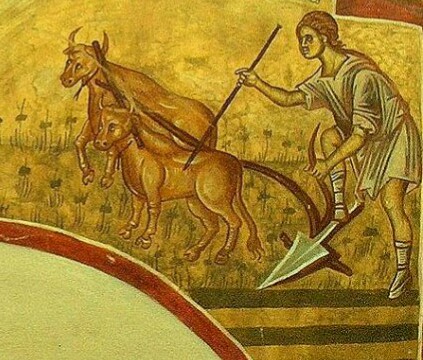
Here is a fresco from medieval Serbian monastery Dečani (14th century) depicting plowing using ralo (plow):


Here is a picture from Serbia (20th century) depicting plowing using ralo (plow):


These two pictures show the how tools and tool names survive for centuries and millenniums until they get replaced by better more cost effective tools. 

Rilica is protruding organ on heads of insects which bite, burrow, gouge skin, like in ticks called hypostome


Or a protruding organ on heads of insects which suck juices like bees, butterflies called proboscis...


From Latin proboscis, from Ancient Greek προβοσκίς "elephant's trunk,"??? In Serbian "probosti" means to puncture, to bore through, which is is exactly what these organs are for.

Rilica is a diminutive of rilo, rila, meaning something small pointy, sharp used for gouging, cutting, sticking into, poking, making holes...Something pointy used to cut a surface...

riljati - dig with a spade, cut the soil
riljač - spade
rana - wound. Probably from ri, ra + na = cut + on

rita - rag, ripped cut clothes. rita = ri + ta = cut, scraped, ripped + that, something

rnj, rnje - snout, what pigs use to gouge. From ri + nj = cut, gouge + with it = the thing with which you gouge. In Serbian the pig rije, ruje meaning it gouges the ground...

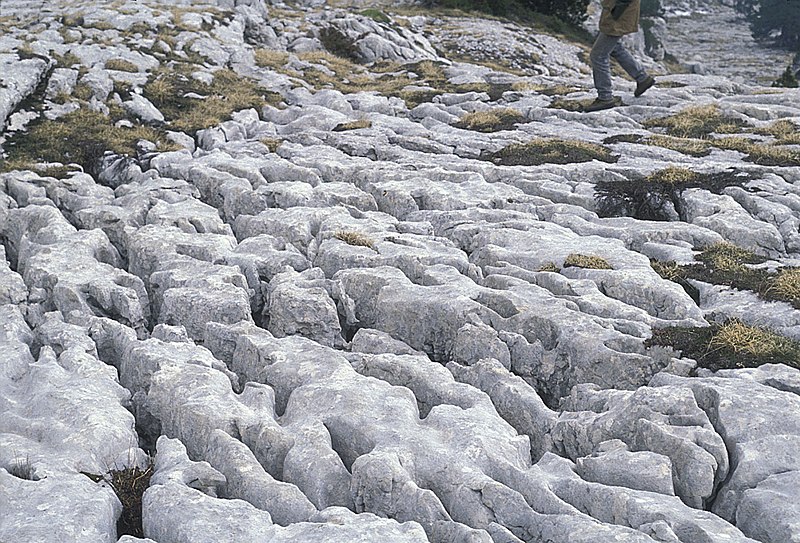
A very interesting word is word Krist meaning Karst, cut stony landscape.


The English word karst was borrowed from German Karst in the late 19th century. The German word came into use before the 19th century. According to the prevalent interpretation, the term is derived from the German name for the Kras region (Italian: Carso), a limestone plateau surrounding the city of Trieste in the northern Adriatic (nowadays, located on the border between Slovenia and Italy, in the 19th century part of the Austrian Littoral). Scholars however disagree on whether the German word (which shows no metathesis) was borrowed from Slovene. The Slovene common noun kras was first attested in the 18th century, and the adjective form kraški in the 16th century. As a proper noun, the Slovene form Grast was first attested in 1177, referring to the Karst Plateau—a region in Slovenia partially extending into Italy, where the first research on karst topography was carried out. The Slovene words arose through metathesis from the reconstructed form *korsъ, borrowed from Dalmatian Romance carsus. Ultimately, the word is of Mediterranean origin, believed to derive from some Romanized Illyrian base. It has been suggested that the word may derive from the Proto-Indo-European root karra- 'rock'. The name may also be connected to the oronym Kar(u)sádios oros cited by Ptolemy, and perhaps also to Latin Carusardius.


You can see that wiki says that "Ultimately, the word is of Mediterranean origin, believed to derive from some Romanized Illyrian base." However the word has full etymology in SerboCroatian: Krist, Karst = ka + r(i)s + t(o) = like + cut, chiseled, gouged + it 

What is interesting is that the only other language that has a large word cluster which is based on the "ri" root, meaning to cut with something pointy, toothed, is Irish. Have a look at these Irish words. You will see that most of the words are archaic words some of them not used any more. The words can be found in these dictionaries:


Foclóir gaedhilge agus béarla - compiled and edited by the Rev. Patrick S. Dineen.

Foclóir Gaeilge–Béarla (Ó Dónaill)

Etymological Dictionary of the Gaelic Language, MacBain, Alexander

The etymologies given using root "ri" are mine.

críadaire - peasantry.  "cré" means soil. "daire" is ending meaning man, person. Peasants dig, cut ground. críadaire = cré + ria + daire = soil + digging, cutting + person

riadaire, in phr. sean-riadaire, a cunning old fellow; also applied to beasts (Con.). From ria + daire = cut + person = cutting, crafty person.

riaghaim - I tear, rend, lacerate; gibbet, hang, crucify. ria + ga = cut + it, him

aimh- (amh-), neg. pref., un-, in-, dis-, not. 
aimríata ( 1 ríata) - unbroken (usu. of oxen, horses) 

This means that ríata means broken, cut, chipped, toothed. Comes from ri = to cut. ríata = ri + je + to = broken + is + that

riodán, -áin, pl. id., m., a woodworm. See readán. The worm which digs, tunnels, rije through the wood. Comes from ri = to cut.

riastáil, -ála, f., the act of turning sods in the marking off and preparation of grass-land for 
tillage; taking the surface off the furrows in the lazy-bed system of tillage; a severe cutting, a lacerating. Comes from ri = to cut.

riach - cut the surface, graze. Greek @Ge@'reíkw, tear, Lithuanian raiky/ti, draw a furrow, German reihe, row, English row.... Comes from ri = to cut.

riasail - tear asunder, riasladh, mangling, tearing asunder: *reik-so-, root reik, notch, break; Greek @Ge@'reíkw, tear. Comes from ri = to cut. Cognate with Serbian risa + ti, reza+ ti = cut into, cut off

All these words stem from the root "ri" meaning to cut, gauge, dig with something toothed, pointy, sharp. But that root does not exist in Irish. We do however have this word in Irish:

rinn, g. -e and reanna, pl. id., f. a point; sharpness; climax, intensity; the top of anything; line (of battle: acies); a promontory, a foreland, a headland; common in topography. From ri + on(o) = toothed, sharp and pointy + it. 

rinneach, -nighe, a., sharp, pointed, barbed. From ri + on(o) + je + ko = toothed, sharp and pointy + it + is + like.

rian - mark, path, power of movement. Comes from ri + na = cut, gouge + on
rianaigh - to mark, gouge, make path. Comes from ri + na = cutting, gouging + on

Ogham stones are an example of rian marks, marks gouged on the surface of the stone. 


rianta, p. a., marked out, arranged (of a place). Probably from cutting , gouging... Comes from ri + na + to, ta = cut, gouged + on + that 

rianughadh, -uighthe, m., act of marking. Probably by cutting, gouging... Comes from ri = to cut.

Here is the picture of the Offa's dyke. large linear earthwork that roughly follows the current border between England and Wales. The structure is named after Offa, the 8th century king of Mercia, who is traditionally believed to have ordered its construction. Although its precise original purpose is debated, it delineated the border between Anglian Mercia and the Welsh kingdom of Powys. In Ireland the example of such gouged in border is Black Pig's dyke. Both were made by gouging the land: rianta = ri + na + to, ta = cut, gouged + on + that 


risteal - a surface plough, used in the Hebrides, drawn by one horse and having a sickle-like coulter, Scottish ristle; from the Norse ristill, ploughshare, from rísta, cut. Comes from ri + tlo , tle = cut + land, soil.


These last four words are very interesting. Word rian has a variant "raon" meaning path, range, track, line. Word rianaigh has a variant raonach meaning having paths, routes...You can see how this forest path looks as if it was cut, gouged into the soil and vegetation:


Just like a furrow is cut into the soil with a plow:


Now remember Serbian Ranik, raonik, ralnik = plowshare. The tool that makes paths, lines, tracks, furrows....

In the end let's have a look at the Irish word "ri". 

rí (rígh), g. ríogh and rígh, d. rígh pl. ríghthe (in sp. l. ríghte), pl. ríogha (Kea.), gpl. ríogh; (Kea.), m., a king, a sovereign, a prince; as prefix, excellent, princely, as rí-fhear or rígh-fhear, an excellent man; tá sé go ríogh-mhaith, it s excellent.  

Wiktionary says that the Irish "rí" comes from Proto-Indo-European *h₃rḗǵs (“ruler, king”) which is said to come from h₃reǵ- which means "to straighten, to right oneself, right, just". I know this is what kings would like us to think they are, but I think that the root of these words is different. 

Is it possible that the word for king "ri, righ" comes from "ri" to cut, meaning the person who had right to cut, divide? If so is it possible that this word dates to the time of hunter gatherers, when the tribal leader was the one who cut the carcass of hunted animal, deciding who gets which piece of meat. Later on the tribal chief was the one deciding who gets which cut of the battle spoils and and in the end the who gets which cut of land. The role of the king, was always to divide, to give out cuts, to "ri" or "righ" = ri + ga = cut, divide + it. 

That this is the etymology of the word "Ri" can be seen from these Irish words:

riar - administer, manage, distribute. Comes from ri = to cut. ri + ar = the one that cuts, distributes.

riar, g. réir and -rtha, m., act of serving, attending, dividing, partitioning; division, allotment; tá riar a cháis aige, he has as much as he needs (Con.). Comes from ri = to cut. ri + ar = to cut, distribute.

frithríar, ríar - subsidy given by the chief to the tenant in return for the tenant`s riara, rents and services. Comes from ri = to cut. My cut, my percentage...

riar - will, division of property from brehon law. Comes from ri = to cut. We cut, divide everything...

riara - rent in brehon law. Comes from ri = to cut. In the old times person renting the land would work it and would keep all the produce from the land except for the agreed percentage, cut which he would give to the landlord as a rent...

riaraiste, g. id., m., arrears; r. cíosa, arrears of rent. Comes from ri = to cut. In the old times person renting the land would work it and would keep all the produce from the land except for the agreed percentage, cut which he would give to the landlord as a rent...

And from the etymology of the English word rich meaning wealthy. The official etymology says this:

The word rich comes from old English rice "strong, powerful; great, mighty; of high rank," in later Old English "wealthy," from Proto-Germanic *rikijaz (cognates: Old Norse rikr, Swedish rik, Danish rig, Old Frisian rike "wealthy, mighty," Dutch rijk, Old High German rihhi "ruler, powerful, rich," German reich "rich," Gothic reiks "ruler, powerful, rich"), borrowed from a Celtic source akin to Gaulish *rix, Old Irish ri (genitive rig) "king,"

The form of the word was influenced in Middle English by Old French riche "wealthy, magnificent, sumptuous," which is, with Spanish rico, Italian ricco, from Frankish *riki "powerful," or some other cognate Germanic source.

Old English also had a noun, rice "rule, reign, power, might; authority; empire." The evolution of the word reflects a connection between wealth and power in the ancient world.


This connection between the power and wealth lies in the fact that the power is the power to cut, distribute the wealth, to ri + ga = cut + it...

The English language has a lot more words based on the root "ri". And interestingly they all have full etymology in Slavic languages:

ridge - a long, narrow elevation of land; a chain of hills or mountains. the long and narrow upper edge, angle, or crest of something, as a hill, wave, or vault. the horizontal line in which the tops of the rafters of a roof meet. The official etymology says that this word comes from the Old English hrycg "back of a man or beast," probably reinforced by Old Norse hryggr "back, ridge," from Proto-Germanic *khrugjaz (cognates: Old Frisian hregg, Old Saxon hruggi, Dutch rug, Old High German hrukki, German Rücken "the back"), of uncertain origin. Also in Old English, "the top or crest of anything," especially when long and narrow. The connecting notion is of the "ridge" of the backbone. Spelling with -dg- is from late 15c.

Probably from the toothed appearance of the back bone vertibrae and the mountain ridges. Also possible cognate with Serbian hrbat - back, ridge and grba - hump, bump. 


rill - small brook, rivulet, furrow. The official etymology says that this word comes from or is related to Dutch and Frisian ril, Low German rille "groove, furrow, running stream," probably from Proto-Germanic *ril- (cognates: Old English rið, riþe "brook, stream," which survives only in dialects), a diminutive form from PIE root *reie- "to run, flow". I believe that the word is derived from "ri" to cut, gouge, make mark, furrow, ditch using a pointy tooth like instrument. Serbian riti, riljati - gouge land, rilo - what is used for gouging, making furrows.


river - early 13c. The official etymology says that this word comes from Anglo-French rivere, Old French riviere "river, riverside, river bank" (12c.), from Vulgar Latin *riparia "riverbank, seashore, river" (source also of Spanish ribera, Italian riviera), noun use of fem. of Latin riparius "of a riverbank". Gener lized sense of "a copious flow" of anything is from late 14c. The Old English word was ea "river," cognate with Gothic ahwa, Latin aqua (see aqua-). Romanic cognate words tend to retain the sense "river bank" as the main one, or else the secondary Latin sense "coast of the sea" (compare Riviera). Another direct cognate from Latin is rivus ‎(“stream”). Cognates  from other languages are Middle Irish rian ‎(“river, way”), Sanskrit ऋति ‎(ṛti, “course, way”), रीणाति ‎(rīṇāti, “causes to flow”) and Gaulish *Renos ‎(“that which flows”). The rivers cut, gouge their sides into the land like Sanskrit rti (riti, to gouge), Irish rian (ri unj = gouge in), Sanskrit rinati, Gaulish renos (push through, cut through), so I believe that this word also comes from the root "ri" to cut with something toothed, to gouge. In the case of river it is ri + v = cut, gouged + in. This is exactly what rivers do.


Interestingly in Serbian the words for river are "rika", "rijeka", "reka". The are all also based on the root "ri", "re" meaning to cut with something toothed, to gouge. rika = ri + ka =  ri + ga = cuts, scrapes + it. rijeka = rije + ka = rije + ga = gouges + it. reka = re + ka = re + ga = cuts + it....

rim - the upper or outer edge of an object. The official etymology says that this word comes from Old English rima "edge, border, verge, coast," as in særima "seashore," literally "rim of the sea," and dægrima "dawn," literally "rim of the day." Related to Old Norse rime, rimi "a raised strip of land, ridge," Old Frisian rim "edge," but with no other known cognates. I believe that this also comes from the toothed appearance of the coast when viewed from the sea. Probably from ri + mar = toothed, chiseled, gouged + sea.


rime - hoarfrost. The official etymology says that this word comes Old English hrim, from Proto-Germanic *khrima- (cognates: Old Norse hrim, Dutch rijm, German Reif). Old French rime is of Germanic origin. Rare in Middle English, surviving mainly in Scottish and northern English, revived in literary use late 18c. This is obvious if you have a look at the picture of the hoarfrost ans see how much it is "toothed"....


riot - 12th century. Originally meant debauchery, extravagance, wanton living.The official etymology says that this word comes from Old French riote (12c.) "dispute, quarrel, (tedious) talk, chattering, argument, domestic strife," also a euphemism for "sexual intercourse," of uncertain origin. Compare Medieval Latin riota "quarrel, dispute, uproar, riot." Perhaps from Latin rugire "to roar." Meaning "public disturbance" is first recorded late 14c. The meaning in English is I believe more linked to the word Ri meaning king and reffering to the way kings lived. The meaning dispute, quarrel, (tedious) talk, chattering, argument, domestic strife could be linked to the bearing of teeth and sharp noise which characterizes these situations.

rip - tear apart c. 1400.
rough water,  1775, perhaps a special use of rip. Originally of seas. The official etymology says that this word is probably of North Sea Germanic origin (compare Flemish rippen "strip off roughly," Frisian rippe "to tear, rip") or else from a Scandinavian source (compare Swedish reppa, Danish rippe "to tear, rip"). In either case, from Proto-Germanic *rupjan-, from PIE root *reup-, *reub- "to snatch." Meaning "to slash open" is from 1570s. Related: Ripped; ripping. Ripping is done with a sharp pointy object, like a hand, nails, sharp rock, a knife or teeth. I believe that the root for these words is not *reup-, *reub- to snatch but "ri" to cut with toothed object. The actual etymology is ri + po = cut + on, over, across.

ripple - early 15c, to crease; 1660s, to present a ruffled surface.
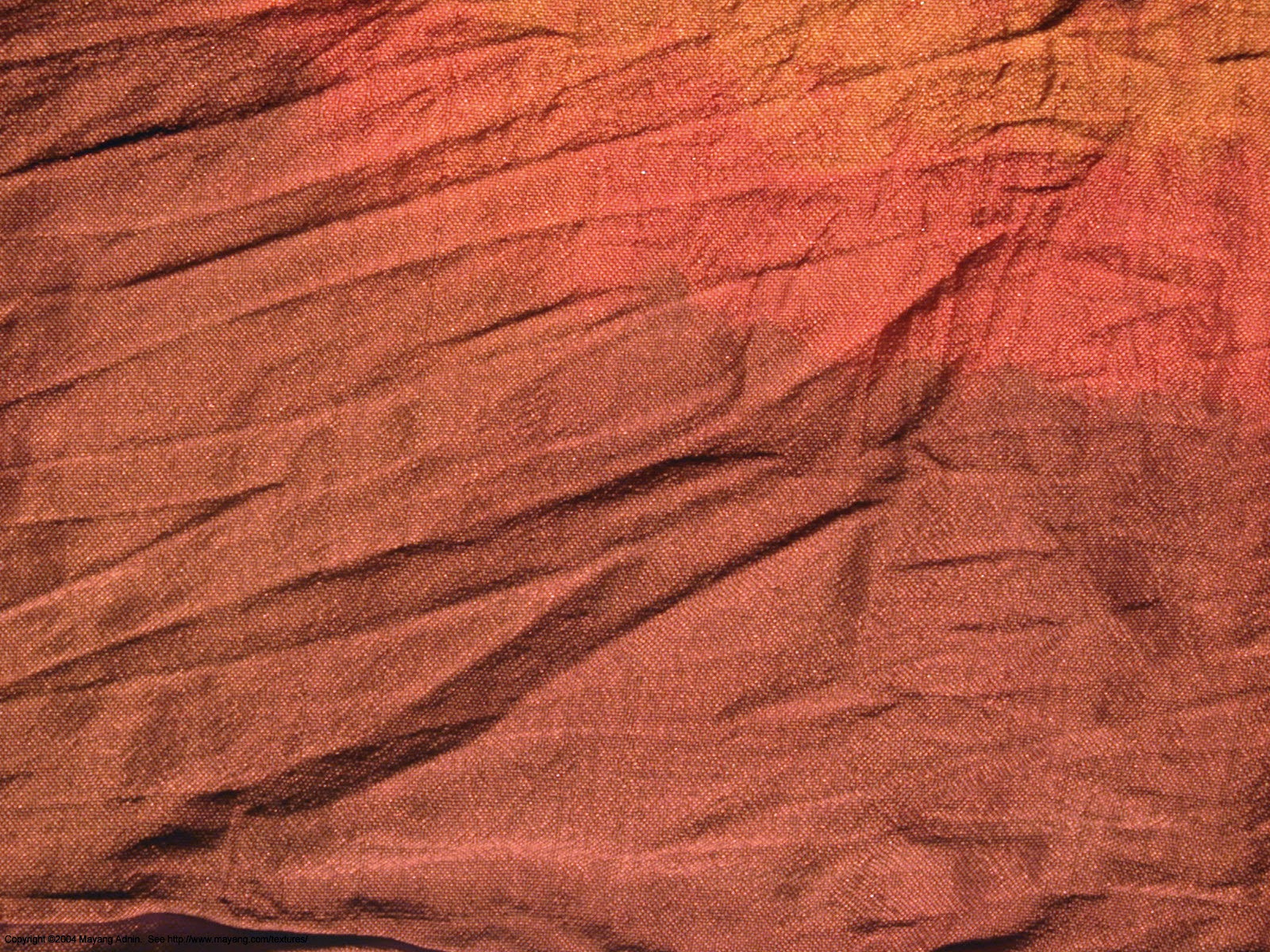
very small wave, from earlier meaning "stretch of shallow, rippling water", from verb to ripple. The official etymology says that this word is of unknown origin, perhaps a frequentative of rip (v.). Rippled surface is "toothed". We can see this clearly if we look at the picture of the rippled water or material. So I believe that the root of this word is also "ri" meaning toothed, choppy, serrated...The actual etymology is ri + po + le = cut, gouge + on, over + surface, particularly the horizontal and even more particularly water surface. 


rive - tear in pieces, strike asunder - c. 1200. 

riven - split, cloven, rent - c. 1300, past participle adjective from rive "to tear, rend." 
The official etymology says that this word comes from a Scandinavian source akin to Old Norse rifa "to tear apart" (compare Swedish rifva, Danish rive "scratch, tear"), from PIE root *rei- "to scratch, tear, cut" (see riparian). These words come from the same root "ri" meaning to cut, split with something pointy, toothed like a sharp stone, nail or a wedge. The actual etymology is ri + v = cut + into or ri + v + nj = cut + into + it.


rift - early 14c, a split, act of splitting. The official etymology says that this word comes from a Scandinavian source (compare Danish and Norwegian rift "a cleft," Old Icelandic ript (pronounced "rift") "breach;" related to Old Norse ripa "to break a contract" (see riven). If you look at the split material or a rift in the land you will see how much they resemble something that was gouged with something sharp tooth like like a plow or split with something toothed like a wedge. The actual etymology is ri + v + to = cut + into + that.


rivet - c. 1400. The official etymology says that this word comes from Old French rivet "nail, rivet," from Old French river "to clench, fix, fasten," possibly from Middle Dutch wriven "turn, grind," related to rive (v.). The English word may be directly from Middle Dutch. Again this comes from the shape of the old rivets, nails which were sharp toothed objects. The actual etymology is ri + v + to = cut, gouge, stick something like a tooth  + into + that (which is stuck into)


reef - rock ridge underwater. 1580s. The official etymology says that this word comes from riffe, probably via Dutch riffe, from a Scandinavian source such as Old Norse rif "ridge in the sea; reef in a sail". The most important characteristics of riffs is that they are sharp toothed rocks which can rip you and your boat to bits. So I believe that this word also comes from the root "ri" meaning to cut with a toothed point. The actual etymology is ri +  v = the toothed thing + in. Sharp rocks in water. 


Interestingly most of these words are said to have Scandinavian origin. 


So to conclude:

Serbian seems to have preserved the ancient root "ri" meaning to cut with something toothed, to gauge, chisel with something sharp and pointy like a tooth. Serbian has also preserved a large set of related derived words. 

How old are these Serbian words? I believe that they could be some of the oldest words preserved in European languages. The way the word cluster is built around the natural sounds related to showing teeth, biting, using teeth, suggests that this is the case. I believe that this word cluster is at least as old as Blagotin archaeological site, (7th millennium bc) and probably even older.

Irish has preserved the word "rinn", meaning a point; sharpness; climax, intensity; the top, tip of anything. Irish has also preserved a large set of words derived from the root "ri" meaning to cut with something toothed, to gauge, chisel with something sharp and pointy like a tooth. 

English also has many words based on the root "ri" which all seem to come from Scandinavian roots. 

The distribution of this word cluster suggest that this word cluster came to us from the ancient tribal languages of the I2a or maybe even older I haplogroup people..


How old are these words? I think that they could date to  Mesolithic or early Neolithic times.  I think that here we have a true linguistic fossil. What do you think?