Showing posts with label Lepenski vir culture. Show all posts

Sunday, 19 March 2023

Mother of grain

MOTHER Earth...The symbolic link between women and earth depicted on this Early Vinča Culture terracotta figurine from Jela, Iron Gate region of the Danube, Serbia, c. 5200 BC, H. 5.3 cm, which has a branching plant growing out of the womb...Pic from "The Body of Woman as Sacred Metaphor"...

It is interesting that this Neolithic Early Vinča culture depiction of the mother goddess was found in the same region where in Mesolithic we find Lepenski Vir culture, whose people made exactly the same image out of a bone...5000 years earlier...around 10,600 BC. It was found at Cuina Turcului, a rock shelter in the Iron Gates gorges on the Danube river, Romania.


The symbolic depiction of a mother earth as a woman is kind of easy to understand. They both give birth to things...

What is interesting is that Slavs who live in the area today, have preserved this symbolic depiction of the mother earth as a female...

Baba, the word which means Mother, Grandmother, Midwife...Birth Giver...The rock which gives birth to life...Which is why we have so many rocky mountain peaks in the Balkans named Baba. Like this one, "Baba's tooth" from Stara Planina (Old Mountain) You can find many more examples in my post "Baba, mountains and crags"...


That mountain alone has all these toponyms and hydronyms with Baba (mother, grandmother) in them...

But Slavs have also preserved something else: belief that female fertility and earth fertility, particularly agricultural fertility, and even more specifically grain fertility, are directly linked, and that one can affect the other...

Which is why we have Slavic agricultural rituals like these: In the past in Russia, after the last sheaf of grain was cut, women harvesters would lie down on the ground and roll around the field "to return the strength to the earth"...I talked about this in my post "Walking sheafs of wheat"...

Or why we have Slavic beliefs like this: A pregnant woman was forbidden to climb fruit trees or even touch them, because "the tree would dry out" (she would steal the tree's fertile energy for her own pregnancy)...I talked about this in my post "Planting tree when the child is born"... 

Or why bread oven is called "baba" (mother, grandmother, midwife, birth giver, mother earth)...I talked about this in my post "Baba, earthen bread oven"...

Now back to our mother earth figurines. The people from Lepenski vir who made that figurine depicting plants growing out of the womb of the mother earth, also made these: womb stones. Sculpture from the hearth of house No. 51, Lepenski Vir (9500–6000 BC, Serbia). It shows a vulva in a specific physiological state, just before giving birth, with all its anatomical details...Photo: From "Lepenski Vir" by Dragoslav Srejović 1972...
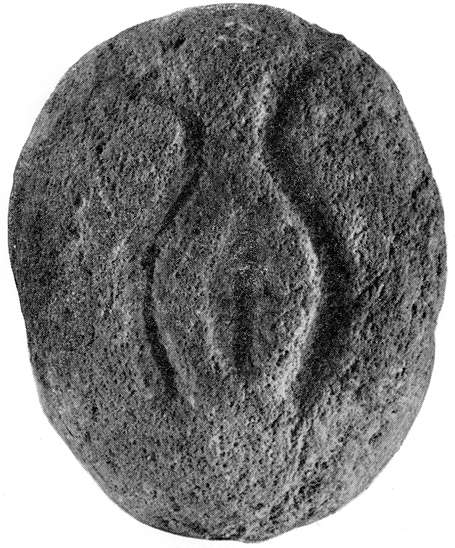
They also made very strange trapezoidal shaped houses dated to 6300-6000BC. 

They are all shaped like a flat top pyramid they could see from their settlement. Why? Because every summer solstice, the sun rose on top of it...I talked about this in my post "Sun on top of pyramid"...

Interestingly the only other example of a house like this was a Natufian culture "shrine", dated to 12,600-10,000 BC. I talked about this in my post "Natufian house"...

Natufians also made lots of stones like these...The pic is from this paper "The Natural Inspiration for Natufian Art: Cases from Wadi Hammeh 27, Jordan" which says that "They have sometimes been referred to as ‘shaft straighteners’ with the idea being that they were used to straighten bone or wooden shafts, perhaps when heated..."

"This function is unlikely, however, given direct observations of traditional artisans and experimental reconstructions of these objects’ use. Wooden spears or shafts are usually straightened by hand while being held over a fire..."

"Alternatively, the grooved stones were probably used to abrade softer materials such as Phragmites reeds, while drawing shafts back and forth through the cavity formed by binding two stones tied together with the grooves opposed..."


So we don't know what these stones were used for. That they were tools becomes doubtful (at least to me) when we know that they also made decorated, stones of the same type...The pic is from the same above article...


And this is why I don't think these were tools. The same type of objects, just made from clay, were found deposited in a sacrificial pit in the 7th mill BC early grain farming Starčevo culture Blagotin settlement in Serbia. I talked about this in my post "Blagotin"...

These were the guys who brought grain to Europe...The guys who built temple dedicated to grain. 

If we look at the clay objects from Blagotin, we can see that the groves made in them are too wide and shallow to be used for any kind of straightening of anything...

Which is why they were interpreted by Serbian archaeologists as "grain seed models", grain fertility idols...Now if you squint you will see that they don't just look like grain seeds. They also look like vulvas...Vulvas made of stone and clay, made of the body of mother earth...

Starčevo culture was ancestral culture of the Vinča culture...So we have come full circle...Hence plants growing out of the womb of the Vinča culture idol...But also out of the womb of the Lepenski Vir idol. Which predates Starčevo...

I recently came across this: A gynomorphic (woman like) figurine made of "soil mixed with chaff and grain seeds" from Grčac, Serbia. Proto-Starčevo culture, 6200-5500 BC. Direct symbolic link between earth, grain and female fertility. Basically, "Mother of Grain"...

Now that I think about it, the plant is most likely grain...These are symbols for grain from Mesopotamia and Central Asia...


This (widespread) belief that plants (especially grain) grow out of the womb of the mother earth was for the first time spelled out in Mesopotamia, where in "The Courtship of Inanna and Dumuzi" we find these verses:

"...Before my lord, Dumuzi,

I poured out plants from my womb.

I placed plants before him,

I poured out plants before him.

I placed grain before him,

I poured out grain before him,

I poured out grain before my womb..."

BTW, every year during the harvest, a man and a woman performed ritual sexual act on a threshing floor, imitating Inanna (earth, womb) and Enki (sweet water, seed) consummating their holy marriage. I talked about this in my post "Sacred marriage on the threshing floor"...


The result of which was grain grew out of Inanna's womb...

And so on and so forth...I will end this rambling article here. Got to go and make dinner...

PS: Forgot to say that Natufians were some of the first people to eat, gather and maybe even grow grain...I talked about this in my post "How grain came to Sumer"...


Sunday, 12 September 2021

Mesolithic sturgeon fishermen

Objects made of stone, dated to 6300 – 5990 BC and excavated in houses of the Mesolithic Lepenski vir culture, 9500-5500BC, Danube Iron Gates gorge, eastern Serbia. All have carvings on the surface. Lengths: 35-45cm. Classified as "stone sceptres". But are they?


The other day I came across the article "Big Fish Hunting: interpretation of stone clubs from Lepenski Vir" by Ivana Živaljević.

In this paper, the author proposes that these objects were in fact stone clubs or mallets, which may have been used in fishing as stunners. Not any fish fishing...Sturgeon fishing...


These giant fishes were, until very recently abundant in Danube river. They are migratory fishes, which spend most of their life in the Black and Azov sea, but migrate every spring into rivers to spawn...


And they are easily caught using fish traps. 19th c. sturgeon traps in the Danube Iron Gates gorge were described as follows: The narrow branches of the Danube are disrupted [by] double post structures made from timber, arranged in a V-shape, opening downstream...

Once the sturgeons enter, it is not their habit to turn downstream. As they proceed in the ever-narrowing funnel, they wind up in the 'death chamber' at the end...” All you need to do then is kill it and drag it out of the water...

Danube Iron Gates gorge is exactly where Mesolithic Lepenski vir settlement was located. We know that people from Lepenski vir were fishermen, judging by the huge number of fish bones found in the settlement, particularly sturgeon bones...

There is no evidence how Lepenski vir people caught sturgeons, but we can assume that they used fish traps used by fishermen world over to catch migratory fish, either in rivers or in tidal seas.


Ivana Živaljević proposes that once sturgeons were stranded inside the "death chamber" at the end of the trap, that they were basically clubbed to death using stone mallets...


If you are wondering why they didn't use spears to finish the fish off, these are armored fish with thick bony plates protecting their heads and their bodies...


So basically the easiest way to kill these monsters was to smash their skulls with clubs, mallets. Like the above "stone scpetres"? What do you think? Plausible? Would a longer wooden club been better for this? I don't know...

Ivana Živaljević says that "The massive and often ornamented stone clubs were initially interpreted as 'magic' and 'ritual' devices; however, it should be noted that the 'ritual' and 'profane' uses of an object need not exclude one another"...

There is one reason why Ivana Živaljević might be right in thinking that maybe these stone objects were both stone mallets used for killing giant sturgeons and sacred sceptres...

One other thing found in many Lepenski vir houses is this: a  statue carved out of a large river pebble (boulder). It is believed by many archaeologists that it depicts a human-fish hybrid...And not any fish. A human-sturgeon hybrid...


The row of bumps on the statue's back resemble sturgeon spinal scutes.

But also human spinal vertebrae...


The large downturned statue mouth resembles mouths of large sturgeons once caught in the Danube river. 


But also human mouths...Sad human mouths...


So it is possible that Lepenski vir people didn't see sturgeons as just "giant fishes"...According to one of the Serbian archaeologists "sculpted boulders from Lepenski Vir could represent metamorphosis of the deceased into fish"...

Who knows...But there is definitely something fishy going on here...

By the way, did you know that the migration of giant sturgeons up Danube river started every year "as soon as the the snow started melting, and water level started to rise, in late February, early March". In pisces...I talked about pisces as an animal calendar marker for the migration of continental European salmon (now extinct) in my post "Fishes"...

If you have found this interesting, you might find this post interesting too: Sun over pyramid, sun worship in the Lepenski Vir culture... 

Sunday, 13 October 2019

an ki = ankh

In the Lepenski Vir collection of the National museum in Belgrade are kept artefacts from the archaeological site of the same name. The objects date from 10th to 6th millennium BC. The collection consists of bone, horn and antler objects – needles, fishhooks, spatulas, and jewellery made of bones and shells, and artefacts made of chipped stone. Among the bone artefacts we find this:


I believe that this object as a symbolic representation of a pregnant woman. Mother and child. Creation of new life.

But the more we look at this object the more it looks familiar doesn't it? It looks like ankh, an ancient Egyptian hieroglyphic symbol that was most commonly used in writing and in Egyptian art to represent the word for "life" and, by extension, as a symbol of life itself.


Early examples of the ankh sign date to the First Dynasty (c. 30th to 29th century BC). There is little agreement on what physical object the sign originally represented. Most scholars believe the sign is a knot formed of a flexible material such as cloth or reeds or rope... The below stone ankh was actually made to resemble ankh made from reeds.


This ankh is made by bending one piece of reed into a loop, and then tying it to a handle created from  another piece of reed bent to form T shape. Like this:


Here is one I made today :)


So we know actually what first Ankhs looked like, I believe...But is there anything that this original Ankh represented? Anything physical?

Here is something very interesting. Ankh looks very much like the strange object seen on Mesopotamian reliefs, the so called "Rod and Ring" symbol.

The Rod and ring symbol is a symbol that is depicted on Mesopotamian stelae, cylinder seals and reliefs. It is held by a god or goddess and in most cases is being offered to a king who is standing, often making a sacrifice, or otherwise showing respect. The symbol dates from the Neo-Sumerian Empire (c. 22nd to 21st century BC) to the Neo-Assyrian Empire (c. 911 and 609 BC). 

The best known examples of the symbol are from Code of Hammurabi stela


It is commonly explained as "a coil of measuring string and a yardstick". 

This is what a coil of measuring string and a yardstick would look like separately and being held in a hand:


I talked in detail about this symbol in detail in my post "Etemenanki". In this post I explained why I believe that this symbol is the earliest incarnation of the "square and compasses" symbol. 

In my post "Square and compasses" I talked about thy symbolism of these two measuring tools. 


The ancient Hebrews saw the universe as a stone built structure with the stone flat Earth as the base and the stone Heavenly dome as the roof. Knowing this, the idea of God being the Great Architect starts making a lot of sense. Only a great architect could have built such a magnificent stone universe...

That architect would have used the Compasses to draw the top of the universe, the great stone semi circular dome of Heavens. 

He would also have used the Square to draw the bottom of the universe, the great stone flat earth. 


And this is exactly how the Compasses and Square are positioned in the Masonic symbol: the Compasses at the top, representing the Heavens, the Square at the bottom, representing the Earth. 

This is a doodle that got me into trouble when I was in primary school. Father and Mother in an act of creating life :)

Looks familiar? Well it should be. It is the above Square (Mother Earth) and Compasses (Father Sky) image again...

It seems that Hebrews inherited this world view from the Sumerians.

Sumerians believed that both sky and earth were built out of stone. And they did see the sky as Father God An and Earth as Mother Goddess Ki.


Ok but what about measuring rod and measuring line?

Well if you were a builder and you wanted to draw a straight line, you would use a measuring stick. But if you wanted to draw an arch or a circle, you would not use compasses. You would use measuring line. Like this:

You take the measuring line, tie it to the central pole and then walk around the pole. As you walk you mark a circle with the centre in the pole. This predates compasses. Also, you can't use compasses to draw large arches or circles. You have to use measuring line. 


I talked about this in my post "Boaz and Jachin". 

So the original symbol of a mason was indeed a measuring rod and measuring line.


There is actually Serbian saying "Pomoću štapa i kanapa" (Using stick and rope) meaning "in the old primitive way"...


These two tools are also the symbols of Heaven and Earth. The measuring line, used for drawing arches, is the symbol of the Sky. And the measuring rod, used for drawing straight lines, is the symbol of Earth. They represent Sky Father and Earth mother. Put together, they represent the power of Sky and Earth to create life. 

Sumerians actually believed that An (the sky) and Ki (the earth) mated together and produced basically everything there is including all life. Have a look at this drawing:


An (Sky, Father) and Ki (Earth, Mother) create life (AnKi, Ankh).

Held together in a hand, they look very much like the Ankh symbol. 


When this symbol meaning "life" reached Egypt, where An and Ki meant nothing, AnKi (SkyEarth = FatherMother = Life) became corrupted to Ankh. 

That would mean that Sumerians venerated An and Ki before the begging of the 3rd millennium, before the first Ankh appeared in Egypt...

We know they venerated An (sky) and built ziggurats for him in the 4th millennium BC. And that these ziggurats had a "mating" platform at their top... Were the ziggurats built to bring Mother Earth (Ki) closer to Father Sky (An) so that they can mate (AnKi) and produce life? I believe so. You can read more about this in my post "Etemenanki". 

The ankh was one of the few ancient Egyptian symbols that continued to be used after the Christianization of Egypt during the 4th and 5th centuries AD.

According to Socrates of Constantinople, when Christians were dismantling Alexandria's greatest temple, the Serapeum, in 391 AD, they noticed cross-like signs inscribed on the stone blocks. Pagans who were present said the sign meant "life to come", an indication that the sign Socrates referred to was the ankh; Christians claimed the sign was their own, indicating that they could easily regard the ankh as a crux ansata.

This is crux ansata:


The explanation that the Ankh symbol meant "life to come" is very interesting indeed as AnKi = FatherMother literally means "life to come"...

What does the intercourse between the Father Sky and Mother Earth produce? Life. Living nature including us humans...Life is materialised divine, (sky) god who became (earth) matter.  

What did the intercourse between God and Mary (basically symbolical replacement for Mother Earth) produce? Christ who is God who became Man. God materialised. So based on the above analogy, Christ is just a symbol. Symbol of life itself. 

If Christ is life, living nature, and we are part of life, living nature, then we are Christ. We truly live and move and have our being in Christ...

If Christ is life, living nature, god who became matter, then we are all god materialised. Just like the mystics the world over have been teaching for millennia.

This is Christ on the cross from "Plaque from the Maskell ivories", AD 420-30, Rome 


This is also crux ansata, Ankh, AnKi, life...

Interestingly in Central Europe we find a curious type of "anthropomorphic" cross, known in Serbia as "Narodni krst" (Folk cross), which looks very much like Ankh...Her is one of these Ankh crosses from Serbia:


Do they symbolises eternal life through Christ who is Life? In Christ (Life, Living nature) we are immortal...We die only to be reborn as another living thing in Christ (Life, Living nature)...