Showing posts with label irish. Show all posts

Thursday, 8 December 2016

Trom


In Serbian and Croatian we have adjective "trom" which means:

moving with difficulty
sluggish
slow

It is implied that the slowness and sluggishness comes from heaviness. The word has an opposite meaning to words meaning springiness, lightness of movement, lightness.

In Makedonian we have word "tromav" which means cumbersome, clumsu. 

This word is, as far as i am aware, found only in these South Slavic languages.

And in Celtic languages.

Irish "trom"

of great weight, of high specific gravity, of heavy texture, stodgy, hard to digest, dense, thick, abundant, of great force or intensity, laborious, burdensome, grievous, severe, harsh, tyrannous
unsparing, sultry, oppressive, weighty, profound, important (heavy), dull, tedious, laboured, drowsy, deep, slumberous, oppressed, sad

Old Irish "trom"

heavy (weight), heavy, severe, grievous, difficult, sad, sorrowful, great, vast, powerful, mighty

Scottish Gaelic "trom"

heavy, hard, difficult, weighty, serious, depressed, melancholy, addicted (heavily into something), pregnant (with child)

Manx "trome"

heavy, substantial, dense, difficult, emphatic, intense, pregnant

Welsh "trwm"

literally and figuratively heavy

Apparently all these Celtic words come from Proto Celtic root "trummos" meaning heavy. 

Where does the Serbian word comes from then? 

I personally believe that it is a borrowing from Celtic languages. But how come we find this word only in Celtic languages and in Serbian (Croatian)? When was this word borrowed into Serbian (Croatian) and where? 

Monday, 27 June 2016

Na

South Eastern dialect of Serbian has a peculiar grammatical construct. It uses "na" meaning "on" to express belonging, possession. This construct using the word "na" exists (as far as I know) also in neighboring Macedonian and some Bulgarian dialects, all centered around southern Carpathian or Balkan mountains.

South Serbian:

Q: Na koga je ovo kuče - on whom is this hound (whose hound is this)? 

A: To je kuče na Petar - this is the hound on Petar (of Peter)

Bulgarian:

A: Tova e kuče na Petar - this is the hound on Petar  (of Peter)

Macedonian:

A: Toa e kuče na Petar - this is the hound on Petar  (of Peter)

This construct defines possession through physical contact which is the oldest known form of possession. What belongs to me is on me, within my boundary, within what i can grab, hold, wear, carry, protect...

Fernand Cormon, Cain, Musée d’Orsay, Paris
What is interesting is that the Irish language has the same construct. On the page about Hiberno-English (English dialect spoken in Ireland which is hugely influenced by the Irish grammar and vocabulary) we read:

There are some language forms in Hiberno-English that stem from the fact that there is no verb "to have" in Irish. Instead, possession is indicated in Irish by using the preposition at, (in Irish, ag.). To be more precise, Irish uses a prepositional pronoun that combines ag "at" and mé "me" to create agam which basically means "at me, on me". This is then reflected in Hiberno-English, where the verb "to have" is used, interchangeably with phrases "with me" or "on me" that derive from "tá … agam". This gives rise to the frequent:

"Do you have the book?" – "I have it with me."
"Have you change for the bus on you?"
"He will not shut up if he has drink taken."

My favorite Irish Gaelic expression using this construct is "Tá áthas orm" meaning "I am happy, I have happiness" but literally meaning "There is happiness on me" :)

So what language did this construct originate in: Irish or these south Slavic dialects? Remember that the Irish language only has this constrict to express possession. And that this part of the Balkans was once "Celtic central" and is the area where we still find "Celtic" village crosses, like this one from Crna Trava:


And how old is this construct? Is it possible that this is a true linguistic fossil, which comes to us from the time before settled communities and static property? 

And does a similar construct exists in any other language? 

Well it seems that it does. In Finnish of all languages. Finnish doesn't have a separate verb for "to have". Instead it uses a different sentence construction, centered around the verb "olla", "to be". It's interesting to note that the "minulla on" literally means"on me there is". 

Very interesting, because it shows the age of this construct. 

Sunday, 6 March 2016

End

I have been passing by this traffic sign every day for years. I think it deserves a post in my blog. 


The Irish word "críoch" means "end, boundary, limit, aim, purpose, confines, territory, district, land". The word comes from Old Irish "crích" with the same meaning (compare Scottish Gaelic crìoch). Apparently it has no cognates in other Indoeuropean languages.

However :)

In Serbian the word "kraj" means "end, border, edge, brink, brim, fringe, side, rim, land, country, bank, near (the end, edge), beside (by the end, edge), despite (after the end of all that)"....

The word comes from the Proto-Slavic "krajь" and is found in all the other Slavic languages with the same meaning:

East Slavic:

Old East Slavic: краи ‎(krai)
Belarusian: край ‎(kraj)
Russian: край ‎(kraj)
Ukrainian: край ‎(kraj)

South Slavic:

Old Church Slavonic: краи ‎(krai)
Bulgarian: край ‎(kraj)
Macedonian: крај ‎(kraj)
Serbo-Croatian: kraj
Slovene: kràj

West Slavic:

Czech: kraj
Kashubian: krôj
Polish: kraj
Slovak: kraj
Slovincian: krɵ̯̏·i̯, kråj
Lower Sorbian: kraj, kšaj
Upper Sorbian: kraj

The cognate of the word "kraj" meaning "end" in the Slavic languages is the word "kraj, kroj" meaning to cut, to create end, to create edge...

Apparently, according to the official etymologies, these two words (the Irish "críoch" and Slavik "kraj"), which both have the same meaning, are not in any way related...

Interesting don't you think...

Sunday, 28 February 2016

Pride

I am watching the reports on the Irish elections. From constituency to another, the scene is always the same. The representative of the election comity reads the results announcing that someone was elected to the Dáil Éireann (House of Deputies, Parliament) . Then you hear cheering and then the camera swings towards the camp of the successful candidate. There you see a lot of happy people, shouting and laughing. And then two of them would lift the proud new member of the Parliament on their shoulders and carry him around.


What is the root of this custom? Well it is simple really. If you are proud of something, you flaunt it, carry it around, show it off by carrying it around on yourself, wearing it. A rare and expensive item of clothing or jewelry or a rare and expensive gadget thus become status symbols, which distinguish you from the crowd. This is the ultimate example of a something that you carry around to show off: an engagement ring. I got him, I won...


If you are a soldier, you proudly wear uniform of your army and insignia of your unit and the flag of your clan, tribe or country. You proudly carry a good and expensive sword which is not easy to get by and you carry the heads or scalps of the dead enemies that you have killed using that sword or a medal saying that you have killed many enemies (much more practical). And you get to be carried on your comrade's shoulders:


If you are a sportsman you carry a laurel wreath on your head that says you were victorious or a medal or a trophy in a shape of cup or plate. You proudly wrap yourself in the flag of your country and carry it around. And you get to be carried on your supporter's shoulders:


If you are proud of a person, you carry him around on your shoulder. This was a treatment which is reserved for heroes and champions. Having a hero or a champion as a member of your family, clan or tribe becomes a status symbol which makes the family, clan or tribe look good. And what do you do with a status symbol? You carry it around, show it off by carrying it around.

In Serbian and in other South Slavic languages, the word for "to carry, to wear" is "nos". The word "nositi" means "to carry, to wear", "prinos = pri + nos = towards, to us + brings" means yield, "odnos = od + nos = from + brings" means relationship and so on. There is a whole cluster of words built around the root "nos" meaning to carry. And believe or not one of those words is the word for pride: "ponos =  po + nos" which literally means "something you carry on yourself, something you flaunt, something you carry with you to show off"... 

So the people above lifted and carried their political candidate, champion, warrior on their shoulders (po nos), because they, by getting elected, winning championship, killing enemies, became something to be proud of and because of that, something that you can carry around with pride (ponos) because it makes you look good to because you are part of the winning team, army, family, clan, tribe....

Cool, don't you think?

Have a look at another Serbian word built using the root "nos" to carry.  The word "nošnja" means costume, traditional dress, something you carry on yourself to mark yourself as a member of a family, clan, tribe. The traditional dress conveys the customs, manners and style of the tribe. It says this is "us" and we are proud of who "we" are. The most visible part of the traditional dress was always the head dress. No wonder then that caps, hats, helmets, hairstyles, feather dress were often used as symbols of identity which were worn (nos) as sign of clan, tribe, national pride (ponos).

Here as some examples of what I am talking about:

Phrigian cap:


Turkish fes:


Serbian šajkača:


Six nations feather gear:


There are many more examples of traditional clothing items which were used as a distinguishing marks and were worn to show pride of being part of a group. This custom of wearing what you are proud of is very strong even today. 

Wearing a football jersey or scarf of the football team you support is just such an example of carrying (nos) of what you are proud of (ponos).


The same goes for the GAA (Gaelic athletic association). Here the link between belonging to the old tribal supporter group and the new sports team supporter group is clearly visible. The teams are actually linked to a village (clan) and county (tribe) and the players still play dressed in tribal colors wearing tribal crests while the old war flags of their tribes (counties) are waving in the wind. 


If you are a member of a church or a cult, you proudly wear the symbol of your church to show everyone that you are a believer:


If you are a member of a political party, you proudly wear the symbols of the party to show that you belong to it and that you share their ideas:


Even if you are a punk, and you think you are different from anyone else, you are basically proudly wearing punk symbols which show that you are a member of a punk subculture. You also wear badges and symbols of the Punk bands that you are most proud of...


So... 

We wear (carry on our self) what we are proud of. And this link is preserved in South Slavic languages through the words "nos" meaning "to carry, to wear" and "ponos" meaning "pride" but literally meaning "to carry, wear on yourself". 

Now what is interesting is that in Irish the word "nós", from old Irish "nós", means custom; manner, style, tradition, fame, renown...


Monday, 15 February 2016

Alps

The Alps (Italian: Alpi; French: Alpes; German: Alpen; Slovene: Alpe) are the highest and most extensive mountain range system that lies entirely in Europe, stretching approximately 1,200 kilometers (750 mi) across eight Alpine countries: Austria, France, Germany, Italy, Liechtenstein, Monaco, Switzerland and Slovenia. 


But these are not the only Alps in Europe. In The Balkans we find Dinaric mountains known also as Dinaric Alps. This mountain range stretches along the Eastern Adriatic coast across Albania, Serbia, Montenegro, Bosnia, Croatia and Slovenia. The highest peaks of the whole range are in the southern end which lies in Montenegro, Serbia and Albania. 


The English word alps comes from the Latin alpes which comes from Latin albus ‎meaning white. Latin albus, is said to come from Proto-Italic *alβos meaning white.

The official etymology says that we don't really know where the original word comes from.

Basically we have two theories.

First theory proposes a Proto-Indo-European root for the word Alps. It says that the Proto-Italic *alβos is derived from Proto-Indo-European *h₂élbʰos, *álbʰos, *albʰós ‎meaning white. Cognates include Umbrian ‎alfu meaning white, Ancient Greek ἀλφός ‎(alphós) meaning whiteness, white leprosy and Hittite alpas meaning cloud.

Second theory proposes non-Indo-European origin. According to the English Etymological Dictionary, the Latin Alpes might possibly derive from a pre-Indo-European word *alb "hill, mountain". This theory then proceeds to propose that this supposed  pre-Indo-European word is the root of many Albania mountain areas: Balkan Albania, Caucasus Albania and Scottish Albania (Alban). 

I would like to propose another theory: The word Alps comes from Gaelic and means "white stones, white cliffs, white peaks".

The first clue that the word Alps could be of a Gaelic (Celtic) origin can be found in a comment made by Maurus Servius Honoratus, a late fourth-century and early fifth-century grammarian, who in his time had a reputation of being the most learned man of his generation in Italy. He said in his commentary on Virgil (A. X 13) that: "all high mountains are called Alpes by Celts".

The second clue is the fact that in Latin the word "albus" is used primarily to mean "white" that is dull or matte which would mean more grayish white than bright shining white.

The third clue is the fact that in Ancient Greek the word ἀλφός ‎(alphós) means whiteness, white leprosy, lichen white, again grayish white, not bright shining white.


The fourth clue is that the German word Alp or Alm (meaning "seasonal high mountain pasture", from Old High German alpa, alba) was originally identical to the name of the Alps (German Alpen) itself.

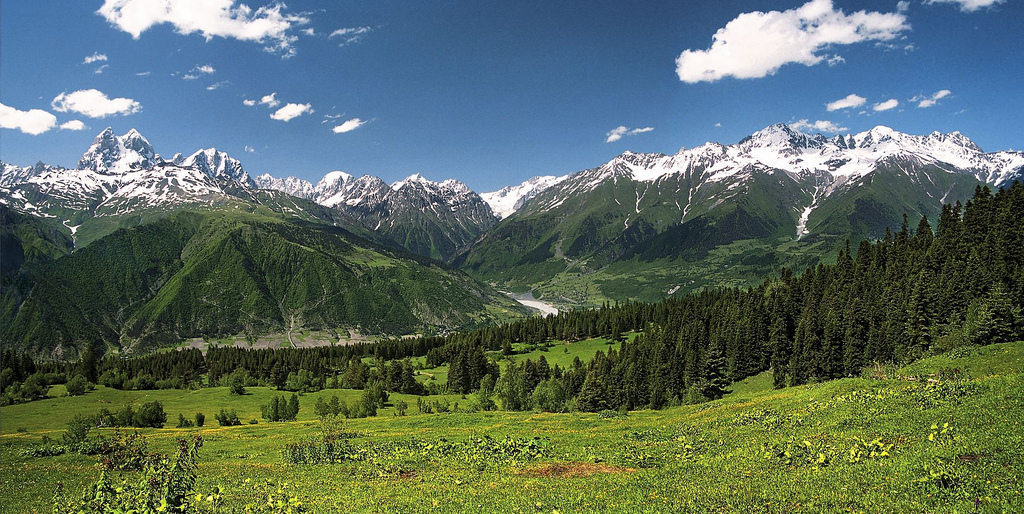
Have a look at these two pictures.

Alps (grayish white rocks towering over green high mountain pastures)


Dinaric mountains (Alps) (grayish white rocks towering over green high mountain pastures)


So what does this have to do with Gaelic?

In Gaelic we have this cluster based on the root word ail - stone, rock:

aill, -e, pl. id., and ailltreacha (Aran), f., a cliff, a rock; cf., an Áill, the "Naul" Co. Dublin (also faill, f., bárr na faille, the top of the cliff).
ailleort - high-rocked; from ail, rock
aill-bhruachach - having steep or rocky brinks. 
ailleadóir- cliff-climber.
ailbhinn - flint, precipice; from ail - rock.

From the same root ail - large stone, rock we have this word:


ailp, pl. alpa - a protuberance, a huge lump, a high mountain; a stout person

In Gaelic we also have this word:

bán - white which comes from Proto-Indo-European "bʰeh₂-" meaning - "white", "shining"

From these two words ail and bán we can make the construct: 

ail bán - alban - rock white - white rocks, white peaks, high mountains

What is also very interesting is that in Irish  the word "ailbh" means "flock, heard, drove".... Is this word derived from the fact that flocks, herds were driven up to the mountain pastures, ailban, alpen, alps, every summer? This is a high mountain pasture from Slovenian Alps.


In A.D. 875 Scotland was still known under its Roman name: Caledonia. Caledonia was in turn divided among the following lands: the Kingdom of Alban, the Northern Islands, and the Borders, which include the Kingdom of Strathclyde, Galloway, and the northern portions of the Kingdom of Northumbria. 


The kingdom of Alban lied mostly along the great Grampian Mountains. These are highland pastures lying under the great Grampian Mountains:


This is a picture of the highland pastures under the Matterhorn peak, Valais Alps, Switzerland.


Do you see any similarity? High pastures with grayish white rocky peaks?

Alba is the Scottish Gaelic name (Pronounced Alpa) for Scotland. It is cognate to Alba (gen. Albann, dat. Albainn) in Irish and Nalbin in Manx, the two other Goidelic Insular Celtic languages, as well as words in the Brythonic Insular Celtic languages of Cornish (Alban) and Welsh (Yr Alban) that also, in modern practice, are the Goidelic and Brythonic names for Scotland; although in the past they were names for Britain as a whole, related to the Brythonic name Albion. The term first appears in classical texts as Ἀλβίων Albíon or Ἀλουΐων Alouíon (in Ptolemy's writings in Greek), later as Albion in Latin documents. Historically, the term refers to Britain as a whole. Is this name derived from the appearance of the white cliff of Dover, which is the first thing anyone crossing the Channel and approaching Britain would see? So when Gaels first approached Britain, and they was the white cliffs, they would have probably named the land they were about to land on "ail bán" = white cliff land. And if later a Greek traveller crossing into britain asked the Gaelic speaking natives what was the name of this new land (pointing at the white cliffs), they would probably tell him "ail bán" = white cliff? And hey presto, we have a name for this new land of white cliffs...(Thank you Tim for pointing this to me)


Gaelic speakers in Scotland used Alba (dative Albainn, genitive Albann, now obsolete) as the name given to the former kingdom of the Picts which lied along the Great Grampian Mountains, which is full of white greyish white rocky peaks covered in snow. Did the name originally just mean "white peaks", "the land of white peaks"? Not too many of those in Ireland, so it must have been some sight for the invading Gaels. So a fitting name for the new foreign land...

In the High Medieval period Alban became re-Latinized as "Albania". This latter word was employed mainly by Celto-Latin writers, and most famously by Geoffrey of Monmouth. It was this word which passed into Middle English as Albany, although very rarely was this used for the Kingdom of Scotland, but rather for the notional Duchy of Albany.
So is Gaelic ail bán - Alban - rock white - white rocks the root of the word Alpen, Alp? What is the relationship of this phrase and the Latin albus, Ancient Greek ἀλφός ‎(alphós) and Hittite alpas? Are they related at all? Is the Gaelic phrase the root of all these other words? Or is all this just a coincidence?

Is it possible that by the early Iron Age, the expression "ail bán", or some of the dialectal versions of this expression, entered Ancient Greek and Latin from Gaelic, or some other dialect of Celtic languages, in the meaning of white cliffs, white rocks, white peaks? And is it possible that this is why Greeks and Romans named the region lying along the Greater Caucaus - Albania?

Caucasian Albania (Latin: Albānia, Greek: Ἀλβανία, Albanía, in Old Armenian: Աղուանք Ałuankʿ (Aguank), Parthian: Ardhan, Middle Persian: Arran; Georgian: რანი, Rani); is a name for the historical region of the eastern Caucasus, that existed on the territory of present-day republic of Azerbaijan (where both of its capitals were located) and partially southern Dagestan. The territory lies on the southern part of the Greater Caucasus range.


Caucasian mountains (grayish white rocks towering over green high mountain pastures)


-ia is a word-forming element in names of countries, diseases, flowers, from Latin and Greek -ia, which forms abstract nouns of feminine gender. In paraphernalia, Mammalia, etc. it represents the Latin and Greek plural suffix of nouns in -ium or -ion. 

So Albania is Alban + ia = ail + ban + ia = the land, country of white clifs, white peaks = Greater Caucasus

And it is the same with the Balkan Albania, which only appeared in records in Early Medieval time. The highest peaks of the Dinaric range are found in its southern part which lies in Montenegro, Serbia and Albania. Viewed from the coast, you see giant rocky peaks covered with snow looming over green pastures. So was Albania used here just as a name for the land of white cliffs, white peaks?


Let me know what you think about all this. 


Saturday, 13 February 2016

Lasta


If you have ever looked up during the summer months, you probably would have seen swallows zooming around chasing insects. This is a great video showing swallows in flight. 

Swallows flying

Swallows are a group of birds in the family Hirundinidae that are characterized by their adaptation to aerial feeding. They generally forage for prey that is flying, but they will on occasion snap prey off branches or on the ground. The flight may be fast and involve a rapid succession of turns and banks when actively chasing fast moving prey; less agile prey may be caught with a slower more leisurely flight that includes flying in circles and bursts of flapping mixed with gliding. Swallows have evolved these highly acrobatic flying skills to capture some of nature’s most elusive prey: flies. According to the scientists who studied their flying abilities, "swallows are the absolute extreme when it comes to flight performance. They're at the cutting edge for what can happen with an avian body plan in terms of flight."

So if you had to use one word to describe swallows in a way to distinguish them instantly from all the other birds, that word would probably be "fast".

Now here is a funny thing. 

In Serbian the word for swallow is "lasta" and "lastavica". Official etymology says that this word comes from Proto-Slavic *lasta. Cognates include:  Church Slavonic: ластунъ, ластуна, ластовица, Russian: ла́стка, ла́стовка, ла́стушка, ла́стица, Ukrainian: ластови́ця, ла́стiвка, Bulgarian: ла́стовица, ла́ставица, Slovenian: lástovica, lástovka, Czech: lаštоviсе, Slovakian: lastovička, Polish: łastówka, łastawka, Lusatian Serbian: łаstоjса, Polabian: lostövéica.

The meaning of the Proto-Slavic *lasta is not given. 

In Irish, one of the lesser known meanings of the word "lasta" is "to move at high speed"...

So... Is this the root of all the Slavic words for swallow, "the bird that moves at high speed"? Or did this (obscure) word in Irish meaning "moving at high speed" come from Slavic word for swallow?

One more interesting thing. In many Slavic languages, including Serbian, there are two words for swallow: "lasta" and "lastavica". Lasta means fast. But where does the "vic" (pronounced vits) comes from. Well it could be a diminutive. But there is also another possibility. 

These are three videos in which you can clearly hear the sounds swallows make. It sounds like: 

vicviccvicvic....

Sound of swallows 1
Sound of swallows 2
Sound of swallows 3

So lastavica is lasta (fast moving bird) which says "vic"...

Interesting don't you think? And the most interesting is the question: where and when did this borrowing occur? Considering that the word lasta is present in all the Slavic languages, the borrowing, if the word was borrowed from Gaelic to Slavic languages, had to occur during the Iron or Bronze Age. But where? Central Europe? Balkans? And if the word was borrowed from Slavic languages into Gaelic, when and where did this happen? 

Lots to think about :)

Friday, 20 November 2015

From knee to knee


In this post I would like to talk about the word "knee" and the special meaning that this word has in Serbian and Irish language and culture. 

The word knee has these meanings in English:

1, The joint or the region of the joint in the middle part of the leg between the thigh and the shank.
2. A piece of timber or metal formed with an angle somewhat in the shape of the human knee when bent. Any knee-shaped item or sharp angle in a line, "the knee of a graph", an inflection point.

The etymology of the word knee says that the word knee comes from Middle English kne, from Old English cnēo, from Proto-Germanic *knewą, from Proto-Indo-European *ǵnéwo-, a thematic derivative of Proto-Indo-European *ǵónu. Compare Hittite genu, Latin genū, Tocharian A kanweṃ (dual), Tocharian B kenī, Ancient Greek gónu, (knee), gōnía (corner, angle), Old Armenian cunr, Avestan žnum, Sanskrit jānu.

It seems that all Indoeuropean languages have words for knee which come from the root "kn, gn". Well all except Slavic and Celtic languages where the words for knee come from the root "kln, gln".

In Celtic languages the words for knee are:

Old Irish: glún
Irish: glúin
Scottish Gaelic: glùin
Breton: glin
Welsh: glin

In Slavic languages the words for knee are:

Old East Slavic: колѣно ‎(kolěno)
Belarusian: кале́на ‎(kaljéna)
Russian: коле́но ‎(koléno)
Ukrainian: колі́но ‎(kolíno)
Old Church Slavonic: колѣно ‎(kolěno)
Bulgarian: коля́но ‎(koljáno)
Macedonian: колено ‎(koleno)
Serbo-Croatian: koljeno, koleno, kaljen, kalino, kolino, golino
Slovene: koléno
Czech: koleno
Polish: kolano
Slovak: koleno
Slovincian: kʉ̀ɵ̯lanɵ
Lower Sorbian: kóleno
Upper Sorbian: koleno

A possible cognates are also:

Lithuanian: kelys, kelénys =  knee
Latvian: celys = knee

But it is not just the root of the Celtic and Slavic words for knee that is the same. In Gaelic and South Slavic languages the word knee has additional meanings appart from the "joint in the middle part of the leg" and "something bent in a shape of a knee". These meanings are:

Serbian (koleno, koljeno, kaljen, kalino, kolino, golino): generation, step in descent, offspring, family, clan, race, house

Gaelic (glúin): generation, step in descent, step in pedigree

Serbian: Tri kolena = Three generations
Irish: Trí ghlúin daoine = Three generations of people

Serbian: Markovo prvo koleno = The first descendant(s) of Marc
Irish: An chéad ghlúin ó Marc = The first descendant(s) of Marc

Serbian: Oni su braća u trećem kolenu = they are related in the third degree; they are second cousins.
Irish: Is iad an treas glúin iad = they are related in the third degree; they are second cousins.

Serbian:

poklon - bending, bowing, gifting, gift
klanjati se - bend, bow, prostrate, kneel in front of someone
klečati - kneel
pokoljenje = Po + koljeno = generation 
oni su iz istog kolena = They are from the same klan
on je od odlična koljena = He is from a great stock, clan
nakolenče - baby boy which is placed on the brides knees (lap) during the wedding ceremony to ensure that the first child is a boy.

Irish:

bean ghlúine = woman knee = midwife


Again we see strange similarity between the Slavic and Celtic languages and cultures.

What is very interesting about the above meanings of the word for knee in Celtic and Slavic languges is that this can shed a new light on the etymology of the Irish word "clann".

Serbian: Oni su iz istog "kolena" = They are from the same "clan"

The Irish word "clann" meaning children, family, offspring, followers, plant comes from Middle Irish: clann, Old Irish clann (alternative form cland). The official etymology says that this is a borrowing from Old Welsh plant, from Latin planta meaning plant, shoot, twig, sprout.

This is all great except that we need to explain how the Slavic word koleno with its meanings fit into all this. Is it possible that the Irish words "clan" (children, family, offspring, followers) and "glúin" (generation, step in descent, step in pedigree) and the Serbian word "koleno, koljeno, koleno, kaljen, kalino, kolino, golino" (generation, step in descent, offspring, family, clan, race, house) all come from the same root "kln, gln" meaning knee? In this case "clan" would be just a specialisation of the word "glúin". We can see that in Serbian we have both koleno and golino, so it is possible that the Irish also retained both "k" and "g" variant of this word.

In Serbian we also have these words: član, čljan, člin, člen, čljen, šljen, Sijan, Síjén, cjen, iklân, ikljen. These are all dialectic versions of the same word  which means "member, part, generation" and are directly linked to the notion of group, family, clan. They all also come from the same "kln" root as "koleno" (knee, bend, generation, step in descent, offspring, family, clan, race, house).

What is interesting is that this link between the knee and the generation, step in descent, offspring, family, clan, race, house can also be found in Sanskrit, Ancient Greek and Latin:

Sanskrit: jānu = knee and janas = race, class of beings
Ancient Greek: γόνυ =  knee and γένος = offspring, descendant, family, clan, nation, race, gender, any type or class
Latin: genu = knee and genus = birth, origin, kind, type, class, species (of animal or plant), race (of people), set, group (with common attributes)

I was just made aware that the same link exists in Basque, Finish and Saami languages too:

Basque: In Basque the word for generation (belaunaldi) is also formed with "knee" (belaun). It can be used directly with "belaun", too, as in "belaunez belaun" (from generation to generation)

Saami: The word for knee and generation is also the same in all Saami languages, cf. the phrase "Aerpien maahtoe boelveste boelvide" (ancestral knowledge from knee to knee/ from one generation to the next) in South Saami.


Finish: The semantics of 'generation' and 'knee' are also connected in Finnish (related to Saami). The word for generation, 'sukupolvi,' is suku (family) + polvi (knee), and the word for 'to descend from (genealogically)' is 'polveutua,' a verbalised form of the nominal 'polvi.' The verb is strictly used for genealogical descent, not physical descent of any kind.

Oh and then there is this


But this link only becomes visible through Slavic and Celtic words for knee and their meaning.

But where does this link between the knee and generation, step in descent, offspring, family, clan, race, house comes from? 

The English word genuine comes from Latin genuinus ‎(“innate, native, natural”), from gignere, from Old Latin genere ‎(“to beget, produce”), from genus meaning birth, origin, kind, type, class, species (of animal or plant), race (of people), set, group (with common attributes). The related word is gens which means Roman clan, related by birth or marriage and sharing a common name, tribe; people, family. 

The English etymological dictionary says something interesting though about the etymology of the word genus. It says that there is a possibility that the etymology of this word could come "from Latin genu "knee," from a supposed ancient custom of a father acknowledging paternity of a newborn by placing it on his knee."

So is this where the link between the knee and the offspring, the next generation, family, clan, race, house comes from? In Irish the word clann doesn't mean any children. It means paternally acknowledged, legitimate children. Was this custom of acknowledging that the child is yours by placing it on your knee once widespread among the Indoeuropeans? I believe so. During the tribal expansions and wars a lot of men died. This left a surplus of "available" women both from the victorious tribe and from the subdued tribes. Judging by the current paternal genetic map of Evroasia, the victorious warriors used this situation to their advantage, having sex with as many of these women as they could. This was done partially out of lust, but mostly as way of claiming the dead warriors' property. The one who lay with a women laid a claim to her and her property. The final seal of ownership was stamped by the acknowledgement of the children produced from such unions. And that acknowledgement was done by father placing (laying) the child on his knees.  

My offspring, my next generation, family, clan, race, my "koleno", "glún", "clan", "gens" are the the children that sat on my knees. I acknowledge them and I give them my name. And I take their property as mine too.

Another clue why there is a link between the knee and generation, step in descent, offspring, family, clan, race, house can be found in Serbian saying that the knowledge and tradition are passed "sa kolena na koleno". This literally means "from knee to knee" but it also means from one generation to the next generation, from grandparents and parents to their grandchildren and children. 

One of my favorite childhood memories involve sitting on my parent's or my grandparent's knees and listening to their stories. My mother, a primary school teacher, told me fairy tales and taught me how to read using old battered "Bukvar" (Alphabet primer). My father, technical education teacher, told me stories about strange animals and strange faraway lands and taught me how things are made and how they work. My maternal grandmother, who was a housewife, told me stories about saints and taught me how to say prayers and curses and how to cook jams and preserves. My maternal grandfather, who was a baker, told me stories about the war and taught me how to make bread and cakes and play card games poker and tablić. My paternal grandmother, who was a housewife, told me stories about vampires and karakondžulas and other mythical creatures and taught me everything there is to know about farm animals, how to make cheese and how to feed silkworms. My paternal grandfather told me stories about the wild animals and birds and plants and taught me how to recognize animal tracks, how to make animal traps and how to hunt using a hunting rifle,  how to use farm tools and how to make brandy and wine. 

This is the way the knowledge and tradition was passed in the past. And this is how the family bond was built and preserved. 

After all these years, the stories that I heard while sitting on my parents' and my grandparents' knees are still as fresh and as clear as if I heard them yesterday. And the things that I learned from them as a child I still remember today. And when my son was born, I held him on my knees and I told him some of the old stories that were passed down to me through time "from knee to knee". And I added few new ones of my own. I hope one day he will have children of his own and will sit them on his knees and tell them some of the stories that he heard from me, and a lot of nice stories of his own...