Showing posts with label Metallurgy. Show all posts

Tuesday, 22 March 2016

Development of Montenegrian tumuluses

The development of Copper Age tumulus in the territory of Montenegro went through several stages.

The initial phase is represented by the central pit grave within the first mound of the Gruda Boljevića tumulus. This initial burial was dated to the beginning of the fourth millennium BC. Culturally it belongs to the southwestern branch of the Yamnaya culture, characterized by pit grave burials.

The next phase in the Copper Age tumulus development are represented by Velika Gruda and Mala Gruda tumuluses, which was dated to the period between the 3000 and 2800 BC. Mala and Velika Gruda tumuluses also have central pit burial. But this time the body was not placed directly into the pit. First a shallow grave pit was dug into the earth to the depth of half a meter. Then a stone cist was built inside the pit. First the bottom of the grave pit was covered with a stone plate and then the vertical stone plates were placed on top of it to form the dolmen cist. The body was placed inside the stone cist and then the cover stone plate was placed on top of it. The stone dolmen cist which was sticking out of the pit was then covered with a tumulus pile.


The final phase in the Copper Age tumulus development is represented by the Mogila na Rake and Bjelopavlići tumuluses. These two tumuluses were dated to the period between 2700 and 2400 BC. These two tumuluses also have a central burial withing a stone cist. But this time this stone cist is free standing on the surface of the earth. There is no trace of a burial pit any more. I don't have detailed description of the Bjelopavlići tumulus but I do for the Mogila na Rake tumulus. The stone cist was built on a base which was round in shape, and made of medium and small pieces of limestone (0.5 to 0.20 m) mixed with red-brown earth. The cist was built on this layer using local stones. The sides were  constructed from massive trapezoidal shape stone plates (1.40 × 1.00 m, about 20 cm thick), which were bonded with yellow waterproof clay.  The body was placed inside the cist, and the cist was then covered with two massive rectangle shaped plates (1m x 1.20m and 1.80 × 1 m; 20 cm thick). After the cist was covered the dolmen cist was then covered with a tumulus pile.


The Late Copper age Montenegrian tumuluses have several common elements:

1. a central position of the burial within a large multi layered tumulus with stone curb
2. a cross in circle symbol inscribed either on a golden disc which topped the axe shaft hole or on ceramic vesel, which was interpreted as thurible and which was part of a special funerary ceramic set.
3. placing of food vessels inside the burial

These common elements show clear cultural continuity.

But at the same time the actual burial underwent a significant change:

1. a burial inside a pit with or without a cist dug into the ground
2. a burial inside a cist sticking out of a pit which was dug into the ground
3. a burial inside a free standing cist built on the surface of the ground.

This shows clear cultural development.

So by 2500 BC in Montenegro we find massive stone burial dolmen like cists which were placed on the surface of the ground and then covered by multi layered earth tumuluses with stone curbs.


In my previous posts about Montenegrian tumuluses, I already discussed the possibility that the Irish Annals contain records describing the arrival in the mid 3rd millennium BC, of the first metallurgists to Ireland from Montenegro. The finding of golden cross discs in both Montenegro (early 3rd millennium BC) and then in Ireland (late 3rd millennium BC), and the latest genetic data (which I will discuss in one of my future posts) seem to confirm this. 

So there is definite observable cultural influence brought to Ireland by immigrants from Montenegro in the mid 3rd millennium BC. 

But was there, at the beginning of the 3rd millennium, a previous cultural influence brought to Montenegro by people who emigrated from Ireland? 

Is it possible that the cultural process of "raising" of burial cists from the ground, which happened in Montenegro in the first half of the 3rd millennium BC was influenced by these Irish immigrants? Or did the Montenegrian immigrants arrive to Ireland in several waves, the first wave arriving before 2800 BC and the second wave arriving around 2500 BC?

I will talk more about this in my next post. 

Tuesday, 29 December 2015

Baba - Hammer and anvil

These are hammer and anvil, the two tools which are today most associated with smiths and metalwork.


An anvil is a block with a hard surface on which another object is struck. The block is as massive as is practical, because the higher the inertia of the anvil, the more efficiently it causes the energy of the striking tool to be transferred to the work piece. On a quality anvil the smith's hammer should rebound with almost as much energy as the smith put into the downward stroke, making the smith's job easier. In most cases the anvil is used as a forging tool. Before the advent of modern welding technology, it was a primary tool of metal workers. The great majority of modern anvils are made of cast or forged steel that has been heat treated. Inexpensive anvils have been made of cast iron and low quality steel, but are considered unsuitable for serious use as they deform and lack rebound when struck. But the original anvils were first made of stone as a lithic stone tool, then bronze, and later wrought iron.

A hammer is a tool that delivers a blow (a sudden impact) to an object. Most hammers are hand tools used to drive nails, fit parts, forge metal, and break apart objects. Hammers vary in shape, size, and structure, depending on their purposes.The usual main parts of  a hammer are a head (most often made of steel) and a handle (also called a helve or haft) made of wood or steel.


Hammer and anvil are among the simplest tools imaginable. Because of that they are among the oldest tools used by proto humans and humans. Originally both hammer and anvil were made from stone. As a matter of fact they were just two stones. A roundish stone big enough to fit into a hand (hammer), and a flat heavy stone (anvil). You would then place what ever you wanted to strike with your hammer stone on the anvil stone and you would then hit it with the hammer stone really hard...

Hammer and anvil are such primitive tools that even some animals use them for breaking open nuts and shells. Chimpanzees, orangutans, gorillas, capuchin monkeys crack open nuts by using rocks as both hammer and anvil.


Sea otters use stones to crack open shells. They place a flat stone on their chests and use it as an anvil. They then smash the shell against it.


When people started using hammer and anvil they basically did exactly what the chimpanzees, orangutans, gorillas, capuchin monkeys did. They took a big flat stone (anvil), like this one from Paleolithic site Üçağızlı Cave , Turkey


placed what ever they wanted cracked, smashed, pulverized on it, and then banged that thing with another stone (hammerstone) like this one from Wangfujing Paleolithic Site, Beijing, China.


And people still do that today. I did so many times when I was a kid when I wanted to crack open nuts. Here is a picture of a Berber woman cracking open argan nuts:


The same tools were used for cracking open bones to get the bone marow.


Hammerstones and anvils were not only used for cracking open nuts and bones. They were also used for pounding various materials into a pulp, like nut kernels, acorns, tubers and finally grains. This is a picture an Australian aboriginal woman using hammerstone and anvil to pulverize tubers:


Hammerstone and anvil were used to crack and pulverize acorns and turn them into acorn meal, except that these hammerstones (pestle) and anvil (mortar) had to be slightly different from ordinary hammerstone and anvil. Because we don't want the pulverized bits to go everywhere, hollowed anvils were used instead of flat ones. Because of the hollow in the anvil, the hammerstone had to be elongated not round, in order to reach the bottom of the anvil hollow.  I wrote about this in my article entitled "Eating acorns".


As I said eventually these new types of hammerstones and anvils were used for pounding and grinding grains:


Another use of hamerstones and anvils was for making stone tools. The simplest way to create a sharp edge comes from bipolar flaking. All you need is an anvil (large base stone), hammer stone, and a smaller rock (chicken egg size) to crack like you would a nut. Place the egg sized stone upright (pole to pole, hence the term bipolar) on the anvil and strike it with your hammer stone. This crude technique takes little skill and provides sharp tools like scrapers, sharp flakes, and small stone drill points. You could make and use these simple tools even with no flint knapping knowledge.


Even precision flint knapping work is done on a stone anvil. This picture shows rough shaping of a flake into an arrow head using a stone anvil and antler hammer:


Hammerstones eventually evolved into hafted hammerstones. Stones attached to sticks with strips of leather or animal sinew were being used as hammers with handles by about 30,000 BCE during the middle of the Paleolithic. This is one of these "advanced" hafted hammers with a handle mostly used for cracking human and animal heads...


Some primitive people still use these types of hafted hammerstones and stone anvils today. This is a kautaq, an Inuit hammer used to crush the bones which is made of an oblong stone mounted on a short slightly curved handle.


Hammerstone (hammerhead) design eventually, during neolithic, changed to resemble today's hammers:


Since then hammer design barely changed. All that changed was the material from which the hammer head was made. With the invention of metallurgy, hammer heads started to be made from first arsenic copper, then bronze and eventually iron and steel.

These are hammers which were used by the Urnfield Culture metalworkers during the late bronze age.


Finally people settled on the lower type, and since then hammers have been looking pretty much like this:


During all this time, while hammers were evolving into first hafted stone head tools and then hafted metal head tools, anvils still stayed just flat slabs of stone. Anything that needed to be cracked open, smashed, pulverized, chipped, ground could still be effectively done on a flat slab of stone.

Even the emergence of metallurgy didn't change the situation.

The first metal workers used pure native metals such as gold, silver, copper and perhaps some small amounts of iron. These were worked with bone and stone tools, stone hammers and stone anvils. These stone anvils were often natural but may have been worked stones as well.

At the beginning of the metal smelting age stone anvils would have continued to be used until the metal was affordable. The oldest known bronze age anvil was discovered at Pyrgos (also Myrtos-Pyrgos), an archaeological site of the Minoan civilization near Myrtos in the municipality of Ierapetra on the south coast of Crete. The settlement was inhabited around 2500 BC. In the east part of the settlement a copper (bronze) smith workshop was found. The workshop had a mud oven-forge, built from large slabs of calcarenite, and two stone anvils made of andesite.

This is one of the two (30kg) stone anvils, which could be considered the prototype of modern metalwork anvils. The anvil has a cutting on its “table” to shape blades.


This is a depiction of a bronze metalworker from the fifth dynasty tomb from Giza, Egypt dated to the second half of the 3rd millennium BC. We can see a metalworker hammering a bronze plate using a hammerstone and stone anvil mounted on a wooden block.


Bronze During the Bronze Age forging (a process involving the shaping of metal using localized compressive forces made by blows delivered with a hammer) was largely drawing of edges and decoration of cast items. Small stone anvils were originally used.

This is an early Bronze Age anvil stone found in Ribble Valley, Lancashire . It is incredibly heavy for its size (probably hematite) and shows evidence of continual impacts that appear deliberately placed. It is as likely that the anvil was used in the production of gold items, as well as coper alloy objects. The length is 72mm, width 60mm, thickness 45mm. Dates to between 2100 and 1500 BC.


These are stone anvils and hammers found in context with gold in bronze age Bell Beaker graves in Lunteren, Netherlands which were dated to the perdiod 2200 - 2020 BC. The person buried in the grave with the stone anvils was probably a gold worker, making gold spirals, hair clips etc.


First metal bronze anvils were basically imitations of the above simple cube stone anvils with the addition of the sharp pointy tong which can be stuck into a stump (log).


They were used like this:


Later on small bronze L shape anvils appeared like these ones described by Margaret Ehrenbery in her article "The Anvils of Bronze Age Europe" in The Antiquaries Journal. In her article she describes 37 small bronze anvils that are located in museums in Western Europe and the British Isles. Most have been dated from about 1200 to 700 BC because of the material with them. They are not just little blocks with a flat side, but some of them have horns, punching holes, swages of various shapes in them and a stake for mounting them. Although they are relatively small, they contain about every complexity or feature that has been used on smiths anvils to date.


At the beginning of the iron age in the West the anvil had to develope all over again. The reason for this is that gold, copper, bronze are produced in a fundamentally different way from iron.

Copper and bronze were refined in crucibles, and then poured into stone or clay moulds. Bronze was only finished or decorated on the Bronze Age bronze anvils where most work was done cold. This is why anvils made for bronze working were small and made for precision work.

Iron, on the other hand, was forged by being beaten on an anvil and most work was done hot. This is why anvils made for iron working can be divided into two groups: smaller anvils made for precision work with cold and worm iron and larger anvils made for  heavy pounding of hot iron.

This difference between the bronze and iron metalwork is even mention in the Bible: "The ironsmith is naturally called ‘he who strikes the anvil’, while the bronze-worker, who had to trim rough castings by hammering, is called ‘he who smooths with the hammer’ (Is. 41:7)"

The problem was that while bronze anvils could be cast using moulds, iron anvils had to be forged. That is quite a procedure which requires a lot of skill and a lot a iron. And this is why originally iron smiths returned to stone anvils. Stone anvils ended up being used used again for two reasons:

1. the iron could not be worked on the lower melting temperature bronze anvils.
2. the small bronze anvils were not strong enough to withstand the force used in iron work.

Soon a new type of forged iron anvils developed like this stump anvil seen here in a working iron age forge.


Eventually anvils assumed the shape that we today associate with anvils, like this one. It is similar in shape to bronze age L shaped anvil but much simpler and heavier.


However stone anvils continued to be used for iron work in Europe until late medieval time. This is a stone in Powys area of Wales, known locally as the Blacksmith's Anvil. The stone marks a junction on the path to Grwyne Fawr Reservoir, Capel y ffin and Bal Mawr.


The above stone could actually have once been used as an anvil stone. This is an actual Viking anvil stone at Aðalból in East Iceland.


This picture is taken from a very good article by Patrick Ferneman, which explains how to use primitive tools to work iron. He uses stone anvil and hamerstone:


Stone anvils were used well into the 20th century by primitive peoples in various parts of the world such as Zulu in Africa. This picture shows Zulu spearkmaker beats a spear blade with a stone hammer on stone anvil.


Now one important thing about stone anvils. Anvil stone has to be exceptionally hard, like basalt or fine grained granite or andesite (like the stone from which the Minoan anvils were made), or some other type of bedrock. Again it all depends what you want to do and what kind of hammering force are you going to use. Alternatively you can make the anvil from metal-bearing rocks (ore). That will allow you to work metal of hardness up to the metal that can be extracted from the anvil stone. The best naturally occurring metal bearing rocks are meteorites, which are almost pure heat tempered iron. So it is not surprising that meteorites were used as anvils for metalwork.

Gold-rush traveller Asa Bement Clarke and boundary commissioner John Russell Bartlett both reported seeing a meteorite used as an anvil by a Tucson blacksmith called Ramon Pacheco around the mid 19th century. Bartlett provides this description of the meteorite he examined at Tucson and provides an accompanying sketch:

"...A remarkable meteorite, which is used for an anvil in the blacksmith’s shop. This mass resembles native iron, and weighs about six hundred pounds. Its greatest length is five feet. Its exterior is quite smooth, while the lower part which projects from the larger leg is very jagged and rough. It was found twenty miles distant towards Tubac, and about eight miles from the road, where we were told are many larger masses..." This is a replica of the Tuscon meteorite in it's original position whn used as an anvil, currently displayed in the Flandrau – Science Center & Planetarium.


Hammerston and stone anvil have been used for millions of years by both humans and animals with pretty much no modification. The use of these tools have changed but the tools themselves remained pretty much the same. This is a remarkable example of "if it works don't fix it" maxim.

Knowing all this, is it possible that some languages have preserved the fact that both hammers and anvils have essentially been just two stones for best part of human history? Well there are.

The word "hammer" comes from Old English hamor "hammer," from Proto-Germanic *hamaraz (cognates: Old Saxon hamur, Middle Dutch, Dutch hamer, Old High German hamar, German Hammer). The Old Norse cognate hamarr meant "stone, crag" (it's common in English place names), and suggests an original sense of the Germanic words as "tool with a stone head," or just "hamerstone" which would describe the first hammers. Cognates: Proto Slavic dialectal:  kam, kamy, kamen, kamor  - stone, rock.

In Ancient Greek words for stone are λίθος (lithos) and πέτρα ‎(pétra). However the Ancien Greek word for anvil is  ἄκμων ‎(ákmōn). This word comes from the same root as the word hammer "(a)k(a)m" and originally just meant stone. Its cognates in European languages are:

Slavic: kam, kamy, kamen, kamor  - stone, rock
Germanic - hamaraz -  hammer, stone, rock
Latvian: akmens - stone
Lithuanian: akmuo - stone

This is very interesting I believe. If anyone knows any other language where the word for hammer and anvil also means stone, please let me know so that I can update my post.

What does all this have to do with the word baba you might be asking yourself?

This is a type of anvil used for peening the scythe. Peening is the process of working a metal's surface to improve its material properties, usually by mechanical means, such as hammer blows. In case of scythe it is done to sharpen the blade. The traditional method of preparing the scythe edge uses a cross peen hammer and a small anvil. The peening process takes advantage of the plastic nature of metal. Hammering the cutting zone draws the metal out, thinning it for easier sharpening. This beating also work hardens the metal and enhances edge retention. This is exactly the kind of work done by bronze age metalworkers.


What is interesting is that in Serbia this peening anvil is called baba, babica, bapka,  bа̀pčić, bakva, bakvica (from baka, diminutive of baba). And the wooden block into which the peening anvil is stuck is called babac.

Why is this anvil call "baba" in Serbia? Is it because the word baba in Serbian once meant stone, rock? I believe so. I will talk about this in detail in my next post. 

Until then, stay happy and healthy.

Thursday, 30 July 2015

Mogila na Rake


Several early Bronze age tumulus graves have been discovered and excavated in Montenegro in last 10 years. They are concentrated in the fertile Zeta and Bojana valleys, both of which are linked to the Skadar lake. I already wrote about the Bjelopavlići tumulus. This time I will write about the tumulus known as "Mogila na rake" or "Spič tumulus" which was discovered in 2011.

Spič tumulus (Mogila na rake)

Tumulus which was found in the Spič field just south of Sutomore, under the Nehaj fortress is a tumulus type grave with a central dolmen cist which was built from a massive stone plates. It is estimated to be almost 5000 years old, dating to the early 3rd millennium BC, more precisely to 2700 BC. This is one of the so called princely graves common for southern Europe of that period.

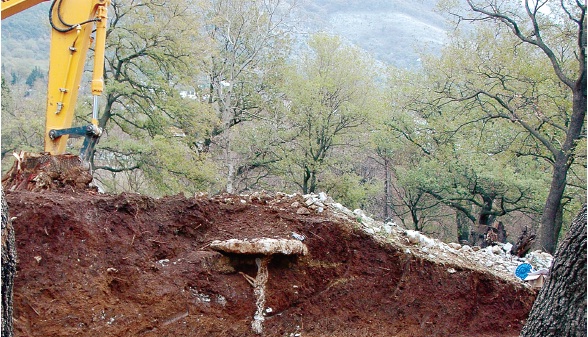
This is a completely new archaeological locality. It was discovered by pure accident while people were clearing part of an old forest to build a house. Here is a picture of the first sight of the dolmen cist emerging from the tumulus mound.


This is what the dolmen cist looks like after all the soil was cleared away.


According to the archaeologists the tumulus was built by the people who belonged to the early bronze Age Ljubljana culture. This culture seem to have stretched along the whole East Adriatic coast. It also seem to have stretched inland into Bosnia and all the way to Sava and Danube where it could have had contacts with Vučedol culture.

The original tumulus had the radius of about 15 m and the height of about 1.80 m. The dolmen cist is surrounded by a ring of stones, which ritually separates the land of the dead from the land of the living. The sacred area was carefully cleared and compacted. It was then covered with fine dry soil and then treated with fire. Only then the central dolmen was built. The dolmen was made from massive stone plates. The person buried inside this dolmen cist was buried in a foetal position. This symbolizes rebirth after death and points to a belief that the death was seen as a new birth. Once the deceased was placed inside the cist, the cist was sealed with several types of clay, making the grave completely watertight The inside of the grave was as dry as when it was initially sealed almost 5000 years ago.  

This is the translation of the excavation report filed by archaeologist Mladen Zagarčanin who lead the excavation:

The Early Bronze Age tumulus “Mogila na Rake“ from Sutomore was found on the northeastern part of Spič field, about 1 km from the sea. The big earth-stone tumulus which had diameter of about 15 m, and height of about 1.80 m. It was discovered during the works related to the clearing of a private land with the use of diggers. During the dig the majority of the western and northeastern part of the tumulus was destroyed. The excavation work stopped when the digger uncovered the cover plate of the central tomb dolmen cist.

This is a rough cross section diagram of the tumulus:


The tumulus was covered with a layer consisting of large river pebbles.


After removing the stone layer the removal of the red-brown earth layer, about 0.80 to 1.00m thick, was carried out. There were almost no stones in this layer, although now and then one could notice particles of grime, small fragments of broken flint and small pieces of atypical pottery. The excavation of the earth mound confirmed the dense concentration of small and big stones, about 1.20 m thick, from which the stone layer was formed, covering the middle of the conical pile of pressed red coloured clay. The diameter of this layer was about 3.20 m, and the height about 0.80 m.
Further excavation revealed, the layer of green-dark earth, partly mixed with grime, which was roughly piled along the dolmen cist walls up to 0.60 cm height. Several fragments of pottery were found in this layer, as well as larger amount of chipped stone , while a smaller flat stone construction was confirmed on the north side of the same layer. We can assume that this construction represents a stair abutting the tomb, and it could have served as a platform from where the person in charge of the burial carried out the ritual.

With the removal of the green-dark layer the base of lower stone covering was revealed, round in shape, and made of medium and small pieces of limestone (0.5 to 0.20 m) mixed with red-brown earth. The cist was built on this layer using local stones. The sides were  constructed from massive trapezoidal shape stone plates (1.40 × 1.00 m, about 20 cm thick), which were bonded with yellow waterproof clay.

The cist was covered with two massive rectangle shaped plates (1m x 1.20m and 1.80 × 1 m; 20 cm thick), a large amount of yellow green clay was added to the layer of green-dark clay, whose purpose was to cover the plates both above and below, providing in that way the hydro insulation of the tomb interior.

Before the funeral ceremony, the interior of the cist was covered with a layer of fine sea sand, and the body was put on top of it in a foetal position, with the head directed toward to west, arms folded at the elbow, and with folded legs.


The anthropological analyses showed that the buried person was a man in his forties or fifties who had serious problems with his spine during his lifetime. During the detailed bone examination, it was concluded that he suffered of osteoporosis, or bone loss. It was also concluded that arthrosis, or arthritis was present among the ilium bones, as well as diseases of peripheral joints because of degenerative changes in joint cartilage. The third bone disease was found in the lumbar area and sacrum. The deformation found here indicates that the deceased walked with problems during his lifetime and that he suffered great pain in his back. These diseases suggest that he spent much time on horse back, because those deformities are characteristic for riders.

What is very interesting is that this was not the only skeleton found in the cist.

The bones of a child 8-10 years old (teeth and parts of other bones were preserved) were found his legs, as well as a smaller number of bones of a person 25-30 years old. The archaeologists assume that those are the bones of close family members, perhaps his son and wife who died before him. The missing skull and other bones of the buried skeletons point to the possibility that their bones were excavated from some other place and put in this tomb later on. But there is also a possibility that the woman and the child were sacrificed and then buried with the man. 

The cist did not contain any metal objects which is strange for these types of graves from this period. This could mean that this is not a grave of a warrior but a person who was in some other way important. Like a priest.

What was found in the cist are two ceramic vessels: a jug and a shallow plate.

The plate has a thick ring shaped stand and was thus interpreted as a thurible, a vessel used for burning incense during rituals. The thurible is richly decorated on both sides. The cross shaped detail was drawn on the upper surface which was shaped as a shallow plate with the extracted front and rounded back part, formed by the ribbons filled with the crossed lines. The ribbon ornaments formed borders which go along the edge of the vessel. Two holes were made on the corners of the extracted part of the thurible. On the bottom, a star shaped detail was engraved, formed of triangle fields and filled with crossed lines.


Now have a look at the cross symbol drawn on the top surface of the thurible. Remember the grave is dated to 2700 BC:


Is this pattern just a decoration with no meaning? Well if the above incense burning vessel was the only vessel with this symbol found in Montenegro we could say that this is indeed just a meaningless decorative pattern. But exactly the same vessels were found in other tumuluses and some of them are even older than this tumulus and were dated to the end of the 4th millennium BC. Surely the pattern choice was deliberate and must have had some cultural or maybe even religious meaning. I will talk about these other tumuluses and why they are extremely important for understanding of the Early Bronze Age Irish history in my next post. For now, let me just ask you a question: do you remember the gold cross discs which the Early Bronze Age Irish copper miners loved so much? The ones I wrote about in my post Or -Ireland's gold

This is the pair of these "Irish" golden discs found in Monaghan, dated to 2200 - 2000 BC.

Remember that I said that these "Irish" cross discs were made from gold that was brought into Ireland from Cornwall? The gold which was, according to the Irish annals, brought to Ireland by Partholon? The same Pathalon which according to the Irish "pseudo histories" came from the Balkans, via Iberia sometime during the second half of the 3rd millennium BC? 

Please note the cross symbols on the discs. This is the same cross symbol found on the thurible from the Sutomore dolmen. Is this just a coincidence? I don't think so. Not just because there are several incense burning vessel with this symbol found in Montenegro. But also because the same tumuluses which contain the incense burning vessel with this symbol also contain golden discs with this symbol... And all of them predate the Irish gold cross discs and because it all fits perfectly into the story of Partholon found in the old Irish histories.

But more about it in my next posts. Until then stay happy.