Showing posts with label religion. Show all posts

Saturday, 21 May 2022

Ishti

Sanskrit इष्टि ("ishti") - 1. Wish, desire. 2. A sacrifice, any sacrificial rite... 

This is the essence of "sacrifice": Hey God (insert name here), we want a lot of something, and in exchange, here is a bit of something...Fair enough?

People made God(s) in their own image, because it is easier to bargain with someone who has a human face, than with a faceless natural force...It is easier to pray for rain to a Rain God than to a cloudless sky...

Every prayer is a wish addressed to someone who we believe can fulfil it...And in exchange we give something in return, something we think is less valuable...Or promise to give at least...

Please mum, can I get...I promise I will...🙂

And so, once you humanise a natural force, you, being human, and knowing how humans work, naturally, try to cheat it, by performing "iṣṭi", a sacrifice...or promising to perform a sacrifice if you get what you want...That's called thanksgiving...

Please Rain God, give us rain when we need it and as much as we need it so that my grain granaries area again full this harvest time...In exchange here is a sacrificial bread, wine... Come and eat and drink it with us...

Fair enough?

So if the Rain God is a benevolent one, meaning if the climate is predictable and suitable for agriculture, then the rains will come when they are needed and as much as they are needed. The sacrificial feast seems to work...And this is what god keeps getting...

But if the Rain God is a grumpy f*ker, and the climate suddenly starts to wobble, and becomes unpredictable, and rains suddenly stop arriving when they are needed and as much as they are needed, the sacrifice changes...

Please Rain God, please give us some rain or my grain harvest will be bad and and my family will starve...We'll have to eat bloody acorns again...Here is a sacrificial animal...Come and eat it with us...

Some Rain Gods will be happy with the "smell of burned meet"...And they will supply rains when they are needed and as much as they are needed...But sometimes Rain Gods like to play hard...And sacrifice becomes the ultimate sacrifice...Human sacrifice...

Of course people wouldn't be people if they didn't try to cheat even at the brink of death...In its essence, even a human sacrifice, even a sacrifice of the first born children, was an attempt to bargain with god, to get a lot for a little...

Please Rain God, please give us some rain or my grain will wither and die and then my family will starve and die...Here is one of my children, please, give us rain so the rest of them will survive...

Terrible...But still in essence the same attempt to bargain with gods to get what we want ("ishti") for what we are willing to pay, sacrifice ("ishti")...

For the record:

According to the linguists, the Sanskrit इष्टि ("ishti") comes from Proto-Indo-European *h₁yaǵ-nós ("to sacrifice, worship") while the Serbian "išti" is the second person imperative of "ìskati" which comes from Proto-Indo-European *h₂i-sḱé-ti ("to wish, request, search") and are apparently unrelated...

So why are all these dictionaries saying that this is one and the same word? 

According to the linguists, the fact that इष्टि (ishti) also means ("to wish, desire") is "a later semantic change" that developed because people did connect wishing and sacrificing, but that does not mean that they have the same origin...

Don't know...

Sunday, 27 May 2018

Square and Compasses

"For in God we live and move and have our being..." - Acts 17:28

When I was 9 years old, I got in trouble at school for drawing a "rude" picture on a piece of paper and passing it around the classroom. This is the "rude" picture :)


For those who have problem figuring out what the picture means: it is a stylised depiction of a couple having a sexual intercourse in a "missionary" position (a man on top). 

This was a time when I was just finding out that there is such a thing called "sex" and was finding it all very funny.

Anyway, time passed, the sex became less funny and more fun and I completely forgot about this incident...

Then recently, while I was looking for something on the internet, I came across a picture of the Masonic Square and Compasses symbol:


The Square and Compasses is the single most identifiable symbol of Freemasonry. This symbol is a mystery. No one knows where it came from or what it means.

Most Freemasons, when asked the meaning of their Square & Compasses logo, state:

"Both…are architect’s tools…to teach symbolic lessons…"

I had of course seen this symbol before and I generally accepted that the symbol is probably in some way related to the idea of the God being the Great architect of the world.

If you look at this picture you will see why:


You can see that the ancient Hebrews saw the universe as a stone built structure with the stone flat Earth as the base and the stone Heavenly dome as the roof. Inside of this structure was all there was, the life itself. 

Now this was very interesting. The origin of the Masons is deeply rooted in the religion of the First Temple. So they probably shared the same world view described in the above drawing. And if we look at the above picture the idea of God being the Great Architect starts making a lot of sense. Only a great architect could have built the stone universe...

That architect would have used the Compasses to draw the top of the universe, the great stone semi circular dome of Heavens. He would also have used the Square to draw the bottom of the universe, the great stone flat earth. 

And this is exactly how the Compasses and Square are positioned in the Masonic symbol: the Compasses at the top, representing the Heavens, the Square at the bottom, representing the Earth. 

It seams that at least some Masons shared this view. 

Albert Pike, in his "Morals & Dogma" says: "The Compass, as the Symbol of the Heavens…and the Square, as the Symbol of the Earth...". 

Albert Pike actually goes further to say that the Compass (Heaven) represents the spiritual portion of the double nature of Humanity…and the Square (Earth) represents the material, sensual, and baser portion of the double nature of Humanity." 

J. S. Ward states in his "Interpretation of Our Masonic Symbols" that "…the compasses stand for…the spiritual side of man, while the square appertains to the material world…"

This is linked to the Euclid’s 47th problem of “Squaring The Circle,” said to be the primary goal of the Masonic craft. 


Squaring the circle, however, does not in this case refer to a mathematical problem. It is a description of the the fact that man has both physical and spiritual nature.

Now the reason why man has both physical and spiritual natures is because we are all children of the father sky and mother earth.


Sky, because we can't touch it, but because it has direct influence on life, is perceived as spiritual. The word spirit comes from breath, air...
Earth, because we can touch it, and because we and everything else that is alive, lives and grows out of earth, is seen as material. The word matter comes from mother...

In Genesis, God forms "Adam", out of "the dust of the ground" and "breathed into his nostrils the breath of life" (Genesis 2:7). This is basically a description of the creation of life by Father Sky and Mother Earth...

This reminded me of a Serbian riddle

Question: Tall (high) father, wide mother
Answer: sky and earth

This riddle contains the ancient belief in Father Sky and Mother Earth which was preserved in Serbian tradition.

Father Sky and Mother Earth are at the core of the old European belief system.

In Serbian tradition the Father Sky and Mother Earth are known as:

Father Sky:

Dajbog - giving god
Djed - grandfather, male ancestor

Mother Earth:

Dajbaba - giving goddess
Baba - grandmother, female ancestor

It is the dynamic interplay between the Sky and the Earth, the intercourse between the Father Sky and Mother Earth, which creates all life.

Which brings me back to my primary school doodle:


A father (on top) and mother (on the bottom) creating life...Compass and the Square. Heaven (Sky) father and Earth mother creating life.

In English speaking countries, the Compass and the Square symbol has a capital letter G in the space between the Compass and the Square.


Among the most widely accepted interpretations are that: [G] stands for God, and is to remind Masons that God is at the center of Freemasonry. In this context it can also stand for Great Architect of the Universe (a reference to God). 

So there is one GOD who creates all. The first thing he created was chaos. He had to. He created everything :) Then he "separated" the chaos into the sky and earth. Sky and earth then created living nature. Living nature then created all living things including man.

This is interesting. God Begets One. One begets Two. Two beget Three. Three beget all living things.

Now where did I see this before?

I know. In Taoism.

The Tao begot one (wuji, chaos).
One begot two (taiji, Heaven and Earth, Yang and Yin).
Two begot three (man heaven earth, life).
And three begot the ten thousand things (All things).

And in Fibonacci sequence. 1, 1, 2, 3... I wrote about the Fibonacci sequence and it being at the core of Taoism in the post entitled "Fibonacci".

Fibonacci sequence describes Genesis, the creation of life, the materialisation of the divine, the squaring of the circle...

In case of Taoism behind everything is unknowable Tao. It is unknowable because it is beyond material universe (chaos) which is all we can ever really know. 
In case of Judeo Christianity behind everything is unknowable GOD. It is unknowable because it is beyond material universe (chaos) which is all we can ever really know.
In case of Science, behind everything is unknowable "something" that kicked off the Big Bang. It is unknowable because it is beyond material universe (chaos) which is all we can ever really know.

There is basically no difference between these three definitions of the beginning of the creation of life. They are all beliefs based on logical deduction that there must have been something or someone that created our universe (chaos) from which (or in which) sky and earth were formed (created) and which in turn created life and us, humans. But we can never have a proof that this belief is true or any way to see this something or someone. 

So from our point of view the only thing that really matters are the two things that directly create, maintain and destroy life: sky and earth. It is because of this that sky and earth were recognised as Father Sky and Mother Earth and were as such deified and venerated as God Father and Mother Goddess.

Sky father was often identified with the Sun. This is why Sky gods are often interchangeable with Sun gods. For instance in Slavic religion Dabog, the Sun god is also the giver of rain hence he is actually the Sky god. Dabog is imagined as a radiant youth who rides across the sky every day from east to west in golden chariots pulled by four white horses. 

There are very strong indications, based on archaeological and historical data, that the First Temple, the Temple of Solomon, the Temple Masons are trying to rebuild, was a solar temple, built on top of an ancient solar observatory, and built by the followers of a solar cult. More precisely the cult of Helios (El). Helios who was the old sun god imagined as a radiant youth driving across the sky from east to west in golden chariot pulled by four white horses...I wrote about this in my posts "Boaz and Jachin" and "Sun god from the first temple". The solar cult of the First Temple was only replaced by the lunar cult of the Second Temple after the return from Babylon. Not all jews agreed with this religious change. Some, like the Essenes, regarded the cult of the Second Temple as a heresy and dedicated themselves to the "rebuilding of the First Temple solar cult"... Now the God of the Jews, El, Helios, Sky Father, was the God of the Early Christians...

There are also very strong indications, based on ethnographic and archaeological evidence, that Virgin Mary is the Christianised Mother Earth. The old holy places related to the Mother Earth worship were converted to holy places dedicated to Virgin Mary (or the main Female Saint of the area). The old rituals performed to appease Mother Earth were transferred to Virgin Mary (or the main Female Saint of the area). I wrote about this in many posts, such as "Shepherd's chapels from Velebit", "Babje leto - Grandmother's summer"...

What does the intercourse between the Father Sky and Mother Earth produce? Life. Living nature including us humans...
What did the intercourse between God and Mary produce? Christ who is God who became Man. God materialised. 

So based on the above analogy, Christ is just a symbol. Symbol of life itself, symbol of nature. Life is materialised divine, god who became matter.  

Squaring (materialising) the circle (Devine, sun, sky, God) = creating life...

If Christ is life, living nature and we are part of life, living nature, then we are Christ. We truly live and move and have our being in Christ...
If Christ is life, living nature, god who became matter, then we are all god materialised. Just like the mystics the world over have been teaching for millennia.

I wonder how many masons and non masons are aware of all this?

What do you think? Does this make sense?

PS:

Chinese creator god Fuxi 伏羲 and mother goddess Nüwa 女娲 in the process of creating life. They are holding square and compasses. Astana (Xinjiang), Tang époque (618-907). 


What an incredible coincidence... :) 

Friday, 23 December 2016

Budi

I give you this as my Christmas present. Read it and think about it. I hope it will make your life better and happier. 

These are stećak standing stones from The Balkans. They are found in Croatia, Bosnia, Montenegro and Serbia. 


And this is an an "alleged" inscription from one of stećak standing stones from Hercegovina. I have found it on the Wikipedia web page about medieval standing stones epitaphs. The reason why I said "alleged" is because I have no way of verifying whether it really is or isn't genuine medieval tombstone inscription. So all I can do is trust the source (for now) and then go and check it later.  

But the reason why I am writing this post is actually the content of the message. Here it is:

"Here I lie on my own noble land. My name is Vlk (Wolf) the son of Hum. Take what I am going to tell you, but don't trust me.  You are you and I am I so our truths don't have to be the same. When you are like me, take stock of your life just like I did. 

Don't hope that what is yet to come is going to last for ever, but also don't feel regret for what has passed. Most people have small knowledge and big expectations. They will therefore always accuse yesterday for what is going to happen to them tomorrow. You should love the moment you are in and the lips that kiss you. 

Later on your bones will, like mine now, peacefully sleep under a heavy stone. Don't knock down my tombstone, let it stand as it stands now. If you don't understand what I am telling you now, maybe some son of your son will understand me one day. 

I lied here on an accursed day in the year 1209."

Talking about Buddhist mindfulness...Be in now. That is all there is... 

The man lying under the stone was not a Buddhist. He was just "budan". In Serbian the word "budi" is an imperative of "to be". It is a command or a suggestion to live in now, to exist in the present. And the word "budan" means "awaken", the one who "is" here and now....

So the man whose epitaph "allegedly" this is, understood the big secret of now. But when did he get this understanding? On his death bed? Or was he lucky to gain this understanding earlier? Maybe this is a message, genuine or not, that is intended to wake us up before we reach that moment of no return and help us live the rest of our lives "awake", which is the only way to truly live...

If you don't understand what I mean, maybe you should read this book: "The power of now" by Eckhart Tolle. It is the best explanation of what mindfulness is I have ever come across. Maybe then you will understand. But if you don't, don't throw the book away. Give it to your children and maybe some child of your child will understand it one day...

And take what I just wrote in this post, but don't trust. See for yourself...


Here is the original in Serbian:

"A se lezim rad na svojini plemenitoj. Ime mi Vlk ot Humske zemje sin. Ono tsto tcu ti rejti ti privati al nejmoj mi vjerovati. Tij si ti, ja sam ja pa nam ni istine ne moraju biti iste. Kad budnes ko ja svedi svoj ratcun tko tsto svedoh ja svoj.

Ne najdaj se da tce biti vjetcno ono tsto tce tek dojti, al ni ne zali za onijem tsto je projslo. Vetcina ljudi ima malo znanje a velka otcekivanja. Oni tce zato uvijek optuzivati jutce za ono tsto tce im se dejsiti sijutra. Ti voli trenutak u tkome jesi i usne koje te jube.

Kasnje tce ti kostji ko sada moje mirno snivati ispod terzka kamena. Ne prevali mi biljega mojega, pusti ga da stoji kako stoji. Ako me ne razumijes sada ti mozda me razumjedne tvojega sina neki sin.

V proklet dan legoh v godini 1209."

Thursday, 19 May 2016

Mountain


People who live below high mountains, see only their side of the mountain. Most people are content with that view and believe that they know the mountain, that their view of the mountain is the mountain...When two people who live on opposite sides of the same mountain meet, they sometimes talk about "their" mountain not knowing that they are talking about the same mountain. And sometimes they even get into a fight over whose mountain is taller, bigger, more beautiful... 

People should hike more...Only through hiking, you can get to understand that even though there are many views of the mountain, and even though they are all different, they are all views of the same mountain...

Friday, 11 March 2016

Babje leto - Grandmother's summer


Indian summer is a period of unseasonably warm, dry weather that sometimes occurs in autumn, from mid September to late November, in the Northern Hemisphere. This warm period in autumn has many different names in Europe but they all seem to fall into these main categories:

Poor people's summer, Gipsy summer

Bulgaria: "Циганско лято" - gypsy summer
Makedonija: "Циганско лето" - gypsy summer
Sweden: "Fattigmanssommar" - Poor man's summer

It is believed that these names are derived from the fact that the good weather at the end of autumn allows poor people to collect whatever is left of the cultivated and forest crops and so survive the winter.

Summer of of one of the autumn saints

Serbia: St Miholj's summer (Officially after Prepodobni Kirijak Otšelnik better known as Sveti Miholj (29th of September), but really Saint Michael's day celebrated in Catholic church as Michelemas and which is celebrated on the 29th - 30th of September)
Spain: Veranillo de San Miguel - Saint Michael's small summer, Veranillo de San Martín - Saint Martin's small summer, Veranillo - small summer
Sweden: Brittsommar - Saint Birgitta's summer
Finland: Pärttylin pikkukesä - Saint Pärttyli's (Bartholomew's) little summer
Italy: l’estate di San Martino - Saint Martin's summer
England: Saint Luke's little summer, Saint Martin's summer
Holand: "Sint-Michiels zomer" - Saint Michael's summer
Catalonia: "Estiuet de Sant Martí" - St. Martin's lil' summer
Portugal: "Verão de São Martinho" - St. Martin's summer

The indian summer period fall between these two dates:
autumn equinox (21 of September, mid point of the climatic autumn) converted to the St Michael's day celebrated on the 29th of September.
5th of November (the mid point between the autumn equinox and the winter solstice, the beginning of the climatic winter) converted to St Martin's day celebrated on the 11th of Novemeber.

Basically this is the second part of the climatic autumn, when the weather is supposed to deteriorate. So good warm weather at this time is "unseasonable". If the warm period is closer to the beginning of this period then it is called "The summer of St Michael" and if it falls closer to the end of this period it is called "The summer of St Martin".

Various

Sweden: "Grävlingssommar" - Badger summer
Finland: "akkain kesä" - summer of hags
Brittany: An hanv c'hraden - the summer of ferns, bracken
Latvia: "atvasara" - resummer, summer again
Holand: "Nazomer" - late summer, after summer

These names are either linked to a particular animal or plant whose behavior is influenced by this warm spell or it just means late summer, or another summer

Old woman's summer, Grandmother's summer

Many Slavic countries, for example, in Russia, Ukraine, Belorussia, Serbia, Bosnia, Croatia, Poland, Czech republic...some variation of "Babje leto" meaning grandmother's summer.
German speaking countries (Germany, Austria, Switzerland): "Altweibersommer" meaning old women's, grandmother's summer
Holand: "oudewijvenzomer" - meaning old women's, grandmother's summer
Hungary: "vénasszonyok nyara" meaning old woman's summer.
Lithuania: "bobų vasara" - Grandmother's summer

This particular name for the indian summer is what I would like to talk about in this article. 

There are several theories about the origin of the name "Babje leto" (Grandmother's summer).

One theory says that the name comes from the meaning "second youth in women". The "second youth" is contemptuously viewed as short-lived and ill-timed. If this was the origin of the name, then "Babje leto" (Grandmother's summer) would also have been seen as something bad and out of place. But that is not the case. "Babje leto" (Grandmother's summer) is seen as something good, as a precious gift. And the name "Babje leto"  (Grandmother's summer) tells us clearly who the people believed this gift of the good weather was from: Baba, the great goddess. In Slavic tradition apart from being mother Earth, Baba also controlled the waters, the cold and ruled the winter. She was the complementing opposite to the Father Sky, who controlled the sun, the heat and ruled the summer. So it is quite possible that the expression "Babje leto"  (Grandmother's summer)  was originally Slavic in origin and comes from the Slavic belief system. It then spread into the countries, which once had large Slavic population, and were strongly influenced by the Slavic culture, such as  Germany, Austria, Switzerland, Lithuania, Hungary, Finland.

Another proposed reason why the late summer is called "babje leto" (Grandmother's summer) is that this is the time of the year when young males of a certain type of spiders, Linyphiidae, produce long strands of spiderweb on which they then fly through the air.


In English this flying spider web is known as gossamer. The English Etymological Dictionary says that this word was first recorded around 1300 AD, meaning "filmy substance (actually spider threads) found in fields of stubble in late fall". It is not known where does this word come from. One theory says that it comes from gos "goose" + sumer "summer" and that the word probably comes from an original sense of "late fall; Indian summer" because geese are in season then. However it is much more likely that the word comes from go + summer = going away, end of summer. Compare obsolete Scottish go-summer "period of summer-like weather in late autumn.".

Swedish and Dutch names for these spider threads clearly show that the word gossamer has to do with the end of the summer: Swedish "sommartrad" meaning "summer thread", Dutch "zommerdraden" meaning "summer tread". It is interesting that in Slavic languages the word "konac" means both "thread" and "end". So the expression "konac leta" would mean both the summer thread and the summer's end. So is it possible that all of this is somehow related, and that the Germanic names for this type of spider threads are direct translations of the Slavic expression "konac leta" meaning summer's end. It is very poetic in a way that the shiny silvery spider threads (konac) which appears at the end (konac) of the white, hot part of the year (summer, autumn).

As I already said in German Babje leto is called "Altweibersommer" which literally means "the old woman's summer". The word weib is an archaic German word meaning woman, wife. This word is very close to an old Germanic root word "web" meaning net, something woven, like spider net which is related to an old Germanic root verb "weben" meaning to weave. So we can see here clear link between web (made of thread) and wife, woman. However it seems that in Germany, the expression "Altweibersommer" has only been in use since the 17th century, which points to an old cultural import. I would like to confirm this however, so if anyone has any more info about the history of this expression in German, I would be more than grateful if you send it to me, so I can update this post.

Babje leto (Grandmother's summer) is in Germany also called "Madchensommer" meaning young girl summer (maiden's summer, virgin's summer).

So no wonder that that in German this type of flying spider tread was once called "Marien garn, Marien faden". There is a folk belief that these threads are remnants of the cloth used to wrap the body of the Virgin Mary, and which unraveled into the threads and dropped from the sky during her ascension.

In most Slavic languages these strands of spiderweb are called "bapske vlasi", "babina kosa" meaning baba's hair, grandmother's hair, or witch's hair. Folk belief is that this is the time when new witches are inaugurated and that the flying strands of spiderweb are their hair. People also believed that this spiderweb was tow, unprocessed wool, used by fairies, witches and Virgin Mary for making thread.  and that a girl will soon get married if this flying spiderweb got entangled into her hair.

What is interesting is that on the 1st of October, during the period of "Babje Leto" (Grandmother's summer), we find a very interesting Othodox Christian holiday: Intercession of the Theotokos. No remember, this is the time when silver spider threads fall from the sky, silver spider threads which Slavs call grandmother's hair.

Theotokos literally means "God-bearer", "Birth-Giver of God" and "the one who gives birth to God." Less accurate translations include the primarily Western title "Mother of God" (Latin: Mater Dei). It is funny that the Nativity of the Theotokos, which is in Serbian called "Mala Gospojina", and which is celebrating the birth of Mary, is celebrated, according to the old Julian calendar on the 8th of September. This day falls in the middle of the Virgo zodiac sign: 23 August – 23 September. Strange don't you think? According to the new Gregorian calendar this day falls on the 21st of September, autumn equinox. It is the date when the night becomes longer than the day. The we enter the part of the year dominated by the destructive female principle the Goddess, Baba. The period dominated by darkness, dampness and cold. No wonder that the good warm and dry weather during this period is seen as the gift from Baba. This is why it is called "Babje leto", Grandmother's summer. The normal summer is gift from god, Dabog, Grandfather. 


Anyway, the Intercession of the Theotokos celebrates the protection afforded the faithful through the intercessions (actions of intervening on behalf of another) of the Theotokos (Virgin Mary). In the Russian Orthodox Church it is celebrated as the most important solemnity after the Twelve Great Feasts. The feast is commemorated in Eastern Orthodoxy as a whole, but by no means as fervently as it is in Russia, Belarus and Ukraine. Interestingly this religious celebration is in Slavic languages also known as "Pokrov" and in Greek as "Skepe". 

The Slavic word Pokrov, like the Greek Skepe has a complex meaning. First of all, it refers to a cloak or shroud, but it also means protection or intercession. For this reason, the name of the feast is variously translated as the Veil of Our Lady, the Protecting Veil of the Theotokos, the Protection of the Theotokos, or the Intercession of the Theotokos. It is often translated as Feast of the Intercession. 

According to Eastern Orthodox Sacred Tradition, the apparition of Mary the Theotokos occurred during the 10th century at the Blachernae church in Constantinople where several of her relics (her robe, veil, and part of her belt) were kept. On Sunday, October the 1st at four in the morning, St. Andrew the Blessed Fool-for-Christ, who was a Slav by birth, saw the dome of the church open and the Virgin Mary enter, moving in the air above him, glowing and surrounded by angels and saints. She knelt and prayed with tears for all faithful Christians in the world. The Virgin Mary asked Her Son, Jesus Christ, to accept the prayers of all the people entreating Him and looking for Her protection. Once Her prayer was completed, She walked to the altar and continued to pray. Afterwards, She spread Her veil over all the people in the church as a protection.


Have a look at the above icon. Do you see the "glowing" threads shimmering in the air? Do you see how Mary's "pokrov", the veil, turns into "glowing" threads which are then covering the faithful? Do you remember what Germans once called the spider treads which fly during the "Babje leto"? They called them "Marien garn, Marien faden" meaning "Mary's yarn, Mary's threads"? Do you see how the "porkov", the veil looks like hair? Do you remember how Slavs call the spider treads which fly during the "Babje leto"? They called them "Babina kosa" meaning "Baba's hair". The Mary's veil is Baba's hair.  

It is interesting that it was a Slavic mystic monk who saw "the Virgin Mary wearing a shroud, cloak, moving in the air above him, glowing". What he saw were the spider treads which fly during the "Babje leto". The same threads which are by Slavs called "Babina kosa" meaning "Baba's hair". Baba was the old great Mother Goddess of the Slavs. Mary was the new Christian Mother Goddess. If we know this then the description "the Virgin Mary wearing a shroud, cloak, moving in the air above, glowing" can be translated as "Great Goddess with long silver hair, moving in the air above him, glowing". 

So it is most likely that originally Slavs saw the  spider treads which fly during the "Babje leto" as Baba's, Great Goddess' hair falling from the sky symbolically covering and protecting her people. I believe that the white silvery shining spider web threads, Baba's hair, were symbols of snow and ice of winter, when Old Mother Earth becomes gray white. There is a belief in Slavic countries that if we have Babje leto the following winter will be long, showy and cold.

The Pokrov icon may be related to the Western Virgin of Mercy image, in which the Virgin spreads wide her cloak to cover and protect a group of kneeling supplicants. 


The first known examples of this type of icons date from Italy at about 1280 and were probably influenced by Slavic Christian art from the Balkans, which we say was influenced by the old pagan Slavic beliefs.

The fact that these spider threads are linked to both Baba (old woman, but also young woman Mother Earth) and Virgin Mary are another proof that in Europe the worship of Mother Earth, Baba, Dajbaba was replaced with the worship of Virgin Mary, in the same way that the worship of the Father Sky, Djed, Dajbog was replaced with worship of god the father.

But if Mother Earth was replaced with Mary the mother, Theotokos, the Birth giver, and if the Father Earth is replaced with God the father, who is then Christ the son of the Mother Earth and the Father Sky? I will talk about this in my future posts. 

I want to thank my friend Jože Kotnik for helping me with translation of some articles from Slovenian.

Keep smiling, stay happy.

Wednesday, 7 October 2015

The riddle of Odin's ravens


Odin had two ravens named Huginn (Old Norse “thought”) and Muninn (Old Norse “mind”). Every day, Odin would send them out at dawn, and the birds would fly all over the world before returning at dinner-time. They would then tell Odin everything they saw and heard. It is said that this is the reason why one of Odin's names was “raven-god” (hrafnaguð). 

In the Poetic Edda sonnet Grímnismál, the god Odin (camouflaged as Grímnir) tells Agnarr, the young son of King Geirröðr a very strange thing about his two ravens. I include here four different translations of the stanza in question so that you can get better feeling for what Odin is saying. 

1797 Amos Simon Cottle in Icelandic Poetry “The Song of Grimnir”

Hugo, in azure fields of air,
And Mumin too each day appear:
I fear lest Hugo safe return,
But more for Mumin inly mourn.

1851 C.P. in The Yale Magazine, Vol. 16 “The Song of Grimner”

Huginn and Muninn, over the fields of earth 
Fly daily; fear creepeth upon my soul, 
Of Huginn, lest he come not faithfully; 
But of Muninu I have greater fear than this.


1866 Benjamin Thorpe in Edda Sæmundar Hinns Frôða “The Lay of Grimnir” 1883 Gudbrand Vigfusson in Corpus Poeticum Boreale “The Sayings of the Hooded One”
 
Hugin and Munin
fly each day
over the spacious earth.
I fear for Hugin,
that he come not back,
yet more anxious am I for Munin.

1883 Gudbrand Vigfusson in Corpus Poeticum Boreale “The Sayings of the Hooded One”

Thought and Mind [his two Ravens] fly every day over the mighty earth
I fear for Thought lest he never come back, but I am still more fearful about Mind. . . .

Scholars have been wondering for a long time about the meaning of the above verses. 

John Lindow relates Odin's ability to send his "thought" (Huginn) and "mind" (Muninn) to the trance-state journey of shamans. Lindow says the Grímnismál stanza where Odin worries about the return of Huginn and Muninn "would be consistent with the danger that the shaman faces on the trance-state journey."

Rudolf Simek is critical of the approach, stating that "attempts have been made to interpret Odin's ravens as a personification of the god's intellectual powers, but this can only be assumed from the names Huginn and Muninn themselves which were unlikely to have been invented much before the 9th or 10th centuries" yet that the two ravens, as Odin's companions, appear to derive from much earlier times. 

Anthony Winterbourne connects Huginn and Muninn to the Norse concepts of the fylgja—a concept with three characteristics; shape-shifting abilities, good fortune, and the guardian spirit—and the hamingja—the ghostly double of a person that may appear in the form of an animal. 

Bernd Heinrich theorizes that Huginn and Muninn, along with Odin and his wolves Geri and Freki, reflect a symbiosis observed in the natural world among ravens, wolves, and humans on the hunt. He proposed that the Odin myth was a metaphor that playfully and poetically encapsulates ancient knowledge of our prehistoric past as hunters in association with two allies to produce a powerful hunting alliance. It would reflect a past that we have long forgotten and whose meaning has been obscured and badly frayed as we abandoned our hunting cultures to become herders and agriculturists.

I believe that the above stanza is a riddle, a koan, which was used for teaching the novices about the difference between Thought and Mind. The fact that Odin has two ravens called thought and mind is already very significant. Most people equate thought, thinking, the thought machine and mind. But interestingly mystics all over the world, since the beginning of time have been trying to tell us that the truth is exactly the opposite. Thought, thinking, thought machine and mind are two different things independent of each other. Odin is trying to tell us the same. 

Many books were written on the subject of dualism of Thought and Mind. Basically anything ever written about meditation, mindfulness and achieving enlightenment actually tries to explain the relationship between the Thought and Mind. In my opinion one of the best was written by the guy called Eckhart Tolle. The book is called "The Power Of Now". This is not a religious book. This is a practical guide to understanding the relationship between Thought and Mind.

But how are we to understand Odin's worry that his ravens will not return. John Lindow is partially correct when he relates Odin's ability to send his "thought" (Huginn) and "mind" (Muninn) to the trance-state journey of shamans. Only the Muninn's flight is a metaphor for the meditative process. Huginn's flight is a metaphor for the thought process. Lindow says the Grímnismál stanza where Odin worries about the return of Huginn and Muninn "would be consistent with the danger that the shaman faces on the trance-state journey." But actually I believe that Odin is not worried. It is a riddle. He is opposite from worried. He is hoping that the ravens will not return. 

The reason why scholars are still wondering what the meaning of the above stanza is, is because they are not vikings. 

Ravens were used by Vikings to determine if there was a land ahead during their long voyages across the open sea. They carried ravens with them in cages. When they found themselves far away from the shore, and didn’t know which way to go, they would set a raven free. Raven would fly high in the air and then start flying in circles searching for land in the distance. Because ravens can't land on water, if the raven could not see a land, he would return to the ship. But if the raven saw land in the distance, it would fly straight for it. All the Vikings had to do is follow the raven. So raven acted as a guide, which guided Vikings through the unknown and uncharted waters to a safe haven. Which means that raven must be directly related to the idea of a guide, leader, just like Odin, Wodan whose name actually means Guide, Leader. You can read more about it in my post called "Odin the wandering deity".

As I said already it is very important that there are two ravens of Odin. Thought and Mind. They are two ravens which each of us can use to search for the way forward through the unknowable future. Most people only ever use Thought. This is because they are not even aware of the existence of the other raven, Mind because they think that Thought and Mind are one and the same. That mind is a sum of our thoughts, rather than a completely separate entity. This is a pity because all the mystics in the world throughout the history have been telling us that it is the mind, clear of all thought, the mind of no mind, which gives us the true vision, the true sight. The sight that reaches much further in space and time then our thoughts would ever be able to reach. And this is exactly what Odin is telling Agnarr. Odin says that although there is a possibility that thought might not return, he is more anxious about Mind not returning than thought. What this actually means is this:

It might be possible to use your thought to successfully guide you through life. This is symbolised  by Odin's fear that Hugin, Thought, might not come back. As I have already said, raven Thought would not come back only if it had found the way (Tao) through life which you can follow. But Odin says, that he is more worried about the Muninn, Mind, not returning. This means that Odin thinks that raven Mind, mind empty of thought, the opposite of thought, is more likely to find you the way (Tao) through life which you can follow. This is, I believe, the message Odin was trying to convey to Agnarr and everyone else.

And so, I believe, the riddle of Odin's ravens is solved. A fitting message from the God whose name means Guide, Leader. What do you think?

Friday, 28 August 2015

Krkava Triglav stone


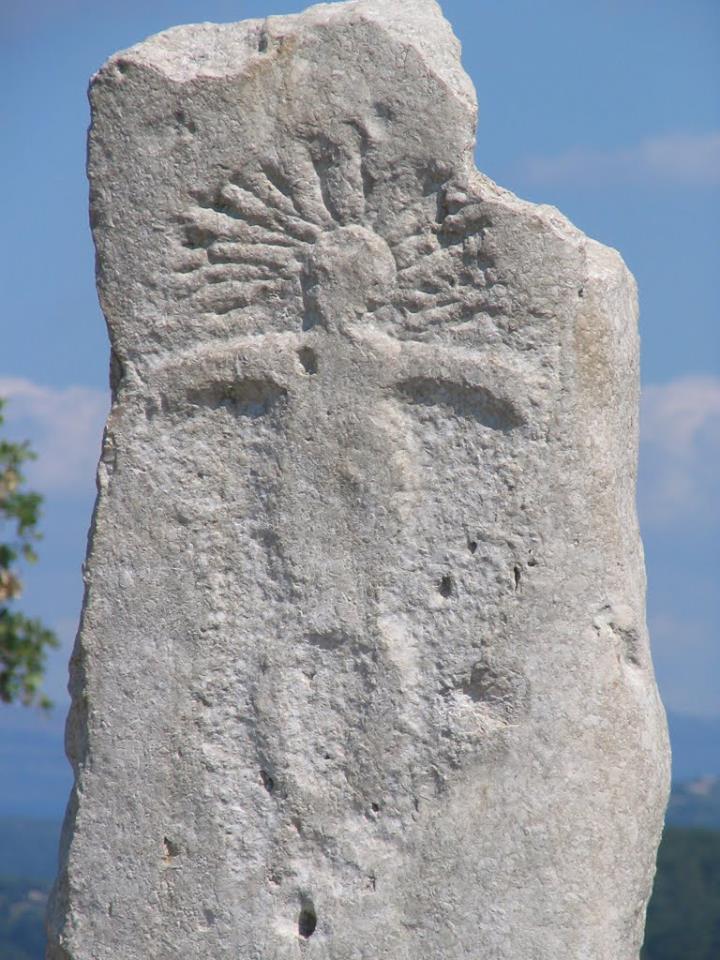
This is Krkavški Kamen (Krkava stone) also known as Triglav stone from Istria. Dating of the stone is uncertain but it is proposed that it was not built later than the 12 century and that it could be much older. It stands 400 metres southeast of the Krkavče cemetery, north of the path leading past the Gradišče field towards the Škrljevec hamlet.

The monolith is approximately 2.5 metres high and roughly hewed. Only 1.6 m still stand above ground and the upper part of the monolith is partially damaged. There is a stylised human image carved on both sides. 


It is an anthropomorphic image with widely spread arms, erect penis and with a crown of sun rays. 


In this the image from the Krkava stone resembles the "Lion man" stone from Armagh in Ireland. 


I wrote about this stone and its link with the Slavic Triglav worship in my post about Radegast.

The surface of the two images shows different treatment and the reliefs were probably made in two if not even three phases. 

The locals say that the stone once had three heads carved on its top which are now missing. Some say that it was only one head with three faces. Maybe like this one from Ireland:


This is why the stone is called Troglav, Triglav, the Three headed one. This Triglav is the the old European Trinity, Sun, Fire, Thunder, the three in one, the one which is three, the Trinity known in India as Trimurti. I wrote about Triglav worship in Serbian tradition in my post about Triglav.  

There are local legends that claim that in the field called Gradišče, which means "Fortified city" once stood a stone city and that the Triglav stone was erected by the people who built the city. Other legends say that the stone is older than the city. People say that the city was built by the king who had a golden calf...Other legends say the it was the Devil himself who lived in the old stone city and who had the golden calf. They say that the Devil went under ground to protect his gold. This is very interesting as in Serbia we also have legends of the evil king Trojan (Triglav) who lived in the old stone city on top of the mountain. Trojan, Triglav was in Serbia identified with Dabog, who later became Christian Devil.. Archaeologists have found Roman villa in the field, but there is an Illyrian fortress nearby. 

Locals say that the stone was once worshiped as holy. They say that according to the local lore, the stone is dedicated to the sun god. On the day of St. Vid people used to come to the stone to lay hands on the stone. St Vid is Christianized Slavic sun god Svetovid, who was originally celebrated on the day of the Summer Solstice. On Christmas eve, which is Christianized Winter Solstice celebration, people used to spend all night burning oak logs around the stone. This is the ceremony of rekindling of the fire of the Sun which is still performed in the Balkans for Orthodox Christmas. At the dawn the whole village would gather around the stone and celebrate the rising of the first sun of the new solar year. This is the rebirth of the young Sun god which Christians turned into the birth of Christ. In Serbian the word for god is "bog" and the word for young god is "božić", which is what Serbians call Christmas. The whole Winter Solstice ceremony around the stone was linked to fertility. I already wrote about similar ceremonies from Serbian territories in the Balkans in my post about threshing floors. These pagan ceremonies were condemned by the Christian clergy and were performed in secret and eventually abandoned. They were replaced by church processions following the same routes that the old pagan processions probably followed.  


There were many Christian processions which either started or ended at the stone or passed by the stone. The main one started from the stone and and ended in front of  the Church of St. Michael the Archangel. These processions took place on Rogation Days preceding Accession Day. The Accenssion Day is the old Beginning of the Summer ceremony, Beltane, the day of Jarilo, the Fire part of the Triglav. I wrote about Beltane, the Day of Jarilo in my post about the Beltane circle. It is very interesting that the procession ends at the church dedicated to the Archangel Michael. In Serbian tradition, Triglav was replaced by Archangel Michael who represents the lightning part of the Triglav trinity.

According to the local tradition the stone used to be used as a punishment, shaming stone. People who committed a crime were tied to the stone. They were then spat on and had insults and curses hurled at them. In recent times children were threatened with being tied to the stone when they did something wrong. Was this an ingenious way devised by Christians to replace the veneration of the holy Triglav Sun Stone with loathing of the Punishment and Humiliation stone? Or was the stone used as a shame stone even before the arrival of Christianity? In Serbian we still have an expression "to put someone on the pillar of shame" when you want to expose and shame someone for the bad deeds that he had committed. Is this somehow linked with the "prokletija" stoning ceremony about which I wrote in my last post? Were people who were tied to the Triglav stone originally stoned? Was spitting and hurling of abuse originally spitting and hurling of stones and abuse?

Archaeologists Pleterski and Puhar have proposed that the stone is part of a large spatial alignment. The stone and the four surrounding churches form perfect Latin Cross. 


The churches are all linked to the stone with well trodden paths once used for annual processions.  Local legends say that the churches were deliberately build like this around the stone so that they would "destroy the devil's power residing in the stone". But they were probably built on top of the old holy places which with the Triglav stone once formed the larger holy landscape dedicated to the celebration of Triglav, the old Trinity. 

You can read detailed study of the stone written by Jana Puhar and Andrej Pleterski in Slovenian here.