In this article I will talk about two (actually three) sacrifices, which marked the beginning and the end of the Trojan war...
7th c. BC Mykonos pithos.
It contains the oldest depiction of the Trojan Horse, the way Homer described it...
Now in my article "Trojan horse", I talked about the proposition by the Italian naval archaeologist, Francesco Tiboni, that the famed Trojan horse was not a horse at all, but a ship, with a horse head on the prow...
Like this one, from a depiction of Phoenician ships found in the palaces of Assyrian kings from the 7th and 8th centuries BCE.
It is because of this that the Greeks called the Phoenician ships "horses", and the Phoenicians "the horse people".
Tiboni says that "it would make far more sense to think of the Greeks' treacherous gift to the Trojans as a ship, because nautical 'hippos' were commonly used to carry tributes to the enemy - such as precious metals - after defeats."
"A ship's hold would also have made a better hiding place for soldiers than a wooden horse's belly. And a reference in Virgil's Aeneid to wary Trojans calling for the sinking of the Greek gift seems odd outside of a nautical context." concludes Tiboni...
I agree with Tiboni. But my article was not about what Trojan horse really was. My article was about the fact that both Phoenicians and Greeks had sea gods associated with horses...Very strange...
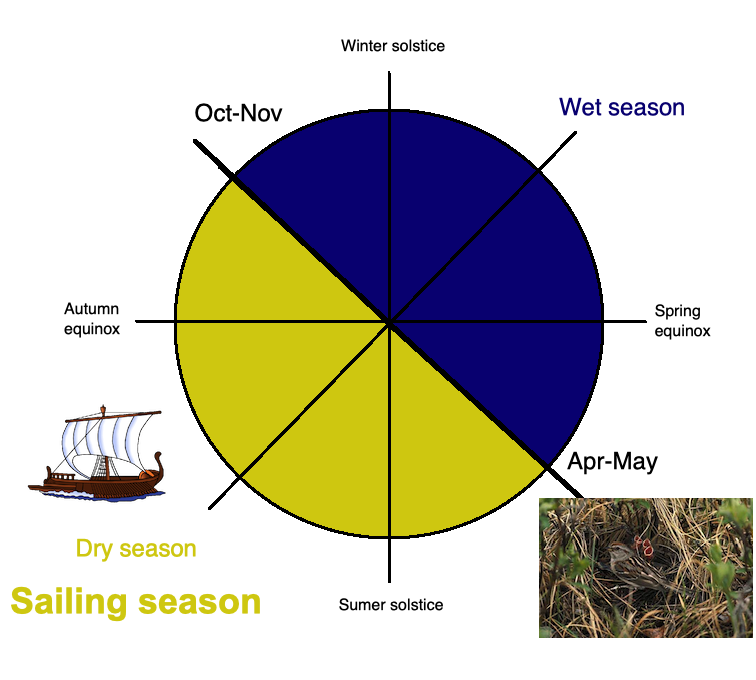
Well, strange that is, until you look at the sailing season in the Eastern Mediterranean and the natural mating season of horses, which is characterised by vicious stallion fights...They pretty much overlap...

When horses start their mad mating fights, in Apr, it's time to put your ships into the water...
When horses stop their mad mating fights, in Sep, it's time to take your ships out of the water...
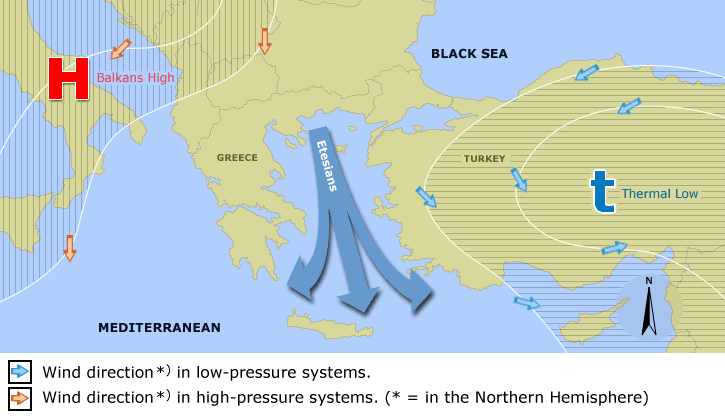
Why? Cause of the weather...And particularly because of the winds...This table, from a South Aegean Yachting site, gives directions of the prevailing winds in Aegean sea during the sailing season: Apr-Oct...

Even today, with much better boats, this is the safe sailing season...Because of the fact that this is when the persistent Northerly trade winds blow over the Aegean...
They start in Apr, but stabilise in May, and blow towards Levant and Egypt until Sep, when they become unstable again and cease all together in October...
These are "etesian" winds, and I talked about them in my post "Anat", about this Semitic "warrior" goddess worshipped by the Canaanites & Egyptians during the Bronze and Iron Ages.
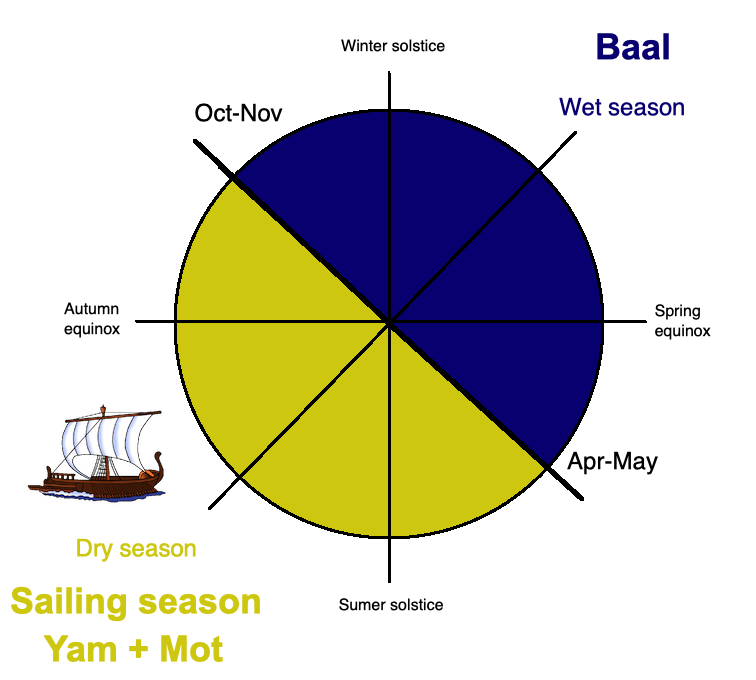
She was a sister and the right hand woman of the rain god Baal...Interestingly, Baal's enemies were two brothers, Mot, the god of death, and Yam, the sea god...Strange division of power, right?
Well, apparently, Mot, the god of death, was by the people of Levant equated with the sun...I talked about this in my post "Oldest Arabic poem"...
Not surprising considering that we find sun as the god of death in Middle East since the time of Sumerians...Nergal, the destructive sun of the late summer...Which is the strongest and most deadly in Jul/Aug...In Leo...Hence, Nergal the lion man...I talked about this in my post "Winged superhuman hero"...
If we look at the climate in Levant, we can see that the climatic year is divided into cool wet season, ruled by Baal, and hot dry season, ruled by Mot...Hot, dry season being also the sailing season, we end up with brothers Mot and Yam, "natural" enemies of Baal...
So in the Anat mythology, she is said to have killed Arsh, a monstrous attendant of Yam, the sea god and "the darling of the gods"...In order to bring Baal back to power...Apparently Arsh means "towards the land"...Who is Arsh? Who does Anat kill?
Well, the "etesian" winds of course, which blow "towards the land" of Levant and Egypt during the hot, dry season in the Eastern Mediterranean. And which stop blowing right when the hot, dry season, ruled by Mot, Sun, ends and the cool, wet season, ruled by Baal starts...
Sooooo....What the hell does any of this have to do with the beginning and the end of the Trojan war????? 🙂
Well, a lot...You want to sail in Aegean sea, you need to know all of the above, very very well...
Sorry about the long intro, but I think it was necessary...
You see, the Greeks could not have set sail for Troy, at the beginning of the war, before the beginning of the sailing season, in Apr...And they couldn't have set sail for Greece, at the end of the war, after the end of the sailing season, in Oct...


Wait, the prevailing winds in the Aegean during the sailing season are northerly winds...And if the Greeks wanted to sail across the sea, they needed to have a keel (A large beam along the underside of a ship’s hull from bow to stern which gives the ship's structure its rigidity), in order to stabilise the ship, and allow them to sail with the side winds...
Well, the oldest shipwreck we have (last time I checked) with a keel is Uluburun shipwreck, a shipwreck of a Late Bronze Age Phoenician ship, dating to ca. 1400 BC.
Here is the ship structure with the central keel and the horse head stem invented by Phoenicians...Looks familiar to anyone?
But did Greeks have ships with keels? Well, based on the available depictions of ancient Greek ships, they definitely did...Way back in the 3rd millennium BC...This Minoan seal is from 2000BC from this great site: "The Greek Age of Bronze"... 
Unfortunately, we don't have any actual shipwrecks to prove this. But considering that Greeks were able to sail from Aulis, where they assembled, to Troy, and back, using side Northerly winds, proves that they must have had boats with keels...
Well, they could have done it technically, providing there was wind...And here we come to the two sacrifices, which I mentioned way up there in the first tweet, and which marked the beginning and the end of the Trojan war...
Finally...🙂
The sacrifice that marks the beginning of the Trojan war, is the famous one, the sacrifice of Iphigenia:
"As the Greek fleet gathers in Aulis to prepare for war against Troy, Agamemnon, the leader of the Greeks, kills a deer in a grove sacred to the goddess Artemis."
"Artemis punishes Agamemnon by STOPPING THE WINDS, so that Agamemnon's fleet cannot sail to Troy. Calchas the seer tells Agamemnon that to appease Artemis, he must sacrifice his eldest daughter, Iphigenia."
"At first Agamemnon refuses, but pressured by the other commanders, he finally agrees. Iphigenia gets either killed, or at the last moment replaced with a deer by Artemis herself, who accepts the sacrifice, RESTARTS THE WINDS, and the Greeks sail to Troy."
Here is a typical depiction of the sacrifice of Iphigenia, Greek, 450-400 BC. Kiel Antikensammlung Kunsthalle B538.

The sacrifice that marks the end of the Trojan war, the sacrifice of Polixena/Polixene is less well known:
"An oracle prophesied that Troy would not be defeated if Trojan Princess Polyxena's brother, Prince Troilus, reached the age of twenty."
"So, Achilles kills Troilus and then falls in love with Polyxena and tells her about his vulnerable heel. She then tells that to her brothers, Paris and Deiphobus, who ambush Achilles in the temple of Apollo, and shoot him in the heel with an arrow, guided by Apollo himself."
"After the burial, Achilles' ghost comes back to the Greeks to demand that Polyxena is sacrificed "so as to appease the wind needed to set sail back to Greece". Polyxena, gets sacrificed, the winds start blowing and the Greeks sail away."
Interesting...
While depictions of the sacrifice of Iphigenia are quite subdued, the depictions of the sacrifice of Polyxena are anything but...
The most famous one is this gruesome image, showing Polyxene's throat being slit over the sacrificial fire alter, from an Atic black-figured amphora, dated to 570BC-550BC. Currently in the British Museum...

The second most famous one is this one from the so called "Polyxena sarcophagus", a late 6th century BC sarcophagus from Phrygia.

Anyone still here? 🙂
Interesting, right...Two sacrifices of young princesses, to get good winds...
And two questions:
Was there once a custom to sacrifice girls "for good winds"?
When did Greeks make these sacrifices? At what time of the year?
I can't answer the first question. I believe so, but can't prove it...
But,I can answer the second question, and I think I can give you the approximate time of the year of the beginning and the end of the Trojan war...Cool right?
Spoiler: the same time of the year...
So we know that the Greeks could only sail from Aulis to Troy from April to October...We know that they had to sacrifice Iphigenia to get the winds "start blowing again". So this must have been sometime after the beginning of the sailing season...Which is April...
But when exactly? Which month? To answer this, we will first have to look at the third sacrifice...The one that took place during the first gathering of the Greek army at Aulis...Before their first attempt to reach Troy, which failed miserably cause no one knew where Troy was.🙂
So, after all the ships gathered at Aulis, Greeks performed a sacrifice...
Homer, in Iliad, doesn't specify to which god did Greeks make their sacrifice.
But Apollodorus, in Epitome, explicitly states that they sacrificed to Apollo.
Why did the Greeks sacrifice to Apollo before sailing for Troy?
Well, when does the sailing season start?
In Apr/May...The beginning of the hot dry half of the year, dominated by the sun...
It is the sun, that heats up the Eastern Mediterranean...Which creates an updrift, which sucks the cooler air from Europe to start streaming southward, creating the etesian trade winds...And they get stronger as the summer progresses...
You know how Phoenicians believed that Mot, the god of death, the sun, and Yam, the sea god, are "brothers"...No wonder they thought that...It was easy to see for everyone that the hottest the sun was, the better the sailing conditions were...
According to Hesiod, the best time to go sailing was in Jul/Aug...Which is when the sun is the hottest...And when the etesian winds are the strongest...
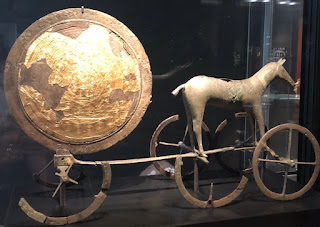
Oh by the way, you know how both Phoenician and Greek sea gods loved horses...And how Phoenicians considered Sun god and Sea god to be linked (brothers)...Well, ever heard of a solar horse? That pulls sun's chariot?
Bronze Age "Sun Chariot" pulled by a horse, Denmark 1400 BC...
But I am digressing, again 🙂 So Greeks are sacrificing to the sun god, when suddenly, a snake slithered from the altar to a sparrow's nest in a plane (platanus) tree nearby. It ate the mother and her nine chicks, then was turned to stone.
Calchas the seer interpreted this as a sign that Troy would fall in the tenth year of the war...
That's the same Calchas who during the second gathering of the Greeks at Aulis, before they actually set sail for Troy, told Agamemnon to sacrifice his daughter "for good winds"...
So the above mad "prophetic scene" with the snake, plane (platanos) tree and sparrows, is actually a complex animal and plant calendar marker, which points at exact time of the year when the first gathering of Greeks at Aulis took place...And the first sacrifice to Apollo...
First the snake. Snake is the only true solar animal. It is in our world when sun is in our world (day and hot part of the year) and it is in the underworld when sun is in the underworld (night and cold part of the year).
Considering that the Greeks were praying to Apollo, appearance of his holy animal is not a surprise at all...BTW, knowing that snake is a solar animal, the fact that Apollo took over the snake temple at Delphy makes a lot more sense now, doesn't it?
Anyway, apart from being the symbol of the sun and sun's heat, snake is more specifically a calendar marker for Apr/May, beginning of summer. Why? Because this is the time when most common snakes in Europe mate...And fight...Something not easy to miss if you are out and about...
So the snake comes out of the Apollo's altar, and slithers up a platanus tree...Platanus, is a very common tree in Greece...And because its distinctive red ball flowers appear in Apr/May, which are hard to miss, it is a perfect plant calendar marker for this time of year...

"This is all circumstantial!!!" I can hear classicists yell...
Enter sparrows 🙂
The snake slithers up the plane (platanus) tree and devours a sparrow and her chicks...Now there are two types of sparrows that live in Greece:
L: house sparrow http://oiseaux-birds.com/card-house-sparrow.html
R: Spanish sparrow http://oiseaux-birds.com/card-spanish-sparrow.html
Both house sparrow and Spanish sparrow nest in Apr/May...Incubation lasts 11-14 days and the chicks become independent at about 25-28 days...Sooooo...
So, the only time of the year when a snake could have devoured a nesting sparrow and her chicks on a plane (platanos) tree, is Apr/May...The beginning of the sailing season in the Eastern Mediterranean, right when the northerly trade winds start to blow down the Aegean sea...
Cool, right?
Homer doesn't give us a clue when did the second gathering at Aulis take place, but I would bet that it took place at the exact same time of the year, in Apr/May, the beginning of the sailing season...
When the northerly trade winds start blowing...Well they did, eventually, after Agamemnon sacrificed his daughter to Apollo's "twin sister" Artemis...Who was in her earliest incarnation associated with the Sun...Twin!!!...And snakes...And Gorgone......I will talk about it soon...
Well actually, Homer does, in a way, symbolically, give us a clue when the second gathering in Aulis took place, and when the Greeks sacrificed Iphigenia "for good winds": after Agamemnon killed a sacred deer...
Now I will soon write an article about Artemis and her sacred deer...But here I would just say that there is a time of the year, when all the stags die, and only hinds/does are left to graze the meadows...And that happens in Apr/May...Clue in this article, "The return of the Apollo to Delphi", where I analyse symbols depicted on this large Cycladic krater...
So, I think that we can pretty confidently say that the Greeks performed the first sacrifice in Aulis, and set sail for Troy in Apr/May...But when did they perform the second sacrifice in Troy and set sail back for Greece?
If I was a betting man, I would say in Apr/May, at the beginning of the sailing season in Eastern Mediterranean...You want to catch "the good winds" early...
The scene depicts Polixene being dragged towards the mound representing the tomb of Achilles, whose ghost is depicted as a miniature warrior flying above it...Love it 🙂 So far so expected...

The unexpected things are:
The ivy leaves and fruit on the shield of the Greek warrior standing to the left of Polyxene...
Huge snake and small lion depicted on the tomb of Achilles...
Polixene is depicted being dragged from the Ivy to the snake-lion...
Why?
Now in this article, "Woman and a pitcher", I explained why Ivy is linked to winter and the Winter sun, Dionysus...Ivy flowers in Autumn, and bares fruit during winter...See the little dark dots on the ivy wreath around Dionysus's head?
This is what is depicted on the shield of the Greek soldier who is standing behind Polyxene, blocking the way of the horses which are following Polyxene...Solar horses???
So Polyxene is being dragged from the winter, the season of ivy fruits, to the "season that starts when snakes begin to mate (Apr/May) and ends when lions begin to mate (Jul/Aug)"...Summer, also the best time to sail in Eastern Mediterranean...
Do you think that it is interesting that the grave mound, is symbolically linked to summer? Knowing that Phoenicians symbolically linked the god of death and the sun? I do...
Considering that Greeks sacrificed Polyxene on the grave of Achilles, with the snake, the marker for the beginning of summer depicted extra large, I would say that this sacrifice "for good winds", at the end of the Trojan war, took place at the beginning of summer, in Apr/May...
And just like the two sacrifices that wer performed "for good winds" in Aulis, and which were dedicated to Apollo and "his twin sister", this one that was performed in Troy is also most likely performed in the temple of Apollo, or dedicated to Apollo...
Cause it is the sun that heats up the sea and causes the northerly trade winds to begin to blow down the Aegean sea...And as expected, after the sacrifice, the good winds begin to blow...And the Greeks leave Troy and set sail to Greece...
Oh, BTW, Here is another Etruscan vessel, where ivy was used as a plant calendar marker related to Apollo...
These Etruscans knew stuff...Which Greeks seemed to have forgotten...I talked about it in my post "Skipping"...
So this is it from me for today I think...Hope you didn't give up half way through this article, and that you have found it interesting...
To read more about ancient animal and plant calendar markers, start here…then check the rest of the blog posts related to animal calendar markers I still didn't add to this page, and finally check my twitter threads I still didn't convert to blog post...I am 9 months behind now...