Thursday, 16 June 2022

Iris


Iris was originally the personal messenger of Zeus, later becoming the messenger of the Olympian gods in general...

Her name contains a double meaning, being connected with both the Greek word iris "the rainbow" and eiris "messenger, speaker of messages"...

Now, today Iris is known as the "goddess of the rainbow"...But in Dictionary of Greek and Roman Biography and Mythology we can read that "In the Homeric poems, Iris does not appear as the goddess of the rainbow, but the rainbow itself is called iris"...

Dictionary of Greek and Roman Biography and Mythology also states: "Even though some poets describe Iris actually as the rainbow itself, the more prevalent view in antiquity was that she was associated with a rainbow"...

For instance "the rainbow was only the road on which Iris traveled" or "Iris was rainbow clad" or "Iris blazed a rainbow trail beneath the clouds as she flew"...

This is very interesting. If Iris was not originally a personification of the rainbow, but was instead associated with the rainbow, what was she the personification of? 

I would suggest thunder/lightning...

In accordance with her role as messenger,  most of Iris's poetic titles and epithets are related to her swiftness: "swift footed", "wind-swift footed", "storm-footed, storm-swift"...

Is rainbow something you might call swift, fast? Is lightning something you might call swift, fast? Do we say "rainbow fast" or "lightning fast"?

In the Iliad, when Zeus sent Iris to summon Thetis: "Storm-swift-footed Iris started at once on this mission...she dived into the dark bosom of the sea with a resounding splash...She found Thetis...and said: Come, Thetis; Zeus in his unending wisdom calls you to his side"...

There is something very strange about this description of Iris "diving into the dark bosom of the sea with a resounding splash"...If Iris is a rainbow...Do we ever see rainbow as "moving", "diving", "plunging"?  What about lightning?

Can rainbow make a "resounding splash"? Another translation of this chapter is "Iris...plunged in the dark water, and the sea crashed moaning about her"...Can rainbow do that? Can it make "the sea moan"? Can thunder/lightning?

In the Dictionary of Greek and Roman Biography and Mythology we can also read that: "It is also possible that Iris's name may be connected with "eirô" (I join)...Join what? Lightning joins Sky (Zeus) and Earth...Rainbow???

Psalm 18:13: The LORD thundered from heaven, And the Most High uttered His voice.

What is the voice of the Sky god if not thunder/lightning???

If Iris was the personification of thunder/lightning, then that would explain the "resounding splash" that she makes when she plunges into the sea...Lighting strike would do that...Rainbows...Not really...

Thunder/lighting strike would make people look to the sky in fear and pay attention to what the Sky god had to say...Rainbow...Not really...

Thunder/lightning strike would make gods look to the sky and pay attention to what the Sky god had to say...Rainbow...Well you know yourself...

But what about Iris creating a rainbow when she moves...

Lightning is often tinged with another color around the edges. That color can be any color of the rainbow, but the three most common colors, are blue, yellow, and violet...


So it is possible that Iris could create a rainbow like display as she moves swiftly between the sky and earth, "speaking the messages (being the voice) of Zeus"...

Now here is something very interesting...In Vedic mythology, we find the storm and thunder god Indra happily married to a goddess called Indrani (basically female Indra). Here they are riding on an elephant together...

If you want to know why elephant check my post "Musth". In short, Indian elephants mating season overlaps with the Indian monsoon season...

This goddess has another, much more interesting name: Shachi...

Shachi is derived from the Sanskrit word "shach", which means "speak", "say" or "tell". Shachi is also associated with the Sanskrit word "shak", meaning "power", "strength", "action"...

So Indrani was the power of Indra...Which is why Indra was referred to as "Shachipati" meaning "master of Shachi" or "Shachivat" meaining "possessor of Shachi"...

But, even more importantly for our Iris story,  Shachi was the voice of Indra...The one who speaks for Indra...

What is the power of the storm and thunder god which is at the same time the voice of the storm and thunder god???

Oh by the way, rainbow was known as "the bow of Indra", who presumably shot lightning bolts from it??? So we have association between Thunder god, his messenger thunder/lightning and rainbow...

The same association between thunder god, his wife, his bow and rainbow is found in Slavic folklore, where we find Perun, the god of thunder and storms, happily married to his wife Perunika (literally female Perun), who wears a rainbow as her belt...

Perunika is not explicitly described as lightning personified...But she "helps her husband to load the lightning bolts and shoot them at thieves, liars, and immoral people in general"...Perun's bow is not explicitly described as a rainbow, but...

Oh yeah, did I mention that in South Slavic languages, Perunika is also the name for flower Iris...Flower which was believed to grow from the place struck by lightning...


Flower whose petals actually look like they have a depiction of a bright yellow lightning bolt in a dark blue sky...

So...I don't know what to  think about Iris really...

Oh yeah, I know that Iris was not the wife of Zeus, like Perunika (Iris) was the wife of Perun...But isn't it interesting that Iris "was often described as the handmaiden and personal messenger of Hera" the wife of Zeus...Curious...

Finally, someone just asked when does Perunika (Iris) flower...The beginning of the flowering season is Apr/May...Right at the beginning of the thunderstorm season in the Balkans...

Basically, Perunika is a plant calendar marker for the beginning of the thunderstorm season...

To read more about ancient animal and plant calendar markers, start here…then check the rest of the blog posts related to animal calendar markers I still didn't add to this page, and finally check my twitter threads I still didn't convert to blog post...I am 9 months behind now...


Fertility goddess with poppies

Akkadian seal, currently in the University of Chicago


Official description: "Sun god in a boat. On prow long-haired crowned figure with punting pole and human-headed lion, snake's head for stern, plow, vase and two objects above, fertility goddess beside boat, fish below"...

That's it??? Of course not...I wrote a whole article about what is actually depicted on this super interesting seal: "Sun god in a boat". But I missed few bits, which is why I am writing this article today...

In a nutshell, this is a complex calendar marker, which depicts beginning of summer (Apr/May), just after the grain and poppy harvest. This is symbolised by the goddess, with grains growing out of her body, holding poppies, standing behind the boat and waving it goodbye...

This girl is the same as this girl...Corinth plate with Demeter...Demeter is holding a torch in her right hand, symbolising winter. I love the fact that in her left hand she is holding grain and poppies, symbolising summer...Man can't live on bread alone. He needs drugs too :) 

Kind of important, right?

I talked about this link between grain goddesses and poppies in my posts "Demeter riding a panther"...

About torches...Check my articles "Abduction of Persephone", "Woman with torches and swans", "Thyrsus"...

I identified the seated figure holding the rudder and steering the boat as Shamash/Utu, the sun god...You can see this from the sun/heat rays coming out of his shoulders...

Sun god which rules summer, the dry, hot half of the year (Apr/May - Oct/Nov). I talked about him in my posts "Shamash young and old", "Canals", "When Utu steps up into heaven"...

On the above seal, Shamash is standing in a dry irrigation canal bed "between lions", meaning in Leo (Jul/Aug), the hottest and driest part of the year in Mesopotamia...


This part of the year is marked by a lion, because this is when Eurasian lions mating season starts...


So in my original post about the "Sun god in a boat" Akkadian seal, I proposed that the lion is in the boat, because the boat is sailing from the beginning of the Mesopotamian summer (harvest, Apr/May) to the middle of the Mesopotamian summer (Jul/Aug), Leo...

But somehow I completely missed the implications of the fact that the lion has a human head...

This is not an ordinary lion...This is Nergal, the god of death, who rules the hottest and driest part of the year...The Bad Shamash...The deadly sun in Leo, which brings drought and death. I talked about him in my post "Winged superhuman hero"...

So there are actually 3 gods in the boat

So we have Shamash steering the boat of summer towards the hottest part with Nergal hitching a lift towards Leo...So the third god. In my original post I completely ignored the "long-haired crowned figure with punting pole standing on the prow". Didn't know what to make of him...


Until recently, when I came across stories about Enki, the god of fresh water and the good of the annual flood of Tigris and Euphrates and his little boat...I wrote few articles about this: "Goatfish", "Enki's little boat", "Rain and flood"...


The above seal shows Enki in a boat, which represents the annual flood. The flood starts in (Apr/May), the time of the peak water levels in Tigris (left) and Euphrates (right)...And the grain harvest time. See the grain sheaf on the right of the boat?

By the way this part of the year (Apr/May) is marked by a bull, Taurus, Because this is the beginning of the calving season of wild Eurasian cattle. I talked about this in my post "Ram and bull", "Cow and calf ivory"


It's the snowmelt in the Anatolian and Zagros mountains, caused by the sun (Shamash/Utu) that releases the flood waters (Enki/Ea) which cause the flood during the calving season of Aurochs...Hence Both Shamash and Enki being linked to bulls...I talked about this in my post "Butt chewing"...


On the above relief you can see Triumphant Shamash, as a bull, in Taurus, which marks the beginning of the flood, Climbing up the mountain, to melt the snow and release Enki, the flood...His butt is being chewed by a winged lion though...Leo, which marks the end of the flood...


Back to Enki's boat, which represents the summer flood. 

On one side is grain (Apr/May). On the other side of the summer flood (Jul/Aug) is a star...Any random star? Of course not...

Sirius, rising before the sun, pretending to be "the morning star"... Otherwise known as Inanna/Ishtar "The queen of heaven"...The one that poses on the lion...In Leo...Girl which has some serious "conflicts of interest" with Nergal, Shamash, Sun in Leo...I talked about this in my post "Ninshubur", "Sacred marriage on a threshing floor"...

So, who is this guy? 

He is Enki depicted as being the flood boat...

BTW, do you see the fish underneath the boat? Check my post about "Goatfish", which explains why the annual flood was in Sumer known as "Carp flood"...And why fish always swims around Enki...

So that't it...Few bits which fell into place since I wrote the original article...

Hope you enjoyed this...

To read more about ancient animal and plant calendar markers, start here…Then check my twitter threads I still didn't convert to blog post...I am way way behind...

Wednesday, 15 June 2022

Sekirica

The (most likely ceremonial) battle axe "sagaris" of the Scythian period, 7th century BC. The Hermitage Museum, Saint Petersburg (Russia)....


The sagaris (Ancient Greek: Σάγαρις) is an ancient Iranian shafted weapon used by the horse-riding ancient Saka and Scythian peoples of the great Eurasian steppe. It was used also by Western and Central Asian peoples: the Medes, Persians, Parthians, Indo-Saka, Kushans, Mossynoeci, and others living within the milieu of Iranian peoples. According to Aristarchus of Samothrace, the legendary Amazons used the sagaris, as well. In The Histories, Herodotus attributes the sagaris to the Sacae Scythians in the army-list of Xerxes the Great...

The word "σάγαρις" is apparently a "...foreign word without known etymology...but one would rather...expect Iranian origin, and it is probably a cognate to Latin secūris (broad axe) and Proto-Slavic *sekyra (broad axe)..."

Hmmm....

Slavic word for an axe is sekira (sikira). While sekirica (pronounced sekiritsa), sikirica (pronounced sikiritsa) means "little axe", from sekira (axe) with "ica" diminutive ending which put together means "small (head) axe"...

Sounds very much like "sagaris" right? Which was a small head axe on a long handle...Like Scythian battle axe...Is there any etymology for σάγαρις (sagaris) in Iranian languages I wonder...If not, is it possible that σάγαρις (sagaris) came into Ancient Greek via an intermediate (Proto) Slavic???

Anyway, It gets more interesting...Enter the Akkadians...

In Ancient Greek, the word for an axe was πέλεκυς (pelekus) and for axe handle was πέλεκκον (pélekkon)...Apparently:

"... πέλεκυς is often considered a Wanderwort (A loanword that has spread to many different languages, often through trade or the adoption of foreign cultural practices), because of the similarity to Arabic فَلَقَ‎ (falaqa) meaning to split apart which comes from Akkadian 𒁄 (pilakku, pilaqqu) meaning wooden handle; spindle, harp, which itself comes from Sumerian 𒁄 (balag) meaning wooden handle; spindle, harp; possibly a split piece of wood or wooden wedge..."

A Wanderwort you say...Well if πέλεκυς is a Wanderwort, why is σάγαρις not one too? Because

Bronze axe head, Akkadian, c. 2340-2200 BC, inscribed with owner's name. Akkadian 𒅆𒆕 "šukurru" (metal wedge, spear, axe)...Officially "not related" to Slavic sekira (axe), Latin secūris (axe) and Ancient Greek σάγαρις "ságaris", Scythian axe. 


Definitely is related...

One of the Akkadian words for "destiny" is "isqu" meaning "lot" which derives from "esēqu" (to make a drawing, to incise a relief) and specifically "to apportion lots"...Etymology of the Akkadian word from: "Luck, Fortune, and Destiny in Ancient Mesopotamia Or How the Sumerians and Babylonians Thought of Their Place in the Flow of Things"...

Which is very interesting, considering that in Slavic languages "sek" (From PIE "sek" meaning to cut) means "to cut",  and "isek" means "to to cut out, to apportion".


How are these words not related? When it comes to Ancient Greek πέλεκυς (pelekus), apparently "...some suggest that the Proto-Indo-European terms are ultimately borrowed from...Akkadian..." Is it possible that  Akkadian words with "sk" root were borrowed into Akkadian from som IE language? Considering that the "sk" root only exists in IE languages...

And interestingly, we again find link between Slavic and Akkadian...I talked about few more in my posts "Kurban", "Pelasgos", "Kaunakes", "Zib-Ba-An-Na"...

Strange...Slavic being "the youngest IE language branch" and all that...


Sunday, 12 June 2022

Mycenaean vessel with prickly pears

Hammered conical silver vessel with gilded rim, known as the "Siege rhyton". Mycenaean, c. 1550 BC. Find from the tomb IV in Grave Circle A, Mycenae. Currently in the National Archaeological Museum of Athens.


It depicts the siege of the coastal city. Defenders have left the walls and are getting ready to engage the enemy. 

Women wave their hands on the walls, supporting them with shouts and gestures...

On the very right of the scene we can see two infantry soldiers with shields and spears. In front of them are three archers firing arrows at the enemy...And in front of them all are three slingers in a process of firing sling shots...

Was this the normal position for the slingers? Ahead of the other troops? I presume they would need a good view of the enemy and enough space to swing the sling...

Sling was a deadly weapon...


Publius Flavius Vegetius Renatus wrote that "Soldiers, notwithstanding their defensive armor, fear more the round bullets from the sling than all the arrows of the enemy"...The most common lead bullets among both Greeks and Romans were acorn-shaped. 


They were cast in two-part molds and measuring about 35mm X 25mm and weighing about 28 grams. In ancient Rome they were known as "glandes plumbeae" (lead acorns)...

Some of these molds were made to impart symbols on the sling shot. I am not sure, but I think this is a thunderbolt, a quite an appropriate symbol to put on a sling shot which strikes and kills from a distance like a thunderbolt...

But most of them had inscriptions like these: "This is for dessert", "Here’s a sugar plum for you", "Crack your teeth", "Catch" and several variations of "up [insert the enemy king name here] arse!"...

PS: is this the plant depicted in the background? The so called "prickly pear"?

No, it can not be, even if it is now very common in the Mediterranean. Opuntia is a cactus, like all cactus it is from America undiscovered at the time...But I don't know any other plant, native to Mediterranean, that looks like the plants depicted on this Mycenaean vessel...

Something crazy just occurred to me...Could this vessel be a modern forgery, made well after the introduction of the cactus into the Mediterranean, by someone, who like me, didn't know that this cactus was introduced from America? Ta Ta Taaaaaaaa! 🙂 Mystery...


Friday, 27 May 2022

Surya's wives

This very happy looking dude (no wonder he is happy, he has two gorgeous babes sitting on his laps) is no other than the Vedic Sun God Surya. You could say he is positively "beaming" with pride and excitement..And I guess pretty glad to have few extra hands...

Ok who are the babes? Well that's complicated (like every threesome is)...Thankfully, we have Rig Veda, the ultimate Indian tabloid of the time to tell us all about it. Here it goes:

It all started when Tvastar, the Holy Artificer, the creator of cosmos, and few other things, threw a Svayamvara party for his daughter Saranyu...

Svayamvara, as the readers of Rig Vedas are well aware, is a special party during which a girl of marrying age is supposed to pick her future husband from the assembled eligible suitors...

Well, as our readers know, Saranyu was a stunner, so pile of good looking, rich and powerful young men attended her Svayamvara, all hoping to get her hand (and elbow, and shoulder and)...

Among the potential husbands was Surya, under the name of Vivasvan. Surya was hot, hot, hot...I mean he was sizzling...Not surprising for a sun god, some readers might say...And of course Saranyu, picked him. So they get married...

So, the newly weds had steamy passionate relationship full of hot sex...Surya was walking around beaming more and more, cause he got picked by such a stunner who is also great in bed...But then one day, after Saranyu gave birth to Ashvin twins, she suddenly decides to leave...

It turns out, Surya got too hot. And he was all: look at me, I'm so hot...blah blah blah...To the point where Saranyu couldn't stand him any more...But in fairness, what did Saranyu expect (I can hear some of our readers say). She married a sun god...Cause he was hot...

Anyway, before she left, Saranyu arranged "services" of a woman called Savarna, to replace her in Surya's bed. [Or maybe gods arranged this, it all happened all of a sudden before our reporters could get to the Surya's mansions]...Savarna was "similar" to Saranyu, but mortal...

Surya of course didn't notice the swap. [All he was interested was my body, Saranyu said later to our reporter. He didn't care about me as a person. So he was easily fulled by a body double]...And so he went on banging his gorgeous "wife". But  Savarna bears him no children...

Saranyu in the meantime goes back to her father, Tvastar, complaining about Surya: He is just unbearable, I can't even look at him any more...Beaming, beaming, beaming...Uhhhh...

But her father basically tells her: 

"What are you complaining about, you wanted a hottest guy you got the hottest guy...Go back to your husband...And as for the beaming, I'll give him a call and tell him to turn it down a notch...Ok? Good girl!"

[Men 😠, Saranyu later remarked]

So what's all this about...I think climate in India...The climate in India is pretty much hot all the time...The sun, Surya, rules the place...Hence the bling, and the babes...

Here is yearly temperature and precipitation for New Delhi...

The [super important] bit that changes twice a year, are the prevailing winds. During the summer, between Apr and Sep they blow from the sea northwards. And during the winter, between Oct and Mar they blow from the mountains southwards...

Summer winds bring rain. They make rivers swell and rush and make land fertile... 

Winter winds bring drought. They make rivers dry out and make land barren...

I talked about these winds in my post "Ganesha"...

What does this have to do with Surya's wives?

Saranyu is the female form of the adjective saraṇyú, meaning "quick, fleet, nimble", used for wind and flowing water in the Rigveda. Saranyu has also been described as "the swift-speeding storm cloud"...

The name of her replacement Savarna, means "same-kind"...She is not the same as Saranyu, but similar to Saranyu...She is a wind, but not the same wind...

One of the main differences in the between the two, at least in Vedas, is that Saranyu is fertile while Savarna is barren... 

Saranyu is the wet summer monsoon which makes the land fertile...

Savarna is the dry winter monsoon which makes the land barren...

I wonder if this is the reason that one of Surya's consorts is depicted with bare breasts (as in breastfeeding mother) and the other one with covered breasts...Don't know, but If I wanted to depict two Indian seasons, that's how I would do it...Sexy...🙂

PS: Tvastar did call Surya. This is the recording of the conversation obtained by one of our reporters: 

"Son, my daughter came to me today, and burst my ear complaining about you...I am hoping you do understand that when my only daughter is unhappy, that makes me unhappy...And when I am unhappy someone usually gets hurt. You do understand that? Good. So I assume she will not come complaining again?

Surya knew better than to mess with the godfather of the universe...See how temperatures drop after the end of the rain season...

Watering papyrus

Here is another very interesting object I've stumbled across in Louvre last weekend 

It is a Hellenistic stela dated to the 4th-3rd c. BC, found in Umm al-Amad, Lebanon. The important bit of the description is circled in red


So...A ritual "watering of papyrus" by two (semi?) naked women...Anyone heard of this ritual? 

I can bet that this is a fertility related ritual considering papyrus is watered by (semi?) naked women 🙂 That and the fact that it "recalls the Egyptian motif of annual renewal"...

But what does "Egyptian motif of annual renewal" mean? Well check this article: "Cow and calf ivory", in which I talk about the importance of papyrus in Egyptian mythology. Why it is directly linked to the annual flood. It is basically a plant calendar marker that marks the beginning of the rising of the water level in the river Nile, because the papyrus start flowering at that exact time...

Here is Hathor/Mehet Weret (Great Flood), emerging from the flowering papyrus...


Hence "annual renewal"...

Hence "ritual watering of papyrus"...The ritual imitation of the flood...Very interesting indeed...

I wonder if people in Umm al-Amad knew what this all meant? This stela is definitely not an import from Egypt. It was made locally. Depicting local people performing ritual papyrus watering...Which makes no sense in Lebanon...

Anyway another great example of a transplanted deified calendar marker. This time plant calendar marker...

To read more about ancient animal and plant calendar markers, start here…then check the rest of the blog posts related to animal calendar markers I still didn't add to this page, and finally check my twitter threads I still didn't convert to blog post...I am 9 months behind now...

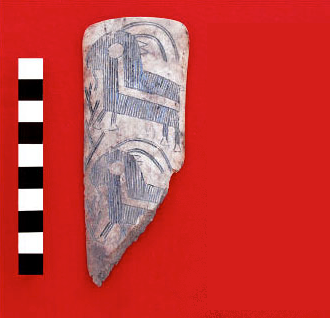
Goat and snake from Körtik Tepe

Two very interesting objects from the 10,000BC  Pre-Pottery Neolithic B site Körtik Tepe, located in the Diyarbakır district of Turkey. Thanks to @MattSibson for the great info about early Anatolian sites...

To understand what these two objects represent, we need to look at the climate in the Körtik Tepe area


You can see that the climatic year in the area is divided into hot, dry half (roughly Ap/May - Oct/Nov) and the cool, wet half (roughly Oct/Nov - Apr/May)

Now lets have a look at these two objects. 

The object on the left is engraved with the depiction of two Ibex goats and a tree...

Ibex goats, which start mating, and fighting, in Oct/Nov, at the beginning of the rain season in the area of Körtik Tepe...

So Goats (of rain) with tree (of life)...

I talked about the depictions of the Goats of Rain in early Anatolian sites in my post "Goats and tree of life from Çatalhöyük"...

The object on the right is engraved with the depiction of three snakes. 


And not just any snakes, Vipers, which start mating in Apr/May, at the beginning of the drought season in the area of Körtik Tepe...

So Snake (of drought)...

These two objects are depicting two animal calendar markers:

Goat, marking the beginning of the cool, wet season in the area of Körtik Tepe (Oct/Nov), 

Snake, marking the beginning of the hot, dry season the in the area of Körtik Tepe (Apr/May)...


So goat and snake...

To read more about ancient animal and plant calendar markers, start here…then check the rest of the blog posts related to animal calendar markers I still didn't add to this page, and finally check my twitter threads I still didn't convert to blog post...I am 9 months behind now...