Showing posts with label Rainbow symbolism. Show all posts

Sunday, 8 December 2024

Rainbows and peacocks

A Sassanian dish, 400-600AD, Iran, Currently in Al Thani collection...

What is exactly depicted here? Some would say just an exotic dancer. I think that this is a depiction of the goddess Anahita, Zoroastrian goddess of water and fertility...

I already talked about Anahita in my post "Anahita" about this Sassanian dish, which again depicts her "holding a scarf above her head"...
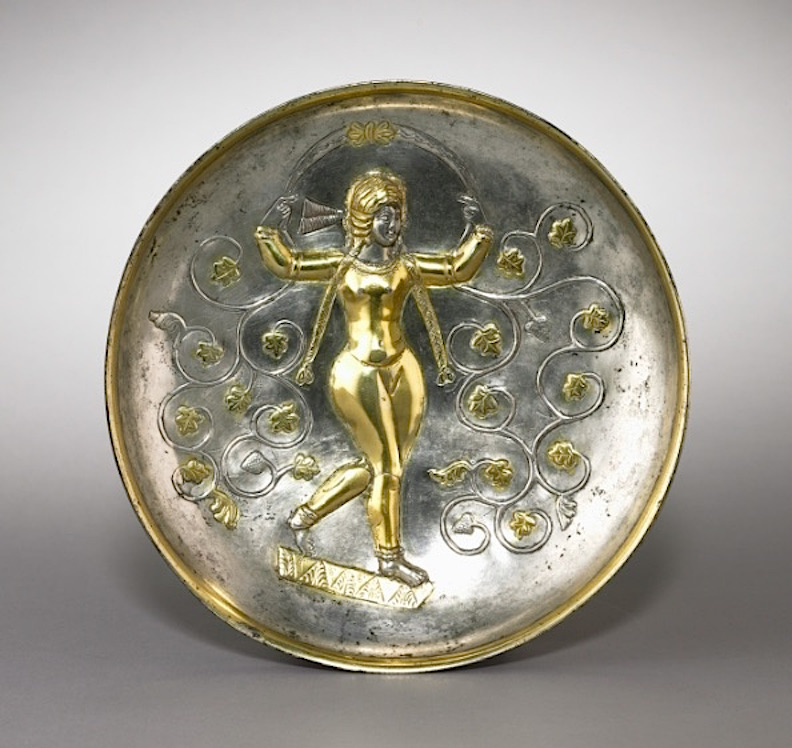
In that article, I proposed that the scarf is symbolic depiction of a rainbow. 

Rainbow which is in Iran only seen during the rain season, which in most of Iran is Oct/Nov - Apr/May...


I also proposed that this is the tree of life that is depicted growing out of her scarf (rainbow) because it is the rainbow creating rain that is the source of life in Iran...

I then backed my claim by this other Sassanian dish which depicts the same tree of life, this time without Anahita as it's source, but instead flanked by two ibex goats, the goats of rain...

Ibex goats are animal calendar marker for the Oct/Nov, the beginning of the rain season in Iran, because Oct/Nov is when ibex goats start mating in Iran, mating which is characterised by vicious male goat fights...

I talked about symbolism of ibex goats in many of my posts, like 

Europe:

"Pitys", "Goat in European culture", "Patera of Rennes"... 

Levant:

"The tree of life/light", "Lachish animal calendar"...

Mesopotamia:

"Feast plaque from Louvre", "Green pastures", "Problems with Abzu", "Relief from Dur Sharrukin", "Goatfish"...

Iran: 

"Flamingos from Susa", "Goat carrier", "Iranian goat of rain", "Strider", "A vessel from Tepe Hissar"...

Above the goats, we can see some birds: 

Male and female peafowl

Male and female pheasants 

Why?

Well because both of these bird species start their mating season in Mar/Apr...

And this is important why?

Well, because all that rain (and snow) that falls during the cool wet season cause the water flow of the rivers in Iran to suddenly start increasing in Mar/Apr which leads to the floods in Apr/May/Jun...

Flow chart for the Zayandehrud River that flows through Isfahan. It suddenly increases in Mar/Apr. 

And here is Aries Ram, with blue (water) horns, lying in water...Describing exactly what is happening in Mar/Apr...In Aries...

Talked about it in my post "Sagittarius from Isfahan", about an amazing 14th c. Isfahan zodiac... 

Floods that Anahita as the goddess of water was also linked to...

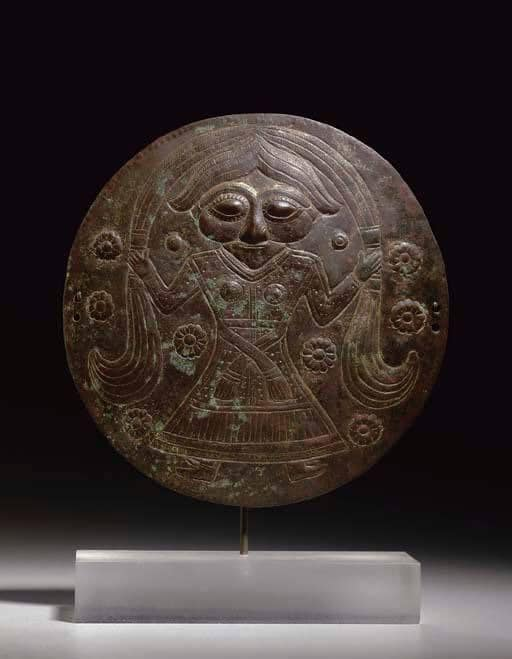
We find Anahita with rainbow in Iron Age Iran...Bronze disc from Luristan, Western Iran. 8th century BC depicting a goddess holding a scarf (rainbow) above here head...
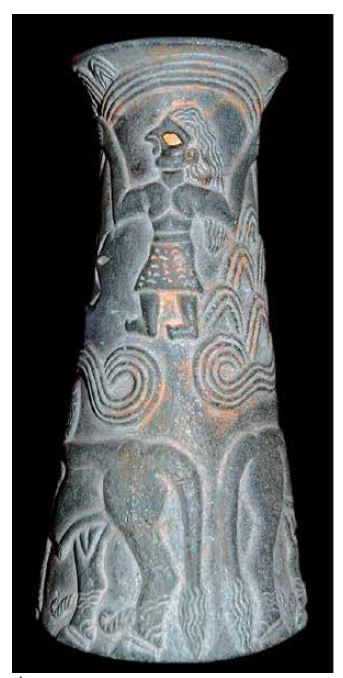
And in Bronze Age Iran...Chlorite carved flask, Jiroft culture, Western Iran, 3rd millennium BC depicting a goddess holding a rainbow above here head...

I talked about this in my post "Jiroft flood vase"...

Here is the whole flood vase design:

Bronze Age Anahita? Goddess of water? Standing on bulls...

In Taurus? Apr/May? The time of the annual flood? It seems like this is what is depicted here, considering that the goddess is holding a water scarf (rainbow) and the same water is depicted flowing out of bulls heads...

I talked about the link between bulls and annual flood in Iranian art in my post "Dedicated to Inshushinak", about this 3200 years old Elamite ceremonial silver pouring vessel with handle and double spout in the form of two bulls...

So peacocks and pheasants start mating right at the time when the water levels in Iranian rivers start to rise...

This is why, on our original Al Thani dish, Anahita is holding a scarf with the peacock feathers "eyes" designs above her head, and is flanked by two peacocks...

BTW, in India, where peacocks come from, they breed during the monsoon season, and are believed to "call the rain to come"...

I talked about this in my post "Makara", about the mount of the old monsoon god Varuna, who was mainly just imagined as a crocodile, but was sometimes imagined as a complex "creature" (animal calendar marker), with a peacock tail...

BTW, do you see the star and the moon next to the Bronze Age Anahita? 

That's symbol of Sirius..The original star of Inanna/Ishtar, before Venus took over...

I talked about this takeover in my post "Sirius the mother of Venus"... 

I explained why, based on Sumerian Inanna mythology, only Sirius could have been the original star of Inanna/Ishtar in my posts: "Inanna and Sukaletuda", "The brightest star"...

The brightest star which is visible in winter sky over Iran together with the winter moon...

I talked about the winter wet moon in my post "Moon god Nana/Sin"...

Sirius disappears from the night sky in Apr/May...The time of the fertility bringing annual flood...The emptying of the winter moon...Which is why we find this symbol right next to Bronze Age Anahita holding a rainbow...And which is why in the Sumerian epic "Inana and Šukaletuda" we read that Inana "stretched herself like a rainbow across the sky, and reached thereby as far as the earth"...

Cause Bronze Age Anahita was the same goddess as Bronze age Inanna/Ishtar...

It seems that I am not the only one linking Inanna/Ishtar with Anahita. I recently came across this article which actually explores the possibility that Anahita could actually be Inanna/Ishtar in disguise...

To read more about ancient animal and plant calendar markers, start here…Then check my twitter threads I still didn't convert to blog post...I am way way behind...

Thursday, 16 June 2022

Iris


Iris was originally the personal messenger of Zeus, later becoming the messenger of the Olympian gods in general...

Her name contains a double meaning, being connected with both the Greek word iris "the rainbow" and eiris "messenger, speaker of messages"...

Now, today Iris is known as the "goddess of the rainbow"...But in Dictionary of Greek and Roman Biography and Mythology we can read that "In the Homeric poems, Iris does not appear as the goddess of the rainbow, but the rainbow itself is called iris"...

Dictionary of Greek and Roman Biography and Mythology also states: "Even though some poets describe Iris actually as the rainbow itself, the more prevalent view in antiquity was that she was associated with a rainbow"...

For instance "the rainbow was only the road on which Iris traveled" or "Iris was rainbow clad" or "Iris blazed a rainbow trail beneath the clouds as she flew"...

This is very interesting. If Iris was not originally a personification of the rainbow, but was instead associated with the rainbow, what was she the personification of? 

I would suggest thunder/lightning...

In accordance with her role as messenger,  most of Iris's poetic titles and epithets are related to her swiftness: "swift footed", "wind-swift footed", "storm-footed, storm-swift"...

Is rainbow something you might call swift, fast? Is lightning something you might call swift, fast? Do we say "rainbow fast" or "lightning fast"?

In the Iliad, when Zeus sent Iris to summon Thetis: "Storm-swift-footed Iris started at once on this mission...she dived into the dark bosom of the sea with a resounding splash...She found Thetis...and said: Come, Thetis; Zeus in his unending wisdom calls you to his side"...

There is something very strange about this description of Iris "diving into the dark bosom of the sea with a resounding splash"...If Iris is a rainbow...Do we ever see rainbow as "moving", "diving", "plunging"?  What about lightning?

Can rainbow make a "resounding splash"? Another translation of this chapter is "Iris...plunged in the dark water, and the sea crashed moaning about her"...Can rainbow do that? Can it make "the sea moan"? Can thunder/lightning?

In the Dictionary of Greek and Roman Biography and Mythology we can also read that: "It is also possible that Iris's name may be connected with "eirô" (I join)...Join what? Lightning joins Sky (Zeus) and Earth...Rainbow???

Psalm 18:13: The LORD thundered from heaven, And the Most High uttered His voice.

What is the voice of the Sky god if not thunder/lightning???

If Iris was the personification of thunder/lightning, then that would explain the "resounding splash" that she makes when she plunges into the sea...Lighting strike would do that...Rainbows...Not really...

Thunder/lighting strike would make people look to the sky in fear and pay attention to what the Sky god had to say...Rainbow...Not really...

Thunder/lightning strike would make gods look to the sky and pay attention to what the Sky god had to say...Rainbow...Well you know yourself...

But what about Iris creating a rainbow when she moves...

Lightning is often tinged with another color around the edges. That color can be any color of the rainbow, but the three most common colors, are blue, yellow, and violet...


So it is possible that Iris could create a rainbow like display as she moves swiftly between the sky and earth, "speaking the messages (being the voice) of Zeus"...

Now here is something very interesting...In Vedic mythology, we find the storm and thunder god Indra happily married to a goddess called Indrani (basically female Indra). Here they are riding on an elephant together...

If you want to know why elephant check my post "Musth". In short, Indian elephants mating season overlaps with the Indian monsoon season...

This goddess has another, much more interesting name: Shachi...

Shachi is derived from the Sanskrit word "shach", which means "speak", "say" or "tell". Shachi is also associated with the Sanskrit word "shak", meaning "power", "strength", "action"...

So Indrani was the power of Indra...Which is why Indra was referred to as "Shachipati" meaning "master of Shachi" or "Shachivat" meaining "possessor of Shachi"...

But, even more importantly for our Iris story,  Shachi was the voice of Indra...The one who speaks for Indra...

What is the power of the storm and thunder god which is at the same time the voice of the storm and thunder god???

Oh by the way, rainbow was known as "the bow of Indra", who presumably shot lightning bolts from it??? So we have association between Thunder god, his messenger thunder/lightning and rainbow...

The same association between thunder god, his wife, his bow and rainbow is found in Slavic folklore, where we find Perun, the god of thunder and storms, happily married to his wife Perunika (literally female Perun), who wears a rainbow as her belt...

Perunika is not explicitly described as lightning personified...But she "helps her husband to load the lightning bolts and shoot them at thieves, liars, and immoral people in general"...Perun's bow is not explicitly described as a rainbow, but...

Oh yeah, did I mention that in South Slavic languages, Perunika is also the name for flower Iris...Flower which was believed to grow from the place struck by lightning...


Flower whose petals actually look like they have a depiction of a bright yellow lightning bolt in a dark blue sky...

So...I don't know what to  think about Iris really...

Oh yeah, I know that Iris was not the wife of Zeus, like Perunika (Iris) was the wife of Perun...But isn't it interesting that Iris "was often described as the handmaiden and personal messenger of Hera" the wife of Zeus...Curious...

Finally, someone just asked when does Perunika (Iris) flower...The beginning of the flowering season is Apr/May...Right at the beginning of the thunderstorm season in the Balkans...

Basically, Perunika is a plant calendar marker for the beginning of the thunderstorm season...

To read more about ancient animal and plant calendar markers, start here…then check the rest of the blog posts related to animal calendar markers I still didn't add to this page, and finally check my twitter threads I still didn't convert to blog post...I am 9 months behind now...


Sunday, 16 January 2022

Birth giver from Luristan

Luristan bronze disk pin, c. 1500 to 700 BC, showing a woman giving birth while holding her breasts, between 2 gazelles, and among flowers. Louvre museum, Paris. From Iranian province of Luristan...


Archaeologists interpret this image as "depiction of Mother Goddess", basically Mother Earth giving birth to all and providing food for all...And I 100% agree with this...

I think the fact that the Birth Giver is depicted between the two gazelles (Goitered Gazelles to be more precise) and the flowers is the proof that this is indeed Mother Goddess, Mother Earth...

Here is why. This is climate chart for Luristan...You see how the year is divided into hot dry summer (May-Oct) and cool wet winter (Nov-Apr)?

Guess what happens in Oct/Nov? Goitered gazelles start mating...Which is why they are used in this part of the world as animal calendar markers for the beginning of the rain season (winter) and for the whole rain season (winter)

So this image basically means: Mother earth gets fertile and produces life and food because of the rain (and snow) which falls during winter, period between the mating and birthing of Goitered gazelles (gestation period of Goitered gazelles is 5-6 months)...

Here is the same "girl", this time holding a shawl, basically a stylised rainbow...Bronze disc from Luristan, western Iran. 8th century BC...Sold by Christies for 28,000$...

Rainbows are only visible during rain season...And this same symbol for the "moist fertile earth" was used in Iran from Jiroft culture until Sassanian culture...I talked about this in my post "Anahita" and "Jiroft flood vase"...

This link between Mother Earth's fertility and rain, depicted through the image of birth giver surrounded by plant and animal calendar markers for rain season, is what I was talking about in my previous post "Modesty", about the Indian version of this goddess, Lajjā Gaurī...

What is very interesting is that because the climate in Iran and India is different, the animal and plant calendar markers used to link the birth giver with the rain are different...Appropriate for the local climate...

If you are interested in animal (and plant) calendar markers, start here, then check the rest of the blog posts I still didn't add to this jump page (I got lazy after a while), and finally check my twitter threads @serbiaireland I still didn't convert to blog post...I am 11 months behind now...

Wednesday, 16 September 2020

Jiroft flood vase

This is the chlorite carved flask discussed in the paper entitled "Searching for mythological themes on the 'jiroft' chlorite artefacts" by Massimo Vidale of the University of Padua. The Flask dated to the 3rd millennium BC, is kept in the Bagh-e Harandi Museum, Kerman. 

In the paper we read: "The scene can be coherently read from the bottom to the top. In the foreground, we see a long-haired personage in kneeling position who grabs from the throat two massive humped bulls facing each other in a heraldic position. Below the neck of the animals runs a strip simiilar to a rope...The bulls (probably sky creatures) emanate heavy water flows, causing a major flood. At the end, the first mountain (or mountains) emerges from the flooded world, as water retires. Then another long-haired personage, accompanied by two heavenly signs (moon and star), puts in the sky an imposing rainbow, and signals that the flood is finished. Beyond the rainbow, a renovated world has finally emerged from the deadly waters."


So the paper interprets the scene from the vase as "a representation of a destructive flood, ending when a divinity lifts a rainbow in the sky at which point the first mountain emerges from the flood waters". And it then goes on to compare these images with Old Babylonian and later cuneiform versions of flood myths. 

I would have to strongly disagree with this interpretation. 

I don't think that the scene depicts a destructive flood and certainly not "The Flood". Instead it depicts the annual flood, the snowmelt flood, which was the main source of water, and life, for the people of the Jiroft culture. 

The rivers in the mountain areas of Iran, including the Halil river, around which the Jiroft culture was based, are fed by rainfall during the winter, but mostly by snowmelt during spring and summer. The snowmelt starts in late Feb early Mar, and peaks in late Apr, early May. 

Pic: the flow of Iranian rivers, which have a spike between Mar and Aug with peak in late Apr early May...


Pic: Halil River

So the flood peaks in late April early May, in Taurus. As I explained in my article about Khafajeh vase, another very interesting Jiroft artefact, on which bulls are linked with water, there is a direct link between the old wild cattle and the annual flood season in the Jiroft area. Here is the bulls and "rivers" part of the scene from the Khafajeh vase:

These are not just any bulls. These are Zebu bulls. Zebu's mating season coincides with the snowmelt flow season which peaks in Taurus 🙂. This is why, on Khafajeh vase, the "human looking being" who stands on zebus is holding flowing water, the rivers among lush vegetation...This is also why water, actually rivers, "emanate" from the bulls heads on this Jiroft vase. 

So the Jiroft rivers flood during the spring and summer. 

But the rain and snow that feed them fall during the winter and spring...

The climatic year in the Halil River (Jiroft) area is divided into dry season (Apr/May to Oct/Nov) and wet season (Nov/Dec-Mar/Apr). The wettest month is Feb, while the driest month is Jul which is also the hottest month...

The only time when you can see a rainbow is during the rain season. Which is winer and spring.  The rainbow "personage" has moon pointing upward with a star. The moon points up during the winter. 

Which is the rain and snow season in Zagros mountains. Hence the only time you can see a rainbow.

So the rainbow personage (I think most likely goddess) represents winter (and spring) and the zebu "personage" (I think this could be goddess again) represents (spring and) summer snow melt floods. The water reach seasons... 

By the way, remember this rainbow girl from Sassanian Iran? 

People now think that this girl "is just a dancer". But once people thought that she was Goddess of water and fertility Anahita. I talked about her in my post Anahita. By the way I still think she is the water and fertility goddess...Mostly because she is holding a rainbow from which vegetation grows...Basically she symbolises the same thing as the rainbow "personage" from the Jiroft flood vase. Rain creating life...

So it seems that the rainbow goddess was the thing in Iran from at least Jiroft culture, until the Sassanian culture...

We know this because these two rainbow holders are linked by this: Bronze disc from Luristan, western Iran. 8th century BC...Sold by Christies for 28,000$... 

Oh and it is not "the first mountain emerges from the flooded world as the waters of The Flood recede"...It's just the Zagros mountains, the source of water and life for Jiroft people...The rainbow is over the mountains because Jiroft guys lived in valleys surrounded by high mountains...

To read more about ancient animal and plant calendar markers, start here…then check the rest of the blog posts related to animal calendar markers I still didn't add to this page, and finally check my twitter threads I still didn't convert to blog post...I am 9 months behind now...