One thing no one talks about when they analyse the conquering of the Minoans by the Mycenaeans is this:

What influence did Minoan warming have on Minoan agriculture and their ability to feed their population? And the reputation of their ruling priestly caste?
What prompted me to ask this question was this interesting X thread which tries to answer the question: How come Mycenaeans were able to so (seemingly) easily conquer the Minoan civilisation even though we know that Minoans had a strong army and navy...

Great account btw, with great threads...
The main hypotheses presented in this thread is that Thera volcanic eruption and the series of earthquakes and preceded it caused a wave of refugees from the Cycladic islands to descend on Crete, causing population explosion, and eventually food shortage...
I lived on Crete. It is a huge, fertile island, with lots of arable land, the garden of Greece, that supplies the Greek mainland with fruit and vegetables.

I am pretty sure that it was able to sustain the Bronze Age Cretan population plus any refugees that could have come to the island from the Cyclades...Providing the climate didn't get too hot...

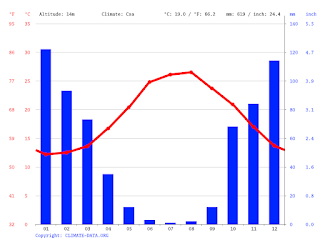
Which is exactly what happened during the Minoan warming period...I don't know what kind of effect that would have had on the local Cretan climate. Most likely negative. This paper states that:
"Climate modelling results show a decrease in precipitation and an increase in temperature from 2001 to 2100, resulting in 18-56% decrease of flow, 15-34% decrease of soil moisture and 22-65% decrease of groundwater reservoir volume"...
The temperature during Minoan warming was even higher...That would have had a catastrophic effect, triggering famine and the loss of power of the ruling theocracy, which probably claimed that they can in some way control the weather (all religions do that to some extent)...
Mostly through sacrifices, usually animal sacrifices...

You can read more about this in "Minoan Sacrificial Ritual, Cult Practice and Symbolism"...
I also wrote about Minoan animal sacrifices in these two articles: "Minoan bull sacrifice" and "Agia Triada sarcophagus".
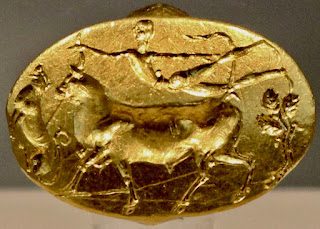
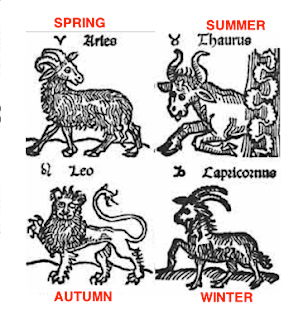
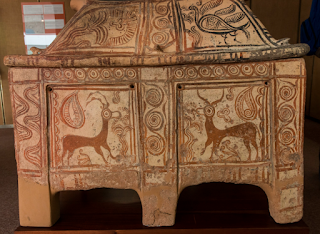
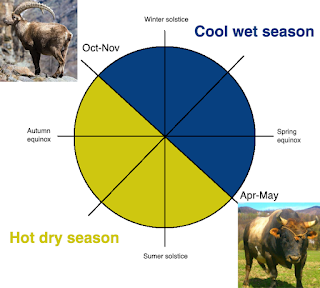
In them I proposed, based on the analysis of the animal and plant calendar markers depicted on this sarcophagus that this scene from the Minoan Hagia Triada Sarcophagus didn't depict funeral scene but a sacrifice of calves and a boat to (Proto) Poseidon.

It turns out I could have been right: When Odysseus’ son Telemachus voyages to Pylos, he witnesses the sacrifice of 81 bulls to Poseidon. Archaeologists have found what’s likely an inventory for a very similar real-life ceremony recorded on tablets unearthed at Pylos!

You can read about it here...
But there is evidence that during extremely difficult times Minoans, like many other peoples in similar situations, practiced human sacrifices too.
In the summer of 1979, Giannis and Efi Sakellarakis, excavated the so-called Temple of Anemospilia, which was located at the northern foothills of Mount Juktas and in close proximity to the important Minoan site of the Archanes.
The Temple was a symmetrically rectangular building, consisting of three rooms on the south side and a vestibule on its north side, having a clear palatial orientation.

It was destroyed by an earthquake and a subsequent fire...
This is a depiction of what the temple contained inside (based on archaeological findings) at the moment of its destruction:

The important thing is what was found in the western room.
It contained three bodies:
an approximately 28-year-old woman, lying face down;
an approximately 37–38-year-old man, lying on his back;
an approximately 18-year-old male, lying on a slightly raised structure/platform.
The last individual was discovered on a raised platform in such a tight fetal position which indicated that he was bound. A bronze blade was found associated with his body.
The archaeologists argued that all the forensic evidence indicated that he had been killed shortly before the earthquake/fire.
The adult man and woman were interpreted as the priest and priestess.
Their reconstruction of the events was:
Earthquakes threaten the community.
Priests attempt to appease the deity with a human sacrifice.
Sacrifice is underway. The sacrificial victim is already dead. Blood is being collected for libation.

Another earthquake strikes.
Building collapses and kills everyone inside...
You can read more about this in "Drama of Death: Human Sacrifice in a Minoan Temple"
I am sure that the sudden climate only increased the number of sacrifices, but also decreased the belief of the local population in the effectiveness of these sacrifices and in the power of the priests who performed them...
The same happened with Latin American native cultures...
This probably caused unrests. Maybe even an uprising against the ruling elite. Maybe even a civil war. Which probably prompted one of the Minoan leaders to hire Mycenaean mercenaries to help him fight whoever he was fighting, his own population or other Minoan leaders...
Mycenaeans were known as arms for hire in the whole of Mediterranean...Egyptians used them. So I would say Minoans did too...But as we know from history, mercenaries often turn on their employers in the failing states...

Once on the island, in the middle of the chaos caused by the earthquakes and the climate change, Mycenaeans seized control first of the city state they were meant to protect and then of the rest of the island...
Simple...
I honestly can't see any other reason...
All the ancient civilisations were ruled by the elites who based their power on their ability to feed the population...
The temples and palaces were centres of agricultural administrations first and foremost and were responsible for agricultural organisation and support.
And when they failed to fulfil this duty...
PS: You might find this interesting. In this old article, "Legendary battle" originally proposed this: Is it possible that the "Combat agate" was worn by a Minoan warrior to commemorate a once famous Minoan victory over Mycenaeans? Only to be taken off his dead wrist by an avenging Mycenaean warrior, buried in the warrior grave found near Pylos, Greece?

But now that we know that The Griffin Warrior was not genetically Mycenaean (The 2022 Science study and UC research confirm no steppe ancestry. Actually, they confirm the exact opposite—his DNA shows local origins, rooted in Neolithic Aegean populations, not Yamnaya)...
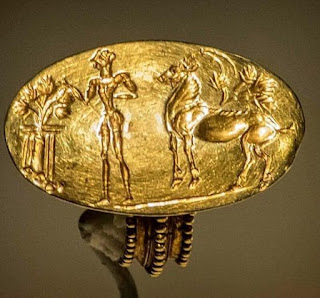
Maybe this Minoan jewel was never taken off "a dead Minoan hand"...
Maybe Mycenaeans didn't conquer Minoan Crete completely replacing Minoan elite with their own...Maybe the story is much more complicated...Maybe a new, mixed elite was formed which then took over the whole of Aegean...The huge cultural influence Minoans had on Mycenaeans supports this...