Showing posts with label Iris. Show all posts

Sunday, 31 July 2022

12 Olympians

In this article, I would like to again point at things hidden in plain sight...Around 435 BC, Greek sculptor Phidias made a giant seated statue of the sky and thunder god Zeus for the Temple of Zeus in Olympia...

Unfortunately the statue was destroyed during the 5th century AD; but we know what the statue looked like from Greek and Roman coins...
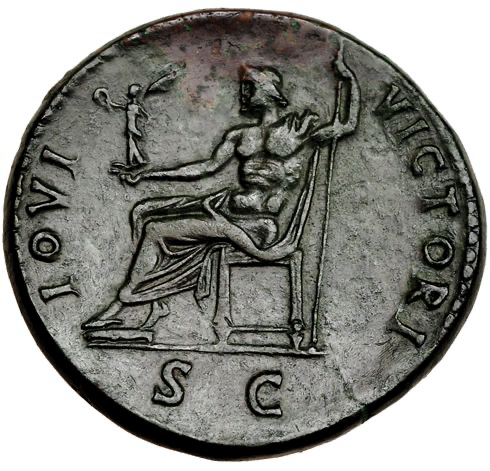
And from written records, like the one left by the 2nd c. AD geographer and traveler Pausanias

What I want to talk about here is what Pausanias says about the platform that supported the throne. He says that it depicted a line of paired deities standing between the sun and the moon...

Zeus and Hera...and Hermes and Vesta close to Hermes...and Eros receiving Aphrodite...and Apollo and Artemis...and Athene and Hercules, and at the end Amphitrite and Poseidon...

They were all coupled based on some mythological link that connected them. What is interesting is that Phidias depicted Hermes coupled with Hestia...Why? 

What is the relationship between these two deities? They are not husband and wife, nor brother and sister, nor mother and son nor protector and protege...

Holy fire and a Messenger of Zeus? What could connect the two? 

That these two were not put together by accident on the Zeus's throne, can be seen from this Fragment of a Hellenistic relief (1st c. BC–1st c. AD) currently in the Walters Art Museum and depicting the twelve Olympians...
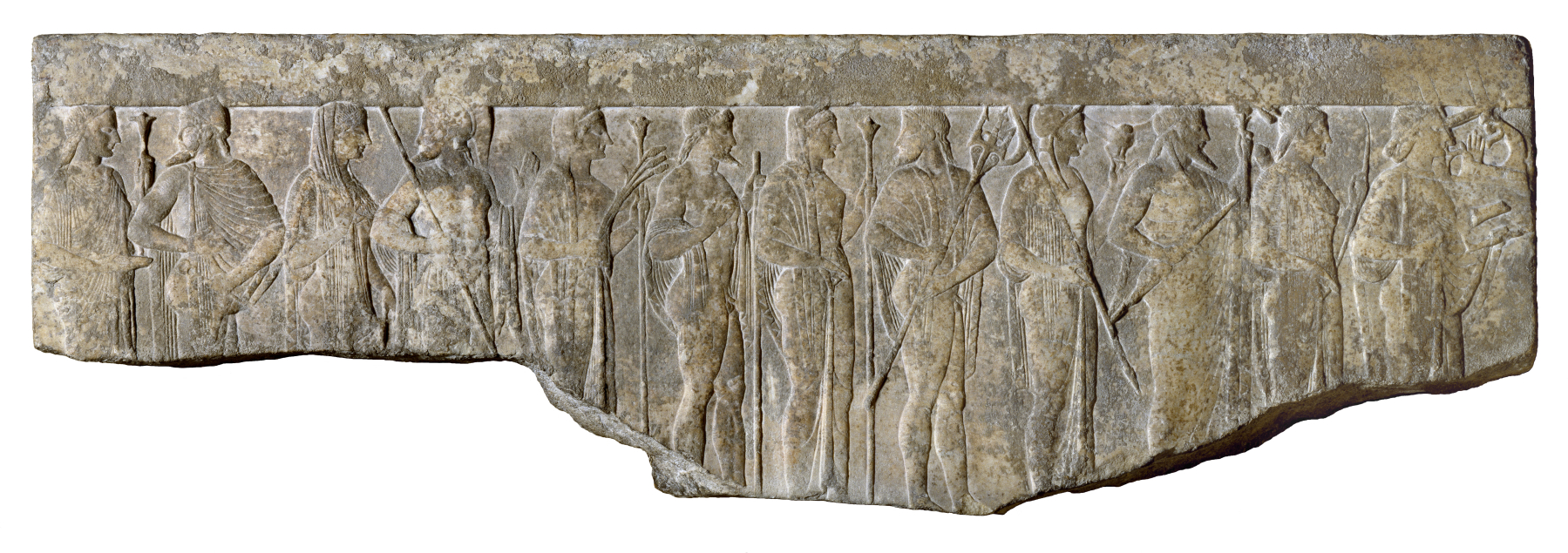

From left to right: 

Hestia, Hermes, Aphrodite, Ares, Demeter, Hephaestus, Hera, Poseidon, Athena, Zeus, Artemis, Apollo

Here they are, Hestia and Hermes...

Hestia and Hermes were also linked together in The Homeric Hymn 29 to Hestia...

"Hestia, in the...dwellings of all, both deathless gods and men who walk on earth, you have gained an everlasting abode and highest honour...for without you mortals hold no banquet...and you, Hermes, messenger of the blessed gods, bearer of the golden rod, giver of good...be favourable and help us, you (Hermes) and Hestia...come and dwell in this glorious house in friendship together; for you two, well knowing the noble actions of men, aid on their wisdom and their strength..."

Really, what's going on with these two? 

Well, lots of people have asked this question before me...

Jean-Pierre Vernant asked this question in 1969 in his paper "Hestia - Hermes : The religious expression of space and movement among the Greeks"

Patricia J. Thompson asked it in 1994 in "Dismantling the Master's House: A Hestian/Hermean Deconstruction of Classic Texts"

Apparently this was still an unanswered question in 2001, so Jean Robert asks it again in "Hestia and Hermes: The Greek Imagination of Motion and Space"

The explanation given by Jean Robert, is that Hestia and Hermes are coupled because they express two opposing, but linked concepts...

Hestia, whose place is at the hearth, in the center of the house, rules over the inside. Hermes, whose place is the door, at the edge of the house, rules over the outside...Hestia anchors, Hermes makes mobile...

Cool. But I think that there is much better reason for this seemingly strange association. Guess what was the first thing Hermes did after he was born? He escaped his cradle, and managed to steal Apollo's cattle...


Funnily enough the thieving Hermes was on the above vase depicted as an adult...With all his attributes including the caduceus, his magic staff...Important detail! Artistic freedom I suppose?

Anyway, after stealing Apollo's cattle, Hermes then wanted to make the first ever sacrifice to the gods. But he couldn't. Cause in order to do so, he needed fire, Hestia, to burn his offerings in...But he had no fire, and apparently, making fire was an art still not invented...

Sooo: "He [Hermes] chose a stout laurel branch and trimmed it with the knife ...held firmly in his hand: and the hot smoke rose up. For it was Hermes who first invented fire-sticks and fire"...From "Hymn 4 to Hermes"...

Wow...


A very strange thing to be attributed to a messenger of Zeus...

Or is it? 

Remember the article about this excerpt from the Homeric Hymn To Hestia: "Hestia, you who tend the holy house of the lord Apollo...come now into this house...having one mind with Zeus the all-wise..."?

In it I talked about how strange it was that Classical cultures still talked about the invention of fire making as if it was a really really big deal?

And I also talked about the fact that before people learned to make fire themselves, Fire (Hestia) descended to earth from the Sun (Apollo, Helios) through Thunder/Lightning (Zeus)... 
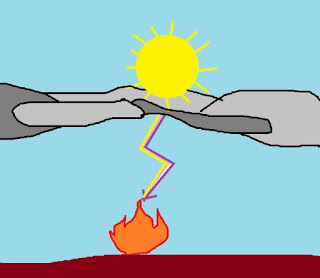
So if fire (Hestia) was made (Fathered) by the thunder/lightning (Zeus) then Hermes, "the messenger of Zeus", is the perfect inventor of the fire stick and fire making... 

Remember, Hermes was not the only messenger of Zeus...He shared his workload with Iris. (Attic Red Figure Stamnos, ca. 480-470 BC, Louvre)

Look they are both holding caduceus stick...

Actually, before Hermes got the job, Iris was the sole "speaker of messages of Zeus"...The only "voice of Zeus"...Which is kind of important...

Remember the article "Iris" in which I proposed that Iris might not have been the personification of the rainbow...But that instead she could have been the personification of thunder/lightning, the true "voice of the thunder god"...


Remember that before people invented the fire stick (sorry before Hermes invented the fire stick), Zeus used lightning to light fires on earth...Lightning was the "fire stick" of the Thunder god...

Thunder, which is inseparable from lightning, is the "voice of thunder god"...Which, as I explained in my article about Iris, I believe is the meaning of the "speaker of messages of Zeus"...

If Iris is personification of thunder/lightning, and Hermes is her later replacement as the messenger of Zeus, then Hermes would be perfect god to invent fire stick...The human replacement for thunder/lightning...

That's it...

I mean could there be a more direct link between Hestia and Hermes? Without Hermes there would be no Hestia...To me this is glaringly obvious...Maybe too obvious for some...

But if you "miss" (ignore) this, you can then go ahead and write endless academic papers trying to answer the question "why are Hestia and Hermes linked together"...

Anyway, this brings me back to one of my favourite unanswered questions: why was invention of fire such a big deal in all our mythologies, if people knew how to make fire, like, for ever?

Thursday, 16 June 2022

Iris


Iris was originally the personal messenger of Zeus, later becoming the messenger of the Olympian gods in general...

Her name contains a double meaning, being connected with both the Greek word iris "the rainbow" and eiris "messenger, speaker of messages"...

Now, today Iris is known as the "goddess of the rainbow"...But in Dictionary of Greek and Roman Biography and Mythology we can read that "In the Homeric poems, Iris does not appear as the goddess of the rainbow, but the rainbow itself is called iris"...

Dictionary of Greek and Roman Biography and Mythology also states: "Even though some poets describe Iris actually as the rainbow itself, the more prevalent view in antiquity was that she was associated with a rainbow"...

For instance "the rainbow was only the road on which Iris traveled" or "Iris was rainbow clad" or "Iris blazed a rainbow trail beneath the clouds as she flew"...

This is very interesting. If Iris was not originally a personification of the rainbow, but was instead associated with the rainbow, what was she the personification of? 

I would suggest thunder/lightning...

In accordance with her role as messenger,  most of Iris's poetic titles and epithets are related to her swiftness: "swift footed", "wind-swift footed", "storm-footed, storm-swift"...

Is rainbow something you might call swift, fast? Is lightning something you might call swift, fast? Do we say "rainbow fast" or "lightning fast"?

In the Iliad, when Zeus sent Iris to summon Thetis: "Storm-swift-footed Iris started at once on this mission...she dived into the dark bosom of the sea with a resounding splash...She found Thetis...and said: Come, Thetis; Zeus in his unending wisdom calls you to his side"...

There is something very strange about this description of Iris "diving into the dark bosom of the sea with a resounding splash"...If Iris is a rainbow...Do we ever see rainbow as "moving", "diving", "plunging"?  What about lightning?

Can rainbow make a "resounding splash"? Another translation of this chapter is "Iris...plunged in the dark water, and the sea crashed moaning about her"...Can rainbow do that? Can it make "the sea moan"? Can thunder/lightning?

In the Dictionary of Greek and Roman Biography and Mythology we can also read that: "It is also possible that Iris's name may be connected with "eirô" (I join)...Join what? Lightning joins Sky (Zeus) and Earth...Rainbow???

Psalm 18:13: The LORD thundered from heaven, And the Most High uttered His voice.

What is the voice of the Sky god if not thunder/lightning???

If Iris was the personification of thunder/lightning, then that would explain the "resounding splash" that she makes when she plunges into the sea...Lighting strike would do that...Rainbows...Not really...

Thunder/lighting strike would make people look to the sky in fear and pay attention to what the Sky god had to say...Rainbow...Not really...

Thunder/lightning strike would make gods look to the sky and pay attention to what the Sky god had to say...Rainbow...Well you know yourself...

But what about Iris creating a rainbow when she moves...

Lightning is often tinged with another color around the edges. That color can be any color of the rainbow, but the three most common colors, are blue, yellow, and violet...


So it is possible that Iris could create a rainbow like display as she moves swiftly between the sky and earth, "speaking the messages (being the voice) of Zeus"...

Now here is something very interesting...In Vedic mythology, we find the storm and thunder god Indra happily married to a goddess called Indrani (basically female Indra). Here they are riding on an elephant together...

If you want to know why elephant check my post "Musth". In short, Indian elephants mating season overlaps with the Indian monsoon season...

This goddess has another, much more interesting name: Shachi...

Shachi is derived from the Sanskrit word "shach", which means "speak", "say" or "tell". Shachi is also associated with the Sanskrit word "shak", meaning "power", "strength", "action"...

So Indrani was the power of Indra...Which is why Indra was referred to as "Shachipati" meaning "master of Shachi" or "Shachivat" meaining "possessor of Shachi"...

But, even more importantly for our Iris story,  Shachi was the voice of Indra...The one who speaks for Indra...

What is the power of the storm and thunder god which is at the same time the voice of the storm and thunder god???

Oh by the way, rainbow was known as "the bow of Indra", who presumably shot lightning bolts from it??? So we have association between Thunder god, his messenger thunder/lightning and rainbow...

The same association between thunder god, his wife, his bow and rainbow is found in Slavic folklore, where we find Perun, the god of thunder and storms, happily married to his wife Perunika (literally female Perun), who wears a rainbow as her belt...

Perunika is not explicitly described as lightning personified...But she "helps her husband to load the lightning bolts and shoot them at thieves, liars, and immoral people in general"...Perun's bow is not explicitly described as a rainbow, but...

Oh yeah, did I mention that in South Slavic languages, Perunika is also the name for flower Iris...Flower which was believed to grow from the place struck by lightning...


Flower whose petals actually look like they have a depiction of a bright yellow lightning bolt in a dark blue sky...

So...I don't know what to  think about Iris really...

Oh yeah, I know that Iris was not the wife of Zeus, like Perunika (Iris) was the wife of Perun...But isn't it interesting that Iris "was often described as the handmaiden and personal messenger of Hera" the wife of Zeus...Curious...

Finally, someone just asked when does Perunika (Iris) flower...The beginning of the flowering season is Apr/May...Right at the beginning of the thunderstorm season in the Balkans...

Basically, Perunika is a plant calendar marker for the beginning of the thunderstorm season...

To read more about ancient animal and plant calendar markers, start here…then check the rest of the blog posts related to animal calendar markers I still didn't add to this page, and finally check my twitter threads I still didn't convert to blog post...I am 9 months behind now...