A 2334-2154 BC cylinder seal depicting Indian elephants, rhinos and crocodiles, all animal calendar markers for monsoon season.
Made somewhere in Indus Valley Civilisation and found outside of Uruk, ziggurat of Ur, in Akkad, during Saragon II era. Pic plate 61 from "Stratified cylinder seals from Diyala region"...
What does this all mean? Maybe animal calendar markers can help us figure this out. Again...
Indian crocodiles all hatch during the monsoon season...
It is because of this that crocodile is the vehicle of Varuna, the old rain god...
BTW, we find Indian Crocodile as an animal calendar marker for the monsoon season during Indus Valley Civilisation. I talked about this in my post "Proto Durga" in which I analyse the scene depicted on this Harappan clay tablet with a "narrative scene"...
And in my post "Mohenjo Daro boat tablet" in which I try to answer the question: Why is the central hut of this flat bottomed river boat depicted oo this 2500–1750 BC Mohenjo-Daro tabletflanked by two date palm trees?
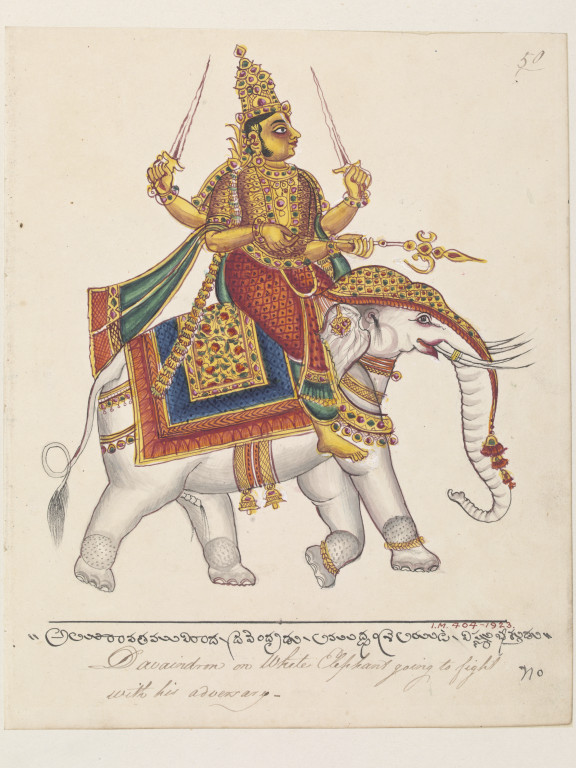
In the Rigveda, Indra, the thunder and rain god, is associated with a white (cloud) elephant named Airavata...
Why? Indian elephants mate during Indian monsoon season...
This is another proof that Rig Vedas had to have been written in India proper, cause this link between rain gods and elephants makes no sense anywhere else...
What about the Indian rhino? I never talked about this animal as an animal calendar marker before. These rhinos breed all year round. So their mating, birthing can't be used as animal calendar marker for monsoon season...
But what they do during monsoon season is that these usually solitary animals form large groups, which then together wallow in the mud. A lot. A lot more than during any other time of the year...
Which means that this wallowing during monsoon season can be used as an animal calendar marker for monsoon season...
So every animal on this strange Indus Valley Civilisation seal found outside of Uruk, ziggurat of Ur, in Akkad is an animal calendar marker for the rain monsoon season in India. Really cool find.
That's it. To read more about ancient animal and plant calendar markers, start here…Then check my twitter threads I still didn't convert to blog post...I am way way behind...
About another proof that Rig Vedas had to have been written in India proper, proof discovered through applying animal calendar markers theory to one of the more obscure parts of the Marut's legends.
7th c. Maruts relief, Sambor Prei Kuk, Kampong Thom Province, Cambodia.
In the Vedic mythology, Maruts, are a group of storm/rain deities which always accompany Indra...You can read about them in "THE MARUTS" by Uma Chakravarty...
Indra of course primarily the monsoon rain god, whose main duty is to annually defeat Vritra, the dragon of drought...You can read about this aspect of Indra in "Indra as God of Fertility" by E. Washburn Hopkins
BTW
Indian elephants mate during Indian monsoon season...
Which is why Indra, the thunder and rain god, rides on a white (cloud) elephant...
They create darkness with the cloud when they shed rain
You can read more about this in "Vedic Mythology" by Macdonell, Arthur Anthony
Their mother is said to be the ocean or the heavenly cow Pṛśni (rain cloud). And their father is said to be Agni (fire) or Vāyu (wind).
A terrestrial river is called, Marudvṛddhā, 'swelled by the Maruts'.
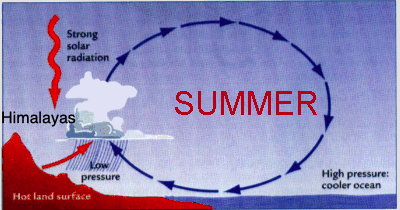
All of this describes the summer wet monsoon
Varāhapurāṇa chapter 82: A "river of the sky" starts at the "ocean of the sky" and, being agitated by the elephant of Indra, falls at the top of mount Meru, where at the bottom it forms four great rivers...I talked about this in my post "Elephants and the river in the sky"...
In other places in Rig Veda, Maruts are said to be the sons of Rudra, and are also often called Rudras. I will talk about Rudra and Rudras soon. This is a very interesting topic which deserves its own post.
On the Sambor Prei Kuk relief, maruts are depicted riding on Makaras.
Makara is another complex animal calendar marker for monsoon season, which could have only been developed in Indian Subcontinent. I talked about it in my posts "Yakshi" and "Makara"...
And, Makara is already found, with many other, later deified, animal calendar markers, in Indus Valley Civilisation. I talked about this in my post "Proto Durga"...
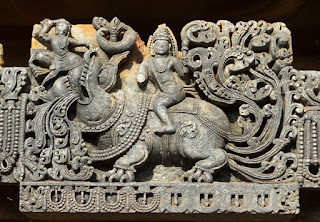
On the Sambor Prei Kuk relief, the central Marut is depicted riding on an elephant.
Already explained that elephant is an animal calendar marker for the summer monsoon season, cause elephant mating season peaks in Jul/Aug, peak of summer monsoon season in India...
The elephant rider is flanked by two horse riders. Horse is a universal solar symbol. And horse mating season (Apr/May-Sep/Oct) marks the summer monsoon season in India...You can read more about it in my article about solar horse in India, "Hayagriva"...
Anyway, after this shortish introduction, let me get to the interesting bit 🙂
"Maruts, whose steeds are the spotted deer..." Rig Veda 7.40.3
Rig Veda is full of references to Maruts riding on chariots pulled by spotted deer. And I haven't seen one explanation why would that be the case.
I have seen attempts to replace spotted deer with spotted horses, probably to make the whole story more Steppe Indo-European. But there is a perfectly good Indian Subcontinent explanation for this "weird" choice of ride for Monsoon Rain Gods...
The chital or cheetal, also known as the spotted deer, is a deer species native to the Indian subcontinent...
Now I explained many times before, animal calendar markers mark significant events from the annual reproduction cycle of the depicted animal: mating, birthing...
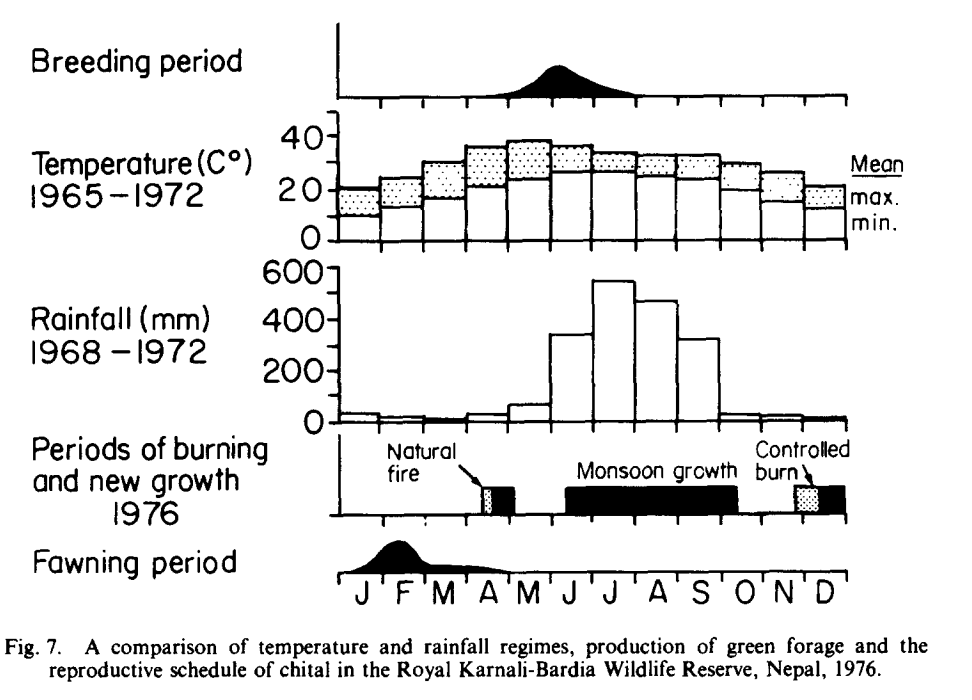
Events well known to the local population. So for the spotted deer, people in India would say: "when spotted deer start mating, that would mean that monsoon rain is soon to arrive to"...Why? Cause of this:
You can read more about cheetal deer here and here...
How would locals have known when spotted deer started to mate? Chital stags bellow loudly during mating season. Not something you can miss...
Chital Stag Bellowing - Unseen and Often Unheard Chital Deer Call
Chital stags fight madly during mating season. Also not something you can miss...
So the locals could indeed say "mating of spotted deer is followed by monsoon rain". Or they could say "spotted deer brings rain"...Or they could say "Maruts arrive on chariots pulled by spotted deer"...More poetic...
And apparently this was incomprehensibly difficult to decode for all the people who looked at Rig Veda before me...Why is that? I mean this is obvious, right? Anyone with some knowledge of Indian climate, flora and fauna could have figured this out, right?
Well, yes, if you knew about the existence of animal calendar markers, then this would be obvious. But it seems that the idea of using animals and plants as calendar markers never occurred to anyone...Before me...
And honestly, I am not bragging. I just can't believe I am...
1981, Belgrade, Serbia, Yugoslavia...Šarlo Akrobata - O, o, o, o, o...
Prvi i Jedini 🙂 The First and The Only one
Finally, the fact that the spotted deer is an animal calendar marker for the beginning of summer monsoon in India, means that the hymns about Maruts and their spotted deer steeds had to have been composed in India proper, where all this spotted deer nonsense actually makes sense.
That's it. To read more about ancient animal and plant calendar markers, start here…Then check my twitter threads I still didn't convert to blog post...I am way way behind...
Varāhapurāṇa chapter 82: A "river of the sky" starts at the "ocean of the sky" and, being agitated by the elephant of Indra, falls at the top of mount Meru, where at the bottom it forms four great rivers...From "Indra as God of Fertility" 1916 article By E. WASHBURN HOPKINS, Professor in Yale University.
Basically a description of summer monsoon...
But why elephant?
Because Indian elephants mate during Indian monsoon season...
Which is why Indra, the thunder and rain god, rides on a white (cloud) elephant...
As for ocean (and) river in the sky (Okeanos Potamos 🙂)
The 340 BC Derveni papyrus which contains commentary on an Orphic poem by Anaxagoras, says this: "...It is unclear to the many, but quite clear to those who have correct understanding, that Oceanus is the [river in the] air". This river?
That's it. To read more about ancient animal and plant calendar markers, start here…Then check my twitter threads I still didn't convert to blog post...I am way way behind...
2nd century BC relief of Yakshi, a nature spirit associated with water, trees and the fertility of the earth, standing on an elephant. Bharhut, Madhya Pradesh...
Why is Yakshi standing on an elephant? Cause rain/water = fertility...
Indian elephants mate during Indian monsoon season...This eventually lead to "elephant" becoming an animal calendar marker for "monsoon season"...
Which is why Indra, the thunder and rain god, rides on a white (cloud) elephant...
2nd century BC relief of Yakshi, a nature spirit associated with water, trees and the fertility of the earth, standing on Makara. Bharhut, Madhya Pradesh...
What is Makara and why is Yakshi standing on Makara? Cause rain/water = fertility...
Relief from the 199-100 BC stupa from Sanchi, Madhya Pradesh, India, depicting Makara, the "mythical being" and a vehicle of Varuna, the ex god of rain and water...Actually a complex animal calendar marker for monsoon season...Pic from: vmis.in
Makara has many forms, from a simple gharial, fish eating, crocodile, used as a mount by Varuna...
...to truly incredible composite beings. Like this one...
But interestingly, all the animals that form main Makara parts either mate or give birth or migrate during the monsoon season, and can be used as animal calendar markers for the monsoon season... I talked about Makara in my post "Makara"...
Makara is one of the best examples of how complex animal calendar markers are formed from overlapping reproductive behaviour of many different animal species...
And how they are then morphed into "mythical beings" linked to gods which control the part of the year these calendar marker once marked...
Also check this article about "Proto Durga", which talks about gharial crocodile as calendar marker, which probably predates Makara, and was the original vehicle of the rain god, before Indra arrived on his elephant...
Which is why Yakshi stands on Makaras...
Yakshas have intimate connection with (life giving) waters: "Yakshas control, not so much the waters as mere waters, but that essence in the waters which is one...with the seed (sperm) in living beings"...
Rain as semen of the Sky father which fertilises Earth mother an creates life...A common "mythological" theme in areas where we have dry and wet season...
In Hindu mythology, the earth is supported by four elephants standing on the back of a turtle.
It's Diskworld by Terry Pratchett. He stole his Diskworld idea from the Hindus...For a laugh...Cause he thought it was the most idiotic world myth there was...Bonkers, right? Complete nonsense, right?
Not if you look at turtle and elephants as animal calendar markers: It's all a complex calendar marker for the monsoon season...
Elephants:
Indian elephants mate during Indian monsoon season...
Which is why Indra, the thunder and rain god, rides on a white elephant...
There are many turtle and tortoise species in India. So which one is "The World Turtle"? Apparently, The World Turtle is the reincarnation of the Hindu god Vishnu...And Hindus believe that the animal in question is Indian Star Tortoise. You can read about it in this paper "A star attraction: The illegal trade in Indian Star Tortoises"...
It is very interesting that this sacred tortoise of Vishnu, Kurma, is associated "with the sun"...Vishnu has tendencies to be associated with solar animals...I talked about this in my article about Solar Horse Hayagriva, also Vishnu avatar...
But equally tortoise was believed to be "The lord of waters" and "The sap of life". You can read about it in this article "Tortoise in the Vedic mythology and ritual"...
Why is this important? Cause the monsoon season in India is the sunniest, hottest time of the year in India...
So I don't think that in this legend, the earth is really "The Earth"...It is more like Life giving earth...Apparently, Prajapati, the Procreator, took the shape of a turtle when creating all living beings...
So that's one possible explanation...But maybe I am wrong and this is all just a bonkers story that makes no sense...
Iris was originally the personal messenger of Zeus, later becoming the messenger of the Olympian gods in general...
Her name contains a double meaning, being connected with both the Greek word iris "the rainbow" and eiris "messenger, speaker of messages"...
Now, today Iris is known as the "goddess of the rainbow"...But in Dictionary of Greek and Roman Biography and Mythology we can read that "In the Homeric poems, Iris does not appear as the goddess of the rainbow, but the rainbow itself is called iris"...
Dictionary of Greek and Roman Biography and Mythology also states: "Even though some poets describe Iris actually as the rainbow itself, the more prevalent view in antiquity was that she was associated with a rainbow"...
For instance "the rainbow was only the road on which Iris traveled" or "Iris was rainbow clad" or "Iris blazed a rainbow trail beneath the clouds as she flew"...
This is very interesting. If Iris was not originally a personification of the rainbow, but was instead associated with the rainbow, what was she the personification of?
I would suggest thunder/lightning...
In accordance with her role as messenger, most of Iris's poetic titles and epithets are related to her swiftness: "swift footed", "wind-swift footed", "storm-footed, storm-swift"...
Is rainbow something you might call swift, fast? Is lightning something you might call swift, fast? Do we say "rainbow fast" or "lightning fast"?
In the Iliad, when Zeus sent Iris to summon Thetis: "Storm-swift-footed Iris started at once on this mission...she dived into the dark bosom of the sea with a resounding splash...She found Thetis...and said: Come, Thetis; Zeus in his unending wisdom calls you to his side"...
There is something very strange about this description of Iris "diving into the dark bosom of the sea with a resounding splash"...If Iris is a rainbow...Do we ever see rainbow as "moving", "diving", "plunging"? What about lightning?
Can rainbow make a "resounding splash"? Another translation of this chapter is "Iris...plunged in the dark water, and the sea crashed moaning about her"...Can rainbow do that? Can it make "the sea moan"? Can thunder/lightning?
In the Dictionary of Greek and Roman Biography and Mythology we can also read that: "It is also possible that Iris's name may be connected with "eirô" (I join)...Join what? Lightning joins Sky (Zeus) and Earth...Rainbow???
Psalm 18:13: The LORD thundered from heaven, And the Most High uttered His voice.
What is the voice of the Sky god if not thunder/lightning???
If Iris was the personification of thunder/lightning, then that would explain the "resounding splash" that she makes when she plunges into the sea...Lighting strike would do that...Rainbows...Not really...
Thunder/lighting strike would make people look to the sky in fear and pay attention to what the Sky god had to say...Rainbow...Not really...
Thunder/lightning strike would make gods look to the sky and pay attention to what the Sky god had to say...Rainbow...Well you know yourself...
But what about Iris creating a rainbow when she moves...
Lightning is often tinged with another color around the edges. That color can be any color of the rainbow, but the three most common colors, are blue, yellow, and violet...
So it is possible that Iris could create a rainbow like display as she moves swiftly between the sky and earth, "speaking the messages (being the voice) of Zeus"...
Now here is something very interesting...In Vedic mythology, we find the storm and thunder god Indra happily married to a goddess called Indrani (basically female Indra). Here they are riding on an elephant together...
If you want to know why elephant check my post "Musth". In short, Indian elephants mating season overlaps with the Indian monsoon season...
This goddess has another, much more interesting name: Shachi...
Shachi is derived from the Sanskrit word "shach", which means "speak", "say" or "tell". Shachi is also associated with the Sanskrit word "shak", meaning "power", "strength", "action"...
So Indrani was the power of Indra...Which is why Indra was referred to as "Shachipati" meaning "master of Shachi" or "Shachivat" meaining "possessor of Shachi"...
But, even more importantly for our Iris story, Shachi was the voice of Indra...The one who speaks for Indra...
What is the power of the storm and thunder god which is at the same time the voice of the storm and thunder god???
Oh by the way, rainbow was known as "the bow of Indra", who presumably shot lightning bolts from it??? So we have association between Thunder god, his messenger thunder/lightning and rainbow...
The same association between thunder god, his wife, his bow and rainbow is found in Slavic folklore, where we find Perun, the god of thunder and storms, happily married to his wife Perunika (literally female Perun), who wears a rainbow as her belt...
Perunika is not explicitly described as lightning personified...But she "helps her husband to load the lightning bolts and shoot them at thieves, liars, and immoral people in general"...Perun's bow is not explicitly described as a rainbow, but...
Oh yeah, did I mention that in South Slavic languages, Perunika is also the name for flower Iris...Flower which was believed to grow from the place struck by lightning...
Flower whose petals actually look like they have a depiction of a bright yellow lightning bolt in a dark blue sky...
So...I don't know what to think about Iris really...
Oh yeah, I know that Iris was not the wife of Zeus, like Perunika (Iris) was the wife of Perun...But isn't it interesting that Iris "was often described as the handmaiden and personal messenger of Hera" the wife of Zeus...Curious...
Finally, someone just asked when does Perunika (Iris) flower...The beginning of the flowering season is Apr/May...Right at the beginning of the thunderstorm season in the Balkans...
Basically, Perunika is a plant calendar marker for the beginning of the thunderstorm season...