Showing posts with label Serbian history. Show all posts

Saturday, 16 November 2024

Winged Hussars

The charge of the Polish Winged Hussars at the 1683 Battle of Vienna. 3000 of them took part of the biggest cavalry charge in history, which finally stopped the Turkish expansion into Europe...

This is the story about their origin...

And about a very interesting and unusual Serbian phrase: "Kititi se tuđim perjem" which means "To take credit for something great someone else has done", but literally it means "To adorn oneself with someone else's feathers"...

So where do we start? With Nicolas de Nicolay, a French nobleman, who In 1567 publish a book entitled "Quatre premiers livres des navigations" which recorded his observations about the Ottoman court and peoples from his 1551 mission to Istanbul on behalf of the French government.

The book served as the first comprehensive survey of customs and costumes in the Ottoman world, and is hailed as one of the earliest and most accurate depictions of the Islamic world to appear in Europe.

Nicolas traveled to Istambul via Serbia and in the chapter entitled "Des avanturiers, appelles Del", he talks about the Ottoman shock troop light cavalry unit called "Delier" which means "brave, crazy, reckless, madmen"...These guys...

The main role of these units during war time was to create chaos and confusion among enemy troops by using guerrilla tactics. During peace time they acted as personal guard of high level Ottoman officials in the Rumelia (Balkan part of the Otoman Empire).

The first Delier were created in Turkish occupied Bosnia and Serbia in the late 15th century, but these military units were soon formed in other districts of Rumelia too.

There is a lot of confusion about who these "Crazy Balkan Horsemen" were...The Deli wiki page about Delie says that "Most of the Delie were usually of Ottoman Turkish origins". Which is kind of misleading. You'll see soon why...

I think that, at least at the beginning, the majority of these Crazy Balkan Horsemen were Serbs from today's territories of Serbia and Bosnia. 

But don't take my word it. Here is what Nicolas de Nicolay had to say about Delier:

"Delijer are adventurers, who seek adventures in the most dangerous places, where they are given the opportunity to prove their courage and heroism with their warrior feats".

"They are located in the areas of Bosnia and Serbia. Today they are called Serbs and Croats, but these are the real Illyrians, those whom Herodian describes as people very brave, large, well-built, strong, lion colored faces, more than barbarians by their customs"

Note: Interesting. I know, most people will now say: Serbs and Croats are Slavs, not Illyrians...This French diplomat had no reason to invent the link between Serbs and Croats and Illyrians...Because this was the prevailing historiographic opinion until very recently.

Note: Interestingly, Slavic legends, and not just South Slavic legends, talk about Illyricum as the birth place of the Serbs in particular, from where they were Expelled by the Romans after a great war...I wrote about it in my post "St Paul among Slavs"...

Anyway, back to what Nicolas de Nicolay had to say about Delier. 

"The Turks call them Delier, which means crazy and brave. However, they call themselves "zataznics", which in their language means: those who challenge people, challengers".

"Each one of them has to challenge and defeat 10 enemies in order to to acquire the name and insignia of a deli or a zataznic". 

Note: Nicolas de Nicolay doesn't say what is that insignia, but I would guess it has something to do with feathers...

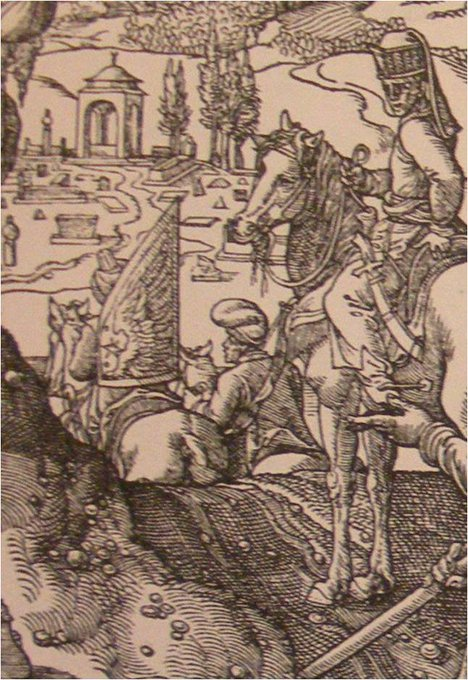
Nicolas de Nicolay then describes the Deli he met (this guy): 

"He wore wide trousers made of the skin of a young bear with fur on the outside. Under his trousers he wore shoes or short yellow boots, pointed at the front and very high at the back, with long, wide spurs"

"He had a hat on his head...which fell towards one shoulder, made of spotted leopard skin. Deli attached a wide eagle wing. The other two wings were attached to large gilded nails on his shield".

Note: Nicolas de Nicolay concludes that this was done "to make Deli look as scary as possible". But was the reason for eagle feathers to make Deli scary, or were they "the insignia", the mark of their mad bravery which made them a Deli? I certainly believe the later.

"His weapons were scimitar, lance, spear, and a war-mace"...Note: Most pictorial representations from the 16th century show the Deli armed with scimitars, lances, spears, and war-maces.

"Then I saw him on a horse, covered with the whole skin of a large lion, which was attached to the horse's chest with its front paws while the other two hung behind. His mace hung on the back of the saddle. In his right hand he held a sharp spear, with a long hollow shaft"...

Nicolas de Nicolay actually talked to the Deli he met. This is what he says about this conversation: 

"I was also curious to ask him through Dragoman (translator), to which people he belongs and what religion he professes".

"He let me know that he was a Serb by nationality...As for his faith, he said, he only pretends when he lives with the Turks according to their law, because he is a Christian by birth, heart and will".

And here is a very very very interesting bit. Although Deli told Nicolas de Nicolay that he was a Serbs, he also told him that "his ancestors were Parthians, people who in ancient times enjoyed a great respect as the most warlike people in the entire East"...

Eeeeee what? The Crazy Balkan Serbian Horseman believed that he was descended from Parthians, the people who were renown for their cavalry...

Is this an embellishment added by Nicolas de Nicolay? Why would he do it? Or did the Serbian Deli actually say this? And if so, did he just invent all this, in order to make himself look even cooler than he already looked to Nicolas de Nicolay?

I don't know if too many people in 16th c. Europe would have been impressed by the mention of Parthians...

So maybe this crazy story was actually a remnant of a real ancestral legend, now forgotten, of (this particular) Serb and his kinsmen? Serbs are a very mixed population, so I think that anything is possible...But as I said, I don't know...

Now we are going to leave the Balkans and Delier and we will go north of Serbia, into Hungary (Today's Hungary, Romania) where we find Hungarian Hussars...

Hussars were a light cavalry, originating in Central Europe during the 15th and 16th centuries. The title and distinctive dress of these horsemen were subsequently widely adopted by light cavalry regiments in European armies in the late 17th and early 18th centuries...

The hussars reportedly originated in bands of mostly Serb (whom Hungarians called Rác) warriors, crossing into southern Hungary after the Ottoman conquest of Serbia in the late 14th century. Interesting...

Speaking of the Hungarian name for Serbs "Rác", do you remember my article about "Racka" (Serbian) sheep breed? 


Anyway, the word hussar stems from the Hungarian "huszár", which in turn originates from the medieval Serbian "husar", "gusar", meaning brigand (because early hussars' shock troops tactics used against the Ottoman army resembled that of brigands)...

And finally we come back to the beginning...Polish Winged Hussars, who were one of the main types of Polish cavalry in Poland and in the Polish–Lithuanian Commonwealth between the 16th and 18th centuries...I love this picture...

Original Winged Hussars were units of exiled mercenary warriors of Serb origin, also called Racowie (Polish name for Serbs). They were based on the Hungarian Hussars of the Hungarian King Matthias Corvinus, who were also originally exiled Serbian mercenary warriors...

The oldest mention of hussars in Polish documents date to 1500, although they were probably in service earlier...

Following the military reforms of the Polish king Stephen Báthory, the Polish Hussar unit was transformed into famous heavily-armoured shock cavalry...

The husaria banners and units participated in the largest cavalry-charge in history at the Battle of Vienna in 1683 and ranked as the elite of Polish cavalry until their disbandment in the 1770s...

So full circle...

But there is more...

Here is another proof that both Hussars and Delie had the same common origin...In this article, entitled "Deli and Hussar: confusion, ambiguity, and hybrid identities" we can read both Delie and Hussars used the same very unusual "wing shaped" shield...

Shield whose origin, according to the author, is "uncertain"...Well, kind of...Someone left a very interesting comment at the end of the article:

Start of comment: 

"While Kovacs might argue for an "uncomplicated Hungarian origin" his colleague Szabo (in A honfoglalóktól a huszárokig,2010) presents substantial evidence that the more convex variety of the shield has its origin in Western Balkans".

"(Funnily enough both also refer to the study by Kužič - a scholar who studied the shield forms found on period balkan gravestones-stećci)".

"Regardless of "the true origins" these shields indeed seem to be like an evolutionary step from the targe commonly used by central european cavalrymen (e.g. Knights in kepes kronika, hrvoje missal etc)".

"15th century depictions from Balkan stećci in fact suggest the existence of both varieties at roughly the same period and I get the impression that with time the shields actually grew larger and more convex". 

End of comment.

Were these shields just an imitation of the shape of an eagle wing? Which Delie used as a decoration for their shields...This Turkish example suggests so...
One last thing about the origin of these Crazy Balkan Horsemen. The man credited with the formation of the Delier was Gazi Husrev-beg. His father, Ferhad-beg, was a Slavic nobleman who converted to Islam, originally from Hum (modern-day Herzegovina)...

So the father of the creator of the Delier cavalry, populated by Serbs and Croats, was of South Slav (most likely Serb) from a noble (most likely) knightly family...

And the oldest depictions of their feathered shield is found on monuments from the same area...

Interesting...

One other possible clue about the origin of the Crazy lancers who adorned themselves with eagle wings...Here is a detail of the "Betrayal of Judas" fresco from the Church of the Apostles, the oldest church in the Serbian Patriarchate of Pec...
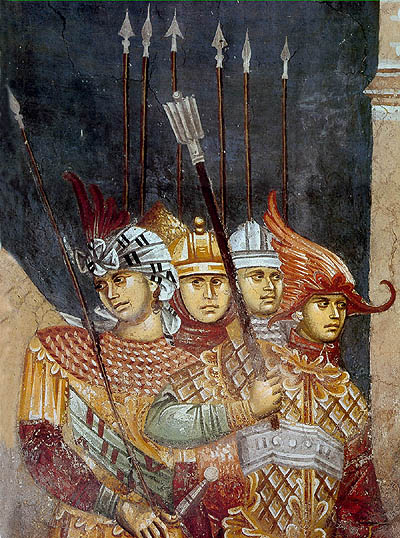
The fresco is dated to 1300 AD. At least a century and a half before the first feathered Delier and Hussars appeared in Turkish and Hungarian armies...

Were these guys just adorning themselves with wings for a laugh, or...

I know this sounds like a cool story...But to me this is a tragic story. The Hungarian and Polish (but really Serbian) Hussar's main enemy were Turkish (but rally Serbian) Delier...Hussars were specifically used "to counter Ottoman Delier cavalry"...

Serbs killing Serbs...For king and sultan? For Christianity or Islam? Or just because they were "brave, crazy, reckless, madmen"?...I think that most Delier who were of Serbian origin, were "Poturice" (local Serbian name for Serbians who converted to Islam, became Turks).

Some of them could have been like the guy Nicolas de Nicolay interviewed, nominally Ottoman Turks and Muslims, but secretly still Serbs and Christians...But most of them were probably true converts, true believers, true Ottoman Turks of Serbian origin...

Which is why I said earlier that the statement that "Most of the Delier were usually of Ottoman Turkish origins" was misleading...

The "brave, crazy, reckless, madmen" who were also religious fanatics...And I am talking about both Christian Serbs from Hussars and Muslim Serbs from Delier...They both fought with god on their side, looking for glory in battle...No wonder they became legendary...

But I guess, both Hussars and Delier soon ran out of these "brave, crazy, reckless, madmen" Serbs...Those kind of people don't live very long, and very quickly depart into legends...

This is where I wanted to finish...And then, just as I was about to post this article, I came across this: the gold coin of Eucratides I who ruled Bactria 171–145 BC...Are these winged horsemen?
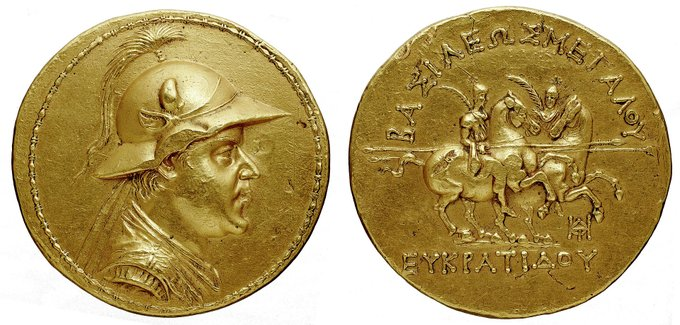


Apparently he was aligned to Parthians...

I will leave this here, as I have no idea what to do with it... 🙂

Sunday, 23 August 2020

Serbian or Celtic burials?

The court epic poetry have flourished in Serbia in the time of Tsar Dushan (early 14th century) and before it. After the death of Tsar Dushan, the Serbian kingdom started to disintegrate under the pressures of the civil war and Hungarian and Turkish invasions. Over the next 200 years, the court epic poetry ceased to exist. But epic poetry did not disappear. Theis is because the origin of the Serbian court epic poetry was in Serbian folk epic poetry. In Serbian tradition heroes and their deeds have always been "sang about" and this is tradition that predates Serbian medieval states. The tradition which probably dates to the old Heroic age of the Balkans from which epics like Iliad and Odyssey came to us through Homer. So because the Serbian epic poetry was part of the Serbian folk tradition and not something foreign introduced into the culture through the court, it continued to exist and even flourish after the destruction of the Serbian medieval state. 

The corpus of Serbian folk epic poetry recorded during the 19th and 20th century can be divided into following cycles:

Pre-Kosovo cycle (Преткосовски циклус/Pretkosovski ciklus) - poems about events that predate the Battle of Kosovo (1389)
Kosovo cycle (Косовски циклус/Kosovski ciklus) - poems about events that happened just before and after the Battle of Kosovo (no poem covers the battle itself[citation needed])
Cycle of Kraljević Marko (циклус Краљевића Марка/ciklus Kraljevića Marka)
Post-Kosovo cycle (Покосовски циклус/Pokosovski ciklus) - poems about post-Battle events
Cycle of hajduks and uskoks (Хајдучке и ускочке песме) – poems about brigands and rebels
Poems about the liberation of Serbia and Montenegro (Песме о ослобођењу Србије и Црне Горе) - poems about the 19th-century battles against the Ottomans

Serbian epic poetry is being made even today in this same form. Modern songs sing about modern events and people, such as the Yugoslav Civil war and Kosovo War. Some modern songs are published in books or recorded, and under copyright, but some are in public domain, and modified by subsequent authors just like old ones.

The "discovery" of the Serbian epic poetry opened what is today known as "the Homeric Question":

    "Who is Homer? Was there ever a single poet called Homer or was homer just a title equivalent to bard?"
    "Are the Iliad and the Odyssey of multiple or single authorship?"
    "By whom, when, where, and under what circumstances were the poems composed?"

To these questions the possibilities of modern textual criticism and archaeological answers have added a few more:

    "How reliable is the tradition embodied in the Homeric poems?"
    "How old are the oldest elements in Homeric poetry which can be dated with certainty?"

Well...Let me add two more questions here:

    "How reliable is the tradition embodied in the Serbian folk epic poems?"
    "How old are the oldest elements in Serbian folk epic poetry which can be dated with certainty?"

Spear "stabbed" into a Scordisci Celtic warrior burial (#11) at Karaburma (Belgrade), Serbia (1st c. BC)


The pic is from the article "STABBING DEATH – The Ritual Deposition of Spears in Celtic Europe" found on a great blog https://balkancelts.wordpress.com by Mac Congail.

In the article we can read that: A fascinating phenomenon to be observed among the Balkan Celts in the later Iron Age, i.e. the period of the Scordisci Wars against Rome, is the custom of "stabbing" spears into the warrior burials...

The main assault weapon of the Balkan Celtic warrior, numerous cases of spears being stabbed into burials in this distinctive fashion have been recorded throughout the region, particularly among the Scordisci of eastern Croatia, southwestern Romania, Serbia and northern Bulgaria.

What is very interesting is that these Iron Age "Celtic" funerary practices are described in Serbian epic folk poetry...

As I said above, Serbian oral folk poetry, first recorded in the 19th century, describes events from medieval time until the 19th century. 

But warrior funerary practices it describes are not Serbian medieval funerary practices, but Iron Age Balkan Celts funerary practices...

I talked about the Celtic "killing of weapons" funerary practice described in the Serbian epic poem "The death of Prince Marko"  

Ritually "Killed" Spearhead from the Celtic burial at Sremska Mitrovica, Serbia.  


Today I would like to talk about the description of the Balkan Celtic funerary practice of "stabbing" the spear into the warrior grave found in Serbian epic folk poems: "Marko Kraljević i solo" (Prince Marko and the falcon), "Smrt vojvode Kaice" (The death of warlord Kaica) and "Smrt majke Jugovića" (The death of the mother of Jugovitch brothers)

The first person to talk about the strangeness of these funerary practices from Serbian folk poetry, was Dragan Jacanović from the National museum Požarevac, in his great article "Srpska narodna epika kao izvor arheološke informacije" (Serbian folk epic poetry as a source of archaeological information). 

I will here give the translation of the relevant parts of each poem. The original Serbian versions of the poems can be found on this page: "Srpske narodne pjesme"

"Marko Kraljević i soko" (Prince Marko and the falcon)

Prince Marko fell ill
He laid next to the road
He stuck his spear above his head
He tied his horse to his spear
...

Smrt majke Jugovića (The death of mother of Jugovitch brothers)

...Dead she finds nine Jugovitch brothers 
And the tenth, the Jug Bogdan, their father. 
Above their heads stuck nine battle-spears. 
To the spears tied nine good battle-horses..


In both previous two poems we find the identical motif of "sticking" the battle spear above the head of the dead (sick, soon to die) hero. In the poem "Smrt vojvode Kaice" (The death of warlord Kaica) we not only find that, but the description of the full tumulus burial...

"Smrt vojvode Kaice" (The death of warlord Kaica)

...They buried the warlord Kaica
They stuck his spear above his head
They tied his horse to his spear
They placed his weapons next to him
They made tumulus over his body...


So question here is: eeeee what, how??? Why are we finding descriptions of Celtic funerary practices from the 1st c. BC Balkans in Serbian late medieval and later epic poems??? Cultural continuation from Celts to Serbs???

The people who analysed epic poetry came to conclusion that epic poems are quite formulaic. Effective poetic descriptions are reused by various folk poets in various poems over a wide time period sometimes verbatim...

I think that this funerary practice description is an example of such poetic "borrowing". But these epic poems were transmitted orally, by illiterate folk singers...

So for them to borrow the idea of the "spear above the head", they had to hear it from someone else, and they had to hear it from someone else, and they had to hear it from someone else...

How far back?

The original poems depicting these Celtic funerals are now lost. And so are the names of the Celtic heroes, buried with their spears stuck above their head, with their horse and their weapons, under a tumulus...

What is left is a cool poetic description, applied to heroes from much much much later times...By the way, Dragan Jacanović from the National museum Požarevac believes that this is not the only thing from Bronze and Iron Age time that reached us through Serbian folk poetry...

He says that the description of the dress and decorations of the Warlord Kaica correspond to the decorations found in Bronze and Iron age princely graves from the Balkans, including the fact that Warlord Kaica wears a gold torc around his neck:

"Oko vrata kolajna od zlata"...

So strange, strange, strange...Right? Well not really. Look at the Serbian genes. Serbs are basically a mix of pretty much everyone who ever lived in the Balkans...Their descendants and preservers of their cultures and traditions...Well bits of them anyway...

Wednesday, 29 July 2020

And those who lie


"And those who lie (break promise), may a dog f*ck their wives and their mothers"...


Here is the original part from the original text 


According to "Slavonic Letters in Moldavia, Wallachia and Transylvania from the Tenth to the Seventeenth Centuries" by D. J. Deletant, it seems that "Slavonic" was the language of choice in Wallachia, Moldavia and Transylvania during medieval time...Why? And which Slavonic, Medieval Serbian or Medieval Bulgarian which was pretty much indistinguishable from Medieval Serbian? 

Only a person who spoke Serbian and was brought up as Serbian could have used the curse from the above letter. This is still one of the worst curses you can utter in Serbian...It comes from the deepest and darkest part of the Serbian culture...I talked about ritual and ceremonial cursing in Serbian culture in my post "Prokletija":  

Do Bulgarians have this curse?

2 questions: 

1. Why would Wallachian (Romanian) ruler be called Voivode (Serbian Voj, Boj + vodja = war+ leader) which is what all the early Wallachian (Romanian) rulers were called? 
2. Why would a Wallachian (Romanian) ruler write the letter in Serbian to German burgers of Sibiu?

Maybe the reason Voivode Alexander wrote his letter to the citizens of Sibiu in Serbian and used the above mentioned Serbian curse to emphasise that he meant business, is because both him and the recipients of his letter spoke Serbian and knew how serious the curse was...

That this was probably the case can be seen from huge number of Slavic (actually Serbian) toponyms all over Romania...I talked about this in this article about Romanian national hero Iovan Iorgovan, who according to Romanian legends came from Serbia... 

All in all a very interesting subject...Oh by the way, Alexander's half brother was Vlad II Dracul, father of The Vlad Dracul, The Impaler...And here is a letter by Vlad II to the citizens of Brașov, another German city in Transylvania. Again in Serbian... 

Saturday, 18 April 2020

Stake

This Ogham Stone stands overlooking Smerwick Harbour, Co. Kerry, Ireland. It can be found just off the route of the Dingle Way - Slí Chorca Dhuibhne, in Ballinrannig, close to Wine Strand and Béal Bán beaches...


Ogham stones are found mainly in burial grounds, and churchyards. But some ogham stones are found outside of these areas. Here the stones may have been boundary or territorial markers, or perhaps memorials, marking where someone died, or fell in battle, or indeed was buried...

In "A smaller social history of ancient Ireland", published by Joyce Patrick Weston in 1906, we can read that "when tribe-chief had taken possession of a district, he "erected pillar-stones there...in order that his share there may be known"... 


Joice then goes to say "But pillar-stones were erected for other purposes, of which the most usual was as a monument over a grave...Battles were (also) often commemorated by pillar-stones..."

And finally he says that "...pillar-stones were sometimes erected as idols..." and "...that a stone set up to mark a boundary was sometimes called a 'stone of worship'..."

In Serbia, people also erected boundary stones between villages until recently. Erecting of the boundary stones was witnessed by both sides accompanied by many religious rituals aimed at consecrating the stone. Consequently the boundary stone was considered sacred...

Any damage to the stone, falling the stone or moving the stone and even touching the stone was prohibited. These stones were always visited by the village processions from both villages during religious festivals, reaffirming the holiness of the stones and the sacredness of the border they represented...

The use of stones as border markers is very old. But I believe, that before people used stones, to mark the land as theirs, they used stakes...


This ancient tradition was preserved again by culturally super conservative Balkan Serbs...

In Serbia every unclaimed or uninhabited land was considered a wasteland, no man's land, unclean land. In the old times it was enough to stick a stake into such land to clean the land from demons and to claim the ownership of that land...

Interestingly, in Serbia when people wanted to insure that the dead stay dead :) and don't turn into a vampires, they stuck a stake through the dead body lying in the grave to "tie it down". I talked about this in my post "Vampires"... 

It seems that the land, earth was similarly subdued and "tied down" by sticking the stake into it...

The english expression "stake a claim to the land" actually describes this ancient custom. I have tried to find any explanation how this custom and expression entered the English language. I found this explanation in the English Etymological Dictionary: "From early 14c. as 'divide or lay off and mark (land) with stakes or posts'". 

When claiming the land, the stake was usually stuck in the middle of the claimed land where future clan village would be erected. Old clan histories still remember who was the first to stick the stake into the land and therefore claim the land for the clan...

In villages on mountain Rudnik, there was a custom to first stick a stake in the place where a new house was going to be built to purify the land, to clean it of bad spirits, and only then the house was built on "clean land"...

That stake was a tabu, and was never removed or in any way spoiled. People believed that doing so would bring bad luck to the family...

Once few clans moved into the same territory, clan lands would be merged into a village land. At that stage a new communal stake would be stuck into the ground to mark the communal village land...

These communal stakes were usually stuck on crossroads, near wells, in the centre of the future village and that stake would become the cult centre of the whole village. These village stakes would later be the places where churches and or graveyards would be placed...

Until recently in some parts of Serbia stake was also used as grave marker. Archaeologists have discovered remains of wooden stakes, always one stake per grave stuck at the head of the grave where today we find tombstones and crosses...

Stakes were used to mark the borders between private and communal land and also to mark the border between two village or clan lands...

Just like the border stones I talked about earlier, these border stakes were considered holy. And it was their holiness which made moving of the borders a tabu, and therefore prevented expansionist wars between the neighbouring tribes and clans...

In the Balkans, Slavs used the word "stup" (stake) to also denote "arable land, agricultural land, village land, cleared land which wholly belongs to one person"...

The ethnographic data from Montenegro and Stari Ras (Hercegovina), shows that when the new land was claimed, a wooden or stone "stake" was stuck into the land to mark the clan, tribe ownership over the land "until the end of time"...Which is why stake came to mean "owned land"...

Stup is mentioned as the word for arable land is found in 1321-1331 "Dečani charter", signed by Stefan Uroš III Dečanski of Serbia, the Serbian King, which contains a detailed list of households and villages in what is today Metohija and northwestern Albania...


One last thing. 

In both Ireland and Serbia, people lived in kin-groups, based on a belief that there was common male ancestor.

The closest kin group that was specifically defined consisted of the descendants of a common grandfather. In Ireland this group was called "gelfine" and in Serbia this group was called "zadruga".

This kin-group, consisting of grandparents, their sons and their families, could sometimes have over 100 individuals. All the property was owned by the family and the only personal property was what was on ones person.

The leader of this kin-group was the grandfather, and he was known either as "the head of the family", "cenn fine" in Irish and "glava porodice" in Serbian or "the pillar (stake) of the family", "ágae fine" in Irish and "stub porodice" in Serbian. 

Serbian sources:

Душан Бандић–"Народна религија Срба у 100 појмова" 
Бранислав Русић–"Старији обичаји код одређивања земљишних међа и око пољских радова у Кичевији, Гласник етнографског музеја у Београду XIX"
Група аутора-"Српски митолошки речник"

Wednesday, 13 November 2019

Hungarian graveyards

Ancient graveyards (medieval or older) are in Central Serbia called "Madžarska groblja" (Hungarian graveyards), "Grčka  groblja" (Greek graveyards) or "Džinovska groblja" (Giants graveyards).

This is one of these "Greek graveyards" from Hrta, Serbia.


Neither Greeks nor Hungarians ever lived in Central Serbia. The border between Hungarian and Greek graveyards goes along the line of the old border between Hungarian occupied Northern Serbia and Turkish occupied Southern Serbia during the Turkish Austrian wars 1718—1739.

His is history map of South Eastern Europe 1648-1739, Wars of Turkey with the Austro Hungarian Empire, Venice and Poland 


- The Austro-Turkish frontier fixed by the Peace of Carlowitz 1699 (yellow)
- The Ottoman Empire as in 1739 (green)
- The Austro-Turkish frontier fixed by the Peace of Passarowitz 1718 (red)

The so called Hungarian graveyards are located above the red line.

This is Jovan Hadži-Vasiljević, a Serbian historian and ethnographer.


He excavated one of the "Hungarian graveyards" located in the village of Stave in western Serbia. He found that all the graves contained dead buried according to Orthodox Christian custom. One of the graves contained Austrian coin from 1650

What is incredible is that he did his excavation in 1914 right after Kolubara battle, one of the biggest battle which Serbian army fought, and won, against invading Austrian army at the beginning of the WWI.


He fought in the battle, then during the lull after the battle asked his commander to give him couple of soldiers and let him excavate the graveyard in the nearby village...

Basically he excavated on a battlefield. What a guy 🙂

The description of his excavation can be found (in Serbian) in 1931 "Journal of the Ethnographic museum in Belgrade, book 6".

Milenko Filipovic in his work "Ancient graveyards from Takovo region" (Central Serbia) talks in detail about Hungarian graveyards from this area still standing in 1950's.

This is one of the old tombstones from a "Hungarian graveyard" from his book


Milenko Filipovic tried to explain the reason why these old graveyards are called "Hungarian". His conclusion is that these were old graveyards built by Serbs who escaped across Danube and Sava with Austro-Hungarian army after they pulled out of Serbia at the end of the 18th c.

The whole clans moved away. Locals in the 1950's still knew for some cemeteries who built them and said that some "Hungarians" used to come back for years to visit their dead...

Wednesday, 16 October 2019

Trojan's city

On mountain Cer in North Western Serbia, there is a ruined fortress known locally as King Trojan's city. 


According to the local legend, King Trojan had 5 daughters: Kosana, Vida, Koviljka, Soka and Dostana and he built a fortified city for each of them too. The remains of their fortresses can also still be seen today 

These are remains of Kosanin grad (Kosana's city) 


These are remains of Vidin grad (Vida's city) 


These are remains of Koviljkin grad (Koviljka's city) 


These are remains of Dostinik (Dostana's city) 


These are remains of Soko grad (Soka's city)


Usual interpretation of the name of the Soko Grad is "Falcon city", "soko" being Serbian word for falcon. This fortress was originally built by the Eastern Roman emperor Justinian I. The spa in the valley below the fortress also dates from the Roman time and has interesting legend related to the discovery of medicinal water wells. Here is the legend of the Falcon spa:


All the other fortresses were probably originally Roman fortresses too.

Interestingly a Roman emperor called Trajan Decius (3rd c. AD) was born nearby in Budalija, near Sirmium (today Sremska Mitrovica) 


So is the local legend about King Trojan a faint memory of Roman Emperor Trajan Decius which was preserved by the local population to this day?

Or is king Trojan from the legends old Serbian God Triglav (Trojan means triple and Triglav means three headed)?

By the way, none of these fortresses are being excavated or protected. They are overgrown in vegetation and silently crumbling to dust...😞

Monday, 16 September 2019

Bridal suicide

A very beautiful, strange and sad ritual wedding song from Galičnik, Macedonia. 


Original song from the Journal of the Ethnographic museum in Belgrade, book 1, published in 1926.Serbian, Cyrilic


It was sang by the groom during the erection of the flag on top of his family house, the day before he goes to pick the bride... 

Originally, according to the ethnographic records from 1926, this flag was some kind of family flag. At 1920's it was more and more replaced by the Serbian flag (when this area became part of Southern Serbia after WW1) and now it's Macedonian flag (as this is now part of Macedonia, since the WW2)...


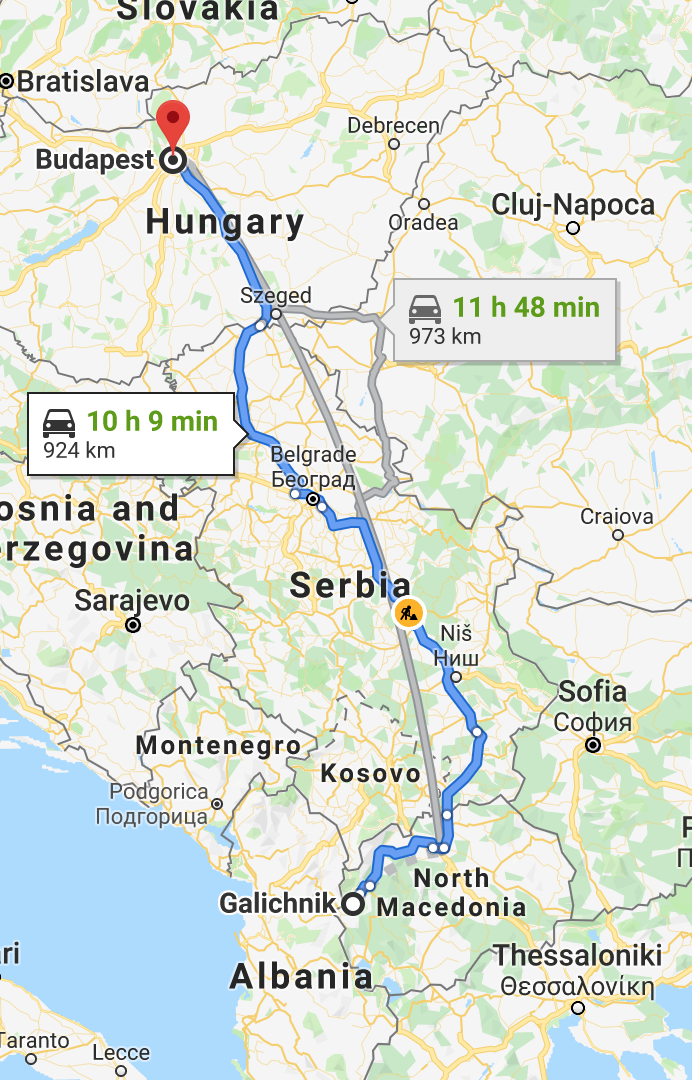
To me, the strangest thing about this wedding song, is not that groom sings about bridal suicide the day before he goes to pick up the bride 🙂. The strangest thing about this song is that the runaway bride does not jump into Vardar (the biggest river in Macedonia) or any river that flows near Galičnik. She runs 600km away and jumps into Danube...


And she calls the people living along Danube "her brothers", and begs them to instruct her family not to cut wood or cut grass growing along Danube or draw water from Danube...


Did this song actually originate much much further up north, somewhere along Danube? 

I believe that this is quite possible as another song, which is sang by girls during the dressing of the groom goes like this:


Original song from the Journal of the Ethnographic museum in Belgrade, book 6, published in 1931. Serbian, Cyrilic


This songs doesn't talk about going to Skopje, the biggest city in Macedonia, or any other town or village in the ares to get the girl. It talks about going to Budim (the oldest part of today's Hungarian capital Budapest), to get a Budim girl!!! 


This is over 900km up north!!!


So were did the people who originally composed these wedding songs live? And when did they move down to Galičnik?