Showing posts with label Blood sacrifice. Show all posts

Sunday, 30 August 2026

Bird hills

A map from "Tičnice iz naravoverja: zanesljivi kažipoti v slovensko prazgodovino" [Bird-hills from Natural Religion: Reliable Waymarks of Slovene Prehistory] self published book by Leopold Sever in 2013. 

It is showing "gradišča" [hill-forts] (blue circles) and "tičnice" [bird-hills] (red circles) in the historical  Slovene regions in Slovenia and southern Austria...

In Slovenia, there are currently more than 200 hill-forts known as (gradišče) and more than 200 bird-hills known under various names (Tičnica, Tičn’ca, Tičistan,  Tičerca, Tičnik, Tičevo, Na tičnici, Tičjak, Tičjek, Križ na tičnici, Ptičjek, Za tičnico, etc).

According to local lore, these were the hills where people once performed religious ceremonies (???), fed birds (???) and "exposed their dead to the birds so that the birds could carry the soul of the  deceased into the sky" (???) before burials...Oh and they believed that these hills were haunted and should be avoided after dark...

Thanks to @another_barbara for alerting me to this.  The book is mentioned in this paper:

Staroverstvo - the Old Religion - the Slovene Pre-Christian Religion

In several parts of Eastern Bosnia and Hercegovina, at the end of the wheat harvest, a patch of wheat is left unharvested "for God's birds". 

In pre-Christian times, Slavs believed that souls of their dead entered birds and through birds entered heaven, Iriy. So feeding birds with grain was basically a form of feeding the ancestors, sacrificing to the ancestors...

Scandinavians did the same, although they don't seem to remember why...

I talked about this in several of my posts: Nav, Bird wedding, Julenek...

Slavs also believed that the bountiful grain harvest was direct result of the good will of the dead ancestors...

And that good will was the result of their descendants remembering them and providing them with food (grain, bread) and drink (water, milk, red wine).

So...

I talked about the importantce of feeding the dead with bread in several of my posts like "Soul breads" "Dead man loaf"... 

According to the Serbian folklore, it is important that the food served to the dead contains "a bit of everything that land gives birth to". It was believed that the dead are the source of life and that they give back manyfold what we give to them...

It is important that the food for the dead contain especially "a bit of all the grains" again because the dead will give us back manyfold of what we give them... 

This is the root of "Koljivo" the meal made from boiled grains, nuts, raisins and sugar used in the Eastern Orthodox Church for commemorations of the dead...


The origins of koliva predate Christianity. In the Ancient Greece, panspermia, a mixture of cooked seeds and nuts, was offered during the pagan festival of the Anthesteria, which was primarily concerned with placating ancestral spirits...  

So when a priest tells you that you should not bring food to the grave for your dead, because that is a pagan custom, and that instead you should make koljivo, which is Orthodox Christians custom...

Serbian ethnographer Veselin Čajkanović believed that originally the sacrifice offered to the dead included blood sacrifice as well. The meal contained not just plant food, but also one of each type of farmed animal, ritually slaughtered, drained of blood, and roasted...

Blood was given to the dead, as it was their favourite drink...I talked about blood sacrifices in many of my posts...
 And the meat was eaten by the living...

Again all of this was done because people believed that their dead are the ones who "make the crops (and especially grain) grow"...

Depiction of Diduch (grandfather), symbolic representation of the ancestral spirit which governs the lives of the living (and most importantly determines how good grain harvest will be). From Central European Slavic mythology / folklore. 


I talk about Diduch and it's symbolic representation in my post "Diduch"...

Tuesday, 10 November 2020

Bleeding for Martin

Cockerel standing on top of the sun gate, on the border between the darkness and light, between the land of the dead (where sun spends night) and the land of the living (where sun spends day). Medieval (?) standing stone, Bosnia...


In the old Irish calendar, the solar year was divided into two parts: the dark part (Nov-Apr) and the light part (May-Oct). The day that marked the end of the light part of the year and the beginning of the dark part of the year was the first of November. Samhain...


But because in the Irish calendar the day started at sunset, Samhain is celebrated  at the sunset of the October 31, on Halloween...And just like the day started with the evening, in the Irish calendar, year started with the beginning of the dark period, on Samhain...

Now until very recently, in Ireland, the practice in many places was to kill a cockerel on "Ould Halloweve" night, the night prior to St. Martin ’s feast day on the 11th of November.

The date for "Ould Halloweve", or old Halloween, came about as a result of the removal of ten days from the calendar when the Gregorian calendar replaced the Julian in 1582...

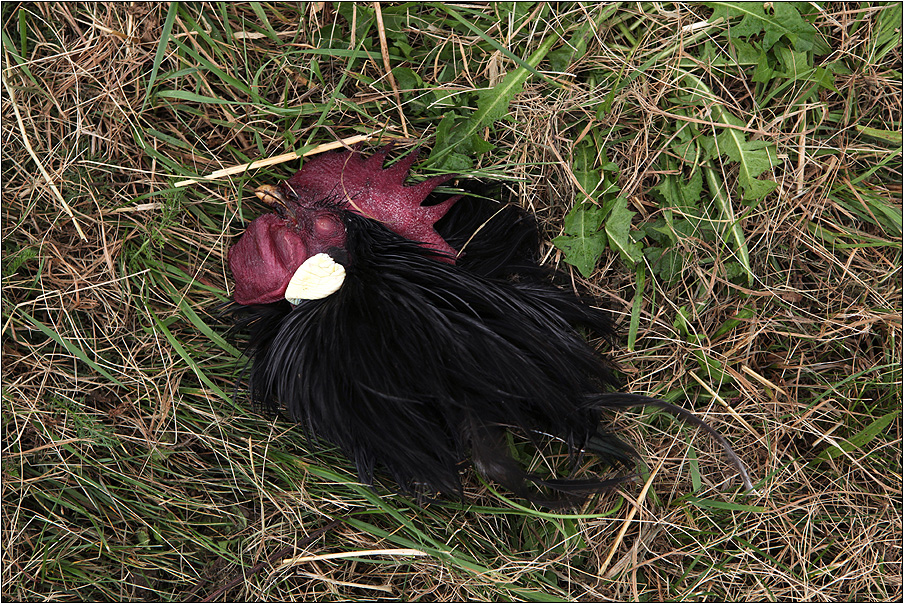
Here is the interesting bit. The killing of the cockerel was known as "the bleeding". The bleeding was done by cutting the neck, or more usually by slitting the head of the bird along the comb and then hanging it to allow the blood to fall on the ground or to be gathered in a jar...

The blood was then sprinkled in all four corners of the house (kitchen if house had more than one room) and across the main threshold, in the belief that this protected the home from evil or "bad luck".

When the blood was not sprinkled in this manner it was daubed in the shape of a cross on the front and back doors while saying, "I shed this blood in honour of God and St. Martin to bring us safe from all illnesses and disease during the year"...

The rest of the blood was collected and used to make a Sign of the Cross on the residents foreheads, again as a protective talisman.

So this was not just "killing of a cockerel to make dinner". This was a blood sacrifice. That this is the case can be seen from the ethnographic data collected around Ireland in the 1930's. I particularly love this story from county Kerry:

So it seems that "the bleeding" was an obligatory blood sacrifice. It was strictly observed that bleeding must be done between Nov. 1st and the eve of the feast, or on the Vigil, as it was said: Martin will accept before his feast but not after it".

But blood sacrifice to whom? To St Martin? Well, no, of course not. To the dead? Samhain eve, Halloweve, Halloween, was in the Irish tradition the day of the dead...

Irish believed that on that night, the barrier between our world and the world of the dead became so thin, that the dead could come back to our world.

And the dead looooove blood. It's their favourite drink, because it makes them feel alive again...I wrote about this in my post "Blood red vine" in which I talked about why red vine is used in mortuary rituals... 

That this is indeed the case can be seen from the identical ritual which is performed on St Mrata's day in Serbia. In Serbia Samhain was replaced by two Holy Days: Mitrovdan (St Martin's day) and Mratindan (St Mrata's) day.

Both days mark the beginning of winter and the beginning of the dark part of the year, as the Old Serbian calendar, just like the old Irish calendar, divided the solar year into the dark part (Nov - Apr) and the light part (May - Nov). 


More about this in my post "Two Crosses".

And on the day of St Mrata, Serbs used to slaughter a cockerel on the house doorstep. 

After the cockerel is slaughtered, a hair from every animal in the household is placed in its beak.

The beak is then tied with a red thread and is hanged over the door or is buried under the doorstep to protect the house and its animals from the evil spirits. The wings and sometimes the head were hanged on the cauldron chain over the fire. I talked about this in my post "Verige".

Both the door and particularly the doorstep and the fire place are in Serbian tradition closely linked with the cult of the dead and are places believed to be inhabited by the spirits of the dead ancestors.

So slaughtering the cockerel on the doorstep is literal blood sacrifice to the dead on their altar. This is the equivalent of the Irish custom of marking the doors with sacrificed cockerel's blood.

Burying the cockerel's head under the doorstep with the hairs of all the animals from the household is clearly a panspermia (mixed sacrifice), a type of sacrifice which was in Serbia offered to family ancestors and to the ancestor of all Serbs, Giving God, Dabog...

The fact that the sacrifice was given to the hearth is the equivalent to the Irish sprinkling cockerels blood only in the room with the hearth. But what about the Irish custom of sprinkling the cockerel's blood in the corners?

Well in Serbian mythology, corners are also seen as places where ancestors gather. During Christmas dinner, which was in Serbia seen as "meal eaten together with the ancestors", walnuts, symbol of fertility was thrown into each corner of the house, for the dead...

Now here is something very interesting. Serbian ancestral deity Dabog has another name: Hromi Daba. In several of my posts I talked about the similarities between the Serbian Hromi Daba and the Irish Chrom Dubh...

One of the similarities is that both gods were in the past offered Human Sacrifices...On Samhain...As thanksgiving for the bountiful harvest which had just finished...

Now remember that in Serbian mythology, cockerel sacrifice is a replacement for a human sacrifice...Particularly when it comes to agricultural rituals. I talked about this in my post "Cock bashing"...


And knowing that St Martin's day is just another Christianised Samhain, when we "bleed cockerel for Martin" who are we sacrificing really and to whom?

Friday, 3 January 2020

Blood red wine

In ancient Greece undiluted red wine was reserved exclusively for gods and was only used for libations. Drinking undiluted red wine was considered sacrilegious and in some cities was punishable by death...


Greeks also believed that blood was the favourite drink of the dead. The dead liked blood because blood is life and only through drinking blood could the dead obtain living consciousness. When Odysseus goes to the underworld to talk to the dead he first gives them sheep blood...

The red wine was the closest thing to blood, which is why eventually blood letting (blood libation) was replaced with the red wine libation...

In Serbia the ancestral cult, the cult of the dead, is at the core of all folk beliefs. Dead were believed to have power over the living and could decide the faith of their descendants. Basically all the dead were deified... Even the main pagan god of the Serbs, Dabog, Sun (Sky) god, was considered to be the progenitor of the Serbs, their original ancestor. He was also the god of the dead, the god of the underworld....So no wonder that in Serbia, during funerals, and during annual visits to the graves, undiluted red wine is poured on the graves of the dead. 

As a matter of fact, in the past, no feast could start without the dead being mentioned and some (originally) red wine, but now any spirit, been spilled on the ground "for the dead"...

As I said in my post "Thirst" Balkan Slavs believed that droughts were caused by "thirsty" ancestors, who were not given enough water through libations by their descendants. 

Destructive storms were also seen as the "wrath of the angry ancestors". In some parts of Serbia people believed that storms actually contained the demons of the restless dead. 


To protect the livelihood people would cut their fingers and point the bloody side to the clouds...


Why? Were they giving their own blood as the sacrifice to the dead to appease them?

Ancient Greeks in the same situation were lifting read scarves towards the cloud. This is again a replacement for the much older blood sacrifice for the dead which was unchanged preserved by Serbian peasants...

That Serbian peasants preserved this most archaic sacrificial ritual is not surprising at all. Blood sacrifices were a big thing in Serbian culture. Agricultural year started and ended with a blood sacrifice. A new house couldn't be built without a blood sacrifice. The end of the harvest was marked by a blood sacrifice...

More info about South Slavic blood sacrifices can be found in my post "Kurban"...