This is the reconstruction of the Beli križ (White Cross) shrine which was once located in the valley southeast of the village of Prelože, Slovenia...

The shrine was destroyed during the First World War. But the locals preserved a vivid memory of it and of the rituals performed around it. These were collected by ethnographers during the middle of the 20th century...
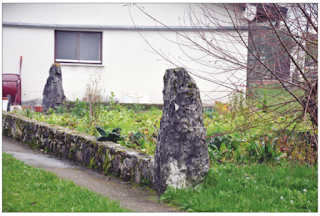
As you can see, it was "a cross in a circle" made of stones, with four stones in each quarter of the circle and four pointy rocks on the ends of cross hands...
Basically this is a so called "sun cross", which symbolises a solar year with four season. Ever spinning solar wheel. This is confirmed by the fact that a bonfire was lit in the field near the shrine on Kresovanje (Bonfire night, Midsummer night)...

In the center of the "shrine" was a stick on which young green tree branches were attached, symbolising a young green tree. Or maybe this cross was rebuilt every year around a real young tree. This is not clear from the original text...This tree symbolically grew during the fertility ceremony which was performed around the cross in the spring "when the foliage turned green", which in the Prelože area happens in April...The carpet of crocus flowers across the slopes of Velika Planina in Slovenia, April...

A very interesting metal plaque from the so called "Letnitsa Treasure", a 4th c. BC Thracian hoard discovered near Letnitsa, Bulgaria...This one depicts one of the most common themes from Balkan fairytales: a princess being kidnapped by a dragon...

Jarilo (Jura), whose name means both "the brightly burning one" (sun) and "the young one, the green one" (bringer of spring, summer, The Green Man) was in other Jurjevo rituals from Slovenia represented by a living walking tree.
Zeleni Jura (Green Yura) walking the earth. Part of Jurjevanje, celebration of the return of Jarilo, Jura, The Young Sun God who brings spring...Today performed on St George's day...Tells you a lot about the true Identity of St George...

This ritual is performed Bela Krajina, area inhabited by descendants of Serbians who migrated here during Turkish invasions of the Balkans. Today split between Croatia/Slovenia...This is the original Green Man...
The Sun God's name Jarilo (pronounced Yareelo) comes from the root "jar" (yar) meaning: young, green (Life giving warm sun of green spring), but also brightly burning and raging, furious (Life destroying burning sun of yellow summer)...
Interestingly, in Sanskrit, har (cognate of jar, yar) can also mean green and yellow...
So the fact that a (symbolic) young green tree, symbol of the sun god Jarilo, was "growing" in the middle of the shrine shaped like a sun cross, points at the symbolic meaning of this shrine: solar year and the climate which it creates...
And it is this climate which people of Prelože were trying to control...As part of the ceremony at the White Cross, four young girls span around the circle interconnected by ivy branches, singing prayers for "sun, rain and abundant crops"...
They prayed to "Dajbogec" (Giving god), another name for Dabog, the old Slavic Sky God...
In Serbian the expression "On vedri i oblači" means "he rules", "he has absolute control, absolute power". Literally this expression means "he makes the sky clear and cloudy"...I talked about this in my post "The power of the thunder giant"...

Dabog, Dajbog was also another name for Triglav, Trimurti, the Supreme god...I talked about Triglav in several of my posts: "Lugus or Triglav", "When the bride dies soon after the wedding", "Sun thunder fire", "Riddle", "Krkava Triglav stone", "Triglav, Trojan, Trinity, Trimurti, Agni"...
This is what Triglav is, one God with three faces: Sun, Thunder, Fire...

It is very interesting that the "shrine" contained pointy upward stones and that at this shrine girls (women) prayed to Dabog for good weather (just enough rain and sunshine) so that their crops would yield abundantly...
Because this is not the only place where we find large stones used in weather rituals involving Dabog and performed by women...
In his 1925 paper "The Ring of Nestor", Sir Arthur Evans, the excavator of Knossos, mentions a curious rain-making ritual which was performed in Ibrahimovci, near Skoplje, Macedonia, during droughts.

Pic: Altar dedicated to Jupiter, Juno und Minerva, Macedonia

This is 1925 we are talking about. At least 1500 years since Jupiter was officially a god of rain...And yet, uneducated, illiterate SLAVIC villagers in Macedonia still remembered him in times of desperation...
What is very interesting is that this altar "was lying face down normally but was lifted when the rain was needed". Compare this with this Slavic rain making ritual from Belarus in which Dabog's stone is ceremonially lifted...I talked about this in my post "The last megalithic ritual in Europe"...

And compare this with other weather controlling Slavic rituals involving sky pointing "weather stones"...See, these weather stones have the same shape as the stones from the White Cross...I talked about them in my post "Weather stones"...
Pleterski, A. 2015, Preplet 3 in 4, preloška "Beli Križ in Triglavca ter Zbruški idol", in: Nesnovna krajina Krasa


