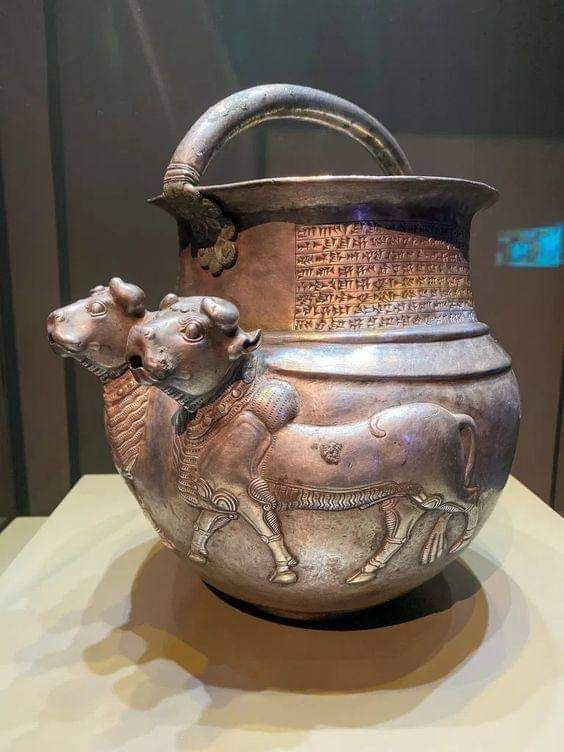
Etruscan bronze protome of Achelous from Tarquinia, 500-475 BCE, currently in the Etruscan Museum in the Villa Giulia in Rome...
Who the hell is Achelous?
Well, just an ancient deified animal calendar marker for Apr/May...Taurus...And I mean really ancient...
So...Apparently, he was "the god associated with the Achelous River, the largest river in Greece"...
Ok....Why would Etruscans care about some obscure local river god from Aetolia? Well cause Achelous was not just a river god. He was THE River God...
From at least as early as Homer, Achelous was an important divinity throughout Greece. While people would offer sacrifices to their local river, only the Achelous river was honoured everywhere, with Achelous's name often being invoked in oaths, prayers and sacrifices...
Achelous was also an important deity in the Etruscan religion. Apparently, the oldest depiction of Achelous as man-faced bull was found in Etruria, and dates to the 8th c. BC, the tradition which was, only later adopted by the Greeks...Etruscan funerary shields, 6th c. BC.
Why man-faced bull? Well, there is a legend about Achelous falling in love with Deianeira, daughter of the king of Calydon, and coming to ask her father for her hands as a man, as a serpent and as a bull with human head...
Deianeira wasn't very enthusiastic about this proposition, and "prayed in her misery that she might die rather that lie in that marriage bed"...Luckily for her, Heracles came to her rescue...
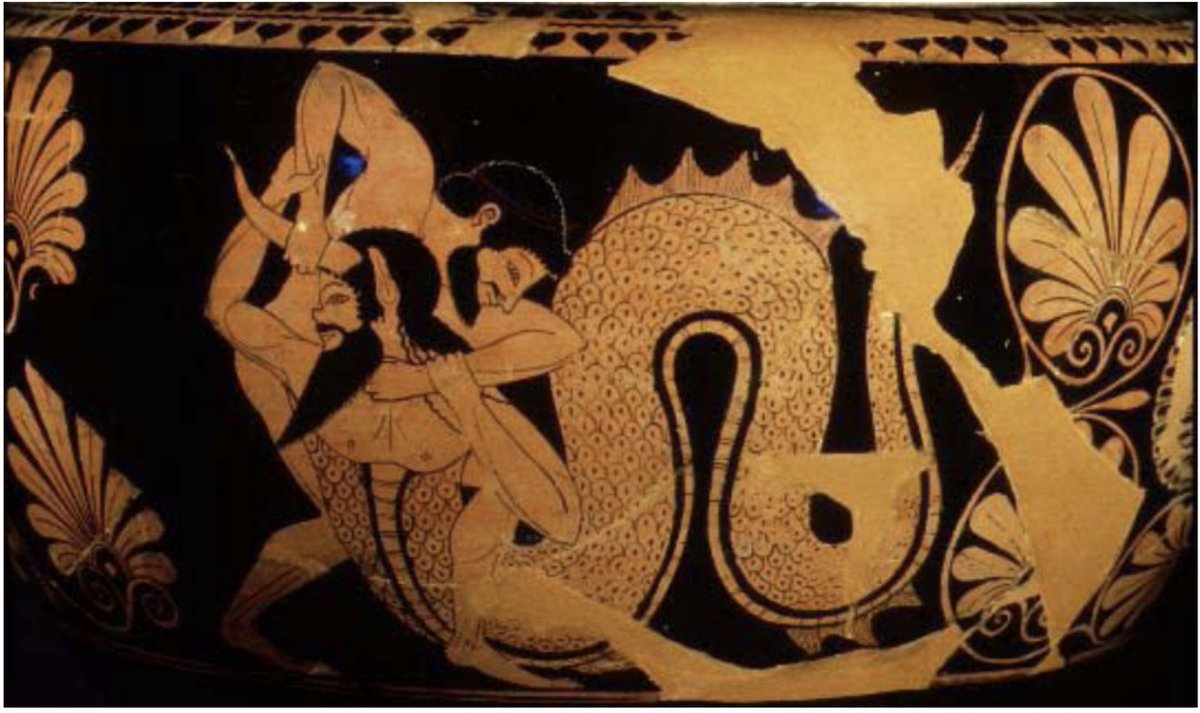
Heracles fought Achelous, who during the fignt, first took the shape of a man, then of a serpent and finally of a bull with a head of a bearded man. But that shapeshifting made no difference. Heracles won the fight and Deianeira was saved from the "faith worse than death"...
Heracles fighting Achelous as a man, Roman fresco from Herculaneum
Heracles fighting Achelous as serpent (dragon?) with a head of a bearded man with bull horns, 6th century BC Attic stamnos, British MuseumHeracles fighting Achelous as bull with a head of a bearded man with bull horns, 5th century BC Attic column krater, Louvre
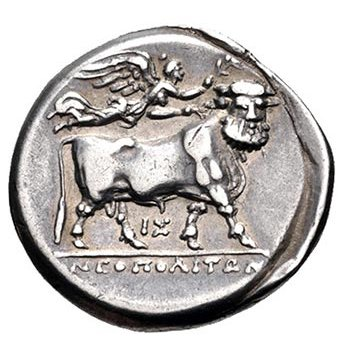
It is Achelous as a bull with a head of a bearded man, which is how Achelous was most commonly depicted on ancient coins.
L: Sicily, Gela, 480-470 BC
R: Campania, Neapolis 275-250 BC
Now, after Heracles had subdued Achelous, he broke off one of Achelous's horns. There are two versions of what happened next:
Version 1: Heracles gave the broken bull horn to some nymphs, who filled it with flowers and called it Cornucopia.
Version 2: Achelous was able to get his horn back by trading it for a horn from Amalthea, the goat that suckled Zeus. The real Cornucopia.
So...WTH does all this mean? According to Diodoros Siculus and Strabo, the meaning of the victory of Heracles over Achelous is allegorically depicting the channel excavation and construction of dikes to confine the shifting bed of Acheloos...You can read about it in "Agricultural hydraulic works in ancient Greece"
But to me that doesn't sound very plausible...To me this sounds like no one really knows what the meaning of this was...So let me have a go at it, and see what I can come up with...
What we need are...animal calendar markers...and local climatological and hydrological records...
Here are
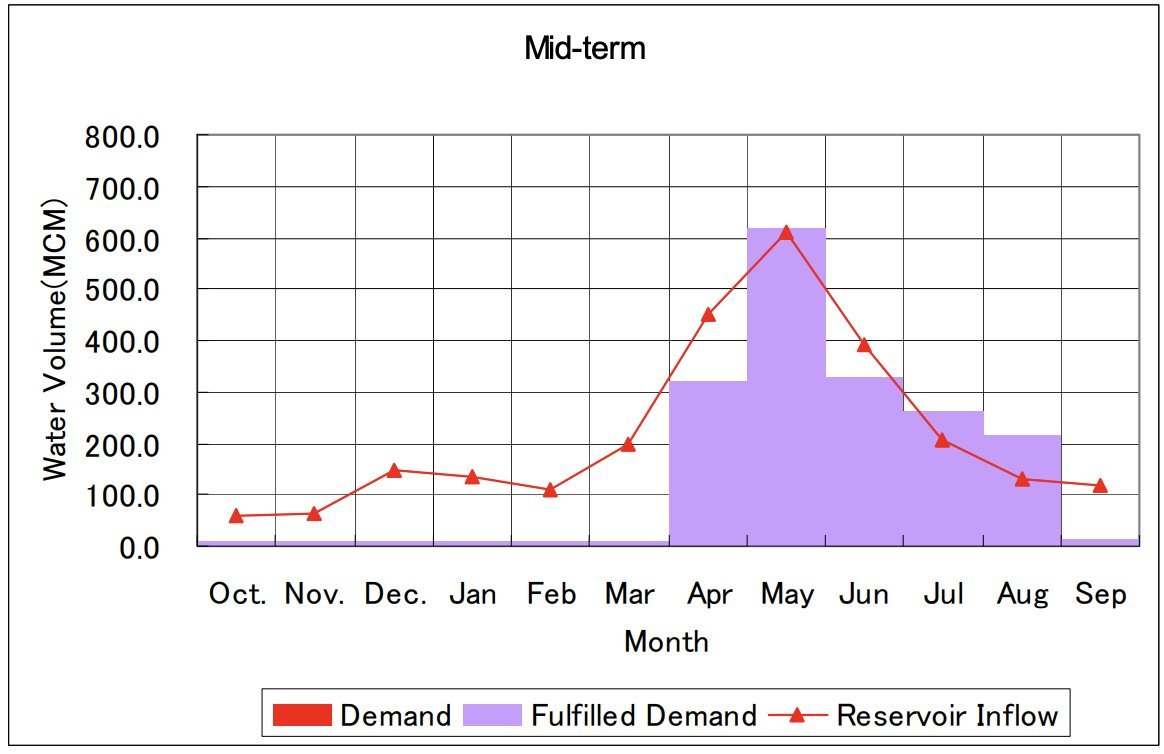
The climate chart for Aetolia
and
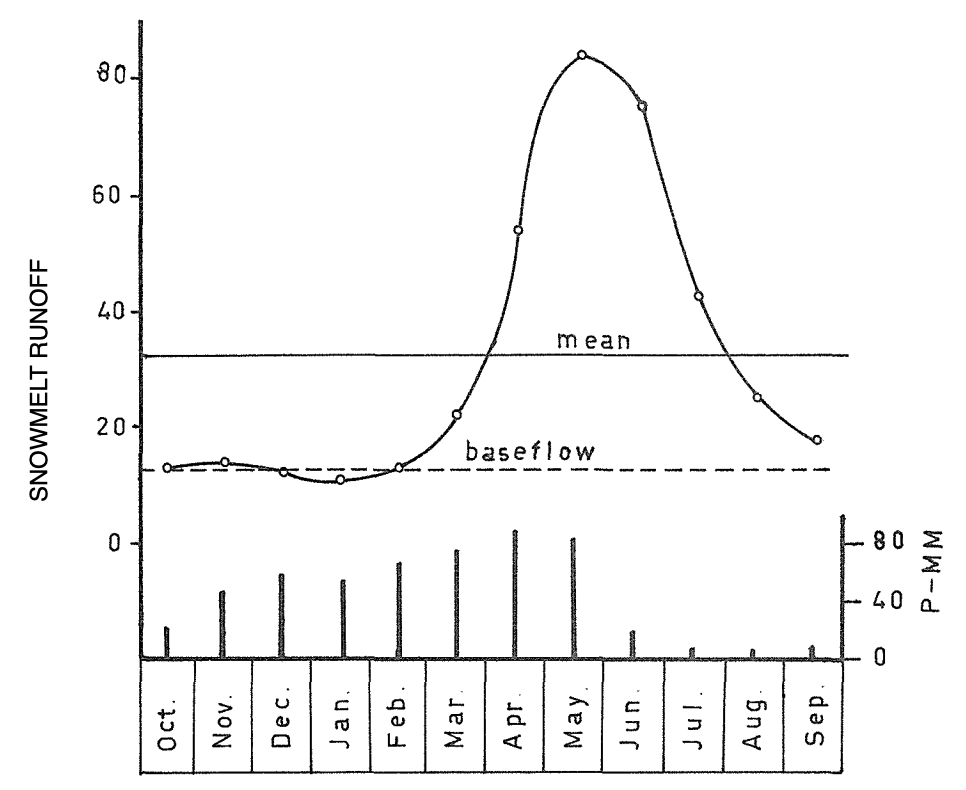
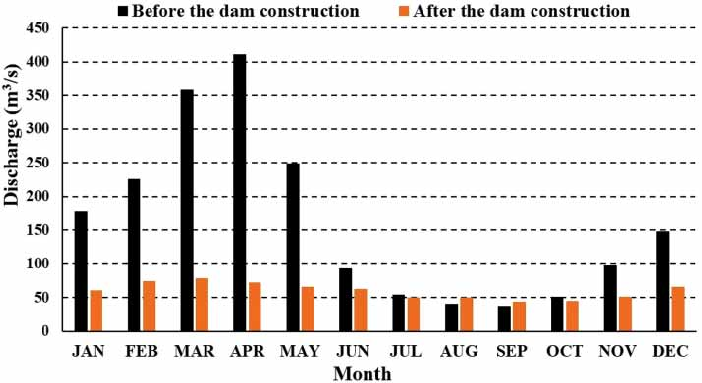
The monthly flow chart for the Achelous river
You can see that the water discharge suddenly jumps in Oct/Nov, and suddenly drops in Apr/May...And that this jump and drop correspond with the beginning and the end of the rain season...
The river flow chart and table are from "Assessment of environmental flows under limited data availability: Case study of the Acheloos River, Greece".
Now in the above legend, Heracles fights and defeats Achelous. The defeat of Achelous, the river god of the river Achelous, could mean only one thing: the drop in river water level...Which happens in Apr/May...
And the animal shapes that Achelous took while fighting Heracles, serpent and bull (with human head) are both animal calendar markers for Apr/May...
Taurus (Apr/May) is the ancient animal calendar marker which marks the time of the year when Wild Eurasian cattle used to start calving... I talked about it in many articles, for example "Cow and calf ivory".
Here is an article "Foundation peg of the goddess Nanshe", which. talks about the Old Taurus, this time from Mesopotamia...It discusses the reason why bull calf among the reeds is standing on top of the foundation peg of the temple of the goddess Nanshe...
And here is another article about Old Taurus, "Human-Bull hybrid", about this seal from Mohenjo-Daro, dated to 2600-1900BC, now in National Museum of Karachi (inv NMP 50,214)
Now, snake doesn't have its western zodiac symbol, but snake is an animal calendar marker of the beginning of summer, Apr/May, because this is when the most common Eurasian snakes, vipers, begin their mating season...
God most high...
Snake: Apr/May, beginning of the main snake mating season, beginning of summer.
Lion: Jul/Aug, beginning of the main lion mating season, end of summer.
And in the middle...From my article "You will trample great lion and serpent"
Snake is a pure solar animal. It is in our world when sun is here (day, hot half of the year) and it is in the underworld when sun is there (night, cold half of the year)...I talked about it in my articles "The chthonic animal" and "Enemy of the sun"
To understand fully the meaning of the snake animal calendar marker, and its link with bull animal calendar marker, we need to understand snake's relationship with dragon...
According to Slavic folklore, Dragon (the symbol of the destructive summer sun's heat which burns everything and brings drought) is just "an old snake" (symbol of sun's heat)...Also Slavic "zmaj" (dragon) is masculine form of "zmija" (snake)...I talked about this in my post "The Letnitsa treasure"
This same link between snakes and dragons is found in Mesopotamia...
In Mesopotamia, summer lasted seven (hot) months...Which is why local dragon (dragon = symbol of summer), had seven snake heads (snake = symbols of sun's heat)...Oh, and look, we also have dragon killer(s) and the princess 🙂 I talked about this in my article "Seven headed dragon".
There are also South Slavic legends about people sacrificing girls to a lake monster. The monster was at the same time a snake/dragon and a bull. Basically both bull and snake/dragon are solar symbols, both symbols of burning summer sun...I talked about this in my article "Water bull".
BTW, Bactrians also had this symbolic link...Here is my favourite Bactrian seal. It depicts a snake with two heads: a dragon (left) and a bull (right)...Symbolically equating dragon (summer sun) and bull (summer starts in Taurus) and linking both with the sun's heat, symbolised by a snake body...I talked about this in my article "Bactrian snakes and dragons".
The same symbolic link between bull and snake is found in Greece. You can find both snake and bull animal calendar markers embedded in the myths about Hermes...I talked about it in my articles "When grapes flower" and "Lyre of Apollo".
Here I want you to keep in mind that both bull and snake are solar animals, and as calendar markers both mark Apr/May, the beginning of the summer, the domain of the sun...This will be important later...
Anyway, Heracles defeats Achelous in Apr/May (time of the year marked by both snake and bull). The water level in Achelous's river drastically drops...This is symbolically reinforced by Heracles breaking off one of Achelous's horns...
The water is still flowing, but the flow is greatly diminished...Now Achelous wants his horn back, because by getting it back, he will get back his power...which is measured by amount of water in his river...And the water level in the Achelous river suddenly rises in Oct/Nov...
Oct/Nov is marked by the Old Capricorn, the Goat of Rain. Because this is the time when male ibex goats start their ferocious mating fights...
And because the wet season in Eastern Mediterranean, Levant, Central Asia, Mesopotamia, Iran starts when ibex goats start mating, ibex goat became an animal calendar marker for the beginning of the rain season...Here are some articles about Ibex goat as an animal calendar marker imbedded in various Eurasian cultures where rains arrive in Oct/Nov...
And guess what, Cornucopia (horn of plenty) was originally an actual horn which belonged to Amalthea, the Ibex (goat of rain) that suckled infant Zeus (god or rain) on Crete, passing on to him its rain bringing powers. I talked about this in my post "Cornucopia"...
It is rain that makes agriculture possibly to these lands. Which is why the horn of the goat of rain became Cornucopia, the horn of plenty...I think that this version of the legend about Acholous and Cornucopia is older...But the other version, where broken bull horn becomes Cornucopia, also has it's explanation through animal calendar markers...In Ancient Greece the grain harvest started in Apr/May, in Old Taurus. If we are to trust Hesiod...I talked about this in my post "Hesiod on grain"
As I said, Apr/May is also when snakes start to mate...Hence the links between Demeter/Persephone and snakes...
I talked about this in my posts "Demeter riding panther" and "Who are Persephone's parents"
So Heracles defeats Achelous as snake/bull (in Apr/May), breaks off one of his horns, and it becomes Cornucopia, the horn of plenty, because this is when harvest season started in Greece...
See...This also makes sense when viewed through animal calendar markers...
Soooo...So far so good? It looks like this legend is entirely local, Greek, in origin...Which doesn't explain the veneration of Achelous as "the god of all rivers and all water"...
The 1st c. AD Oxyrhynchus Papyrus 221 equates Achelous and Oceanus, and says that "...many people sacrifice to Achelous before sacrificing to Demeter, since Achelous is the name of all rivers and the crop comes from water..."
Ha!!!
Oxyrhynchus Papyrus 221 also says that "the waters of silver-eddying Achelous" are the source of "the whole sea"...And the late 5th c. BC commentary on Orphic theogony, preserved by the Derveni Papyrus, calls the rivers the "sinews of Achelous"...
If only there was another ancient all powerful god, older than Greek gods, who was the god of (all) rivers, and who was symbolically linked to snakes and bulls...And who was also linked with grain (harvest)...Hmmmm...
The meaning of the name Achelous Ἀχελώϊος is "possibly pre-Greek...Semitic in origin, with the initial Αχ- stemming from the Akkadian aḫu ("bank of the river")...and the suffix -ελώἴος, from the Akkadian illu ("watercourse" or "water of the river")...
This proposition comes from "Potamikon: Sinews of Acheloios. A Comprehensive Catalog of the Bronze Coinage of the Man-Faced Bull, with Essays on Origin and Identity" by Nicholas Molinari and Nicola Sisci...A book of which I only heard the other day...
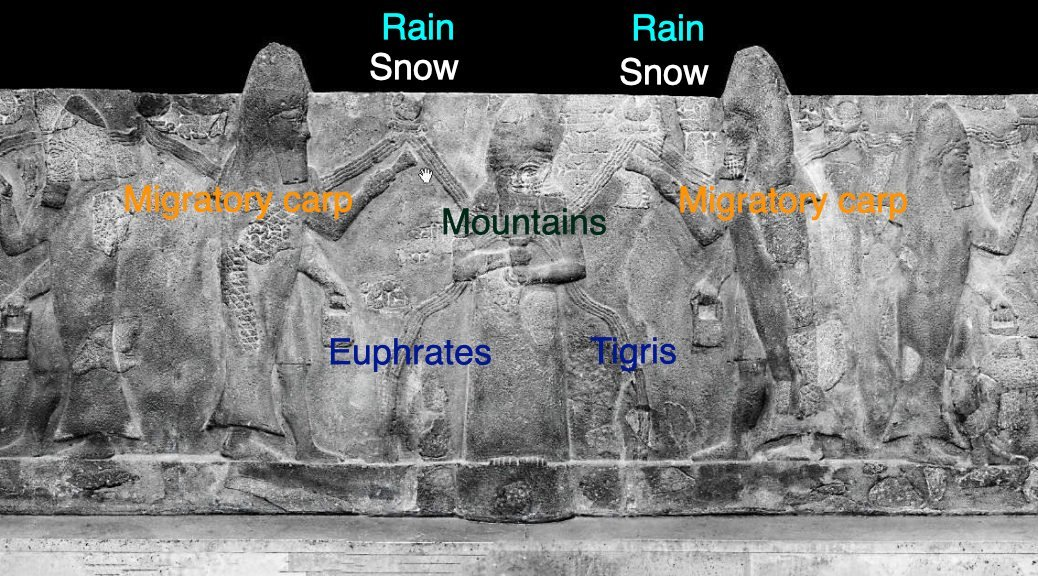
That's very interesting, cause in Mesopotamia we find Enki/Ea, the god (of the) the source of the rivers Tigris and Euphrates (all the rivers in Mesopotamia)...I talked about this in many of my blog posts about Enki/Ea and check my X threads too...
BTW, ever wondered why Mesopotamian deities have bull horns???
Here is why. Many Mesopotamian "Supreme" gods have an attribute "The Great Mountain". Cause they all wanted to be Enki...But there is only one Enki, who is (in) Abzu, "place that is a big mountain" source of all water...All the others are just imposters...I talked about this in my post "Great imposter"...
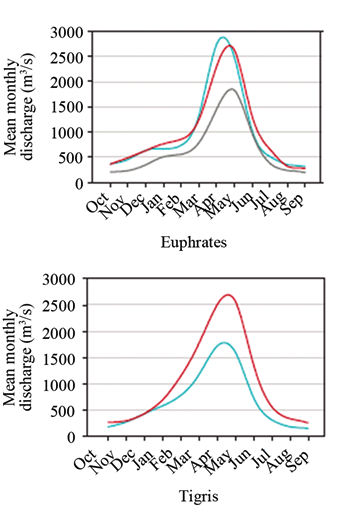
The mountains to the north and east of Mesopotamia are the source of water that flows through Tigris and Euphrates...
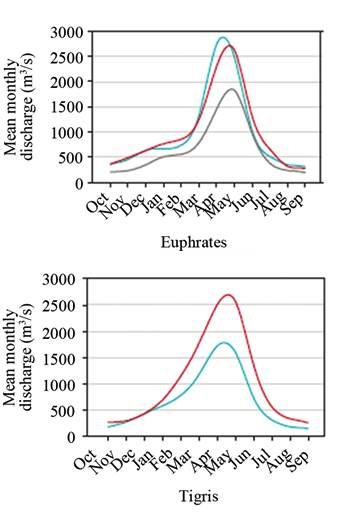
The water flow starts to increase when wild goats start to mate (Oct/Nov) and peaks when wild cows start to calve (Apr/May)...
I talked about this in my post "Problems of Abzu"...
This is why in "Enki and the world order" we read: "...Father Enki...he stood up full of lust like a rampant bull, lifted his penis, ejaculated and filled the Tigris (and Euphrates) with flowing water. He was like a wild cow mooing for its young in the wild grass..."
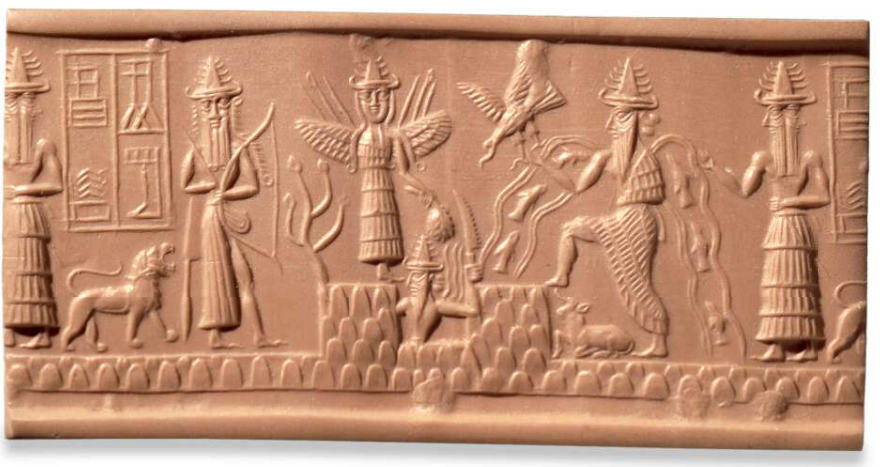
This is also why Enki, the god of fresh water and the annual "carp flood" is standing on a bull, while fish swim towards him.
Tigris and Euphrates flood in Apr/May, in Taurus, when big carp swim upstream for spawning...
I talked about this in my posts "Adda seal", "Apkallu"... and many others...
BTW, now that I mentioned the carp flood, you might find this interesting
Goatfish, the sacred animal of Enki, the Sumerian god of fresh water, is a complex animal calendar marker for the wet half of the year in Mesopotamia...Between the mating season of wild goats and the mating season of giant Mesopotamian carps...
I talked about this in my post "Goatfish"...
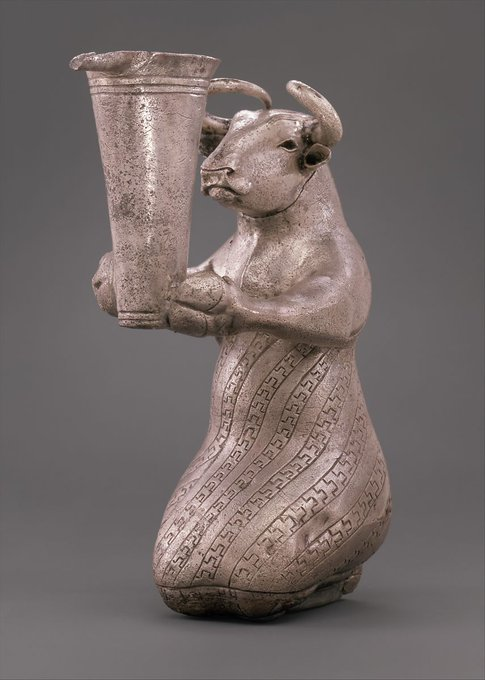
But do we find Enki/Ea depicted as a bull with bearded human face? Actually no. In Mesopotamia, the bull with bearded human face was commonly used to depict Utu/Shamash, the sun god...Human-headed bull, Neo-Sumerian, 2080 BC. Mesopotamia, Girsu (modern Tello). Met Museum...
Every spring, the sun god Utu / Shamash climbs the holy mountain (Abzu) to free Enki / Ea, the god of sweet water from his icy prison and release the waters...I talked about this in my posts "Shamash young and old" and "When Utu steps up to heaven"...
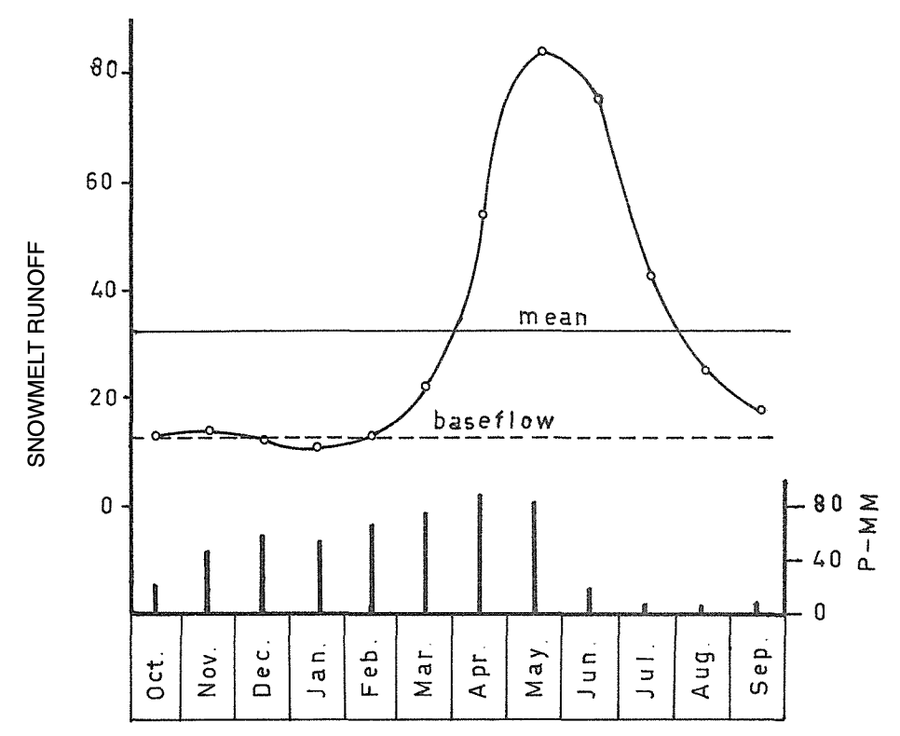
This freeing of Enki is an euphemism for snowmelt, in the mountains north and East of Mesopotamia, which are the source of Tigris and Euphrates. Snowmelt contributes more than 70% to the annual water flow of these great rivers. And this snowmelt peaks in Apr/May...
Which is why the water flow of Tigris and Euphrates also peaks in Apr/May in Taurus, resulting in the annual flood...Which is why, in "Enki and the world order" we also reed that: "Enki placed in charge of the whole of heaven and earth the hero, the youth Utu (Shamash), the bull standing triumphantly, audaciously, majestically...". I talked about it in my post "Butt chewing"...
Triumph, Taurus, Peak of the Flood which ends in Leo
And which is why "Enki and the world order" describes Utu/Shamash...as a bull with a lapis-lazuli beard...and why we find Shamash depicted as a golden (solar) bull with lapis lazuli (water) beard...Basically sun in taurus at the peak of the flood season...
Sun and River...
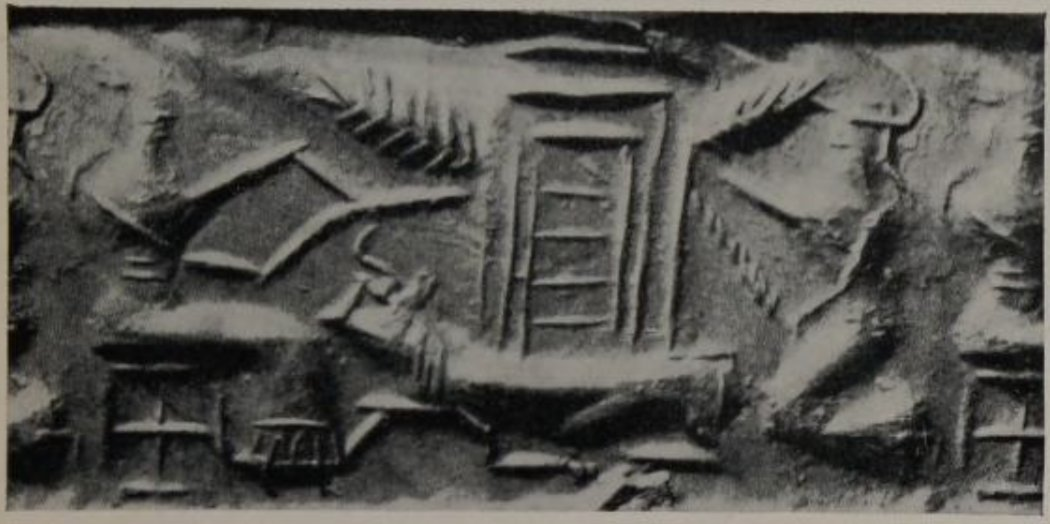
Oh look. Shamash as a man with bull horns...
This is Maran Shamash (Lord Sun), the main god of Hatra, an ancient city in Upper Mesopotamia located in present-day eastern Nineveh Governorate in northern Iraq, the city whose full name was Hatra Shamash ([Temple] Enclosure of the Sun God)...I wrote about it in my post "Maran"...
Oh, the bull animal calendar marker also marks the beginning of the grain harvest in Mesopotamia...I talked about it in my post "Bull carrying grannary", about this very interesting seal, one of many seals, from "Die Entwicklung der Glyptik während der Akkad-Zeit" by Boehmer, R. M. published in 1965...
Oh look. Bulls with bearded human heads...
And: every year during the harvest, a man and a woman performed ritual sexual act on a threshing floor, imitating Inanna (earth, womb) and Enki (sweet water, seed) consummating their holy marriage.
Enki/Inanna = Achelous/Demeter???
I talked about this in my post "Sacred marriage on the threshing floor"...
Finally...What about snake? In the Deliver Me from Evil: Mesopotamian Incantations, 2500-1500 BC, By Graham Cunningham, we can read that in the Earliest Sumerian texts, Enki, the god of flowing water was associated with poisonous snakes...Why?
Snake mating season starts in Apr/May, which is the peak of the snowmelt runoff in Iranian mountains, the peak of the flood season of the Iranian rivers and the peak of the Tigris/Euphrates flood...
Hence Enki (Or at least Elamite equivalent of Enki, Napiriša) sitting on a snake throne...
I wrote about this in my post "Snake water bowl"...
And soooo...The same animal calendar markers, marking the same times of the year, used in river (god) related mythology in Mesopotamia and Greece, but with different meanings, because of a different hydrology...
In Mesopotamia, bull and snake, mark the peak of the water discharge in "All the rivers", hence triumphant bull...
While in Greece, bul and snake mark the decline of the water discharge in "All the rivers", hence subdued bull...
In Mesopotamia, the reason for (all) rivers peaking and flooding is Utu/Shamash...The sun (god)...
In Greece, the reason why (all) rivers drop and dry out is Heracles...The sun (god) in disguise...
Now back to "Potamikon: Sinews of Acheloios. A Comprehensive Catalog of the Bronze Coinage of the Man-Faced Bull, with Essays on Origin and Identity" by Nicholas Molinari and Nicola Sisci. In it they further say that:
"Both the form and substance of Achelous, as a god of water primarily depicted as a man-faced bull, have roots in Neolithic Old Europe..After the disappearance of many Old European cultures, the traditions traveled to the Near East at the beginning of 4th mill BC (Ubaid period)"
"It finally migrated back to Greece, Italy...during the Late Bronze Age through the Orientalizing period...all examples of man-faced bulls are found around the area of the Mediterranean, suggesting some intercultural continuity."
Interesting...Cause I came up with the same idea and elaborated it in this article entitled "Solar bull"...
Oh hello there, gorgeous 🙂 A Neolithic bull with human face and beard from Bulgaria...Karanovo Culture, 5th millennium. BC...These bull men predate Sumerian bull men and Greek bull men by several millenniums...No one knows what they mean of course 🙂
Well, the continuity is kind of obvious. But continuity of what...Which I think we now know...That's it for tonight...Sorry for dragging this on...
To read more about ancient animal and plant calendar markers, start here…then check the rest of the blog posts related to animal calendar markers I still didn't add to this page, and finally check my twitter threads I still didn't convert to blog post...I am 9 months behind now...