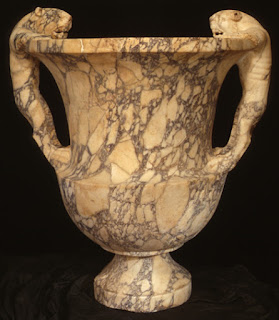
Friday, 24 December 2021

Flamingos from Susa

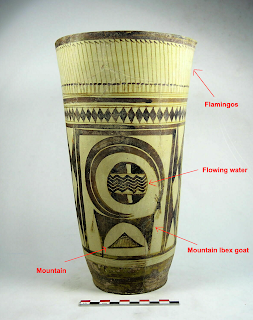
This beautiful vase is not a Modern Art Masterpiece...It is almost 6000 years old, and is currently kept in Louvre, Paris in the "Département des Antiquités orientales"...
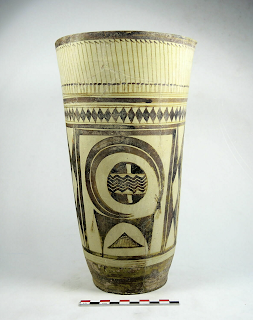
It was made between 4000BC and 3000BC by the people who lived in Susa, South Western Iran...


I don't know if you can see what is actually depicted on this vase, cause of amazingly stylised drawing style...So Here is the same vase with annotations...


The goat depicted in the centre of the vase is our old friend, Ibex goat, The Goat of Rain...


The most depicted animal (calendar marker) in Iran...I talked about it in my post "Iranian goat of rain"...
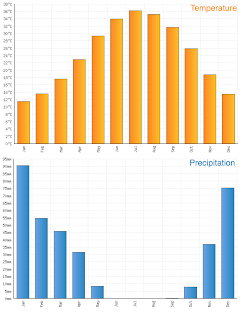
Why was Ibex goat so important to ancient Iranians? Cause the beginning of the mating season of Ibex goats in this part of the world, Oct/Nov, coincides with the arrival of life giving rains, and with the beginning of the cool, wet half of the year...
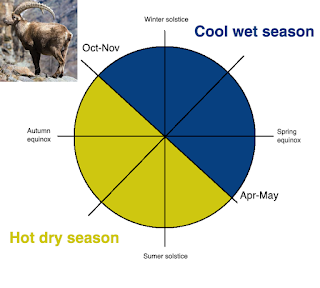

Susa climate
Goats were so symbolically powerful, that kings, when they wanted to look really important, depicted themselves carrying baby goats...
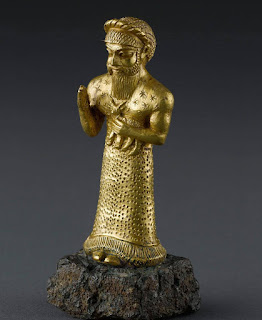
I talked about this in my post "Goat carrier"...Follow the links in the article to read more about the the Goat of Rain...

So, Goat of Rain, animal calendar marker for Oct/Nov...

What about flamingos? This is Greater Flamingo
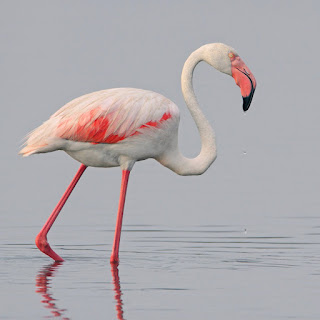
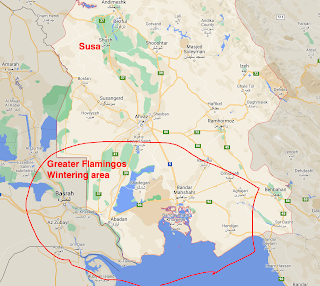
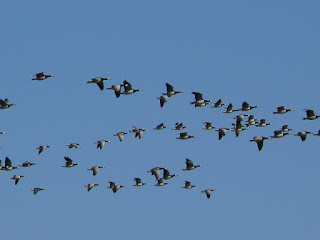
And in Oct/Nov, at the same time when The Goat of Rain starts mating, huge flocks of Greater Flamingos arrive from their northern breeding grounds in Central Asia, to their wintering grounds in the warm Southern Mesopotamian marshes...
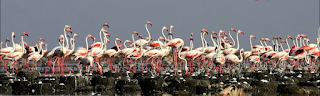
Unfortunately, not for much longer...Thousands are caught every year by poachers in both Iraq and Iran and are sold either "alive, to people who want to decorate their gardens with living Flamingos" or "dead, to people who like eating roast Flamingos"...
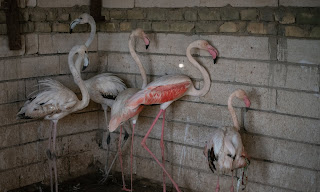
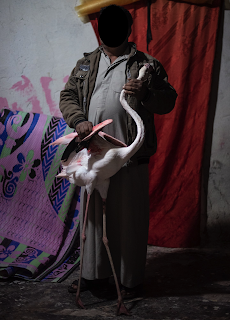
Two articles about migratory bird (and flamingo) poaching in: Iraq and Iran...

Now Susa is located in Khuzestan Province

When I started looking at the flamingos in Khuzestan, the first article that I came across was this one that talks about a mating colony of Greater Flamingos in Khuzestan Shadegan Ponds...
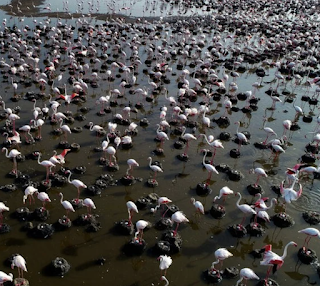
Flamingos mate there between April and August...So that screws up the interpretation of the Susa vase flamingos as animal calendar marker for Oct/Nov...

Maybe ibex mating season marks the beginning and flamingo mating season marks the end of the cool wet half of the year???


Well...

The problem is that all the papers about Flamingos in Iran are citing Lake Urmia as the main Greater Flamingo nesting ground in Iran...
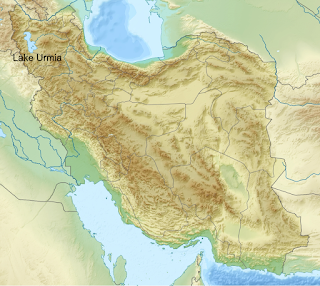

For instance, in "FlamingosBy Janet Kear, Nicole Duplaix-Hall we can read that:

"Lake Rezaiyeh (Urmia) is the main Greater Flamingos breeding ground...Southern marshes (including Khuzestan Shadegan marshes) wintering grounds..."

The problem is that the lake Urmia has all but disappeared over last 20 years...
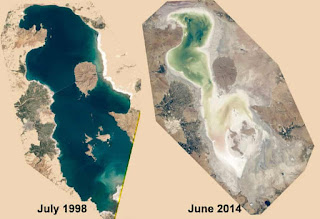
It almost completely dried out...
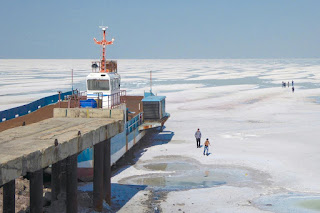
Which means that the Iranian Greater Flamingos had to find some other place to nest...Or die out...

The 2017 "Birds of Iran: Annotated Checklist of the Species and Subspecies" by Abolghasem Khaleghizadeh, Kees Roselaar, Derek A. Scott, Mohammad Tohidifar, Jiří Mlíkovský, Michael Blair & Pavel Kvartalnov, says:

"Greater Flamingo: Formerly an abundant breeding bird at Lake Urumiyeh, Azarbaijan...common winter visitor to...Khuzestan and entire south coast..."

But:

"recently found breeding in...Khuzestan (at Shadegan)"

So it seems that the birds now nesting in Khuzestan have moved there after their native habitats in Central Asia (listed in "Zoogeographical results of the bicentennial study of the northern part of the asian population of Phoenicopterus roseus" by Boris Yu. Kassal) and the ones in Northern Iran were destroyed...

And that at the time when the Susa vase was made, all the Greater Flamingos found in the Southern Marshes near Susa were winter visitors arriving in huge flocks when Goats of Rain started to mate, in Oct/Nov...

But I might be wrong...BTW this is just one of many vases from the same period depicting Goats and Flamingos...
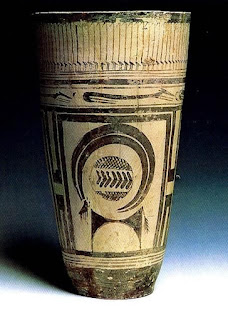

Most likely not by accident...

BTW, at the same time when people form Susa, Iran, made their Ibex - Flamingos vases, someone in Naqada, Egypt, made this...Looks familiar?
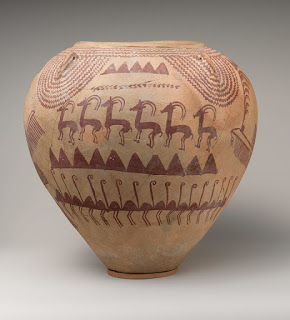
I talked about this in my post "Markhor goat from Naqada"...

Thursday, 23 December 2021

Inviting spring

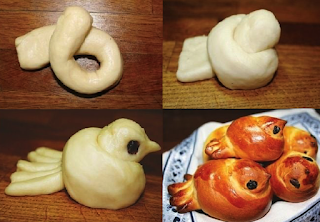
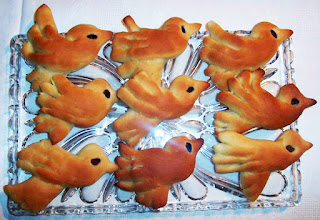
There are special kind of bird shaped buns baked by Eastern Slavs as part of the "inviting spring" rituals which were traditionally performed in March every year.  They are called "жаворонки, zhavoronki" (larks) or "кулики/kuliki" (sandpipers) ...

These cookies were baked in March for the first (1st of March), second (9th of March) and third (March 22 or 25th) calling (inviting) of spring...I guess one can get pretty impatient waiting for spring to arrive...🙂

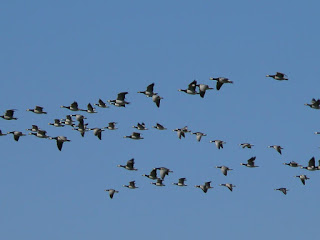
People believed that larks and sandpipers arrived “carrying spring on their wings” and “leading other migratory birds behind them”. And the arrival of migratory birds was a sure sign of coming spring. And an extremely important event in Slavic tradition...I talked about this in my post "Leto"...


Remember, Slavs believed that every autumn, migratory birds took away the sun to Iriy, Slavic Otherworld, World of the Dead, where he spent winter. And that every spring, migratory birds brought the sun back into our world...

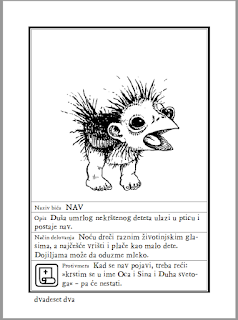
But Slavs also believed that migratory birds also brought souls from Iriy. Souls which were ready to be reborn...I talked about this in my post "Nav"...

Here is how you can make two main types of bird buns, the flying one and the sitting one...


Anyway, once made, the "larks" and "sandpipers" buns were placed on the windowsill, but most were given to children who ran around with them pretending that the birds were flying, all along shouting and calling spring to come...

Some children stuck their "bird" bun on long rods and waved them high in the air pretending that the birds were flying. Some other children threw the "bird" buns in the air trying to make them “fly” as high as possible. Some carried the "bird" buns on their heads...

The kids tried to bring their "bird" buns to "the high places": tops of hills, trees, rooftops, haystacks, fences...Children played with their "larks" all day and ate them in the evening, but some bird buns were left on the high places as offerings...

In some areas the kids would eat the bodies of their bird buns, but the heads were fed to the cattle "before they were taken out to graze in the fields for the first time"...This again seems to have been a ritual offering, a sacrifice of sorts "for good weather"...

Some bird buns were left on a patch where all snow melted. And some were thrown into a river...Remember snow melt is another sure sign of the departing winter (Morana/Marzana, the Old Hag Earth) and arriving spring (Vesna, the Young Maiden Earth)...

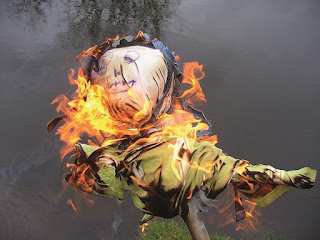
Which is why Slavs burn the effigies of winter or drown them or both...To be sure to be sure...But also heating of the earth causes snow to melt and the rivers to swell with the snowmelt...I talked about this in my posts "Gryla", "Baba's day"...

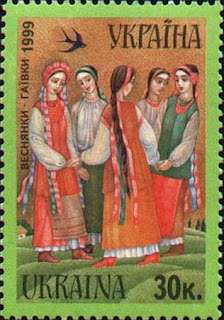
Apart from children, young unmarried women also played a major role in "calling of spring" rituals. They were the ones who sang "Веснянки / Vesnyanki" (Spring songs)...

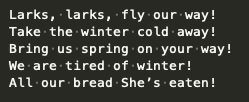
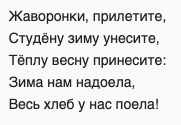
Like this one. And do you see how the end of bread (flour) is linked with the departure of winter and the arrival of spring?


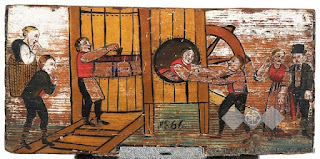
That's interesting...Because it explains the "magical transformation of an old woman into a young maiden through milling" images from Slovenia...

I talked about this in my post "Grandmother's mill"


And in my post "Old woman of the mill dust" about a very similar folk tradition from Ireland...

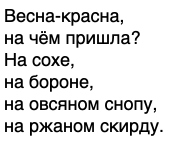
Here is another Vesnyanka (Spring song). This one directly linked with grain agriculture too...


I don't get this Red Spring thing though...Was this once Весна Красивая (beautiful spring)??? Or is red = hot?

Anyway, in some areas, women baked rye bread and then went out of the village, to the fields, orchards, meadows... There they bowed to earth, threw the bread on the ground and exclaimed: "Here is, Mother Spring, some rye bread for you"...

Again, this is a ritual sacrifice of bread to the mother of bread...And it is performed by a woman...In Slavic tradition (and not just Slavic) Earth fertility and female fertility was directly linked...I talked about this in my post "Walking sheafs of wheat", "Wheat wreath", "Corn dolly"...

This pre Christian Slavic celebration of the end of winter and the beginning of spring was later incorporated into Christianity and is now seen as part of "Сороки / Soroki" (Forty Martyrs of Sebaste)  for some weird reason... 

Here you can find the recipe and the instructional video for these beautiful bird buns (with English subtitle)... 

More about spring and birds in Slavic folklore can be found in these posts: "Partridge",  "Tetjorki", "Swallows", "Bird wedding", "Leto", "Radegast", "Cock bashing"...

Dioscuri plate from Iran

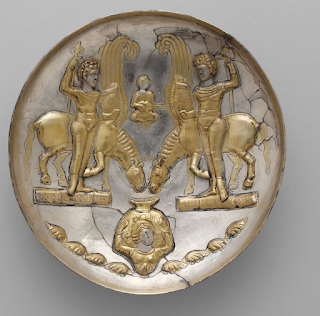
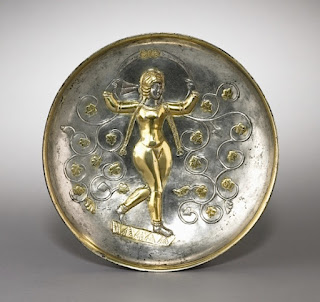
Sasanian plate with youths and winged horses ca. 5th–6th century A.D. Currently kept in the Met Museum...


Official description: 

"Two youths stand on platforms facing one another, each holding a staff and the reins of a winged horse. This is reminiscent of representations of the hero Bellerophon and Pegasus as well as of the Dioskouroi (the divine twins Castor and Pollux)...

Both horses bend their necks down to drink from a large vessel supported by a female figure, who appears in bust form emerging from a frieze of half-palmettes. 

She is most likely either a personification of water or the Iranian river goddess Anahita (This girl. I talked about her in this post)

The scene may have cosmic significance, if indeed the two youths represent the constellation Gemini, called Do Paykar (Two Warriors) in Middle Persian astronomical texts"... 

The end of the official description...

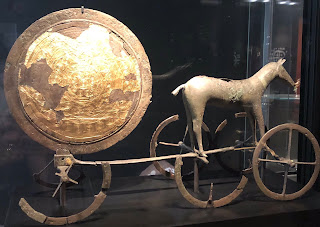
Now this is interesting...Winged horses, winged horses...Have you seen this?

Bronze Age "Sun Chariot" pulled by a horse, Denmark 1400 BC. 

Why are horses so prominent in solar cults?

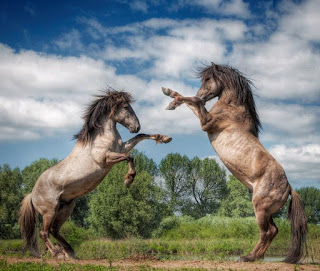
Did you know that horse mating season, which is characterised by vicious stallion fights, is governed by the sun and it peaks on summer solstice. Two horses facing each other as symbols of summer solstice...Hmmmm...

Hence horse pulling sun chariot...I talked about this in my posts "Svetovid", "Trojan horse", "Unicorn", "Re'em"...

So? What does this have to do with this Iranian plate?

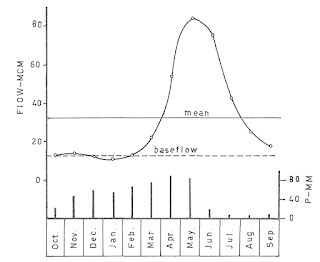
Well, have you seen this? 

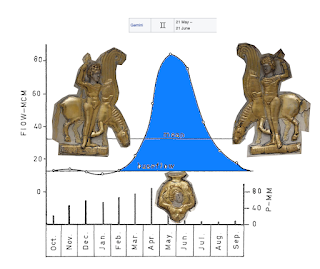
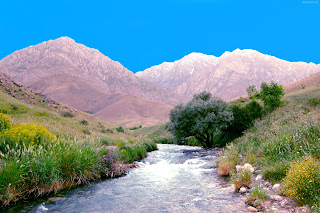
This is the flow chart of the rivers in Western Iran, in the Zagros mountains...The flow is directly dependent on the snowmelt...Which is directly dependent on sun's heat...Symbolised by the horse...Winged horse to make sure we are in heavens...

The snowmelt starts at the beginning of Spring (February) which is when the earth starts to warm up...Which is why this part of the Solar year is marked by Aquarius...This is also when the snowmelt starts in Europe by the way...

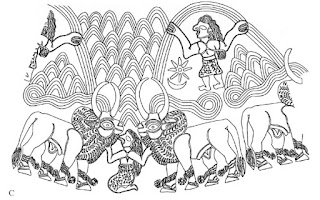
The snowmelt then sharply increases in Taurus, when we have the annual flood depicted on so many Jiroft culture vessels coming out of bulls...Like this one I talked about in my post "Jiroft flood vase"...


The flood peaks during the part of the year marked by Gemini twins. Coinciding with the most fertile period of the mares and the main mating season of the wild horses...

When Anahita, the goddess of water, fills the rivers to the brim...

Party time? Anyone knows how to play a lute?


PS: Sasanian plate depicting two winged horses in the same drinking position facing the tree of life (?) 🙂, currently in the Arthur M. Sackler Gallery...


Lod mosaic

The Lod Mosaic is a mosaic floor dated to ca. 300 AD, discovered in 1996 in the Israeli town of Lod. It is one of the largest (180 m²) and best-preserved mosaic floors uncovered in the country...

And it has an interesting central piece...Not only because it prominently features rhinoceroses and giraffes, which were not common in Roman art. Or because of the absence of human figures, which is also rare in Roman art...

To me this mosaic is interesting because of this: The depiction of the vase with two leopards holding onto its rim...


Why is this interesting? Because of this: a marble vase with two tigers holding onto its rim...From the 5th century AD Christian church in Petra, Jordan. Just down the road so to speak...


Why is this interesting? Because apparently these kind of vessels are associated with Dionysus...Because both leopards and tigers are associated with Dionysus??? Why? Check my article "Leopard and tiger" out...


In short, because in these arid parts of the world, the solar year is divided into two halves: the dry, hot summer (May-Oct), the season of death, and cool, wet winter (Nov-Apr), the season of life...

Levant climate chart:


And leopards (which do live in Levant) and tigers (which by the way don't live in Levant) mate during the middle of the cool, wet part of the year...During the rain season...The season of rebirth of nature in Levant...

Just thought of something: In these parts of the world, wine symbolically equals water, as wine is created from grapes during the rain season, which right after the grape harvest...

Are these vases symbolic depictions of this? Quite possibly yes...On the Lod mosaic, on the opposite side of the octagon we find lion attacking deer...

This is usually the symbol for the hottest, driest part of the year, Aug...The beginning of the mating season of both Eurasian lions and Persian fallow deer which were native to the area in the past...I talked about this in my post "Entemena vase" and many other... 

And, between the two opposites, leopard = mid winter and lion = mid summer, we have on one side 

Ibex goat, symbol of the beginning of winter, rain season in Levant

and on the other

hare, symbol of the end of winter, rain season in Levant...

Do you think this is random, accidental?

If you are interested in the symbolism of the animals associated with Dionysus cult, you should read this article about the Patera of Rennes and follow the links to other articles talking about it...

You'll enjoy it, I promise... 

I am also convinced that the birds and the fish were not chosen randomly...I will have to spend some time and try to identify them and see how their lifecycles correspond with their place on the seasons circle...

Interestingly, the church from Petra, where the tiger vase was found, also has amazing mosaics. Depicting four seasons...In a more usual way Romans depicted seasons, in human form...

Archaeologists are also suspecting that the Lod building with mosaics could have also been an early church...Again with the depictions of "seasons", using animal calendar markers...

And both seem to have vases linked to Dionysus...

Kind of interesting and important, right? What's with the Early Christians and Dionysus and seasons???

To read more about ancient animal and plant calendar markers, start here…then check the rest of the blog posts related to animal calendar markers I still didn't add to this page, and finally check my twitter threads I still didn't convert to blog post...I am 9 months behind now...