Showing posts with label Early Christianity. Show all posts

Sunday, 19 November 2023

Alexamenos graffito

This is so the called "Alexamenos graffito". Carved sometime between the first and the third c. into a wall of the palace complex on the Palatine Hill in Rome, this is the earliest known pictorial representation of the crucifixion of Christ and his idolization.

It depicts a roughly drawn figure of a man with the head of an ass crucified on a cross. Next to the crucified figure is a smaller figure with one arm extended towards the former. Underneath the figures is a crudely written caption that reads "Alexamenos worshipping his God".

This graffito "mocks Christianity" which Romans "found foolish". Marcus Cornelius Fronto, a 2nd c. Roman orator, explains why: "Christians worship a crucified man, and even the instrument itself of his punishment. They are even said to worship the head of an ass..."

Interestingly, 3rd c. Christian author Tertullian mentions a peculiar anecdote that occurred in Carthage, where he saw an apostate Jew carry around a picture of man dressed in toga but with the head of an ass and hooves for legs.

Rather than feeling insulted, Tertullian was amused at the joke and wrote that "we laughed at both the label and the image". And then he said "Our god is the head of an ass,” he wrote, "but you (Non Christian Romans) in fact worship the ass in its entirety, not just the head" (?)

Apparently, the reference to donkey-worship comes from a story recounted by the Roman historian Tacitus, in which a group of Jews, expelled from Egypt, wandered through the desert, exhausted and dying of thirst, until they were led to water by a herd of wild asses.

In turn, the Jews started worshipping the animal that saved them, and a "god with the head of an ass" - a notion that was apparently also carried over to Christians. Hence Alexamenos graffito" with a crucified god with ass head...

Very very interesting...Didn't know about any of this...But I am not surprised at all...Remember this article about the origin of the Hanukah (Winter Solstice) celebration? And the link between Yahweh and Shamash, the old Semitic (Akkadian) sun god...I talked about this in my post "The tree of lite/life"...

Shamash who rode on a quadriga pulled not by horses, but by "kungas", a specially bred hybrids between female domesticated donkey and a wild male Syrian wild ass...Basically fancy donkeys...I talked about this in my posts "Shamash playing with solar horse" and "Sun god from Tell Brak"...

Why was the Sun god riding on a quadriga pulled by donkeys/asses and not horses? Cause the beginning of the worship of Shamash (late 4th/early 3rd millennium BC) predates the domestication of horses...

Kungas were so highly regarded, that "they were deemed especially suitable for drawing the chariots of kings and gods"...

Kings and gods...Kings and gods...Why did Jesus have to ride into Jerusalem on a donkey/ass again? To prove what?

People say: He was't proving anything. He was fulfilling a scripture prophecy.

"Rejoice, O people of Zion! Shout in triumph, O people of Jerusalem! Look, your king is coming to you. He is righteous and victorious, yet he is humble, riding on a donkey" Zechariah 9:9

God/King riding on the favourite ride of the old Gods/Kings...

In a letter dated to 1775 BCE, Bahdi-Lim, governor under the Mari king Zimri-Lim, insists that the king should not ride horses in his capital, as it was considered uncivilized. Instead, he urges the king to honor his royal status by riding in a donkey-drawn wagon.

This is very interesting. By the time the Jews built First Temple and dedicated it to Jahweh, horses were domesticated and had replaced donkeys/asses as the vehicles of the Semitic sun god...

"He (Josiah) removed from the entrance of the LORD's Temple the horse statues that the former kings of Judah had dedicated to the sun... He also burned the chariots dedicated to the sun..." Is this the god of the First Temple? I talked about this in my post "Sun god from the first temple"...

But it seems that (some) Jews, thousands of years later, still remembered the old ways, and the link between their (sun) god and donkeys/asses...

BTW, the reason why the Semitic sun god Shamash was depicted riding in chariots pulled by equids, is because the old Mesopotamian summer, the sunny half of the year, the domain of the sun god, starts in Apr/May. 


Which is when the equids (donkeys and horses) start mating...

Basically, equids, donkeys and horses, were originally animal calendar markers for the hot/dry half of the year. Animal calendar markers which were later deified and turned into sun gods riding on chariots pulled by equids...

Or sun gods with equid heads...Just like...

Once Lord Vishnu’s head was cut off accidentally by other gods. The head turned out to be the Sun. The gods then attached a horse head to Vishnu's body, which is how he assumed his Hayagriva form. 

I talked about solar horse animal calendar marker in Indian mythology in my post "Hayagriva"... 

So no wonder Tertullian didn't find it funny that the Romans depicted his god with a donkey head, and that instead he found it funny that the Romans thought this was funny...

The Jews who were saved from dying from thirst in a desert (domain of the sun god) by the wild asses (holy animals of the sun god) definitely thought that it was their (sun) god who personally intervened to save them...

And it seems that early Christians were aware of this link between their (sun) god and donkeys. The link which predates the link between the sun god(s), like Surya, Helios, Sol Invictus...and horses by almost a millennium...

So back to "Alexamenos graffito"...Knowing all this, what was Christ with donkey/ass head mockery of the Christian belief, or just a symbolic depiction of the true nature of Christ/Sun, the way early Christians might have seen it?

You live and learn...

Ahhhh I completely forgot to mention that cross is an ancient Mesopotamian symbol of the sun (god)...I talked about this in my post "The cross of Shamash"...


That's it. To read more about ancient animal and plant calendar markers, start here…then check the rest of the blog posts related to animal calendar markers I still didn't add to this page, and finally check my twitter threads I still didn't convert to blog post...I am 9 months behind now... 

Saturday, 28 January 2023

Merovingian Christ

Terracotta plaque from Auvergne (Auvergne-Rodano-Alps, France). Merovingian era, 5th-6th century AD, Musée d ' Archéologie nationale et domaine national de Saint-Germain-en-Laye...


A very strange thing indeed...

"Accepted opinion" is that this plaque "depicts Christ with the sword, victorious over the forces of evil represented by the submissive serpent. In his right hand he squeezes the Moon (the lunar crescent), and in the left a torch with the flame facing upward"...Hmmmmm....

First, is this a torch or a spear? You know something like a thrusting spear...Like these ones? Did they exist in Europe in the 5th -6th century?

And If it's a torch, isn't  "torch (light) bringer (carrier)" direct translation of "Lucifer"? Would you really depict Christ like this?

Second, is this a moon or a shield or a mirror? If it's a moon, then the torch could be Venus, the morning star...Lucifer....

Third, what's with the round, very "sun like" face of "Christ"? And would you place cross on Christ's forehead?

Fourth, what is this on "Christ"'s head? A diadem? Strange thing for "Christ" to wear...Or is this a sun rays crown? Just like the one worn by Sol Invictus? Or a crown of thorns?

Fifth, what's with the funny ears? Are these lion's ears? Why would "Christ" have lion's ears? Or maybe this is not Christ at all, but sun in Leo...Have you seen this artefact from 11th c.? Lion (end of summer) killing snake (beginning of summer) under the head of Helios? I talked about it in my post "Lion killing snake"...

BTW

The reason why snake symbolises (is an animal calendar marker for) the beginning of summer, Apr/May, is because the most common Eurasian snakes start mating in Apr/May...

The reason why lion symbolises (is an animal calendar marker for) the end of summer, Jul/Aug, is because the Eurasian lions start mating in Jul/Aug...

Sixth, the only thing that looks as it should be is the snake...And honestly it doesn't look very submissive to me...It is looking at "Christ" and not away from him...And it's not like "Christ" is stomping on it, which is usually taken to mean "subduing, vanquishing"...

Like on this mosaic from Ravenna depicting Christ the warrior stomping on lion and snake, made during the same period as the Merovingian plaque. And even this can be interpreted in several different ways, like any symbol can...I talked about it in my post "You will trample great lion and serpent"...

So maybe the snake is just there looking at the "Christ" because that is not Christ at all. It is the Sun...And snakes love sun...After all they are solar animals...

They are in our world when sun is in our world, during the day and during the warm half of the year. And they are in the underworld when sun is there too, during the night and during the cold part of the year...I talked about it in my posts "Enemy of the sun", "The chthonic animal", "Bactrian snakes and dragons", "Dragon who stole rain", "Letnitsa treasure"...

And is this why "Christ" has a cross on his forehead? Cause this is not Christ at all, but some Sun god who was Christianised...Baptised..."The priest imprints a cross on the forehead...as a sign that he or she belongs to Christ"...

Not that he is Christ...

Anyway, as I said, a very strange object indeed...But who knows what was going on through the minds of the early European Christians...Anything is possible....

To read more about ancient animal and plant calendar markers, start here…then check the rest of the blog posts related to animal calendar markers I still didn't add to this page, and finally check my twitter threads I still didn't convert to blog post...I am 9 months behind now...

Thursday, 23 December 2021

Lod mosaic

The Lod Mosaic is a mosaic floor dated to ca. 300 AD, discovered in 1996 in the Israeli town of Lod. It is one of the largest (180 m²) and best-preserved mosaic floors uncovered in the country...

And it has an interesting central piece...Not only because it prominently features rhinoceroses and giraffes, which were not common in Roman art. Or because of the absence of human figures, which is also rare in Roman art...

To me this mosaic is interesting because of this: The depiction of the vase with two leopards holding onto its rim...


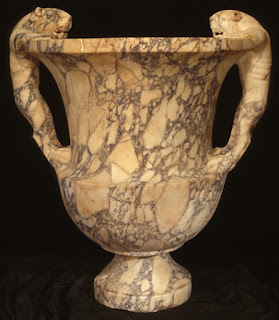
Why is this interesting? Because of this: a marble vase with two tigers holding onto its rim...From the 5th century AD Christian church in Petra, Jordan. Just down the road so to speak...


Why is this interesting? Because apparently these kind of vessels are associated with Dionysus...Because both leopards and tigers are associated with Dionysus??? Why? Check my article "Leopard and tiger" out...


In short, because in these arid parts of the world, the solar year is divided into two halves: the dry, hot summer (May-Oct), the season of death, and cool, wet winter (Nov-Apr), the season of life...

Levant climate chart:


And leopards (which do live in Levant) and tigers (which by the way don't live in Levant) mate during the middle of the cool, wet part of the year...During the rain season...The season of rebirth of nature in Levant...

Just thought of something: In these parts of the world, wine symbolically equals water, as wine is created from grapes during the rain season, which right after the grape harvest...

Are these vases symbolic depictions of this? Quite possibly yes...On the Lod mosaic, on the opposite side of the octagon we find lion attacking deer...

This is usually the symbol for the hottest, driest part of the year, Aug...The beginning of the mating season of both Eurasian lions and Persian fallow deer which were native to the area in the past...I talked about this in my post "Entemena vase" and many other... 

And, between the two opposites, leopard = mid winter and lion = mid summer, we have on one side 

Ibex goat, symbol of the beginning of winter, rain season in Levant

and on the other

hare, symbol of the end of winter, rain season in Levant...

Do you think this is random, accidental?

If you are interested in the symbolism of the animals associated with Dionysus cult, you should read this article about the Patera of Rennes and follow the links to other articles talking about it...

You'll enjoy it, I promise... 

I am also convinced that the birds and the fish were not chosen randomly...I will have to spend some time and try to identify them and see how their lifecycles correspond with their place on the seasons circle...

Interestingly, the church from Petra, where the tiger vase was found, also has amazing mosaics. Depicting four seasons...In a more usual way Romans depicted seasons, in human form...

Archaeologists are also suspecting that the Lod building with mosaics could have also been an early church...Again with the depictions of "seasons", using animal calendar markers...

And both seem to have vases linked to Dionysus...

Kind of interesting and important, right? What's with the Early Christians and Dionysus and seasons???

To read more about ancient animal and plant calendar markers, start here…then check the rest of the blog posts related to animal calendar markers I still didn't add to this page, and finally check my twitter threads I still didn't convert to blog post...I am 9 months behind now...

Tuesday, 26 January 2021

Heavenly throne


Remains of an early Christian basilica, built in 4th c. AD and abandoned in 6th c. AD. It was built on a little plateau called “Nebeske stolice” (Sky chairs), located 1800 meters above the sea level on the Kopaonik mountain, central Serbia...

The interior of the basilica was richly decorated, floors were covered with mosaics, while walls were painted with frescoes. Size of the basilica and its lavish decorations are suggesting that it was connected to a large nearby settlement, whose remains are yet to be found...

I mean, if you wanted to be close to god...I just love the name: "Nebeske stolice". It means "Sky chair" but could also mean "Heavenly throne"...