Showing posts with label Jiroft culture. Show all posts

Thursday, 23 December 2021

Dioscuri plate from Iran

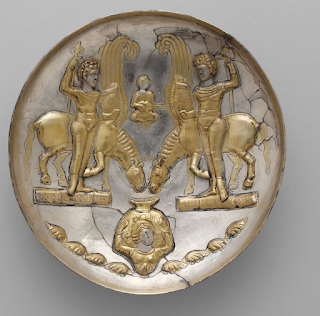
Sasanian plate with youths and winged horses ca. 5th–6th century A.D. Currently kept in the Met Museum...
 

Official description: 

"Two youths stand on platforms facing one another, each holding a staff and the reins of a winged horse. This is reminiscent of representations of the hero Bellerophon and Pegasus as well as of the Dioskouroi (the divine twins Castor and Pollux)...

Both horses bend their necks down to drink from a large vessel supported by a female figure, who appears in bust form emerging from a frieze of half-palmettes. 

She is most likely either a personification of water or the Iranian river goddess Anahita (This girl. I talked about her in this post)
The scene may have cosmic significance, if indeed the two youths represent the constellation Gemini, called Do Paykar (Two Warriors) in Middle Persian astronomical texts"... 

The end of the official description...

Now this is interesting...Winged horses, winged horses...Have you seen this?

Bronze Age "Sun Chariot" pulled by a horse, Denmark 1400 BC. 
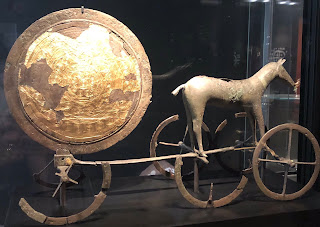
Why are horses so prominent in solar cults?

Did you know that horse mating season, which is characterised by vicious stallion fights, is governed by the sun and it peaks on summer solstice. Two horses facing each other as symbols of summer solstice...Hmmmm...
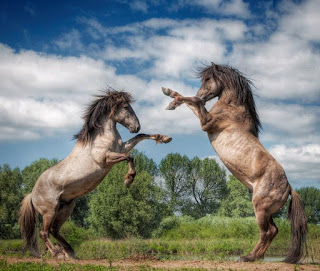
Hence horse pulling sun chariot...I talked about this in my posts "Svetovid", "Trojan horse", "Unicorn", "Re'em"...

So? What does this have to do with this Iranian plate?

Well, have you seen this? 
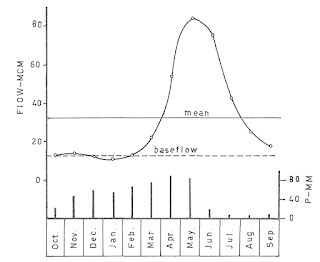
This is the flow chart of the rivers in Western Iran, in the Zagros mountains...The flow is directly dependent on the snowmelt...Which is directly dependent on sun's heat...Symbolised by the horse...Winged horse to make sure we are in heavens...

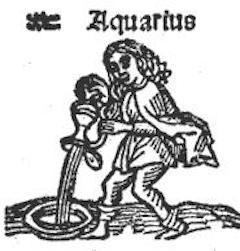
The snowmelt starts at the beginning of Spring (February) which is when the earth starts to warm up...Which is why this part of the Solar year is marked by Aquarius...This is also when the snowmelt starts in Europe by the way...
The snowmelt then sharply increases in Taurus, when we have the annual flood depicted on so many Jiroft culture vessels coming out of bulls...Like this one I talked about in my post "Jiroft flood vase"...
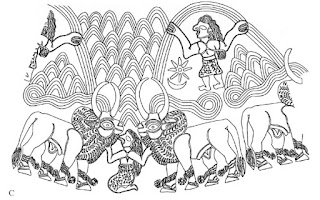


The flood peaks during the part of the year marked by Gemini twins. Coinciding with the most fertile period of the mares and the main mating season of the wild horses...
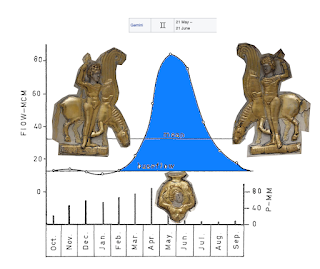
When Anahita, the goddess of water, fills the rivers to the brim...
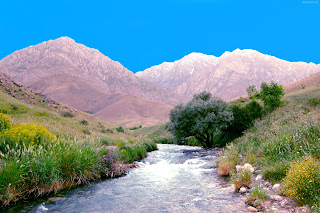
Party time? Anyone knows how to play a lute?


PS: Sasanian plate depicting two winged horses in the same drinking position facing the tree of life (?) 🙂, currently in the Arthur M. Sackler Gallery...


Thursday, 11 November 2021

Lions with grain tails

A while back I wrote an article about the Khafajeh vase, which was made in Iran in the mid 3rd mil. BC by the people of the Jiroft culture...It is still one of the most amazing animal calendars I have seen so far...


This particular scene depicts the driest and hottest part of the year in the Jiroft County, located in the Kerman Province of the South-Eastern Iran...Jul/Aug...Leo...


This is symbolised by the person holding two snakes (symbols of sun's heat) standing between two lions (in Leo)...

This "person" is the sun god, the same dude depicted on this Bactrian seal from the same period. I talked about this in my post "Bactrian snakes and dragons"...

What I didn't notice at the time when I wrote my article were the tips of the lions' tails. They end in what looks like wheat ears...Why? Is this significant?


Well, in my post "Shamash young and old" I talked about young and old sun god Utu/Shamash from Mesopotamian mythology...

He is most often depicted as a man with heat rays radiating from his shoulders...See here, Shamash standing in a dried up canal during the hottest and driest part of the year, Jul/Aug, in Leo, holding a reed cutting knife (that is the best time to cut reeds for making houses and boats)...In Leo is again depicted as "between the lions"...I talked about this in my post "Canals"...
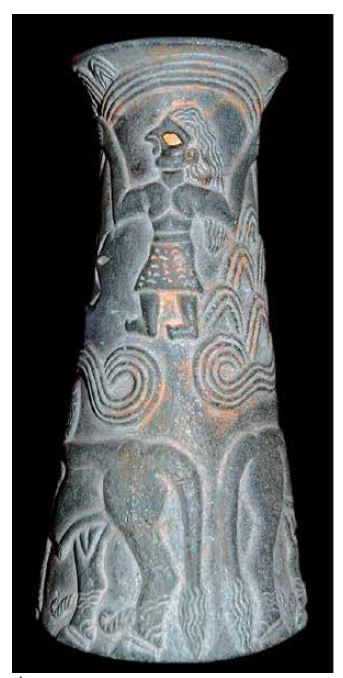

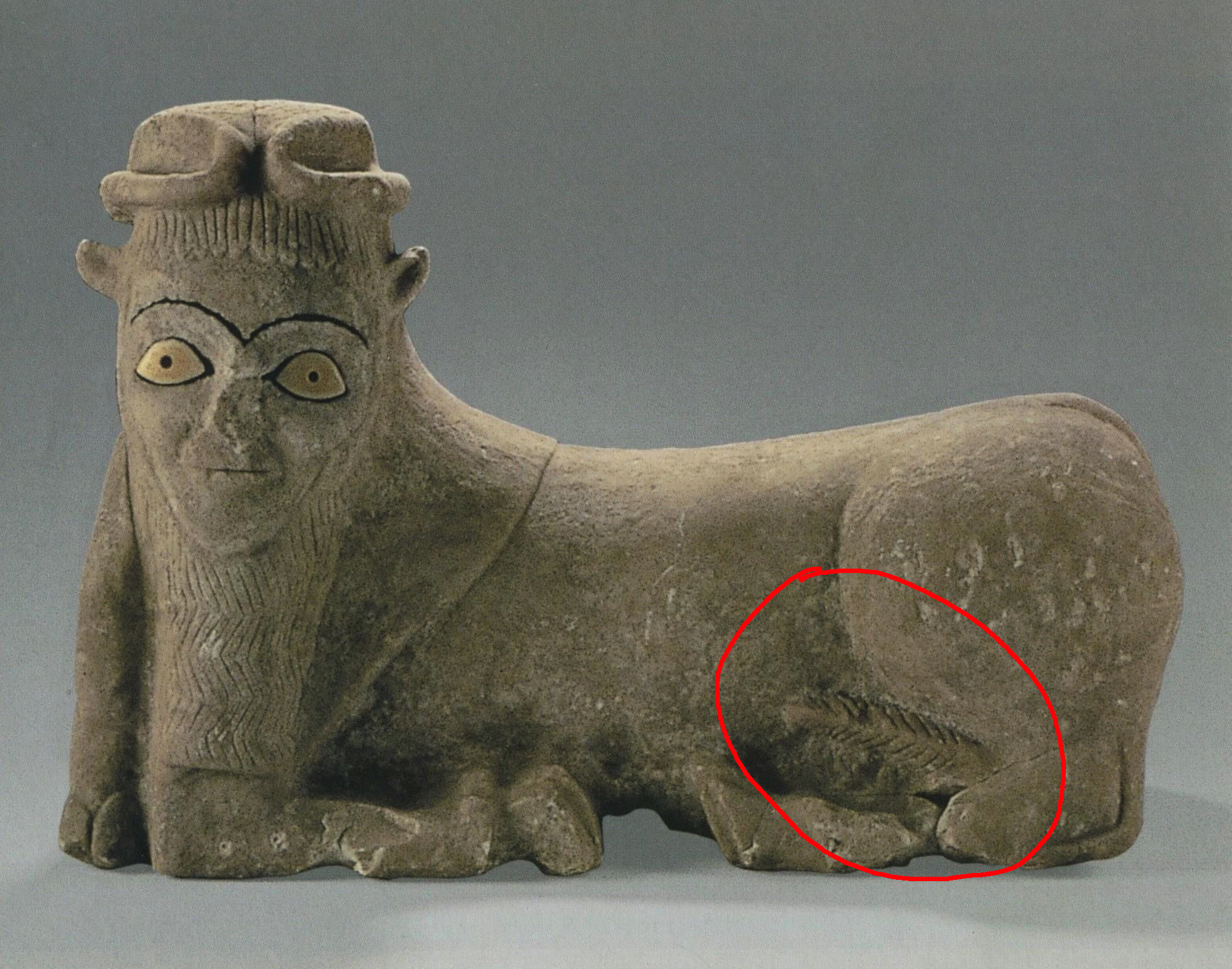
But Utu/Shamash is often depicted as a bull with human face and long flowing beard...

Sometimes Utu/Shamash is depicted as a bull with human face and a long flowing beard having his butt chewed by a winged lion...This is because summer, symbolised by a bull, ends in Leo...I talked about this in my post "Butt chewing"...

Here is another one of those depictions of the sun god Utu/Shamash as a bull with human face and a long flowing beard. But this time he also has a tail that ends in a ear of wheat...Why? Is this significant?

Well it is. Utu/Shamash is depicted as a bull, cause summer starts in Apr/May, in Taurus, the time when Wild Eurasian Cattle begin to calve...I talked about this in my posts "Dairy farming seal", "Green pastures" and many others...Summer as a season is most often symbolised by a bull too...I talked about this in my post "Symbols of the seasons"...

This is also the time of the peak flood of the Tigris and Euphrates, which is caused by the snowmelt on the mountains that feed these two great rivers, which is in turn caused by the sun, Utu/Shamash...Hence golden bull (sun metal) with blue lapis (water stone) beard 

Apr/May, Taurus, is also the time when the grain harvest  begins in Mesopotamia...Hence bulls and grain...And bulls with grain tails...I talked abut this in my posts "Bulls and grain bowls" and "How grain came to Sumer"

But what does this have to do with the lions with grain tails from the Jiroft vase? Well...

I googled Iran grain harvest season and (eventually) found this: "wheat harvest season is approximately 4.5 months in Iran starting in early April up to mid-August, depending on the region and it's local climate"...

According to this paper about the affect of the global warming on grain agriculture in Iran, "...most of the wheat in Iran is cultivated in October and harvested in July..."

Finally I found this: "KERMAN, Aug. 13 (MNA) – Farmers of Deh Ziyar village in Kerman province, harvest wheat using traditional methods"... 


Basically they are harvesting grain in Leo...

Is Jul/Aug really grain harvest season in Kerman province? Is this why lions on this vase made by the people of the Jiroft culture from the Kerman province of Iran have tails that end in grain ears?

PS: I just looked at the pictures of the wheat being harvested in Kerman province. It looks like one of the old wheat types, emmer, durum, which are both awned (with bristles). 

Durum wheat is the predominant wheat type grown in the Middle East. And it is traditionally a "spring wheat" which is sown in Feb/Mar and harvested in Jul/Aug. It has lower yields, thick husks, long bristles and is resistant to high temperatures...

It fits...

Friday, 6 August 2021

Falling on his head

A really weird carved chlorite(?) jar with high-relief image of two oxen tied to a tree, inverted nude male between them. 222 grams, 64mm (2 ½"). Mid-third millennium BC. Sold at auction...

These kind of vessels are believed to have been originally made by people of Jiroft culture from Zagros mountains in Western Iran. 


Anyway, no one knows what this scene means. Who is the dude falling on his head? I don't know. But it is important that he is falling on his head between two water buffalos...


Why is it important that these are buffalos? Because different animals represent different things, depending when they mate or give birth in relation to the local climate...They are different calendar markers...Water buffalo bulls are symbol of winter...Oct/Nov-Jan/Feb

Because, wild water buffalo are seasonal breeders in most of their range, typically in October and November...Domesticated buffaloes also breed mostly during the winter...Which makes them an ideal animal calendar marker for Oct/Nov, beginning of winter...And winter in general...

I talked about water buffalos as animal calendar marker in my post "Mahishasuramardini"... 

This is the beginning of winter and the rain season in Jiroft culture area...

I talked about two other Jiroft vessels with weird (read complex) bull scenes which turned out to be complex animal calendar markers...

You can read about them in my posts "Khafajeh vase" and "Jiroft flood vase"...

On both of these vessels we see zebu bulls, which are calendar markers for the annual snowmelt flood which spans the whole of summer, season symbolised by a bull, flood which peaks in Apr/May, in Taurus...

Summer is the season of the bull because Wild Eurasian cattle calved at the beginning of summer, Apr/May, and mated at the end of summer, Jul/Aug...

I talked about this in my post "Ram and bull"...Interestingly, Zebu cattle could once have had mating peek in Apr/May...I talked about the mating habits of zebu cattle, and their use as animal calendar markers in Indus Valley civilisation, in my post "Kharif and Rabi seasons

But as I said, buffaloes are different. They mate during the winter rain season...Is this why they are tied to a green tree? Because it is the rain (and snow and subsequent snowmelt), which start during the mating season of water buffalos, that turn plants green...

BTW, when I first saw water buffalos on this vessel, I was like, in Iran? But it turns out there are buffalos in Iran...This is a map showing the distribution of buffalo breeds in Iran

You can read more about it in this paper: A genome-wide scan for signatures of selection in Azeri and Khuzestani buffalo breeds...

And according to this paper "Buffalo breeds and management systems": "There is some evidence that buffalo were raised in Lorestan (Iran) in the 9th c. BC. since six engraved buffalo heads have been found on a bronze stick from this period." 

Well add about 2000 years to that now as these buffalo look like domesticated buffalos to me...

This is seriously cool right?

So...why would a male figure be falling down between the buffalos? 

Well there are indications that in Iran, the rain season was linked to the goddess of water since Bronze Age...It was she who ruled the cold, wet, dark (Yin), but also fertile, part of the year...

Here she is in the early centuries AD

Here she is in the in the 8th century BC


And I think here she is again in the mid 3rd millennium BC...


A girl holding a rainbow...

You can read more about this in my post "Jiroft flood vase"

She ascends to the throne at the beginning of the rain season, between the mating (fighting) buffaloes...Well after kicking the sun from the same throne...Sun which rules the other part of the year, the hot, dry, bright (Yang) part of the year...

So maybe the falling male figure is the symbol of the end of the rule of Sun, Yang and beginning of the rule of Rain, Yin...I really don't know 🙂 What do you think? Just an acrobat? 

To read more about ancient animal and plant calendar markers, start here…then check the rest of the blog posts related to animal calendar markers I still didn't add to this page, and finally check my twitter threads I still didn't convert to blog post...I am 9 months behind now...

Friday, 18 December 2020

Grazing horned animals

One of the most common designs found on Bronze Age Jiroft culture vessels from Halil River catchment area is "horned animals grazing on green shoots"...

The two animals depicted on these designs are:

Wild goats (Bezoar ibex)


Wild sheep (Mouflon)

Both animals have mating seasons which start at the end of Oct, beginning of Nov, at the exact moment when the rain season starts in the Halil river (Jiroft) valley...

The baby Bezoar goats and baby Mouflon sheep are born in April, at the end of the rain season...So the mating (Oct/Nov) and birthing (Apr) of wild goats and wild sheep marks the beginning and the end of the rain season in the Halil river (Jiroft) valley...


The rain season is also the "green" season, the time of new growth...Which is why these two animals are always depicted together with branches or bushes or trees full of new (green) leaves. Basically, they are used as calendar markers for beginning (and end) of the rain season...

So two more animals to add to already identified list of Jiroft culture animal solar year calendar markers I talked about in these two articles: "Khafajeh vase" and "Jiroft flood vase"...

Sunday, 25 October 2020

Zebu migrations

Ceremonial "buckle"? from Bactria, end of the 3rd mill. BC. Does it depict an Indian Zebu (top) and a Eurasian Auroch (bottom)? Or is this Zebu on both sides?

Geneticists from Trinity college in Dublin, sequenced 67 ancient genomes from both wild and domestic cattle sampled from across eight millennia...

Sequencing Near Eastern wild cattle, or aurochs, allowed the team to unravel the domestication process of this most formidable of beasts...

Genetic similarity to the early domestic cattle of Anatolia concurs with a primary origin in that region. However different local wild populations also made significant additional genetic contributions to herds in Southeast Europe and southern Levant...

These earliest domestic cattle are Bos Taurus. 


They had no ancestry from Bos Indicus, or zebu – herds that originate separately further to the east in the Indus Valley...And which we find depicted all over Indus Valley Civilisation pottery. 

I wrote about the use of Zebu as solar calendar marker in Indus Valley Civilisation in my post "Kharif and Rabi season".

By the way, Indus Valley people knew about aurochs too. They are the so called "unicorns" 🙂depicted on the Indus Valley Civilisation seals, like this one


Anyway, during the early 3rd millennium BC we see depictions of the zebu cattle on Jiroft culture artefacts, meaning that by then zebu has already reached Iran, possibly Iraq.

I talked about the use of of Zebu as solar calendar marker in in Jiroft culture in my post "Khafajeh vase"

A dramatic change occurred around 4,000 years ago when we detect a widespread, wholesale influx of zebu genetics from the east...Probably linked to a dramatic multi-century climate event that was experienced across the world, referred to as the 4.2 kya climate event. This event caused terrible flooding in some places and terrible droughts in others. It is now believed that it is the drought caused by this event that may also have initiated the collapse of the Indus Valley Civilisation...

Now cattle don't migrate by themselves. Which means that if huge number of zebus suddenly appeared in Mesopotamia and Anatolia, they were driven there by their owners...

Where did this huge westward migration start? In Indus valley? Or in Iranian river valleys, like Halil river valley, home of the Jiroft culture which suddenly ended around that time?

We can see from the Trinity college study the effect of this migration on the cattle genetics in Western Asia, Europe, North Africa. 

What was the effect of this migration on human genetics in these areas???

Trinity college paper: "Ancient cattle genomics, origins, and rapid turnover in the Fertile Crescent"

5/8/2022. Today I came across this very interesting paper about the spread of Zebu from India westward and how it correlates with the spread of Indian male genes westward too..

"The spread of zebu cattle from South Asia to the East Mediterranean region as a marker of Indo-European population dispersal"


Wednesday, 16 September 2020

Jiroft flood vase

This is the chlorite carved flask discussed in the paper entitled "Searching for mythological themes on the 'jiroft' chlorite artefacts" by Massimo Vidale of the University of Padua. The Flask dated to the 3rd millennium BC, is kept in the Bagh-e Harandi Museum, Kerman. 

In the paper we read: "The scene can be coherently read from the bottom to the top. In the foreground, we see a long-haired personage in kneeling position who grabs from the throat two massive humped bulls facing each other in a heraldic position. Below the neck of the animals runs a strip simiilar to a rope...The bulls (probably sky creatures) emanate heavy water flows, causing a major flood. At the end, the first mountain (or mountains) emerges from the flooded world, as water retires. Then another long-haired personage, accompanied by two heavenly signs (moon and star), puts in the sky an imposing rainbow, and signals that the flood is finished. Beyond the rainbow, a renovated world has finally emerged from the deadly waters."


So the paper interprets the scene from the vase as "a representation of a destructive flood, ending when a divinity lifts a rainbow in the sky at which point the first mountain emerges from the flood waters". And it then goes on to compare these images with Old Babylonian and later cuneiform versions of flood myths. 

I would have to strongly disagree with this interpretation. 

I don't think that the scene depicts a destructive flood and certainly not "The Flood". Instead it depicts the annual flood, the snowmelt flood, which was the main source of water, and life, for the people of the Jiroft culture. 

The rivers in the mountain areas of Iran, including the Halil river, around which the Jiroft culture was based, are fed by rainfall during the winter, but mostly by snowmelt during spring and summer. The snowmelt starts in late Feb early Mar, and peaks in late Apr, early May. 

Pic: the flow of Iranian rivers, which have a spike between Mar and Aug with peak in late Apr early May...


Pic: Halil River

So the flood peaks in late April early May, in Taurus. As I explained in my article about Khafajeh vase, another very interesting Jiroft artefact, on which bulls are linked with water, there is a direct link between the old wild cattle and the annual flood season in the Jiroft area. Here is the bulls and "rivers" part of the scene from the Khafajeh vase:

These are not just any bulls. These are Zebu bulls. Zebu's mating season coincides with the snowmelt flow season which peaks in Taurus 🙂. This is why, on Khafajeh vase, the "human looking being" who stands on zebus is holding flowing water, the rivers among lush vegetation...This is also why water, actually rivers, "emanate" from the bulls heads on this Jiroft vase. 

So the Jiroft rivers flood during the spring and summer. 

But the rain and snow that feed them fall during the winter and spring...

The climatic year in the Halil River (Jiroft) area is divided into dry season (Apr/May to Oct/Nov) and wet season (Nov/Dec-Mar/Apr). The wettest month is Feb, while the driest month is Jul which is also the hottest month...

The only time when you can see a rainbow is during the rain season. Which is winer and spring.  The rainbow "personage" has moon pointing upward with a star. The moon points up during the winter. 

Which is the rain and snow season in Zagros mountains. Hence the only time you can see a rainbow.

So the rainbow personage (I think most likely goddess) represents winter (and spring) and the zebu "personage" (I think this could be goddess again) represents (spring and) summer snow melt floods. The water reach seasons... 

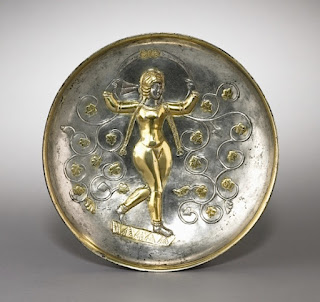
By the way, remember this rainbow girl from Sassanian Iran? 

People now think that this girl "is just a dancer". But once people thought that she was Goddess of water and fertility Anahita. I talked about her in my post Anahita. By the way I still think she is the water and fertility goddess...Mostly because she is holding a rainbow from which vegetation grows...Basically she symbolises the same thing as the rainbow "personage" from the Jiroft flood vase. Rain creating life...

So it seems that the rainbow goddess was the thing in Iran from at least Jiroft culture, until the Sassanian culture...

We know this because these two rainbow holders are linked by this: Bronze disc from Luristan, western Iran. 8th century BC...Sold by Christies for 28,000$... 

Oh and it is not "the first mountain emerges from the flooded world as the waters of The Flood recede"...It's just the Zagros mountains, the source of water and life for Jiroft people...The rainbow is over the mountains because Jiroft guys lived in valleys surrounded by high mountains...

To read more about ancient animal and plant calendar markers, start here…then check the rest of the blog posts related to animal calendar markers I still didn't add to this page, and finally check my twitter threads I still didn't convert to blog post...I am 9 months behind now...