Showing posts sorted by relevance for query "dragon" "fire". Sort by date Show all posts

Sunday, 10 November 2024

Red archer

"A savage Dragon lives in the forest, / Most venomous he is [...] / In the hour of his death / His venom becomes the great Medicine". Book of Lambspring 15 c...

Fiery (fire breathing) dragon, symbol of the destructive sun's heat during the hot, dry half of the year, which peaks in in Leo, Jul/Aug, the hottest and dries time of the year in continental Europe, Levant, Central Asia, Mesopotamia, Iran...

I talked about this dragon in Mesopotamia in my post "Seven headed dragon"...

In Mesopotamia, summer lasted seven (hot) months...Which is why local dragon (dragon = symbol of summer), had seven snake heads (snake = symbols of sun's heat)...Oh, and look, we also have dragon killer(s) and the princess 🙂 


Why were Persian kings so obsessed with lion hunt? Cause they were reenacting the annual fight between the Rain season (Rain god) and the Dry season (Lion/Dragon) in which the rain god always wins...


And I talked about this dragon in Europe in my posts "Scaring off dragon", "Dragons always get killed", "Letnitsa treasure", "Dragon who stole rain", "The damned"

In Bulgaria, at the start of summer, all the strong and healthy village men would gather at midnight, strip naked and walk the village land in ritual silence brandishing axes or cudgels, weapons of thunder gods "to scare the dragon who steals the waters" 

And I talked about this dragon in Central Asia in my posts: "Bactrian snakes and dragons". 

In all these places, dragon always marks Jul/Aug, the hottest and driest time of the year...

Is the venom the water that dragon (drought) stole? Which gets released when dragon dies (drought ends) and the waters that dragon stole get released as rain and flowing water?

It is the main duty of all the thunder gods to kill the snake/dragon and release the waters the dragon stole...

So is the archer depicted pointing its arrow at the dragon a thunder god? This guy depicted here with a bow, killing the blazing sun that causes drought?

Until recently I would have been sure it was. In Fertile Crescent, where I think this fire breathing dragon mythology originated, the year is divided into two halves, 

And right at the beginning of the rain season, lightning arrows start shooting from the night sky. Orionids....

And if arrows are shooting down from the night sky, there must be an [invisible] archer shooting them from up there. Orion...

I talked about this father of all thunder gods in my post "Invisible archer"...

But now I know that there are two Great Archers in the sky. One that shoots his arrows towards Earth in Oct/Nov (Orion), and the other one that shoots his arrows towards Earth in Jul/Aug (Perseus)...

I stumbled across this while I was writing my article "Apollo the great archer" about why Apollo was the terrible "far shooting" archer...About arrow and bow constellation from Mesopotamia, Ishtar, Sirius, and Jul/Aug, the season of Perseid meteor shower...


And I have a feeling that the red dude from the original image is the later...The one which was marked by Mesopotamians with the bow and arrow constellation...

Question here, which I will try to answer soon: Did Mesopotamians see both Great Archers as one, just shooting at two different times of the year?

And the one which was in India called Rudra/Indra, the leader of the army of Rudras/Maruts armed with golden spears...I talked about this in my post "Rudra"...


And the one whom Greeks called Perseus...And Heracles...I talked about him in my post "Cetus"...


And the one whom Serbs call Ilija Gromovnik (Elijah the Thunderer), a very very strange saint celebrated in Jul/Aug...

Amazing picture. Elijah's Chariots of Fire, Byzantine Museum, Athens, Greece. 

When I wrote my articles about him, "The thundering sun god", "Alidjun", "Zodiac killer", I already suspected that Elijah the Thunderer was not just simple replacement for Perun, Slavic thunder god. Like in Greece where he seem to have replaced Zeus, because most holy places associated with Elijah in Greece are mountain tops once associated with Zeus... 

The reason why I thought that there was more to Elijah, is because Serbs believed that Every August 2nd, the hottest day of the year, Ilija Gromovnik (Elijah the Thunderer) is about to burn the world to ashes, but his sister/wife Ognjena Marija (Fiery Mary), another strange Serbian saint, persuades him not to do it. 

This Russian "Christian" icon depicts Ognjena Marija or the "Fiery Mary" surrounded with fiery wheels of Perun, inside the burning flame. 

This is why I called him The Thundering Sun God/Saint...But I couldn't fully make sense of him...

Then while I was writing my article "Croesus" I came across "Thundering Apollo" which sounded very similar to The Thundering Sun God/Saint from Serbian folklore...

It all finally made sense when I discovered the reason why Apollo was "the most feared archer"...

You should check my articles about Apollo if you want to fully understand what I am talking about here:

"Palil". About "Palil" a nickname of Nergal, the terrible, burning, destructive sun of Jul/Aug, Leo...And about the origin of the name Apollo and its meaning...

"Lord of the flies". About Nergal and Apollo as "The lords of the flies"...And about Jul/Aug, Leo, being the peak of the fly and fly born diseases season in Northern Hemisphere...

"Lions of Delos". About the Lions of Delos, the burning destructive sun in Jul/Aug, Leo, and the fact that both Nergal and Apollo are linked to lions. 

"Apollo and dolphins". About Jul/Aug, Leo being the "best time to sail in Eastern Mediterranean", and the link between dolphins and Lions...and Apollo...

"Marble throne of Apollo". About snakes (symbols of sun's heat), dragons (symbols of burning sun's heat) and terrible sun gods, Nergal and Apollo who are dragons themselves...

"Apollo and Python". About why Python followed Apollo after his birth? Cause snakes are solar animals...According to the Delphian tradition, Apollo was born on the 7th day of the month of Bysios (Jan/Feb)

"White raven". About the black and white raven legend which is found in both Nergal and Apollo mythology, Egyptian vultures and the twins that guard the gates of hell. And some other weird stuff...

"Threshing floor of Apollo". About the threshing floors as solar observatories/temples, about the threshing floor of Apollo from Delphi, about Jul/Aug, Leo, being the holy month of Apollo, and about solar bonfires...

"Apollo the great archer". About why Apollo was the terrible "far shooting" archer...About arrow and bow constellation from Mesopotamia, Ishtar, Sirius, and Jul/Aug, the season of Perseid meteor shower...

"Apollo Sminthius". About Apollo and peak infectious diseases season, Jul/Aug


That's it. To read more about ancient animal and plant calendar markers, start here…Then check my twitter threads I still didn't convert to blog post...I am way way behind...

Sunday, 11 September 2022

Longma

I never know where the day will take me...And today took me to China, to meet Longma...Longma is a fabled winged horse with dragon scales in Chinese mythology. The Chinese word longma combines long 龍 "dragon" and ma 馬 "horse"...


Longma is most famous for its connection with the mythical Hetu 河圖 "Yellow River chart; Yellow River map"...A magic document of extraordinary importance for Chinese culture...

The Yellow River is the second-longest river in Asia, following the Yangtze River, and the sixth-longest in the world. It is along the Yellow River that some of the earliest agricultural societies in China had developed...

The Yellow River has changed its course, settling in new beds, with different outlets to the ocean, many times in the past, causing death and devastation to the human population living along its banks...

The most devastating event of this type was in Chinese history recorded as The Great Flood of China. It was a major flood event which lasted for two generations and which resulted in great destruction, famine and population displacements...

According to mythological and historical sources, this flood is dated to the third millennium BCE, or about 2300-2200 BCE, during the reign of Emperor Yao. 

Interesting. 

Ever heard of The 4.2-kiloyear BP event?

This was one of the most severe climatic events of the last 10000 years. Starting around 2200 BC, it probably lasted the entire 22nd century BC. And probably caused the collapse of the Old Kingdom in Egypt, the Akkadian Empire in Mesopotamia, the Indus Valley Civilisation...

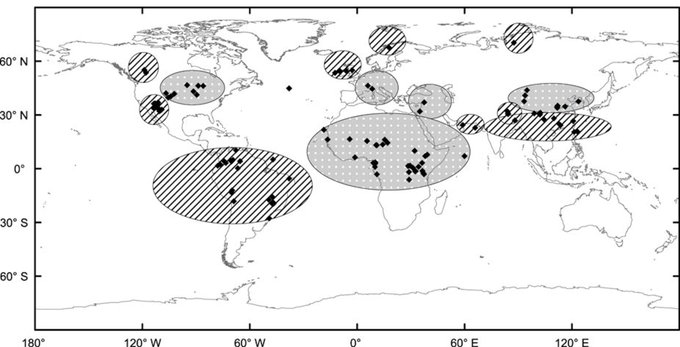
What about China? Have a look at this. This is the map of the world showing the effects of this global weather event. The dotted areas by drought or dust storms. The hatched areas were affected by wet conditions or flooding...

Now have a look at this...You can see that the border between the area affected by aridity and the area affected by flooding goes right between Yellow river and Yangtze river...

Now if I know anything about climate, having such opposing forces so close together for so long can mean only one thing: the whole area was most likely thrown into a complete chaos of droughts followed by floods followed by droughts followed by floods followed by...

The story of the "Great Flood" and the heroic attempts to abate the disaster is a narrative fundamental to Chinese culture. It explains the founding of the first Chinese dynasties, whose main task was the provision of food for their people through control of the great rivers...

According to the tradition, the main river which went crazy during this period was the Yellow River, and one of the keys to the eventual successful efforts to control its waters was the Yellow River Map, Yellow River Chart...

The magic document which enabled people of China to understand the behavior of the Yellow River and to subdue and control it. The Yellow River Chart, Hetu 河圖, which was brought to people by Longma, the dragon-horse...

Which is why Yellow River Chart, Hetu 河圖 is alternately named longtu 龍圖 ("the Yellow River sent forth the dragon chart") and matu 馬圖 ("the Yellow River sent forth the horse chart")...

The fact that it is said that it was Yellow River which itself sent forth the chart that allowed people to subdue it and control it, is very interesting...

Is this the way to say that the observation of the erratic behavior of the Yellow River over the period of the "Great Flood" enabled people to figure out the natural laws which govern their environment...

The chart is directly linked to the most important Chinese natural concepts: 2 principals, 5 Elements, 8 trigrams...Basically, this "magical" document is at the root of the Chinese understanding of nature...

And this "magic" document was sent to people by the Yellow River itself and brought to people by horse-dragon...

Why horse dragon?

Well, because of the climate in the Yellow River valley, and the animal calendar markers that describe it...

TATATAAAA!!! 🙂

I talked about dragon as the symbol of sun's heat which is associated with drought and death in many of my articles, for instance "Dragon who stole rain", "Letnitsa treasure", "Pegasus and Chimera", "Angra Mainyu", "Lion radiating heat", "Seven headed dragon", "Bactrian snakes and dragons"...

In Europe, Levant, Middle East, Central Asia, Iran...There is an association between fire breathing dragons and the burning sun of the hottest, driest part of the year (Jul/Aug) which causes droughts and death...

But not in China, where dragon is bringer of water and life...

Why?

The reason why Chinese dragon is linked with water is because of the climate in the Yellow River valley. Here are climate charts from 4 places along Yellow River (Zhengzhou, Xian, Ordos, Jinan)...


You can clearly see that Jul/Aug, the hottest part of the year, the time of fire breathing dragons, is also the wettest part of the year...So dragon in China really does bring water...I talked about it in these articles: "Chinese dragon" and "Tiger and dragon"...

It is the harmony between the rain water (Yin) and sun's fire (Yang) that keeps the Yellow River in check. Too much Yang and not enough Yin and you have droughts. Too much Yin and not enough Yang, and you have floods...

And you know how dragon is always coiling, writhing, changing direction, jumping up and down during Chinese dragon dance...

I wonder what this represents? The ever changing, unpredictable behavior of the heavenly fire-water dragon which controls the climate in the Yellow River valley...And if so, how old is this? Does it date to the time of the Great Yellow River Madness?

That explains dragon bit in dragon-horse. But what about the horse bit? Believe or not, I already explained that bit and the whole dragon-horse concept in this article, "Mythical beast from Xian", without even knowing about the existence of Longma, which I only discovered today...

It's all in there. Important bit: The horse fertility is governed by the sun. So the natural horse mating season starts in Apr, peaks on summer solstice and finishes in Sep. 

Hence horse as a solar symbol in Eurasia. I talked about it in my article "Hayagriva"...

This also makes a horse a great animal calendar marker for the hot (and in China also wet) half of the year...Just like a dragon, horse also brings both sun's heat (Yang) and rain water (Yin)...

Which makes dragon and horse interchangeable animal calendar markers...

And so...Longma, Dragon-Horse...

"A being with a horse's body, and dragon scales". 

"A being who is the [qi 氣] vital spirit of Heaven and Earth"

Also the being that pulls the sun chariot of the sun goddess Xihe...Surprise surprise 🙂

But that's a story for another article...Soon...

To read more about ancient animal and plant calendar markers, start here…then check the rest of the blog posts related to animal calendar markers I still didn't add to this page, and finally check my twitter threads I still didn't convert to blog post...I am 9 months behind now...

Saturday, 21 May 2022

Pozoj

The legend about the pozoj (dragon in local dialect) from Čičanjska Jama (jama here meaning marsh, lake, river tributary) near Donji Vidovec, Međimurje, Croatia:

It was long known that there was a pozoj (dragon) in Čičanjska Marsh whose tail was under the Church. [In the legends from the area, dragons were always huge, always lived under ground and always had a tail under some church]

Namely, when the pozoj (dragon) turned over in the marsh, all the candles fell of  the altar in the Church. It happened once that a young gentleman dressed in a black suit came to the village. He went to the parish house and talked at length there with the parish priest...

Then the parish priest called the sacristan, who led that man to Čičanjska Marsh. That man carried a large book under his arm. He was a grabancijaš [literally black scholar, black student, man in black 🙂 the only person who can control and defeat pozojs (dragons)]...

When they reached the marsh, he went very close to it, and stood on the root of an alder shrub and started thus to read from the book. The sacristan hid a little further away in the reeds and watched all that was happening...

All of a sudden the water started to be disturbed and a pozoj’s (dragon's) head appeared. The grabancijaš (black student, man in black) then grabbed a golden bridle and threw it over the pozoj (dragon). And he kept on reading from the book...

When the pozoj’s (dragon's) body was half out of the water, the grabancijaš (black student, man in black) jumped upon him and rode him to the south. Thee pozoj (dragon) had such a long tail that he dragged one part of it along the ground as he  flew...

Suddenly a wind came up, it clouded over and hail began to fall, as fat as a walnut, so that it destroyed everything from the Dravica Stream to the Drava River...

The shepherds on the upland pasture grazing their cows could clearly see the pozoj’s (dragon's) tail as well as his rear legs. The reverend parish priest said later that the grabancijaš (black scholar, man in black) had ridden the pozoj (dragon) to Africa...

In this legend we see that as soon as grabancijaš (black student, man in black) rides the pozoj (dragon) away, hail storm starts which destroys the village land...

I believe that Suzana Marjanić, the author of the paper "Dragon and Hero or How to Kill a Dragon – on the Example of the Legends of Međimurje about the Grabancijaš and the DragonZmaj i junak ili kako ubiti zmaja na primjeru međimurskih predaja o grabancijašu i pozoju" wrongly believes that it is grabancijaš (black student, man in black) who causes the hailstorm...

It is actually his action of taking the dragon away that causes the hailstorm... Because it was dragon that protected the village from the hailstorms and other bad weather...This is a common mythological theme found in the Balkans among South Slavs...

Bulgarians, Serbs and Macedonians believed that it was male dragons (of a fire breathing kind) called "zmaj" which protected their territory from evil female dragons called "ala", whose main activity was to lead storm and hail clouds over fields to destroy crops...

Whenever a "zmaj" (male dragon) noticed an "ala" (female dragon) approaching, he would fly up into the clouds to fight against her and chase her away. He shot fiery arrows and stones at her, which produced lightning and thunder...

Zmaj (male dragon) was benevolent toward the humans,  and he took care that his territory received the right amount of rain at the right time, for good growth of the crops...

If a village didn't have its own "zmaj" (male dragon), it had its "zmajeviti čovek" (dragon man). The dragon man was believed to posses the same supernatural powers possessed by a dragon and to act similar to the dragon when it came to bad weather and especially hailstorms...

As soon as he saw bad weather approaching, which he knew was brought by an ala (evil female dragon), the dragon man would leave whatever he was doing, and fly up to confront the demon...

This he did by falling into a deep sleep, or entering a state similar to death, usually at the very spot where he happened to be at that time. His soul then left his body in the form of a snake, and soared skywards to confront the ala inside the hailstorm clouds...

It was claimed that he was not breathing as long as his soul was absent from his body. The battle could last for a whole day, or even for several days, during which time the man lay unconscious, sweating profusely from the exertion of the fight...

He should not be pushed or moved while in this state: if he was not in the same position as when he fell asleep, his soul would not be able to return into his body, and he would die...

Now here is an interesting twist: in some regions of Serbia, people believed that it was actually ala (female dragon) which was  connected to a territory, which she defended against attacks by the ale (female dragons) from other territories...

In the past, in the villages that now form part of the city of Kruševac, Serbia, when blessings were pronounced on Christmas Eve, the villagers would also say, "God, save our guardian ala"...

People interpreted hail ravaging their crops as a defeat of their ala (female dragon) by an ala (female dragon) from elsewhere. The victorious ala (female dragon) would loot the crop yield of the ravaged area, and transfer it to her own territory...

Further twist: in Banat and some areas of eastern Serbia, the dragon men were referred to as "alovit". This adjective is derived from the noun ala, and means "being like ala, having supernatural properties"...

In these areas people believed that an alovit man can gather a hailstorm and guide it to the fields of another village in order to destroy them...

But they also protected their village from these attacks At the sight of hail clouds, the alovit man would fall into a trance-like sleep. His soul would then fly up to the clouds, where he would fight the soul of the alovit man who created and guided the storm...

So...Back to the original story...The grabancijaš (black student, man in black), takes the dragon (the protector from hail) away, and the hail destroys the village land...

However, in Slovenian legends the grabancijaš (black student, man in black) drives out the dragon because the dragon causes the stormy weather or the serious weather predicament...This is obviously not a dragon, but an ala...

Interstingly in Slovenia, the dragon fighter is known as Kresnik (Fiery one, from kres=fire)...This is very important, you'll why soon...A fiery being just like dragon, who fights alas....

In Hungarian folk legends,  garabonciás was believed to be capable of whipping up storms or hail showers, or alternatively, of driving them away. Just like in Serbia...

Hungarians believe the same about dragons, too. They can create storms or hail showers, or alternatively, drive them away. Except that Hungarians forgot that hailstorms are created by female dragons (ala) and that the dragons that drive hailstorms away are male dragons (zmaj)...

PS:

The above article was originally a twitter thread...After I finished it, at the very end, I realised that I made a mistake at the very beginning of my opening argument...So here is the correction 🙂 ...

The pozoj from Čičanjska Jama is a female dragon (ala)...Not a male dragon (zmaj)...

I still think that it wasn't the grabancijaš (black student, man in black, the dragon fighter) who causes the hailstorm...Even though they can do that...

But I also don't think that it is actually his action of taking the dragon away that causes the hailstorm... I thought that the hailstorm destroyed the village land because pozoj was a male dragon (zmaj), which protects the village from the hailstorms and other bad weather...

But now I think that pozoj was an ala (evil female dragon). And that it was pozoj herself who caused the hailstorm while flying over the village land. Which is what alas do...They create and use hailstorms and bad weather to destroy crops and steal fertility of the land...

Whatever (whoever) can create ice in the middle of summer, which is the main hailstorm season, has to be very very very cold... And if it wasn't for my dyslexia and me trying to do two things at the same time, I would have not missed the last line of the legend which says this:

I ended with this:

"...The reverend parish priest said later that the grabancijaš had ridden the pozoj to Africa." 

I missed this:

"The pozoj has such cold meat that the Africans put a piece of it under the tongue and it keeps them cool all day." 

And ala is a personification of hail, ice storm, destructive cold weather, in the middle of summer...

How "cool" is this? 🙂

But this doesn't really change the validity of the rest of my argument...So if you are interested in dragons, I think you will definitely enjoy this article...

To read more about Slavic dragon lore and to understand why it is Male Dragon that fights the ice storms, check this post about "Letnitsa treasure"...

Thursday, 15 August 2019

Bull of Grom Div

Storm clouds over norther Serbia, 2nd of August.


Terrible storms hit Serbia yesterday and today. Crops were destroyed, houses damaged, people killed. 

In Serbian the expression "On vedri i oblači" means "he rules", "he has absolute control, absolute power". Literally this expression means "he makes the sky clear and cloudy"... Storm clouds over northern Serbia... You can read more about this in my post "The power of the Thunder Giant" 

You can see why agricultural societies, like the Early Slavic society, would consider the Sky God, Perun to be the Supreme god... Procopius, 6th c. Byzantine historian, who tells us that the Slavs “believe that one god, the maker of lightning, is alone lord of all things...

Interestingly the 2nd of August is the old day of Perun, Slavic Thunder god. Painting depicting Perun by Andrey Shishkin.  


I like that Shishkin depicted Perun with a blazing sun on his chest. This is because Perun's day falls in the middle of Kresovi (Fires), the hottest part of the year in the Northern hemisphere.  You can read more about this in my post "Two Crosses"

This is why the 2nd of August is also the day of Helios, The burning sun. Today in Serbia known as the the day of St Elijah. St Elijah who every year gets so angry, that he wants to burn the world into cinder... Very saint like 🙂 


You can read more about St Elijah the Thunderer in my post "Thundering sun god". 

But St Elijah doesn't burn the world to cinder. Because his wife Ognjena Marija (Fiery Mary) calms him down. Ognjena Marija who is also known as Perunika. The wife of Perun, who has burning sun at its heart 🙂 Here is Ognjena Marija surrounded by Perun's burning wheels...


You can read more about Ognjena Marija in my post "Ognjena Marija".


The fact that Perun comes on the 2nd of August, when Sun is the hottest is symbolically depicted through Perun's wheel being basically Svetovid's wheel on fire...


Basically Perun and Svetovid are one and the same. 

You can read more about Svetovid in my post "The Horseman". 

So Perun comes at the moment of maximum heat to announce the beginning of the cooling of the northern hemisphere...This is part of the never ending change of the climate as a result of the never ending interplay between the Father Sun, Sky (Male principle) and Mother Earth (Female principle).  


You can read more about this in my post "Yin and Yang" and "Square and Compases";  


That Perun (thunder) really has Svetovid (sun) at its heart can be seen from the latest scientific data. It shows that it is the high speed solar wind particles which directly cause lightning. 


You can read more about this in my post "Sun Thunder Fire";

Svetovid (Sun) through Perun (Thunder) creates (Fire) Svarog. Fire (Svarog) heats up Sun (Svetovid) who creates lightning (Perun). In Slavic mythology this is symbolically represented by Triglav (Three headed) god... 

"Because it is a great secret how come Svarog (hevenly and earthly fire) is at the same time Perun (thunder) and Svetovid (Sun)..." From Book of Veles...


You can read more about this in my post "Triglav Trojan Trinity Trimurti Agni". 

In Slavic mythology, Perun's main "opponent" is Veles. He is "the great horned snake" who "stole heavenly cows from Perun". Every year on his day, 2nd of August, "Perun defeats Veles" and "rescues his heavenly cows"... 

Great snake is another name for a Dragon, a fire breathing beast. In Serbian mythology Dragon is just "an old male snake". Serbian word for dragon "zmaj" is a masculine form of the Serbian word for snake "zmija". And snakes are solar animals who Slavs believed "eat sun's heat, sun's fire" and cause sun to cool down and summer to end. You can read more about this in my post "Apep".

Fire breathing dragon is the symbol of sun's heat, sun's fire which causes draught.


Heavenly cows are clouds and their milk is rain. 


Basically Veles, the fire breathing Dragon, is the end of summer heat which dries the sky and the land and causes draughts. And guess what. The end of summer, the hottest part of the year in the northern hemisphere, which is by Balkan Slavs called "kresovi" (fiers), is also known as "dog days" and falls in the middle of Leo zodiac sign. St Austell Norman baptismal font with a dragon standing between the lions (in the middle of Leo) on top of a dog??? 


You can read more about this symbolism in my post "St Austell font" and "You will trample the great lion and the serpent". 

And every year, in the middle of Leo, in the middle of Dog Days, on Perun's day, 2nd of August, Perun "kills" Veles. Summer (draught) ends and Autumn (rain) begins. 

The reason why Veles is "horned snake" or more precisely "horned dragon" is because Veles is not just dragon, he is also a bull (hence his love of heavenly cows🙂). This is because Veles is summer, and summer starts in Taurus. You can read more about this Dragon-Bull duality in my post "Water bull" where I talk about Balkan legends which equate dragons and monstrous bulls. 

At the beginning of summer the bull of summer is young, fertile and life creating. At the end of summer the bull of summer is old, sterile and life destroying. And has to be slaughtered before it destroys everything...Which is what happens on day of Perun...The bull is killed, summer ends. 


Interestingly, bull is also the animal sacrificed in Serbia on Perun's day, which falls on the same day as Lughnasadh (Crom Dubh day) in Ireland (2nd of August, Last Sunday in July or First Sunday in August, the beginning of Autumn). You can read more about sacrificial animals in Serbian culture in my post "Sacrificial animals"


This tradition of sacrificing bulls to Perun was attested by Procopius, 6th c. Byzantine historian, who tells us that the "Slavs sacrifice to Perun oxen and every victim.”  

Now remember my post "Bull of Crom Dubh"? In it I talked about the link between bull and mysterious Irish Sun (Sky) god and god of Agriculture, Crom Dubh. The Irish celebrated him on the Lughnasadh, Crom Dubh Day, the First Sunday in August and sacrificed bulls to him. As I said at the end of that post, there is one more god to whom people sacrificed bulls at the end of summer: Grom Div (which means Thunder Giant, Thunder God in Serbian), Perun...Interestingly in Serbian folklore (and only in Serbian folklore, not any other Slavic folklore), Dabog (Giving god), who is at the same time Sun god and Rain god (Sky god) is also known as Hromi Daba. Believe or not, in Irish folklore, Crom Dubh is said to be another name for Dagda (Giving god)...

In Bosnia every first Sunday in August, people organise traditional bull fights. These were originally probably organised as part of the old Perun day celebration which revolved around "bull sacrifice"... You can read more about these bull fights in my post "Bo-Vo". 


Day of Perun, sorry day of Helios, sorry day of St Elijah the Thunderer 🙂 is so important that it is also celebrated by Balkan Muslims (Serbs who converted to Islam during Turkish rule) as Alidjun, meaning "The day of Ali (Elijah)". More about this in my post "Alidjun"

As I said, the reason why bull is sacrificed on this day is because this is the day when summer ends. And the summer starts in Taurus (Bull). So killing the bull is symbolic killing of the summer, summer heat. But bull is also symbol for grain which grew through the summer and is ready to be harvested. In most of Europe, harvest (from Old English "hærfest" meaning autumn) begins at the beginning of August. And so killing of the bull on Perun's day is also symbolic killing of the grain, beginning of harvest. You can read more about this in my post "Klas". 


In Ireland this is Crom Dubh day, the day of first fruits when in the distant past even first born were sacrificed to the God of Grain, Crom Dubh, but to whom until recently people sacrificed bulls as replacements for human sacrifice. You can read more about these ancient sacrifices to Crom Dubh in my post "How old is Crom Dubh".

In Cornwall the last sheaf of wheat is ceremonially "slaughtered" while crying "we have cut the neck" (of summer). 


In Slavic countries the last sheaf of wheat is called "Velesova brada" (Veles's beard)...Veles (summer) has been slaughtered...Harvest is finished...


Interestingly, in some Slavic areas this last sheaf is called Perun's beard...and in Bulgaria the last sheaf of wheat is dedicated (sacrificed) to St Vlas, Christianised Veles...

So what is the link between Irish Crom Dubh, Serbian Hromi Daba and Grom Div?

I believe that Grom Div arrived to Ireland during Bronze Age, when we find many stone circles being aligned to his day, 2nd (1st) of August, beginning of harvest, Crom Dubh Day, Lughnasadh. There, the true meaning of God's name was forgotten and was replaced with the closest Gaelic words Crom Dubh (stooped dark???, strange name for sun, sky god). I believed that Crom Dubh then arrived to the Balkans during Early Iron Age. By then the original name of the Sky God, Grom Div, was long forgotten and Gaelic Crom Dubh was replaced with the closest Serbian words Hromi Daba (lame daba???, daba means nothing in Serbian). But both the Irish and the Serbs preserved the ancient link between the Sky god and the bull and his day which marks the end of summer and beginning of autumn.

This explanation, I know, opens sooooo many "difficult" questions...

I also believe that this is one the most important links found in European folklore and mythology, the link which is a key for understanding a lot of forgotten ancient lore encoded in numerous legends, rituals and monuments scattered throughout Eurasia and North Africa...I have been writing extensively about this on my blog.

Saturday, 6 September 2025

Malatya relief

A while back @PIELexicon posted this image:


With this description: A Luwian Storm-God conquers a sea-dragon, called Illuyanka in Hittite in this Malatya relief. The Luwian designation, unless the same, remains unknown. If the name was included in the relief, it was contained in the section broken off, now unfortunately permanently gone and lost...

He then said that the first deity spearing the dragon is Hitt.-Luw. Tarhunza = Hurr. Teshub and the second one is Sarma = Sarruma, the mountain God...

At which point someone joined the conversation and said that Illuyanka is not a dragon but a snake. He argued that Illuianga has the determinative MUSH "snake", which is why Friedrich call it "ungeheure Schlange" (monstrous Snake). 

Snake is a solar animal, pretty much a universal symbol of the sun's heat. Snakes follow sun everywhere. They are in our world when sun is in our world (day, summer) and in the underworld when the sun is in the underworld (night, winter)...I talked about this in many of my posts. 

Which is why the terms "snake" and "dragon" are fluid in the vocabularies and mythologies. For instance, according to Slavic folklore, (Fire Breathing) Dragon (the symbol of the destructive summer sun's heat which burns everything and brings drought) is just "an old snake" (symbol of sun's heat)...

I talked about the link between snake and sun in many of my posts...

Also Slavic "zmaj" (dragon) is masculine form of "zmija" (snake). 


I talked about this in my post "Letnitsa treasure", about the 4th c. BC Thracian treasure found in Bulgaria, which among other artefacts contained this metal plaque which depicts a common theme from Balkan fairytales: a princess being kidnapped by a dragon...And she seems to like it...Please note that the dragon was depicted with a snake body...

@PIELexicon replied that drawing distinction between "snake, snake-demon, and dragon" is "splitting hairs": Tischler gives all alternatives as the translation of Hitt. illuyanka- (c.) "Schlange, Schlangenungeheuer, Drache" (Snake, Snake demon, Dragon), (HHand2: 67), as people interpret a snake-demon as a dragon.

@PIELexicon also pointed at the article "The Serpent-Fighting Imagery of Anatolia in the 2nd Millennium BC and Malatya Serpentine Monster in the Light of Newly Published Old Assyrian Seal Impression from Kültepe" which actually states that the current understanding is that the closer examination of the Malatya "monster" shows that it has paws and multiple heads...

And that the existence of paws and multiple heads is confirmed by the recently seal impression from the Pushkin State Museum of Fine Arts...


And that "Paws are also mentioned in other Hittite texts for creatures designated by the Sumerogram MUŠ ‘snake’, for example, MUŠ[-aš] GÌR.MEŠ ‘snake paws’ in the Pittei ritual, because this Sumerogram could cover the entire range of reptiles"...

And "The Serpent-Fighting Imagery..." article also states that some of the Hittite legends about Illuyanka mention the monster being tied with a rope before being killed, tying which is usually done to tie paws, legs...

Mesopotamians depicted dragon with lion body and snake heads...Cause dragon is a snake is a dragon...

The oldest depiction of a Hero (actually two Heroes) killing a Dragon...Mesopotamia, 2200BC...Seven headed dragon to be more precise...With seven snake heads...One for each hot month of Mesopotamian summer...Analysis of the meaning of this image can be found in my post "Seven headed dragon"...

Bactrians depicted dragons as winged snakes. No legs...Cause dragon is a snake is a dragon...I talk about this in my post "Bactrian snakes and dragons"...

So it is definitely a dragon, not a snake...

But what kind of dragon? 

I asked @PIELexicon what he thought the dots above the dragon represent. 

@PIELexicon then said that he thought that what was depicted above the dragon were thunderclouds, rain and raindrops. He then again pointed to the article "The Serpent-Fighting Imagery..." which contains the analysis of this relief in which rain/hail was mentioned as one interpretation. 

The article he also stated that "It can be that lines and circles shown above the serpent’s figure represent rain and hail caused by the Storm-God and directed by his assistants from heaven just onto the monster as an additional weapon against it".

The dots are definitely rain drops. I have found this interpretation in many places. For instance, in my post "Lapis lazuli water seal" I analyse the scene depicted on this amazing Lapis lazuli seal from the point of view of the local climate and animal calendar markers. The seal was made between 2400BC and 2000BC in Eastern Iran. British Museum.

But I don't think that the rain is "a weapon used against the monster". As I already said, (Fire Breathing) Dragon (the symbol of the destructive summer sun's heat which burns everything and brings drought) is just "an old snake" (symbol of sun's heat)...So Dragon "steals the rain" and the Thunder God kills the dragon and "releases the stolen rain" with the help of his assistants. 

I talked about this in my post "Scaring off the dragon" in which I analyse this interesting Bulgarian ritual: 

In Bulgaria, at the start of summer, all the strong and healthy village men would gather at midnight, strip naked and walk the village land in ritual silence brandishing axes or cudgels, weapons of thunder gods "to scare the dragon who steals the waters"... 

The reenactment of Teshub killing Illuyanka, or another version of this pretty universal Eurasian (And not only IndoEuropean) myth?

To read more about ancient animal and plant calendar markers, start here…Then check my twitter threads I still didn't convert to blog post...I am way way behind...