Showing posts with label Bactrian mythology. Show all posts

Saturday, 6 September 2025

Malatya relief

A while back @PIELexicon posted this image:


With this description: A Luwian Storm-God conquers a sea-dragon, called Illuyanka in Hittite in this Malatya relief. The Luwian designation, unless the same, remains unknown. If the name was included in the relief, it was contained in the section broken off, now unfortunately permanently gone and lost...

He then said that the first deity spearing the dragon is Hitt.-Luw. Tarhunza = Hurr. Teshub and the second one is Sarma = Sarruma, the mountain God...

At which point someone joined the conversation and said that Illuyanka is not a dragon but a snake. He argued that Illuianga has the determinative MUSH "snake", which is why Friedrich call it "ungeheure Schlange" (monstrous Snake). 

Snake is a solar animal, pretty much a universal symbol of the sun's heat. Snakes follow sun everywhere. They are in our world when sun is in our world (day, summer) and in the underworld when the sun is in the underworld (night, winter)...I talked about this in many of my posts

Which is why the terms "snake" and "dragon" are fluid in the vocabularies and mythologies. For instance, according to Slavic folklore, (Fire Breathing) Dragon (the symbol of the destructive summer sun's heat which burns everything and brings drought) is just "an old snake" (symbol of sun's heat)...

I talked about the link between snake and sun in many of my posts...

Also Slavic "zmaj" (dragon) is masculine form of "zmija" (snake). 


I talked about this in my post "Letnitsa treasure", about the 4th c. BC Thracian treasure found in Bulgaria, which among other artefacts contained this metal plaque which depicts a common theme from Balkan fairytales: a princess being kidnapped by a dragon...And she seems to like it...Please note that the dragon was depicted with a snake body...

@PIELexicon replied that drawing distinction between "snake, snake-demon, and dragon" is "splitting hairs": Tischler gives all alternatives as the translation of Hitt. illuyanka- (c.) "Schlange, Schlangenungeheuer, Drache" (Snake, Snake demon, Dragon), (HHand2: 67), as people interpret a snake-demon as a dragon.

@PIELexicon also pointed at the article "The Serpent-Fighting Imagery of Anatolia in the 2nd Millennium BC and Malatya Serpentine Monster in the Light of Newly Published Old Assyrian Seal Impression from Kültepe" which actually states that the current understanding is that the closer examination of the Malatya "monster" shows that it has paws and multiple heads...

And that the existence of paws and multiple heads is confirmed by the recently seal impression from the Pushkin State Museum of Fine Arts...


And that "Paws are also mentioned in other Hittite texts for creatures designated by the Sumerogram MUŠ ‘snake’, for example, MUŠ[-aš] GÌR.MEŠ ‘snake paws’ in the Pittei ritual, because this Sumerogram could cover the entire range of reptiles"...

And "The Serpent-Fighting Imagery..." article also states that some of the Hittite legends about Illuyanka mention the monster being tied with a rope before being killed, tying which is usually done to tie paws, legs...

Mesopotamians depicted dragon with lion body and snake heads...Cause dragon is a snake is a dragon...

The oldest depiction of a Hero (actually two Heroes) killing a Dragon...Mesopotamia, 2200BC...Seven headed dragon to be more precise...With seven snake heads...One for each hot month of Mesopotamian summer...Analysis of the meaning of this image can be found in my post "Seven headed dragon"...

Bactrians depicted dragons as winged snakes. No legs...Cause dragon is a snake is a dragon...I talk about this in my post "Bactrian snakes and dragons"...

So it is definitely a dragon, not a snake...

But what kind of dragon? 

I asked @PIELexicon what he thought the dots above the dragon represent. 

@PIELexicon then said that he thought that what was depicted above the dragon were thunderclouds, rain and raindrops. He then again pointed to the article "The Serpent-Fighting Imagery..." which contains the analysis of this relief in which rain/hail was mentioned as one interpretation. 

The article he also stated that "It can be that lines and circles shown above the serpent’s figure represent rain and hail caused by the Storm-God and directed by his assistants from heaven just onto the monster as an additional weapon against it".

The dots are definitely rain drops. I have found this interpretation in many places. For instance, in my post "Lapis lazuli water seal" I analyse the scene depicted on this amazing Lapis lazuli seal from the point of view of the local climate and animal calendar markers. The seal was made between 2400BC and 2000BC in Eastern Iran. British Museum.

But I don't think that the rain is "a weapon used against the monster". As I already said, (Fire Breathing) Dragon (the symbol of the destructive summer sun's heat which burns everything and brings drought) is just "an old snake" (symbol of sun's heat)...So Dragon "steals the rain" and the Thunder God kills the dragon and "releases the stolen rain" with the help of his assistants. 

I talked about this in my post "Scaring off the dragon" in which I analyse this interesting Bulgarian ritual: 

In Bulgaria, at the start of summer, all the strong and healthy village men would gather at midnight, strip naked and walk the village land in ritual silence brandishing axes or cudgels, weapons of thunder gods "to scare the dragon who steals the waters"... 

The reenactment of Teshub killing Illuyanka, or another version of this pretty universal Eurasian (And not only IndoEuropean) myth?

To read more about ancient animal and plant calendar markers, start here…Then check my twitter threads I still didn't convert to blog post...I am way way behind...

Friday, 17 May 2024

Menorah from Nipur

This is one of the most interesting seals I have ever seen. It was found in the scribal quarters of Nippur, and was documented in the excavation report published by the Oriental Institute of the University of Chicago.

I am not sure exactly what the dating of this seal is, but the scribal quarter has layers from Akkadian, Gutian and the Third Dynasty of Ur periods...So the late 3rd mil BC...

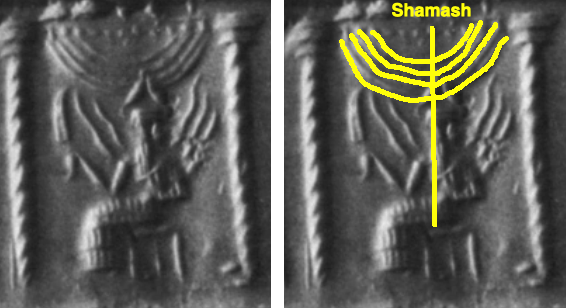
So why is this seal so interesting? Let me explain: The seal depicts the sun god Utu/Shamash, identifiable by the wavy sun/heat rays emanating from his shoulders.

I talked about this in my post "Utu or Enki" about the above images found in an incredible book called "Seal cylinders of Wester Asia". 

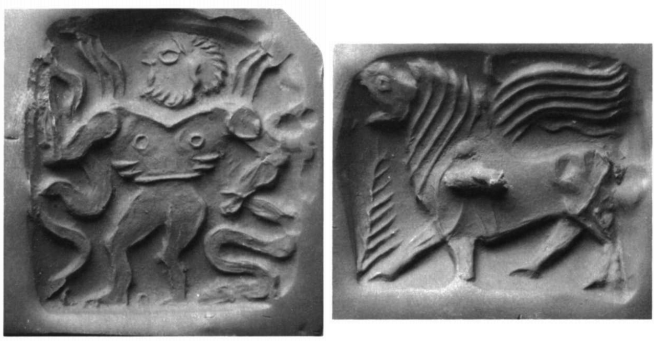
This same symbolism was found not only in Mesopotamia in the late 3rd mil BC...This is a great example of the use of related animal calendar markers. Bactrian two side seal. Sun god with sun rays emanating from his shoulders (like Shamash/Utu), with snakes, symbols of sun's heat and winged lion, Nergal, symbol of hottest part of the year...

I talked about this in my post "Summer and winter BMAC seals"...

Utu/Shamash is  sitting on a throne, holding a cerated knife, another one of his identifying symbols...That tells us that this is old Utu/Shamash, the summer sun...

Sun God Utu/Shamash with sun (heat) rays emanating from his shoulders, standing in in an empty canal, in Leo (between the lions), the hottest, driest time of the year in Mesopotamia, and the time when canals were repaired, holding reed cutting knife...I talked about this in my post "Canals"

I talked about young and old Utu/Shamash here

It is Young Utu/Shamash, Spring Sun, who climbs up the mountains to release Enki/Ea, (god of) fresh water, from (his) it's icy prison. It is he who fills the rivers and canals...And it is Old Utu/Shamash, Summer Sun, who empties them...I talked about this in my post "Shamash young and old"...


On our Nipur seal, Shamash is flanked by two bull-men, holding (???)...Whatever they are holding, is telling us that we are looking at the sun in Taurus, Apr/May, beginning of summer, ruled by the old Utu/Shamash...

Similar to this:

The sun god stands "between two bulls", which means "in Taurus" (Apr/May). Out of the bulls grows grain, which means beginning of grain harvest in Apr/May...From my post "Bull carrying grannary"...

Sooooo....What's so special about this???

Remember my post "The tree of light/life" about the solar symbolism of Menorah? 

In it I talked about the fact that the central candle of the Hanukah (Solstice) Menorah is called Shamash, and that this candle has to be lit first, and then used to light all the other candles...

Now have a look at the central part of the Shamash cylinder seal from Nippur. Are you seeing what I am seeing, or am I just seeing things...again? Is this a symbolic depiction of the Menorah emanating from Shamash himself?

I think this could finally settle the debate about why the central Menorah candle is called Shamash, and why Menorahs are lit during winter solstice, the time when "people have to make sure the sun's fire does't die"...Which BTW is the point of Yule logs...

"The ancient fire-festival of the winter solstice...has survived...in the custom of the Yule log...[once]...widespread in Europe, it seems to have flourished especially in England, France, and among the South Slavs"...From "The Golden Bough"...I talked about Yule log tradition from around Europe in my posts "Badnjak", "First footer", "La buche de Noel", "Yule log in English tradition"

Now, as I explained in my post about Menorah, Menorah was not just the solar symbol, but also the tree of life symbol...Remember this post, "Bactrian bronze age menorah" about the tree of life depiction on this super cool Bactrian bronze stamp, dated to 2400BC-1600BC...

All the images of the rampant goats flanking the tree of life can be explained through animal calendar markers: Ibex goats mating season, which starts in Oct/Nov, overlaps with the rain season in all these areas, and it is the rain that makes life possible in these arid lands...


The ibex goat mating season peaks around the winter solstice/Hanukah...When the Menorahs are lit up using central Shamash candle...Until now I could not see the direct link between the solar and tree of life meaning of Menorah...But now I can...

Remember, every spring, the young Utu/Shamash, the spring sun, climbs up the mountains to release the fresh water (Enki/Ea) from its icy prison (melt the snow)

Which is why the poem "Enki and Ninhursanga" states that "When Utu [the sun god] steps up into Heaven (Holy mountain), fresh waters shall run out of the ground for you"...I talked about this in my post "When Utu steps up into heaven"...

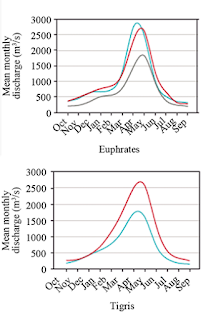
The snowmelt peaks at the beginning of summer, Apr/May, in Taurus. 

Which is when Tigris and Euphrates flood reaches its peak. 

Which is why Utu/Shamash was depicted as a golden bull (Sun in Taurus) with flowing lapis lazuli beard (flowing water)...

And it is this flood (caused by the snowmelt, caused by the sun, Utu/Shamash) that was the (main) source of life in Mesopotamia...The tree of life literally grew out of Shamash...

Makes more sense now? 🙂

I want to thank my friend @dalaygiz for this great observation: 3-waves on each side, with the solar-head in the centre 🤔


Oh and BTW, in Mesopotamia, summer lasted seven hot months...Which is why local dragon, symbol of summer, had seven snake (symbol of sun's heat) heads...So number seven (seven lights) here becomes kind of obvious??? I talked about this in my post "Seven headed dragon"...


That's it. To read more about ancient animal and plant calendar markers, start here…then check the rest of the blog posts related to animal calendar markers I still didn't add to this page, and finally check my twitter threads I still didn't convert to blog post...I am 9 months behind now...


Sunday, 22 May 2022

Snake hiding behind a tree

Double-sided stamp seal: snake behind tree; winged dragon, ca. late 3rd–early 2nd millennium B.C. Bactria-Margiana. Currently in the Met Museum...

I just love this: "snake behind tree" 🙂 "winged dragon" 🙂 What is actually depicted on this seal?

First the "winged dragon"...It is actually winged lion, the symbol of the hot dry half of the year (Apr/May-Oct/Nov) in Central Asia. 

I talked about this in my post "Lion radiating heat", "Summer and winter BMAC seal", "Nude winged hero dominating snakes"...


And the extreme heat of the hottest part of the year in the Northern Hemisphere, in Jul/Aug, Leo...

Now "snake"...Snake is the symbol of sun's heat...Snakes are the only true solar animals. They are in our world when sun is in our world (day and hot part of the year) and they are in the underworld when sun is in the underworld (night and cold part of the year)...

I talked about this in my posts "Bactrian snakes and dragons", "Enemy of the sun", "Chthonic animal", "Letnitsa treasure",  "Wolf and snake"...

That snake as a symbol is directly linked to the sun, can be seen from this Bactrian seal: 

Sun god, with a cool hairdo and with sun heat rays coming out of his shoulders, just like Sumerian Utu and Akkadian Shamash. And snakes instead of hands...And a snake belt...Just so we all know that snake is a solar animal...

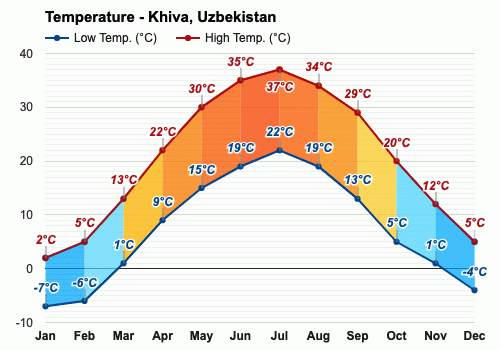
Snakes hibernate during the cold part of the year and come out only when the ground and air get sufficiently warm...Over 60 degrees° Fahrenheit (16° C)...Which in the area of the old Bactria is Apr/May...


And that is the exact same time when wild alliums start to bloom in Central Asia...Like these, Allium karataviense Regel...

Plant data from "Medicinal Plants of Central Asia: Uzbekistan and Kyrgyzstan"

There are many other wild alliums found in the area of old Bactria. 

Like 

Yellow Allium Obliquum

Purple Allium Przewalskianum. 

They all flower during the hot part of the year...You can find the list of (all?) of them here (search for Central Asia) https://pacificbulbsociety.org/pbswiki/index.php/AllAlliums

Alliums have always been used in Central Asia as food (Source Edible Alliums of Uzbekistan) and as medicines (Source Wild Allium species (Alliaceae) used in folk medicine of Tajikistan and Uzbekistan)

Why do I think this is a flower and not a tree? Cause wild flowers appear as calendar markers on other Bactrian artifacts...

I talked about this in my post "Tulip goddess" about this mobile perfume or cosmetic bottle depicting a winged goddess among flowering tulips. Bactrian, the end of the 3rd, beginning of the 2nd millennium BC, Louvre Museum...


The "allium" leaves on the seal don't match the true allium leaves. That made me wonder if I identified the flower correctly as allium. But you can see that the leaves on tulips depictions are also cerated and don't really match the actual leaves. So I am sticking with it 🙂

Unless one of you has a better match? Anyway, as a calendar marker, flowering of the first alliums and the emergence of the first snakes from hibernation marks the time of the winged dragons (lions)...Hot part of the year...

To read more about ancient animal and plant calendar markers, start here…then check the rest of the blog posts related to animal calendar markers I still didn't add to this page, and finally check my twitter threads I still didn't convert to blog post...I am 9 months behind now...

Sunday, 30 January 2022

Pegasus and Chimera

Pin head in form of a winged horse, ca. 8th–7th century B.C. Luristan, western Iran in the Zagros Mountains. Currently in the Met Museum...

Cool right? For so many reasons. 

First: How old is the oldest depiction of Pegasus in Europe?

Second: Please note sun symbol on the horses side. Did you know that horse mating season is governed by the sun and it peaks on summer solstice. 


I talked about this in my post "Unicorn"...

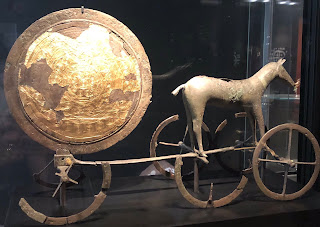
The link between horses reproductive cycle and the sun is why we see things like these: Bronze Age "Sun Chariot" pulled by a horse, Denmark 1400 BC...


And why Greek sun god rides in a chariots pulled by white horses...


And why when Ezekiel accuses the builders of the First Temple of being Sun worshippers, he says that they kept horse pulled chariot in the temple...I talked about this in my post "Sun god from the first temple"....

And why "Solar horse" is such a common motif on Celtic coins...

And why white horse is the sacred animal of the Slavic sun god Svetovid, and was kept in his temples...


I talked about this in my post "Svetovid"...

And so on and so forth...

BTW, I discovered this link between horses and sun while I was researching the reason why Eastern Mediterranean is why local Sea gods were so obsessed with horses...


It turns out the horse mating season overlaps with the sailing season in the region...I talked about this in my posts "Trojan horse"...

Anyway, here is a very interesting thing I discovered the other day:

the link between horse and sun can be seen from the fact that in some parts of Croatia people believed that dragon is "a winged horse"...

Eeeee, what?

To understand the importance of this belief, we need to understand that snakes are solar animals. They are in our world when sun is in our world (hot part of the year) and they are in the underworld when sun is in the underworld (cold part of the year)...I talked about this in my post "The chthonic animal"...

This makes them a perfect solar symbol...Symbol of the sun and the sun's heat...Slavs actually believed that snakes feed off the sun's heat...And that when snakes get old, they turn into dragons...

And dragons, old snakes, are symbol of the old sun, destructive summer sun which burns the land and causes drought. Steals and guards water...Which is why in Slavic mythology, dragon, always breathes fire...


There is actually a Serbian belief that "a snake got wings when it lived over 100 years, after which it flew away to live in lakes and waters"...Just like a Dragon...

This is in addition to the belief from Ukraine and Poland that snakes once had wings and flew in the sky. But the sun burned their wings and they fell on the ground....

I talked about snakes and dragons in my post "Letnitsa treasure" (and many others)...

And now we see that Serbs also saw a dragon, solar symbol, as a winged horse...

This link between dragons and winged horses doesn't end here...

Slavs also believed that when a hero kills a dragon by cutting his head(s) off (the only way to kill a dragon by the way), "rivers (of fertility) flow from each of dragon's necks"...

Did you know that, "according to legend, everywhere the winged horse Pegasus struck his hoof to the earth, a water spring burst forth...Without proper explanation...Very very interesting...

Pegasus which allowed Bellerophon to ride him in order to defeat the monstrous Chimera...


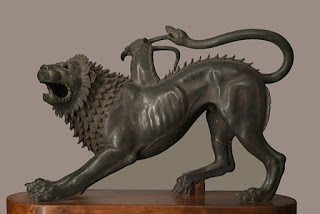
Is that The Chimera, whom Homer, in his Iliad, depicts like: "a thing of immortal make, not human, lion front and snake behind, a goat in the middle, snorting out breath of terrible flame, of bright fire". 

But was Chimera a monster or a complex solar symbol? I asked this question in my post "Chimera" and I explained why I thought so...But I now think that, even though I was on the right track in interpreting Chimera as a complex solar symbol, I originally misinterpreted part of its meaning. Because at the time when I wrote the original article about Chimera I was still not aware of the Animal Calendar markers...

I correctly interpreted the meaning of 

The snake (Apr/May, beginning of summer, because this is when the most common snake species in Eurasia start to mate)


The lion (Jul/Aug, beginning of autumn, because this is when the Eurasian lions main mating season starts)

Well, I know this now...At that time I was just guessing...All I knew at that time was the mating season of Ibex goats...Which in the Alps does peak around winter solstice...I cared too much about solstices at that time, which lead me astray...

So I misinterpreted the meaning of the goat head in Chimera as the symbol of the winter solstice...I was wrong...

Cause what I didn't know then was the link between Ibex goats, their mating season and the beginning of the rain season in Eastern Mediterranean, Levant, Middle East, Central Asia, Iran...I didn't know about the Goat of Rain...

You can read more about this in my posts "Dancing goat men from Luristan", "Green pastures" and "Pan, goat of rain"...and many others...

And in this climatic area where we find roots of all the Greek myths, the mating season of Ibex goats starts in Oct/Nov, the beginning of winter...

Now in the past, people in that part of the world divided the solar year into two seasons:

1. Winter, cool, wet, season of life (Nov-Apr)

2. Summer, hot, dry, season of death (May-Oct)

Summer in Mesopotamia was dominated by Utu/Shamahs, the sun god...The Dragon...Seven headed dragon to be more precise...With seven snake heads...One for each hot month of the summer...And lion's body...

I talked about this in my post "Seven headed dragon", "Winged superhuman hero", "Ninshubur"...

Sounds familiar??? Snake, solar animal, the symbol of the sun, sun's heat...Lion, solar animal, the symbol of the destructive sun, sun's heat...We find the same symbolism in Bactria...You can read more about this in my post "Winged superhuman hero dominating snakes"...


Amazing...It points us towards the fact that lion-snake composite animal is actually dragon, symbol of the hot dry half of the year...

But what about the goat? To understand where goat fits into all this, we need to plot the beginnings of the mating seasons of snake, lion and goat on the climatic solar year in Eastern Mediterranean, Levant, Mesopotamia, Central Asia, Iran...


This is what I wasn't aware of when I wrote my article about Chimera...The tree animals that it consists of mark the beginning, the middle and the end of the "old" summer, the hot, dry part of the year dominated by the sun...The season of death...

The season of the Dragon...I think Chimera makes a lot more sense now...Particularly that it "snorts out the breath of the terrible flame of bright fire"...Just like a dragon...

And the guy who kills this terrible beast rides on a winged horse...A symbol of the sun and another Dragon...Funny...Just like St George (Old Sun God Jarilo, the Scorcher) kills the Dragon (Symbol of sun's fire) while riding on a white horse (Solar animal and symbol of summer)...

Ok...That's it for tonight. If you want to know more about ancient animal and plant calendar markers, start here then check the rest of the blog posts I still didn't add to this page, and finally to to @serbiaireland and check my twitter threads I still didn't convert to blog post...I am 9 months behind now...