Showing posts with label pomerania. Show all posts

Friday, 1 March 2019

Horn of Wismar

This is "Horn of Wismar". It was discovered more than 100 years ago near Wismar, Pomerania, Germany. It was made in the first half or the second millennium BC.


The bronze metal fittings on the Horn of Wismar are richly engraved with complex decorations. 


The decorations on the Horn of Wismar consist of geometric motifs such as circles and spirals as well as with depictions of boats and soldiers carrying spears and shields


This is the enlarged version of a warrior depiction from the Horn of Wismar. 


Wismar is located in Pomerania the same region where we find Tollense river valley, where the biggest Bronze Age battleground so far was discovered few years ago. 


The warriors depicted on the Horn of Wismar could be the same warriors who fought around Tollense river bridge. You can read more about this battle in my post "Tollense battle".

Wismar is located in in a deep bay, protected from the Baltic storms. It is a perfect harbour. 


It's location at the entrance into the Baltic Sea makes it a perfect place to locate a fleet which could control the access to the amber coast further east.


The boats depicted on the Wismar horn are the same boats depicted on Late Bronze Age rock carvings across the Baltic Sea. Like these ones from Bohuslän, western Sweden.


Who were the people who sailed (rowed) these "dragon boats"? Were they local or foreign? Were they the people who brought amber to Ireland during the late Bronze Age? Like this necklace found in Tooradoo, Co. Limerick.


Were they the people who brought bronze and Bronze Age into Scandinavia? Were they the same people who brought Bronze Age into Ireland, and who, the ancient Irish Annals claim, came from Mediterranean? You can read more about the arrival of Bronze Age into Ireland from Mediterranean in the series of posts entitled "Montenegrian tumuluses".  


Wednesday, 1 July 2015

Tollense battle

A few weeks ago someone wrote this comment on my post about knobsticks:

"One of the knobsticks found in the Tollense River is actually made from blackthorn (sloe) wood (Prunus spinosa)! A remarkable resemblance to the Irish tradition. "

I had no idea what this person was talking about. I never heard of Tollense river before. So I decided to investigate the whole thing. It turned out Tollense river was a site of a big battle which took place around 1200 BC. But was this battle a clash of two armies, or an attack on a caravan traveling along the ancient Amber road?


 This is Tollense valley, a river valley located in western Pomerania. 


According to reports in the German media, human remains from the Bronze Age have been found in this region since 1997. Horse bones have also been found in the same archaeological layer. Many human bones showed signs of serious injury and violent death. But then a  humerus (upper arm) bone was found which contained a flint arrowhead firmly embedded into it. 


This pointed to a possibility that this area of the Tollense river valley was a site of an ancient battle and that the bones belonged to the battle victims. A serious archaeological study of the river valley started in 2008 and it narrowed down the possible battle site to an area of two square kilometers. 


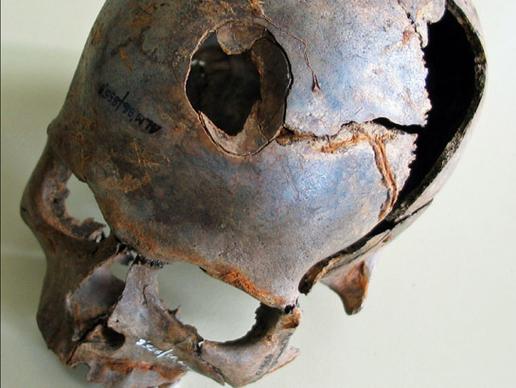
As well as the humerus (upper arm) bone with the embedded flint arrow head, archaeologists have found other proofs that other people have also died in the same area of the violent death. Many bones discovered at the site contain lesions which were produced by blows and many were broken. A scull was found with a bronze arrowhead found firmly embedded into it, penetrating the scull and entering the brain. 


Until now 25 socketed bronze arrowheads were detected which occur in clusters especially where human and horse bones also come to light. In conclusion there is little doubt that the remarkable number of these bronze projectile points and the bones belong to the same find.


Also several fractured skulls were  unearthed which have all the characteristics of the impact trauma suggesting that the fractures were made by a massive blows with blunt weapons. 


The archaeologists have found remains of several wooden clubs, of which some were shaped like baseball bats and were made of ash wood, and some were shapes like croquet mallets and were made of sloe (black thorn) wood. 


Both types of these battle sticks are also found in the Irish arsenal of knobsticks. You can see the mallet shaped Irish knobstick, third from the left. It is also made from the black thorn wood.


It is now estimated that about 200 people died in this small area of the Tollense valley. And based on the forensic evidence, it is believed that these people were murdered. Originally it was believed that it was possible that these people were ritually killed and sacrificed, but it is now believed that it is much more probable, considering all the weapons found on the site, that all these people were killed in some kind of a battle. A battle which was fought with wooden blunt weapons (clubs), arrows with flint arrowheads and bronze arrowheads, spears with bronze spear tips, axes with bronze axe heads, bronze swords and knives, all of which were found in the area. 


All these findings were possible due to the preservation of the former swamp ground and the fact that the Tollense has never really changed its course. Since the population density then was about 5 people per square kilometer, this would have been the most significant battle in bronze period Germany yet to be discovered. And one of the earliest battle sites discovered in Europe to date. Based on the radiocarbon dating this battle took place some time between 1300 bc and 1200 bc, but closer to 1200 bc. 

So who fought this battle in which so many people were killed? Well this is still a mystery. The injuries suggest face-to-face combat in a battle. Most archaeologists agree that this battle was fought between two warring tribes. But I have my doubts about this. And this is why. 

Most of the bodies appeared to be young men. This would indeed suggest that the people who were killed were indeed warriors belonging to two warring armies. But not all bodies are those of the young men. Many bones belonged to young women. Fair enough they could also have been warriors. The same can be said for middle aged men whose bones were also found at the site. But the bones were also discovered which belonged to old women and young children. These were definitely not warriors. And armies are unlikely to contain among their ranks young children and old women. What if an army of one tribe attacked a settlement of another tribe. There sure could have been some civilians, even old women and children which were caught and killed in the conflict. But no settlement was found anywhere near the battle scene. So what were all these people doing fighting in the middle of nowhere? What were they fighting over? A swamp? A field? If the population density was really that small at the time of the battle, there was plenty of space for everyone, so what were these people fighting over? The place where the battle took place is a very very unlikely place for a battle between the two armies to take place. 

Does that mean that I believe that there was no battle? No, I believe that there was a battle, but that this was not a war, but a heist, an armed robbery. I believe that what happened in Tollense valley was an attack of an armed gang on a caravan. 

Caravan is a group of people and their transports (Horses, Camels, Mules, ..., Cars, Trucks) which moving together and transfer cargoes. The reason why people would travel in caravans is because they offer protection in numbers. A lone traveler, particularly if he is carrying anything valuable is an easy target for robbers and wild animals. A group of people traveling together is much more difficult to attack particularly if they are armed and or have armed guards traveling with them. The more valuable the cargo carried by the caravan, the more armed guards the caravan would have to insure the security of the cargo. Caravans can be ad hock or regular caravans going along the predetermined route at predetermined intervals. Additional travelers would often attach themselves to caravans for protection. This could make caravans quite large and it they could grow until sometimes hundreds of people would end up traveling together. Caravans have been used for millenniums during which they didn't change much. This is an engraving of a medieval Persian caravan

You can see travelers protected by armed guards, of which some are cavalry armed with spears and probably swords and some are foot soldiers armed with bows and arrows. Travelers are also either traveling on horseback or are walking next to their horses which are carrying saddlebags full of cargo. I believe that this is the exact type of caravan that was attacked by a band of armed robbers in the Tollense valley some time between 1300 bc and 1200 bc. 

Do we have any evidence that the Tollense battle was indeed an attack on a caravan? I believe we do. The archaeological reports say that "the evidence was also found among the human remains of a millet diet, which is not typical of Northern Germany at the time, which may indicate the presence of invaders. Bronze pins of a Silesian design which were also found on the site could suggest contact with the Silesian region 400km to the south-east". So the idea is that invaders came from Silesia and attacked locals in Pomerania. I agree that some people involved in the battle at the Tollense valley were from Silesia, but I don't agree that they were invaders. I believe that they were traders, and more specifically metal, tin and bronze traders. It was these Silesian metal traders who were traveling in a caravan protected by the armed guards, which were attacked by a gang of robbers. And these robbers attacked the caravan precisely because it was carrying the most precious metal of the bronze age: tin. 

Do we have any proof that the people who fought the battle in the Tollense valley carried with them tin ingots? Yes we do. Among the bones and weapons archaeologists have also found several gold spiral rings and bronze spiral rolls,  a small bronze finger-ring, a bronze arm ring and most importantly tin spiral ring ingots. 

Gold rings:


Tin spiral ring ingots and bronze spirals:


These are extremely unlikely things to be found in the equipment of a warrior belonging to an invading army. But they would be exactly the kind of things that you would find in the saddle bags of a metal trader. Archaeologists are extremely excited about these finds. Because preservation of prehistoric tin is very difficult, the raw material remains more or less invisible in the archaeological find record. There are no comparable tin objects available from northern Germany.

In the Bronze Age tin was a raw material of fundamental importance. Bronze is an alloy consisting primarily of copper, commonly with about 12% tin and often with the addition of other metals (such as aluminium, manganese, nickel or zinc) and sometimes non-metals or metalloids such as arsenic, phosphorus or silicon. But the most important element in this mixture is tin. No tin - no bronze, no bronze - no bronze weapons. Copper itself is too soft and mixed with other elements too brittle. But copper mixed with tin will give you the bronze alloy which is just right for making blades. So to make bronze you need copper and tin. Copper is not a problem. There are huge copper deposits all over Europe. But tin is another story. Tin is an extremely rare raw material in Europe. This is why tin was during the Bronze Age more valuable than gold. This is why we don't find more bronze age tin objects. All the tin was used to make bronze. The most important prehistoric sources of tin were  Brittany in western France, Cornwall in south western England and the northwestern part of the Iberian Peninsula. And Erzgebirge (Ore Mountain) area in eastern Germany. And guess what is just next to the Ore Mountains, the most important continental European source of Tin and Copper? Silesia. 

This is the position of the Ore Mountains in South of Germany. You will see that they are located right next to Silesia.


The Ore Mountains area played an important role in contributing Bronze Age ore, and as the setting of the earliest stages of the early modern transformation of mining and metallurgy from a craft to a large-scale industry. This is because the Ore mountains are extremely rich in both tin and copper as well as silver and led ores. No wonder this area was the place where as early as 2500 BC we find highly developed mining industry. Tin mining knowledge spread to other European tin mining districts from Erzgebirge and evidence of tin mining begins to appear in Brittany, Devon and Cornwall, and in the Iberian Peninsula around 2000 BC.

Not only that but the Ore Mountains were rich in ore necessary for making bronze, but the surrounding mountain area was covered in ancient forests which provided endless easily obtainable fuel for smelting the metal, while the river valleys just south, north and east of the mountains were ideal for growing cereals. Everything a metallurgical culture needed to develop was there concentrated in this one small area. No wonder that just after the 2500 BC in this area we see emergence of the Unetice culture. The Unetice culture is the most important archaeological culture of the Central European Bronze Age, dated roughly to about 2300–1600 BC. The eponymous site for this culture, village Únětice, is located in Central Czech Republic, northwest of Prague, just under the Ore Mountains in the fertile cereal growing country. The culture quickly spread to all the areas surrounding the Ore mountains. Today this archaeological culture is known from Czech Republic and Slovakia from approximately 1400 sites, from Poland (550 sites, Silesia) and Germany (approximately 500 sites and loose finds locations). The Unetice culture is also known from north-eastern Austria (in association with the so-called the Böheimkirchen Group), and from western Ukraine. This is the map of Unetice culture sites and their relationship with the Ore Mountains and Silesia.


Here is another map of the distribution of the Unetice culture from Eupedia website which might give even better idea how central the Ore Mountains were for the development of this culture:

The Únětice culture is commonly associated with Nebra Sky Disk.


But Unetice culture is also associated with another type of artifact: ingot torcs. Ingot torcs are torcs made from tin and bronze intended for trading as raw metal. This is an example of Unetice ingot torc from Silesia:


And here is a bronze bracelet from Unetice culture which looks exactly like the Tollense tin spiral rings:


The Únětice culture had trade links with the British Isles. A gold lunula of Irish design has been found as far south as Butzbach in Hessen (Germany). Amber was traded as well. But the most important trade item I believe was tin, copper and bronze. The tin from the Ore Mountains was traded north to the Baltic Sea and south to the Mediterranean following the Amber trading route.

Amber trading route was an ancient travel and trade rout which connected Balkan and Baltic from at least early Neolithic. It mostly fallowed the river valleys radiating north and south from the area between the Ore Mountains and Silesia. This area is very peculiar. It is a watershed. Just above it we have three major rivers, Laba (Elbe), Oder and Visla (Vistula) flowing into the Baltic and North sea. Just below it we have river Danube which flows into the Black sea and whose tributaries start at the watersheds with Adriatic and Aegean sea (Sava, Morava, Drina) and from which we can follow Neretva river into Adriatic sea and Vardar river into the Aegean sea.


Please note that on the above map the territories of Unetice culture and Lusatian culture are very similar. This is not a coincidence. They both cover the same area defined by the three major Baltic rivers Laba (Elbe), Oder and Visla (Vistula). This shows that both cultures were oriented towards the South Baltic and the North sea as their main Maritime trade gate. The control over these three rivers was crucial to ensure the movement of goods and people from the area around the Ore Mountains and the South Baltic and North sea coast.


So this trade route connected Balkan and Baltic. And it didn't stop at the coast of Balkans either. It continued from north Italy to Corsica and Sardinia, and from the Balkans across the Dardanelles to Asia Minor and then to Middle East and Egypt. But this trade route did not stop at the coast of the South Baltic and North Sea. From there it continued over the sea to Britain and Ireland and further down to Brittany and Iberia.

And bang in the middle of this most important European trade route we find a rich copper, tin and wood deposits right next to the fertile agricultural land. It is then no wonder that in the 3rd millennium BC this area underwent technological, economic, political and population boom and the emergence of the Metallurgical Unetice culture.

The new study of the Únětice Culture done by Dalia Pokutta aimed to produce a ‘bioarchaeological portrait’ of the Únětice culture in Poland (Silesia). The study presents the subject from a palaeodemographic perspective based on the results of isotopic analysis of human remains dating back to the Early Bronze Age (2200-1600 B.C).

‘It is the biggest isotopic project undertaken in Poland so far. Hundreds of samples were analysed, not only human bones, but also animals. Total of fifty human remains were analysed. The author focused on the Early Bronze Age lifestyle, medical knowledge and diseases, occupations and professions, as well as chosen subgroups of the Silesian prehistoric society, such as the tribal aristocracy, children and elders. The study provides information regarding diet and subsistence, transportation, human migrations and territorial mobility as well as the impact of these factors upon Úněticean society, expansion of metallurgy and commerce, forms of rulership and collective identity.

One of the leading conclusions is a very high level of territorial mobility of the prehistoric population in Silesia, with presence of immigrants from Germany, Czechia, Hungary and Sweden. This confirms that the area around the Ore mountains, became due to its economic prosperity, a magnet for traders, soldiers and all sorts of other people from along the Amber trading route.

This movement of people along the Amber trading route only intensified in the following millenniums during the Bronze Age. Unetice Culture was replaced by the Tumulus Culture and then by the Urnfield Culture. When the Tollense battle happened, the whole area above Silesia and between the rivers Laba (Elbe) and Visla (Vistula), Including the Tollense valley, was part of the Lusatian culture (pink on the map), which is regarded as part of the Urnfield culture.


The Lusatian culture existed in the later Bronze Age and early Iron Age (1300 BCE – 500 BCE) in most of today's Poland, parts of the Czech Republic and Slovakia, parts of eastern Germany and parts of Ukraine.

The Lusatian culture was heavily influenced by the west-alpine and Hallstatt cultures. Metalwork technologies were imported from the South via the Laba (Elbe), Oder and Visla (Vistula) river. From where? From the area of the Ore Mountains and Silesia. Numerous archaeological findings of imported Scandinavian products prove contacts to Nordic Bronze Age peoples. So we can see that the Amber trading route is still operational. 

And here is something that beggars belief:

The archaeologists agree he spiral rings like those from Tollense valley have general parallels in younger context (Unetice) and this long-lived type of objects supports the idea that they may have functioned as ingots. The archaeologists believe that the Tollense valley tin rings provide evidence for the trade and transport of tin in small standardised units suitable for ad hock small scale use.  So the archaeologists agree that these are trade ingots. But guess what? Archaeologists "don't know where these tin ingots came from" !?

They know that at least some people involved in the Tollense battle came from south of Germany, more precisely from Silesia. They know that Silesia has been for at least 1000 years an important metallurgical center. They know that Silesia is located next to the biggest tin mine in continental Europe. They know that the Tollense river valley is located between Laba (Elbe) and Oder rivers, bang on the Amber trading route, which was used for transporting tin and bronze from the area of the Ore mountains to the South Baltic coast for at least one thousand years. And the archaeologists still don't know where did the tin come from?

What do you think is the most probable source of tin ingot torcs found on the Tollense valley battlefield?  And do you still believe that this was a battle between the invading Silesians and the locals? 

This is what I think happened in Tollense valley. A caravan transporting large quantities of tin and other metals was moving from Laba (Elbe) valley, probably from a harbor or a large settlement. The metal came from Silesia, the area around Ore mountain. The caravan had many people, traders and other travelers and many pack animals. It moved along Tollense river, then along Peene river towards Oder river, probably towards another harbor or a settlement. Of it could have been moving in the opposite direction. The caravan was protected by armed guard which consisted of both horsemen and infantrymen. These soldiers were either traveling with the caravan from Silesia or were assigned to the caravan at a port somewhere in Laba (Elbe) valley. This was a normal practice since the first caravans started crisscrossing the world. One of the most important duties of any country was always to protect its roads and in this way allow free movement of people and goods. These guards were armed with bronze weapons: arrows with bronze arrowheads, bronze spears, axes, swords, daggers...In Silesia bronze was common and cheep so it is to be expected that the Silesians were armed with bronze weapons. The caravan was attacked by a gang or even a small marroding army which probably came from the north west, probably from the Jutland peninsula or even further north or from across Laba (Elbe) river. These people were armed with more primitive weapons, arrows with flint arrowheads, wooden spears and wooden clubs. Denmark and Sweden have huge flint deposits so it is quite possible that the attackers came from there. The attackers, who probably outnumbered the people in the caravan, waited hidden for the caravan to appear and launched a surprised attack from the forest which surrounded the river. They first pelted the caravan with arrows, targeting the mounted soldiers first. This is why we have dead people mixed with dead horses. Remember the clustered bronze arrowheads mixed with human and horse bones? Were they the arrows which the horsemen never got to take out of their quivers? I believe that the arrows with the bronze arrowheads were fired by mounted archers. The  proof for that is the bronze arrowhead which was found embedded in a scull. This arrowhead could only have been fired from a position above the head, which would indicate that the archer was on a horseback. Also the flint arrowhead which was found embedded in a humerus (upper arm) bone is embedded under such angle that the shot must have come from below, meaning that the arrow was fired by a foot soldier shooting a mounted warrior. Anyway what happened then was the attackers sprayed all the other people from the caravan with arrows. The arrows were fired from the other side too. Then the frontal assault ensued which resulted in hand to hand battle. Who won? That is difficult to say. It is most probable that the attackers won. The number of dead would suggest that this is what happened. The attackers killed all the people from the caravan, collected all the metal, metal armor and weapons and other valuables and remaining pack animals and returned back to wherever they came from. Whatever was left on the scene is whatever they missed. They left all the dead Silesians where they fell. They maybe even left their own dead at the scene if their losses were great, or they could have carried their dead with them or burned them and carried the ashes or buried the ashes somewhere in the area. 

And this is it. This is my interpretation of what happened in Tollense valley. It is based on archaeological data currently available from the site. This can of course all change in the future with new discoveries and my story could become just a failed speculation. But for now I believe that this is much better interpretation of the events than the official one. What do you think? 

5 years later, 28th of October 2020...


Thursday, 16 April 2015

How old is Crom Dubh

The worship of Crom Dubh or Crom Cruiach, the old Irish god of agriculture, is most closely associated with Tigernmas, sometimes called Tiernmas, the Irish high king who is said to have perished while worshiping this god. But where and when did the worship of Crom Cruach, Crom Dubh originate? 

The old Irish annals tell us that the first race that lived in Ireland were Fomorians. Then, after the flood, came the people of Partholón who are credited with introducing cattle husbandry, ploughing, cooking, dwellings, trade, and dividing the island in four. But then Partholon and all his people later died of plague leaving Fomorians as the single inhabitants of Ireland. Then The people of Nemed came, the descendants of the brother of Partholon, and they found Fomorians living in Ireland. They fought the Fomorians under Nemed and won. But after Nemed's death, Fomorians enslaved Nemed's people and demanded a heavy tribute: two thirds of their children, grain and cattle. The tribute that Nemedians had to give to Fomorians was exactly the same as the tribute Tigernmas had to give to Crom Dubh. Nemed's son gathered an army of sixty thousand, rose up against them. After a great slaughter on both sides, only thirty of Nemed's people escaped in a single ship, scattering to the other parts of the world, leaving again only Fomorians in Ireland. Well actually the Lebor Gabála Érenn says that when the next invaders, the Fir bolg, came then found Ireland empty. But Lebor Gabála Érenn also seems to suggest that Fir bolg and Fomorians were one and the same people. At least Macalister, the translator and editor of the Lebor Gabála Érenn thought that this could be so when he says that:

"The line between the Fir Bolg and the Fomorians is not clearly drawn…"

What is also very interesting is that Fir Bolg are also said to have been the descendants of Nemed who was the descendant of Partholon's brother. This makes Fomorians and the people of Partholon one and the same people. 

We have to ask ourselves why are the Fomori most directly linked to Fir Bolg. The Lebor Gabála Érenn states:

"Partholon took Ireland: he dwelt there five hundred and fifty years, till the  Cynocephali (dog headed, wolf headed) drave him out, and there escaped [survived] not one of his children alive."

Who were these wolf people?  Macalister suggests that “the Cynocephali introduced into the subsequent Partholon story have no place in the orthodox narrative, unless we are to equate them to the Fomoraig. What is the old Irish word for wolf? It is "faolchú". In Slavic it is Vuk, Volk, Vlk. Slavs have long tradition of ware wolfs. Slavic warriors wore wolf skins. These are the berserkers from the Norse legends, people wearing wolf skins as part of their war attire. 

The Úlfhéðnar (singular Úlfheðinn), another term associated with berserkers, mentioned in the Vatnsdœla saga, Haraldskvæði and the Völsunga saga, were said to wear the pelt of a wolf when they entered battle. Úlfhéðnar are sometimes described as Odin's special warriors: "[Odin’s] men went without their mailcoats and were mad as hounds or wolves, bit their shields...they slew men, but neither fire nor iron had effect upon them. This is called 'going berserk.'" In addition, the helm-plate press from Torslunda depicts (below) a scene of Odin with a berserker—"a wolf skinned warrior with the apparently one-eyed dancer in the bird-horned helm, which is generally interpreted as showing a scene indicative of a relationship between berserkgang... and the god Odin"—with a wolf pelt and a spear as distinguishing features.
This is Vendel era bronze plate found on Öland, Sweden, thought to represent Odin, Vodan with wolf warriors. 


In my post about Odin I wrote about the the fact that the etymology of the name Odin, Vodan comes from Slavic languages. Are these the same wolf people, Fir Volk from Irish legends?


Serbs in particular believe that they descend from Van, the man who could shift into a white wolf, who was the son of Dabog, Hromi Daba who I believe is the the same as Crom Dubh. Dabog was also known as a wolf shepherd. Appropriate god for Fomorians who according to The Lebor Gabála Érenn: 

"made a sheep-land of Ireland". 

And the Biggest Slavic tribe which is mentioned in relation to the Samhain human sacrifices are called Volci, Vilci, wolf people...Could it be that Fir Bolg are Fir faolchú actually Fir volk, Fir voulk, wolf people, wolf head people? We have seen already that when words cross from irish into serbian the b turns into v and g turns into k. We have a general hardening of sounds from Slavic to Celtic. That this is the case suggests the fact that the Fir Bolg are first mentioned in the 9th century Historia Brittonum, where they are referred to as the Builc...

Then came the Tuatha Dé Danann, another group of descendants of Nemed who was descendant of Partholon's Brother. They defeated the Fir Bolg in the first Battle of Magh Tuiredh and took possession of Ireland. But then they had to defeat the Fir Bolg again, this time under the name of Fomorians at the Second Battle of Magh Tuireadh. Interestingly the Annals of Loch Cé call Magh Tuiredh "Magh-Tuiredh-na-Fomorach" and explain that Magh-Tuiredh what the place "where the Fomorians were imposing their tributes on the men of Erinn..." The name Mag Tuired (modern spelling: Magh Tuireadh) means "plain of pillars" or "plain of towers". Crom Cruach was represented by a large idol, made completely of gold, which stood on the plain of Mag Sleact, which is in Cavan County in Ulster , Ireland . Twelve smaller idols, these of stone, formed a ring around the Crom Cruach. Were pillars which were standing on this plain the same pillars representing Crom Dubh, Crom Cruach???

At the end of the Second Battle of Magh Tuireadh, Bres, the leader of the Fomorians was found unprotected on the battlefield by Lugh, the leader of the Tuatha Dé Danann. Bres pleaded for his life with him. Lugh spared Bres because he promised to teach the Tuatha Dé Danann agriculture. Bres is said to have possessed the the secret knowledge of "How shall the men plough?  How shall they sow?  How shall they reap?". He gave that secret to Lugh, the leader of the Tuatha Dé Danann and his life was spared. 

What is interesting about this story is that both Bres, the leader of the Fomorians and Lugh the leader of Tuatha Dé Danann at the Second Battle of Magh Tuireadh were half Fomorian and half Tuatha Dé Danann.

Lugh's father was Cian of the Tuatha Dé Danann, and his mother was Ethniu, daughter of Balor, of the Fomorians.
Bres's father was Elatha of the Fomorians and Eri, daughter of Delbaith of the Tuatha Dé Danann.

This means that the Tuatha Dé Danann, who are said to have replaced Fomorians as the rulers of Ireland actually claim descent from or at least close kinship with the Fomorians. Actually the line between the Fomorians and the Tuatha 
Dé Danann is so blurred, that in the "lebor gabála Érenn" we read:  

At the end of three days and three nights thereafter the Sons of Míl broke the battle of Sliab Mis against demons and Fomoraig, that is, against the Túatha Dé Danann"...

This line literally equates the Fomorians and the Tuatha Dé Danann.

From the above story we see that if Fomorians were indeed related to Partholon, then it was the Fomorians who brought the secret of the grain agriculture to Ireland and preserved it until the time of Tuatha Dé Danann. We also see that when the Milesians came to Irleand, the Fomorians were still there. Lebor Gabála Érenn tells us that the Irial Fáid father of Ethriel and grandfather of Tigernmas:

"...cleared twelve plains, dug seven royal forts, and fought four battles against the Fomorians..."

The Fomorians were apparently still in Ireland at the time of  Cú Chulainn. In the medieval Irish tale entitled "The Training of Cú Chulainn", preserved as a copy by Richard Tipper in British Library, we read:

"Cúchulainn came to the place and saluted them. 'What is this sorrow or the misery upon you?' says Cúchulainn. The damsel answered and this she said: ‘A royal tribute which the tribe of Fomorians carry out of this country every seventh year, namely, the first-born of the king's children. And at this time it has come to me to go as that tribute, for to the king I am the dearest of his children.’‘What number comes to lift that tribute?’ asks Cúchulainn. ‘Three sons of Alatrom of the Fomorians,’ she answers, ‘and Dub, Mell and Dubros are their names.’"

Did Fomorians brought with them their god of grain agriculture, Crom Cruach, Crom Dubh and is this why the both Crom Dubh and Fomorians demanded the first born sacrifices? And if Tigernmas was worshiping Crom Dubh, was he worshiping Fomorian god? And if so, was Tigernmas a Fomorian king? I believe so. 

If the Fomorians were the people who possessed the secret of the grain agriculture and Tigernmas was the king who introduced the agricultural cult to Ireland which included the same types of sacrifices which were also demanded by Fomorians, that would certainly suggest that Tigernmas was a Fomorian king. James Bonwick thought so too. In the book "Irish Druids and Old Irish Religions" he identified Tigernmas, the king who perished while worhiping Crom Cruach, Crom Dubh, the god of agriculture, with Balor, the King of Fomorians. This is based on the fact that the ancestry of the god Lugh is usually given as Lugh son of Eithliu daughter of Balor but in the text Baile in Scáil it is given as Lugh son of Eithliu son of Tigernmas, thus equating Tigernmas and Balor, the king of Fomorians.

In the comments in the translation of the annals of the four masters by Owen Connellan we reed that in Ireland the sun was worshiped under the names of Bel, Beal, and Baal. Belenus (also Belenos) was a deity worshiped in Gaul, Britain, and Celtic areas of Austria and Spain. He was the god who brought light, who brought whiteness. The name comes from bel + nos = white, light + brings. Beltane was the Irish beginning of Summer festival, celebrating the beginning of the white, bel, part of the year. According to 17th century historian Geoffrey Keating, there was a great gathering at the hill of Uisneach each Beltane in medieval Ireland, where a sacrifice was made to a god named Beil which was again the same sun god Bel, Beal, Baal.

At the time of the writing of the Irish medieval manuscripts, the word Baal was commonly accepted to mean lord. This word is said to come from the Hebrew בעל (ba‘al, “lord, master, owner”), from Proto-Semitic *baʿl- (“lord, master, owner”). Baal was also the enemy of Yahweh, the Christian god, so the term was well known to the christian monks, and would have been used to describe the old gods, the enemies of the Christian god. 

So if a Christian monk wanted to write "a lord who brough gold into Ireland" he could have written this as baal + or = lord + gold. So we have the manuscript "Baile in Scáil" equating Tigernmas who is "the beautiful lord who brought gold to Ireland" with Balor whose name means "the lord of gold, or golden lord". Coincidence? If we know that Bel, Beal, Beil, Beli, Baal were all the names of the Sun god, the name Balor could also mean a "golden sun"...A fitting name for a sun god with a "blazing" eye... One last thing. Both Tigernmas and Bres mean beautiful. 

Tigernmas is sometimes referred to as the “culture king”, because it is said that he was the one who brought aspects of civilisation to Ireland including the smithing of gold and silver, the dyeing of fabrics, and the making of music and art. It seems that he could have brought the agriculture too. This would mean that it was the Fomorians who brought both agriculture and the metalwork to Ireland. 

According to the archaeological records, the grain farming arrived in Ireland in the fourth or third millennium bc. As for metallurgy, according to the archaeological records the copper metallurgy was brought to Ireland in the third millennium bc.

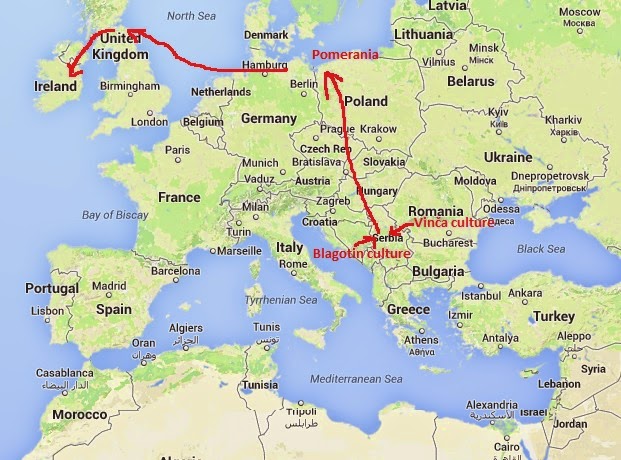
At the end of the 7th millennium bc, we find in the Balkans, in Serbia, a highly developed grain farming Blagotin culture, which was part of the early Starčevo culture.There are strong indications that this culture was a direct precursor of one of the direct precursors of the Vinča culture. Vinča houses had grinding stones and bread baking ovens indicating that the Vinča culture was both an advanced metallurgical and an advanced grain farming culture. It is quite possible that from the 6th millennium bc, metallurgy and grain farming spread together into Europe from Serbia? And if so then the metallurgy and grain farming really could have reached Ireland together, brought by the same people, the first inhabitants of Ireland, the Fomorians. 

So who were these Fomorians then and where did they come from? Irish historians agree that the name Fomorians means probably people of the sea, or people who came from across the sea, or sea pirates. Where could have been that land across the sea famous for its sea pirates whose name sounds like Fomori?

There is a country like that. It is south Baltic part of Germany, called Pomerania or Pomorje.

Pomerania, Pomorje is a Slavic word meaning the land by the sea. The word comes from po + more = by, along + sea. The people living by, along the sea are in Slavic languages called pomori, pomorci, pomorjani, meaning the sea people, coast people. 

This is the territory of Pomerania, Pomorje:


Pomerania (German: Pommern, Latin: Pomerania, Polish: Pomorze) is a historical region on the south shore of the Baltic Sea. The name Pomerania comes from Slavic po more, which means Land at the Sea. The adjective for the region is Pomeranian (Polish: pomorski, German: pommersch), inhabitants are called Pomeranians (Polish: Pomorzanie, German: Pommern).
This land was indeed famous for its sea pirates and traders. Pomerania is where we find Sorbs, northern Serbs who also worship Dabog (Dazdbog). These Baltic Slavs, Sorbs made human sacrifices in medieval time to their gods at the end of harvest at the beginning of November, at Samhain. Lebor Gabála Érenn says that "Tigernmas died in Mag Slecht, with three fourths of the men of Ireland in his company, on Samhain night to be particular, while worshiping of Crom Cruaich; for he was the king-idol of Ireland." During these Samhain ceremonies, human sacrifices were offered to Crom Cruaich, Crom Dubh.  Tigernmas is said to have been the first king to give drinking-horns to his follower. The god to whom Pomeranian Slavs sacrificed people on Samhain was Svetovid. He is sometimes referred to as Beli (or Byali) Vid (Beli = white, bright, shining), and is often depicted with a sword or bow in one hand and a drinking horn in the other. Drinking horn was used for divination during the Slavic ceremonies. In Slavic mythology, the "horn of plenty" is the equivalent of Dagda's "cauldron of plenty". Dagda is then in turn believed to be another name of Crom Dubh, Crom Cruach

There is a well established cultural distribution path Balkans - South Baltic (Pomorje, Pomerania) - Ireland which has been in operation since at least fifth millennium bc. I wrote about this in my posts about henges, in my post about wooden trackways, tochars and in my post about baba stone statues. I believe that the agriculture and metalwork probably followed the same distribution route, which means that the people who brought agriculture and metalwork could have been referred to as Fomori, Pomori.


It seems that the old Irish legends about Tigernmas the king of Fomorians bringing agriculture and metal work to Ireland could be true. Except that if they are true, then Tigernmas lived in the 3rd or 4th millennium bc. Is it possible that the Irish oral tradition has preserved records of events that happened 5000, 6000 years ago? Is it possible that metallurgy arrived in Ireland earlier than we think, at the same time when grain farming arrived? Or did grain farming arrive in Ireland later than we think, at the same time with metallurgy? 

Crom Cruach also known as Crom Dubh who was the Sun God,Thunder god but also the god of agriculture. One of the most important early Bronze Age monuments in Ireland, The Grange circle, was built as a temple dedicated to Crom Cruach, Crom Dubh.


When was the Grange circle built? If we knew when the Grange circle, the temple of Crom Cruach, Crom Dubh was built, that could help us determine how old Crom Dubh as a deity was. In my post about the Grange circle you can read that professor Ó Ríordáin postulated that the circle dated from the Late Neolithic and that it was built c. 2,200 B.C. Archaeologist Helen Roche, however, has suggested that the Grange stone circle was constructed in the Late Bronze Age (c. 1000 BCE) on a site that may have been sacred for thousands of years.

I believe that the building date proposed by Seán P. Ó Ríordáin (2200 bc) is much closer to the actual building date. I believe that the Grange circle was contemporary with the Newgrange and that was certainly built between 3200 bc and 2200 bc. However, additions and changes were probably made in the following millenniums as the worship of Crom Dubh persisted in Ireland up until the arrival of Christianity.

If the Grange circle was built in the 3rd millennium bc, then it would fall into the "pre flood" period which would make Crom Dubh a deity of Fomorians.

Grange circle was built as a giant threshing floor. Threshing floors were in the past used not only for threshing wheat but also as solar observatories and as ceremonial grounds used for agricultural cult practices. I wrote about this in my post about threshing floors. So it is only to be expected that the temple dedicated to Crom Cruach, Crom Dubh, the Sun God and Harvest god of Fomorians, the people who brought agriculture to Ireland, was built to resemble a giant threshing floor.


So is it possible that Crom Dubh is really 5000 years old deity? I believe so. We find aditional proof of the antiquity and the importance of Crom Dubh in the Serbian tradition where Crom Dubh is known as Hromi Daba. This is what Serbian tradition tells us about Hromi Daba:

According to the Serbian folk tradition, Hromi Daba was another name for the old god Dabog, Dajbog, Dažbog, Daždbog, the Giving God, the ancestral deity of the Serbs. Serbs believe that they descend from Dabog. 

Hromi Daba, Dabog was also said to be "the oldest devil and this is why he is also called "djed" meaning the elder, the ancestor". This means that the Serbian tradition claims that Hromi Daba is the the oldest god. With the arrival of Christianity the main old God of the pagan Serbs became the main Devil of the Christians. 

Hromi Daba is also "the devil from which all the other devils come from". This identifies Hromi Daba as the origin of all the other pagan gods. If Hromi Daba, Crom Dubh, Grom Div is really 5000 or 6000 thousand years old, that would make him at least a contemporary with the oldest deities in Evroasia and north Africa if not their origin. The fact that Crom Dubh is directly linked with the Bull cult makes it possible that Crom Dubh descends from much earlier bull cults which originated in Catalhuyuk and which were later found in Vinča. I will dedicate a whole post to this link bewteen the Crom Dubh and the Bull worship.

Hromi Daba was "the main enemy of god", "as powerful as the god in heaven" but aslo that he was "the king of earth". This identifies Hromi Daba as the main god of the pagan Serbs. Hromi Daba is said to "carry the sun on top of his spear" which identifies Hromi Daba as a sky god. Crom Dubh is in Ireland associated with solar circles and with the Croagh Patrick, the holy sun mountain. We know from the archaeological records that Croagh Patrick and the area around it was regarded as a holy place in the 4th millennium bc.

Hromi Daba, Dabog is also identified as Triglav, Trimurti, the three headed Sun, Thunder and Fire deity. Triglav is also identified as the main god of the Serbs. The three headed idols found in Ireland are identified as representations of Crom Dubh. This confirms that Triglav and Dabog, Hromi Daba are one and the same deity. According to the Serbian folk tradition, "god gave thunder and ligthning to St Ilija, to kill all the devils and he did so. Only Hromi Daba managed to escape". St Ilija is the Christian replacement of Perun, the thunder god of the pagan Slavs. As I already wrote in my post about Triglav, Perun is the third head of Triglav, the sun at its most powerful and dangerous, at the end of the summer. You can read more about this in my posts about Ognjena Marija and Threshing Floors. The day of Perun and St Ilija is the 2nd of August, which is in Ireland the day of Crom Dubh. In Indian tradition both Trimurti, Shiva and Agni are represented as three headed deities. In Europe Lugh, the thunder god was also represented as three headed. I believe that cruciform tumuluses which were built in Ireland in the 4th millennium bc were built as temples of the three headed god Triglav, Crom Dubh, Hromi Daba, Grom Div. But I will talk about this in a separate post in detail. 

 Another Serbian folk tale identifies the hill in eastern Serbia which was the home of the "Silver king", the demon of the mines, as Dajbog hill. This means that Dajbog, Hromi Daba was also a god of metalurgy. Serbian word "hrom" means lame and lameness was a common mallady aflicting the first metalurgists working with arsenic copper. This is why Serbian historian Veselin Čajkanović thought that Dabog was among other things the Smith god. Croagh Patrick, the holy mountain of Crom Dubh is also a gold mountain, as its top is very rich in gold. The 12th century "Book of Leinster", talks about the god called Crom Cruach, whose cult image, consisted of a gold figure surrounded by twelve stone figures. This deity was "propitiated with first-born sacrifice in exchange for good yields of milk and grain" and it is said that "High King, Tigernmas, along with three quarters of his army, have died while worshipping Crom on Samhain eve". The 9th century "Tripartite Life of Saint Patrick" talks about the deity called Cenn Cruach, which is another name of the Crom Cruach, Crom Dubh. The book says that Crom had a cult image which consisted of a central figure covered with gold and silver, surrounded by twelve bronze figures. This i believe identifies Crom Dubh as a deity linked with metalurgy as well as with agriculture, but also as a solar deity. 

In the biographies of the Bishop Otto fon Bramburg, who converted Western Slavs (Sorbs) in the South Baltic, in Pomerania we can find more information about the god Triglav (Dabog, Hromi Daba). All three biographers ( Ebo , Herbord and an unnamed monk from the monastery of Priflinger ) have witnessed the existence of a three-headed idol in Wolin and Szczecin. Ebo said that the city of Wolin is situated on the slopes of three hills, and that it has a temple dedicated to a deity with three heads, which was called God Triglav („...deo Triglavo dicitus, tricapitum habebat...“). The same author says that Otto von Bamberg destroyed the idols, by chopping the heads off with an axe. He then sent the three silver coated heads to the pope Calixto II in Rome, as evidence that his mission of converting Polabian Slavs (Sorbs) was successful. According to Ebo, Triglav is the highest Slavic God ( " summus Deus " ), the ruler of the three worlds (heaven , earth and the underworld). The statue was made of wood, that it's three heads were encrusted in silver, and that it's heads were covered with the "tiara" or some kind of a hat made of gold, which covered the idol's eyes.

In the town of Stettin were three hills, the central one being dedicated to Triglav, the chief local deity. This idol was of gold and had three heads, while its eyes and lips were covered with a golden veil. The pagan priests declared that Triglav ("Three-Heads") was tricephalous because he wished to make it known that he ruled over three realms, i. e., heaven, earth, and the underworld; and he covered his face because he would not see the sins of men. The temple of Triglav was built with wonderful skill. On the inner and outer sides of the walls were various embossed figures of men, birds, and animals, so well made that they seemed to live and breathe. Their colour was always fresh and durable, and could be damaged neither by rain nor by snow. According to the custom of the ancestors one tenth of all booty was stored in the treasury of the temple, and there was, moreover, an abundance of gold and silver vessels used by the chieftains on festive occasions, as well as daggers, knives, and other rare, costly, and beautiful objects. In honour of and in homage to the gods colossal horns of wild bulls, gilded and adorned with precious stones, were kept there, some serving for drinking vessels, and some for musical instruments.

The fact that Crom Dubh, Hromi Daba is both the Solar Agricultural god and Smith god is understandable if we remember that Farming and Agriculture spread together from the Balkans.


In Serbia Hromi Daba, Dabog was finally "killed" by St Sava, who became the patron saint of Serbia. In Ireland Crom Dubh was finally "killed" by St Patrick, who became the patron saint of Ireland.

So how old is Crom Dubh? Is Crom Dubh, Hromi Daba, Grom Div realy a 5000 or even 6000 thousand years old Deity? Did Crom Dubh, Hromi Daba, Grom Div arrive to Ireland from the Balkans with the  the first farmers and metallurgists to reach Ireland in the 4th or 3rd millennium bc?  What do you think?

And if Crom Dubh really is 5000 or even 6000 thousand years old, isn't it amazing that his cult managed to survive in Ireland and Serbia and only in Ireland and Serbia, until medieval time?

The Irish word "dar" means by, in a sense "i swear by". This word is used in swears and oaths and invokes the god as a witness. There are several versions of this swear all with the same meaning "by God": "Dar Dia", "Dar Duach" and "Dar Crom".

"Dar Dia". Dia is the Irish word for God which comes from Old Irish día (“god”), from Proto-Celtic *dēwos (compare Welsh duw), from Proto-Indo-European *deywós. So no surprises here. 


"Dar Duach". Duach is the Irish word with an interesting etymology. In Irish it is said that it comes from du- , do- prefix which denoting badness of quality, Irish, Old Irish du-. In Welsh we find the word duach as comparative form of du which comes from Proto-Celtic *dubus (“black”) (compare Old Irish dub, Irish/Scottish Gaelic dubh), from Proto-Indo-European *dʰewbʰ meaning black. So this would make "Dar Duach" mean By Dark Lord, By Evil Lord...Interesting don't you think? Were people really swearing by the Dark Lord? I don't think so. I don't think that this is the true meaning of the word Duach in this phrase. In Slavic languages the word Duh means spirit, ghost and it comes from the Proto-Indo-European root *dʰeus meaning breath or the root *deywós meaning god. So no surprises here about the meaning. 


In the end we have "Dar Crom". That Crom is still used in Irish to mean God is a big surprise. After all the attempts to eradicate the belief in Crom Dubh from Ireland and to turn the oldest sky god of Evroasia into the Dark Lord, the Devil, the Evil king of the Earth, the Irish languages still managed to preserve the true meaning of Crom Dubh in this one little phrase: Dar Crom = By Jove...
Crom is not the Devil, he is the God, and not just any God, but Jove, the Sky god, the god in Heaven, the Thundering Sun Giant.