A few weeks ago someone wrote this comment on my post about knobsticks:
"One of the knobsticks found in the Tollense River is actually made from blackthorn (sloe) wood (Prunus spinosa)! A remarkable resemblance to the Irish tradition. "
I had no idea what this person was talking about. I never heard of Tollense river before. So I decided to investigate the whole thing. It turned out Tollense river was a site of a big battle which took place around 1200 BC. But was this battle a clash of two armies, or an attack on a caravan traveling along the ancient Amber road?

This is Tollense valley, a river valley located in western Pomerania.

According to reports in the German media, human remains from the Bronze Age have been found in this region since 1997. Horse bones have also been found in the same archaeological layer. Many human bones showed signs of serious injury and violent death. But then a humerus (upper arm) bone was found which contained a flint arrowhead firmly embedded into it.

This pointed to a possibility that this area of the Tollense river valley was a site of an ancient battle and that the bones belonged to the battle victims. A serious archaeological study of the river valley started in 2008 and it narrowed down the possible battle site to an area of two square kilometers.


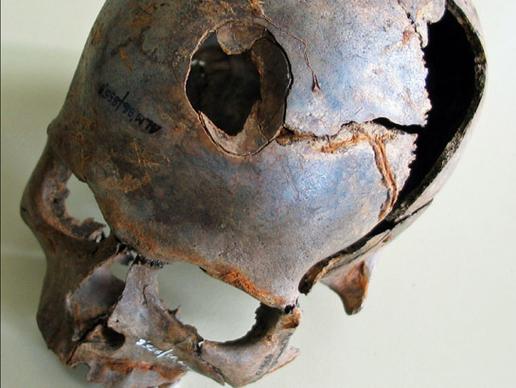
As well as the humerus (upper arm) bone with the embedded flint arrow head, archaeologists have found other proofs that other people have also died in the same area of the violent death. Many bones discovered at the site contain lesions which were produced by blows and many were broken. A scull was found with a bronze arrowhead found firmly embedded into it, penetrating the scull and entering the brain.

Until now 25 socketed bronze arrowheads were detected which occur in
clusters especially where human and horse bones also come to light. In
conclusion there is little doubt that the remarkable number of these bronze projectile points and the bones belong to the same find.

Also several fractured skulls were unearthed which have all the characteristics of the impact trauma suggesting that the fractures were made by a massive blows with blunt weapons.
The archaeologists have found
remains of several wooden clubs, of which some were shaped like baseball
bats and were made of ash wood, and some were shapes like croquet
mallets and were made of sloe (black thorn) wood.


Both types of these
battle sticks are also found in the Irish arsenal of knobsticks. You can
see the mallet shaped Irish knobstick, third from the left. It is also
made from the black thorn wood.

It is now estimated that about 200 people died in this small area of the Tollense valley. And based on the forensic evidence, it is believed that these people were murdered. Originally it was believed that it was possible that these people were ritually killed and sacrificed, but it is now believed that it is much more probable, considering all the weapons found on the site, that all these people were killed in some kind of a battle. A battle which was fought with wooden blunt weapons (clubs), arrows with flint arrowheads and bronze arrowheads, spears with bronze spear tips, axes with bronze axe heads, bronze swords and knives, all of which were found in the area.

All these findings were possible due to the preservation of the former swamp ground and the fact that the Tollense has never really changed its course. Since the population density then was about 5 people per square kilometer, this would have been the most significant battle in bronze period Germany yet to be discovered. And one of the earliest battle sites discovered in Europe to date. Based on the radiocarbon dating this battle took place some time between 1300 bc and 1200 bc, but closer to 1200 bc.
So who fought this battle in which so many people were killed? Well this is still a mystery. The injuries suggest face-to-face combat in a battle. Most archaeologists agree that this battle was fought between two warring tribes. But I have my doubts about this. And this is why.
Most of the bodies appeared to be young men. This would indeed suggest that the people who were killed were indeed warriors belonging to two warring armies. But not all bodies are those of the young men. Many bones belonged to young women. Fair enough they could also have been warriors. The same can be said for middle aged men whose bones were also found at the site. But the bones were also discovered which belonged to old women and young children. These were definitely not warriors. And armies are unlikely to contain among their ranks young children and old women. What if an army of one tribe attacked a settlement of another tribe. There sure could have been some civilians, even old women and children which were caught and killed in the conflict. But no settlement was found anywhere near the battle scene. So what were all these people doing fighting in the middle of nowhere? What were they fighting over? A swamp? A field? If the population density was really that small at the time of the battle, there was plenty of space for everyone, so what were these people fighting over? The place where the battle took place is a very very unlikely place for a battle between the two armies to take place.
Does that mean that I believe that there was no battle? No, I believe that there was a battle, but that this was not a war, but a heist, an armed robbery. I believe that what happened in Tollense valley was an attack of an armed gang on a caravan.
Caravan is a group of people and their transports (Horses, Camels, Mules, ..., Cars, Trucks) which moving together and transfer cargoes. The reason why people would travel in caravans is because they offer protection in numbers. A lone traveler, particularly if he is carrying anything valuable is an easy target for robbers and wild animals. A group of people traveling together is much more difficult to attack particularly if they are armed and or have armed guards traveling with them. The more valuable the cargo carried by the caravan, the more armed guards the caravan would have to insure the security of the cargo. Caravans can be ad hock or regular caravans going along the predetermined route at predetermined intervals. Additional travelers would often attach themselves to caravans for protection. This could make caravans quite large and it they could grow until sometimes hundreds of people would end up traveling together. Caravans have been used for millenniums during which they didn't change much. This is an engraving of a medieval Persian caravan

You can see travelers protected by armed guards, of which some are cavalry armed with spears and probably swords and some are foot soldiers armed with bows and arrows. Travelers are also either traveling on horseback or are walking next to their horses which are carrying saddlebags full of cargo. I believe that this is the exact type of caravan that was attacked by a band of armed robbers in the Tollense valley some time between 1300 bc and 1200 bc.
Do we have any evidence that the Tollense battle was indeed an attack on a caravan? I believe we do. The archaeological reports say that "the evidence was also found among the human remains of a millet diet, which is not typical of Northern Germany at the time, which may indicate the presence of invaders. Bronze pins of a Silesian design which were also found on the site could suggest contact with the Silesian region 400km to the south-east". So the idea is that invaders came from Silesia and attacked locals in Pomerania. I agree that some people involved in the battle at the Tollense valley were from Silesia, but I don't agree that they were invaders. I believe that they were traders, and more specifically metal, tin and bronze traders. It was these Silesian metal traders who were traveling in a caravan protected by the armed guards, which were attacked by a gang of robbers. And these robbers attacked the caravan precisely because it was carrying the most precious metal of the bronze age: tin.
Do we have any proof that the people who fought the battle in the Tollense valley carried with them tin ingots? Yes we do. Among the bones and weapons archaeologists have also found several gold spiral rings and bronze spiral rolls, a small bronze finger-ring, a bronze arm ring and most importantly tin spiral ring ingots.
Gold rings:


These are extremely unlikely things to be found in the equipment of a warrior belonging to an invading army. But they would be exactly the kind of things that you would find in the saddle bags of a metal trader. Archaeologists are extremely excited about these finds. Because preservation of prehistoric tin is very difficult, the raw material remains more or less invisible in the archaeological find record. There are no comparable tin objects available from northern Germany.
In the Bronze Age tin was a raw material of fundamental importance. Bronze is an alloy consisting primarily of copper, commonly with about 12% tin and often with the addition of other metals (such as aluminium, manganese, nickel or zinc) and sometimes non-metals or metalloids such as arsenic, phosphorus or silicon. But the most important element in this mixture is tin. No tin - no bronze, no bronze - no bronze weapons. Copper itself is too soft and mixed with other elements too brittle. But copper mixed with tin will give you the bronze alloy which is just right for making blades. So to make bronze you need copper and tin. Copper is not a problem. There are huge copper deposits all over Europe. But tin is another story. Tin is an extremely rare raw material in Europe. This is why tin was during the Bronze Age more valuable than gold. This is why we don't find more bronze age tin objects. All the tin was used to make bronze. The most important prehistoric sources of tin were Brittany in western France, Cornwall in south western England and the northwestern part of the Iberian Peninsula. And Erzgebirge (Ore Mountain) area in eastern Germany. And guess what is just next to the Ore Mountains, the most important continental European source of Tin and Copper? Silesia.
This is the position of the Ore Mountains in South of Germany. You will see that they are located right next to Silesia.

Not only that but the Ore Mountains were rich in ore necessary for making bronze, but the surrounding mountain area was covered in ancient forests which provided endless easily obtainable fuel for smelting the metal, while the river valleys just south, north and east of the mountains were ideal for growing cereals. Everything a metallurgical culture needed to develop was there concentrated in this one small area. No wonder that just after the 2500 BC in this area we see emergence of the Unetice culture. The Unetice culture is the most important archaeological culture of the Central European Bronze Age, dated roughly to about 2300–1600 BC. The eponymous site for this culture, village Únětice, is located in Central Czech Republic, northwest of Prague, just under the Ore Mountains in the fertile cereal growing country. The culture quickly spread to all the areas surrounding the Ore mountains. Today this archaeological culture is known from Czech Republic and Slovakia from approximately 1400 sites, from Poland (550 sites, Silesia) and Germany (approximately 500 sites and loose finds locations). The Unetice culture is also known from north-eastern Austria (in association with the so-called the Böheimkirchen Group), and from western Ukraine. This is the map of Unetice culture sites and their relationship with the Ore Mountains and Silesia.

Here is another map of the distribution of the Unetice culture from Eupedia website which might give even better idea how central the Ore Mountains were for the development of this culture:


And here is a bronze bracelet from Unetice culture which looks exactly like the Tollense tin spiral rings:

The Únětice culture had trade links with the British Isles. A gold lunula of Irish design has been found as far south as Butzbach in Hessen (Germany). Amber was traded as well. But the most important trade item I believe was tin, copper and bronze. The tin from the Ore Mountains was traded north to the Baltic Sea and south to the Mediterranean following the Amber trading route.
Amber trading route was an ancient travel and trade rout which connected Balkan and Baltic from at least early Neolithic. It mostly fallowed the river valleys radiating north and south from the area between the Ore Mountains and Silesia. This area is very peculiar. It is a watershed. Just above it we have three major rivers, Laba (Elbe), Oder and Visla (Vistula) flowing into the Baltic and North sea. Just below it we have river Danube which flows into the Black sea and whose tributaries start at the watersheds with Adriatic and Aegean sea (Sava, Morava, Drina) and from which we can follow Neretva river into Adriatic sea and Vardar river into the Aegean sea.

Please note that on the above map the territories of Unetice culture and Lusatian culture are very similar. This is not a coincidence. They both cover the same area defined by the three major Baltic rivers Laba (Elbe), Oder and Visla (Vistula). This shows that both cultures were oriented towards the South Baltic and the North sea as their main Maritime trade gate. The control over these three rivers was crucial to ensure the movement of goods and people from the area around the Ore Mountains and the South Baltic and North sea coast.

So this trade route connected Balkan and Baltic. And it didn't stop at the coast of Balkans either. It continued from north Italy to Corsica and Sardinia, and from the Balkans across the Dardanelles to Asia Minor and then to Middle East and Egypt. But this trade route did not stop at the coast of the South Baltic and North Sea. From there it continued over the sea to Britain and Ireland and further down to Brittany and Iberia.
And bang in the middle of this most important European trade route we find a rich copper, tin and wood deposits right next to the fertile agricultural land. It is then no wonder that in the 3rd millennium BC this area underwent technological, economic, political and population boom and the emergence of the Metallurgical Unetice culture.
The new study of the Únětice Culture done by Dalia Pokutta aimed to produce a ‘bioarchaeological portrait’ of the Únětice culture in Poland (Silesia). The study presents the subject from a palaeodemographic perspective based on the results of isotopic analysis of human remains dating back to the Early Bronze Age (2200-1600 B.C).
‘It is the biggest isotopic project undertaken in Poland so far. Hundreds of samples were analysed, not only human bones, but also animals. Total of fifty human remains were analysed. The author focused on the Early Bronze Age lifestyle, medical knowledge and diseases, occupations and professions, as well as chosen subgroups of the Silesian prehistoric society, such as the tribal aristocracy, children and elders. The study provides information regarding diet and subsistence, transportation, human migrations and territorial mobility as well as the impact of these factors upon Úněticean society, expansion of metallurgy and commerce, forms of rulership and collective identity.
One of the leading conclusions is a very high level of territorial mobility of the prehistoric population in Silesia, with presence of immigrants from Germany, Czechia, Hungary and Sweden. This confirms that the area around the Ore mountains, became due to its economic prosperity, a magnet for traders, soldiers and all sorts of other people from along the Amber trading route.
This movement of people along the Amber trading route only intensified in the following millenniums during the Bronze Age. Unetice Culture was replaced by the Tumulus Culture and then by the Urnfield Culture. When the Tollense battle happened, the whole area above Silesia and between the rivers Laba (Elbe) and Visla (Vistula), Including the Tollense valley, was part of the Lusatian culture (pink on the map), which is regarded as part of the Urnfield culture.

The Lusatian culture
existed in the later Bronze Age and early Iron Age (1300 BCE – 500 BCE)
in most of today's Poland, parts of the Czech Republic and Slovakia,
parts of eastern Germany and parts of Ukraine.
The Lusatian culture was heavily influenced by the west-alpine and Hallstatt cultures.
Metalwork technologies were imported from the South via the Laba (Elbe), Oder and Visla (Vistula) river. From where? From the area of the Ore Mountains and Silesia. Numerous archaeological findings of imported Scandinavian products prove contacts to Nordic Bronze Age peoples. So we can see that the Amber trading route is still operational.
And here is something that beggars belief:
The archaeologists agree he spiral rings like those from Tollense valley have general parallels in younger context (Unetice) and this long-lived type of objects supports the idea that they may have functioned as ingots. The archaeologists believe that the Tollense valley tin rings provide evidence for the trade and transport of tin in small standardised units suitable for ad hock small scale use. So the archaeologists agree that these are trade ingots. But guess what? Archaeologists "don't know where these tin ingots came from" !?
They know that at least some people involved in the Tollense battle came from south of Germany, more precisely from Silesia. They know that Silesia has been for at least 1000 years an important metallurgical center. They know that Silesia is located next to the biggest tin mine in continental Europe. They know that the Tollense river valley is located between Laba (Elbe) and Oder rivers, bang on the Amber trading route, which was used for transporting tin and bronze from the area of the Ore mountains to the South Baltic coast for at least one thousand years. And the archaeologists still don't know where did the tin come from?
What do you think is the most probable source of tin ingot torcs found on the Tollense valley battlefield? And do you still believe that this was a battle between the invading Silesians and the locals?
This is what I think happened in Tollense valley. A caravan transporting large quantities of tin and other metals was moving from Laba (Elbe) valley, probably from a harbor or a large settlement. The metal came from Silesia, the area around Ore mountain. The caravan had many people, traders and other travelers and many pack animals. It moved along Tollense river, then along Peene river towards Oder river, probably towards another harbor or a settlement. Of it could have been moving in the opposite direction. The caravan was protected by armed guard which consisted of both horsemen and infantrymen. These soldiers were either traveling with the caravan from Silesia or were assigned to the caravan at a port somewhere in Laba (Elbe) valley. This was a normal practice since the first caravans started crisscrossing the world. One of the most important duties of any country was always to protect its roads and in this way allow free movement of people and goods. These guards were armed with bronze weapons: arrows with bronze arrowheads, bronze spears, axes, swords, daggers...In Silesia bronze was common and cheep so it is to be expected that the Silesians were armed with bronze weapons. The caravan was attacked by a gang or even a small marroding army which probably came from the north west, probably from the Jutland peninsula or even further north or from across Laba (Elbe) river. These people were armed with more primitive weapons, arrows with flint arrowheads, wooden spears and wooden clubs. Denmark and Sweden have huge flint deposits so it is quite possible that the attackers came from there. The attackers, who probably outnumbered the people in the caravan, waited hidden for the caravan to appear and launched a surprised attack from the forest which surrounded the river. They first pelted the caravan with arrows, targeting the mounted soldiers first. This is why we have dead people mixed with dead horses. Remember the clustered bronze arrowheads mixed with human and horse bones? Were they the arrows which the horsemen never got to take out of their quivers? I believe that the arrows with the bronze arrowheads were fired by mounted archers. The proof for that is the bronze arrowhead which was found embedded in a scull. This arrowhead could only have been fired from a position above the head, which would indicate that the archer was on a horseback. Also the flint arrowhead which was found embedded in a humerus (upper arm) bone is embedded under such angle that the shot must have come from below, meaning that the arrow was fired by a foot soldier shooting a mounted warrior. Anyway what happened then was the attackers sprayed all the other people from the caravan with arrows. The arrows were fired from the other side too. Then the frontal assault ensued which resulted in hand to hand battle. Who won? That is difficult to say. It is most probable that the attackers won. The number of dead would suggest that this is what happened. The attackers killed all the people from the caravan, collected all the metal, metal armor and weapons and other valuables and remaining pack animals and returned back to wherever they came from. Whatever was left on the scene is whatever they missed. They left all the dead Silesians where they fell. They maybe even left their own dead at the scene if their losses were great, or they could have carried their dead with them or burned them and carried the ashes or buried the ashes somewhere in the area.
And this is it. This is my interpretation of what happened in Tollense valley. It is based on archaeological data currently available from the site. This can of course all change in the future with new discoveries and my story could become just a failed speculation. But for now I believe that this is much better interpretation of the events than the official one. What do you think?
5 years later, 28th of October 2020...
They know that at least some people involved in the Tollense battle came from south of Germany, more precisely from Silesia. They know that Silesia has been for at least 1000 years an important metallurgical center. They know that Silesia is located next to the biggest tin mine in continental Europe. They know that the Tollense river valley is located between Laba (Elbe) and Oder rivers, bang on the Amber trading route, which was used for transporting tin and bronze from the area of the Ore mountains to the South Baltic coast for at least one thousand years. And the archaeologists still don't know where did the tin come from?
What do you think is the most probable source of tin ingot torcs found on the Tollense valley battlefield? And do you still believe that this was a battle between the invading Silesians and the locals?
This is what I think happened in Tollense valley. A caravan transporting large quantities of tin and other metals was moving from Laba (Elbe) valley, probably from a harbor or a large settlement. The metal came from Silesia, the area around Ore mountain. The caravan had many people, traders and other travelers and many pack animals. It moved along Tollense river, then along Peene river towards Oder river, probably towards another harbor or a settlement. Of it could have been moving in the opposite direction. The caravan was protected by armed guard which consisted of both horsemen and infantrymen. These soldiers were either traveling with the caravan from Silesia or were assigned to the caravan at a port somewhere in Laba (Elbe) valley. This was a normal practice since the first caravans started crisscrossing the world. One of the most important duties of any country was always to protect its roads and in this way allow free movement of people and goods. These guards were armed with bronze weapons: arrows with bronze arrowheads, bronze spears, axes, swords, daggers...In Silesia bronze was common and cheep so it is to be expected that the Silesians were armed with bronze weapons. The caravan was attacked by a gang or even a small marroding army which probably came from the north west, probably from the Jutland peninsula or even further north or from across Laba (Elbe) river. These people were armed with more primitive weapons, arrows with flint arrowheads, wooden spears and wooden clubs. Denmark and Sweden have huge flint deposits so it is quite possible that the attackers came from there. The attackers, who probably outnumbered the people in the caravan, waited hidden for the caravan to appear and launched a surprised attack from the forest which surrounded the river. They first pelted the caravan with arrows, targeting the mounted soldiers first. This is why we have dead people mixed with dead horses. Remember the clustered bronze arrowheads mixed with human and horse bones? Were they the arrows which the horsemen never got to take out of their quivers? I believe that the arrows with the bronze arrowheads were fired by mounted archers. The proof for that is the bronze arrowhead which was found embedded in a scull. This arrowhead could only have been fired from a position above the head, which would indicate that the archer was on a horseback. Also the flint arrowhead which was found embedded in a humerus (upper arm) bone is embedded under such angle that the shot must have come from below, meaning that the arrow was fired by a foot soldier shooting a mounted warrior. Anyway what happened then was the attackers sprayed all the other people from the caravan with arrows. The arrows were fired from the other side too. Then the frontal assault ensued which resulted in hand to hand battle. Who won? That is difficult to say. It is most probable that the attackers won. The number of dead would suggest that this is what happened. The attackers killed all the people from the caravan, collected all the metal, metal armor and weapons and other valuables and remaining pack animals and returned back to wherever they came from. Whatever was left on the scene is whatever they missed. They left all the dead Silesians where they fell. They maybe even left their own dead at the scene if their losses were great, or they could have carried their dead with them or burned them and carried the ashes or buried the ashes somewhere in the area.
And this is it. This is my interpretation of what happened in Tollense valley. It is based on archaeological data currently available from the site. This can of course all change in the future with new discoveries and my story could become just a failed speculation. But for now I believe that this is much better interpretation of the events than the official one. What do you think?
5 years later, 28th of October 2020...


