Showing posts with label Thunder stones. Show all posts

Sunday, 26 July 2026

Goibniu

This map shows surnames in different languages which mean "smith". 

Look at Ireland (Mac Gabhain) and Scotland (Mc Gowan)...

Both the Irish and Scotish surnames mean son of a smith (Gaelic gobha, gabha, pronounced gova which comes from Old Irish gobae, gobann meaning smith, cognate with Middle Welsh gof, Middle Breton goff, Old Cornish gof, Gaulish gobedbi, "Of disputed PIE origin possibly only found in Celtic languages and coming from Proto-Celtic stem *goben-, meaning smith"...

Hmmm...

Now look at all the Slavic countries...

Slavic languages have a whole cluster of words based on the root "kov" meaning metal:

        kov(ina) - metal/iron

        kovati - to forge, to strike hot metal to perform metal work

        nakovanj - anvil, that on which forging is done

        kovačnica, kovnica - forge

        kovanica - something forcefully stack together like being forged

        kovač - smith

From Proto-Slavic "kovati", from Proto-Balto-Slavic "*kauˀ-", from Proto-Indo-European "*kowh₂-", from the root "*kewh₂-" meaning to strike, to hit... 

But for some weird reason, Celtic words for smith can in no way be cognates with Slavic words for metal and smith...God forbid...

Now, in Celtic lands we find several gods, Irish deity Goibniu, Welsh deity Govannon, Gaulish deity Gobannos, whose names have a hypothetical Proto-Celtic root "*goben-", smith...

I will here like to talk about the Irish smithy, Goibniu (pronounced gov-nu), cause he will also help you understand what I am going to say about Lugh...

In Irish mythology Goibniu was the smith of the Tuatha Dé Danann. He is believed to have been a smithing god and was also associated with feasting.

According to Lebor Gabála Érenn, his father was Tuirenn...Who is basically, Taranis, The Celtic Sky/Thunder god in disguise. 

At the same time, in Irish mythology and folklore, his father was also named "Esarg" and "Tuirbe Trágmar".

"Esarg", meaning "striker", is derived Old Irish root esorcon, meaning "smiting," "striking," "beating," or "a blow dealt to a foe in battle". 

So far so normal and expected. Sky/Thunder gods were after all "Mighty Smiters"...

"Tuirbe Trágmar" which means "the axe-thrower" is a character which appears in Irish mythological texts as a warrior ancestor or father of Goibniu. 

In the Metrical Dindshenchas (Lore of Places) he is described as a "man of skill" and the father of Gobbán Saor "a highly skilled smith or architect". The text describes his feat of hurling his magical battle-axe from Tulach Bela (the Hill of the Axe) into the face of the incoming flood-tide to order the sea to stop rising. 

In the Lebor Gabála Érenn (The Book of the Taking of Ireland) Tuirbe Trágmar appears as an alternate name or epithet for Esarg (Striker, The thrower of axes), listing him directly as the father of Goibniu the smith-god. 

In the Oidheadh Chloinne Tuireann (The Tragedy of the Sons of Tuireann) he is mentioned as Tuirenn Tuirbe Trágmar, (Taranis, The thrower of axes) and is identified as the father of the divine smiths.

Tuirenn, Striker, Thrower of Axes, the father of the Smith God...

Remember the PIE root "*kewh₂-" means to strike, to hit. Striking, hitting is an integral part of axe making process since the Palaeolithic. 

Stone axes are made by striking a large flint nodule in such a way that small chips of stone are gradually removed until a sharp axe shaped blade is produced. 

Bronze axes are first cast, then the edge is cold hammered to harden it and then it is wet sand polished to sharpen it. 

Iron axes are first wrought (hot melted bloom, mix of ore and charcoal, folded, hammered, folded, hammered...) and then forged (reheated wrought iron hammered) to desired shape, then the edge is wet stone polished to sharpen it.

So striking = making axes...

That's "Maker of Axes"...This doesn't explain why  Goibniu's father was called "Thrower of Axes"???

Striking, hitting is also what sky gods did a lot. With thunderbolts. Which were imagined by people all over the place as stones...

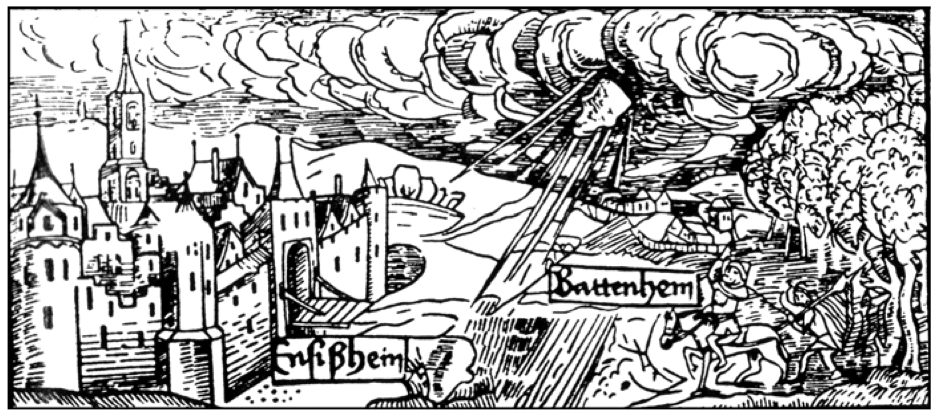
A 15th-century engraving depicts the town of Ensisheim in present-day France being struck by a thunderbolt (stone)...I talked about this in my post "Jack and magic beans", about giants who lived on a stone sky and who hurled giants rocks down on earth...The original sky (stone) thunder gods...

What is also interesting is that people thought that these thunder stones were actually (shaped like) stone axes...This belief existed in Europe until well into the Middle Ages...Which is why ancient stone axes were believed to be petrified lightnings and were kept as talismans as a protection against lightning strikes...

I talked about this in my posts "Thunder axe" and "Kataibates"...

Which is why a lot of thunder gods wielded axes...Like Hadad...Whose name has no known etymology, possibly from Northwest Semitic root hdd meaning "to thunder," "to crash," "to make a loud noise"...

Now look at the smith surname map again. In Semitic languages we have word for smith "haddad", which apparently comes from the Proto-Semitic root *ḥdd = "to be sharp, pointed" 

So we have:

Hadad → the divine striker (lightnings, thunderbolts which were imagined as being made of stone)

ḥaddād → the one who makes sharp edges by striking metal

But apparently, linguists currently keep ḥdd ("sharp") and the proposed root of Hadad separate because they begin with different Proto-Semitic consonants (ḥ vs. h).

As I already said, in Stone, Bronze and Iron Age, striking was the universal method by which cutting tools were produced or improved, whether in stone, bronze, or iron. That makes "striker" and "maker of sharp edges" naturally adjacent concepts in many ancient cultures, even if they are not always etymologically identical.

As I said already, stone axes are made by striking a large flint nodule in such a way that small chips of stone are gradually removed until a sharp axe shaped blade is produced. 

Now if, while making a stone axe, you strike, hit a flint nodule with a pyrite nodule, cause you just happened to have picked this particular shiny stone to use as knapping stone, you will generate a spark, a mini lightning, strong enough to light combustable dry material and start fire...


Here is a video showing how this is done

In several of my posts I asked the question: How old is the connection between stone axes and thunder gods?

In my 2019 post "Sun stones", about ceremonies with exploding flint axes performed in Late Neolithic Vasagård site located on the southern side of the island of Bornholm, Denmark, I suggested that this link between a stone, more specifically flint axes, and thunder gods, already existed in the 4th millennium BC Europe...

In my post "Oldest symbolic monument" which I wrote last year, I suggested that the link between flint axes and lightning could be 40,000 to 160,000 old. At least based on "the oldest symbolic monument, that is to say, one with no obvious practical use and probably responding to a belief", which, according to this article is this pile of stones piled up next to a spring at El Guettar (Southern Tunisia) which has flint nodules placed on top of a pile of other round stones...

Round stones (like sling stones), falling (being thrown) from the sky...Where did I hear about this before? All over the place actually. I talked about this in my post "Cetus",  "Mithras", "Rudra"...

In Ireland, that was the speciality of Lugh...

But the latest archaeological discovery indicates that it is possible that this link already existed 400,000 years ago. According to this paper Neandertals struck chunks of iron pyrite against flint to light campfires - the oldest evidence of humans intentionally making fire. And the flint pieces found were actually flint axes...


Did Neanderthals link stone axes with lightning? Anyway...

Remember this:

A blacksmith has to strike his anvil with his hammer on every Christmas morning before sunrise. If he doesn't do it, his hammer and anvil should be broken and he and his family should be expelled from the tribe (medieval Vasojevići tribe law cannon, Montenegro)...

Striking anvil with hammer produces sparks and sparks create fire. And Christmas Day is the day when the fire of the sun gets rekindled (the old winter solstice, the rebirth of the sun and solar year)...

This is what Yule log rituals are all about...

A toast to yule log, Dalmatia, 1893. South Slavs believed that yule log was the earthly seat of god,  addressed it with utmost respect and made sacrifices to it, during cutting, bringing in, burning...

I talked about this in my posts "Badnjak", about Yule log customs in the Balkans, "La buche de Noel", about Yule log customs in France and "Yule log in English tradition", about Yule log customs in England. 

BTW, you need an axe to cut a Yule log...

Everything indicates that the Yule log ceremonies are solar ceremonies. But why was Oak, the holy tree of Perun, The Thunder God, used as Badnyak (Yule Log)? 

To understand the link between the heart fire, yule log, thunder god and the sun, you need to check this out:

"It is a great secret how Svarog (heavenly and earthly fire) is at the same time Perun (thunder) and Svetovid (Sun)"...

Mathis (Matthias) Gerung, The Mighty Angel with the Little Book (Revelation 10), illuminated miniature on parchment in the Ottheinrich Bible, vol. 8, fol. 293r, c. 1530–1532 AD. Collection: Bayerische Staatsbibliothek, Munich...

Apparently, no one knows what this image really represents. I think it represents this:

Modern science has confirmed that it is indeed (heavenly) fire of the Sun which through Lightning descends to earth and becomes (earthly) Fire. I talked about this in my post "Sun Thunder Fire"...

So this is why the Yule Log is an Oak Log.

An Oak Yule Log (The Holy Tree of the Thunder Gods) is placed in the house hearth, the seat of the Earthly Fire on Christmas (Winter Solstice) eve to (symbolically) link it to the Sun's Fire...As long the Yule Log is burning, these two fires are (symbolically) connected and on Christmas (Winter Solstice) morning, the earth fire will (symbolically) ascend from the hearth to the sun and will restart the sun's fire...

BTW, this is how Ancient Greeks symbolically depicted the same thing:

"Hestia, you who tend the holy house of the lord Apollo...come now into this house...having one mind with Zeus the all-wise..." (Homeric Hymn To Hestia)...  

What does this mean? Sun (Apollo, Helios) creates Fire (Hestia) through lightning (Zeus)...

I talked about this in my post "Having one mind with Zeus"...

Back to sparks:

In Serbia, one of the most important part of the Yule log ceremony was the sparks divination performed by the first footer, the luck bringer...I talked about this in my post "First Footer"...

The First Footer repeatedly "strikes" the fire to produce sparks. After each strike, he exclaims:

As many sparks, as much luck!
As many sparks, as much love!
As many sparks, as much health!
As many sparks, as much money!

This "creation of sparks by striking burning Oak (the sacred tree of the thunder gods) Yule log" seems to me to be symbolic enactment of the creation of lightning by the thunder god...

Smith "creating sparks by striking hot iron with a hammer" seems to me to have the same symbolic meaning and directly links smiths with thunder gods...

Which is why, I suppose, Thor wields a hammer...Like here on the 11th century Altuna Runestone...


But is Thor holding a hammer or a double axe?

You might find my post "Axe or hammer" interesting. It explors the origin of Thor's hammer (axe?) Mjǫllnir and its relation with Perun's axe: 

Anyway, this is all important to know if you want to understand the following:

So the father of the Irish smith god Goibniu was the sky god, Tuirenn, the Thrower of Axes (thunderbolts)...

Guess whose father was Goibniu? Lugh's...

According to an Irish legend, Balor hears a prophecy that he would be killed by his grandson. 

To avoid his fate, he locks his only daughter, Ethnea (Eithne), in a tower to keep her from becoming pregnant. 

Balor goes to the mainland and steals the magical cow of abundance Glas Gaibhnenn belonging to Cian. 

Cian learns he can only get the cow back when Balor is dead, so he manages to secretly enter the tower, finds Ethnea and impregnates her. 

When she gives birth to three sons, Balor orders the three to be drowned, but one survives without Balor's knowledge. 

The kid, Lugh, is fostered by a smith who is also Lugh's uncle. 

Balor eventually encounters his grandson by chance and is killed by him.

That magical cow of abundance Glas Gaibhnenn, was in other Irish legends said to have belonged to one of several figures variously named Gavida, Gavigan, Gaibhlen, identified as smiths, and believed to be Goibniu in disguise and who were in some way involved in the conception of Lugh.

BTW, the name of the magic cow Glas Gaibhnenn means "grey cow of the smith (god)", basically a rain cloud of the sky god...


Heavenly cows (rain clouds) are a common mythological image found all over Eurasia. 

In Indian mythology we find story about Indra's cows (rain clouds) being stolen by Panis demons who also steal sunlight (it is the sun that creates the wet summer monsoon) and hidden "inside the mountain" (Himalayas create up-drift which pulls the moist air from the sea). 

I talked about the Indian monsoon mechanism in these posts: "Vayu", "Maruts", "Mahishasuramardini"...

The cows are found by Indra's hound (the wet summer monsoon peaks during the Dog Days, Jul/Aug)...

Why are dog days in Jul/Aug?

When our mythologies were made out of animal calendar markers, Sirius, the Dog Star rose with the sun in Jul/Aug, when mating season of the old dog breeds began...

We find this embedded into myths in:

Egypt: Article about "Dog days"...

Mesopotamia: Article about "Tishtrya"...

India: Article about "The bitch of the gods"...

Anyway...

In Slavic mythology we find Perun (thunder) who every year fights Veles (dragon, burning sun) who steals heavenly cows (rain clouds) from Perun...And every year Perun triumphs over Veles and rescues his heavenly cows... 

In Ireland we find Balor (dragon, burning sun) who steals "grey cow of the smith (god)", from a smith or someone related to a smith (god) so the smith (god) impregnates Balor's daughter, whose son, Balor's grandson, eventually kills Balor by striking his burning eye with a shiny (sling) stone, after which the cow of abundance is returned to the smith (god)...And this also happens in...Jul/Aug...Which is the peak thunderstorm season in Ireland... 

Soo....

What do you think, cool?

Monday, 2 March 2026

Thunder axe

Few days ago @CotswoldArch posted this on X:

Imagine digging Iron Age and Roman pits in central Bedfordshire, and coming across 𝘵𝘩𝘪𝘴 Neolithic beauty? 🤯

This polished Late Neolithic axehead is made of a volcanic rock called gabbro. These axeheads were widely exchanged around the British Isles, and sometimes even across the Irish Sea into Ireland, but that doesn't explain how it ended up in a pit some 2000 years after its creation!

Older artefacts found in newer archaeological features are often termed as 'residual' – redeposited from earlier activity – yet our pit appeared undisturbed. We want to think it was intentionally kept – possibly a prehistoric "curiosity", treasured by the people living centuries later...

I don't think this stone axe was kept as "curiosity". I think it was kept as a protective talisman known as "thunder axe"...

Check this out:

Prehistoric axe head, engraved during the medieval time (9th–early 13th century.) with the image of Christ and St Elijah (Byzantine, Balkan???). Currently kept in Met museum...

Balkan Slavs believed that these stone axes fell from the sky when lightning struck the ground and were attributed to Perun. They were known as thunderstones...Hence Perun's axe...I talked about this in my post "Axe or hammer"...

St Elijah was in Balkan Slavic countries known as St Elijah the Thunderer...So a thunder god replaced with a thunder saint...

I talked about Elijah in my post "Thundering sun god"...

Here is also a very interesting article about Elijah and Teshub, which proposes that Elijah was just a thinly disguised Sky (Thunder) god...

So that explains St Elijah being depicted on the Thunder Axe...

Interestingly, Zeus's thunderbolt was imagined to be a stone or a stone axe. Hence the belief that stone axes had protective powers which is why they were used as magical amulets. 

I talked about (stone) axe as a symbol of Zeus/Jupiter and thunder (gods) in general in my post "Kataibates"...

I also talked about why storm gods from different cultures carry (stone) axes in my post "Mamaragan"...

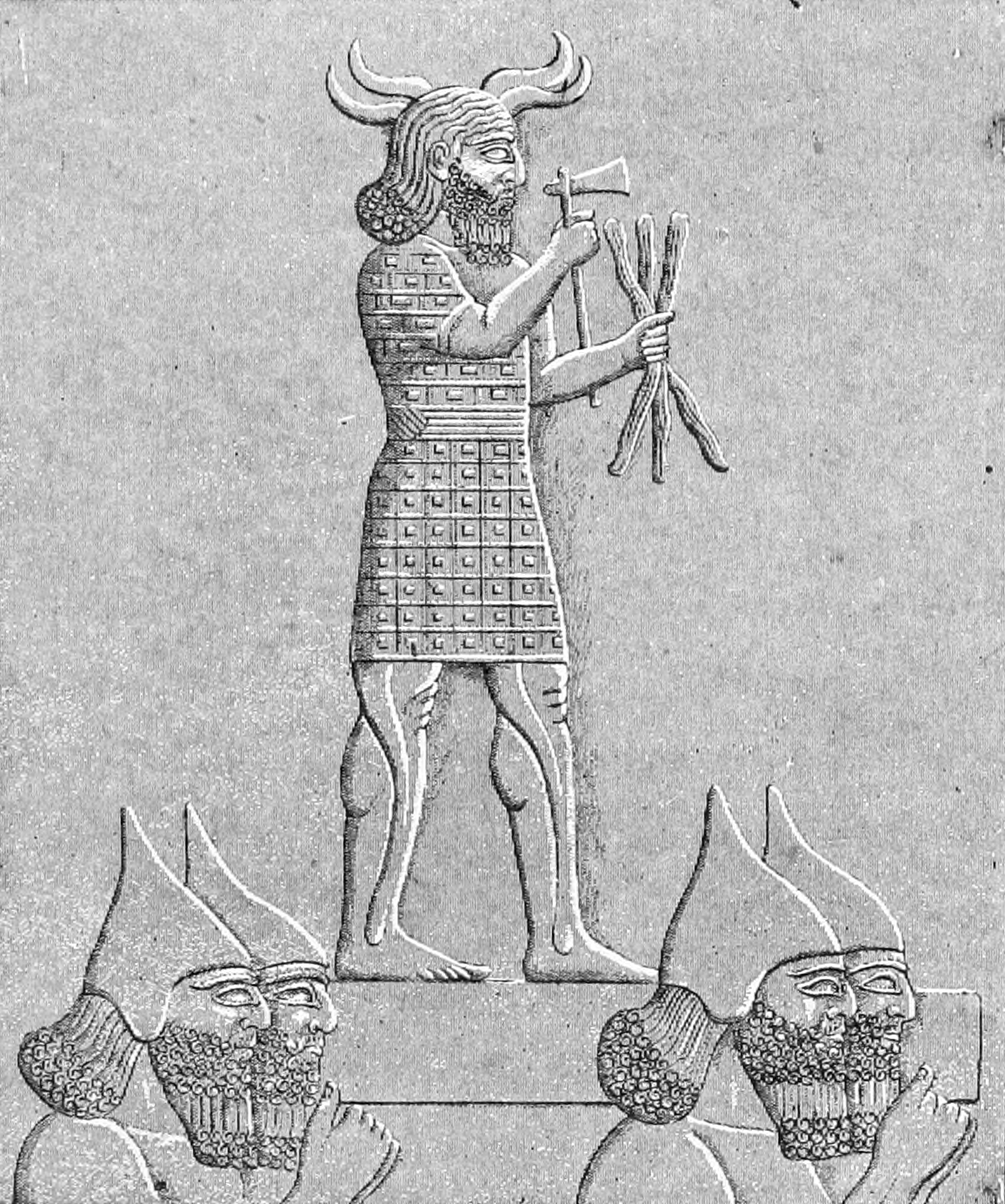
Adad, Mesopotamian storm god, holding an axe and lightning bolt...


Teshub, Hittite thunder god, also wielded a (thunder) axe. While standing on a bull...About to kill a snake/dragon...I talked about this relief in my post "Teshub killing snake"...

How old is this association between storm (thunder) gods an (stone) axes? 

I suggested that this link between a stone, more specifically flint axes, and thunder gods, already existed in the 4th millennium BC Europe...I explained why I thought so in my post "Sun stones" about exploding flint axes rituals fron Neolithic Denmark...

Knowing all this, it is no wonder that people believed that thunderbolts were made of stone well into middle ages...A 15th-century engraving depicts the town of Ensisheim in present-day France being struck by a thunderbolt (stone)...I talked about this in my post "Jack and magic beans", about giants who lived on a stone sky and who hurled giants rocks down on earth...The original sky (stone) thunder gods...

One of these "thunderbolts" was found and secured in a church to ensure it wouldn’t escape back into the sky...


Tuesday, 29 July 2025

Mamaragan

Adad, Mesopotamian storm god, holding an axe and lightning bolt...How old is this association between storm (thunder) gods an (stone) axes? How about at least 40,000 years?

I tried to explain the association between thunder gods and (stone) axes in my post "Jack and the magic beans"..

In which I proposed that some of our myths about sky gods are in fact very very old scientific theories which tried to explain the available observed phenomena in the best possible way with the knowledge of the universe people possessed at that time...Like if giant stones are falling from the sky, there must be a giant (sky god) throwing them from up there on our heads...

These stones that fall from the sky then became "thunder bolts" and "thunder stones" and "petrified lightnings". 

At the end of my post "Kataibates", about stone thunder axes from European folklore tradition, I asked how old this tradition could be...

I suggested that this link between a stone, more specifically flint axes, and thunder gods, already existed in the 4th millennium BC Europe...I explained why I thought so in my post "Sun stones" in which I talked about exploding flint axes...

But then I saw this picture of Namarrkon/Mamaragan, the storm "god" from Aboriginal mythology from Western Arnhem Land in northern territories. He lives high in the sky, rides storm clouds and makes thunders by striking the clouds with stone axes fixed to his head, elbows, and knees...

He also "soaks up the sun's rays and turns them into lightning"...In monsoon regions of the world, the end of the dry season is marked by spectacular electric storms which announce the arrival of the rains...

Also in Northern Australia, the hottest time of the year is also the rainiest time of the year...

So sun's heat is obviously and literally turned into lightning...

BTW, remember this?

"Because it is a great secret how come Svarog (hevenly and earthly fire) is at the same time Perun (thunder and lightning) and Svetovid (Sun)." Modern science explains the link between solar energy, lightning and fire...I talked about this in my post "Sun thunder fire"...

Now, Aboriginals arrived to Australia about 40,000 years ago...Which could mean that the link between thunder gods and stone axes, is more than 40,000 years old??? If we assume common root of the myth...

I already wrote about the age of (some) Aboriginal myths in my post "Dream time" and "Yeti revisited". Some Australian Aboriginal "dreamtime" stories, passed orally from generation to generation, could, according to latest scientific data, actually be over 40,000 years old...

Or, maybe, again, everyone ended up with the same explanation for the same observed phenomena...

Sunday, 4 July 2021

Kataibates

Zeus, the god of lightning, had a nickname "Kataibates" (he who descends). This basically equated Zeus with Thunder/Lightning...

Pic: Antikenabteilung, Staatliche Museen zu Berlin—Preussischer Kulturbesitz

Remember this article about what came first: Thunder/Lightning or Thunder God? Thunder gods of course...

The piece of ground hit by lightning cannot be walked on, is consecrated to Zeus and is marked by a monument or an altar. These altars were then used to make offerings to Zeus in exchange for protection from lightning...

Same altars dedicated to Zeus Kataibates were also built in front of houses, and there too offerings were made in order to protect the house from lightning. This custom seems to have been fairly common in Greece. 

You can read more about this in "Greek Popular Religion" by Martin P. Nilsson...

Interestingly, Zeus's thunderbolt was imagined to be a stone or a stone axe. Like this one. 


Which is interesting considering that Zeus didn't wield an axe...Well that's not exactly true. Late Roman god Jupiter Dolichenus, whose mystery cult was widespread in the Roman Empire from the early-2nd to mid-3rd centuries AD, wielded an axe. And rode on a bull... Here is an altar from Vindolanda dedicated to Jupiter Dolichenus...


It is believed that he came from the east...And in the east, in Anatolia, we find Hittite thunder god(s) wielding an axe...

Pic: www.mesopotamiangods.com

And even further east we find Adad, Mesopotamian storm god, who also loved axes...


Pic: History of Egypt, Chaldea, Syria, Babylonia and Assyria, Vol. III

How far East and how far back in time should we go?

Stone axes or adzes, originally shaped and polished in Neolithic times, sometimes turn up in later archaeological sites or graves from the Bronze Age down to the medieval period...

Because they were apparently thought to have some kind of magical power to protect buildings and people, especially from lightning and violent storms...

We know something about these beliefs thanks to a string of testimonia in technical treatises on stones, beginning with a third-century BCE Greek author named Sotacus and ending with a twelfth-century bishop of Rennes. And thanks to European folklore...

It is important to understand that there is no evidence that the Greeks or Romans realized that these axe-heads were manufactured by previous stone-age cultures. They were believed to be “natural” stones which, like amber, jet or coral, had special protective powers...

Sotacus, the Hellenistic author of a lost treatise on stones maintained (according to Pliny’s abridged account) that "cerauniae are similar to axes" except they are not axes but magic thunderstones...

Latin lapidary (natural history) attributed to Damigeron-Evax, devotes an entire chapter (12) to the "lapis ceraunius" (thunderstone), which is found in places where lightning has struck...

Timotheos of Gaza, a 5th c. CE author tells us that "you will have an amulet against a thunderblast (keraunon), if you inscribe a thunderstone (lithon keraunion) with the letters αφια αφρυξ and keep it in your house"

In his Etymologies Isidore, the early 7th c. CE bishop of Seville, also notes that "ceraunia" (thunderstones), were found in places struck by lightening and could avert lightening...

In the 12th c. AD, Marbodaeus, the bishop of Rennes, preserves a similar account in his own Liber lapidum.

And in the 11th century the Byzantine emperor sent to the Holy Roman emperor a "heaven axe" as a present...

Ethnographers and folklorists have also established the existence of similar long-standing and widespread beliefs throughout Europe.

For instance, in modern Greece, astropelékia ("lightening axes") are sought out at places where "lightning has fallen" and are kept in houses to ward off lightning and fire...

Perun, Slavic thunder god, also wielded an axe...According to Slavic folk beliefs, prehistoric stone axes found in the ground were remains of these weapons...

Thor wielded a hammer...And we know that in Scandinavia thunderstones were frequently worshiped as family totems which kept off spells and witchcraft...

Both Slavs and Scandinavians wore axe (hammer) amulets...

Thor's hammer amulet

Pic: Sveriges hednatid, samt medeltid, förra skedet, från år 1060 till år 1350

Perun's axe amulet

Pic: Древнерусские амулеты-топорики

I always thought that Thor's hammer looked like a stylized axe

That Thor's "hammer" was originally an axe, can be seen from this next artifact. A museum in Utrecht has a relic called "the hammer of St. Martin of Tours". 

Pic: Museum Catharijneconvent

The "hammer" was made in the 13th or 14th c. from a Bronze Age stone axe dated to 1,000 - 700 BC...

What does this have to do with Thunder gods? Well, St Martin is another "saint" who is nothing more than the thunder god in disguise. I talked about this in my post The "The axe of Martin"...

Another indication that Thor's hammer was originally an axe, can be seen from the etymology of the the Thor's axe name: Mjǫllnir. The etymology of the hammer's name is disputed among historical linguists.

Here are proposed etymologies. You tell me which one is most plausible:

1. Old Norse Mjǫllnir developed from Proto-Norse *melluniaR and one proposed derivation connects this form to Old Church Slavonic mlunuji and Russian molnija meaning 'lightning' (either borrowed from a Slavic source or both stemming from a common source) and subsequently yielding the meaning 'lightning-maker'. 

2. Another proposal connects Mjǫllnir to Old Norse mjǫll meaning 'new snow' and modern Icelandic mjalli meaning 'the color white', rendering Mjǫllnir as 'shining lightning weapon'. 

3. Finally, another proposal connects Old Norse Mjǫllnir to Old Norse mala meaning 'to grind' and Gothic malwjan 'to grind', yielding Mjǫllnir as meaning 'the grinder'.

Considering the amount of mixing between Slavs and Norse and mutual cultural influences...

Also, The word "mo(ld)nya" (lightning) exists in all Slavic languages. It's cognates, apart from Norse Mjǫllnir are: Latvian "milna" (hammer of the thunderer 🙂), Old Prussian "mealde" (lightning), Middle Welsh "mellt, myllt" (lightning)...So...

Archaeological evidence confirms, that this belief in the link between Thunder Gods and stone axes, and the belief in their protective power was already widespread all over early Roman Empire.

For instance, in a survey of pre-historic axe-heads found in Roman sites in Britain, of the forty known examples, twenty nine were found in or closely associated with buildings...Some in temples...

You can read more about this in "Inscribed Greek Thunderstones as House- and Body-Amulets in Roman Imperial Times". 

The generally accepted belief was that a thunderstone fallen from the sky will in future protect against thunderstorms and lightning strikes. It's power will be greatly increased if inscribed with a magic spell...Like this roman example with Greek inscription...

Pic: www.nat.museum-digital.de

Or like this Roman stone axe amulet worn as a protection against evil...Lightning too...


Pic: Inscribed Greek Thunderstones as House- and Body-Amulets in Roman Imperial Times

So...

Are European folk beliefs related to the thunderstones Roman in origin?

Are Roman beliefs related to thunderstones Greek in origin?

Are Greek beliefs related to thunderstones Hittite in origin?

Are Hittite beliefs in thunder gods armed with an axe Mesopotamian in origin?

Where and when does the link between the stone axe and thunder god originate?

I would suggest that this link between a stone, more specifically flint axe, and thunder gods, already existed in the 4th millennium BC Europe...Enter exploding flint axes dudes from Southern Baltic... 

Pic: www.naturstyrelsen.dk