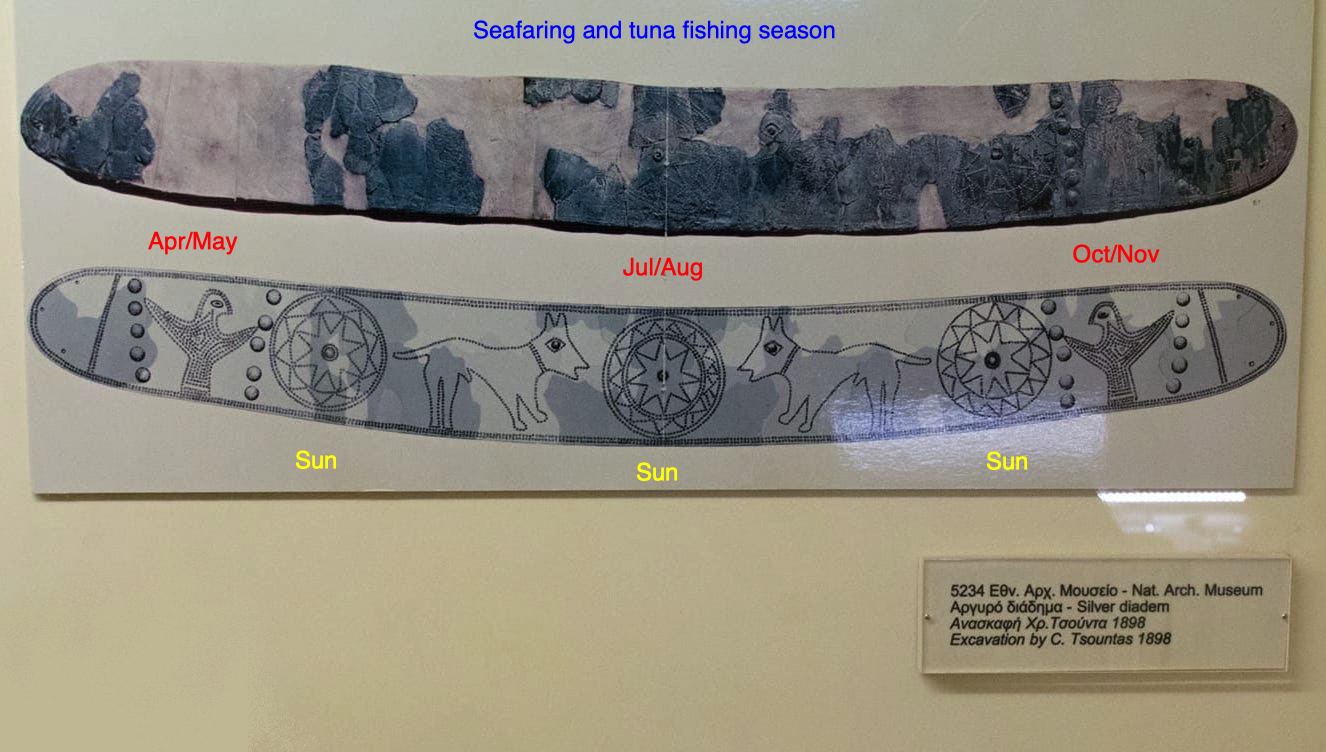
So...How old is the oldest depiction of Demeter, Greek Mother of Grain? How about 4500-4200 years old? Do you want to see it? Here she is in all her glory...

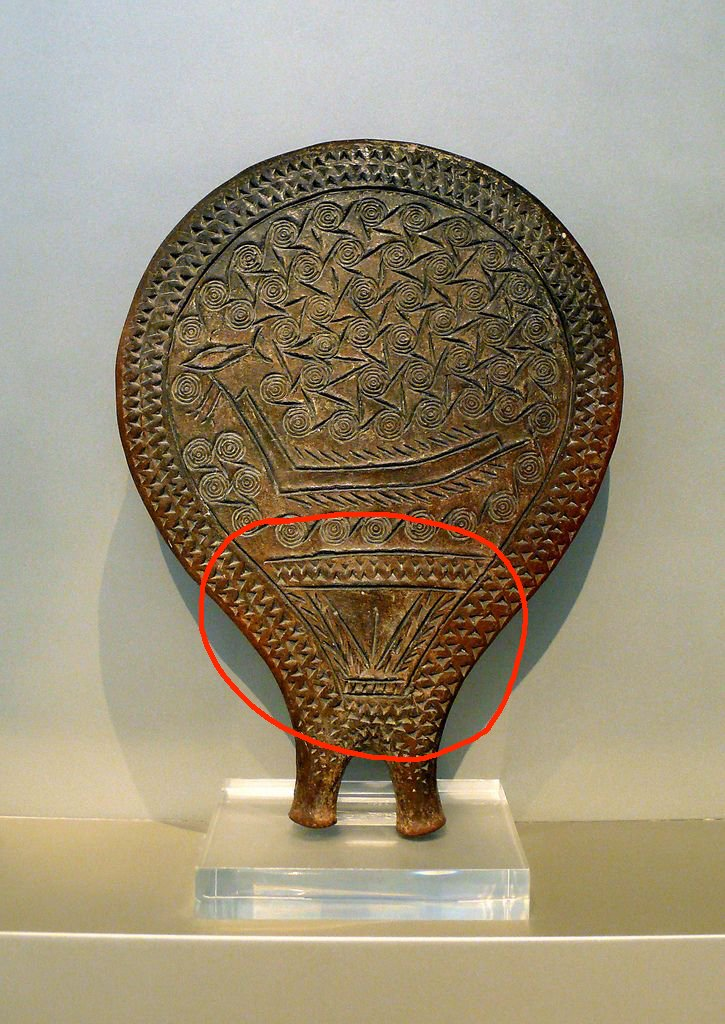
Mother (vulva) surrounded with grain...This symbol is hidden in plain sight on this strange object. This is one of many mysterious Early Cycladic "Frying Pans" found on Cycladic islands in Greece and dated to the second half of the 3rd mill BC

I talk about this particular frying pan, in my post "Tuna boats" about Bronze Age Cycladic tuna fishermen, in which I was discussing the ancient fishing/sailing calendar for the Cyclades. A lot of these "Frying Pans" depict boats, tuna fish and swirling waves...

And of course I completely missed the most important bit: vulva surrounded with grain, symbolic depiction of the Mother of Grain...
We know that this has been a grain symbol in Eastern Mediterranean, Mesopotamia, Central Asia, Iran, since at least Sumerian times...

I talk about this symbol being used in combination with vulva to depict the mother of grain in many of my posts. Like this post, "Arjoune Venus", about the 6th mill BC Halaf culture figurines from Syria. This one has vulva on front and ears of grain on the back...

We even have this symbol described in "The Courtship of Inanna and Dumuzi" where Inanna, Sumerian Mother of Grain, says:
Before my lord, Dumuzi...
I poured out grain before my womb...
I talked about this in many of my posts...
BTW, we find the same symbolism (grain before womb) described in the Greek legends about Baubo and Demeter...I talked about this in this recent post "Baubo", in which I explain why she is one of the most misunderstood figures from Ancient Greek mythology.
This is one of many "Baubo" figurines which were found in the Sanctuary of Demeter and Kore at Priene and dated to the 2nd c. BC.

The fact that we find the earliest use of this symbolism in the Fertile Crescent is important. You'll see why soon.
Anyway, I suddenly remembered the vulva with grain "detail" from our Cycladic "Frying Pan" while I was writing my post "Poseidon pursuing demeter", in which I gave symbolic analysis of this Tetradrachm minted in Byzantium, Thrace, ca 240–220 BC, which depicts veiled head of Demeter, wreathed with corn and Poseidon seated right on rock, holding aphlaston in extended right hand and trident over shoulder.

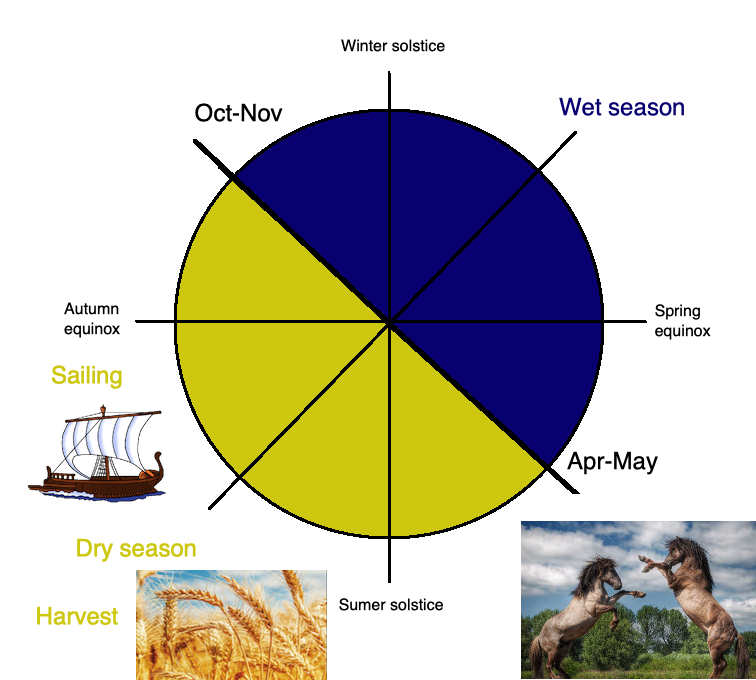
In it, I tried to answer the question: why were Demeter, Goddess of grain harvest (season) and Poseidon, God of sailing (season) paired together? As horses?
Basically, horse mating season, Apr/May-Sep/Oct overlaps with both grain harvest and sailing season in Ancient Greece...
Hence the link between Demeter (Mother of grain), Persephone (Grain) and horses. Here is Demeter in her horse-drawn chariot with her daughter Persephone, driving between two prancing stallions. 🙂 Selinunte, Sicily 6th c. BC

And the link between Poseidon and horses. I talked about this link in my posts "Trojan horse", "Three sacrifices", "Tetradrachm from Byblos", "Seahorse ring"...

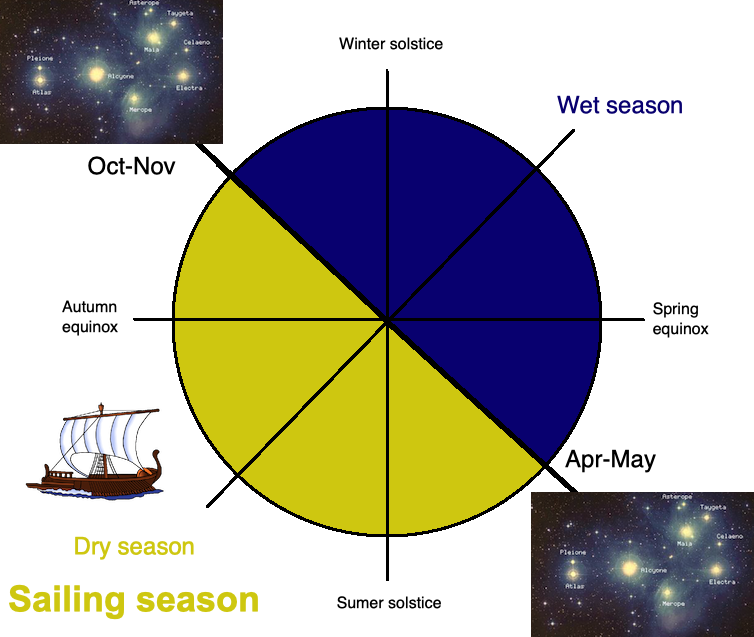
Anyway, I expanded on it in my post "To sail - To harvest", about the heliacal rising of Pleiades being a calendar marker for the start of both harvest and sailing season in Ancient Greece...Greek name "Πλειαδες" comes from πλεω, which means "to sail"...
I think we find proof for this link between the goddess of grain (harvest) and god of the sea (sailing) in Minoan Crete in the 2nd mill BC.
Actually goddesses of grain, Persephone (grain seed) and Demeter (grain harvest)...
Here they are, in a horse drawn chariot, depicted on a late Minoan limestone sarcophagus, dated to around 1400 BC, excavated from a chamber tomb at Hagia Triada, Crete, Greece...

I just remembered I wrote a whole post, "Agia Triada Sarcophagus", about this a while back where I actually talk about this link between Poseidon, Demeter, Persephone and horses in detail. I am getting old and forgetful...
This link between grain harvest season (Demeter) and sailing season (Poseidon) is I think what is depicted on our Cycladic "Frying Pan":
Tuna fishing boat (Poseidon)
Vulva surrounded with grain (Demeter)
What do you think?

But 🙂 there is something that makes me wonder...
This stele, most likely from the ancient city of Mari in Syria, depicts the Mother of Grain in exactly the same symbolic way...And dates from...🥁🥁🥁...the beginning of the third mill BC...Pretty much the same time as our Cycladic "Frying Pan"...

I talk about this amazing object in my post "Mother of grain from Mari"...
So what I am wondering is, does the vulva surrounded with grain depicted on our Cycladic "Frying Pan" depict Demeter...Or maybe her Levantine double, Inanna/Ishtar/Asherah/Astarte...
I already talked about the possibility that the 2nd mill BC Mycenaean Greeks worshipped Asherah who eventually turned into Demeter in my post "Cup of Nestor"...
Cup from Mycenae with doves.

And the lions flanking a pole depicted above the main gate of the Mycenae fortress.

Interestingly, Asherah, who was symbolically depicted as an Asherah Pole, was associated with both lions and doves...And so were Inanna and Demeter...
Asherah the goddess represented as a wooden pole erected on "high places". We have no idea what this means, but I have a hunch that the "high places" were threshing floors and that Asherah poles were central poles of the threshing floors...
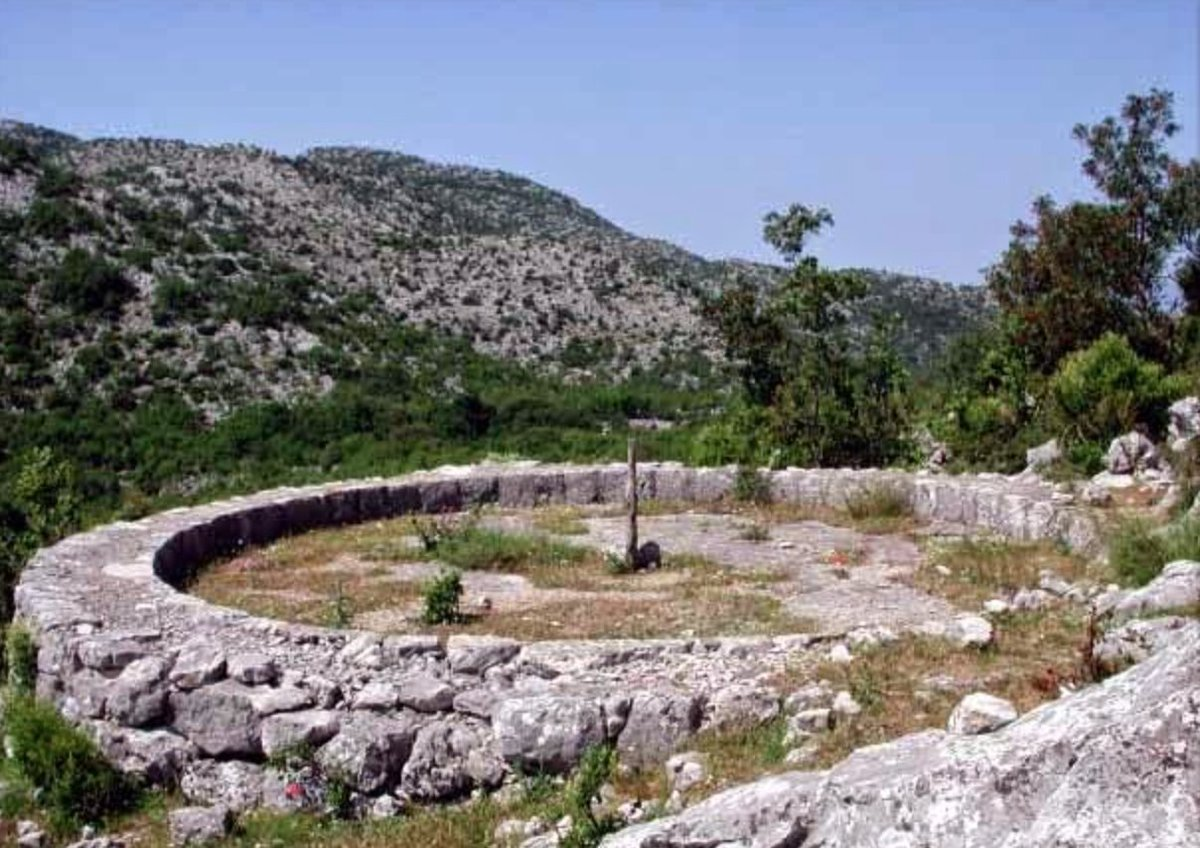
I talked about this in my post "Sacred marriage on the threshing floor"...
And this is what Homer says about Demeter and threshing floors:
"And even as the wind carries chaff about the sacred threshing-floors / of men that are winnowing, when fair-haired Demeter / amid the driving blasts of wind separates the grain from the chaff"...
Which is why Eugene Vanderpool in "ΕΠΙ ΠΡΟϒΧΟΝΤΙ ΚΟΛΩΝΩΙ: The Sacred Threshing Floor at Eleusis" proposes that threshing floors were sacred to Demeter and were in fact her temples...I talked about this in my post "Demeter riding panther"...
But as we can see from the our "Frying Pan", I think that this "Mother of Grain" from the Fertile Crescent came to Greece much earlier...In the 3rd mill BC. Via Greek Islands...Already linked with the god of the sea...
Look at this:
Asherah's son is Yam, god of the sea, or more precisely Yam, deified sea itself. And because of all this, Asherah's title "Rabat Athirat Yam", found in the Baal Cycle, can be translated as "Lady Aṯhirat (Asherah) of the Sea"...
The same sea god Yam, who in Phoenician and Canaanite mythology, was associated with horses?🙂
Phoenician ships often adorned with horse heads as tributes to Yam, who was believed to be appeased with such offerings to prevent destructive storms.
Reproduction of a Phoenician ship from the Archaic era, called a hippoi by the Greeks (due to the horse head at the bow), carved in bone, c. 11th-9th centuries BC, Ifergan Collection, Malaga, Spain (2019)

I talked about this in my post "Trojan horse", in which I asked a question: was Trojan horse "hypos" - a wooden horse left as tribute, or "hypos" - a wooden boat with a horse head used for transporting tributes...
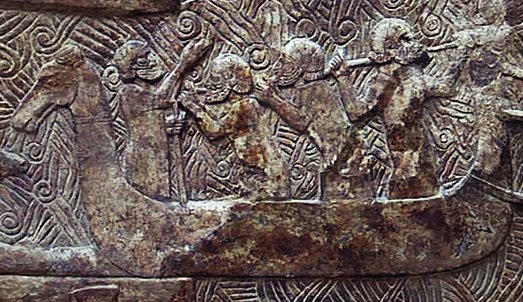
And in this article I also pointed at this "coincidence":
In the Phoenician religion, there was a tripartite division of power between Baal (Storm god), Mot (God of death) and Yamm (Sea god)...
This "seems to have" (first understatement of a millennium) influenced the Greek division between Zeus (Storm god), Hades (God of death) and Poseidon (Sea god)...
Are you kidding me? How many other tripartite divisions of power like this do we have?
It "is possible" (second understatement of a millennium) that Poseidon/Neptune was directly inspired by a Phoenician counterpart Yam...
Is Asherah/Astarte then "inspiration" for Demeter? I just realised I wrote another post, "Goddess on a horse", about this 13th c. BC levantine gold plaque, depicting a lady on a horse, probably Astarte or Anat (according to Israel Museum), who was linked to grain and sailing...

Sooooo...What do you think of all this?
The oldest symbolic depiction of Demeter and Poseidon?
Or
The oldest depiction of Asherah and Yam?
Or both?
I hope you had fun reading this thread. I definitely had a lot of fun researching it, thinking about it and writing it...
That's it. To read more about ancient animal and plant calendar markers, start here…Then check my twitter threads I still didn't convert to blog post...I am way way behind...