Showing posts with label Slavic beliefs. Show all posts

Monday, 3 February 2025

Mother of grain from Otok

In Otok near Senj, Croatia, a very interesting ritual was performed at the end of the harvest until mid 20th century 

The last sheaf of wheat harvested from a field was stood upright. All male harvesters would then stick their sickles into it. They would then  all kneel around the sheaf and pray to the "lady" thanking her for the harvest 

Then the oldest woman would put her hand all the way through the sheaf and would grab a handful of soil from under it. This soil was then tied into a handkerchief and later used as a cure for uterus problems. It was diluted in water given to the sick woman to drink 

Clearly a thanks giving ritual performed for Mother Earth, otherwise known as The Lady. In South Slavic folklore (mother) earth fertility and (mother) female fertility was always linked and was believed to influence each other 

This same Lady, was represented by the Corn dollies which were made from the last sheaf. They were preserved in homes during the winter, and the seads from the corn dollies were the first sawn next spring. 

It was believed that this last sheaf contained the "corn spirit" the fertile power of Mother Earth...Which farmers depended on for their survival.

Source: "Ivo T. Franić, JUGOSLOVJENSKA ŽETVA, Običaji i obredi s uporedbama"


You can read more about Slavic beliefs and rituals related to grain in my posts "Wheat cross", "Diduch", "Walking sheafs of wheat", "Cock bashing", "The old woman of the milldust", "Wheat wreath", "Sowing", "Can you see me", "Babji mlin", "Bogovo gumno"...

This is just a continuation of the ancient "Mother of grain" cult which originated in the Fertile Crescent in early Neolithic...

Articles about the Mother of grain in Neolithic Europe, Central Asia, Mesopotamia, Iran, Levant: "Mother of grain" "Altyn Tepe mother of grain", "A person in little boat", "Sabi Abyad venus", "Hathor grain pendant"...

Sunday, 28 July 2024

Motanka

"Motanka", elaborately decorated but always faceless cloth doll was once a common feature in every Ukrainian peasant home. These dolls weren't just toys. They were magic talismans...

The name "motanka" comes from the word "motaty" (to wind) ie to make a knotted doll out of fabric, without using a needle and scissors. The winding of the doll was to be carried out only clockwise...

The fact that the doll had to be wound clockwise (sunwise) is very important as this direction was by our ancestors considered "positive, natural" and the opposite direction was considered "negative, unnatural"...

The Gaels in Ireland/Scotland were particularly obsessed with this. I talked about the importance of "sunwise" (clockwise) motion, movement in Gaelic rituals in my post "Sunwise". 

The reason why dolls had no faces, is because people believed that giving the doll a face could tie a person's soul to it. Which indicates that these dolls are symbolic depictions of the female ancestors, all the way down to the Mother Earth.

The common characteristic linking all these female ancestors is fertility, ability to give birth, without which there would be no one here today to make "Motanka" dolls...

Remember my post "Palaeolithic Venus figurines" in which I asked: Were European Palaeolithic "Venus" figurines made faceless and with super exaggerated sexual characteristics to depict an "idea" of fertility?


And remember my post "The faceless one", in which I talked about the faceless Persephone? 

Persephone, the anthropomorphised female ancestral fertility and grain fertility, was also sometimes depicted with vailed face or with no face at all...Two statues from Cyrene, Libya...   

And do you remember my post "Bescherkind", about a living "Motanka" from Sorbian tradition?

A girl dressed as a faceless "bride", who brings presents (and good luck) to Sorbian families on last Wednesday before Christmas (originally probably on Winter Solstice day). 

Another confirmation that the doll was a depiction of (the fertility) of the female ancestors is the fact that the process of making "Motanka" dolls is called "kutannya" or swaddling as it is very similar to swaddling a baby.

And because of "Motanka" dolls like this cute one 🙂

And because: There are three main types of the "Motanka" dolls: a bride, a baby and a married woman.

A bride "Motanka" was made to help the girls get married. This doll was richly dressed because it symbolised the dowry of the bride and was supposed to attract a wealthy husband.

At birth of the child, a baby "Motanka" was made which looked like a swaddle baby. It was put in the cradle in order to protect the baby. It was also left in the cradle after the baby overgrew the cradle to protect the cradle until the next baby was born.

A (married) woman "Motanka" was made to help the woman with her marital duties, especially things linked to her own and the land (crops and animal) fertility. Coins, grains, wool were put in the doll.

Also, before the wedding the mother made the doll for the daughter, symbolically passing the female ancestral support and expectation down to the next generation.

All the above dolls were "guardian" dolls and had to be made "while thinking good, positive thoughts"...

But there were also "Motanka" dolls made ritually to get rid of (troubles, diseases). They were made while thinking about the badness they were supposed to represent, and then the dolls were burnt or drowned in water...

Interesting...Remember this: Slavs equated The Goddess of Death, Morana (mor=death) with The Old Hag, The Winter Earth, Marzana (marz=frost). She is ceremonially burned (warmed) or drowned (thawed) or both (to de sure to be sure 🙂) during Slavic spring festivals...

I talked about this in my posts: "Bride", "Bannock", "Gryla", "Party", "To kill a witch", "Baba's day", "Living stone"...

Finally, as I already said, originally, all the the "Motanka" dolls had white empty faces. But today, they usually have a cross across their white empty faces, most likely as symbol of "Christianisation" of this ancient magical artefact...

Sunday, 28 January 2024

Dead man loaf

In Bulgaria, a special loaf of bread was made immediately after a person died, during the washing of the body. It was a simple round loaf, sometimes with a cross. In northeastern Bulgaria it was baked from dough which was made with the water used to bathe the deceased...

Sources:

"Glasnik Etnografskog muzeja u Beogradu knjiga 19 godina 1956"

"Bread in the folk culture of the Serbs in its pan Slavic context"

The dough for the bread was kneaded in a wooden throw. Before the kneading of the bread started, a candle was lit and put next to the through. And the dough was kneaded until the candle burned out...

In some parts of Bulgaria, this bread had to be made by a "clean" woman who had no sexual intercourses, either a virgin girl, a widow or a grandmother...

The name of this bread was пътнина (patnina), meaning "(bread for the) journey". In some parts of Bulgaria, this bread was placed in the coffin with a bottle of water and a bottle of wine, so the deceased would have enough food and drink for his journey to the other world...

This is very interesting. Remember my articles about the pots and pans found in Neolithic, Bronze and Iron Age graves all over the world. Like these Ghandara culture graves from Pakistan, dated to 1200-800BC...Were the drinking vessels placed in graves with drink "for the other world"...

 I talked about this in my post "One for the road"...Why would the living bother with making sure the dead had enough food and drink in the otherworld? 

Our ancestors believed that it was the dead ancestors that directly affected the life of the living and in particular the land/grain fertility. 

I talked about this in many of my posts like my post about Diduch (grandfather), symbolic representation of the ancestral spirit which governs the lives of the living.


The dead had to be remembered, and fed and watered by giving them regular food and drink (mostly water) sacrifices. Cause forgotten, hungry and thirsty dead ancestors will take revenge on their living descendants. And one of the ways they would do that is by causing droughts, storms, floods and other natural disasters that would cause grain crops to fail, and would result in famine and the death of the living...

I talked about this in my posts "Thirst", "White feast", "Soul breads". I talked about the link between the dead and rain and grain fertility in Roman mythology in my post "Lapis Manalis"....

Also, remember this? 

"...humiliation of the Hittite kingdom is the result of the fact that the Hittites have forgotten to respect the sacred bond with their dead..." - Last Hittite king Suppiluliuma II.  From my post "House of bones"...  

Statue of Suppiluliuma II, Hatay Archeology Museum with a pretty depressed expression on his face...

This is why people not just buried their dead with food and water, but also regularly feasted with the dead. 

Starting from the funeral feast. 

In some other parts of Bulgaria, the bread was, while still warm, broken over the deceased person's head, making sure that steam, representing the deceased person's soul, rose the broken bread...The bread was then ritually eaten by the people attending the bathing of the body...

BTW, in Herodotus 4:73 we read that when a Scythian man died his family would put the body on a cart and take it to all his friends houses. They would bring the body into each house where they would eat and drink together with the corpse...

Through the quarterly remembrance feasts. 

There is a custom among Serbs of "feasting with the dead". Four times a year, once per season, on a day called "Zadušnice" (Souls day) a family goes to the graveyard, spreads the tablecloth on the grave, lays food and drink on the grave and has a feast with the dead. 

And literally any other feast.

Serbs actually always feasted with the dead. Every family feast was symbolically eaten with the dead. This prompted some Serbian ethnographers to propose that the whole Serbian belief system was based around the cult of the dead...

Soul breads

As late as the mid 20th century, there was a custom in Poland to bake small loaves of bread for the dead on the All Souls day. Because the All Souls day is in Polish known as Dzien Zaduszki (the day for the souls), the bread was also called zaduszki, bread (for) souls...

Originally these were just a plain sourdough flatbreads...But the recipe gradually evolved into this:

Lublin All Souls' Day breads (powałki)

1 kg of cooked flour potatoes

2 eggs

400 g of wheat flour

100g of fresh yeast

1 teaspoon of sugar

2 flat teaspoons of salt

Press the previously cooked and cooled potatoes through a press, add eggs, flour, salt and yeast grated with sugar. Knead the mixture into a loose dough. Tear off pieces of dough, form thick flat patties and place them on oiled baking tray.

Decorate each patty with a grid pattern using a fork, and leave them to rise for 30 minutes. Bake for 20-30 minutes in an oven preheated to 160°C. 

That's the traditional recipe. If you want, you can add cheese, ham, spices or any other topping of filling to suit your taste...

The origin of this ritual in the old Slavic feast called Dziady, which in Polish means Grandfathers, Forefathers, when the souls of Forefathers would come back to our world to visit their descendants. And the little (soul) breads were made as food for the visiting ancestors.

The soul breads had to be prepared a few days in advance, as people did not want to light the fire on the hearth on All Saints' Day, as they believed that the visiting souls gathered around the house hearth, and they didn't want to disturb them...

Two interesting things here.

First: Slavs believed that it was the (happy) ancestors (satisfied with the way their descendants treated them) who were the source of all good that their descendants enjoyed. Including (and especially) good grain harvest...I talked about this in my post "Diduch" (grandfather), about the East Slavic symbolic representation of the ancestral spirit which governs the lives of the living. 

So a bread for the dead now makes a lot of sense, right? I talked about the ancestral cult root of Slavic agricultural rituals in many of my blog posts and twitter threads. This post, "Wheat cross", is a good jumping point for exploring this subject further. It talks about the ceremonial "wheat cross" from Romania, which was made on the last day of the wheat harvest to carry the "wheat wreath" from the fields to the village. And about the related Slavic harvest traditions and ritual.

Second: Hearth as the place where the dead gather when they visit the house of their descendants. I talked about the link between the dead and the hearth in my post about "Verige" (hearth chain). 

As you can see from the above picture, in the past, the hearth was the focal point of every house. So it is easy to imagine that the souls of the dead ancestors would also gather around the hearth to warm themselves up on the cold November night...

This is confirmed by the fact that in the past in Poland, on All Souls eve, people used to set up bonfires on the crossroads, in order to help the souls of the ancestors warm up a bit...Why on crossroads? Allegedly to show wandering souls their way home...

But interestingly:

In some parts of Serbia, on Christmas eve, a single man from a village would go to a crossroads and lay down a feast for wolves. He would then run home without turning...I talked about this in my post "Wolf feast", about the link between wolves and the ancestors in Serbian folklore. 

And also:

Diduch (Grandfather), the grain effigy representing "The Ancestor" made in Ukraine for Christmas, was in some areas, burned on New Year's eve, on crossroads, "one of the favorite hangouts of evil spirits and vampires"...

See how the souls of the ancestors ended up becoming evil spirits and vampires...With a little help of Christian priests...

Finally, some Serbian ethnographers proposed that the belief that the dead gather around the house hearth might also be a remnant of the ancient (really really ancient) practice of burying the dead under and around the hearth...

I am very important! 

Love this little guy 🙂 Neolithic Vinča culture anthropomorphic terracotta figurine, 5000 BC, Serbia.

"These figurines were found in houses, often near fireplace, sometimes carefully arranged, which indicates that they had ritual, cult value".

Did they represent the deceased, the ancestors?

Monday, 25 October 2021

Tarim basin baby bottle

This infant died when he or she was less than a year old. Dark blue stones covered its eyes, and red woolen yarn was inserted into its nostrils. The infant was buried with a cow horn tip and a bottle made from a sheep’s udder...


This well-preserved infant mummy, was discovered in the cemetery of the Qizilchoqa settlement about 60 km west of Qumul (Hami), an important, old Silk Road town in the far eastern portion of the region. It was dated to ca. 1200 BC...


More info in the "Ancient mummies of the Tarim Basin" and "The mummies of East Central Asia"

It is one of hundreds of Bronze and Iron Age caucasian (European) mummies discovered in deserts along the Silk Road in Central Asia and Northern China...

Now, these are ceramic decorated horns found in infant graves of the Central European Bronze Age Encrusted Pottery culture (2000-1500BC). 

I talked about them in my post "Baby milk horns"...

Why were these horns placed in infant graves? To provide them with drink in the otherworld...How do we know this?

We know this because Encrusted Pottery culture people buried their dead with age appropriate "grave goods": big ceramic pots for adults, small ceramic pots for children and ceramic horns for babies...

I talked about this in my post "One for the road"...

And because of the ancient belief that the otherworld is "a thirsty place"...And because in Central Europe, making sure the dead have enough water in the otherworld is still seen as an imperative... I talked about this in my post "Thirst"...

Have you ever thought about how did our ancestors arrive to the idea that the otherworld was a thirsty place? Or maybe it is better to ask where and when did our ancestors arrive at the idea that the otherworld was a thirsty place?

I am thinking...

Saturday, 24 April 2021

Diduch

This is Diduch or Did, the most important decoration made in the Carpathian villages in Western Ukraine during the traditional winter holidays, originally Winter Solstice, now Christmas...


It is a decorated sheaf of grain (rye or wheat) made from a the first and the last stalks of grain reaped that year and brought home ceremonially from the fields by the queen of the harvest...

I talked about the end of harvest rituals in my post "Wheat wreath"...

In the Boykivshchyna, agricultural tools were stuck in Didukh: a sickle and a rake. Today dried flowers and ribbons are aded...


Diduch was made on the morning of the Christmas Eve by the man of the house and was left in the barn. Then in the evening, with the rising of the first star, the man of the house, or if he had sons, his eldest son, would go to the barn to bring Didukh to the house...


He would bring Didukh solemnly to the house door, and crossing the threshold, he would take off his hat and greet the woman of the house, as if seeing her for the first time:

May God give you health!

God help us. What are you carrying?

Gold, so that you live wealthy life!

Then the man bringing in the Diduch would bless the house wishing everyone peace, good health, good luck, good harvest, fertile women, animals, fields...

Now, "Diduch" (Didukh, Did) literally means "Grandfather" and is believed to contain "the spirit of the dead ancestors" who gather in and around it during the time Diduch is in the house...

In the past, every family in the Ukrainian Carpathian knew, remembered and honored all the ancestors up to the seventh generation. At least...

And throughout the Christmas week, Carpathian Slavs "invited" all the dead ancestors every night to a feast. Funeral dishes were left on the tables for the night for the them, and the food and drink were not remove from the table until the morning...

It was believed that the souls of the dead are in constant contact with the family, help in the household, protect the home and the field from fire, flood, hail, make sure that the family was in order and peace, healthy and happy...

It was also with the help of the dead that all living things grew and multiplied. 

I talked about this Slavic belief in the dead governing the lives of the living in few posts: "Thirst", "Blood red wine", "Wolf feast", "House of bones"...


Which is why I believe that this is why the man bringing Diduch into the house was greeted as a stranger...He wasn't bringing Diduch (The ancestor). He was Diduch (The Ancestor)...One of many or all of them together...

Or maybe even the ancestral deity himself, Dabog, the Giving God...And the blessing the Diduch bringer uttered wasn't his blessing. It was Diduch's (The Ancestor's, God's) blessing...

People believed that the ancestors helped only those families in which they were honored by their descendants. And making Diduch and bringing it into the home and making him part of the family feast was considered to be one of the best ways to show this respect...

Interestingly, when Diduch was brought into the house, he was placed in the "Sacred corner", the holiest place in the house, where the holy icon was kept...And where once Slavs buried their dead, or more precisely reburied the bones and particularly sculls of their dead...

But this is an amazing story in itself and deserves a separate post...Soon...

By the way, it is this life giving power of the dead, which Pluto (Hades), the giver of wealth, appropriated for himself. And this is why Hades and Persephone are depicted sitting on their throne in the land of the dead, with sheafs of wheat and flowers...

I talked about this in my post "Pluto"

This is also why Hades is depicted holding Cornucopia, the horn of plenty... 

Again something he appropriated...Well maybe...Maybe not...You'll see why further down in this article :) I wrote about the origin of Cornucopia and why it is a "goat's horn" in my article "Cornucopia"

It is the ancestors and the ancestral deity Dabog who are the givers (or takers) of wealth, health, luck...Dabog has all the characteristics of the god of the dead, which is how he was interpreted by the Serbian ethnographers...This is of course true. He is "The Giving God"...

But what these ethnographers forgot is that Dabog is also explicitly described as The Sun God and The Rain God, basically Sky God...Whose house is underground...In the land of the dead...From where he comes at sunrise and to where he returns at sunset...

I talked about this in my post "Day star"...

A lot of Winter Solstice, New Year, Christmas "beliefs" and "rituals" from across Europe now feature "scary demons and ghosts" who "descend on" people's houses at this time of the year, and which need to be "expelled" from the houses to protect the living...

The same good, venerated dead and ghosts, which were once invited in by their descendants...This is another great example of the suppression of the old beliefs by the Church and their inversion into their opposites...

Also I think that Diduch explains a lot of things about the end of the harvest rituals, the last sheaf rituals, and winter sheaf rituals...

It is now obvious why the Irish called the last harvested sheaf of wheat "Cailleach" (Old Woman, Grandmother)...

I talked about this in my post "The old woman of the mill dust"...

And it is now obvious why the Irish called the Corn Dolly made from the last harvested sheaf "Cailleach" too. And whose spirit was the "spirit of grain" that inhabited the Corn Dolly...

I talked about this in my post "Corn dolly"...

Diduch also explains which god Slavs talk about when they call this particular type of wheat ornaments made from the last harvested sheaf of grain "Good's beard"...It's Dabog, the Giving God, who was also known as Djed, Did (Grandfather), The Ancestor...
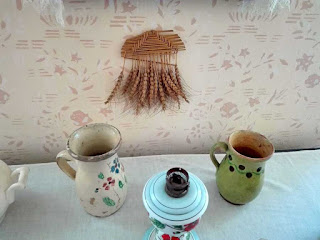
Diduch also explains why "On Christmas morning in Scandinavia every gable, gateway, or barn-door, is decorated with a sheaf of grain fixed on the top of a tall pole, wherefrom it is intended that the birds should make their Christmas dinner"...


I talked about this in my post "Nav"...

Slavs believed that the souls of the dead are ferried to and from the otherworld by birds...So birds feeding on Diduch, The Ancestor is kind of symbolic, right? Did Scandinavians once had the same belief, but they forgot it and kept making Diduch as "one ought to"?

Diduch also explains why "wheat sheafs" roam the streets of many towns in Europe...Like these "skeklers", children dressed in straw suits, who would in the past go round the houses at Halloween (Gaelic new year), New Year, on Shetlands islands, asking for food, apparently "to bring the sun back from the grip of winter and ensure good crops"..

I talked about this in my post "Walking sheafs of wheat"...

Diduch also explains the "old Christmas prank" that people in Scandinavia played with each other: In Sweden in the past, people would make a figure of a goat from the last harvested sheaf of wheat and call it The Yule Goat...


People regarded The Yule Goat as a "spirit that would appear around Christmas to make sure that the Yule preparations were done right" 

Interesting right? Diduch, The Ancestor, The Ancestral Deity, making sure the old ways, which the dead ancestors represent, are still respected.

But then: "In the past in Scandinavia, a popular Christmas prank was to place this Yule goat in a neighbour's house without them noticing. The family successfully pranked had to get rid of it in the same way..."

Bringing of the symbolic representation of the dead into the house, basically inviting the dead to come and celebrate the Winter Solstice, New Year, Christmas day with the living, was originally a sombre ceremony with huge real (for out ancestors at least) implications...

And again this was turned on its head. It was replaced with a "prank" where the symbol of the ancestors and the ancestral deity was brought into the house "against the will of the hosts". And the hosts tried their best "to find the cursed thing and get rid of it"...

All part of the conversion process...Turn old good gods into evil devils...Old good symbols into bad omens...Old positive rituals into negative...Eventually people forget...What's left is Krampus...And such abominations...

I talked about this in my post "Krampus"...

By the way, the reason why goat features prominently in winter agriculture fertility rituals is because in the areas where agriculture was developed, the beginning of the rain season, and winter, coincided with the beginning of the mating season of the Ibex goats (Oct/Nov)


So Ibex goat became "The goat of rain" and "Bringer of fertility"...I talked about this in many articles on my blog, starting with this one about "Goat riding thunder gods"...This is also why Cornucopia is made from an Ibex goat horn...

Anyway, back to Diduch...On the eve of St. Basil's Day (sometimes before the Epiphany), Didukh was taken out of the house at midnight. It was believed that the souls of the dead ancestors also left the house with it...

In some areas of the Carpathian mountains, like in Pokut, Didukh was burned, usually on a crossroad, one of the favorite hangouts of "evil spirits and vampires" (read good ancestral spirits). Diduch's burning symbolically announced the birth of the New Year...

In the villages of the Halyts'kyi district Diduch was threshed  by the first footer. The threshed Diduch grain was then thrown on neighbor's and friend's houses for happiness and good luck...

And that's it...I'll leave you with this image of children carrying Diduchs. The future carrying the past in their hands and their hearts...


Because there is a sacred bond between the living and the dead...

PS: In Slovenia we also find Grandad Grain:

Boris Čok documented an old wheat harvest tradition in Kras, Slovenija:

At the end of harvest the youngest woman placed the last sheaf of wheat at the end of the field. Two smaller sheaves supported it. 


She stuck a poppy flower for mouth, 2 cornflowers for eyes and broke a few ears of wheat down so they resembled a long beard.


This sheaf was a "staž, stažič, starožit, žitni starec" - granfather wheat. He protected the wheat in the next season.


Sunday, 23 August 2020

Jani

Greeting of "Jāņi children" by the house owners during Jāņi (Yanee) day, Latvian summer solstice festival. Pic: Leonid Vladimirovic.

There is something strange about this Latvian holiday. It has part of what we find in Slavic mid summer rituals and part of what we find in Slavic beginning of summer rituals all mixed in one...

For instance, Gathering the fern flower ritual is in Slavic countries performed during mid summer Ivan dan (Jāņi dan) celebrations, just like in Latvia.  

Bonfire lighting which is done in Latvia on the eve of the Jāņi day, is another ritual which is in Slavic countries done on Ivan dan. Pic: Jāņi bonfire 
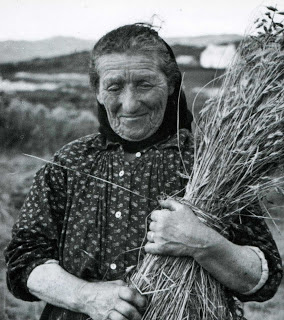

I talked about this Slavic custom in my post "Slavic pyramids

But, gathering flowers and making flower wreaths is in Latvia done on mid summer, Jāņi day.

While in Slavic (Balkan) countries this is done at the beginning of the summer, in late April, early May...I talked about this in my post "Flower girls"...

And particularly interesting is the belief in Latvia that "medicinal herbs picked on Jāņi day have special powers and are particularly potent". In Slavic (Balkan) countries the belief is that the "medicinal herbs picked at the  beginning of the summer have special powers are are particularly potent". Which is when medicinal herbs are gathered...I talked about this in my post "Herb Friday"...

Finally, Latvian belief that"girls should, on Jāņi day, wash their faces with the morning dew, so their face will always be white and beautiful" is in Slavic (Balkan) cultures and in Celtic (Gaelic) cultures is done at the beginning of summer. I talked about this in my post "Morning dew"...

I wonder if this is an example of customs and rituals, which as they moved up north, to the colder parts of Europe, were moved from the beginning of summer to the middle of summer, to fit with the local climate (medicinal herbs flowering later and dew appearing later)...

The reason why I believe flower wreath, medicinal herbs and morning dew rituals didn't originate in Latvia, and were originally performed at the beginning of summer, is because both the Irish and Serbian traditions agree when dew face wash should be done (beginning of summer)

As we know the Irish and the Serbs didn't really have much cultural contacts in say, few thousand years...🙂 So we could be pretty sure that this is an ancient custom preserved by both people independently, and not borrowed from each other recently...

Anyway, very interesting I think and worth further research...