The charge of the Polish Winged Hussars at the 1683 Battle of Vienna. 3000 of them took part of the biggest cavalry charge in history, which finally stopped the Turkish expansion into Europe...

This is the story about their origin...
And about a very interesting and unusual Serbian phrase: "Kititi se tuđim perjem" which means "To take credit for something great someone else has done", but literally it means "To adorn oneself with someone else's feathers"...
So where do we start? With Nicolas de Nicolay, a French nobleman, who In 1567 publish a book entitled "Quatre premiers livres des navigations" which recorded his observations about the Ottoman court and peoples from his 1551 mission to Istanbul on behalf of the French government.
The book served as the first comprehensive survey of customs and costumes in the Ottoman world, and is hailed as one of the earliest and most accurate depictions of the Islamic world to appear in Europe.
Nicolas traveled to Istambul via Serbia and in the chapter entitled "Des avanturiers, appelles Del", he talks about the Ottoman shock troop light cavalry unit called "Delier" which means "brave, crazy, reckless, madmen"...These guys...

The main role of these units during war time was to create chaos and confusion among enemy troops by using guerrilla tactics. During peace time they acted as personal guard of high level Ottoman officials in the Rumelia (Balkan part of the Otoman Empire).
The first Delier were created in Turkish occupied Bosnia and Serbia in the late 15th century, but these military units were soon formed in other districts of Rumelia too.
There is a lot of confusion about who these "Crazy Balkan Horsemen" were...The Deli wiki page about Delie says that "Most of the Delie were usually of Ottoman Turkish origins". Which is kind of misleading. You'll see soon why...
I think that, at least at the beginning, the majority of these Crazy Balkan Horsemen were Serbs from today's territories of Serbia and Bosnia.
But don't take my word it. Here is what Nicolas de Nicolay had to say about Delier:
"Delijer are adventurers, who seek adventures in the most dangerous places, where they are given the opportunity to prove their courage and heroism with their warrior feats".
"They are located in the areas of Bosnia and Serbia. Today they are called Serbs and Croats, but these are the real Illyrians, those whom Herodian describes as people very brave, large, well-built, strong, lion colored faces, more than barbarians by their customs"
Note: Interesting. I know, most people will now say: Serbs and Croats are Slavs, not Illyrians...This French diplomat had no reason to invent the link between Serbs and Croats and Illyrians...Because this was the prevailing historiographic opinion until very recently.
Note: Interestingly, Slavic legends, and not just South Slavic legends, talk about Illyricum as the birth place of the Serbs in particular, from where they were Expelled by the Romans after a great war...I wrote about it in my post "St Paul among Slavs"...
Anyway, back to what Nicolas de Nicolay had to say about Delier.
"The Turks call them Delier, which means crazy and brave. However, they call themselves "zataznics", which in their language means: those who challenge people, challengers".
"Each one of them has to challenge and defeat 10 enemies in order to to acquire the name and insignia of a deli or a zataznic".
Note: Nicolas de Nicolay doesn't say what is that insignia, but I would guess it has something to do with feathers...
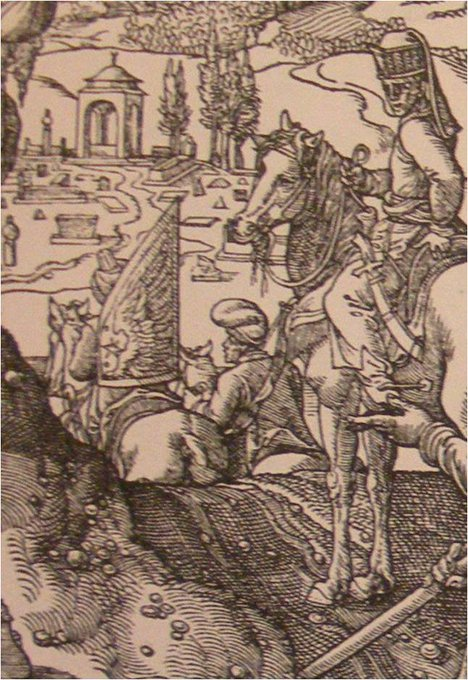
Nicolas de Nicolay then describes the Deli he met (this guy):

"He wore wide trousers made of the skin of a young bear with fur on the outside. Under his trousers he wore shoes or short yellow boots, pointed at the front and very high at the back, with long, wide spurs"
"He had a hat on his head...which fell towards one shoulder, made of spotted leopard skin. Deli attached a wide eagle wing. The other two wings were attached to large gilded nails on his shield".
Note: Nicolas de Nicolay concludes that this was done "to make Deli look as scary as possible". But was the reason for eagle feathers to make Deli scary, or were they "the insignia", the mark of their mad bravery which made them a Deli? I certainly believe the later.
"His weapons were scimitar, lance, spear, and a war-mace"...Note: Most pictorial representations from the 16th century show the Deli armed with scimitars, lances, spears, and war-maces.
"Then I saw him on a horse, covered with the whole skin of a large lion, which was attached to the horse's chest with its front paws while the other two hung behind. His mace hung on the back of the saddle. In his right hand he held a sharp spear, with a long hollow shaft"...

Nicolas de Nicolay actually talked to the Deli he met. This is what he says about this conversation:
"I was also curious to ask him through Dragoman (translator), to which people he belongs and what religion he professes".
"He let me know that he was a Serb by nationality...As for his faith, he said, he only pretends when he lives with the Turks according to their law, because he is a Christian by birth, heart and will".
And here is a very very very interesting bit. Although Deli told Nicolas de Nicolay that he was a Serbs, he also told him that "his ancestors were Parthians, people who in ancient times enjoyed a great respect as the most warlike people in the entire East"...
Eeeeee what? The Crazy Balkan Serbian Horseman believed that he was descended from Parthians, the people who were renown for their cavalry...
Is this an embellishment added by Nicolas de Nicolay? Why would he do it? Or did the Serbian Deli actually say this? And if so, did he just invent all this, in order to make himself look even cooler than he already looked to Nicolas de Nicolay?
I don't know if too many people in 16th c. Europe would have been impressed by the mention of Parthians...
So maybe this crazy story was actually a remnant of a real ancestral legend, now forgotten, of (this particular) Serb and his kinsmen? Serbs are a very mixed population, so I think that anything is possible...But as I said, I don't know...
Now we are going to leave the Balkans and Delier and we will go north of Serbia, into Hungary (Today's Hungary, Romania) where we find Hungarian Hussars...

Hussars were a light cavalry, originating in Central Europe during the 15th and 16th centuries. The title and distinctive dress of these horsemen were subsequently widely adopted by light cavalry regiments in European armies in the late 17th and early 18th centuries...
The hussars reportedly originated in bands of mostly Serb (whom Hungarians called Rác) warriors, crossing into southern Hungary after the Ottoman conquest of Serbia in the late 14th century. Interesting...
Speaking of the Hungarian name for Serbs "Rác", do you remember my article about "Racka" (Serbian) sheep breed?

Anyway, the word hussar stems from the Hungarian "huszár", which in turn originates from the medieval Serbian "husar", "gusar", meaning brigand (because early hussars' shock troops tactics used against the Ottoman army resembled that of brigands)...
And finally we come back to the beginning...Polish Winged Hussars, who were one of the main types of Polish cavalry in Poland and in the Polish–Lithuanian Commonwealth between the 16th and 18th centuries...I love this picture...

Original Winged Hussars were units of exiled mercenary warriors of Serb origin, also called Racowie (Polish name for Serbs). They were based on the Hungarian Hussars of the Hungarian King Matthias Corvinus, who were also originally exiled Serbian mercenary warriors...
The oldest mention of hussars in Polish documents date to 1500, although they were probably in service earlier...
Following the military reforms of the Polish king Stephen Báthory, the Polish Hussar unit was transformed into famous heavily-armoured shock cavalry...
The husaria banners and units participated in the largest cavalry-charge in history at the Battle of Vienna in 1683 and ranked as the elite of Polish cavalry until their disbandment in the 1770s...
So full circle...
But there is more...
Here is another proof that both Hussars and Delie had the same common origin...In this article, entitled "Deli and Hussar: confusion, ambiguity, and hybrid identities" we can read both Delie and Hussars used the same very unusual "wing shaped" shield...

Shield whose origin, according to the author, is "uncertain"...Well, kind of...Someone left a very interesting comment at the end of the article:
Start of comment:
"While Kovacs might argue for an "uncomplicated Hungarian origin" his colleague Szabo (in A honfoglalóktól a huszárokig,2010) presents substantial evidence that the more convex variety of the shield has its origin in Western Balkans".
"(Funnily enough both also refer to the study by Kužič - a scholar who studied the shield forms found on period balkan gravestones-stećci)".
"Regardless of "the true origins" these shields indeed seem to be like an evolutionary step from the targe commonly used by central european cavalrymen (e.g. Knights in kepes kronika, hrvoje missal etc)".
"15th century depictions from Balkan stećci in fact suggest the existence of both varieties at roughly the same period and I get the impression that with time the shields actually grew larger and more convex".
End of comment.
Were these shields just an imitation of the shape of an eagle wing? Which Delie used as a decoration for their shields...This Turkish example suggests so...
One last thing about the origin of these Crazy Balkan Horsemen. The man credited with the formation of the Delier was Gazi Husrev-beg. His father, Ferhad-beg, was a Slavic nobleman who converted to Islam, originally from Hum (modern-day Herzegovina)...
So the father of the creator of the Delier cavalry, populated by Serbs and Croats, was of South Slav (most likely Serb) from a noble (most likely) knightly family...
And the oldest depictions of their feathered shield is found on monuments from the same area...
Interesting...
One other possible clue about the origin of the Crazy lancers who adorned themselves with eagle wings...Here is a detail of the "Betrayal of Judas" fresco from the Church of the Apostles, the oldest church in the Serbian Patriarchate of Pec...
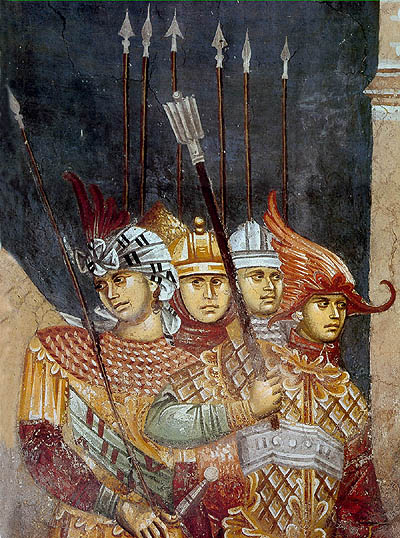
The fresco is dated to 1300 AD. At least a century and a half before the first feathered Delier and Hussars appeared in Turkish and Hungarian armies...
Were these guys just adorning themselves with wings for a laugh, or...
I know this sounds like a cool story...But to me this is a tragic story. The Hungarian and Polish (but really Serbian) Hussar's main enemy were Turkish (but rally Serbian) Delier...Hussars were specifically used "to counter Ottoman Delier cavalry"...
Serbs killing Serbs...For king and sultan? For Christianity or Islam? Or just because they were "brave, crazy, reckless, madmen"?...I think that most Delier who were of Serbian origin, were "Poturice" (local Serbian name for Serbians who converted to Islam, became Turks).
Some of them could have been like the guy Nicolas de Nicolay interviewed, nominally Ottoman Turks and Muslims, but secretly still Serbs and Christians...But most of them were probably true converts, true believers, true Ottoman Turks of Serbian origin...
Which is why I said earlier that the statement that "Most of the Delier were usually of Ottoman Turkish origins" was misleading...
The "brave, crazy, reckless, madmen" who were also religious fanatics...And I am talking about both Christian Serbs from Hussars and Muslim Serbs from Delier...They both fought with god on their side, looking for glory in battle...No wonder they became legendary...
But I guess, both Hussars and Delier soon ran out of these "brave, crazy, reckless, madmen" Serbs...Those kind of people don't live very long, and very quickly depart into legends...
This is where I wanted to finish...And then, just as I was about to post this article, I came across this: the gold coin of Eucratides I who ruled Bactria 171–145 BC...Are these winged horsemen?
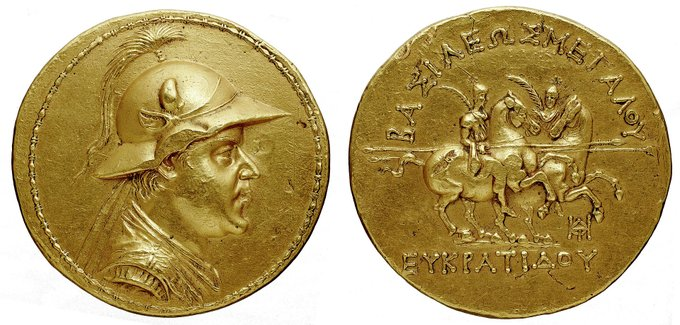
Apparently he was aligned to Parthians...
I will leave this here, as I have no idea what to do with it... 🙂


