Showing posts with label Neolithic Balkans. Show all posts

Monday, 29 April 2024

Ama

The Sumerians wrote word "ama", which means "mother" by drawing the Dingir symbol (ð’€­) which means god, inside the symbol for the house. Does this indicate that the mother, birth giver, is the divine force which turns four empty walls into a home full of life?


In Neolithic Balkans house was equated with the mistress of the house, the oldest mother living in the house. Literally...

Early Neolithic figurines from Macedonia depicting anthropomorphised house and bread oven...They are symbolically equating Woman, Mistress of the house, with the house and the bread oven...


This notion was preserved in the Balkans until today...Until recently, in Makedonija, there was a ritual in which bride and groom entered the groom's house for the first time between the legs of his mother, the mistress of the house, who stood on two chairs...This equated the Mother (Baba means grandmother, mother, birth giver) with the House and the Family...


I talked about this in my post "Mistress of the house"...

Sunday, 5 December 2021

Solar bull

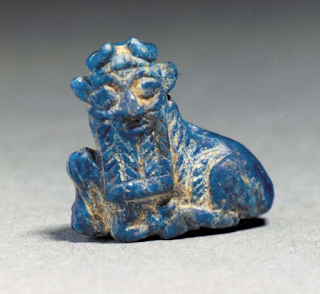
Sumerian lapis lazuli amulet of a bull, early dynastic iii period, 2650-2350 b.c. the reclining bull with bearded human head, curved horns...Sold by Christies...

Who's this guy?

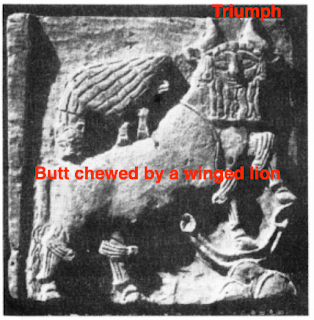
Well, Utu / Shamash, the sun god...

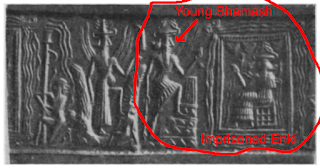
Every spring, the sun god Utu / Shamash climbs the holy mountain (Abzu) to free Enki / Ea, the god of sweet water from his icy prison...I talked about this in my post "Shamash young and old"...

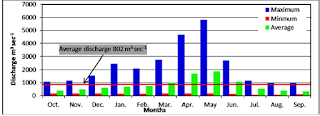
This freeing of Enki is an euphemism for snowmelt, in the mountains north and East of Mesopotamia, which are the source of Tigris and Euphrates. Snowmelt contributes more than 70% to the annual water flow of these great rivers. And this water flow peaks at the beginning of summer, Apr/May in Taurus...

Tigris annual flow chart:


Euphrates annual flow chart:

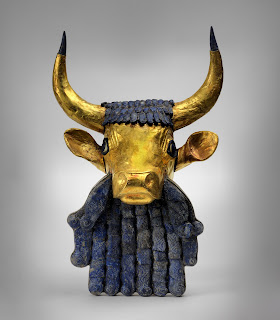
Which is why Shamash is depicted as a golden bull with long flowing "lapis lazuli" (water) beard...


Or as a lapis bull with human head...

"Enki placed in charge of the whole of heaven and earth the hero, the youth Utu (Shamash), the bull standing triumphantly, audaciously, majestically...the great herald in the east of holy An...with a lapis-lazuli beard, rising from the horizon..." 

Do you want to know why there is a winged lion chewing on the butt of Utu / Shamash? I talked about this in my post "Butt chewing"...

Anyway, we can see that in Mesopotamia bull with a human face and beard was a solar symbol...

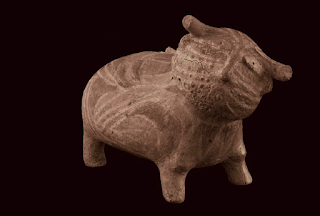
What is amazing is that few thousand years earlier in the Balkans we find this guy...

Oh hello there, gorgeous 🙂 A Neolithic bull with human face and beard from Bulgaria...Karanovo Culture, 5th mill. BC...


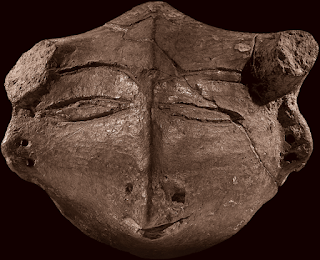
Another neolithic depiction of a bull man from Bulgaria...Tell Rousse, 5th mill. BC...


This version of the bull man seem to have been popular across Neolithic Central Europe...

This 7,000-year-old ceramic horned face pot shard, was discovered in Poland. The object was found during the excavation of the Early Neolithic site in Biskupice, southeast of Krakow... 


Now we don't know if this bull man was also a solar bull, like the Mesopotamian one...

But we know that until recently bull was seen as a solar animal in the Balkans...

In Serbia and Bulgaria there are legends about monstrous bulls who lived in lakes and to whom local people sacrificed young girls...Anyone reminded of any famous legends? 

And around one lake in Serbia, there are two versions of the same legend, one talking about a bull living in the lake, and one talking about a dragon living the lake...I talked about this in my post "Water bull"...

Sooo???

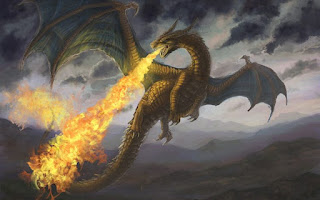
Now we know that dragon of a fire breathing variety, is a symbol of the summer, and particularly the end of summer, Jul/Aug, the hottest and (usually) driest part of the year, the time of droughts...Dragon was used as symbol for dry hot part of the year in Eurasia since Neolithic until today...I talked about this in many of my posts, for instance "Dragon who stole rain", "Seven headed dragon", "Winged superhuman hero", "Is that you Gilgamesh"...

Summer which starts in Taurus, Bull...Hence the equating of bull and dragon in this Serbian legend...Which would make bull a solar animal too...

In my post Re'em, about the origin of a unicorn, I mention this Serbian riddle:

Q: "I slaughtered a bull behind one hill and the blood spurted from behind another" 

A: Sun, setting in the west and rising in the east

Another example of the deep link between bull and sun in Serbian culture...

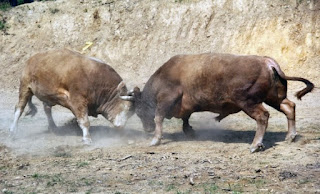
I talked about the killing of the bull of summer, which was once performed in the Balkans as a sacrifice to Perun, the thunder god, on the fist day of autumn, in my post "Alidjun"...On the first Sunday (!) in August, local people also organise bull fights...Interestingly, this is also when in the past Auroch bulls used to start their mating fights...I talked about this in my post "Ram and Bull"...


How old are these Balkan legends and rituals? 

Monday, 1 February 2021

Sun on top of pyramid

In 2017, after the discovery of a strange trapezoid Natufian culture "shrine" (L) with paved floor and central hearth:


I wrote an article asking is there a link between it and and Lepenski Vir trapezoid houses (R) with paved floors and central hearths...

As a link I proposed Pre Potery Neolithic A and B cultures of levant, which were established by the descendants of the Natufians...

They, just like Lepenski Vir people buried their dead under the floors of their houses. And they plastered the heads of their ancestors, and displayed them in their settlements...

Well Lepenski Vir people made stone heads and displayed them in their settlements...

Well, I just found out today that it seems someone else pointed at possible link between Lepenski Vir culture and Pre Pottery Neolithic Levant cultures. In 2007...

Dusan Boric from Columbia University. In his article "The house between grand narratives and microhistories: a house society in the Balkans" he says that:

And then

And that's all 10 years before the discovery of the Natufian trapezoid "shrine"...You should read his article. It's an interesting one. The archaeologists who excavated Lepenski Vir, believed that the trapezoidal houses developed from shrines and were sacred "house-shrines"...

They believed that the people from Lepenski Vir built their houses to resemble the rocky outcrop, cliff, hill, called Treskavac, which is clearly visible from the settlement site...


The hill looks like a flat top pyramid. The houses look exactly like the hill. They are equilateral triangles with the cut off top...

But why would anyone bother building houses that look like a hill? Because every summer solstice, at sunrise, if you stand at the Lepenski Vir site, you see this. The sun on top of the pyramid...

I mean that will leave an impression, right? Now we are talking about 6300-6000 BC...And people in the Balkans being obsessed with sun on top of a pyramid. So much so that they built house-shines in its liking...

Do you think this is where the idea that "pyramids are cool" comes from?

Here is something interesting about these Mesolithic pyramid worshipers. The carried two very interesting haplogroups: I2 and R1b. The I2 are generally accepted as being Neolithic "Old Europeans". But R1b are generally thought to be Bronze Age "Invaders from Eurasian steppe"...

It seems reality is different from "generally accepted and believed" things...From the pyramid worship point of view, it is very very very interesting that these Lepenski Vir R1b people seem to have dispersed in all directions...Some time around 6000BC...

The earliest R1b R-V88 sample from Lepenski Vir is about 11,000 years old. From the Balkans, these individuals at some stage, in one or many waves, moved to Ukraine, where their eastern expansion ends. They also moved north, to Germany, and south, to the Mediterranean.

One theory is that at some point all R-V88 lived in Sardinia and that around 7,500 years ago some of them crossed from Sardinia into Africa. It is also possible that RV88 arrived to Africa through Levant. But to Africa they arrived, before any pyramid was built there...

Some of these R-V88 carriers moved from the coast towards, what was then, Lake Mega Chad, a much larger version of Lake Chad, that existed during the Green Sahara period, which lasted until 5,500 years ago...

As the area became dry, they moved further and further south. They lived in the oases, rivers, and lakes of Niger, Cameroon, Chad, and Nigeria. Their genes are today found in west African populations...

But not all of the R1b R-V88 moved into African Interior. They show up today throughout the Mediterranean, including Spain, Malta, Lebanon, Egypt, and amongst Jewish populations...You can read more about R1b distribution on Eupedia R1b page...

Were some of them among the people who one day, all that time ago, stood on the Giza plateau looking at the vast emptiness before them and said: you know what would look great here? A pyramid. To remind us of the Old Country...

One thing that really puzzles me. Lepenski Vir culture was both territorially and numerically small, at least based on the archaeological data. Yet, they managed to cross half the world, spread all over Mediterranean and central Africa. How?

In Cameroon alone their descendants make up 90% of the male population...Something is wrong here...

I think we are missing something important...

Tuesday, 2 June 2020

First toast

The Baden culture, c. 3600–2800 BC, a Chalcolithic culture from Central and Southeast Europe (Czech Republic, Hungary, Poland, Slovakia, Serbia, Romania, Austria), could be the culture which started the production and ritual drinking of alcohol in Continental Europe...


At least this is what Miloš Spasić from Belgrade City Museum claims in his article "The first toast: the story of Baden culture cups from Belgrade City Museum"

He bases his argument on the fact that Baden culture archaeological sites are the first sites where we find sets of drinking cups, all made identically, found together with pitchers...


His explanation is that these were alcohol drinking sets used for communal feast ...

The making and communal consumption of alcohol is just one of the things Baden culture is credited with. The other are the initial use of dairy products, domestication of the horse, introduction of animal-drawn carts, various innovations grain agriculture and textile production.

That making and consumption of alcohol was a complete cultural shift can be seen from this map of Eneolithic sites in Belgrade area. Vinca culture, technically advanced civilisation in every respect, no drinking cups. Baden culture, equally advanced, drinking cups everywhere...


The mystery is what alcohol was made and consumed by the Baden people?

Wine? Not likely due to Central European climate. Wild grapes grow much better in hotter areas further down south and east...But still a possibility, and one that the author of this article prefers...


Beer? We know that Baden people were grain farmers. So it is very likely that they did make beer. The author of this article discounts this as "the primitive beer is drank through straws from pitchers and not from cups"...Well not necessarily...You can drink it from cups too...

This is boza, a primitive malt drink (ale) made by fermenting various wheat, millet or barley. It is not filtered which is why it has a thick consistency. It has a low alcohol content (around 1%), and a slightly acidic sweet flavour. And as you can see it is drank from cups and glasses... 


For those interested in primitive beer (ale) making, here is an article I wrote few years ago...

Another possibility is Kumis, a fermented dairy product traditionally made from mare's milk with between 0.7 and 2.5% alcohol...If Baden people domesticated horses and made dairy products, they could have also stumbled across Kumis while fermenting mare milk? This is kumis drinking set from Kazakhstan. Looks familiar? 


So what was the drink of choice at Baden culture parties?

Well you know what they say: it's not what you're drinking it's who you drink it with...