Showing posts with label Medieval archaeology. Show all posts

Thursday, 4 March 2021

Monastirište


Are local legends true? And is Monastirište, a plateau in Crna Trava area of Eastern Serbia, which has always been treated by the local villagers as a sacred place, rally the location of an Early Christian monastery?

Well yes 🙂 The geophysical data showed the church walls at the depth of 2,8 meters and many other walled structures located even deeper... 

Short documentary in Serbian:

I just love the fact that archaeologists get "surprised" every time they find an ancient fortress at the place local villagers call "gradina" or "gradište" or "grad" (all meaning city, fort, place where city, fort once stood)...

Or when they find an ancient church or monastery at the place which local villagers call "crkvina", "crkvište" (both mean church, place where church once stood) or "manastir", "manastirište" (both mean monastery, place where monastery once stood)...

Friday, 5 February 2021

Ring with anchor and fishes

The ring, found on the hand of the buried person, in an intact early Christian grave from the start of the 3rd c. AD, found in graveyard of the Roman city of Viminacium, Serbia. Engraved with early Christian symbols, cross-like anchor and two fish...

Roman bronze coin was placed on a chest of a deceased. It was minted by the emperor Caracalla, in the early 3rd c. AD. 


Apart from the ring and the coin, the grave also contained a bronze compasses. Ring and possibly compass are suggesting that person buried in this grave was important figure in early Christian community in Viminacium.

Just so people understand why the archaeologists are so excited about this find and why they believe it was a christian burial. Christian graffiti, fish, anchor and compasses, from the Catacombs of Saint Domitilla in Rome 

Compass is sometimes used as a symbol of the Creation, and sometimes, especially in the Medieval period, God was shown with a compass in his hands, measuring the world that has just been created...For instance: The Frontispiece of Bible Moralisee, 13th c.

By the way, do you know that for measuring the heavenly dome you need compasses and for measuring the earth which lies underneath you need square? I talked about square and compasses, the tools of God, the Great Architect in this post...And about the origin of this symbol in Mesopotamia in this post...

Anyway, the discoveries from the last few years are showing that significant early Christian and Gnostic communities existed in the 2nd and 3rd c. AD in Viminacium, capital of Moesia Superior, a fortified Roman city which had around 30 000 inhabitants...

Site of Viminacium covers area of 450 hectares, and so far, only 2% have been excavated. Archaeologists say that there is enough material for the next 300 years of digging and exploration...

More than 14 000 graves and tombs with more than 30 000 interesting and valuable grave goods inside them have been found at Viminacium necropolis, which makes it the largest Roman cemetery in the world...

Unfortunately, most of Viminacium’s remains were found at the foot of a massive coal-fired power station and above the coal mine deposits, and archaeological excavations are hurriedly carried out before new units of the plant and intensive coal mining devastate this ancient site.

What these discoveries are proving is that Balkans was a centre of Early Christianity. When Serbian archaeologist Djordje Jankovic claimed the same thing years ago, he was ridiculed...But now his claims are being vindicated...

Jankovic based his claims on the discovery of these two 1st c. AD bronze rings, with engraved fish, good shepherd and palm branch! 
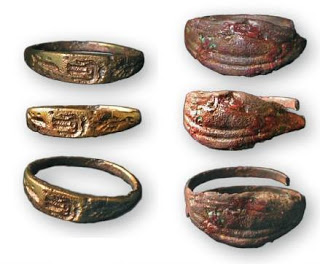
These are the oldest christian rings found so far. They were found in Židovar, an archeological site near Vršac, Serbia. I talked about this in my post "Church on threshing floor

Interestingly, Slavic legends claim that "Slavs were Christianised in the Balkans by St Paul". 

Which places Christian Slavs in the Balkans in the 1st c. AD...I talked about this in my post "St Paul among the Slavs"...

So were there any Slavs among the Christians from Viminacium?

Tuesday, 7 March 2017

Glavica tumulus

Yesterday while I was writing my post about Glavica cemetery, I had this nagging feeling of Déjà vu: calotte shaped isolated hill with many medieval graves dug into its sides. Protected from destruction and looting by a local taboo...

But by the time I have finished my article I still couldn't put my finger on it. So I published my article, went to have dinner, and then it hit me. Suddenly I knew where I had seen something like that before. 


Gruda Boljevića tumulus is one of the most interesting and most important archaeological sites of the Montenegrin Late Copper - Early Bronze age. It is also probably one of the most important archaeological sites found recently in Europe. 

The reason why I believe that this tumulus is so important, is because it shows that the dolmen building, golden cross disc making culture which developed in Montenegro in the first half of the third millennium BC, has its direct cultural roots in Yamna culture of the Black Sea steppe. Why is this important? Because the gold cross discs found in this tumulus and other Montenegrian tumuluses are later found in Beaker culture sites in Ireland and Britan. And the Irish annals tell us that the Early Irish who brought with them metallurgy and gold migrated to Ireland from Russian steppe, via Balkans and then Iberia. Gruda Boljevića is the last and most important piece of evidence which confirms that the Irish annals contain not pseudo histories, but real histories which talk about events that happened in the 3rd millennium BC...

But Gruda Boljevića is also interesting in another way. 


Tumuluses are well known archaeological features in Montenegro, which is why Gruda Boljevića was also assumed to be a prehistoric grave even before the excavation. The local legend says that two wedding parties met and fought and that the victims of this tragic fight were buried under the Gruda Boljevića tumulus. This type of legends is often linked to ancient burial type archaeological sites in Serbia, Bosnia and Montenegro. I already wrote about this type of sites in my post about wedding party graveyards. So it was assumed that Gruda Boljevića was one of such ancient burial sites. This assumption was confirmed during building of a house south of the tumulus, when one of many medieval stone cist graves,  which were dug into the original bronze age tumulus was discovered. This is the plan of the Gruda Boljevića tumulus with the locations of the medieval graves in and around the tumulus.

The Medieval graves fall into two types: 

Stone boxes with gable roof like tops


Stone boxes with flat tops


The skeletons found in these medieval graves date from the period 12-13th century. 


Graves were full of grave goods which show strong cultural links to both coastal regions of Montenegro and the inland regions of Serbia particularly the Morava valley. Here are some examples of the grave goods found:


The above mentioned legend and knowledge of the existence of the graves, saved the mound from destruction, which was not the case with other mounds which allegedly existed nearby. You can find additional information and detailed description of the tumulus in the article entitled "Podgorica praistorijske humke i srednjovjekovne nekropole Gruda Boljevića".

Gruda Boljevića tumulus had an irregular shape and had a diameter of 24 m.

Now have a look at this satellite picture. It shows the location of the Glavica hill cemetery. 


You can see an isolated perfectly circular hill covered in oak forest. The bottom left is the fenced off area with the new cemetery and the chapel. 


This is the side view of the hill. You can see that it has flat calotte shape typical of tumulus hills. 


So the big question is: is Glavica hill a tumulus, which was, just like Gruda Boljevića, reused as the burial ground during medieval time?

Here is a picture of the graves near the summit of the hill with the holy oak and the altar:


Is it possible that all these graves are dug into the side of the tumulus?

Now if Glavica hill is a tumulus it is truly gigantic. Judging by the Google maps it is about 70 meters in diameter. Compare that with Gruda Boljevića which is only 24 meters in diameter.

And finally, if Glavica hill is a tumulus, what period does it date from? If it is from the Early Bronze Age, like all the other tumuluses I wrote about in my series about Montenegrian tumuluses, then we should expect a central cist grave with additional secondary Bronze and Iron Age burials dotting the hill hidden among the later Medieval ones. If however this tumulus is from the Late Bronze age, or Iron Age, then it could, potentially, hide a spectacular untouched huge burial chamber of someone very very important. 

But as I already said in my post about Glavica cemetery, there is no money or will or interest to do any additional excavation on the site. 

Maybe this post might spark some new interest. Hopefully by archaeologists and not treasure hunters...

I want to thank my friend Aleksandar Tešić for this picture of the Glavic hill and for the additional pictures of the actual graveyard inside the forest. 

Monday, 6 March 2017

Glavica cemetery


Holy oak grove covering Glavica (Head) hill in South Western Serbia hides a mysterious medieval Serbian cemetery. Thousands of huge stone monuments of unusual shapes cover the conical hill. They are all placed in circles around a huge ancient oak tree which grows on the hill's summit. Next to the oak trunk stands a stone altar table. 


People were buried in this necropolis between 12th and 18th century. Monuments are of various shapes and sizes and some are truly enormous. A lot of them are finely carved with religious (Christian or Pagan or Fusion???) images


The most unusual ones are the huge carved stone blocks in the form of fish, like this one. 


Similar fish shaped tombstones were also discovered in medieval Serbian cemetery in Mali Zvečan near Kosovska Mitrovica.

The cemetery is located at the very end of a fertile Deževo valley below the steep slopes of Mount Golija, near the village of Ljuljac. The valley is locally known as the "Valley of the kings" because it once was the location of the court of the Serbian Nemanjić family. 


The only reason this cemetery has remained intact and undisturbed by the treasure hunters is the fear of disturbing the holy ground protected by the holy oak forest and the ancient holy oak in its center. The hill is considered a taboo place by the local villagers. 

Unfortunately there is no money, or interest, for any further archaeological investigation of the site. 

Saturday, 18 February 2017

Pendant

This is a pendant with an image of a bull and and what looks like seven bees or seven women. It was found in Ryazan area of Russia, and is attributed to Radimichi (related to Vyatichi), an early medieval Slavic tribe. Pendant, one of many found in Radimich kurgans, is dated to 11th - 12th century AD.  


What does this pendant represent?

The constellation of Pleiades (also known as seven sisters or seven maidens) lies on the neck of the constellation Taurus (bull)...


According to old writers, for instance Virgil book 4, bees only collect honey between the helical rising and setting of Pleiades (May to November). Funnily this period spans 7 months, the same number as the number of stars (bees or maiden sisters) of the constellation of Pleiades...