Showing posts with label Christianity. Show all posts

Wednesday, 13 November 2024

Sun eyes

Skull with plain amber discs on clay in eye-sockets Grave 275. Dated to the 4th millennium BC. Zvejnieki cemetery, Latvia. Researched by F. Zagorskis. Photo by A. Butrimas...

On the skulls with red ochre and clay round amber discs (sometimes rings) were found stuck intentionally into eye sockets as "replacements" for the eyes. In all those cases, the amber pieces have a large, centrally placed hole...

Obviously to resemble eyes...

The graves of the same culture also contained perforated amber disc with "sun cross" design...

Amber disc (obverse (sun cross), reverse (sun rays) and cross-section) from Daktariškė 5 Neolithic settlement...

In 1956 Eduard Šturms presented the first overview of Amber artefacts in Eastern Globular Amphora Culture and interpreted them as symbols of the sun and (male) sun god, as they were (apparently) found in men's graves...

All the researchers agree that amber was regarded as a "sun stone", because of its colour and the way it reflects light...


So, to me it is obvious that the perforated amber "sun" discs that were inserted into diseased eye sockets directly linked sun and sight...

I talked about the same idea here:

Utu, Sun: 𒀭𒌓

According to this table, this means god, heaven + day = sun...
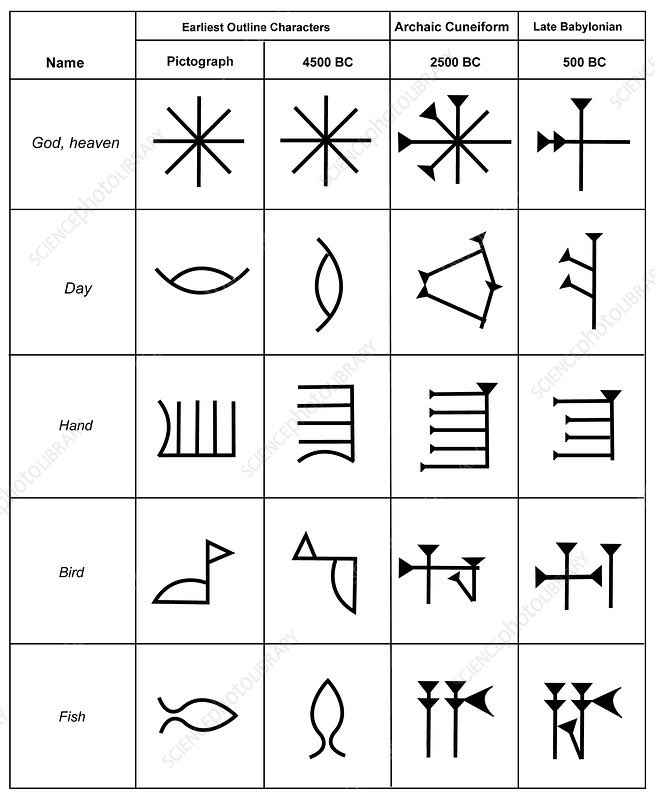
Did the god sign originally mean shiny thing? Did the day sign originally mean "eye"? 

If so: shiny thing + eye = to see = sun? 

Like Slavic Svetovid = light + to see  

I talked about this in my post "Svetovid"...

Now, check this out:

Irish "súil" (eye), from Old Irish súil (eye), from Proto-Celtic "sūle" ("two suns"), dual of "*sāwūl" (sun), from Proto-Indo-European "*sóh₂wl̥" (sun). 

Officially: The change in meaning in Irish is apparently due to the mythological view of the sun as the "eye of the sky"...Or maybe because sun (light) gives us sight...

More info on amber sun discs can be found in this article...

This sun cross thing can explain this petroglyph The Sun in the ship. Rock engraving. Sweden (after R. Rimantienė)...

How? The sailing season in the Baltic Sea and White Sea starts in Apr/May...At the beginning of summer...I talked about this in my post "Bes", about petroglyphs from Lake Onega in Russia...

BTW, while the Globular Amphora guys were making their amber sun discs, the guys from Late Neolithic Vasagård archaeological site located on the southern side of the island of Bornholm, Denmark, were making these: sun stones...I talked about this in my post "Sun stones"...

Oh yeah, and guess who also had a cross as his symbol...Mesopotamian sun god...

This is the 860BC-850BC Middle Babylonian limestone "Sun God Tablet", currently in the British Museum.

And in this article, "Sun god tablet", I tried to add few bits of information that will help us understand some of the symbols depicted on this tablet...
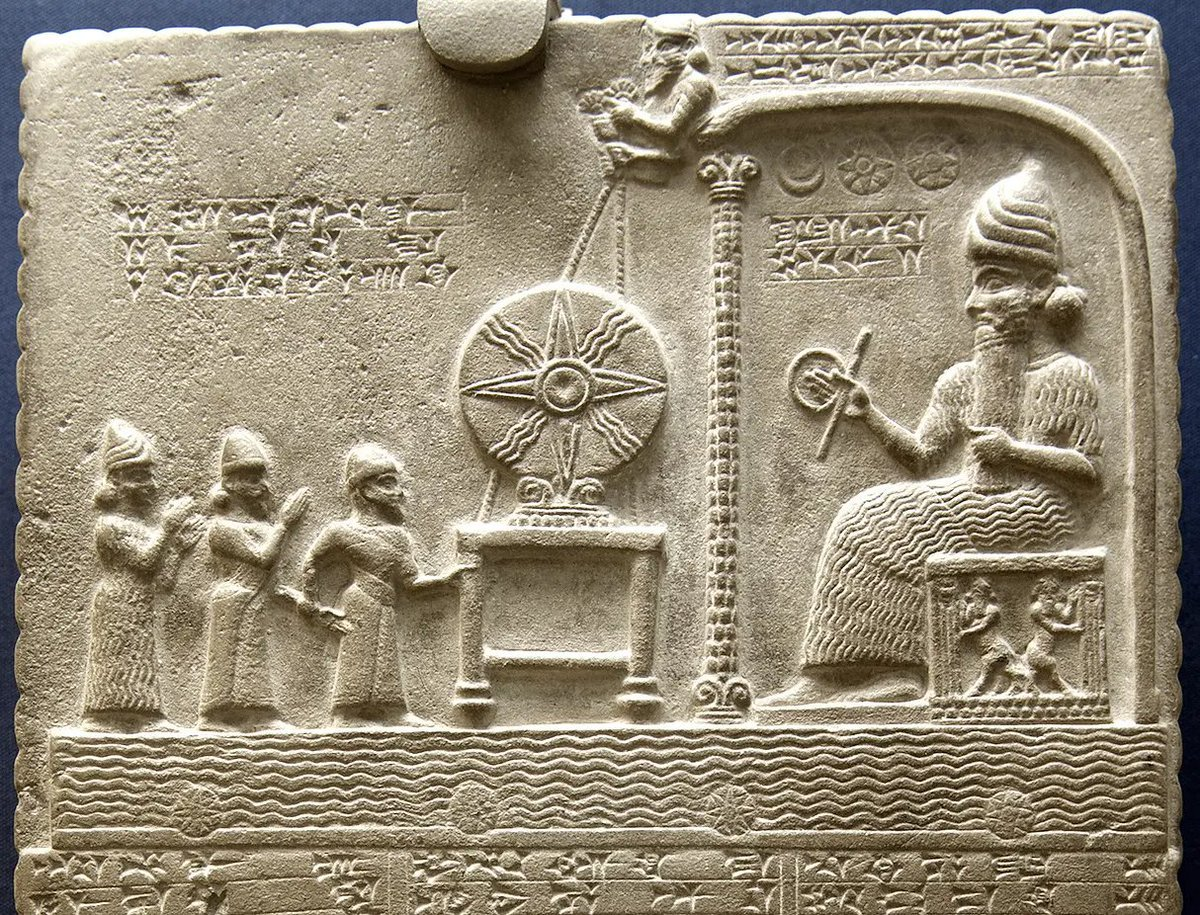
Finally don't forget this...I almost did. I should have posted this right after the post about the eye-sun link in the Irish language...

Basalt Idol (?) depicting a humanoid figure with spiky hair (sun rays?) and torcs (gold lunula like this one from Ireland?) around the neck. 


Ciudad Rodrigo, Spain. Early-Middle Bronze Age. Museo Archaeologico National in Madrid. Pic: Mark Vyvyan-Penney...I talked about the Irish gold sun bling in my post "Or Ireland's gold"...

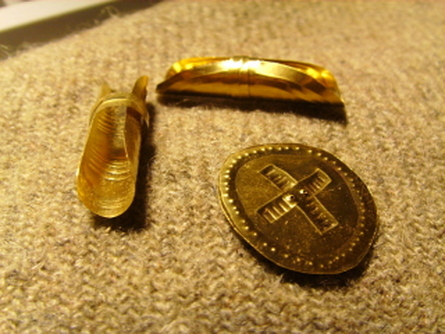
I will talk more about sun crosses soon. Just discovered something interesting related to this on Malta...For people who are wondering why I omitted Bell Beakers and their golden sun crosses...
Almost forgot this. Christ as the sun-god Helios/Sol, 3rd c. AD, Vatican. Christ is born on Winter Solstice, (re)birth day of the sun (god), he enters Jerusalem on a donkey, "animal of the (sun) gods and kings", and gets put on a cross, symbol of the sun (god). Interesting. I talked about this in my post "Alexamenos graffito"...


Finally, I promise 🙂 According to Slavic folklore, west is where the entrance to the other(under)world is. Why? Cause this is where sun enters the other(under)world. Hmmm...Did the "sun disc eye for the dead" dudes also have a notion of this?

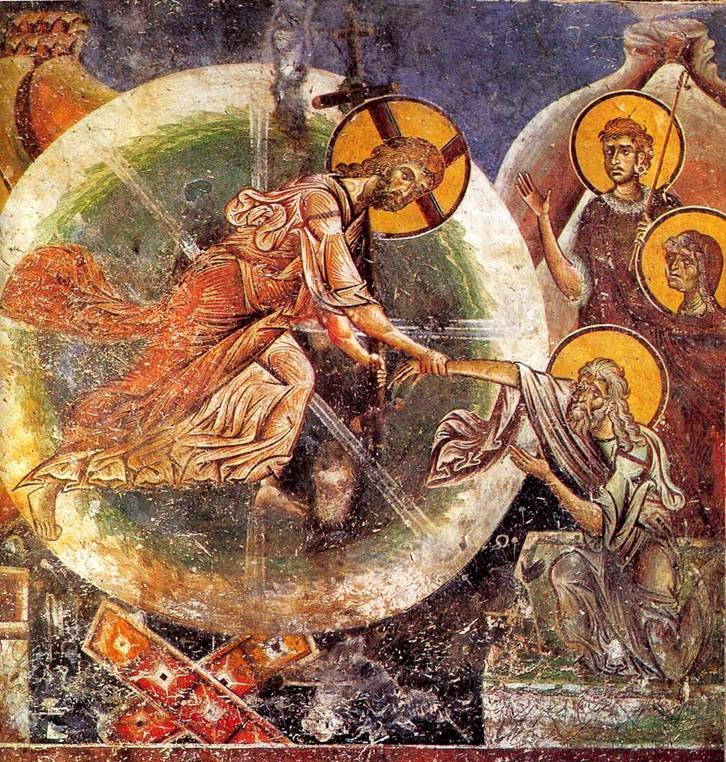
One of my favourite frescoes: Christ's descent into Hades, fresco from the 12th c. Church of St. George, Kurbinovo, Macedonia...Stunningly beautiful, it is also super unusual and interesting.

Article "Descending to Hades", about the Sun God as the ruler of the land of the dead.


Tuesday, 27 February 2024

The damned

 A strange medieval stone panel in the National Museum of Ireland. 

It is thought to date to around the 15/16th century. It depicts the Devil (in the form of a dragon) driving the Damned (in the form of goats) into Hell.

It is funny that when it comes to animal calendar markers, goat is the symbol of winter (Nov-Apr)...And a fire breathing dragon/snake is the symbol of summer (May-Oct)...

Have you ever thought why in the Book of Revelation, Satan appears as a Great Red Dragon? And why hell is burning hot? Did you know that in Levant, Mot, the god of death, the enemy of "The God", Baal, The Devil, was equated with sun? I talked about this in my posts "The oldest Arabic poem", "Anat"...

The burning late summer sun, which causes droughts and creates hell on earth...


This guy, the "monster" which is hot dry Mesopotamian summer. 


Depicted using animal calendar markers: starts in Apr/May, Bull head, Taurus, peaks in Jul/Aug, Lion body, Leo and ends in Oct/Nov, Scorpion tail/Eagle wings and talons, Scorpio/Eagle. I talked about this in my post "Angra Mainyu"...

Deified animal calendar marker at its best. Nergal, the god of death, personification of the destructive sun, as a man-lion.

Leo marks the beginning of the Eurasian lion mating season. 


It also marks the hottest and driest part of the year in Mesopotamia...I talked about this in my post "Winged superhuman hero"...

You know the dragon...


The dude depicted on this very interesting metal plaque from the so called "Let­nit­sa Treas­ure", a 4th c. BC Thracian hoard discovered near Let­nit­sa, Bulgaria...Depicted as part of one of the most common themes from Balkan fairytales: a princess being kidnapped by a dragon...I talked about this in my post "Letnitsa treasure"...

On the other hand goat is symbol of rain, (water of) life...Because in Mesopotamia, Iran, Levant, Eastern Mediterranean, rains arrive when Ibex goats start mating, in Oct/Nov...


I talked about ibex goat as "Goat of Rain", an animal calendar marker linked to rain, and cool wet half of the year, old Mesopotamian winter, in many posts, such as, "Problems with Abzu", "Relief from Dur Sharrukin", "Goatfish", "Flamingos from Susa", "Goat carrier", "Iranian goat of rain", "Strider", "A vessel from Tepe Hissar"... 

BTW, Baal, The God...was the rain god...

So what we have depicted on this Irish relief is "Triumph of (summer, sun) evil over good (winter, rain)"???

Interesting, right?

BTW, this has nothing to do with Mathew 25. I talked about Mathew 25 in my post "Goats and sheep"...

Last Judgement, Basilica of Sant'Apollinare Nuovo, Ravenna, Emilia-Romagna. Italy, 5th-6th century

In it I explained that this Christian scene is inverted, a mirror image of the celestial scene. The blue cold angel is St Mitar (Martin), Samhain, the beginning of the winter. The red angel is St George, Beltane, the beginning of the summer. Between them is Imbolc, the beginning of Spring...


But now, that I know a lot more about animal calendar markers, and the link between Old Mesopotamian religions and Christianity (check my post Alexamenos graffito), I think that I was wrong, and that this Christian icon actually depicts this:


The blue cold angel is St Mitar, Oct/Nov the beginning of the winter, cool wet half of the year, marked by a goat. The red angel is St George, Apr/May, the beginning of the summer. Between them is Sun, Shamash, "who came back" (sun reborn at winter solstice) pointing at ram (Mar/Apr)...

I talked about goat and ram animal calendar markers in my post "Goatfish with ram head"...

Sacrificial lamb actually, as ram (Aries) has to be killed (has to end), so summer, the domain of Shamash, can begin in Taurus...I talked about this in my post "Aries must die" about the sacrificial lamb...

Or, if we remember this stuff from my post "You will trample great lion and serpent":

God most high...Happy summer solstice guys...

Snake: Apr/May, beginning of the main snake mating season, beginning of summer.
Lion: Jul/Aug, beginning of the main lion mating season, end of summer.


And the fact that Christ is sitting on a throne, then maybe, the Mathew 25 actually depicts this:


And the Christian scene is not inverted, mirror image of the celestial scene. But the actual  symbolic depiction of the Sun God on his throne...

I just wonder if this is sun on the summer solstice, or is this sun in Leo, The Dragon...Nergal...


Unfortunately, the more I learn about all this, the more I am convinced that the last is true...

To read more about ancient animal and plant calendar markers, start here…then check the rest of the blog posts related to animal calendar markers I still didn't add to this page, and finally check my twitter threads I still didn't convert to blog post...I am 9 months behind now...

Saturday, 28 January 2023

Merovingian Christ

Terracotta plaque from Auvergne (Auvergne-Rodano-Alps, France). Merovingian era, 5th-6th century AD, Musée d ' Archéologie nationale et domaine national de Saint-Germain-en-Laye...


A very strange thing indeed...

"Accepted opinion" is that this plaque "depicts Christ with the sword, victorious over the forces of evil represented by the submissive serpent. In his right hand he squeezes the Moon (the lunar crescent), and in the left a torch with the flame facing upward"...Hmmmmm....

First, is this a torch or a spear? You know something like a thrusting spear...Like these ones? Did they exist in Europe in the 5th -6th century?

And If it's a torch, isn't  "torch (light) bringer (carrier)" direct translation of "Lucifer"? Would you really depict Christ like this?

Second, is this a moon or a shield or a mirror? If it's a moon, then the torch could be Venus, the morning star...Lucifer....

Third, what's with the round, very "sun like" face of "Christ"? And would you place cross on Christ's forehead?

Fourth, what is this on "Christ"'s head? A diadem? Strange thing for "Christ" to wear...Or is this a sun rays crown? Just like the one worn by Sol Invictus? Or a crown of thorns?

Fifth, what's with the funny ears? Are these lion's ears? Why would "Christ" have lion's ears? Or maybe this is not Christ at all, but sun in Leo...Have you seen this artefact from 11th c.? Lion (end of summer) killing snake (beginning of summer) under the head of Helios? I talked about it in my post "Lion killing snake"...

BTW

The reason why snake symbolises (is an animal calendar marker for) the beginning of summer, Apr/May, is because the most common Eurasian snakes start mating in Apr/May...

The reason why lion symbolises (is an animal calendar marker for) the end of summer, Jul/Aug, is because the Eurasian lions start mating in Jul/Aug...

Sixth, the only thing that looks as it should be is the snake...And honestly it doesn't look very submissive to me...It is looking at "Christ" and not away from him...And it's not like "Christ" is stomping on it, which is usually taken to mean "subduing, vanquishing"...

Like on this mosaic from Ravenna depicting Christ the warrior stomping on lion and snake, made during the same period as the Merovingian plaque. And even this can be interpreted in several different ways, like any symbol can...I talked about it in my post "You will trample great lion and serpent"...

So maybe the snake is just there looking at the "Christ" because that is not Christ at all. It is the Sun...And snakes love sun...After all they are solar animals...

They are in our world when sun is in our world, during the day and during the warm half of the year. And they are in the underworld when sun is there too, during the night and during the cold part of the year...I talked about it in my posts "Enemy of the sun", "The chthonic animal", "Bactrian snakes and dragons", "Dragon who stole rain", "Letnitsa treasure"...

And is this why "Christ" has a cross on his forehead? Cause this is not Christ at all, but some Sun god who was Christianised...Baptised..."The priest imprints a cross on the forehead...as a sign that he or she belongs to Christ"...

Not that he is Christ...

Anyway, as I said, a very strange object indeed...But who knows what was going on through the minds of the early European Christians...Anything is possible....

To read more about ancient animal and plant calendar markers, start here…then check the rest of the blog posts related to animal calendar markers I still didn't add to this page, and finally check my twitter threads I still didn't convert to blog post...I am 9 months behind now...

Saturday, 19 February 2022

Living nature


If Christ is life, living nature, then his immaculate conception and virgin birth become easy to understand...

If Christ is life, living nature, then his death and resurrection become easy to understand...

If Christ is life, living nature, and we are part of life, living nature, then we are Christ. We truly live and move and have our being in Christ...This too then becomes easy to understand...

If Christ is life, living nature, then god who became matter is easy to understand too...

If Christ is life, living nature, then we are all Christ, we are all god. Just like the mystics the world over have been teaching for millennia...

Apparently this is too "Pagan" for "Christians" and too "Christian" for "Pagans"...So everyone gets offended...

Tuesday, 26 January 2021

Heavenly throne


Remains of an early Christian basilica, built in 4th c. AD and abandoned in 6th c. AD. It was built on a little plateau called “Nebeske stolice” (Sky chairs), located 1800 meters above the sea level on the Kopaonik mountain, central Serbia...

The interior of the basilica was richly decorated, floors were covered with mosaics, while walls were painted with frescoes. Size of the basilica and its lavish decorations are suggesting that it was connected to a large nearby settlement, whose remains are yet to be found...

I mean, if you wanted to be close to god...I just love the name: "Nebeske stolice". It means "Sky chair" but could also mean "Heavenly throne"...

Thursday, 6 September 2018

Slavic pyramids

"As the Sunday dawned in the early morning after the service of the Mass had been completed, Otto, the servant of God, having put on his episcopal headdress and with the standard of the cross borne in front of him, went forth to the multitude of the people in order to preach to them. He took with him Udalricus, who wore a dalmatic, as a deacon, and Adalbert who served as a sub-deacon and others to assist in preaching. There were there some large pyramids surrounded by walls to a considerable height in pagan fashion. The good preacher ascended one of these pyramids with his companions, and through his interpreter Adalbert began to explain the way of truth to those who had gone wrong and to threaten them with eternal destruction if they did not turn from their apostasy."
This is the description of Otto's missionary work among the Slavs of Stettin, from "The life of Otto, apostle of Pomerania, 1060-1139"
Were those "large pyramids built to considerable height in pagan fashion" which Otto saw in the 12th century among the Baltic Slavs, the same pyramids Slavs all over Slavdom still make on St John's day (Summer solstice)
Like this one on the picture:


Friday, 17 February 2017

Goats and Sheep

Last Judgement, Basilica of Sant'Apollinare Nuovo, Ravenna, Emilia-Romagna. Italy, 5th-6th century

"When the Son of Man comes in his glory, and all the angels with him, he will sit on his glorious throne. 32 All the nations will be gathered before him, and he will separate the people one from another as a shepherd separates the sheep from the goats. 33 He will put the sheep on his right and the goats on his left."

Matthew 25:31-46


The new, young sun, the new solar year is born on the winter solstice day. The day after, on the 22nd of December, starts Capricorn, Goat. I already wrote about the origin of the Capricorn sign in my post "Goat". The young sun moves through the winter and arrives at the mid point between the winter solstice and the spring equinox, the point which marks the beginning of the spring, the beginning of the vegetative year. I already wrote about the angle between the vegetative and solar year in my post "Two crosses". From here the sun continues towards the spring equinox, which is the beginning of Aries, Ram (Sheep). I already wrote about the origin of the Aries sign in my post "Ram and Bull".

When the spring comes back, when the nature reawakens, Capricorn, the Goat is on the left and the Aries, the Ram (Sheep) is on the right of the SUN of Man, the bringer of life...

The Christian icon is inverted, a mirror image of the celestial scene. The blue cold angel is St Mitar (Martin), Samhain, the beginning of the winter. The red angel is St George, Beltane, the beginning of the summer. Between them is Imbolc, the beginning of Spring...More on that in my post "Two crosses"...

Sunday, 1 January 2017

Cockerel and Lion


Cockerel standing on (or above) a lion. Painting on wood. Kirovsky Regional Museum, from ethnographic material collected in Vologda region.

Middle of Leo, 2nd of August, is when Slavs used to celebrate the day of Perun, the the end of summer and the beginning of autumn. The sacred bird of Perun, the storm god, was the fire cockerel. When Christianity replaced the old Slavic pagan religion, in Serbia Perun was replaced with Sveti Ilija Gromovnik (St Ilios the Thunderer, the Thundering Sun) and the cockerel became associated with this "Thundering" saint. The cockerel, the sacred bird of the thunder god is slaughtered, cooked and eaten on the day of St Ilios the Thunderer "so that the sun would not burn the grain". This is a clear sacrifice to the Storm god for rain...Interestingly it has to be "the oldest" cockerel. Remember Perun is the the old sky god, old sun, the old head of Triglav, two other heads being Jarilo (young sky god, young sun) and Svetovid (adult sky god, adult sun)...This again confirms the link between the cockerel and Perun.

I believe that the fact that cockerel is the sacred bird of Perun, the Storm god, is why the weather-vanes placed on top of churches are in the shape of a cockerel. Weather-vanes like this one from 19th century Russia:


However the official theory is that cockerel shaped weather-vanes or weathercocks are placed on top of church steeples because of St Peter. 

In "Encyclopedia of Religions" by John G. R. Forlong we read that  "Pope Gregory I in the 6th century said that 'the cock (rooster) was the most suitable emblem of Christianity, being the emblem of St Peter'" Some say that it was as a result of this that the cock began gradually to be used as a weather vane on church steeples. In the 9th century, Pope Leo IV had a figure of a cockerel placed on the Old St. Peter's Basilica. Also in the 9th century Pope Nicholas I ordered the figure of a cockerel to be placed on every church steeple, as a symbol of Jesus' prophecy of Peter's betrayal (Luke 22:34), that Peter would deny him three times before the rooster crowed on the morning following the Last Supper.


This is the oldest surviving cock weathervane. The early ninth-century Gallo di [Bishop] Ramperto, Brescia, Italy. 


So it seems that the placing of the cockerel weather-vanes on Christian church steeples has nothing to do with Perun and everything to do with St Peter. However in Slavic folk tradition St Peter seems to have acquired a lot of characteristics of Perun. He is the Saint who Eastern Slavs pray to for rain, as we can read in the "Songs of the Russian People" by W. R. S. Ralston. 

In "Slovenska mitologija - enciklopedijski recnik" by Svetlana M. Tolstoj, Ljubinko Radenkovic we can read that Bulgarians and Russians considered 29th of Jun, Petrovdan, the day of St Peter, to be the end of summer and the beginning of autumn. Just like Serbs considered 2nd of August, Ilindan, the day of St Ilija the Thunderer, the Thundering Sun, old Perundan, the day of Perun,  to be the end of summer and the beginning of Autumn. In "Перуника – цвет небеског или хтонског света?" by Ljubinko Radenkovic we read that in Dubrovnik region people used to celebrate St Petar Bogišar (St Peter of the Iris flower). Iris is in the Balkans known as Perunika, Perun's flower. I wrote about the link between Iris and Perun in my post about Ognjena Marija

So it seems that both St Ilija (mainly) and St Petar became replacement for Perun. 

If so, is the cockerel standing on top of church steeples symbol of St Peter, there to remind people of St Peter' betrayal of Jesus? Or is the cockerel standing on top of church steeples symbol of Perun, there to protect the church from the wrath of the storm god???

And did cockerel jump onto church steeples directly out of Slavic mythology, or did Goths, who before their migration westward lived for centuries mixed with eastern Slavs, act as intermediaries?

This is very interesting indeed, don't you think?

Sunday, 17 April 2016

Majka Božja Krasanska

Holy Mary chapel on Krasno hill


This is the Church of the Ascension of the Blessed Virgin Mary which stands on Krasanski brijeg (Krasno hill) near the village of Krasno in the area of the North Velebit. There is a local legend which tells the story about how and why the church was built where it was built. This legend is very interesting and I believe very important because it is an allegory which contains, in one paragraph, the history of Christianization of Velebit population. 

This is the full text of the legend:

"Where the church stands today, there once used to be a thick old (oak) forest. In this forest local shepherds used to shelter from the heat of the summer. One day they saw a rose growing out of an old tree stump and in this rose they saw the image of Virgin Mary. The shepherds picked the rose and brought it to Krasno village. As there was still no Catholic church in Krasno, they took the rose to the "Greek" chapel in Krasno field. But the rose didn't want to stay in the "Greek" chapel. The next time the shepherds came to the oak forest, the rose was back growing from the same old stump. Then shepherds took the rose to another church in Kosinj, but the rose didn't want to stay there either. The next time the shepherds came to the oak forest, the rose was back growing from the same old stump. So shepherds realized that the Virgin Mary wants to stay in the Oak forest. So they built a stone altar over the old tree stump and the rose and then they built a stone chapel around it. "

Now here is what I believe this story actually means:

Where the church stands today, there once was a holly (oak?) grove where local pagan population worshiped the Mother Earth. Then during the early Medieval time, the Christian missionaries, which belonged to the "Greek" church tried to convert the pagans into Christianity. These "Greeks" were either pre Schism Roman Christians or post Schism Eastern Orthodox Christians which were by Catholics called  "Grko-istocnjački šizmatici (Greek eastern schismatics).  So these "Greeks" built a church in Krasno and for a while people may have even (probably just nominally) accepted Christianity. Anyway this first conversion ultimately failed and the local people returned to their old ways, and worshiping of the old gods in the holy (oak?) grove. The return to paganism probably happened because of the disintegration of the Roman power in the Balkans during the Arrival of the Slavs and the creation of the Slavic Early Medieval states. Another attempt to Chrisitanize the local highland population was made, this time by the Catholic church, probably during the Hungarian rule, but that also failed. People again returned to their old ways. This probably happened because of the Turkish invasion and occupation. Finally after the Turks were expelled from the area, the Catholic church which moved in made another final attempt to Christianize the local population. This time they realized that in order to "Christianize" the local population, they had to Christianize the old pagan temple and the old pagan god(s) to which the temple was dedicated. And this is exactly what they did. Basically the old goddess (Baba, Mother Earth) was converted into the new equivalent Christian character (Virgin Mary, The mother of god) and the chapel of the Virgin Mary was built on top of the old temple. Why do I think that the original temple was dedicated to Baba, Mother Earth? In my post "Shepherd's chapels from Velebit" I already described how old temples dedicated to Baba, Mother Earth in South Velebit were converted to the churches dedicated to the Virgin Mary. Because the same shepherd population lived everywhere on Velebit, I believe that the people in the North Velebit also worshiped Baba, Mother Earth and that the same thing happened with her temple here in Krasno. 

How important this old Pagan center was, can be seen from the fact that the newly built Church of the Ascension of the Blessed Virgin Mary became the most important center of the Marian cult in Croatia. Basically the local people continued flocking to the old (new) temple, to pray to the old (new) Goddess...

Well this is what I think. What do you think?

Source:

"Usmena predaja o gradnji crkve svete Marije u Krasnu" by Ante Glavičić