Showing posts with label Boar mythology. Show all posts

Friday, 28 August 2026

Monkey from the Erin forest

Babylonian baked clay tablet found in Iraq and dated to 2000-1600 BC. It depicts a man, with an assistant kneeling behind him, shooting with a composite bow at a monkey sitting in a tree. On the right, is a wild boar facing the base of the tree. Interesting. Here is why:

Monkeys are often depicted on Sumerian clay plaques. Like this one from Ur III (2200-2100BC), depicting a monkey wallah, a performer who trains monkeys to dance or perform tricks for an audience...

One of the most interesting things about this plaque is that on all of them a monkey is playing the flute, something it would not be likely to do in real life...

According to this paper "More Monkey Business" by Carole Mendleson, this may illustrate a fable, now lost, perhaps Elamite, perhaps Indian or perhaps even Sumerian...

Further on, the paper also says that monkeys and a word for monkeys came to Mesopotamia from Indian via Elam (Iran) during the Ur III period...

And that originally "monkey" was used as a derogatory term for Elamites. When describing an Elamite incursion, a Sumerian text states that "monkeys descended from their mountain", meaning they came from the east, from Elam, Iran...

So monkeys and a word for monkeys came to Mesopotamia from Elam (Iran) during the Ur III period...

And originally "monkey" was used as a derogatory term for Elamites. When describing an Elamite incursion, a Sumerian text states that "monkeys descended from their mountain", meaning they came from the east, from Elam, Iran...

Is it because Elam was "The land of the monkeys" figuratively but also literally? Did monkeys live in the forests of Elam during the 3rd millennium BC?

I think so. 

Ever heard of a mythical Erin forest?

My friend!  We have reduced the forest to a wasteland...How shall we answer God Enlil in Nippur?

Enkidu talking to Gilgamesh, after they have killed Humbaba, the guardian of the Erin forest, and have cut all the trees down...

I while ago I wrote this article "Humbaba" about the identity of Humbaba, the guardian of the Erin forest. I postulated that Humbaba (left) was a deified tiger who once lived in this forest...

Based on the known tiger habitats and where they intersect with Euphrates river, I proposed that the original location of the Erin forest was in Armenian highlands...

After they have cut the Erin trees down, Gilgamesh and Enkidu and their men lashed the trees together into rafts to transport them down the Euphrates river back to Nipur...

Rafts? Like this? Cool...

Then later, new data I found, suggested I might have been wrong about the Erin forest location. It looks like tigers once lived in Elam, Iran, and it is therefore possible that the mythical forest might have been located there:

How far south in Iran did tigers live during Neolithic...This article, "Tigers tigers everywhere", asks his question...And few others...

A Neo Assyrian tablet currently in the Museum of Suleimaniyah, Iraqi Kurdistan, contains a passage from the Gilgamesh Epic with the description of the Erin Forest, which is the most detailed description of nature and its soundscape in the literature of Mesopotamia...

And guess what, the description, published in this paper, contains the following lines:


The Erin Forest had monkeys living in its trees. And Elam was the monkey land...

Sooo...

The monkey hunt tablet could actually be describing an actual monkey hunt in the Erin forest...

And so the two men could be Enkidu and Gilgamesh...

Cool, right?

But this tablet is also interesting from the animal calendar markers point of view.

"Now seriously, why do you always think about animal calendar markers when you see depictions of animals?" I can hear you say. "Couldn't this be just a depiction of a hunting scene?"

Of course it could. But hear me out.

If the forest was indeed located in Elam, then the monkey has to be macaque, the only species that once lived in "areas with cold winters"...

And in the areas with cold winters macaque mating season starts in Oct/Nov...

Ok, so? Question: why did the maker of this tabled decide to depict a wild boar, just casually standing under the monkey tree? Considering that wild boar mating season is also starts in Oct/Nov?

This could of course be just a random choice of animals.  But look at this: This is the climatic year in Iraq/Iran.

The rains arrive in Oct/Nov, when macaques and wild boar start to mate, making both of them animal calendar markers for the rain season...


I talked about wild boar, archer and rain in my post "Achaemenid lion boar seal", where I give symbolic analysis of this Achaemenid cylinder seal, found in Iran and dated to the 6th–4th century BC is currently kept in the Met Museum...

BTW, in Iraq/Iran, the beginning of the rain (cool, wet) season that ends (kills) sun (hot, dry) season, coincides with the Orionid meteor shower...

Just before the rains arrive to Mesopotamia, the rains that end the drought, the arrows start shooting from the sky announcing the arrival of the Sky/Rain god, the great archer...I talked about this in my post "The invisible archer"...

Hence archer? And monkey and boar? But who knows. I am just putting it all out there, and you can decide for yourself. We'll never know.

I want to thank @NkayaMuhittin for posting the picture and the info about this tablet. Great account worth following if you like archaeology...

That's it. To read more about ancient animal and plant calendar markers, start here…Then check my twitter threads I still didn't convert to blog post...I am way way behind...

Friday, 16 August 2024

Eyeballs platter

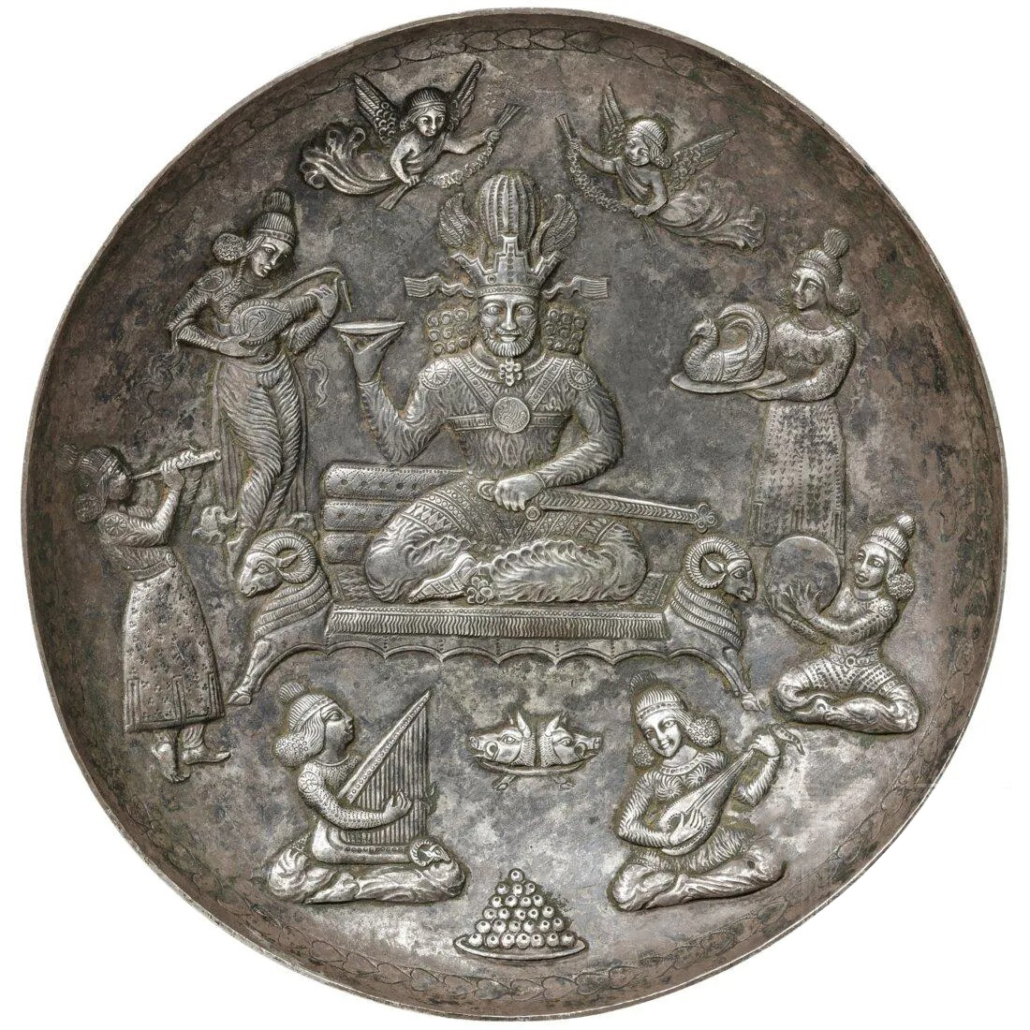
I while back I came across this late 6th or early 7th c. AD Sassanian silver bowl. 


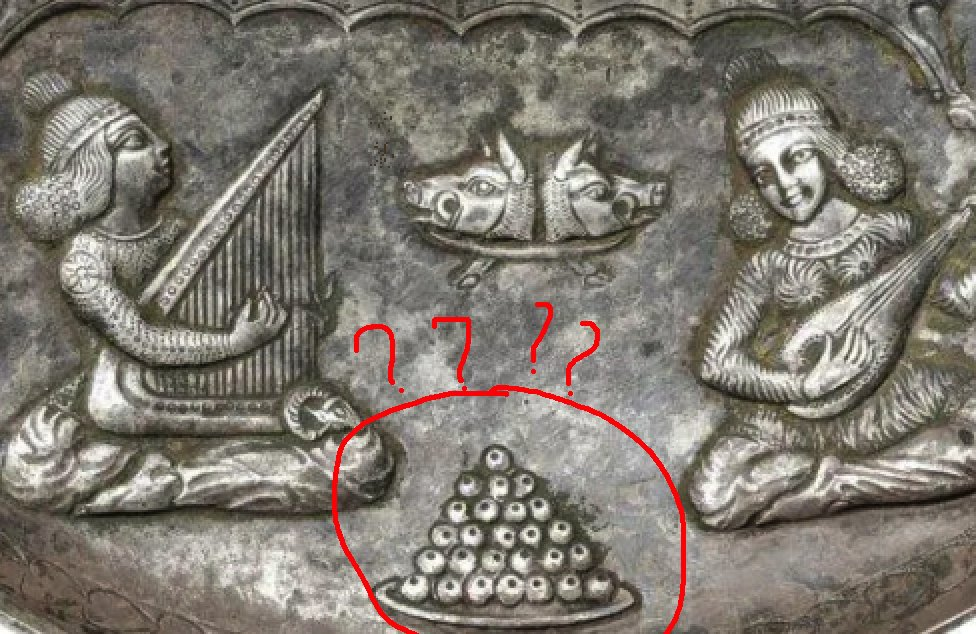
It shows a king sitting on a throne, feasting, surrounded by musicians and servants. We can see a platter with two boar heads in front of the throne and...What the hell is this??? A plate of eyeballs??? 🙂

I suggested that these were not in fact eyeballs, but Naan Gerdooee ~ Persian Walnut Cookies, or some similar type of pastry

Then, @Nazdorove posted a comment to my post reminding me of animal and plant calendar markers 🙂 and telling me that maybe I should check this plate and see if any are present in the depicted scene...Maybe that could help us determine what the mystery balls stacked on the plate are...

So I looked at the scene more carefully, and, I could see something very interesting: The "king" was seated on a throne whose legs are shaped like rams...


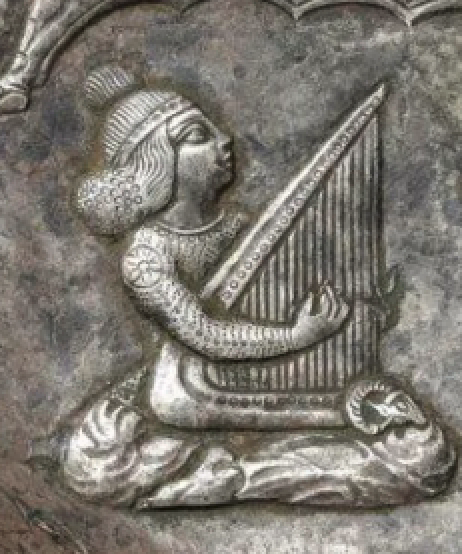
And the harp played by one of the musicians also has a ram's head. Why? I think this is a ceremonial throne and a ceremonial harp...What ceremony are we talking about here? Well...Ram...Aries...Arrives after Spring Equinox...Nowruz...Persian New Year...

Kind of an important event in the Persian calendar...Actually, the most important event...Ram is the animal calendar marker for spring, cause it is in the spring that sheep lambing season takes place...

This is why Aries marks Mar/Apr. Cause this is when the lambing season ends and milking season starts and the flocks are moved to the highland pastures. I talked about this in my posts "April" and "Aries must die"...

Why are these animals found as symbols of the seasons in Eurasia and North Africa, since Neolithic, despite Precession? I talk about it in my post "Symbols of seasons"...

But in Iran, one more thing happens in Mar/Apr...The river discharges suddenly start to increase, as a result of spring rains and snowmelt.

Hence Ram depicted lying in water from the "Zodiac from Isfahan". I talked about it in my post "Sagittarius from Isfahan"...

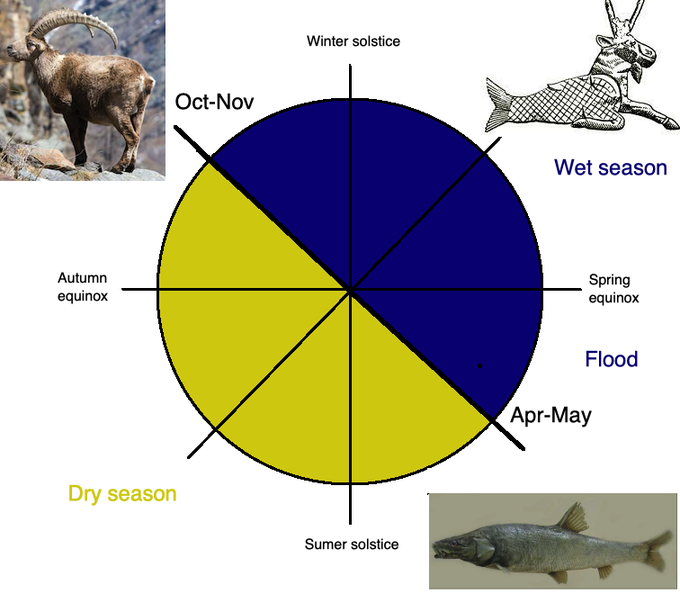
BTW, we find the same animal calendar marker, with the same meaning, in Ancient Mesopotamia too...Goatfish marks the wet half of the year, from the start of the mating season of ibex goats (Oct/Nov) to the start of the mating season of giant Mesopotamian carp (Apr/May) which is when the annual flood peaks. 

The water level in Tigris and Euphrates starts to increase in Mar/Apr, when wild sheep lamb season ends. I talked about this in my post "Goatfish with ram head"

The "King" sitting on the ram throne is having drink poured into his chalice...This could be wine, which becomes ready for drinking at the end of spring, beginning of summer (Mar/Apr/May)...Right on time for New Year festival...


Or it could be water...Symbolically depicting flowing water season...

The other servant is bringing a platter, with what looks like a cockerel, with all its feathers...Definitely not intended to be food...

If it is a cockerel, then it's another animal calendar marker for Mar/Apr.

Europe...

Cockerel was the sacred bird of Perun, Slavic thunder god, used in magic rituals for protection agains lightning.

Why? Maybe cause chicken main mating season is during the period of 14+ daylight hours.

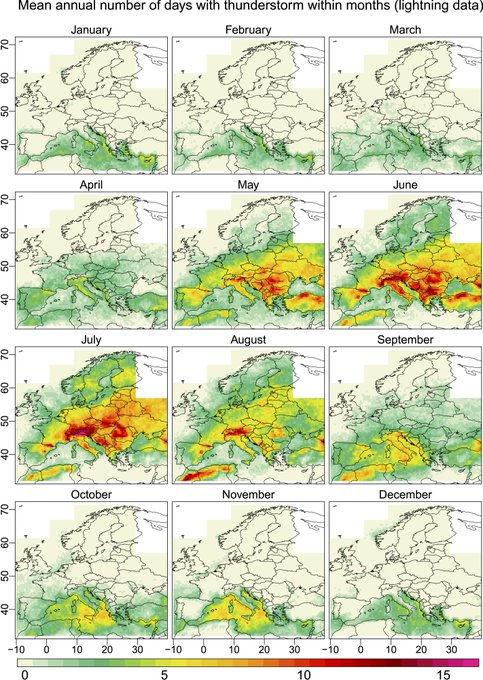
Which is the main thunderstorm season in Europe??? I talked about this in my post "Pero"...


India

Red junglefowl (Gallus gallus), the ancestor of the domestic chicken...

Has a fixed annual mating season, which overlaps with the Zebu cattle mating season...

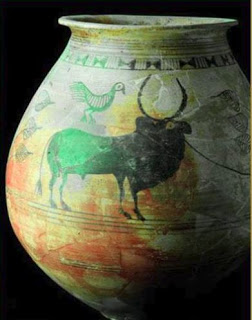
Hence, on Indus Valley civilisation pot, it is placed on the Zebu bull's back...I talked about this in my post "Kharif and Rabi season"...

China...

The real reason why The Lord of Thunder, was depicted as a cockerel is because of the China's latitude and the reproductive cycle of wild chickens, which is governed by the amount of sunlight, and at China's latitude starts in Apr/May...


Which is when the thunderstorm season starts too...

I talked about this in my post "Lei Kung"...

Interestingly, the platter placed before the "King" sitting on his Ram (spring) throne, contains two Boar heads (winter)...

Wild boar is one of the symbols of winter...Cause they mate during the winter...I talked about this in my posts: "When fish swim up Danube", "Achaemenid lion boar seal", "Souvetaurilia", "Sirens", "Summer and winter BMAC seals"...

So how can any of this help us to figure out what is on the front platter? We all know these are not eyeballs 🙂 I was joking...But what are they?

Fruit? Most people suggested pomegranates, which originate in Iran. But pomegranates season is winter...Not spring...

The fruits which are in season during Nowruz (Persian New Year festival) are bitter oranges (narenj). These things...

They are used for making sirups and in cooking and are not eaten as fruit...

So what are these round things neatly piled on the platter? I went to see what traditional cookies are made for Nowruz, and this pic popped out 🙂 Toot, Persian Mulberry Marzipan Candy...Looks familiar? 🙂

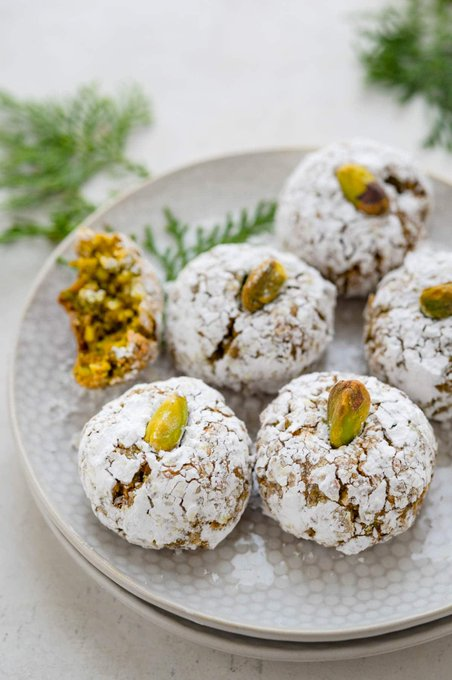
Today it's made with sugar, but originally it could have been made with crushed nuts, dates and honey...Similar to these Italian pistachio cookies...


And so...Thanks to @Nazdorove we might have solved the mystery of the "eyeballs" platter...What do you think?

That's it. To read more about ancient animal and plant calendar markers, start here…Then check my twitter threads I still didn't convert to blog post...I am way way behind...

Tuesday, 6 September 2022

Achaemenid lion boar seal

This Achaemenid cylinder seal, found in Iran and dated to the 6th–4th century BC is currently kept in the Met Museum

Now the scene depicted on this seal could be just an "ordinary king hunting a lion" scene 🙂 Although I already asked a question whether there is anything ordinary about the Persian king's obsession with lion hunting in my article "Sacred hunt"...


And in my article "King killing Angra Mainyu" I explained why I think that this was most likely a ritual in which the king imitated the rain (and war) god Ninurta/Ningirsu killing Nergal...Or "winter rain storms" ending "summer drought"...Which ever you like best...


So why lion and boar? Here's what I think:

Lion and boar are animal calendar markers depicting two halves of the climatic year:

Boar - cool, wet half of the year (Nov-Apr)

Lion - hot, dry half of the year (May-Oct)


I talked about these symbols in my article "Admetus" about Apollo and the chariot pulled by boars and lions...


Lion is the symbol of autumn (Aug,Sep,Oct)...Why? Cause the peak mating season of the Eurasian lions starts in Aug and spans the whole autumn...

Boar is the symbol of winter (Nov,Dec,Jan)...Why? Cause the peak mating season of the Eurasian boar starts in Nov and spans the whole winter...

I talked about the meaning of boar and lion as animal calendar markers, this time in Bactria, in my article "Summer and winter BMAC seals"...


In Mesopotamia, autumn is the hottest, driest part of the year. The time of death...And the ruler of the season of death was Nergal, "the destructive sun", the god of death, who was imagined as a lion...I talked about this in my article "Winged super human hero"...

The summer, the season of death, which starts when lions start to mate, ends when the first rains arrive in Nov...When boar start to mate...Making lions and boar the natural enemies...Like on this Elamite axe head with Lion (Autumn) and Boar (Winter)...I talked about this in my article "Double headed eagle"...

But there is another thing that happens in Nov...Vultures, whose mating season, which spans winter months (Nov, Dec, Jan), begin their courtship aerial displays, where the pairs fly together over one another with outstretched wings...

I talked about this in my article "Double headed eagle". Like this double headed eagle dude from a Bactrian axe dated to 2500-1500 BC. 

Why double headed eagle? Cause the vultures performing this aerial dance look like this from the ground... 


The beginning of the Vultures mating season coincides with the beginning of the cool wet season (Nov-Apr), the rain and snow season in Mesopotamia and surrounding mountain areas to the north and east...


I talked about this in my article "Eagle dance"...

Which is why the old "agricultural" rain god, Ninurta/Ningirsu was originally imagined as a huge eagle with spread wings... I talked about him as a bird man in my article "Judgement of the birdman"...

But Ninurta was also imagined as an archer. Here depicted killing the blazing sun...Ninurta, the hunter, the guy with the bow and arrow...Killing The Blazing Sun (Nergal)...Sagittarius...Which marks the same moment in the solar year...The end of the half of the year dominated by the sun...The Irish will love this. Remember Balor?

I think he is the dude holding the bow on the famous Adda seal. I talked about this seal in my article "Adda seal"...

So here we come to the first interesting question: is the archer depicted on the seal Ninurta killing the deadly late summer sun which causes drought? Or is the archer a king, imitating Ninurta, killing a lion, symbol of deadly late summer sun, Nergal?

And the second interesting question: All this boar, lion, archer stuff is happening under the watchful eye of the Faravahar (the flying dude), basically a man riding on a huge bird (eagle) with spread wings...Hmmmm...

The meaning of Faravahar is unclear...Some say that this is Ahura Mazda...But that is disputed...

Some say that this is actually a symbol of Ashur, the Supreme god of Assyrians, which Pesians borrowed later. 


Just wandering...Do we actually have any written source identifying this flying dude with a bow as Ashur? I don't think so, considering that there is still a dispute what the meaning of this symbol is...

We actually don't know if Ashur was ever depicted. But if he was, this could be one of his depictions. You know one of his names was "Great mountain"...

You see how his skirt was made to look like a mountain? I wrote about this artefact in my article "Assur"...

So is the flying dude Ninurta/Ningirsu, the eagle/archer in another guise? I mean Ninurta was a super important to the Assyrians...

When king Assurnasirpal II moved the Assyrian capital city to Kalhu, the first temple he built was for Ninurta, whom he addressed as: "...the strong, the almighty, the exalted, foremost among the gods, the splendid (and) perfect warrior..."

And as I said, Ninurta was most often depicted holding a bow. Actually bow is his identifying feature. Like on this 8th-century stone carving from Assur, on which a bare-headed king worships a god holding a bow, "thought to be Ninurta". Currently in the British Museum...

If I was a warlike Assyrian, I would want Ninurta, the war and storm god, "the perfect warrior" to be my god...

And as I said, Ninurta/Ningirsu was originally a storm god who was first imagined as a storm bird with outstretched wings...Storm bird that brings the rain to the desert land of Mesopotamia...

If this winged dude is actually Ninurta, the deified storm bird, that would explain why we see this symbol so often hovering over the tree of life...It is the rain that the storm bird (storm god) brings, which supports (tree of) life in Mesopotamia...

Oh look, "winged genies" standing on both sides of the tree of life...I talked about the origin of the Assyrian Eagle dudes and their (possible) meaning in my article "Eagle dude from Alepo"...

But the Eagle dudes were found in the area of Mesopotamia/Iran/Central Asia since Neolithic...

So, now, after saying all this, I will backpaddle here and say that I actually believe that the flying dude is Ahura Mazda...As well as Ninurta...And I will explain why I think so soon...

Until then...

To read more about ancient animal and plant calendar markers, start here…then check the rest of the blog posts related to animal calendar markers I still didn't add to this page, and finally check my twitter threads I still didn't convert to blog post...I am 9 months behind now...