Showing posts with label bullaun stones. Show all posts

Sunday, 3 May 2020

Knocking stones

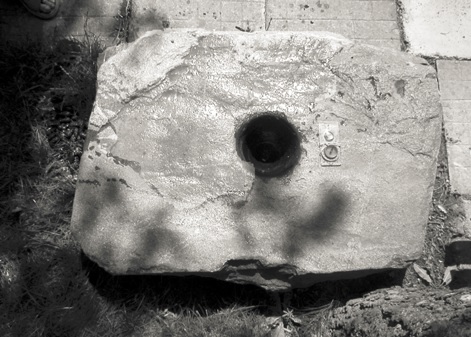
Knocking stones, or Clach chnotainn in Scottish Gaelic were exposed bedrock stone or boulders with a pot-shaped concavity cut into them used for husking and pounding barley and other cereals before the introduction of other methods of milling grain...

They were once used by every farming household and abandoned examples are still to be found in Ireland, the Highlands and the Western Isles and remained in use in remote areas until the 19th century...

A large pot-shaped cavity known as "knocking well" was cut into exposed bedrock or boulders. Grain was then poured into the cavity and pounded with a rounded stone or with a hardwood (oak) mell... These were basically bedrock mortars...

One example of a knocking stone at the old St Macarius chapel site of Mackrikil near Dailly in Ayrshire has a prominent cross carved on one side. Locally it was known as the 'font' and that indicates an understandable confusion with a stoup used to hold holy water for baptism...


Well, maybe not a confusion. In Ireland these kind of stones are called Bullaun stones. And there they are "definitely not mortars"...They are holy stones used for blessing and cursing. And when they get filled with rain water, the water acquires miraculous healing properties...


The fact that the same kind of stones like Bullaun stones (pounding stones) were in Scotland used as mortars means nothing in Ireland. The Irish are different... 🙂

I wrote an article about Bullaun stone being mortars few years ago...Which was then followed by another article about Middle Eastern and Mediterranean Bullaun stones...

These stone mortars were considered holy not just in Ireland and Scotland. In South Baltic region they were buried in the house foundations to protect the household...


I talked about this in my post "Stones with narrow bottomed bowls".

This stone from Latvia is called "Lielais Daviņu Akmens" which means great stone of giving, offering, great altar. It seems that the stone was linked to harvest rituals. For the farmers, anything to do with sowing, harvesting, grinding, eating grain had religious significance...


We know this from ethnographic records. This includes tools used for ploughing, sowing, harvesting, grinding grain and making bread. They all had religious significance and were seen as possessing supernatural powers...

Large bedrock stone mortars were communal tools. Once made they could last for generations. This definitely made them special in the eyes of the farmers who used them. These mortars, being permanent in the impermanent world, must have eventually become holy...

Which is why rain water, water that comes from heaven, accumulated in bedrock mortars was also holy and was used in religious, especially healing ceremonies...

Which is why large boulder mortars were moved to churchyards where a lot of them were turned into holy water fonts. Well they already were holy water fonts even before Christians appropriated them...

I wonder if Christian stone fonts, like this Norman font from St Nonna's Church at Altarnun, UK, developed from stone mortars filled with rain water...This one is particularly interesting because it is decorated with Perunikas, flowers of Perun, Slavic thunder, rain god. 


I talked about this symbol in my posts "Burning rolling wheel", "Ognjena Marija" and "Archangel Michael"...


This symbol is also known as Flower of life...Because it is rain that makes grain grow, makes life possible??? Bread of life anyone???

That this Norman font is not just a once off weirdness, have a look at this article: "St Austell font"...

Monday, 2 May 2016

New material on Bullaun stones

Archaeologist David Eitam said in his comment about multi hole bedrock mortars: "It seems that making flour, was in the past a collective activity. The reason for that was that acorn or cereal grinding was done using grinding stones. This was hard monotonous work which was best endured if done in company.  We can easily imagine the lively group of women covering the large bedrock and the sound of grinding and chat among the crowded millers."

We know from the ethnographic data from North America, that grinding acorns was at least in some cases a communal activity. You can find more info on this in the article "The Distribution and Function of Bedrock Mortars in California".  We also know from the archaeological data from Europe, that grinding cereal was also a communal activity. We can actually see it on this clay model depicting collective grain grinding from Cyprus, from Iron Age settlement at Tel Dor. You can find more details about this site in "An Iron Age I Canaanite/Phoenician Courtyard House at Tel Dor: A Comparative Architectural and Functional Analysis


The easiest way to make communal grinding areas was to cut the mortar holes in the bedrock, creating bedrock mortars. Like these ones at Indian Grinding Rock State Park:


I already wrote abut bedrock mortars in my article on Bullaun Stones. In that articles I compared the yet unclassified European bedrock sites with classified North American bedrock mortar sites. I then asked whether the European  should be also classified as bedrock mortars, considering that they are functionally identical to the North American ones. 

In this article I would like to present some new (to me :) ) evidence that supports my hypotheses that a lot of the European bedrock stones with large and deep cups could be (yet) unclassified bedrock mortars. 

I will start with the bedrock mortars used by the Chalcolithic communities from Central Israel (4,500–4,000/3,900 BCE). The grinding holes were cut into a bedrock with different profiled holes used for grinding different type of material, like grain (and possibly acorn), olives, grape (?). These are examples of the bedrock mortars from the Gassulian (Ghasulian) culture

You can find more info about these grinding bedrock mortars in the article "Cereal in the Ghassulian Culture in Central Israel: Grinding Installation as a Case Study. Israel Exploration Journal 59,1: 63-79"

This is the picture of the bedrock holes from the Ghassulian Horbat site. 


The picture was taken from the article "Excavations at Horbat 'Illit B: A Chalcolithic (Ghassulian) Site in the Haelah Valley". However these holes are in this article classified as flint excavation holes. This is based on the fact that a piece of flint was found at the bottom of one of the holes. 


I wander why would anyone make such smooth narrow round holes to excavate flint? Why not just continue to break bedrock to the left and right of the flint peace to see if there is more hidden in the bedrock? I believe that these are instead bedrock mortars. And this particular one was abandoned when the grinding exposed the hard flint at the bottom, rendering the mortar hole useless. But that is just my opinion. 

Since then, I came across this article, "Excavations at Modi‘in – H̱orbat H̱adat and Be’erit (A)" by Edwin C.M. van den Brink, which classifies these features as bedrock mortars...


Interesting how opinions vary...

From the above three articles it is plain to see that there is still no consensus on the issue of the classification of these bedrock holes. 

But a lot of work has been done lately on collecting and classifying all the available data related to bedrock sites. This is a good article that explores this issue: "Late Epipalaeolithic Rock-Cut Installations and Groundstone Tools in the Southern Levant. Methodology and Classification System".

Now, bedrock mortar type of utensils start to appear in 13000 BP and their use peaked in 6000 BP (Late Chalcolithic) and continued in rural MBII sites. 

Here are some Natufian bedrock mortars from Mount Carmen site dated to 12500 BP. You can find more info on this site in the article "3D Characterization of Bedrock Features: A Natufian Case Study".


This article entitled Article "Experimental Barley Flour Production in 12,500-Year-Old Rock-Cut Mortars in Southwestern Asia" presents result of the experimental archaeology experiments at a Natufian site in the Southern Levant documents for the first time the use of 12,500-year-old rock-cut mortars for producing wild barley flour, some 2,000 to 3,000 years before cereal cultivation. 


Considering that we have evidence of the use of acorns as food in the south western Asia in late Paleolithic, Mesolithic and Early Neolithic time, I would suggest that these mortars could also have been used for grinding acorns, and that that was their original intended use. But once you develop a suitable grinding technology for grinding acorns, it can be applied, with slight modifications to grinding of any similar type of material, like wild grains.  

But Natufians also used single hole boulder mortars, as I already said in my post "Acorns in archaeology".


So obviously grinding was not always communal. This is the situation found in all the other areas where we find multi hole bedrock mortars. So why did people make multi hole bedrock mortars? You can do communal grinding using multiple single boulder mortars. But they are more difficult to make. So maybe multi hole bedrock mortars are older? Or maybe they were located near a source of food, like oak forest or wild grain field, or source of metal ore or pigment, and were used for industrial scale grinding?

These are the large cup holes from the hillside boulders at Göbekli Tepe, dated to (9500 - 8000 BC). The hillside is apparently covered in cupping holes all about 500mm - 600mm, big enough to be acorn or grain grinding holes like the ones found on Bullaun stones in Ireland and the North American grinding boulders and on the above Natufian bedrock mortars. 


These bedrock mortars were discovered in recently excavated site Karahan Tepe located near Göbekli Tepe but even older. Karahan Tepe is dated to pre 10000BC...


As I said above, once you develop a suitable grinding technology for grinding acorns, it can be applied, with slight modifications to grinding of any similar type of material, like wild grains. Or ore. We know from the ethnographic and historical records that almost identical types of mortars were used for grain, spices, pigments and ore grinding. So it is no surprise to find bedrock mortars used for ore grinding. 

This is the Pino del Oro Mining Zone (ZoMiPO) is located straddling the Duero river, within the Arribes Natural Park, in the western part of Zamora province, and adjacent to the Portuguese border. It involves a group of very peculiar gold mining structures dating from the Roman period (1st-2nd Centuries). These are grinding mortars cut into the bedrock and used for grinding ore. Were they originally used for grinding cereal and before that for grinding acorn?


I believe that this new evidence adds a bit more support for my theory that Bullaun stones from Ireland and the similar stones with large deep cup marks, were made to be used as mortars for grinding probably originally acorns, and then wild grain, grain, tubers and even ore...

So what do you think, could the Irish Bullaun stones, like this Clonmore Triple Bullaun Stone be actual bedrock mortars?


The debate will undoubtedly continue. Great. :)


Monday, 1 February 2016

Stones with narrow bottomed bowls

In my post about bullaun stones, the ancient grinding stones, I mentioned that these types of stones are also found in the South Eastern Baltic are. This is one of many old hollowed stones from the Baltic. They are called bowl stones and are, like in Ireland and in Slavic countries, regarded as sacred. The place where the stone is located is used as a place of worship. The diameter of this stone is about 60 cm and a depth - about 15 cm. In the past people considered the accumulated water as sacred and thought that it had healing properties. In the past the stone used to be called the stone of god.


You can see many more of these stones if you run this search. Here are some of them. This one is called "Lielais Daviņu Akmens" which means great stone of giving, offering, great altar. It seems that the stone was linked to harvest rituals.


This stone stands on a hill, where an old oak forest grew until the seventeenth century. The hill was a site of a pagan temple. 


For information about these stones in English look at the pages 27 - 33 of the book "Studies into the Balts’ Sacred Places".

I was just made aware of an article about an interesting half-made bowl-stone from Baltic region. On its top part there's a circular groove of a similar size as the usual bowls on other stones, as if someone had intended to gouge out a bowl there too but stopped half way through the process of gouging the hole. 


We can deduce though that this is how these bowl stones were actually made from their name in Lithuanian. Lithuanian word for bowl is dubuo, dubeni akameni...These words come from Slavic root dub meaning wood, oak but also to gouge. This second meaning comes from the time when utensils were made by gouging bowl like holes in pieces of wood and later stone. In Southern Slavic languages Dubiti means to gouge and Dubeni, Dubeno means gouged, with a gouged hole, bowl in it...Dubeni kameni in South Slavic languages means gouged stones, bowl stones...

But there is a special kind of these bowl stones which are found in the South Eastern Baltic that fall into a class of their own. These are so called "stones with narrow bottomed bowls". 


There are all together 250 narrow-bottomed bowls, but it is quite possible that more once existed, but were destroyed. Majority of these stones are concentrated in two areas: Central and Northern Lithuania / Central Latvia and in Eastern Lithuania. Only a couple of such stones were found in Samogitia.

Historical and archaeological records show that the stones with narrow bottomed bowls are very similar in dimensions and shape, regardless of the area in which they were found. The dimension homogeneity is quite stunning. Processed or unprocessed, the size of the stones varies only slightly. 


They are only in exceptional cases smaller than 60 x 70 cm and never exceed 100 x 120 cm. Stones thickness (height) is also very similar and varies between 25 - 35 cm. Several stones found in-situ protrude above the ground plane from 5 - 15 cm. The diameter of the upper part the bowl is rarely less than 15 - 16 cm and is never more than 23 - 24 cm. The bowls dept varies between 9 and 21 cm.


The stones are usually found on farms: near houses, barns and cattle sheds or inside them, quite often at the base of the building. Often there are 2 to 3 or even 4 to 5 stones with narrow bottomed bowls preserved in every village, for example Montviliskis, Vaiduloniai, Vileikiai. Today most of these stones are used as decorations. Sometimes these stones are used in churches for storing holy water, like in Dotnuva. But it seems that they were once used as corner stones, usually placed under the northern or north western corner of the house. 

Up until the seventeenth century it was customary to build wooden buildings without diging foundations. A layer of stones was placed on the ground and then the wooden house frame was built on top of it. Corner stones were the most important of all as they were placed under the main four supporting vertical beams. The bowl in the corner stone was usually oriented towards the inner side of building. 


The archaeological investigation which was carried near 9 of these stones dated them to the period 16th - 17th century. However, excavation near the Montviliskis stone uncovered two holes of about one meter in diameter full of ashes, cattle bones and potsherds dated to 2nd millennium AD as well as potsherds from the period 16th - 18th century. The bones were all of young animals, indicating that they were sacrificed in a "first fruits" kind of sacrificial fertility ceremony.

There are ethnographic records from Lithuania which show that in the past, when the corner stones were placed in the ground, a special blessing and sacrifice ceremony was performed.  The hole in which the corner stone was to bi placed was dug first. Then the owner of the house would step into the hole and would drink some vodka and then all the workers working on the house would do the same and then they would share some food and continue working. The corner stones were marked with wax crosses and money was placed next to or under them. It was believed that god lived in them. Not only that, but it seems that the stones with narrow bottomed bowls were used as family altars.

At the beginning of the 17th century Jesuits described the stones with narrow bottomed bowls calling them "Deiviu akmenys" meaning "Goddess stones".
The report  from the 1600 says: In stores big stones are kept. They are dug into the ground, with the flat faced facing up. They are covered with straw. They are called "Deyves" (Goddesses) and are faithfully worshiped as the protectors of cereal and cattle.
The report from 1605 says: Some very uneducated village people due to our efforts got rid of the bad habit of worshiping one stone which they thought to be the god of granary, fruitfulness and happiness of home.

Even though it is not specifically stated that the sacred stones were "bowled", there is much in common between the stones described by Jesuits and stones with narrow bottomed bowls: their location in farm buildings, the fact that the top face of the stone was flat, the stones had the function of the cereal, cattle, happiness provider.

There are legends about the stones with narrow bottomed bowls which state that in the old times they were used as mortar stones for milling, grating or pounding. In Veriskiai, the local legends states that the stone was used by the Devil to grind tobacco.

Some stories preserved by old people talk about holy water being stored in the stones and that before that people used to pour milk into the hole for the grass snake, the houses snake, the incarnation of the house protector spirit in Balto Slavic religion.

In the 17th century Jesuits recorded the existence of a god called "Pagirinis", meaning "The one who lives under the quern, under the mortar stone" basically "The one who lives under the stone with narrow bottomed bowl". Knowing this it seems that the most probable function of the stones was as an altar to the god (goddess) protector of home. Another 17th century Jesuit report states that the god "Pagirinis" sometimes comes out of his corner in a shape of a grass snake, but that it spend most of his time buried in the soil, which is kept in a clay or wooden dish or without a dish under the quern (mortar stone, the stone with the narrow bottomed hole).

So this is very interesting. We have:

1. a corner stone
2. which is shaped like an ancient mortar stone
3. which was used as a fertility cult altar.
4. which is referred to as a "Goddesses stone"
5. which is the home of the male deity whose name means "The one who lives under the quern, under the mortar stone"

In some parts of Serbia the " thick wall" made of stone which supports the house is called Baba.


In Bulgaria thick logs which are put under log cabin corners to support the house are called "bа́bka". This gives additional meaning to the Serbian proverb that says that "the house stands on a woman". I wrote about it in the post "Baba - the main column, pole that supports the house". It seems that baba was any supporting structure on which the house stood. 

In Serbian and in other Slavic languages the word Baba also means wich, goddess,  and not just any goddess, the Mother Earth. So it is not surprising that the above corner stones from Lithuania were called "Goddesses" stone. They are basically Baba's stone, as Baba, Mother Earth,  was the fertility goddess to which Lithuanians prayed to. Interestingly

The name of the male deity which is believed to live under the corner stone in Lithuania shows that that these stones were once actually used as grinding stones, as I postulated in my post about bullaun stones.

The fact that the mortar grinding stone was used as a fertility altar dedicated to the Mother Earth is not surprising at all either. A hole in the ground is where the plant seed is planted. A hole (vagina) in the lying woman is where human seed is planted. So a horizontal lying stone with a hole (mortar) is already suggestive enough. Mortar grinding stone and pestle even more. So much so that the mortar and pestle became the symbol of male and female genitalia in Hinduism (Yoni and Lingam).

This is a so called "wet" grinder mortar and pestle from India from this great blog post about making stone ground chutney


And this is Yoni and Lingam 


The union of sky and earth produces (releases) cereal seeds which are then poured into the mortar and pounded into flour with pestle in a motion which greatly resembles coital movement of penis (Lingam) inside vagina (Yoni) which produces (releases) human seeds which are poured into the vagina.... Do you see the link here? The fact that in the Baltic tradition milk was poured into bowl of the corner stone "for the snake to eat" confirms this, milk being symbolic replacement for sperm, milky white liquid containing human seeds. Once the cereal seeds are pounded into the flour flour is made into bread which is bake inside the bread oven which looks like the belly of a pregnant woman. And that bread oven is in Serbia called baba. Ovens were in old Slavic houses placed in north-eastern or north-western corner, just like the Goddess stones. 


The belief that the house protector snake lives in the house foundation does not only exist in the Baltic countries. It is wide spread in Slavic countries and it exist in Serbia too. In Serbia the house protector snake is believe to live in the house heart (stone oven) or the house foundations (the layer of stones which supports the wooden house frame, corner stones originally). It is believed that this snake is the spirit of the founder of the family, some other very distinguished ancestor, or the first male ancestor who died in the house. Either way this snake is the symbol of the male ancestor, just like Lingam. So we have a mortar stone (Yoni) which houses (in a bowl) snake (Lingam)...

And this is it, the story about Lithuanian co called "stones with narrow bottomed bowls". I hope you enjoyed it. Until the next time, stay happy.

References

"Aukštaitiški aukurai" by Vykintas Vaitkevičius
"Studies into the Balts’ Sacred Places" by Vykintas VaitkeviÄŤius
"Pojmovnik Srpske kulture - baba" - Etnografski institut SANU