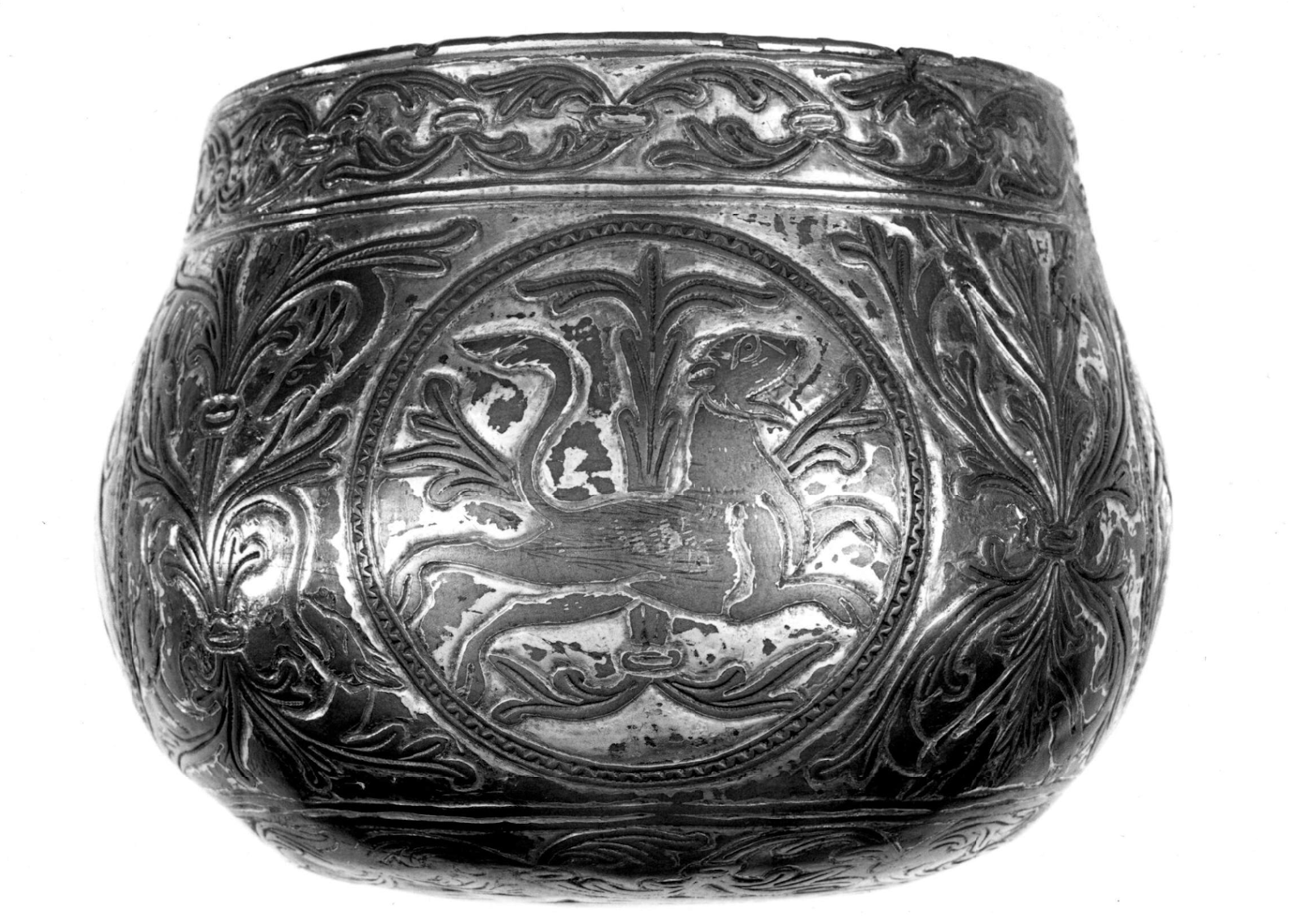
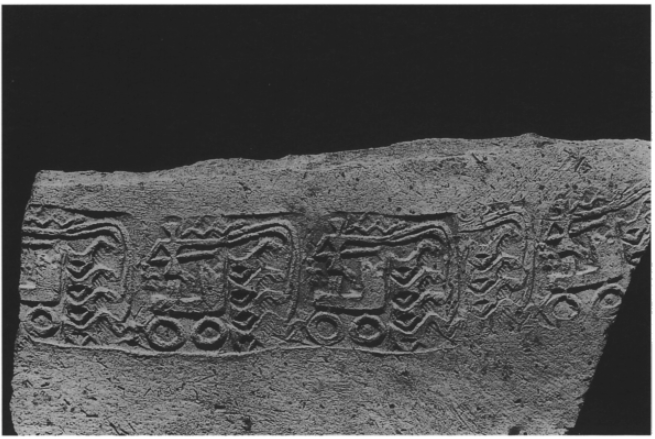
This is the so called Halton Moor cup, made in the 8th c. AD somewhere in the Carolingian empire, France. It was then deposited in the 11th c. AD, as part of a mixed silver and gold hoard in the Halton Moor in England, where it was discovered in 1815...
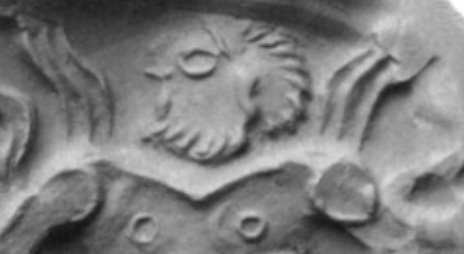
Stunning object. According to the British Museum, where his object is currently kept, "of the four medallions which decorate the cup, two contain the figure of a lion, and the other two contain the figure of an ox with humped back and forked tail"...
The British Museum then goes on to say that these medalions are separated by "a formal plant with radiating branches from which issue four dog-like heads near the extremities, biting foliage". Full description can be found here...
Now according to The Halton Moor Cup and the Carolingian Metalwork in the Cuerdale Hoard By Egon Wamers, "the four roundels on the Halton Moor cup alternate depictions of two different animals, which may be identified as a lion and a unicorn..."
"...these roundels are separated by acanthus plants wih the animal (dog) heads sprouting from their tips". Egon Wamers then says that this is an illustration for Psalm 22 (verses 16–21) where Christ says:
12 Many bulls surround me...
13 Roaring lions [surround me]...
...
16 Dogs surround me...
...
19 But you, Lord, do not be far from me...
20 Deliver me...from the power of the dogs.
21 Rescue me from the mouth of the lions; save me from the horns of the wild oxen.
Interestingly, in the verse 21, the King James's bible actually says:
21 Save me from the lion's mouth: for thou hast heard me from the horns of the unicorns.
WTH does this mean? Ok, let's first sort this unicorn thing out.
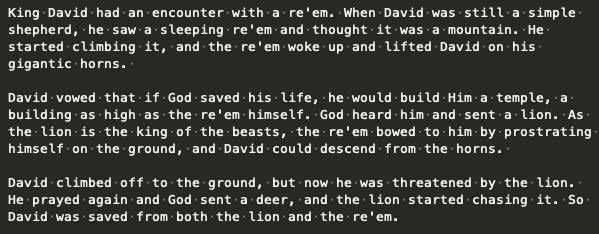
Ever heard of Re'em? A re'em is an animal mentioned nine times in the Hebrew Bible. The Greek Old Testament (3rd-2nd c. BC) translated re'em as "unicorn" which stayed as the main translation of this word until the end of the 19th century...
Then, in 1899, Johann Ulrich Duerst discovered that the word "re'em" was based on the Akkadian cognate "rimu", meaning "Auroch", the Eurasian wild cattle...This has been "generally" 🙂 accepted today as the correct translation, "even among religious scholars" 🙂...
I talked about this in my post "Reem"...
Those interested in unicorns should check my post "Stag and Unicorn", where I analyse figure 3 from "Alchymistica", 17th/18th century document found in Benedictine Abbey Admont, Austria...
Back to the Halton Moor cup. As you can clearly see, the horned animal depicted on the Halton Moor cup is a bull which looks very much like an Auroch (wild Eurasian cattle) bull.
Bull is a symbol of summer (Apr/May - Jul/Aug). This is because Apr/May was when wild Eurasian cattle used to start calving, and Jul/Aug was when wild Eurasian cattle used to start mating (and fighting)...
I talked about (most common) animal symbols for seasons (still imbedded into out zodiac today), found all over Eurasia and North Africa since Neolithic, in my post "Symbols of the seasons"...
Hence Taurus, an animal calendar marker which marks (Apr/May), the beginning of the calving season of the wild Eurasian cattle, and the beginning of summer, the season of the wild Eurasian cattle...I talked about this in many of my posts...
The bull depicted on the Halton Moor cup is depicted in a charging (fighting) pose. Just like it looks during the mating fights which take place in Jul/Aug...I talked about symbolic meaning of the charging bull in many of my posts...
And the bull is charging towards a lion...
Lion which is an animal calendar marker for Jul/Aug, because this is when the main mating season of Eurasian lions starts...Which is why Jul/Aug is marked with a lion, Leo...I talked about this in many of my posts...
So, charging bull and a lion meet in Jul/Leo...This is when Summer (Starts in Taurus, Apr/May - Jul/Aug) ends and Autumn (Starts in Leo, Jul/Aug - Oct/Nov) begins...
Like in India, where we find the Ardhanarishvara, the union of Shiva and Parvati producing river Ganga...
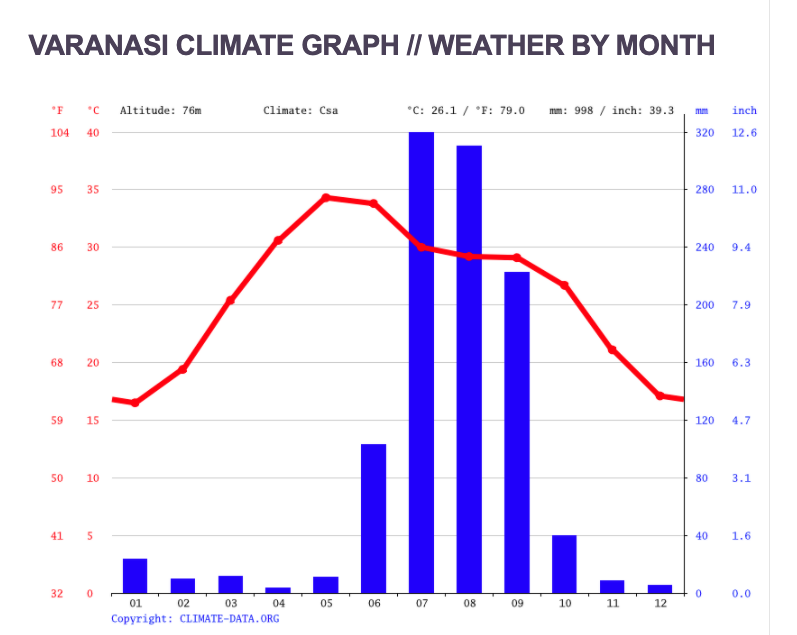
Maximum monsoon, which feeds the river Ganga, falls at the meeting point of Summer (symbolised by Bull) and Autumn (symbolised by Lion), Jul/Aug...
I talked about this in my post "Ardhanarishvara"...
But in Mediterranean and Western Asia, this is symbolically depicted like this: Lion (Autumn, starts in Leo) kills (ends) Bull (Summer, starts in Taurus)...Coin from Cilicia, dated to 361-334BC. I talked about this calendaric symbol in many of my posts...
So, the bull is charging towards the lion, but on the Halton Moor cup he will never reach the lion because bull and lion are separated by "acanthus plants with the animal (dog) heads sprouting from their tips"...
Very interesting...Why? Well, first, the leafs of this plant, if it indeed is acanthus, are the leaves which Ancient Greek sculptor Callimachus (5th c. BCE) used to model the capital of the Corinthian column...
The plant main flowering season is from May to Aug...
After the flowering season, the plant develops a sharply-pointed capsule shaped fruit...Fruiting season is normally Jul/Aug/Sep...Interesting right?
And on the Halton Moor cup the fruit looks like dog head...Why? Cause the old dog breeds mating season started in Jul/Aug...This is why we find dog days in Jul/Aug. And why Sirius is called the Dog Star. When our mythologies were made out of animal calendar markers, Sirius, the Dog Star rose with the sun in Jul/Aug, when mating season of the old dog breeds began...I talked about this in my posts "Dog days", about the Dog star in Egypt, "Tishtrya", about dog star in Mesopotamia and "The bitch of the gods", about the dog star in India...

Anyway, this is why on the Halton Moor cup we find the acanthus plant with dog head fruits between the charging bull and the lion...
BTW, do you see the tree depicted behind the lion? It looks very much like a date palm tree. In Mesopotamia, where most of the date palm symbolism comes from, date harvest starts in Jul/Aug...When Lion kills Bull. In dog days. Under a palm tree. I talked about it in my post "Lion killing bull under date palm"...
But why would someone in Carolingian empire make something like this? Did they know what they were doing or is this just a giant coincidence?
I don't think it's a coincidence. The legend about Re'em has this interesting bit in it. I provide full symbolic analysis of the Re'em legend in my post "Reem"...
David is the guy who built the solar temple on a threshing floor...
If you wanted to make a (First) Temple on a Threshing Floor, and "orient" it (make it to face east), if you wanted to make a "House of God" to face the "House of (Sun) God", how would you do it? Like this...
I talked about this in my post "Boaz and Jachin" and "Sun god from the first temple"...
Solar temple dedicated to a Sun god in a chariot pulled by 4 horses...I originally thought that this god was some kind of local Helios...But since then I learned that Shamash also traveled in a chariot pulled by four equids...
I talked about this in my posts "Sun god from Tell Brak" and "Shamash playing with solar horse"...
So the Sun God that Josiah says the Jews worshiped in the First Temple was most likely Shamash...They still do worship him BTW...
Remember this post, "The tree of life, light", about the origin of the Hanukah (Winter Solstice) celebration? And the link between Yahweh and Shamash, the old Semitic (Akkadian) sun god...
Now in this post, "Menorah from Nipur", about this 3rd mill. BC seal from Nipur, I postulated, based on the fact that Shamash is depicted sitting between two bulls, that the Shamash worshipped through Menorah was Sun in Taurus, Apr/May. The good sun, the sun of life...
But I completely missed the fact that the two bulls have erections, which means they symbolised Jul/Aug, the start of the beginning of the mating season of wild cattle...I talked about this important "detail" in my post "Tree huggers", about this strange moulded plaque, Babylonian, ca. 2000–1600 BC.
And I also, for some weird reason, ignored the fact that Shamash is holding the reed cutting knife. I talked about the importance of the reed cutting knife in my post "Canals", where I explain why Shamash holds reed cutting knife when he is depicted standing in an empty canal/river bed. About Jul/Aug being the best time to cut reed in Mesopotamia if you want to make long lasting reed boats, houses and canal dams...BTW, see how he is standing between two lions, in Leo...
Both pointing to the fact that the Shamash of the Menorah is Shamash in Jul/Aug...See how Shamash has (mostly) 3 heat waves coming from each shoulder? Togehter whith his head, that is 7...7 months of the Sumerian summer...With the head in Jul/Aug, the hottest part of the year...
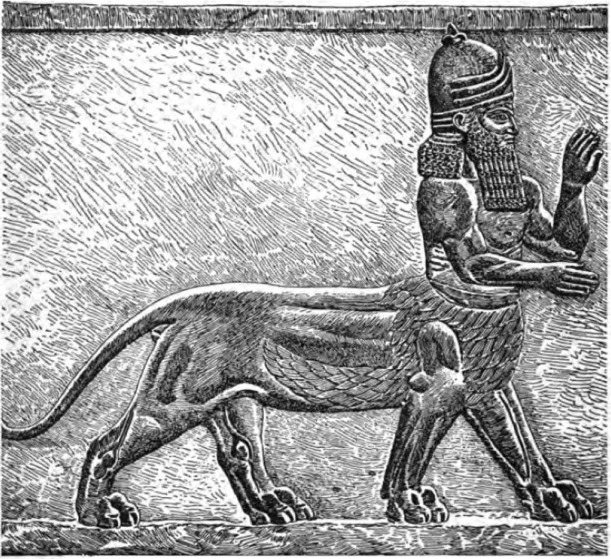
Sun in Jul/Aug. Nergal...The deified destructive "burning" sun, which was depicted as a lion man
because Jul/Aug, Leo, is the hottest and driest part of the year in Mesopotamia...
Talked abut Nergal in my post "Winged superhuman hero"...
Nergal the god of death...
Hello Mot!
In the deserts of Levant, Middle East and Arabia, it was The Sun who was "The God of Death". It is in climate and nature it produces, that we find the root of all our religions... Pic: Over 2000 years old poem about the god of death Mot. From my post "The oldest Arabic poem"...
Nergal, whose seat is located between bull and lion (Jul/Aug, the hottest time of the year, the time of death) and is guarded by a three headed dog (End of Jul beginning of Aug, the dog days)...
Hello Hades!!!
Meet Kerberos, the three haded dog, guardian of the doors of hell...He also had snakes coming out of his body...
Dog, animal calendar marker for the hottest time of the year, the time of the year ruled by Nergal, The God of Death, The personification of Destructive sun's heat, and snakes, symbol of sun's heat...
Nergal who also had a pet three headed dog...Depiction of Nergal from Hatra...
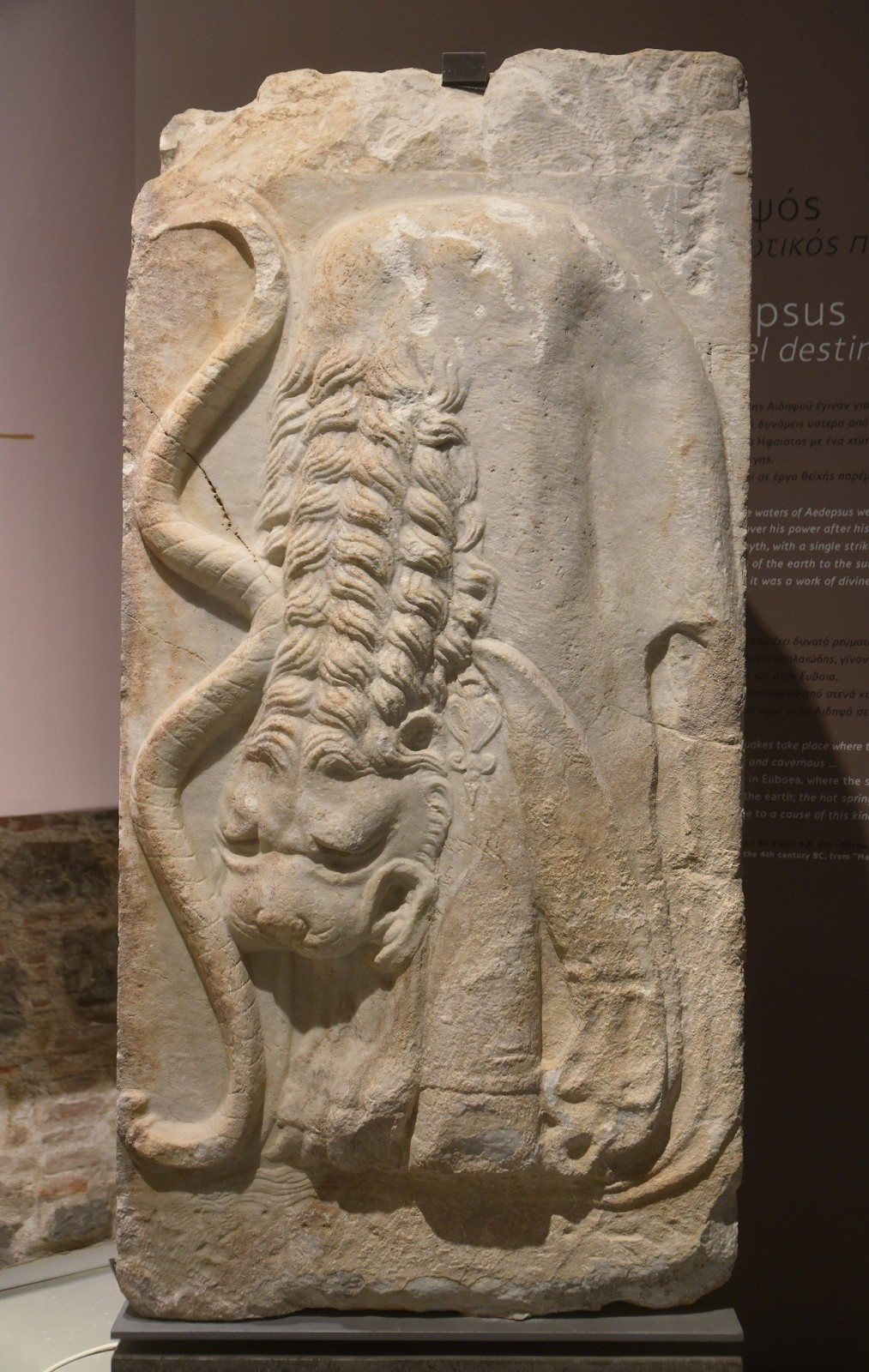
Oh and is that Heracles standing behind Kerberos pretending to be a lion man???
Hello Heracles!!! Who are you really?
Relief featuring the symbols of Herakles, the bow and the lion skin. 1st c. BC, Aedepsus, Euboea. New Archaeological Museum of Chalkis Arethousa, Greece.
The true identity of the Heracles the Archer was discussed in my posts "Cetus" and "Mithras"...
Where are you going with all of this, I can hear you wondering...
As far as I can remember, the god of Menorah is the god father of Christ...
Christ as the sun-god Helios/Sol, 3rd c. AD, Vatican. Christ is born on Winter Solstice, (re)birth day of the sun (god), he enters Jerusalem on a donkey, "animal of the (sun) gods and kings", and gets put on a cross, symbol of the sun (god). Interesting. From my post "Alexamenos graffito"...
And so, according to the psalm 22, Christ, while awaiting death on the cross, the symbol of Shamash, and while being surrounded by bulls, lions and dogs, animal calendar markers for Jul/Aug, invokes his father...
This kind of makes you wonder about what Gnostics knew when they rejected Christian god as Demiurg...And why Cathars and Bogumils rejected cross...
But then again, this could all be just me reeding too much into things...
Or, maybe, the greatest trick The Devil ever pulled was not convincing the world he didn't exist, but convincing the world he was The God...
For the end, wisdom based on centuries of suffering...
Ethnographer interviewing an old peasant woman, Serbia first half of 20th century.
Gran, do you believe in god?
Of course I do my son. Who wouldn't believe in god?
And are you afraid of god, gran?
Of course I am my son. Who wouldn't be afraid of an evil force?
That's it. To read more about ancient animal and plant calendar markers, start here…Then check my twitter threads I still didn't convert to blog post...I am way way behind...