Showing posts with label Sumerian culture. Show all posts

Saturday, 30 November 2024

Animals march three by three

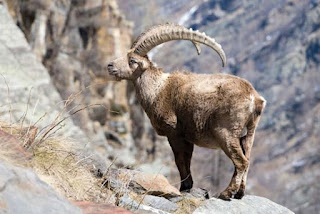
Sumerian limestone bowl fragment with three ibex goats following a lion...3300-3100 BCE, Currently in the Detroit Institute of Arts...

What's all this about?

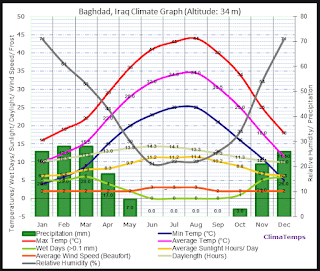
Well, I think, climate in Mesopotamia and annual lifecycle of the depicted animals...

I am so sorry only a fragment of this bowl has survived. But I could bet that the original bowl had 

3 ibex goats, following 3 lions, following 3 bulls, following 3 leopards...

Why?

Check this post out. It is about a copper bowl from the same period and the same area...And about the climatic year in Sumer and Elam, and local Sumerian/Elamite animal calendar markers for the four seasons...

A Sumerian or Elamite Copper Bowl. Early 3rd Millennium B.C.E., H. 9.2 cm., D. 16.2 cm.


To read more about ancient animal and plant calendar markers, start here…Then check my twitter threads I still didn't convert to blog post...I am way way behind...

Monday, 29 April 2024

Ama

The Sumerians wrote word "ama", which means "mother" by drawing the Dingir symbol (𒀭) which means god, inside the symbol for the house. Does this indicate that the mother, birth giver, is the divine force which turns four empty walls into a home full of life?


In Neolithic Balkans house was equated with the mistress of the house, the oldest mother living in the house. Literally...

Early Neolithic figurines from Macedonia depicting anthropomorphised house and bread oven...They are symbolically equating Woman, Mistress of the house, with the house and the bread oven...


This notion was preserved in the Balkans until today...Until recently, in Makedonija, there was a ritual in which bride and groom entered the groom's house for the first time between the legs of his mother, the mistress of the house, who stood on two chairs...This equated the Mother (Baba means grandmother, mother, birth giver) with the House and the Family...


I talked about this in my post "Mistress of the house"...

Friday, 23 September 2022

Carp surfer

Enki/Ea, god of sweet water and the annual flood. He is shown here holding two jars with water flowing out of them, which represent the sources of Tigris and Euphrates...But why is he standing on a carp fish?

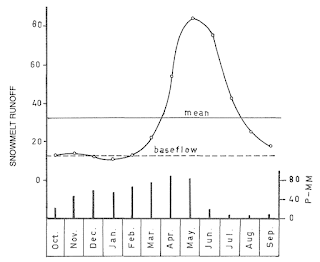
This is the chart showing the annual water flow of Tigris and Euphrates. You can see that it peaks during Apr/May. 

Now remember my post "Goatfish", about the origin and meaning of the Goatfish the symbol of Enki?
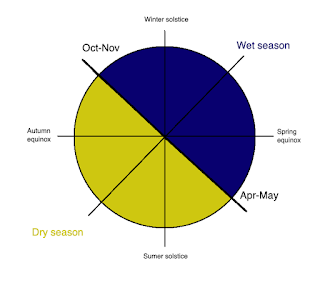
In it I explained that goatfish is the symbol of the wet season in Mesopotamia. 


Wet season which starts in Oct/Nov, when wild goats start to mate, and ends in Apr/May, when the giant Mesopotamian carps start to mate...

The carp swim upstream towards the mountains, which are the source of Tigris and Euphrates...These carps are giants...So there is no way you can not notice their migration upstream...


Migration towards Abzu...Which is a great mountain...Where Enki lives...Here is Enki, standing among the mountains, being a mountain, holding the same two jars, the sources of Tigris and Euphrates...I talked about this in my post "The Great Imposter"...


And so, because peak of the carp mating season coincides with the peak flood season, Enki/Ea, the god of fresh water and the annual flood, is depicted standing on a carp fish, pouring out Tigris and Euphrates...

To read more about ancient animal and plant calendar markers, start here…then check the rest of the blog posts related to animal calendar markers I still didn't add to this page, and finally check my twitter threads I still didn't convert to blog post...I am 9 months behind now...

Monday, 28 February 2022

Elamite water bull

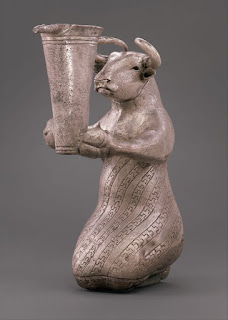
c. 3000BC, Proto-Elamite silver figurine of a clothed kneeling bull which "shows a curious blend of human and animal traits"... holding a spouted vessel. Currently in the Met Museum... The artefact page says: "possibly a symbol of a natural force"...So who (or what) does this figurine represent?

My guess is either Enki (Sumerian god of sweet water) or Utu (Sumerian sun god)...Or their unnamed Elamite equivalent who possibly combines both of them in one...

What do either Enki or Utu have to do with bulls?

In "Enki and the world order" we read: "...Father Enki...he stood up full of lust like a rampant bull, lifted his penis, ejaculated and filled the Tigris with flowing water. He was like a wild cow mooing for its young in the wild grass..."

You have to imagine this, no pics 🙂

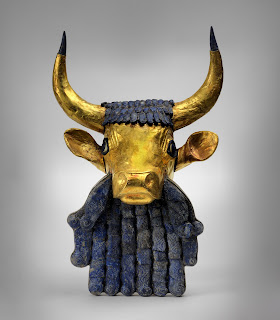
In the same text we also reed: "Enki placed in charge of the whole of heaven and earth the hero, the youth Utu (Shamash), the bull standing triumphantly, audaciously, majestically...the great herald in the east of holy An...with a lapis-lazuli beard, rising from the horizon..."

Hence Shamash depicted as a golden (solar) bull with lapis lazuli (water) beard... 

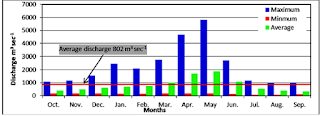
These identifications of these two gods with a bull is not coincidental. These are yearly charts of the water levels in Tigris and Euphrates. You can see that they both peak in Apr/May, Taurus, Bull...

Tigris 

Euphrates

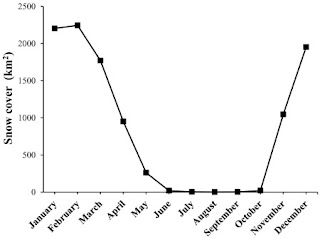
This is the result of the heating up of the mountains which are the source of the two great rivers: Anatolian highlands and the Zagros mountains...Which causes the snow to melt, which causes the rivers to swell...

Snow cover (inverted snowmelt), Zagros

River flow, Zagros

Sun (Utu), "the triumphant bull" melts the snow and fees the water (Enki) who then fills the two rivers, right at the beginning of the calving season of the wild Eurasian cattle, when "wild cows moo for their young in the wild grass"...

I talked about this in my posts "Solar bull" "Shamash young and old", "Butt chewing", "Green pastures", "Rain and flood"...

Hence Enki, bull who ejaculates two rivers...Hence Elamite bull holding a water vessel with a spout, pouring rivers in Taurus...

The link between Taurus and the maximum river water levels is also found on the artifacts of the Jiroft culture, which flourished in the Zagros mountains in the 3rd millennium BC. 

Rivers flowing out of bulls. Held by a figure dressed just like the Elamite bull. I talked about this in my post "Jiroft flood vase"...

To read more about ancient animal and plant calendar markers, start here…then check the rest of the blog posts related to animal calendar markers I still didn't add to this page, and finally check my twitter threads I still didn't convert to blog post...I am 9 months behind now...

Thursday, 27 January 2022

Bribing Shamash

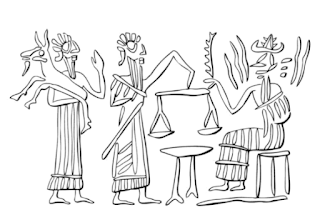
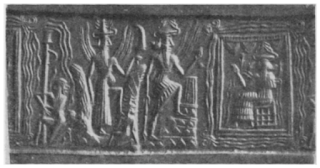
Very interesting. Akkadian seal, 2350-2100BC. From "Gods, demons and symbols of ancient Mesopotamia: an illustrated dictionary" by Jeremy Black and Anthony Green...

Sun god Shamash sitting on his throne, holding a cerated knife, saw, sickle, called "shasharu" with which he is often depicted...I talked about this in my post "Canals"...

You can see heat rays coming out of his shoulders, his trademark...You can read more about Shamash and the heat rays in my post about "Shamash young and old"...


And in my post "Lion radiating heat"...


And "Nude winged hero dominating snakes"...


In front of him are two "men". First one carries a weighing scales, and the second carries a goat, Markhor goat...Now Shamahs was not just the sun god, he was also the god of justice...Probably because he was the scariest of all the Mesopotamian gods...

Sumerian proverb says: "May you hold a baby goat in your right arm and may you hold a bribe in your left arm". Meaning: Bring a baby goat as an offering when asking for a favor from the god. But if that doesn't work, bribe the priest, who can implore the god on your behalf...

So this image can be interpreted as bribing the god of justice. Nice...But I don't think this is what this image depicts...

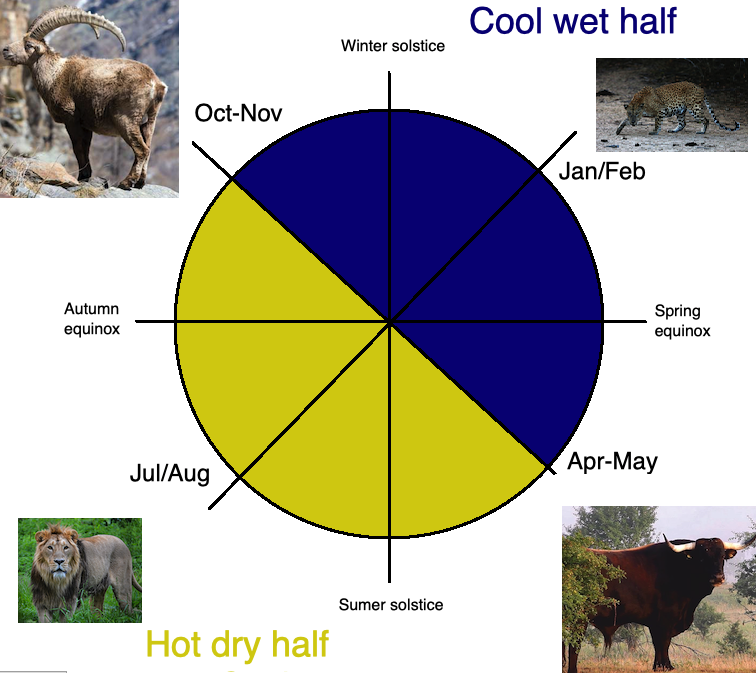
Sumerian year was divided into two seasons: the hot dry half (summer, autumn), which starts in Apr/May and ends in Oct/Nov and cool and wet half (winter, spring) which starts in Oct/Nov and ends in Apr/May...


Shamash is most powerful in the middle of the Sumerian hot and dry season, at the end of summer beginning of autumn, Jul/Aug, Leo. This is the hottest and driest part of the year in Mesopotamia. The time of death, when Shamash turns into Nergal, the god of death...Who is even depicted as man-lion...I talked about this in my post "Winged superhuman hero"...

Now, look at this: 

2 of Aug, beginning of autumn, Shamash on his throne

21 of Sep, middle of autumn, autumn equinox, equilibrium, Libra

4th of Nov, end of autumn, beginning of the mating season of wild goats, end of hot and dry half of the year, beginning of the rain season...


But maybe this is not about climate...Maybe it's just bribing the god of justice...

You can read more about Leo animal calendar marker in my post "Lion killing bull under a palm tree"...

You can read more about Sumerian Libra (balance of heaven) in my post "Zib ba na"...

You can read more about goats as one of the symbols of the beginning of the rain season in my posts "Goat Carrier", "Green pastures"...and many others...

Saturday, 30 October 2021

How grain came to Sumer

Sumerian cylinder seal, Uruk, c. 3500-3100BC , currently in Louvre 


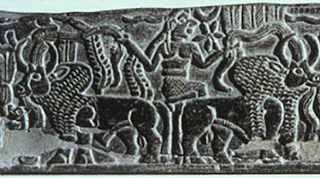
Description: cattle herd in a grain field...Now unless Sumerians grew giant grains, this is most likely a symbol, of something, but what?

Well, as I already explained in my post "Bulls and grain bowls", this is a calendar marker for the grain harvest which in Mesopotamia starts in Apr/May, Taurus

Taurus, which is an ancient animal calendar marker which marks the beginning of the calving season of the wild Eurasian cattle, which used to start in Apr/May...


And has nothing to do with stars...I talked about this in my post "Dairy farming seal"...

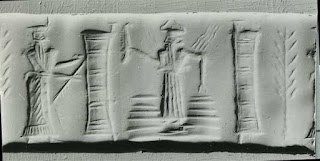
Keeping that in mind, let's have a look at another interesting cylinder seal from Uruk, dated to 3200BC, also in Louvre. Description: king-priest and his acolyte feeding the sacred herd...


You can see that the king is feeding the calves...So again we are in Taurus, the calving season...But what is the king feeding the calves with? It's hard to see on this impression.

Here is another depiction of the same scene. And here it is pretty clear that the king-priest's acolyte is holding the same giant grain...Which is then what the king is feeding the calves with...


So again, unless Sumerians grew giant grains, this is also a symbol, of the same thing: We harvest grain at the same time the wild Eurasian cattle calve...

And maybe Sumerians had some kind of thanksgiving ritual, where they fed the first calves with first grain? Don't know...

But I have already talked about all this before...So today I would like to talk about something else: How old are some of the Sumerian legends? For instance this one: "How grain came to Sumer"...

In this legend, we can read that: 

"Men used to eat grass with their mouths like sheep. In those times, they did not know grain, barley or flax"

When was this time "before grain" in Mesopotamia?

"An brought these down from the interior of heaven"

What does this mean "the interior of heaven"? 

Look at this: 

Sumerian: kur: n., mountain; highland; (foreign) land; the netherworld...

Sumerian Ekur (𒂍𒆳 É.KUR), is a term meaning "mountain house". The term was applied specifically to the mountain(s), where the gods were born...

And before the later speculative view was developed, according to which the gods, or most of them, have their seats in heaven, it was on the E.KUR mountain(s) where gods dwelt...

So maybe An didn't bring the grain from "the interior of heaven" but from the mountains...

E.KUR (The mountain house) was thus the place of the Assembly of the gods in the "Garden of the gods". Which is why E.KUR was also the name for Ziggurats, which were supposed to be models, imitations of the real, one and only E.KUR...

"Enlil...looked southwards and saw the wide sea; he looked northwards and saw the mountain of aromatic cedars. Enlil piled up the barley, gave it to the mountain..."

"Then Ninazu said: "Let us go to the mountain, to the mountain where barley and flax grow; ...... the rolling river, where the water wells up from the earth. Let us fetch the barley down from its mountain, let us introduce the barley into Sumer..."

Very very interesting...Because that is exactly what happened...around 9000BC...

Today I came across this article: "The distribution, natural habitats and availability of wild cereals in relation to their domestication in the Near East: multiple events, multiple centres" which compares the late Pleistocene/early Holocene archaeobotanical assemblages found in the Near East with present-day distributions of wild cereals...


The early agricultural sites are found in the same areas where the wild grains grow in abundance even today. In the mountains and highlands surrounding (and mainly to the north of) Mesopotamia...Look at the relief of the early cereal domestication sites...


Remember my article about the Garden of eden? You know the garden of the God(s)...Which was located "on the holy mountain"...Where, it turns out, grains grew wild in huge amounts...

Is this the place where during "Golden age humans enjoyed the spontaneous bounty of the earth without labor"? You know, Eden...The place from which 4 rivers emerge...The mountains north of Sumer...


Apart from wild cereals, these uplands are full of edible trees: sweet oaks, hazels, fir, junipers...The true garden of eden: God said, “Let the land produce vegetation: seed-bearing plants and trees on the land that bear fruit with seed in it, according to their various kinds”

I wrote series of articles about human relationship with oaks and human consumption of acorns. It seems that all the earliest permanently settled sites were located in edible acorn rich areas. The jump page to the acorn related articles is called  🙂 "Acorns"

Oak uplands can easily support large villages of up to 1000 people and these people could harvest in 3 weeks enough acorns to last them 2 to 3 years...

Acorns could be stored in above ground aerated bins, in underground pits or they can be buried at the edge of streams where they can get leached while they keep fresh...

The people of these oak cultures could, with very little effort, provide their daily bread doing what god told them to do: eat the fruit of the trees and plants that bear seeds...

With plenty of free time people could enjoy life and develop their culture and technology. With plentiful supply of food there was no need to kill and eat all the animals that were caught...

So people could catch and keep the animals, breed them and eventually domesticate them. It was these animals that were probably first fed the wild grasses which later became our grains...

Interesting, right?

Garden of the gods? So how old is the Sumerian legend about "How grain came to Sumer"? Old, very old...And, considering that cuneiform emerged in Sumer in the late fourth millennium BC, and that grain was brought to Sumer from the northern mountains in the tenth millennium BC, this legend was already 6000 years old before it was possibly first time written down...

Guess what, there could be one even older legend. Found in Europe...But possibly not originating in Europe...

Before people gathered and processed grain, they gathered and processed acorns...

Sooooo???

Have you ever heard about the legend how Pelasgos taught people how to eat acorns? 

Apparently: "...Pelasgos was he who checked the habit of eating green leaves, grasses, and roots always inedible and sometimes poisonous. But he introduced as food the nuts of trees, not those of all trees but only the acorns of the edible oak..." 

I talked about this in my posts "Pelasgos" and "Acorns in ancient texts"...

So how old is this myth? And where did it originate? Lots of things to ponder...

That's it for tonight...

To read more about ancient animal and plant calendar markers, start here…then check the rest of the blog posts related to animal calendar markers I still didn't add to this page, and finally check my twitter threads I still didn't convert to blog post...I am 9 months behind now...

Bulls and grain bowls

Fragment of a vessel with wheat stalks and a procession of bulls in relief, Late Uruk–Jemdet Nasr, 3300–2900 BC, Southern Mesopotamia. Why bulls and grain? Currently in the Met Museum


Steatite bowl with bulls in relief (5 cm. high). Found in a house of much later (Persian) times; dated stylistically to the Jemdet-Nasr period, 3100–2900 BC, Southern Mesopotamia. Currently in the gallery of the University of North Carolina...


Sumerian limestone bull cup with wheat stalks. Late Uruk–Jemdet Nasr, 3100–2900 BC, Southern Mesopotamia. Why bulls and grain? Sold by Christies...


Why bulls and grain? For the same reason sun god Shamash/Utu was depicted as a bull with a tail made of wheat...

Because it is in Taurus (Apr/May), at the beginning of the hot half of the year, when sun god ascends to his throne, that the grain harvest begins in Mesopotamia...

But this is the old Taurus, which has nothing to do with stars...It is an ancient animal calendar marker which marks the beginning of the calving of the wild Eurasian cattle. 

I talked about this in many posts...

Like "Ram and bull" about the zodiac sings of Aries and Taurus and their link to annual lifecycles of wild sheep and cattle...

Like "Green pastures" about this plaque from Tel Asmar...


Or like "Butt chewing", about this plaque from the first dynasty of Ur...

If you look at the Mesopotamian agricultural calendar, you will notice that: 

Mesopotamian summer (Apr/May-Jul/Aug) started with grain harvest and ended with grain threshing and storage...These are Neolithic sickles from Mesopotamia

I talked about this in my posts "Sickle" and "Seven seals"...

The grain collecting season, summer, which starts in Taurus, is symbolised by a bull, because both calving (begins in Apr/May) and mating (begins in Jul/Aug) of Wild Eurasian cattle takes place during the summer, May to August...

I talked about animal symbols of the seasons in my post "Symbols of the seasons"...

Which is why on the Late Uruk–Jemdet Nasr vessels we see bulls depicted with ripe grain...

Now check Hesiod and what his agricultural calendar has to say about grain: "When the Pleiades, daughters of Atlas, are rising, begin the harvest". 

At the mid 8th century BCE in Bœotia, the heliacal rising of the Pleiades occurred about 47 days after spring equinox, which corresponds approximately to the first week of May...in Taurus...

I talked about this in my post "Hesiod on grain"...

Oh by the way, this is also when the Sacred marriage ceremony between Enki/Ea and Inanna/Ishtar was performed on threshing floors in Mesopotamia...I talked about it in my post "Sacred marriage on the threshing floor"...

To read more about ancient animal and plant calendar markers, start here…then check the rest of the blog posts related to animal calendar markers I still didn't add to this page, and finally check my twitter threads I still didn't convert to blog post...I am 9 months behind now...