Showing posts with label Elamite archaeology. Show all posts

Saturday, 7 December 2024

Dedicated to Inshushinak

3200 years old Elamite silver pouring vessel with handle and double spout in the form of two bulls. Found in Kalmakareh Cave in Lorestan province, Iran, currently in a private gallery in Kuwait...
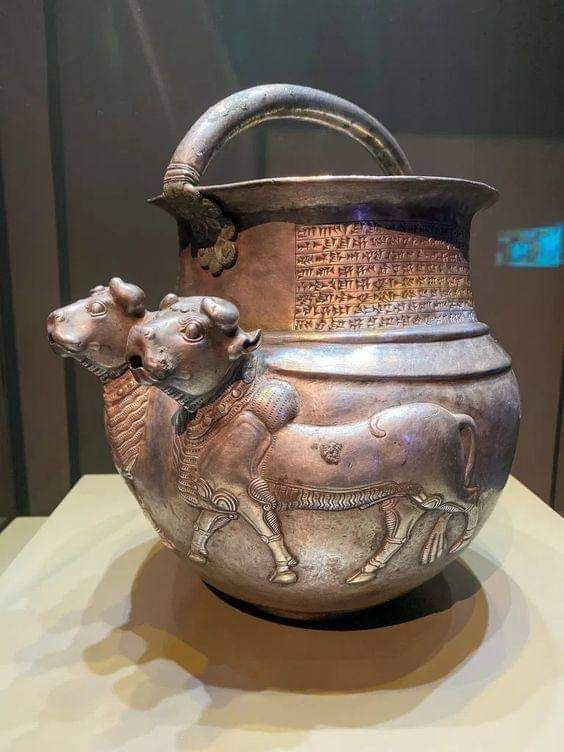
Elamite inscription engraved on the vessel states that the vessel is an offering by the King Shutruk Nakhunte to Inshushinak, the Lord is the protector of his city Susa...

The god Inshushinak is believed to be the Elamite equivalent of the Sumeran/Akkadian god Ea/Enki, the god of fresh water...Enki who is (in) Abzu, the source of water in Tigris and Euphrates...This dude... 

I talked about this in my posts "Problems with Abzu", "Shamash young and old", "When Utu steps up into heaven"

Ea/Enki who was also the god of the annual flood. Flood whose symbol was "Ea's/Enki's boat". 

The annual flood which was also known as "The Carp flood". Why? Cause during the flood, giant Mesopotamian carp migrate upstream for spawning. 

This is why Ea/Enki was often depicted with streams full of fish swimming towards him, toward Abzu. I talked about this in my post "Goatfish"...

Which is why we find carp (men), Apkallu, as Ea's/Enki's henchmen...
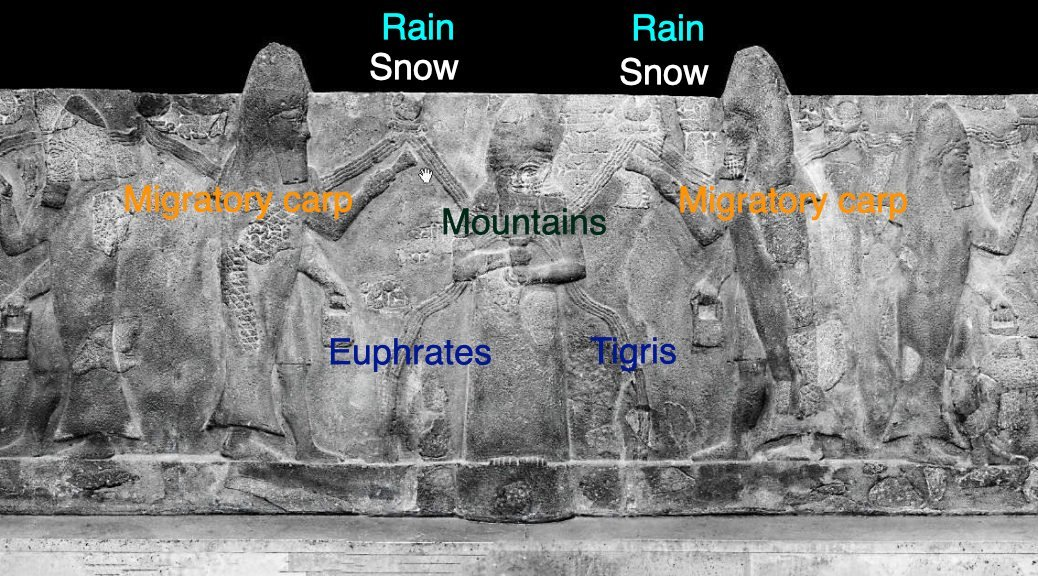
I talked about this in my posts "Apkallu", "Basalt water basin from Assur", "Kassite seal with Apkallu"...

Ok...What the hell any of this has to do with our Elamite silver pouring vessel with spouts in the form of two bulls? Guess when Tigris and Euphrates flood? In Apr/May, Taurus...
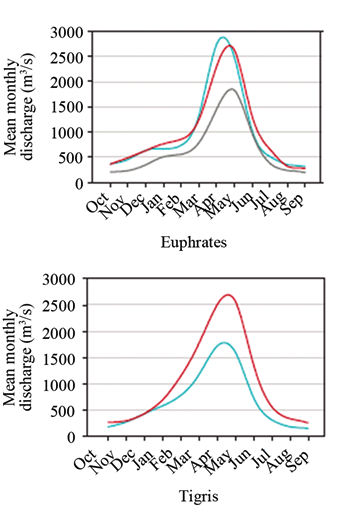
Now as you could have seen on the above map, Susa lies east of Tigris, between two rivers, 

Karkheh (Flow chart article)
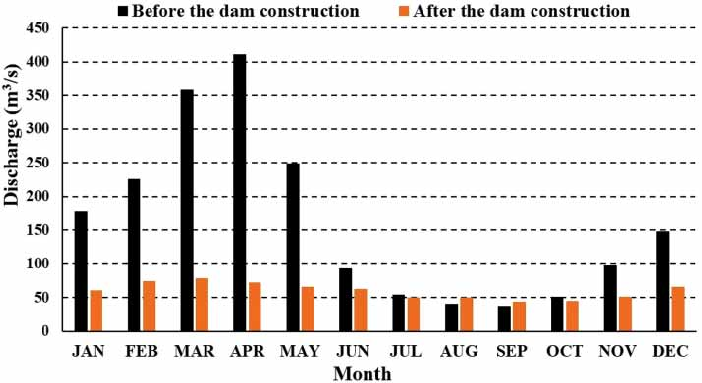
Daz (Flow chart article)

whose flows also peak in Apr/May, Taurus

In "Enki and the world order" we read:  "...Father (Ea)/Enki...he stood up full of lust like a rampant bull, lifted his penis, ejaculated and filled the Tigris [and Euphrates] with flowing water. He was like a wild cow mooing for its young in the wild grass..." Some scene 🙂

Why "like a wild cow mooing for its young"?  Cause Apr/May, Taurus, the peak of the Bull Enki's ejaculation (annual flood), is an animal calendar marker, not a constellation...

Apr/May, Taurus, Bull (it really should be Calf), the beginning of the calving season of the wild eurasian cattle. 

Talked about it in many of my posts...

And to tie all together: Why Ea/Enki, the god of fresh water and the annual "carp flood" standing on a bull? Cause Tigris and Euphrates and their tributaries, like Karkheh and Daz flood in Apr/May, in Taurus, when big carp swim upstream for spawning...
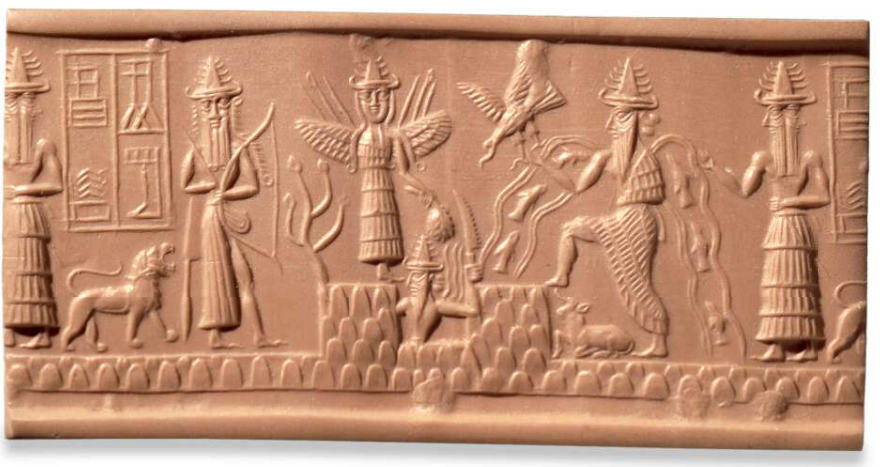
I talked about this in my post "Adda seal"...

So, I think that this could explain why a ceremonial Elamite "silver [water] pouring vessel" dedicated to the Elamite god Inshushinak who was the equivalent of Ea/Enki, god of water and annual flood, would have "double spout in the form of two bulls"...What do you think?

Here is another, older (3000BC), ceremonial Elamite water pouring vessel with the same symbolism...And the same meaning...I talked about it in my post "Elamite water bull"...
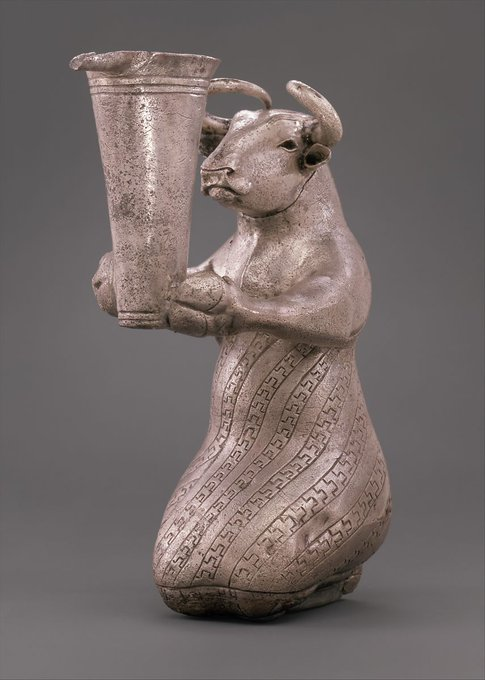

BTW, Do you see that vessel that the bull man is holding? 

Spouted silver bowl decorated with entwined serpents. Southeastern Iran Mid 3rd millennium BC. From Al-Sabah collection. 


I talk about it in my post "Snake water bowl" in which I try to answer the question: Why were water gods in Mesopotamia (Enki) and Elam (Napiriša, Inshushinak) linked to snakes?

To read more about ancient animal and plant calendar markers, start here…Then check my twitter threads I still didn't convert to blog post...I am way way behind...

Saturday, 30 November 2024

Animals march three by three

Sumerian limestone bowl fragment with three ibex goats following a lion...3300-3100 BCE, Currently in the Detroit Institute of Arts...

What's all this about?

Well, I think, climate in Mesopotamia and annual lifecycle of the depicted animals...

I am so sorry only a fragment of this bowl has survived. But I could bet that the original bowl had 

3 ibex goats, following 3 lions, following 3 bulls, following 3 leopards...

Why?

Check this post out. It is about a copper bowl from the same period and the same area...And about the climatic year in Sumer and Elam, and local Sumerian/Elamite animal calendar markers for the four seasons...

A Sumerian or Elamite Copper Bowl. Early 3rd Millennium B.C.E., H. 9.2 cm., D. 16.2 cm.


To read more about ancient animal and plant calendar markers, start here…Then check my twitter threads I still didn't convert to blog post...I am way way behind...

Sunday, 1 May 2022

Elamite Copper Bowl

I just came across this amazing object. I will give first the official description and interpretation...Then I will give my own...You can decide yourself which is better...


Official description: 

A Sumerian or Elamite Copper Bowl. Early 3rd Millennium B.C.E., H. 9.2 cm., D. 16.2 cm.

"The cup was made from arsenic bronze and was cast in a mold. The relief animals could have been made separately and soldered onto the surface of the cup"

"The decoration is organized in two stacked friezes of animals going [in opposite directions]: the upper register is composed of three bulls separated by lions, while the lower register contains two ibexes alternating with spotted panthers [leopards]"

Official interpretation: 

"Oxen and ibexes were important animals in Mesopotamian economy, while the wild beasts were the favorite targets of hunters..."

"...The size of this piece, its artistic merit, and the selected material as well as the subject indicate that it belonged to a temple treasure or to the display plate of a Mesopotamian dignitary"

That's it...

Bibliography

MĂśLLER-KARPE M., Metallgefässe im Iraq I (Von den Anfängen bis zur Akkad-Zeit), Stuttgart, 1993, p. 86 ss. (forme 11, I “Bodenschale”), pp. 235-237, n. 1588, pl. 142.

VAN ESS M. - PEDDE F., Uruk, Kleinfunde II, Mainz on Rhine, 1992, p. 18, n. 109, pl. 19.

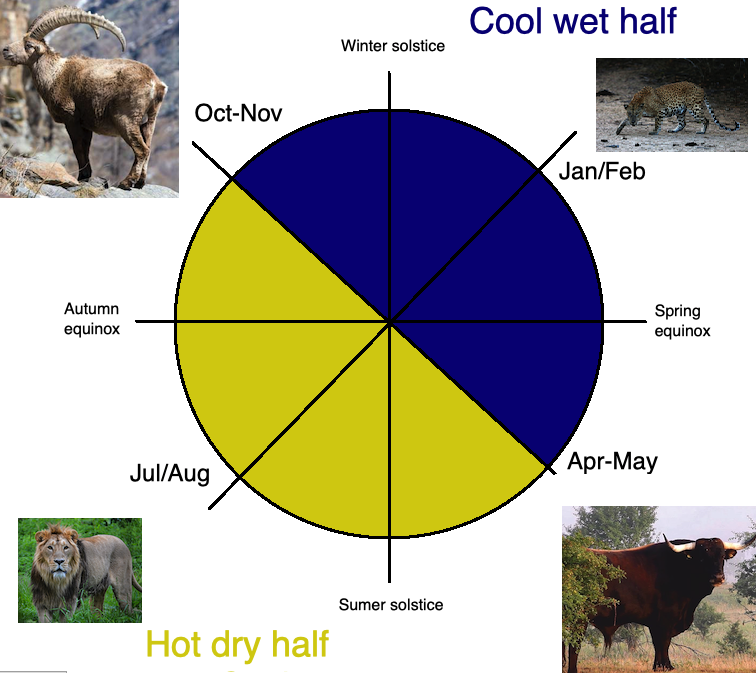
Sooooo...What is the meaning of this. The bowl symbolises climatic year in the area of southern Iraq (Sumer), western Iran (Elam), which is divided into hot/dry half (Apr/May - Oct/Nov) and cool/wet half (Oct/Nov -  Apr/May)


How do I know this? Because of the choice of the animals depicted on the bowl (nothing to do with economy or hunting), and because of the way they are grouped and oriented (which is not random at all).

It's all to do with animal calendar markers. Basically, the earliest calendars were based on behavior of animals and their annual lifecycles: mating and birthing, which happen every year at the same time.

So you could say: 

When wild cattle start calving, which is always in Apr/May.

When lions start mating, which is always Jul/Aug. 

When wild goats start mating, which is always in Oct/Nov.

When leopards start mating, which is always in Jan/Feb.


The top animal frieze consists of bulls and lions. 

Bull, animal calendar marker for Apr/May. Beginning of summer. 

Lion, animal calendar marker for Jul/Aug. Beginning of autumn.

Together they mark hot/dry season (Apr/May-Oct/Nov) =  summer (May,Jun,Jul), autumn (Aug,Sep,Oct)

The bottom animal frieze consists of ibexes and leopards. 

Ibex, animal calendar marker for Oct/Nov. Start of winter. 

Leopard, animal calendar marker for Jan/Feb. Start of spring.

Together they mark cool/wet season (Oct/Nov-Apr/May), winter (Nov,Dec,Jan), spring (Feb,Mar,Apr)

The animals in the two friezes walk in opposite directions. To symbolise opposite climatic conditions in the two halves of the climatic year in the area where this bowl was made:

bull, lion = summer, autumn = hot, dry

goat, leopard = winter, spring = cool, wet

So there you have it. Climatic year depicted through animal calendar markers which symbolise 4 seasons, which are grouped into 2 cool/wet half and 2 hot/dry half...

The circular bow and the endless procession of the animals symbolise cyclical nature of annual climate changes...

I wrote another article "Symbols of the seasons" about animal symbols of the seasons before. In it I talked about the symbols of the seasons still found in our zodiac today: 

ram-spring-lamging

bull-summer-calving

lion-autumn-mating

goat-winter-mating 

As you can see, 3 out of 4 animal calendar markers are the same. But it seems that in Neolithic, Bronze and Iron Age Iran, it was leopard which was the symbol of spring. And which together with wild goat marked the cool/wet/fertile half of the year. You can read more about goat-leopard animal calendar markers for winter and spring in my post "A vessel from Tepe Hissar" about this amazing artefact...


Which leads me to believe that this bowl is of southern Iranian, Elamite origin...

Anyway, these are just some of the commonly used animal calendar markers. Many more are found all over Eurasia and North Africa, and basically form base layer of all known religious iconographies...And can be used to interpret most of the ancient artifacts with animal images...

To read more about ancient animal and plant calendar markers, start here…then check the rest of the blog posts related to animal calendar markers I still didn't add to this page, and finally check my twitter threads I still didn't convert to blog post...I am 9 months behind now...

Bowl bibliography: 

MĂśLLER-KARPE M., Metallgefässe im Iraq I (Von den Anfängen bis zur Akkad-Zeit), Stuttgart, 1993, p. 86 ss. (forme 11, I “Bodenschale”), pp. 235-237, n. 1588, pl. 142.

VAN ESS M. - PEDDE F., Uruk, Kleinfunde II, Mainz on Rhine, 1992, p. 18, n. 109, pl. 19.